






Abstract
Introduction:
Disparities in women’s health have been identified in clinical outcomes, research, and medical education. However, women’s health education remains inconsistent in internal medicine training. Longitudinal women’s health training tracks have proven positive impacts on trainees’ confidence with women’s health clinical practice, and graduates of these tracks go on to become leaders who further expand these efforts. Our objective was to update the 2023 Directory of Internal Medicine Residency and Fellowship Programs in Women’s Health to provide trainees and clinician educators with a centralized list of U.S. internal medicine residency and fellowship women’s health training programs.
Methods:
We contacted women’s health education program leaders from the 2023 directory to update their program information. We sent a recruitment email to the Sex-and Gender-Based Women’s Health Education Interest Group listserv of the Society of General Internal Medicine and used snowball sampling to identify new programs. New program leaders were sent an electronic Qualtrics survey to confirm current program status, contact information, website, capacity, educational offerings, and program highlights.
Results:
This directory describes 29 graduate medical education training programs in women’s health for internists, with 12 residency programs and 17 fellowship programs identified. This is an overall increase from the 25 programs in the 2023 directory.
Discussion:
This directory is a practical resource for trainees seeking educational experiences and for medical educators seeking opportunities for collaboration and leadership in women’s health. The increase in training opportunities is a step toward comprehensive medical education and equitable, high-quality care and research in women’s health.
Introduction
Decades of publications emphasize the importance of integrating women’s health education into internal medicine training programs.1–12 The Society of General Internal Medicine recently published core competencies and entrustable professional activities in sex- and gender-based women’s health to guide implementation and assessment of women’s health training.13,14 Both internal medicine program leadership and trainees, however, continue to identify gaps in women’s health training at a time when gender-based disparities persist worldwide.15–17
Despite national efforts to outline core content for internal medicine residency programs, incorporation of women’s health education remains inconsistent in training. 14 Internal medicine program directors report that most of their residents have not mastered women’s health competencies by the end of residency, and most are interested in increasing women’s health training opportunities in their program.18,19 Dedicated women’s health training opportunities within residency programs have been associated with fewer referrals to gynecology, more discussions about contraception, and increased confidence in gynecological exam skills.8,20–22
One strategy to integrate women’s health training into internal medicine residency and fellowship programs is through longitudinal training tracks, which include focused clinical, didactic, teaching, and research experiences. Graduates of women’s health tracks often go on to become clinicians, educators, researchers, and leaders who further expand and strengthen women’s health care training and delivery in internal medicine and its subspecialties. 23 Our objective is to update the 2023 Directory of Internal Medicine Residency and Fellowship Programs in Women’s Health to provide trainees and clinician educators with a centralized list of U.S. internal medicine residency and fellowship women’s health training programs. 24
Methods
Using information gathered from prior directory publications and from program websites, we e-mailed education leaders at residency and fellowship programs listed in the 2023 directory to update their program and contact information. We sent a recruitment email to the Sex-and Gender-Based Women’s Health Education Interest Group listserv within the Society of General Internal Medicine and also used snowball sampling to identify new training programs. We updated the electronic survey from prior years using Qualtrics and reviewed it for face validity before sending it to identified track/pathway program leaders. We asked for confirmation of current program status, contact information, website, capacity, educational offerings, and program highlights.
Results
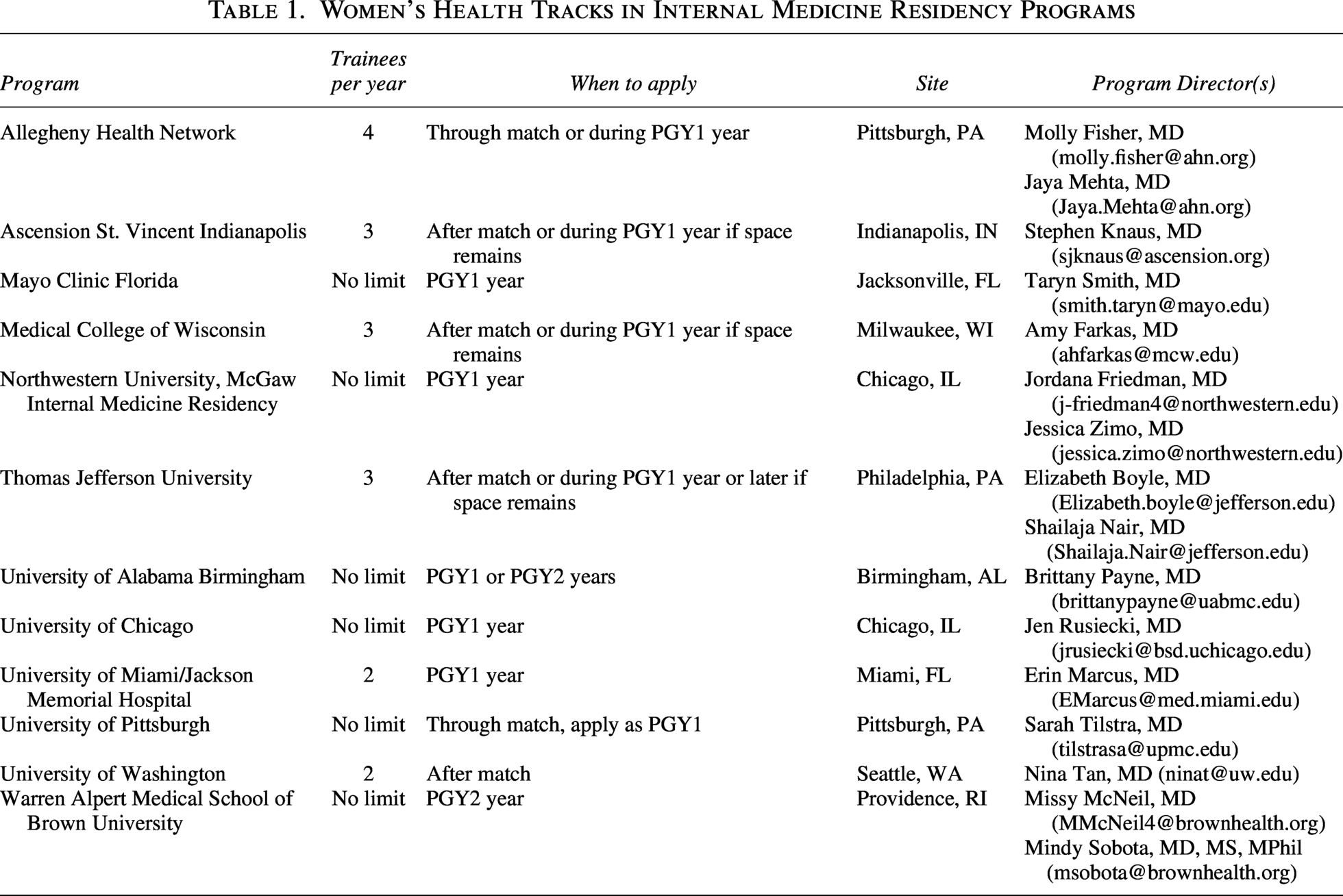
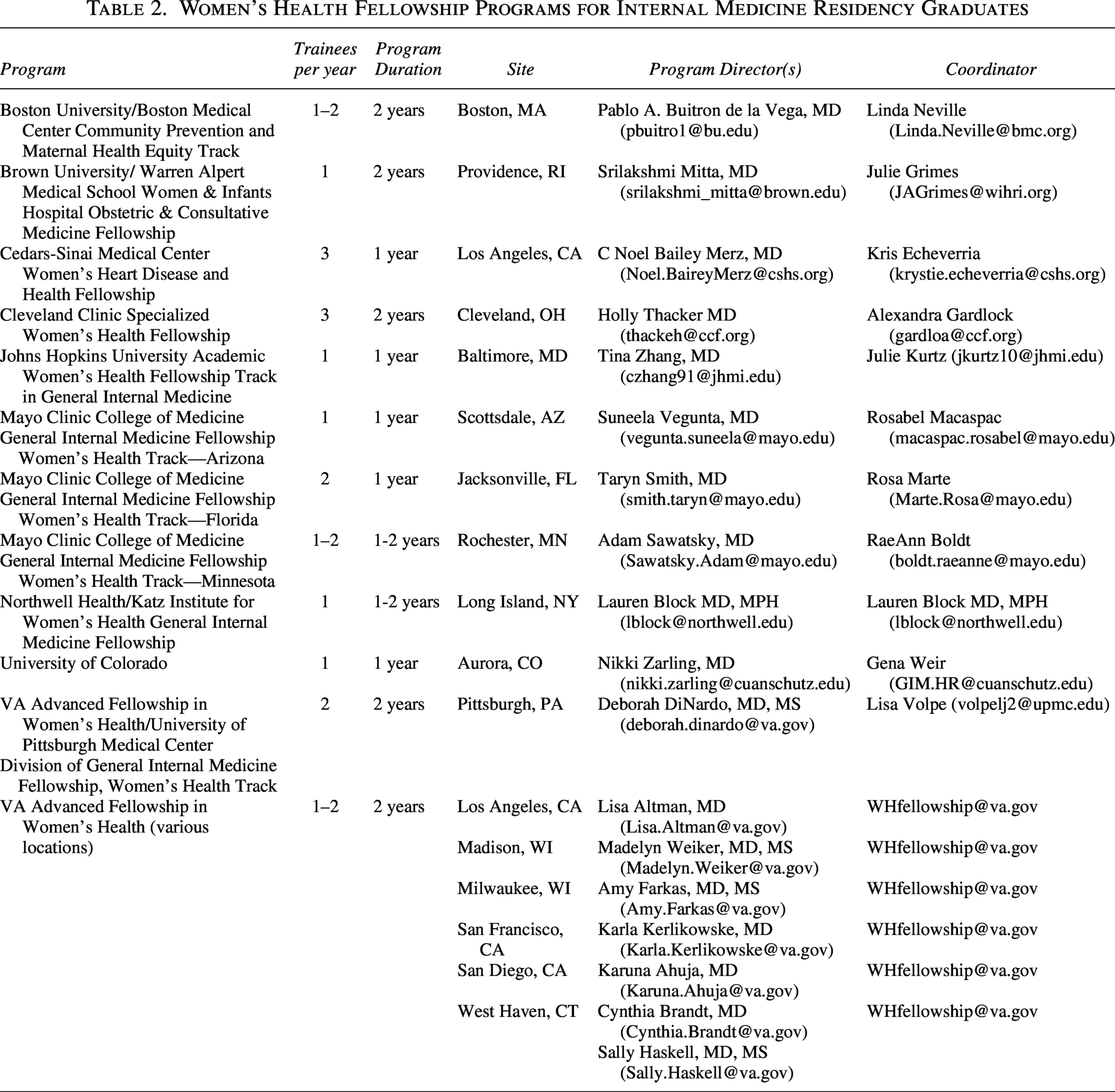
We identified 12 residency training programs (Table 1) and 17 fellowship training programs with women’s health tracks (Table 2).
Women’s Health Tracks in Internal Medicine Residency Programs
Women’s Health Fellowship Programs for Internal Medicine Residency Graduates
Discussion
This directory provides updates for 29 graduate medical education training programs for internists (12 residency programs and 17 fellowship programs) in women’s health. This is an overall increase from the 25 programs identified for the 2023 directory and is an encouraging step toward more comprehensive medical education and equitable, high-quality care and research in women’s health. There was no change in the number of residency-based programs with the addition of Thomas Jefferson University and Mayo Clinic Florida and the closure of programs at the University of Kentucky and Mayo Clinic Rochester. There are four new fellowship programs included in this directory at Johns Hopkins University, Mayo Clinic Florida, University of Colorado, and Boston University/Boston Medical Center. The previously listed general women’s health fellowship program at Boston University/Boston Medical Center was removed; the new program at this site includes training in preventive and maternal health.
An understanding of women’s health is foundational for the general internist, and this directory lists residency and fellowship programs that foster expertise in this area. Some developing or existing programs may have been inadvertently left off of this directory. There are also many programs that offer rotations or mentorship in women’s health without a formalized longitudinal training program. Another limitation of this directory is that we did not distinguish between women’s health and gender-based tracks, which often specifically expand training to include transgender and sex-specific issues related to men and women. A companion article in this issue provides an in-depth analysis of women’s health tracks in residency programs, focusing on reflections from successful programs and expanding upon the value of including gender-based care training.
Our goal is that this directory will help trainees and faculty identify educational opportunities and collaborators that prioritize training future leaders in women’s health research, medical education, and advocacy, as we work toward a more equitable health care system.
Authors’ Contributions
N.T.: Conceptualization, data curation methodology, formal analysis, investigation, writing—original draft. K.B.: Conceptualization, data curation methodology, formal analysis, investigation, writing—review and editing. S.Z.: Conceptualization, data curation methodology, formal analysis, investigation, writing—review and editing. A.H.F.: Conceptualization, data curation methodology, formal analysis, investigation, writing—review and editing. R.S.C.: Conceptualization, data curation methodology, formal analysis, investigation, writing—review and editing. A.E.B.: Conceptualization, data curation methodology, formal analysis, investigation, writing—review and editing. S.S.: Conceptualization, data curation methodology, formal analysis, investigation, writing—review and editing, supervision.
Footnotes
Acknowledgments
The authors wish to acknowledge the Sex-and Gender-Based Women’s Health Education Interest Group at the Society of General Internal Medicine, and the many colleagues who have worked on iterations of these documents over the past few decades.
Statements and Declarations
The views expressed are those of the authors and do not necessarily reflect the position or policy of the Department of Veterans Affairs or the United States Government.
Author Disclosure Statement
A.H.F. is a consultant for the American College of Physicians.
Funding Information
The author(s) received no financial support for the research, authorship, and/or publication of this article.
Supplemental Material
References
Supplementary Material
Please find the following supplemental material available below.
For Open Access articles published under a Creative Commons License, all supplemental material carries the same license as the article it is associated with.
For non-Open Access articles published, all supplemental material carries a non-exclusive license, and permission requests for re-use of supplemental material or any part of supplemental material shall be sent directly to the copyright owner as specified in the copyright notice associated with the article.
