






Abstract
Prior research has suggested that female status offenders are often treated more harshly than male status offenders in juvenile court processing. This finding is often explained by the traditional role perspective which suggests that the juvenile court is attempting to protect the sexuality of girls. In addition, there is theoretical and empirical evidence that the effect of gender may vary by race/ethnicity. This study examines the joint effects of gender and race/ethnicity in the adjudication of status offenders. The findings suggests that Native American boys are the most likely to be adjudicated followed by Black girls and Hispanic girls. Examination of the treatment of girls separately found that White females were the least likely to be adjudicated and Hispanic girls were significantly more likely than White girls to be adjudicated. For males, Native Americans, followed by Hispanic males, were the most likely to be adjudicated. Implications of the results are further discussed.
The juvenile court was created with the goal of protecting children. Instead of being centered on punishment, focus was placed on the treatment for youths (Rothman, 1980). The role of the court, therefore, was to intervene in an effort to save children from their own bad behaviors so children would proceed into a conventional adult lifestyle. This paternalism philosophy was used to justify the inclusion of certain noncriminal offenses, considered deviant behavior when engaged in by juveniles, into the court’s jurisdiction (Feld, 2009). These offenses, referred to as status offenses, became the source of great controversy, as concern grew over the treatment of youths who committed these noncriminal offenses. Part of this controversy centered on the treatment of girls, as the inclusion of status offenses was found to have a larger impact on girls than boys. This more profound impact was largely due to the higher volume of girls being referred to the court for moral rather than criminal offenses (Chesney-Lind & Shelden, 2004; Odem & Schlossman, 1991). Girls also were being judged more harshly in terms of their moral welfare and were being incarcerated “for their own good” rather than for their delinquent behavior (Abrams & Curran, 2000; Boritch, 1992). This often led to girls being placed in residential settings for rebellious or unruly behavior in an effort to protect and prepare them for their roles as wives and mothers (Odem, 1995).
In an effort to solve the problems associated with the inclusion of status offenders in the juvenile court, Congress passed the Juvenile Justice and Delinquency Prevention Act of 1974 (JJPD). This Act forced states receiving federal funding to deinstitutionalize and divert status offenders from the juvenile court (Belknap, 2007; Chesney-Lind, 2006). While the Act was not specifically intended to decrease the gender disparity in the handling of status offenses, research found that the JJPD Act especially benefited females and decreased the harshness of their treatment in the juvenile court (see Chesney-Lind & Pasko, 2004; Teilmann & Landry, 1981).
Although the JJPD Act decreased the harshness of girls' treatment in the court, research comparing the sanctions allocated to male and female status offenders have continued to find that females are being treated more harshly than males for status offenses (e.g., Bishop & Frazier, 1992). In fact, some research has suggested that the gender disparity negatively affecting females is more pronounced among status offenders than among delinquent offenders (Bishop & Frazier, 1992; Chesney-Lind, 1997; Odem, 1995). This may be due to the fact that girls are still more often arrested for status offenses and nonviolent, minor property offenses, such as running away and larceny, while males are more often arrested for more serious violent crimes, such as robbery and drug offenses (Steffensmeier & Schwartz, 2009). This disproportionate arrest of girls for status offenses has been explained by a preoccupation with girls' sexuality on one hand (Chesney-Lind & Sheldon, 1998) and concern for their safety on the other, as girls are more likely to be perceived as promiscuous, out of control, and need of protection if they are out all night (Schaffner, 2006).
Given the great discretion allowed to judges when handling status offenders and the findings of gender disparity in the handling of these offenders, it is important that research examine the treatment of status offenders. Because the harsher treatment of girls also is explained with differing stereotypes and expectations of boys and girls, it is likely that the effects of gender will vary by the race and ethnicity of the juvenile as racial and ethnic groups also are subjected to different stereotypes and expectations. The current research, therefore, examines whether a gender disparity exists in the odds of adjudication for status offenders and examines whether the effect of gender varies by the race/ethnicity of the status offender.
Theoretical Perspectives
The juvenile justice system was largely based on the idea of paternalism. Paternalism affords the state the right to step in and take over control of a juvenile when necessary. This concept was especially relevant to status offenders, as status offenses typically allow court officials a greater deal of discretion than delinquent acts (Kim, 2010). Chesney-Lind (1973, 1977) further argues that these paternalistic attitudes have led to a double standard of justice, with girls being expected to be chivalrous and more obedient than boys. When girls engage in status offenses, they are viewed as violating these gender roles and in need of greater protection. In an effort to exert this protection over girls, juvenile court judges ultimately subject them to harsher penalties. In a recent study, Schaffner (2006) found evidence that these stereotypes existed among probations officers. She found that probation officers referred to aggressive girls as “not very ladylike” and found that the girls who behaved more masculine (i.e., aggressive or hostile), were sanctioned more harshly than girls who adopted a more stereotypical feminine role. This is largely attributable to a patriarchal justice system that devalues girls and women and demonizes them if they stray from the socially prescribed gender roles of passivity and femininity (Chesney-Lind, 2006).
The traditional sex-role perspective also suggests that girls are treated more harshly than boys in the juvenile justice system because court officials are attempting to protect the sexuality of girls. Girls who do not conform to stereotypical ideas of proper female behavior are treated especially harshly, as court officials are attempting to reinforce these ideas. This can have an especially large impact on girls who commit minor offenses. Although these offenses are often ignored when boys commit them, they are met with severe punishments when females commit them (Chesney-Lind, 1982; Odem, 1995).
Stereotypical ideas of female behavior can have an especially negative effect on the treatment of minority girls, as minority girls, and Black girls in particular, fail to exhibit as many feminine behaviors, such as passiveness and submissiveness as White girls (Horowitz & Pottieger, 1991). This has been referred to as “selective chivalry” whereby only certain types of girls are treated more leniently based upon their personal characteristics (Dodge, 2002). This affects minority girls specifically since White girls are thought to be amenable to treatment, but African American girls are thought to be aggressive and dangerous (Seitz, 2005). Minority girls, therefore, are subjected to sexism and racism, causing them to be treated more harshly than White girls and White boys.
Some prior research has supported the argument that minority girls are subjected to both racism and sexism in the juvenile court, finding that Black female delinquents are treated more harshly than White female delinquents (e.g., Bortner & Reed, 1985; Dodge, 2002; Leiber & Mack, 2003; Seitz, 2005). When examining racialized gender-role ideology in Florida, Moore and Padavic (2010) found that racial and ethnic minority girls (except Hispanic girls) received harsher punishment than White girls in some situations. Black girls with a low number of prior records were punished more harshly than White girls with the same number of prior records. For girls with above-average prior records, however, the juvenile justice system punished White girls more harshly than Black girls.
Gaarder, Rodriguez, and Zatz’s (2004) research further indicated a need to consider race and ethnicity when examining gender effects in juvenile court processing. Their research involved the examination of 174 girls' probation files and interviews with probation officers in Maricopa County to better understand the views that court officials have of female juveniles who were ordered to probation in 1999. From these examinations, they found that court officials made decisions that were based more on gender and ethnic stereotypes than on the actual needs of the girls. In addition, their research found that different considerations were taken into account when the girl was a minority, illustrating the unique struggles that are faced by girls of different ethnic backgrounds.
Literature Review
Gender and Status Offenders
The majority of studies examining whether a gender disparity exists in the court processing of status offenders were conducted in the 1970s and 1980s. Although the findings of these early studies are not entirely consistent, many of them found that female status offenders were treated more harshly than male status offenders in the juvenile court. Mann (1979) found that female status offenders were detained more often than male status offenders. He also found that female status offenders were treated more harshly than male juvenile delinquents. Other early research similarly indicated that male juvenile delinquents fared better in the juvenile court system than female status offenders (Chesney-Lind, 1973; Mann, 1979; Pope & Feyerherm, 1990; Sheldon, 1981). Sheldon and Horvath (1986) found gender bias in the decision to formally process a case, with girls being more likely to have their cases formally processed than boys when being referred to the court for the same offenses. Later research conducted in the 1990s examined the treatment of status offenders for specific offenses. This research suggested that gender bias operated through offense type, with status offenses most commonly committed by females (such as running away) being more likely to result in detention (Stahl, 1998).
Not all early studies, however, found a gender disparity in the processing of status offenders. Many of these studies found that female status offenders were not treated differently than male status offenders (Carter, 1979; Clark & Koch, 1980; Cohen & Kluegel, 1979; Dannefer & Schutt, 1982; Datesman & Scarpitti, 1980; Fenwick, 1982). Teilmann and Landry (1981) found that although status offenders were treated more harshly than delinquent offenders, male and female status offenders were treated the same. Bishop and Frazier (1992) found mixed results for the effect of gender in the processing of status offenders. Their analysis examined the three decision points of court processing, adjudication, and final disposition. At the court processing stage, White and female status offenders were more likely to have their cases formally processed. During the adjudication and final disposition stage, however, no gender (or racial) disparity was found.
Only two recent examinations were located that focused on the effect of gender in the court processing of status offenders. Both of these studies indicated that males fared better than females in the juvenile court. Mallicoat (2007) found that judges punished female sexuality but ignored this behavior with boys. Tracy, Kempf-Leonard, and Abramoske-James (2009) additionally found that female status offenders were detained more often than male status offenders.
Race/Ethnicity, Gender, and Status Offenders
Only one study was located that examined the joint effects of race and gender on the processing of status offenders. Bishop and Frazier (1996) found that non-White boys and non-White girls were treated more similarly than White boys and White girls. Other studies that examined the joint effects of race and gender on delinquent offenders (not status offenders specifically) have produced mixed results. Some of this research has suggested that African American boys were treated the most harshly (Sarri, 1983). Other research found that African American females were treated more harshly than African American males and White boys and girls (Bortner & Reed, 1985).
MacDonald and Chesney-Lind (2001) found that male and female delinquents in Hawaii were treated differently at later decision points. Their study examined the decision to petition a juvenile to court, the decision to adjudicate a juvenile, and whether the juvenile was formally sanctioned with detention or probation. At the decision to petition a case and at the adjudication stage, females were not treated more harshly. They did find, however, that females were more likely to receive a formal disposition (detention or probation) for minor offenses, such as running away, than boys. Both male and female Hawaiian youths were more likely to be petitioned, to be adjudicated, and to receive a formal disposition than male and female White youths.
Leiber and Mack’s (2003) examination of the treatment of juvenile delinquents in four Iowa counties found that Black males and females were not treated differently. White boys, however, were significantly less likely than White girls, Black boys, and Black girls to receive leniency at intake. In another study, Guevara, Herz, and Spohn (2006) found that the effect of race was significantly greater for males than for females in the preadjudication decision. For the disposition decision, race only affected the decision to dismiss charges for female youth, with White females being less likely to have their charges dismissed or to receive probation (versus receiving out-of-home placement). For males, on the other hand, White males were less likely to receive out-of-home placement than non-White males. Leiber, Brubaker, and Fox (2009) also recently found that race had differing effects for boys and girls. Their findings indicated that while African American males and females both received lenient treatment at intake, African American boys were treated more severely at detention and petition.
Overall, examinations of the joint effects of race and gender for delinquent offenders are mixed. Bishop and Frazier’s (1992, 1996) were the only studies located that examined these effects specifically for status offenders. These examinations, however, were limited to Whites and non-Whites and did not separately examine the effects of various ethnicities. It is especially important that research examine the joint effects of gender and race/ethnicity in the treatment of juvenile status offenders as gender disparities have been found to be especially pronounced for these offenders. Furthermore, the theoretical perspective suggests that the effects of gender may vary based on the race and ethnicity of the juvenile. The present study examines these possibilities by assessing the individual and joint effects of race/ethnicity and gender on the adjudication of Black, Hispanic, Native American, and White status offenders.
Hypotheses
Given the prior research finding that girls are treated more severely for status offenses than boys (e.g., Dannefer & Schutt, 1982; Datesman & Scarpitti, 1980; Fenwick, 1982) and the argument that judges are concerned with protecting the traditional female role set forth by the paternalism and traditional sex-role perspectives, the following hypothesis is examined: H1: Girls will have significantly greater odds of adjudication for status offenses than boys.
H2: Black, Hispanic, and Native American girls will have significantly greater odds of adjudication than male and White female status offenders. H3: Black females will have higher odds of adjudication than White, Hispanic, and Native American females.
Method
The present study examined the effects of legal and extralegal factors on the decision to adjudicate youths in juvenile court in an urban county in Arizona. The data was obtained from the National Juvenile Court Data Archive and included all youths in 2000 in the juvenile court who were charged with a status offense. The original dataset contained 9,803 juvenile status offenders. Defendants whose race/ethnicity was classified as “other” (N = 51) were omitted from the dataset because a meaningful conclusion could not be made regarding this group. Asian juvenile delinquents also were removed due to their small number in the data (N = 42) as a meaningful analysis was not possible with such a small number of cases. Thus, the final dataset contained 9,710 cases.
Dependent Variable
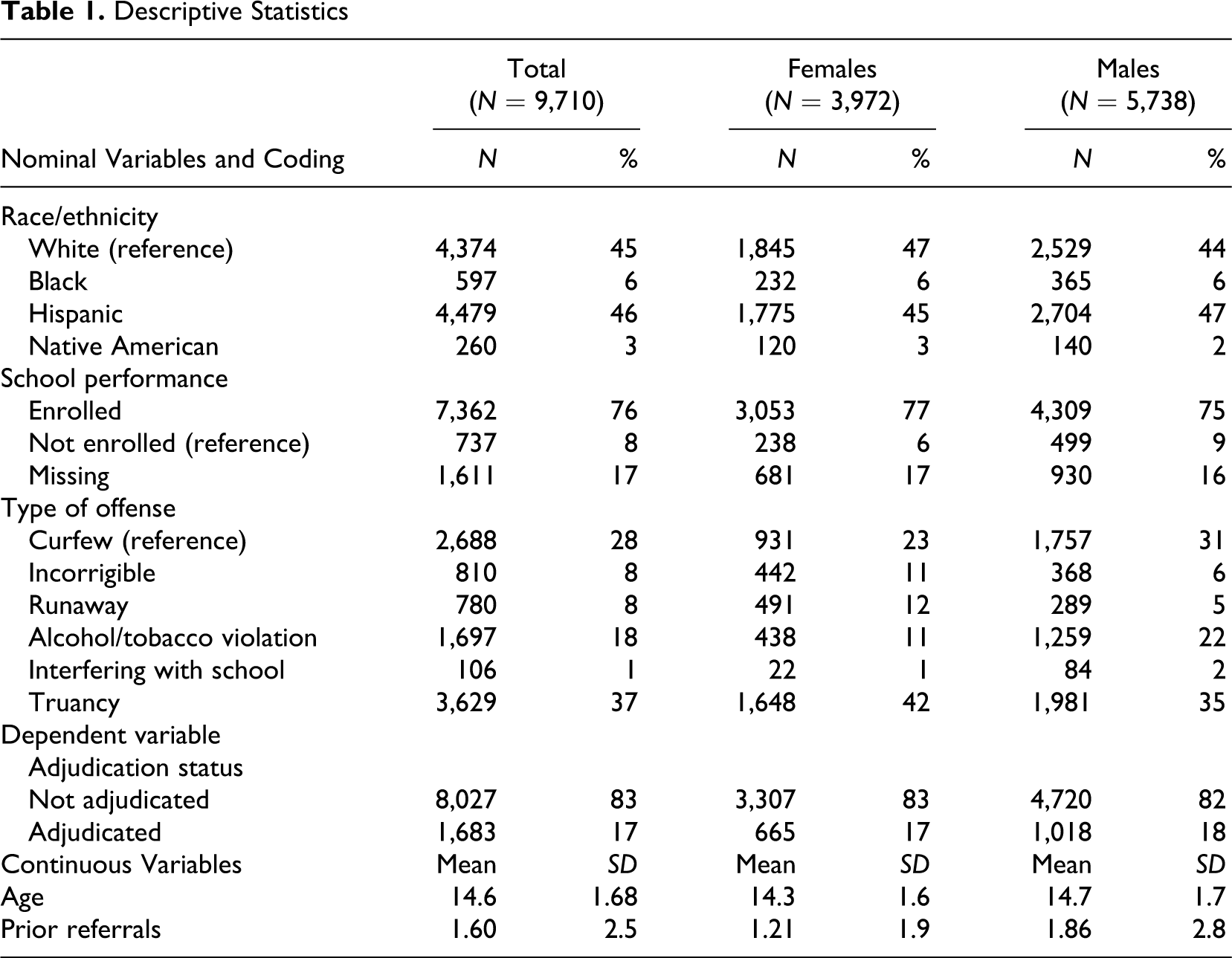
The dependent variable in the current study was a dichotomized measure of adjudication status, with 0 representing juveniles who were not adjudicated and 1 representing those who were adjudicated. In the sample, 8,027 juveniles were not adjudicated and 1,683 were adjudicated. The descriptive statistic for this variable, and all independent variables, is included in Table 1 .
Descriptive Statistics
Independent Variables
Several extralegal variables of interest were included in the analysis. The descriptive statistics for all individual and case characteristics are presented in Table 1. Gender was included and coded as 0 for female and 1 for male. As shown in the table, the sample contained more males than females. For race/ethnicity four dummy variables were created; the four variables represented White juveniles, Black juveniles, Hispanic juveniles, and Native American juveniles. The White juvenile variable was left out of the analysis as the reference group. In the sample, the majority of boys and girls were Hispanic. White juveniles consisted of the next populous group followed by Black juveniles and Native American juveniles.
Because several cases were missing information for school status, three dummy variables were created. The first identified juveniles who were enrolled in school (enrolled = 1) and the second identified juveniles who were not enrolled in school (not enrolled = 1). The third accounted for missing cases (missing = 1). The variable for not enrolled in school was then left out of the analysis as the reference variable. Across boys and girls, youths were more likely to be enrolled in school.
Several legal variables shown to be relevant in juvenile sentencing decisions also were included in the analysis. To measure the severity of the crime, the analysis controlled for type of status offense through six separate dummy variables (curfew violations, incorrigible, runaway, alcohol/tobacco related charge, interfering with school activities, and truancy). Curfew violation was left out of the analysis as the reference category. Examination of type of status offense reveals some differences across boys and girls. The majority of girls and boys committed truancy, followed by curfew violation. The next most common offenses among girls were running away, followed by being incorrigible, an alcohol or tobacco violation, and interfering with school. For boys the next most common offenses were for an alcohol or tobacco violation, being incorrigible, running away, and interfering with school, respectively. A continuous variable also was included that accounted for each juveniles number of prior contacts with the juvenile justice system. Age also was included as a continuous variable with the sample having a mean age of 14.6. The average number of prior referrals for the total sample was 1.6, with boys having a slightly higher average (1.86) than girls (1.21).
Results
The effect of the independent variables on the adjudication decision was estimated using logistic regression models. First the effect of gender, race/ethnicity, and the other independent variables were examined separately. Next, categorical variables for gender and race/ethnicity were estimated, to allow for comparisons of each gender and ethnic combination. Lastly, the models were split by gender and z-scores were calculated to determine whether the independent variables had a significantly different effect on the adjudication decision for male and female juveniles. To be sure that none of the independent variables were highly correlated, multicollinearity diagnostics were performed. Bivariate correlations indicated that none of the correlations were high enough to pose a salient concern in the models estimated. Variance inflation factor (VIF) and tolerance diagnostics also were examined for each model. The VIF values were all less than 4 and all of the tolerance statistics were below .2, indicating that multicollinearity was not a salient concern (Mertler & Vannatta, 2002; also available upon request).
The logistic regression coefficients for adjudication are presented in Table 2 . As shown in the table, the variable for gender indicates that there was not a significant difference in the likelihood of males and females odds of adjudication. While this contradicts our first hypothesis, it is consistent with some prior research (Carter, 1979; Clark & Koch, 1980; Cohen & Kluegel, 1979; Dannefer & Schutt, 1982; Datesman & Scarpitti, 1980; Fenwick, 1982). However, several other variables were significant. Compared to White status offenders, Hispanic (B = .255, p < .001) juveniles were significantly more likely to be adjudicated. Examination of offense type indicated that status offenders charged with being incorrigible (B = .595, p < .001) were significantly more likely to be adjudicated than those with a curfew violation. Juveniles charged with running away (B = –.590, p < .001), however, were less likely to be adjudicated than those charged with curfew violations. Alcohol or tobacco violators (B = .469, p < .001) had significantly greater odds of adjudication than curfew violators. Similar to prior research (e.g., Leiber, Johnson, Fox, & Lacks, 2007), an increased number of prior referrals (B = .106, p < .001) also led to increased odds of adjudication.
Logistical Regression for Adjudication (N = 9,710)

**p < .001.
The models were then analyzed with dummy variables entered for each gender and race/ethnicity combination (Black females, Black males, Hispanic females, Hispanic males, Native American females, Native American males, White females, and White males). Results on these analyses are presented in Table 3 . All independent variables besides gender and the race/ethnicity variables also were included in the analysis. The first model used White males as the reference category; therefore, the coefficient for all other groups compares each group’s odds of adjudication to that of White males. The results indicated that Black females (B = .380, p < .01), Hispanic females (B = .354, p < .001), Hispanic males (B = .294, p < .001), and Native American males (B = .580, p < .01) were significantly more likely to be adjudicated than White males. These results partially support our second hypothesis. They also show, however, that boys of certain minority ethnic groups (Hispanic and Native American) also are disadvantaged at the adjudication stage. These findings also are consistent with prior research examining juvenile delinquency cases, which also has found that Hispanic youths (e.g., Charish, Davis, & Damphousse, 2004) and Native American youths (e.g., Charish et al., 2004; Feld, 1995) are treated more harshly in the juvenile court system.
Logistical Regression for Adjudication with Gender and Race/Ethnicity Categories

*p < .01.
**p < .001.
These findings further suggest that Native American males and Black females, followed closely by Hispanic females are the most likely to be adjudicated. Therefore, the model was first reanalyzed with Native American males as the reference group and second with Black girls as the reference group and thirdly with Hispanic females as the reference group. The results indicate that White males (B = –.580, p < .01) were less likely to be adjudicated than Native American males. This result is similar to Leiber et al.’s (2007) finding that Native American youths were more likely to be adjudicated for delinquent acts than White youths. As shown in the table, Black girls were not treated significantly different than boys of any of the ethnic groups examined. Examining our third hypothesis, Black females did appear to have higher odds of adjudication than the other females in the sample; however, none of the coefficients were significant. With Hispanic females as the reference, the results indicate that White males (B = –.354, p < .001) were significantly less likely to be adjudicated than Hispanic females.
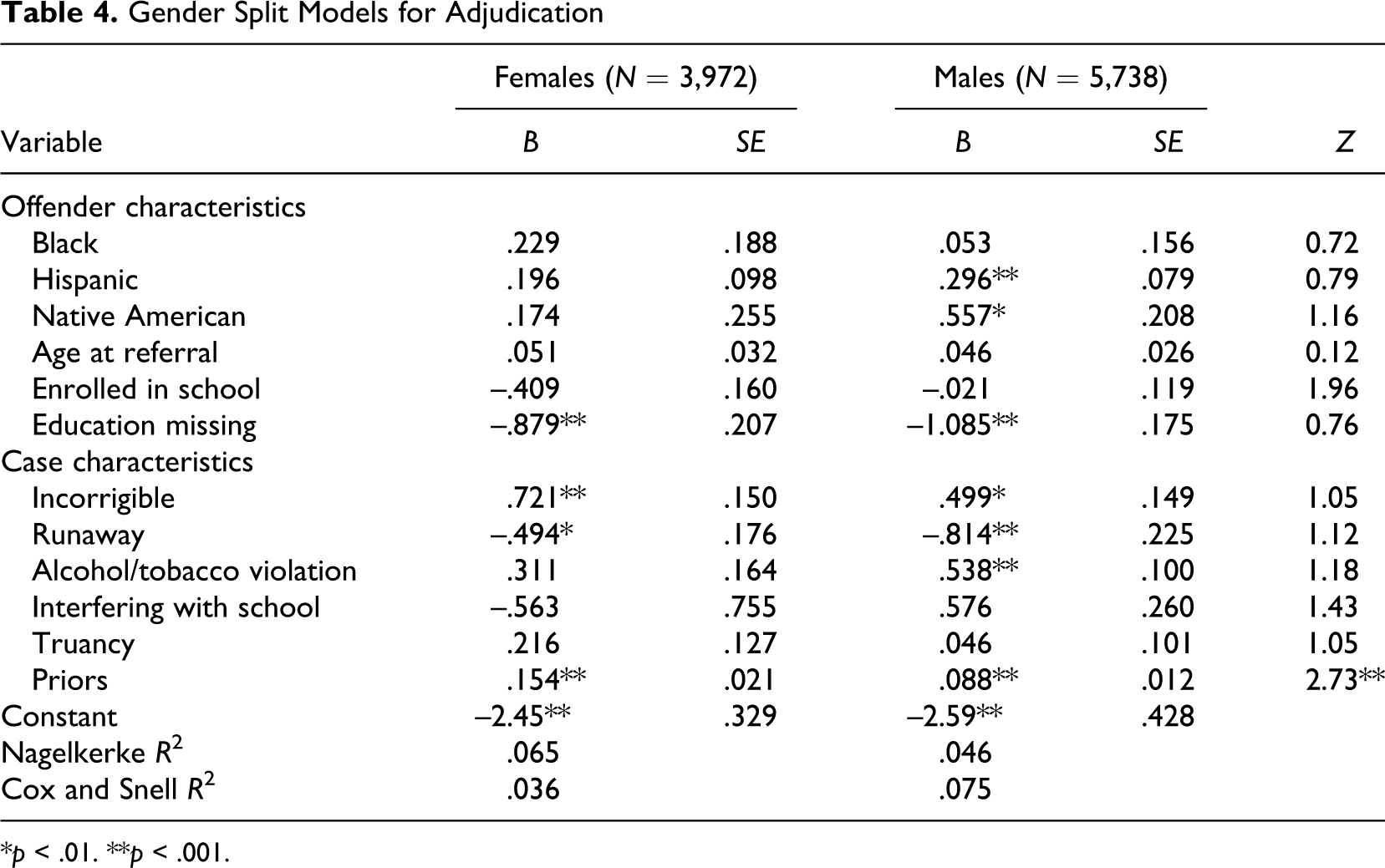
Next, split models were examined for males and females. The results are presented in Table 4 . The female model shows that Black, Hispanic, and Native American females did not have significantly different odds of adjudication than White girls. Examination of the z-scores shows having an increased number of prior referrals to the court also significantly affected females' odds of adjudication more strongly than males' odds of adjudication. None of the other independent variables had a significantly different effect for female and male status offenders in the sample.
Gender Split Models for Adjudication
*p < .01.
**p < .001.
Discussion
The current study addresses arguments that female status offenders are treated more harshly by the juvenile justice system. Results of the model did not support this claim, however, indicating that gender is not a significant predictor of adjudication. It is possible that this is due to the decision point examined. Bishop and Frazier (1992) also failed to find a significant gender effect in the adjudication decision for status offenders. They did, however, find significant gender effects at other discretionary stages. In their examination of delinquency cases, Leiber et al. (2009) also found that race and gender subgroups had different effects on the various decision points examined.
When ethnicity of the offender was examined, however, it was found to have a significant effect, with Hispanic youths having greater odds of adjudication. Examination of the various race/ethnicity and gender groups found that across boys and girls Native American males, followed by Black females and Hispanic females, were the most likely to be adjudicated. When examining only the females, no significant differences existed between odds of adjudication for White females and females of other ethnicities. For males, Native Americans, followed by Hispanic males, were the most likely to be adjudicated. No significant differences were found between Black and White males and Black males and Black females odds of adjudication. These results strongly indicate that gender differently affects youths of different ethnicities.
The harsher treatment of Native American males, Black females, and Hispanic females may be explained by examining the stereotypical images of these groups. Zatz, Chiago, and Snyder-Joy (1991) argued that language and cultural barriers may make it more difficult for Native American youths to participate in juvenile court proceedings. It is further possible that the court views the Native American family as being incapable of controlling male youths.
It appears that Black females are the most affected by racism and sexism. While Black boys are not treated significantly different than White boys, Black girls are significantly more likely to be adjudicated than White boys. White females, on the other hand, are treated more similarly to their White male counterparts. This finding is consistent with the traditional sex-role perspective which suggests that due to cultural differences, Black girls will have a harder time exhibiting traditional feminine behaviors that the court views as important. Hispanic girls also appear to be experiencing the joint effects of sexism and racism. This is not surprising given the findings of Gaarder et al. (2004). Their research suggested that Hispanic girls in the juvenile justice system struggle with such things as discrimination, language barriers, and poverty (p. 563). Of additional concern for Hispanic youths, Gaarder et al. (2004) also found that Hispanic youths are disadvantaged if their families are unable to speak English and effectively communicate with court workers. Future empirical inquires should use more recent data, (the current data represents status offenders in 2000), as stereotypes of Hispanics populations may change over time as these populations become more intergraded into the dominate culture.
Offering further support for the paternalism and traditional sex-role perspectives, the split models found that prior referrals have a significantly greater effect on odds of adjudication for girls than on the odds of adjudication for boys. Court officials may view girls with priors as more in need of formal court intervention. For boys, however, this does not appear to have as great of an effect. Therefore, it appears that juvenile court officials may be more concerned with females establishing a pattern of bad behavior.
Lenient treatment of White boys might indicate a tendency to view these offenders as less threatening. Instead of viewing involvement in status offenses as an indication of future problem behavior, court officials may view this behavior as typical juvenile behavior or “boys being boys.” Therefore, formal court handling of these juveniles does not appear necessary. While the symbolic threat hypothesis would predict that Black boys would not receive this same preferential treatment, due to them being perceived as more dangerous (see Tittle & Curran, 1988), the findings of this study indicate that Black status offending boys are treated similarly to their White counterparts.
The harsher treatment of minority females is especially concerning given the lack of treatment available to these girls (see Belknap, 2007; Chesney-Lind & Pasko, 2004). Research conducted by Gaarder et al. (2004) found that court officials faced issues with program availability in the areas in which minority girls resided. Because these girls were unable to travel to areas where treatment was available, they did not receive these services (Gaarder et al., 2004, p. 562). This research supports arguments that programming needs to be capable of meeting the unique needs of girls of different cultures and ethnicities.
Although this study offers insight into the joint effects of race/ethnicity and gender on the adjudication of status offenders, some limitations to be overcome by future research should be noted. The explanatory power of the models was low, which might indicate a need to consider more variables when examining status offenders' processing in the juvenile court. In the current data, measures of family organization and stability were not available. This information may be especially important when examining racial and ethnic variations in the juvenile court. Previous research has found that court officials view these family factors differently based on the ethnicity and race of the juvenile (see Gaarder et al., 2004; Leiber & Mack, 2003). In addition, when examining Hispanic populations future quantitative research should consider the legal status of the juvenile’s family. Gaarder et al. (2004) found that Hispanic girls' families were viewed more positively if they were legal citizens and spoke English. The variables available in the current study were only able to explain a small amount of variation in the adjudication decision. Adding these variables in future examinations may increase the models overall explanatory power.
It is important that future research continues to examine the experiences of girls in the juvenile justice system. Not only are comparisons of girls' and boys' treatment in the court informative, but examinations of the manner in which race/ethnicity, family status, and class shape girls' experiences also are important. As illustrated in this study, the effect of gender appears to vary by the race and ethnicity of the juvenile. Although socioeconomic and family variables were not available in the current study, it is important that future research examine the joint effects of these four variables (gender, race/ethnicity, family status, and class) in the handling of status offenders.
Footnotes
The author(s) declared no conflicts of interest with respect to the authorship and/or publication of this article.
The author(s) received no financial support for the research and/or authorship of this article.