






Abstract
One of the explicit goals of many recent and ongoing criminal justice interventions is to target youth most at risk for involvement in serious, chronic, and violent offending. While targeted programs appear promising at the conceptual level, data limitations have made systematic evaluations of the efficacy of such practices difficult to achieve. The current study helps to fill this void in the literature by examining the relative risk of youth targeted for prevention and intervention services with a comparable sample of youth from the general school population in Cuyahoga County, Ohio. Results suggest that youth targeted by the program under study were significantly less at risk in three of the four risk domains examined, and in seven of the twelve associated subdomains. Further, the nontargeted sample had higher accumulated risk than the targeted sample, which is a robust predictor of gang involvement. Implications for targeted prevention and intervention programs are discussed.
One of the most consistent findings in criminological research is that a small subset of offenders is responsible for a large proportion of crime (Loeber & Farrington, 1998). Gang members, in particular, represent a particular group of individuals that are often involved in a disproportionate amount of crime and offending, and thus have been the target of a great deal of attention from law enforcement and community crime prevention programs. The United States Department of Justice has made gang prevention and intervention a primary focus, and has endorsed a targeted public health approach to combat gangs under the assumption that “targeting a small, high-risk population can have significant, broader benefits” (Holder, 2009, p. 1). The logic behind this move toward intervention and prevention services targeted at high-rate offenders, especially youth most at risk of future gang membership, is quite simple. If one can prospectively identify those youth most at risk of becoming gang members and successfully direct prevention and intervention services at these individuals before the onset of their gang careers, it can produce a positive impact for both the individual and society. Potential benefits to such an approach are numerous; including reduced financial costs to both individuals and society through decreased losses associated with victimization, decreased public spending on incarceration and correctional supervision, as well as increased physical and psychological well-being for members of the community.
This move to a public health model of targeted crime prevention is perhaps best documented in the city of Los Angeles' efforts to use a survey instrument to decipher which youth are most likely to become gang involved (Casey, 2009; Hennigan & Maxson, in press). The hope is that through the use of risk assessment instruments practitioners can more efficiently identify youth likely to become gang involved than can be done through subjective human assessments. The development of risk instruments has proliferated greatly over the past decades (see Gavazzi, Bostic, Lim, & Yarcheck, 2008 for a review), and evidence suggests that such instruments outperform human judgments concerning the risk for continued antisocial behavior (Gottfredson & Moriarty, 2006; Grove, Zald, Lebow, Snitz, & Nelson, 2000). Mounting evidence also suggests that there are risk factors for gang membership which can be identified prospectively (Esbensen, Peterson, Taylor, & Freng, 2010; Hill, Howell, Hawkins, & Battin-Pearson, 1999; Thornberry, Krohn, Lizotte, Smith, & Tobin, 2003), lending credence to a public health approach to gang prevention. As Jones, Harris, Fader, and Grubstein (2001, p. 485) suggested in their study on the identification of chronic juvenile offenders, however, “to achieve the advantages of the rational decision-making model, of risk classification, and of prediction, one must ensure that the entire process is valid.”
While the logic behind targeted interventions directed at gang members appears sound, the most important policy question is whether practitioners have the ability to identify youth most at risk of becoming gang involved both prospectively and efficiently (Smith & Aloisi, 1999). While advances in risk assessment devices have been made over the past decades, such that use of these instruments clearly outperforms subjective human risk assessments (Gavazzi, Bostic, et al., 2008; Gottfredson & Moriarty, 2006; Grove et al., 2000), the potential for human error has not been eliminated from the process of identifying youth at risk of gang membership. In an ideal world, every youth could be screened for risk factors associated with gang membership and receive intervention and prevention services related to their particular needs. Such practices, however, are not widespread, and do not appear imminent given both budgetary and staffing limitations across US jurisdictions. As Smith and Aloisi (1999, p. 202) concluded, “specific organizational concerns (e.g., staff expertise, size, coordination, and cooperation) in a given juvenile justice jurisdiction limit how many juveniles can be screened to identify subsets of chronic offenders for special interventions.” Thus, human error is still a distinct possibility at the front end of the screening process, where practitioners must identify youth they believe could benefit from a formal risk assessment. This requires contact between the youth and agent responsible for making such recommendations, as well as gaining the youth’s (and parents') permission to carry out such a screening. Given these potential hurdles, even in light of significant progress in the development and implementation of risk screening instruments, youth most at risk for gang membership may be systematically underserved by such programmatic efforts. Unfortunately, this link in the chain of targeted prevention and intervention services, which precedes risk assessment and prevention programming, has not been thoroughly examined, and thus could undermine the theoretical advantages of this strategy.
The current study takes advantage of a unique situation in which two samples of youth in a specific jurisdiction were identified and screened using the Global Risk Assessment Device (GRAD), a risk assessment instrument with documented reliability and validity (Gavazzi, Bostic, et al., 2008). Respondents in the current study were drawn from a nontargeted school-based sample, as well as a sample of youth screened as part of a targeted antigang initiative. This confluence of data allows for the examination of the efficacy of targeted gang intervention and prevention services through the comparison of relative risk between these two samples of youth. Specifically, one would expect that those youth identified as being especially at risk for gang membership would be, on average, more at risk than the general school-based sample. We proceed with a discussion of the literature on risk factors for gang membership.
Risk Factors for Gang Membership
Popular discourse usually associates gangs with their involvement in violence, or the threat thereof. While the media may exaggerate or overemphasize some features of gangs and their associated violence (Esbensen & Tusinski, 2007), there is little doubt that gangs and their members are associated with a disproportionate amount of violent crime (Decker, 2007; Thornberry, 1998). What is often lost in this discussion of the association between gangs and their responsibility for committing acts of crime and violence is their disproportionate level of violent victimization. Whether it has been measured through self-reports of nonlethal violence (Melde, Taylor, & Esbensen, 2009; Peterson, Taylor, & Esbensen, 2004; Taylor, Peterson, Esbensen, & Freng, 2007) or reports on the probability of falling victim to homicide (Decker & Pyrooz, 2010; Decker & Van Winkle, 1996; Kennedy, 1997), gang membership is correlated with a disproportionately high-level violent victimization. For instance, Decker and Pyrooz (2010, p. 129), in their review of the literature on the association between gangs and violence, report that “Gang homicide rates are estimated at up to 100 times that of the broader population.” This reality suggests that effective gang prevention can benefit the community at-large but can be especially advantageous for members of these groups.
There are two distinct issues that complicate the identification of youth most at risk of gang involvement. First is the fact that even in communities plagued by gang activity, only a small proportion of youth will ever become gang members (Klein, 2007). The determination of what sets these individuals apart from those that resist gang membership must, therefore, be done on an individual basis. After all, youth in neighborhoods with a documented gang problem will share many of the same community-level risk factors often associated with increased criminal activity, and will most likely share a great deal of similarity in outside appearance and demeanor (Felson, 2006; Klein, 2007). Second, very few youth have no risk factors associated with violence and gang membership, especially those that live in chronic gang communities, meaning that the identification of youths with one or two risk factors associated with gang membership provides little discriminate validity for proper risk classification (Esbensen et al., 2010; Thornberry et al., 2003). Identification of the small subset of youth most at risk of becoming active gang members, therefore, can be very difficult. Prospective studies, however, have documented some unique characteristics of gang versus nongang youth, which can aid in the identification of youth in need of targeted prevention and intervention services, which we describe next.
Risk factors for delinquency and gang membership are typically divided into five major domains: individual, peer, family, school, and community (see e.g., Howell & Egley, 2005). At the individual level, factors such as antisocial beliefs (e.g., negative views of police; techniques of neutralization) (Esbensen, 2000; Esbensen, Peterson, Taylor, & Freng, 2009; Hawkins et al., 2000), prior delinquency (Esbensen, 2000; Hill et al., 1999; Klein & Maxson, 2006), and the experience of negative and/or traumatic life events (e.g., death or loss of a loved one, illness, suspension or expulsion from school; Klein & Maxson, 2006) have been found to increase the probability of gang membership in adolescence.
While risk factors associated with the family domain have been inconsistently associated with gang membership in the literature (Esbensen et al., 2009), issues related to poor parental management, such as poor supervision and lax disciplinary practices, have been implicated across studies (Hawkins et al., 2000; Howell, 2009; Klein & Maxson, 2006). The role of peers in the genesis of delinquent and criminal behavior, on the other hand, enjoys consistent support in the literature. Specifically, associating with delinquent peers is one of the strongest correlates of individual involvement in delinquency and violence (see e.g., Hawkins et al., 2000; Howell & Egley, 2005; Esbensen et al., 2009), while commitment to delinquent peers has also been found to increase the probability of youth violence and gang membership (Esbensen et al., 2009; Klein & Maxson, 2006).
School risk factors can be further broken down into both individual and environmental domains. While the influence of school-related risk factors have been inconsistent in the literature, from an individual standpoint the negative effect of low bonding and attachment to school (Herrenkohl et al., 2000), little commitment to school activities (Esbensen & Deschenes, 1998; Hawkins et al., 2000), and poor academic performance (Hill et al., 1999; Maxson, Whitlock, & Klein, 1998) have received some support across data sources. From an environmental standpoint, poor school climate (e.g., inconsistent discipline, inadequate administrative support, deficient teachers) and perceptions of disorder (e.g., antisocial behavior on school grounds, victimization) at school are associated with increased involvement in delinquency and gang membership (Gottfredson, 2001; Gottfredson & Gottfredson, 2001; Gottfredson, Gottfredson, Payne, & Gottfredson, 2005).
As was discussed earlier, few youth have no risk factors associated with delinquency and gang membership. There also appears to be no unique predictors of gang membership that can systematically distinguish risk of gang membership from risk of involvement in delinquency and violence more generally. This led researchers to examine the impact of accumulated risk on the probability of gang membership. According to this body of research on the cumulative effect of risk on the likelihood of gang membership, the more risk factors associated with an individual the greater the probability of gang membership (Esbensen et al., 2009; Hill et al., 1999; Thornberry et al., 2003). More specifically, Esbensen and colleagues (2009) and Hill and associates (1999) found that the risk for gang membership was especially pronounced for those youth with seven or more risk factors, compared with those youth with zero or one risk factor. Further yet, it appears that the accumulation of risk factors across domains is also important, such that the risk of gang membership increases as individuals are exposed to risks in multiple domains (Esbensen et al., 2009; Thornberry et al., 2003). Overall, for those charged with identifying youth most at risk for gang membership, it appears that the accumulation of individual risk factors, as well as the accumulation of risk factors across domains, is the best predictor of gang membership; no individual risk factor can efficiently predict gang membership (Esbensen et al., 2009).
Current Study
Targeted criminal justice prevention and intervention practices are predicated on the notion that the largest gains can be obtained by focusing on the relatively small portion of the population that accounts for a relatively large amount of crime and violence in local communities (Howell, 2009; Loeber & Farrington, 1998). To achieve this end, criminal justice system organizations have increasingly engaged interagency (e.g., local, state, and federal law enforcement; probation and parole) and interorganizational (e.g., schools, community groups, rehabilitation) collaborations to make use of the various specialties and information that such organizations can provide (Klofas, Hipple, & McGarrell, 2010). Such practices have received considerable financial support at the federal level by presidential administrations dating back to the late 1980s (see Decker & Curry, 2002; Klofas et al., 2010 for reviews), and appear to be a central theme of ongoing federal initiatives such as Project Safe Neighborhoods (Holder, 2009). Given the disproportionate involvement in crime and violence of gangs and their members, it is no wonder they are subject to targeted interventions. To date, however, we have garnered little information on the relative risk and need of those individuals served through these targeted interventions. That is, we have not yet answered a basic research question related to the efficacy of targeted prevention and intervention: Are those individuals serviced through targeted interventions also those most at risk of chronic and violent offending?
The current study seeks to help fill this gap in the literature on targeted interventions by examining data collected as part of a targeted gang intervention in Cuyahoga County, Ohio. The gang intervention was part of a national Department of Justice program known as the Comprehensive Anti-Gang Initiative (CAGI). Cleveland was one of six cities, later expanded to twelve, that received significant funding ($2.5 million) to implement a combination of suppression, prevention, and reentry strategies intended to prevent gang involvement and reduce gang crime. One of the defining features of the Cleveland project was its use of a validated risk assessment instrument to identify youth at risk for gang involvement as part of the prevention component of the project. Consequently, the program provided a unique opportunity to compare youth targeted for intervention due to their perceived high risk of future gang involvement with a general community sample using the same risk assessment device that has validated psychometric properties. We discuss the current study sample, and the methods of data collection below.
Method
Participants and Procedure
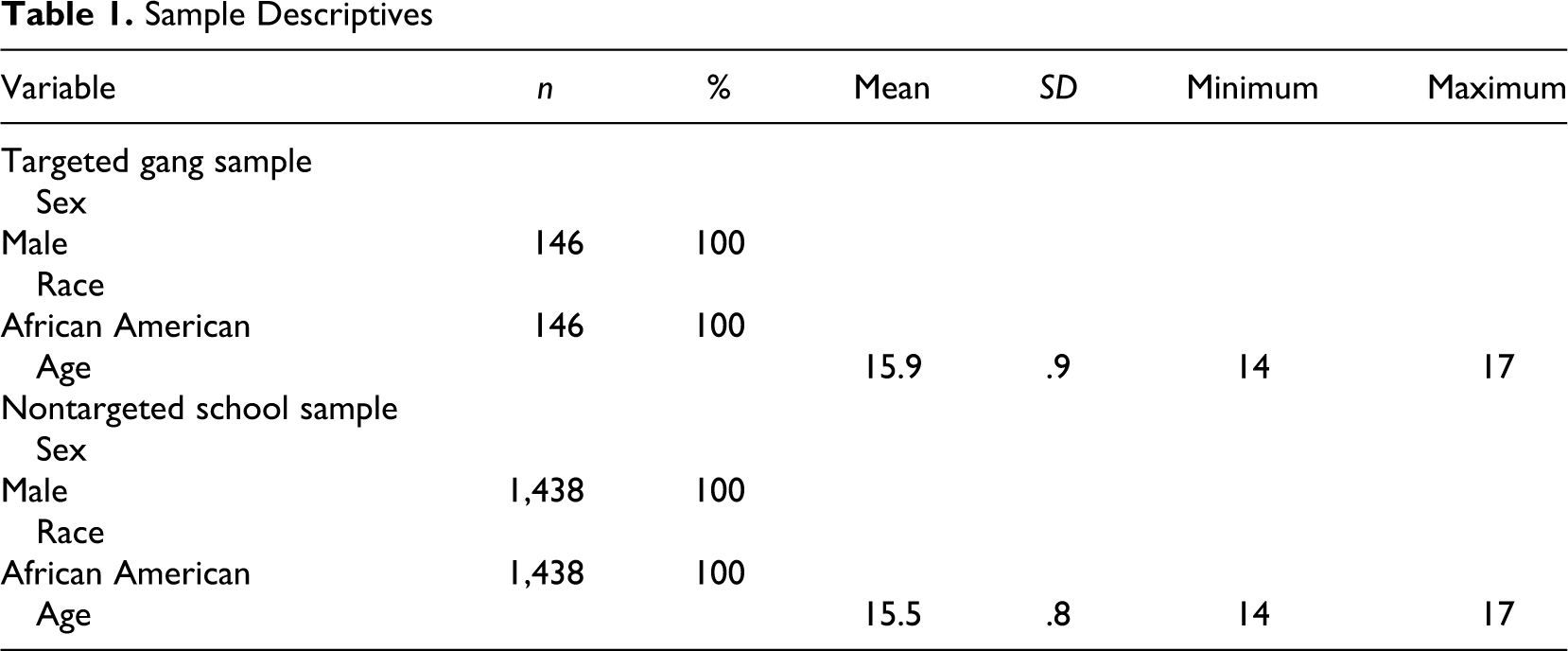
There were two samples that were brought together for this particular study. The first sample was targeted for being particularly at risk for gang involvement and consisted of 146 African American male youth who participated in an antigang initiative in Cuyahoga County, Ohio, between 2007 and 2009. The antigang initiative focused on a neighborhood in the metropolitan area that had the highest rate of violence and gang membership in the city. That is, this neighborhood was designated as the highest risk community in the metropolitan area, and thus most in need of service. At the time of assessment, which preceded their involvement in any intervention activities, these youth were between 14 and 17 years of age (M = 15.9, SD = .9) (see Table 1 ). The comparison group was drawn from the general school-based population across the metropolitan area, and consisted of 1,438 African American male youth in the ninth grade during two consecutive academic years (2007–2008 and 2008–2009). The primary purpose of collecting risk data from this sample was to gather descriptive data on the risks and needs of the African American male student population in this metropolitan school district as a result of pervasive problems among this demographic in making adequate yearly progress toward graduation. 1 The school district used the GRAD instrument to create a profile of the risks and needs of this particular portion of their student body in hopes of devising plans to provide services in these areas of risk and need. Beyond being African American and male, students were not targeted for inclusion in the comparison group, as the school district simply relied on available subjects for inclusion in the survey. At the time of assessment, these youth were between 14 and 17 years of age (M = 15.5, SD = .8). 2
Sample Descriptives
Measure
The data collection instrument used was the GRAD version 1.0 (Gavazzi, Lim, Yarcheck, & Eyre, 2003), an instrument designed to assesses potential threats to the numerous developmental needs of adolescents. The GRAD contains 11 domains of risk/needs: prior offenses, family/parenting issues, deviant peer relationships, substance abuse, traumatic events, mental health issues, psychopathy, sexual activity and other health-related risks, leisure activities, accountability, and education/work issues. The average time that it takes to complete the GRAD is about 25 min.
Respondents are asked to respond to the items by indicating on a scale of 0 to 2 (where 0 indicates No/Never, 1 indicates Yes/A couple of times, and 2 indicates Yes/A lot) how much each item applies to their life. Item scores are totaled to compute a risk score for each domain. The GRAD has been constructed in order to facilitate the collection of information from multiple perspectives (youth, parent, professional). In the present study, the youth’s perspective was employed on three specific domains—family concerns, mental health issues, and educational risks—and the delinquent peer subdomain of the peer relationships domain. Hence, 17 items associated with Disrupted Family Processes (coefficient α = .74), 26 items associated with Mental Health issues (coefficient α = .86), 12 items associated with Educational Risks (coefficient α = .67), and 3 items associated with Delinquent Peer Associations (coefficient α = .65), were employed in the present study. Appendix A lists the measures used in the current analysis.
The Disrupted Family Processes items can be further analyzed according to the three subdomains—family conflict (“How often do you get into fights with adults who live in your home?”), parental tiptoeing (“Do your family members seem to go out of their way to NOT upset you?”), and family hardship (“Does your family have a hard time paying bills and buying food?”)—as reported by Gavazzi, Bostic, et al. (2008). The Mental Health items can be further analyzed according to the two subdomains—internalizing (“Do you feel sad, moody, blue or depressed?”) and externalizing (“Have you threatened to harm people?”) problem behaviors—as reported by Gavazzi, Lim, Yarcheck, Bostic, and Scheer (2008). And finally, the Educational Risks items can be further analyzed according to the three subdomains—disruptive classroom behavior (“Have you had difficulty controlling your behavior in school?”), threats to academic progress (“Have you been held back a grade?”), and learning difficulties (“Have you been enrolled in special education classes?”)—as reported by Gavazzi, Russell, and Khurana (2009).
Preliminary evidence suggests that the GRAD has excellent psychometric properties, including a solid factor structure and high internal reliability coefficients (Gavazzi et al., 2003). More recent studies have generated concurrent validity evidence with other well-established measures of risk/needs (Gavazzi & Lim, 2003), and some initial predictive validity evidence has been generated as well regarding the tool’s use in referring adolescents to clinical services (Gavazzi & Lim, 2003). More recent evidence has been generated regarding its sensitivity to cultural and gender issues (Gavazzi, 2006; Gavazzi et al., 2009; Gavazzi, Yarcheck, & Lim, 2005; Gavazzi, Yarcheck, & Lind, 2006; Gavazzi, Yarcheck, Sullivan, Jones, & Khurana, 2008) in samples of at-risk youth and their families, including findings related to the significant interaction of race and gender.
Analytic Procedure
The main statistical analyses were performed in two stages. In the first stage, a series of t-test analysis procedures were performed in order to examine potential differences between the two samples of African American males in terms of risk levels in the domains utilized in the present study. Next, t-tests were used to determine whether differences existed between groups in terms of accumulated risk across domains, which has been shown to be an important determinate of future offending and gang membership. Scores on the GRAD domains were tricotomized and labeled as high, moderate, and low risk. The low, medium, and high risk groups were created by separating the respondents into equal thirds of the sample, and thus these designations represent relative risk in the sample. For these analyses, individuals classified as being high risk in a particular risk subdomain were given a score of 1, whereas those who were not classified as being at high risk (moderate or low) were given a zero, consistent with the work of Esbensen and colleagues (2009, 2010) and Thornberry and colleagues (2003). 3 An overall accumulated risk score was then developed by summing individual scores across all subdomains to determine if the targeted sample had a higher average accumulated risk score than the nontargeted sample.
Results
T-Test Procedures
Significant differences between the two samples of African American males utilized in the present study were found, although in the opposite direction as would be expected given the targeted nature of the program. That is, the general school-based, nontargeted, sample reported significantly higher risk in three of the four domains, and seven of the twelve associated subdomains used in the current analysis (see Table 2 ). More specifically, for the family risk domain significantly higher scores (t = 4.23, p < .001) were reported by the school-based sample (mean = 6.66) in comparison to the antigang program sample (mean = 5.12). These significant differences were located most specifically in the family conflict (t = 3.34, p < .001) and parental tiptoeing (t = 5.81, p < .001) subdomains.
Mean Comparison of Risk Factors Across Targeted and Nontargeted Samples

Note: Gang targeted, N = 146; Nontargeted, N = 1,438.
* = p < .05 (independent samples t-test).
For mental health, the nontargeted sample reported a mean of 13.56, while the targeted sample reported a mean score of 10.83 (t = 4.69, p < .001). These significant differences were reflected in all of the mental health subdomains, including internalizing (t = 6.88, p < .001), externalizing (t = 3.87, p < .001), and Attention Deficit Hyperactivity Disorder (ADHD) (2.189, p < .05). When it came to the measure of delinquent peer associations, the nontargeted sample reported a mean of 2.32 while the targeted sample mean score was 2.03 (t = 2.56, p < .01). Of particular concern for the targeted gang intervention, there were significant differences between the two groups on both of the items pertaining to interactions with gang members. Specifically, the targeted group reported significantly (t = 2.37, p < .05) less time associating with gang members and involvement with gang members (t = 3.05, p < .01) than the nontargeted school-based group of youth (see Table 1).
Finally, no significant differences were found between the two groups on overall educational risk, nor on any of the three subdomains of this factor. Given the size of the two samples used in the independent samples t-test, the failure to find a single statistically significant difference in the expected direction is noteworthy. In sum, the sample of youth targeted for inclusion in an antigang initiative, supposedly for being particularly at risk for gang involvement, scored significantly lower on three of the four risk domains, and seven of the twelve subdomains included in the study.
Next, we examined the accumulation of risk across domains for each of the samples, given evidence that accumulated risk across domains is a robust predictor of future gang involvement (Esbensen et al, 2009, 2010; Hill et al., 1999; Thornberry et al., 2003). Again, significant (t = 2.60, p < .05) differences are found between targeted and nontargeted samples, but in the opposite direction as expected. Specifically, the mean accumulated risk score for the targeted sample was 2.78, whereas the nontargeted sample had a score of 3.32.
Discussion and Conclusions
A prominent strategy for the prevention of criminal and delinquent behavior is to target those youth most at risk for future involvement in serious acts of crime, violence, and gang membership. To this end, criminal justice organizations have initiated interagency collaborations that make use of the various resources and powers available across local service providers (Klofas et al., 2010). An assumption of this strategy is that agencies involved in these projects have the ability to identify youth in this select group of would-be serious, violent, and chronic offenders, and provide them with appropriate services. In other words, “the existence of organizational rationality is fundamental to the success of comprehensive programs that would attempt to effect system change” (Decker & Curry, 2002, p. 200).
Results from the current study suggest that the ability of local agencies to identify youth most at risk for delinquency and gang membership should not be taken for granted. Officials in Cuyahoga County, Ohio, contracted with numerous social service providers in their local jurisdiction to provide services to youth most at risk for gang membership, yet such a population proved difficult to locate and include in their initiative. Indeed, a comparison group of African American males in the general school-based population were more at risk than the targeted group of adolescents on three of the four risk factor domains, seven of the twelve associated subdomains, and accumulated more risk across domains, as measured by the GRAD version 1.0 (Gavazzi et al., 2003). Thus, it is clear that those served by the initiative were not reflective of the intended target population.
Although the specific reasons for this failure to involve the most at-risk youth in the community are difficult to pinpoint in the current study, interviews with Cleveland officials highlighted some of the challenges. The original plan was to administer the GRAD risk assessment tool with all ninth graders in the Cleveland Metropolitan School District (CMSD), and particularly in the high school serving the neighborhood targeted in the antigang initiative. However, this proved difficult given privacy issues and questions about sharing of information that would be collected in the schools with the justice system and social service agencies. It was also difficult to systematically administer the risk assessment tool in schools that were described as stressed with the numerous demands facing urban school systems. As one respondent stated, “the school in the target area was stressed out. Principals and staff felt overwhelmed already, making it difficult at times to ask for more.” Unable to rely on a central screening process like the schools for conducting the assessment, but wanting to serve youth in need in a high-crime neighborhood, the program tended to rely on referrals from a variety of sources. The end result may indeed have been programs comprised of youth in need who may have benefitted through participation, but it does not appear that the youth most at risk for gang involvement were included.
The failure to target youth most at risk for delinquency and gang membership is likely to lead to little to no programmatic effect (e.g., Andrews et al., 1990; Lipsey, 2009). A recent meta-analysis by Lipsey (2009) found three substantive factors that are associated with positive program effects, and they include the type of treatment provided, the quantity and quality of the services, and the risk level of the youths targeted for service. In fact, Lipsey’s (2009) review and analysis of the literature suggests that delinquency risk is one of the few individual characteristics associated with programmatic effects, in that programs that target higher risk youth produce larger effects than those that target relatively low-risk individuals (see also Andrews et al., 1990).
Beyond the risk of reduced programmatic effects associated with targeting low-risk youth, such practices have also been found to have harmful, iatrogenic, effects (Dodge, Dishion, & Lansford, 2006). For instance, Hennigan, Maxson, Zhang, and Ranney (2003; as cited in Hennigan & Maxson, in press) found that low-risk youth who were provided services through the youth/family accountability model reported higher levels of delinquency than the control sample, whereas the program was associated with a 16% reduction in recidivism among comparable high-risk youth. Evidence presented in Dodge and colleagues' (2006) edited volume suggests that such unintended negative programmatic effects may be due to mixing low- and high-risk youth together, and thus providing youth who might otherwise not be exposed to more seriously delinquent peers an opportunity to develop such friendship networks, resulting in increased delinquency consistent with a delinquency balance perspective (McGloin, 2009). In the end, the failure to identify and include youth most at risk for future delinquency and gang activity is likely to lead to little overall impact (e.g., Andrews et al., 1990; Lipsey, 2009), and has the potential to backfire (Dodge et al., 2006; Hennigan & Maxson, in press), making things worse for youth included in the intervention.
Evaluations of other targeted gang interventions (Decker & Curry, 2002; The Advancement Project, 2006) and delinquency prevention programs more generally (see Larzelere, Kuhn, & Johnson, 2004; Lipsey & Wilson, 1998) have suggested that youth targeted for service were likely not those who posed the greatest risk for future gang involvement and/or offending. A recent evaluation of Pittsburgh, Pennsylvania’s One Vision One Life Program found that targeting practices were anything but strategic, in that the most frequent mechanisms through which clients became involved in the program were through self-selection (33%) and referrals by family members (24%) (Wilson, Chermak, & McGarrell, 2010, p. 39). As might be expected, self-selection or referral of individuals from family members is not an adequate strategy for interventions targeted at the highest risk youth (Guerra, 1997).
A review of selection bias in intervention research by Larzelere et al. (2004) noted that programs which instituted random assignment practices for target selection produced significantly lower overall effect sizes on the likelihood of future arrest than nonrandomized quasiexperiments when controls for pretreatment differences were not included. Such evidence suggests that problems associated with sample selection, such as targeting “success prone” clients, while excluding those individuals who may be more difficult to change—a practice commonly referred to as “creaming” (Rossi, Freeman, & Lipsey, 1999, p. 208), are widespread in crime and delinquency interventions.
In moving forward, the development of strategies, or best practices, for indentifying youth most in need of preventative services is of utmost importance if we are to realize the potential gains associated with targeted prevention and intervention initiatives. Given the comments of Attorney General Holder (2009) and the recent history of federal efforts in this regard (for a review see Klofas et al., 2010), the philosophy of targeting those most at risk for continued or future offending appears to be the reigning paradigm, and thus efforts to improve practitioners' abilities to implement such strategies with fidelity must address the issue of identification. Without systematic and, perhaps most importantly, practical solutions for identifying at-risk youth in a population where few youth have no risk factors for delinquency and gang membership, we are destined to repeat the same mistakes that have been documented in the current study and elsewhere. The efficiency promised through targeted prevention and intervention initiatives, after all, hinges on the ability to identify youth most at risk for serious, chronic, and violent offending.
A particular area of difficulty for those persons and agencies charged with identifying the appropriate population for targeted criminal justice interventions is the confluence of risk and need in communities chosen for interventions such as the Comprehensive Anti-Gang Initiative. Given the focus on disadvantaged, high crime, neighborhoods, the need for social services including job training and placement, after school activities, and counseling are nearly ubiquitous. In other words, many youth in these areas are in need of services, but only select youth are at risk for serious, chronic, and violent offending. Maynard-Moody and Musheno’s (2003) research on the selection of clients into social services highlights how those in need but not necessarily at risk might come to receive a greater degree of services. As Maynard-Moody and Musheno (2009, p. 104 emphasis added) described: Motivation clearly makes a client, ex-offender, or kid much easier to handle, since street-level workers typically define motivation in terms of cooperation. The motivated citizen-client is nonetheless deemed morally superior to the unmotivated. Conversely, the unmotivated, regardless of their need or circumstance, are deemed unworthy.
When contracting with local social service providers, whose mission often extends beyond that of crime prevention, it is important to articulate a clear plan for target selection. Research has highlighted the potential limitations associated with multiple stakeholders collaborating on such endeavors, in that even fundamental processes necessary to execute targeted initiatives, such as defining common goals and the techniques by which these objectives should be achieved can present significant roadblocks for successful implementation (see e.g., Decker & Curry, 2002; Klofas et al., 2010). For instance, the social service providers included in the current study did not always specialize in serving clients particularly at risk for crime and delinquency, but instead provided generalized services that focused on the needs of those in the local population. Consequently, standard operating procedures in these organizations were not to exclude clients with documented needs, and thus reliance on normal screening practices would cast a wider net than was required under the Comprehensive Anti-Gang Initiative. Clearly articulated and practical methods for selecting cases must be part of future targeted intervention strategies.
As was suggested by Le Blanc (1998) over a decade ago, given the low-base rate of youth at risk for involvement in serious, chronic, and violent offending, and by extension gang membership (see e.g., Klein & Maxson, 2006), multiple gating is likely necessary to identify those youth best served by targeted interventions. “Multiple informants and multiple-variable domains seem preferable because of the complexity of the influences” (Le Blanc, 1998, p. 181) at work in leading youth down the path of gang membership. Given the noted influence of accumulated risk across domains (e.g., family, school, and neighborhood), informants from as many of these domains as possible should be included in the decision to intervene in the lives of youth. The confluence of opinions from numerous stakeholders should increase the predictive accuracy of the decision to include and exclude youth from interventions. To be sure, there is also a place for standardized risk assessment using instruments such as the one used in the current study (GRAD version 1.0; Gavazzi & Lim, 2003).
While the current study highlights a potential problem in the successful implementation of targeted gang interventions, it is not without limitations. First and foremost, while all of the respondents in the two samples used in the current analyses are from the same metropolitan area, the data do not allow for a direct comparison of the neighborhoods or schools in which the respondents lived. Due to issues of confidentiality, all identifying neighborhood and school information was cleaned from the comparison data before analyses could be conducted. The lack of neighborhood or school identifiers introduces the possibility that sample selection procedures are responsible for our unexpected results. While this remains a slight possibility, the selection procedures purported to be used for the targeted and nontargeted samples should alleviate such concerns. That is, the gang intervention under study targeted what was deemed the most “at-risk” neighborhood in the Cleveland metropolitan area in a number of domains, including violence, gang presence, school failure, and a lack of adequate social services. From there, those chosen to participate in the initiative were supposed to be the most “at-risk” youth from this particularly distressed community. On the other hand, the nontargeted school-based sample was derived from available subjects from across the CMSD. Such a sampling technique is notoriously biased, but in a way that should underestimate the level of risk of the general school-based population in the CMSD. Reliance on available subjects (also referred to as convenience sampling) has been found to systematically exclude high-risk individuals, as these youth are least likely to be available for, or volunteer to, participate in school-based surveys (Hindelang, Hirschi, & Weis, 1981; Hirschi & Gottfredson, 1993). In the end, while a direct comparison of the neighborhoods and schools from which the two samples were collected is impossible given data restrictions, the observed sample similarities and differences across risk domains remain substantive.
The current study highlights the need for more research on the best practices for implementing targeted interventions. Implementation of multiple gating strategies and systematic processes for assessing risk, including the use of actuarial risk assessment devices such as that used in the current study, are imperative if the benefits associated with targeted interventions are to be realized.
Footnotes
Notes
Acknowledgments
This project was supported by the National Institute of Justice, Office of Justice Programs, U.S. Department of Justice, Award No. 2007-IJ-CX-0035. The opinions, findings, and conclusions or recommendations expressed in this publication are those of the authors and do not necessarily reflect those of the Department of Justice.
The author(s) declared no potential conflicts of interests with respect to the authorship and/or publication of this article.
The author(s) received no financial support for the research and/or authorship of this article.
Appendix A: GRAD Instrument Items
Educational Risks
Have you experienced academic difficulty in school? Have you had difficulty controlling your behavior in school? Have you had a difficult time getting to school or staying in school for the entire day? Have you missed school frequently due to family responsibilities (sibling care, etc.)? Have you had conflict with any of your teachers? Has the school called home this school year because you have been disruptive in class? Have you interrupted what was going on in your classes because of your talking or your behavior? Have you been in danger of dropping out of school? Were you held back a grade? Were you told that you may have learning problems? Were you enrolled in special education classes? Did you have difficulty reading and/or writing?
Disrupted Family Processes
How often do you get into fights with adults who live in your home? How much of the time do the adults who live with you NOT know where you are? Are family members ever too critical of you? Do you ever feel that you are not welcome to stay in your home? Are you ever at-risk of harm, or are you ever in physical danger when you are in your home? When you are punished for your behavior, is it harsh (the punishment is worse than the behavior) or inconsistent (the punishment is never the same twice for the same behavior)? How often have you been involved in a physical fight (shoving, hitting, punching etc.) with an adult family member as a result of something you did wrong? How often are adults who live in your home verbally abusive to you (swearing, calling you names etc.)? Do you ever become more uncontrollable after you have been punished? Do your family members ever seem to go out of their way to NOT upset you? Does it ever seem like your family members tip-toe around you (so they don't upset you)? How often do you fight with your brothers and sisters? Does it seem like the adults in your home do things themselves instead of asking you to do them? Does your relationship with your mother ever feel not so good? Does your relationship with your father ever feel not so good? Does your family have a hard time paying bills and buying food? Has your family been contacted by a social service agency because of something happening in your home?
Delinquent Peer Associations
Have you ever associated with other young people who are known to be gang involved or are loosely associated with a gang? Have you ever been in a gang? Have you ever had friends who have been in trouble with the law?
Mental Health Issues
Do you ever have difficulty controlling your anger? Do you ever exaggerate how good you are at doing something? Do you ever have trouble paying attention or concentrating? Are you ever high strung or tense? Are you ever nervous or do you ever get startled easily? Do you ever have a hard time sitting still? Do you ever try to get attention from someone any way you can? Do you ever try to get even with people when they do something to you? Do you ever destroy things that belong to you when you get angry? Do you ever yell, shout or curse too much? Have you ever threatened to harm people? Have you ever been physically aggressive towards others? Do you ever get into a motor vehicle with others who drive under the influence of drugs and/or alcohol? Do you ever do things to hurt your body, like cutting yourself? Do you ever do things that are dangerous, like jumping from high places, moving cars etc.? Do you ever have bad dreams or nightmares? Do you ever have difficulty sleeping? Have you ever lost interest in things you used to enjoy? Do you ever feel sad, moody, blue or depressed? Do you ever feel like you can't trust anyone? Have you ever experienced a major change in appetite (either increase or decrease)? Do you ever have panic attacks? Do you ever have difficulty breathing, pain in your chest, or it feels like your heart is pounding too much? Have you ever felt like you were physically numb to pain? Do you ever feel like you don't belong anywhere because of the color of your skin or the family you come from?