






Abstract
The current study addresses whether school-related factors, such as the presence of security personnel, affect students' reporting of school violent crimes to police or nonpolice authorities. Data from the School Crime Supplement to the National Crime Victimization Survey are used to assess such possible relationships. Current results revealed (a) limited variation in reporting from 1999 to 2007, and (b) limited evidence to suggest that school-related factors condition the decision to report. However, the authors did find that while the presence of security personnel at school reduced the odds of a school crime being reported to any official (school or police), such a presence increased the likelihood of police involvement when the victimization was reported.
Findings from a nationally representative survey of U.S. public schools administered in 2008 revealed that 75% of schools recorded at least one violent incident on campus in the previous school year; however, only 38% of schools reported a violent incident to the police (Robers, Zhang, & Truman, 2010). The discrepancy between these statistics is a clear indicator of the well-known “dark figure” of crime (i.e., the sizeable number of crimes that are not reported to the police and are thus not included in official crime statistics). Although more numerous, the school crime counts recorded by school administrators (and mandated by federal and state laws) do not include victimizations that were not reported to school authorities. The accuracy of school crime data may rely as much on the actions of students as the reporting practices of education officials. While adolescents generally let someone know if they are a victim of a crime, such disclosure is most often directed at “informal” (e.g., parents, friends) sources (Raviv, Raviv, Vago-Gefen, & Fink, 2009). This means that when crimes occur at school, many are never recorded because students simply elect not to inform school or police authorities. For instance, with data from the National Crime Victimization Survey (NCVS), Finkelhor and Ormrod (2001) found that one half of school violent crimes against youths aged 12–17 were not reported to the police or “other officials” (e.g., teachers). Of course, a consequence of students not seeking formal help is that it confounds efforts to provide the public with an accurate assessment of the level of violence or disorder within their local schools.
So what factors or circumstances determine if a school crime or disciplinary infraction comes to the attention of the authorities? Few existing studies offer answers to this question. Indeed, Unnever and Cornell (2004, p. 373) noted that “despite the vital role victims have in mobilizing school prevention efforts, there has been little research on the victim’s decision to seek help or remain silent.” We add to this sparse literature by assessing, in particular, whether school-related individual factors, such as the perceived clarity of school rules and the presence of school security personnel, shape a student’s willingness to report violent school crimes to police or school officials. Even though school-related dynamics and characteristics are considered influential in explaining student crime and victimization (see Gottfredson, 2001), the effects of school-related factors on student crime reporting have largely gone unaddressed in the literature.
Gaps in the Existing Research
We search for such effects with data from the School Crime Supplement (SCS) to the NCVS. The NCVS serves as the most common source of information on victim crime reporting, and from this source a number of consistent findings have emerged, such as persons often choose not to call the police when victimized (Baumer & Lauritsen, 2010). It has also been found that police involvement is especially unlikely when the victim is a minor whose crime occurred at school (Finkelhor & Ormrod, 2001). Many school crimes are not reported to the police due, in part, to what Finkelhor, Wolak, and Berliner (2001) referred to as “jurisdictional” barriers (see also Goudriaan & Nieuwbeerta, 2007). Schools have internal reporting and disciplinary options available to students that have historically functioned independent of any formal police or criminal justice involvement (Hirschfield, 2008; Simon, 2007). Thus, many school crimes are not reported to the police because affected students elect instead to inform a teacher or school administrator (Garofalo, Siegel, & Laub, 1987). While such reporting does not preclude police involvement, Finkelhor and Wolak (2003, p. 124) noted that “school authorities do not automatically involve police and, in fact, do not seem very often to take the initiative to report when family members defer.” For a victim of a school crime, then, a potential benefit to informing school officials is that their primary motives for reporting can be addressed (e.g., ease distress, stop offender), while at the same time shielding themselves from the stigma and formality of police involvement.
With a few exceptions (e.g., Schnebly, 2008; Watkins, 2005), however, little research has focused on nonpolice reporting or the factors that determine if authorities other than the police are called upon by victims. This dearth in the literature largely reflects an understandable preference on the part of criminologists to view victim reporting “in terms of police reporting and the initiative of the criminal justice system” (Kaukinen, 2002, p. 432). But consistent with the jurisdictional hypothesis, evidence from the NCVS does suggest that, if reported, school officials are normally the first nonparental authority to hear of school crimes. Finkelhor and Ormrod (2001) found, for instance, that violent crimes against juveniles at school were more than twice as likely to come to the attention of “other officials” than the police. Thus, a purely police focus overlooks many school crimes that are “reported” to school personnel who, not unlike the police, have the formal authority to mediate a criminal incident. Given that the current research focuses on school crimes, we account for such nonpolice reporting.
We also identify instances in which student victims report school crimes to the police. As indicated, schools have traditionally dealt with student misconduct internally. But much has been written in recent years about the increased presence of security and police personnel in U.S. schools (e.g., Brown, 2005; Price, 2009; Theriot, 2009). This trend has raised concerns that disciplinary authority over student misbehavior at school increasingly lies with the justice system (Beger, 2002). For purposes here, a stronger police or security presence in U.S. schools suggests that “police reporting” is a more accessible option for contemporary victims of school crime.
Whether dealing with police or nonpolice reporting, school-related factors or dynamics likely play a role in shaping a victim’s willingness to disclose a school crime. Yet, unlike with student crime and victimization more generally, few existing studies have undertaken such a focus (although see Unnever & Cornell, 2004; Williams & Cornell, 2006). Criminologists have traditionally relied on Black’s (1976) stratification hypothesis and a rational choice perspective to explain variation in victim crime reporting (Kaukinen, 2002). In doing so, research has generally determined that incident-severity measures (e.g., victim injury, offender weapon use) are stronger predictors of police reporting than are social characteristics of the victim or offender (e.g., race, education; Greenberg & Ruback, 1992). Often absent from this extant research, though, are measures that speak to the broader environment in which crimes occur or victims reside (Goudriaan, Lynch, & Nieuwbeerta, 2004). An exception includes a small number of studies that have addressed whether aspects of a victim’s neighborhood or community influence police reporting (see Schnebly, 2008, for a review of these studies).
As mentioned, a similar focus on school-related dynamics is largely absent in the literature. Therefore, by assessing the effects of such factors on victim crime reporting, this study adds to the existing literature. More specifically, we use data from the SCS to the NCVS to examine whether certain school-specific variables influence a student victim’s willingness to report school crimes to police or school officials. The school-related variables that we examine were drawn from student responses to SCS survey items that inquired about fear and avoidant behavior at school, perceived clarity and fairness of school rules, school drug availability and gang activity, and use of security or police personnel at school. In addition, we pool multiple years of SCS data in order to examine possible changes in student crime reporting across time. As will be discussed in greater detail below, many U.S. schools have adopted or further solidified policies (e.g., zero-tolerance policies) in recent years that may have had some effect on student crime reporting.
Potential Effects of School-Related Factors on Student Crime Reporting
School Fear and Avoidant Behavior
Evidence from the 2007 SCS indicated that 5% of students aged 12–18 feared being physically harmed at school “sometimes” or “most of the time” (Dinkes, Kemp, & Baum, 2009). It would seem that students who regularly feared for their safety at school would be more inclined to take preventive steps (Lab, 1990). One such recourse might involve fearful students asking teachers or security personnel to confront those who make them feel insecure. To find no or even an inverse relationship between fear and reporting would suggest that students who may have the most to gain by confiding in school or police officials are choosing to resolve their apprehensions informally or not at all. Ideally, of course, the most concerned students would be electing to evoke the services of authorities responsible for their safety and well-being at school.
It could be argued, however, that such officials have already failed these students and so turning to them for assistance seems counterproductive. Stated differently, one reason certain students may be particularly fearful of harm at school is they have grave doubts about the ability of school or security personnel to ensure their safety. If true, it is likely that these students may view their only option as an informal one (Devine, 1995; Welsh, 2001). A similar argument has been raised with avoidant behavior as well; that is, it has been suggested that “a possible impetus for self-protection is the perception that formal legal mechanisms of social control are ineffective” (DeVoe, 2007, p. 7). So when students avoid select places at school (e.g., cafeteria, stairwells) or do not attend, they may take such action because they believe that formal officials are unable or unwilling to protect them.
But as Lab and Whitehead (1994) pointed out, given that school is a structured environment in which the routines of students are largely dictated for them, avoidance is likely less effective within this context. It is certainly difficult, for instance, to regularly avoid the harassment of classmates. It is possible, then, that while avoiding school or select places at school may reduce a student’s risk of victimization in the short term such actions are unlikely to provide a permanent solution. Thus, students who take precautionary steps to avoid contact with certain peers at school may inevitably feel the need to involve formal authorities.
Dugan and Apel (2005) indicated, however, that “exposure reduction” actions can actually exacerbate a situation when the “relational distance” between a victim and offender is small because such actions may result in “retaliatory” violence. Put more simply, a person who chooses to involve the police when victimized by a stranger theoretically runs little risk of retaliatory violence because there was no “absolute exposure” between the victim and offender prior to the incident (Dugan & Apel, 2005). Of course, school crimes tend to involve nonstrangers who obviously share a common environment (Garofalo et al., 1987). Under these circumstances, if a school victim does report their perpetrator who then becomes angered, retaliation seems likely. Some school victims, therefore, may view avoidant behavior as a less endangering option than reporting.
Clarity and Fairness of School Rules
In a meta-analysis of programs aimed at reducing school crime, Gottfredson, Wilson, and Najaka (2002) found that one set of programs which were effective were those that improved the clarity and application of school discipline practices. Perhaps not surprisingly, then, research has generally found that school violence and disorder is more common when students express greater doubts about how well school rules are communicated and equitably applied (e.g., Burrow & Apel, 2008; Mayer, 2010). Such a finding likely materializes, in part, because when students start to question the transparency and enforcement of school rules, it can undermine the perceived legitimacy of school personnel and ultimately a student’s willingness to comply with school rules (Kupchik, 2009; Welsh, 2001). Poorly communicated and enforced rules may also erode the attachment or bond students have to school (e.g., Payne, Gottfredson, & Gottfredson, 2003). We anticipate, therefore, that student victims who have unfavorable impressions of school rules will be reluctant to report because such students more likely view school staff as incompetent or distant (see Schreck, Miller, & Gibson, 2003). And perhaps more directly, it seems unlikely that school victims would report if they were uncertain about how school policy would operate or be applied in a particular situation.
School Disorder
School disorder has been used loosely in the literature to refer to a broad range of adverse student attitudes and behaviors (Welsh, Greene, & Jenkins, 1999). In this research, student perceptual measures of the ease of acquiring drugs and frequency of gang violence at school are used as indicators of disorder. Of course, drug and gang activity are not the types of behaviors that are generally associated with a favorable or secure environment. In fact, these behaviors at school have been linked to an increased risk of student victimization (e.g., Astor, Benbenishty, & Yahia, 2002; Ferguson, 2003). Van Dorn (2004, p. 314) noted that such a relationship may materialize because the presence of drugs and gangs “slowly erode social order in schools and eventually create a climate that is accepting of factors associated with violent and nonviolent victimization.”
If students' tolerance for troubling behaviors does increase with exposure (see Wilkson & Carr, 2008), it seems likely that the threshold for crime reporting would be higher in schools where students report, say, drug and gang activity. For instance, softer (e.g., verbal) forms of aggression are probably less likely to evoke a formal response by student victims when more pressing disciplinary matters are present at school. It also seems probable that students would be more inclined to question the effectiveness of school personnel when such officials have been unable to prevent or stop even serious misconduct at school such as drug or gang activity. Perhaps in such instances students would be more disposed to involve authorities other than teachers or administrators such as the police.
School Security Personnel
For persons who attended school prior to the early 1990s, chances are they rarely, if ever, encountered security personnel patrolling the school hallways or campus. Since the early- to mid-1990s, however, the number of sworn and unsworn security personnel working part- or full-time in U.S. schools has grown substantially (Brown, 2005; Kupchik & Monahan, 2006; Theriot, 2009). Sworn personnel in schools, often referred to as “School Resource Officers” (SROs), are typically employed by local or county police departments (May, Fessel, & Means, 2004), while unsworn security personnel are usually employed by the school or school district and possess no formal arrest powers (see Garcia, 2003). The increased presence of such personnel in U.S. schools, particularly uniformed police officers, has been attributed to a number of factors including high-profile events such as Columbine (Addington, 2009), the availability of federal funds (Beger, 2003), and a broader community-policing movement in law enforcement (Center for the Prevention of School Violence, n.d.). It remains less apparent, however, whether security personnel actually influence student behaviors and attitudes. As Brown (2006, p. 592) indicated, for instance, “it is not clear whether school police officials enhance student safety and little attention has been afforded to measuring the impact the officers have on the school environment.”
We assess the effect such personnel have on student crime reporting. On the one hand, it seems probable that a security presence in school would facilitate crime reporting, especially “police” reporting (Cook, Gottfredson, & Na, 2010; Theriot, 2009). Absent such a presence, school victims realistically have only one formal reporting option available to them: inform a teacher or school administrator. Of course, having ready access to security personnel at school does not mean that student victims are willing to apprise them of a crime. But the existing evidence does suggest that at least with SROs, students generally report favorable impressions of such personnel (e.g., Johnson, 1999; Kupchik & Bracy, 2010; Virginia Department of Criminal Justice Services, 2001). These favorable attitudes likely make SROs a more viable or comfortable reporting option (see Finn & McDevitt, 2005). In addition, many school crimes occur in places outside the classroom that are not as heavily supervised. Astor, Meyer, and Behre (1999) referred to such locations (e.g., hallways, cafeteria) as “unowned places” because, relative to the classroom, it is less clear who is responsible for regularly supervising these areas. School security personnel certainly take on part of this responsibility (Lawrence, 2007), which may alleviate some of the ambiguity over who students should report to in the event they are victimized in one of these unowned places.
Some scholars, however, have been more critical of the likely effects that security personnel have on the school environment. At least one concern is that the permanent placement of security personnel in U.S. schools shifts the primary responsibility for discipline from teachers to law enforcement personnel (Beger, 2003). Devine (1995, p. 179) characterized this shift as a division of labor where teachers retain responsibility for the “the mind” of the student, while security personnel take responsibility for “the body.” It is presumed that such a process results in discipline becoming more “formalized” and executed by personnel who, compared to teachers, are more authoritative with students (Jackson, 2002). This more assertive approach may marginalize certain students who then lose trust in school personnel (see Lindle, 2008). An implication is that a security presence at school may dampen (or at least not facilitate) student reporting.
Potential Changes in Student Crime Reporting Across Time
Zero-Tolerance Policies
This research also focuses on possible changes in student crime reporting across time (1999–2007). We do so because the existing literature suggests that many schools have adopted or further solidified policies in recent years that may have had some effect on student crime reporting. For instance, schools now often take a “zero-tolerance” approach to select student behaviors at school (Welch & Payne, 2010). Such an approach is generally characterized by the application of “predetermined” or “mandatory” punishments, which can often take the form of suspension or expulsion (Skiba, 2000; Skiba et al., 2006). Prior to the early 1990s, however, Simon (2007) noted that most schools did not subject students to exclusionary sanctions due to, among other reasons, the disruptive effect they had on the academic progress of students. But in the mid-1990s, the Federal Gun-Free Schools Act mandated that schools adopt zero-tolerance (exclusionary) policies for weapons possession (Phanuef, 2009). Many schools soon after expanded the application of these policies to alcohol- and drug-related infractions, as well as more minor forms of student aggression (Hanson, 2005). One concern with zero-tolerance policies is that they create an environment where the discretion of teachers is undermined by placing a greater emphasis on uniformly punishing student misbehavior rather than resolving it (Hirschfield, 2008). Kupchik (2009, p. 308) found such a “narrow focus” across four high schools of differing social composition. As he noted, “Rather than treating disciplinary interactions as a teaching opportunity in which students are involved and from which they learn, school staff members tend to treat these interactions as the occasions where punishment is applied without reflection or discussion.”
If, as the research suggests, school punishment has become more punitive and applied with less discretion since the mid-1990s, this may have had a subsequent “chilling effect” on student crime reporting (Simon, 2007). While some student victims may prefer that their aggressors be firmly reprimanded by school or security officials, others may prefer a less punitive or formal route. This may be particularly true among school victims because, as indicated, they often are acquainted with their perpetrators and are likely unable to avoid them altogether at school. Under these circumstances, victims may want to avoid punishments that compromise a student’s academic prospects as well as increase the potential risk of retaliation. Of course, punitive punishments such as suspension remain on a student’s permanent school record and they likely anger those affected. Indeed, evidence generally suggests that suspended students are even more incompliant when they return to school (Skiba et al., 2006). It is possible, then, that the widespread use of more punitive punishment policies in U.S. schools has raised the threshold for what most student victims consider acceptable to report.
Antibullying Policies
It might be, however, that the reporting threshold in U.S. schools has actually lowered in recent years because of efforts to curb student bullying. Bullying has been the focus of recent school prevention efforts due, in part, to high-profile events (e.g., school shootings, student suicides) that have challenged the notion that bullying is mostly harmless behavior that is just a part of growing up (Limber & Small, 2003). Indeed, at least 45 states in the United States have enacted legislation that prohibits student bullying and often mandates that schools take formal steps to prevent such behavior (see Simmons, 2010). While questions remain about how effective schools are in preventing bullying (Ferguson, San Miguel, Kilburn, & Sanchez, 2007), a common aim of antibullying policies is to improve student reporting (e.g., Glover, Gough, Johnson, & Cartwright, 2000). In particular, schools try to create an environment where students feel obligated to report even “softer” or “low-level” (e.g., verbal teasing or harassing) forms of aggression. Therefore, a recent focus on bullying in U.S. schools may have lowered the reporting threshold for many student victims by punctuating the need to disclose even trivial acts of aggression to school or police officials. In addition, such a focus may have resulted in more students directing victims to report when approached for advice.
Method
Data
We examine potential school-related effects on school crime reporting data with data from the SCS to the NCVS. The SCS was first administered in 1989, then again in 1995, and since 1999 has been conducted biannually. The current sample was derived from SCS data collected in 1999, 2001, 2003, 2005, and 2007. In each of these years, adolescents in NCVS households were eligible to complete the SCS if they were ages 12–18, attended school at any time in the 6 months prior to the SCS, and were enrolled in a school that advanced them toward a high school diploma. Across the 5 years of SCS data examined here, a total of 59,562 NCVS respondents were eligible for the SCS, and 41,188 (or 69%) completed the supplement.
Of those adolescents who completed the SCS, we focus on students who reported being a victim of a violent crime at school, specifically a rape, sexual assault, robbery, aggravated assault, or simple assault. 1 Interpersonal crime is often of particular interest in the crime reporting literature because of its increased severity and the deleterious effects (e.g., depression) it may have on victims, especially juveniles (Menard, 2002). Fortunately, only a small fraction of SCS respondents in recent years have reported experiencing a violent crime at school. Bauer, Guerino, Nolle, and Tang (2008) found, for instance, that 1% of students in 2005 indicated they were a victim of a violent crime at school in the 6 months prior to the SCS interview. Such a low base rate does limit statistical power, however, which we attempt to offset by pooling 5 years of SCS data. Combining these data generated a current sample of 559 violent crime incidents that occurred “in a school building” or “on school property.”
Dependent Variables
Two dependent variables are examined in this research. The first, reported to official, is a binary outcome that differentiates crimes that came to the attention of a police or nonpolice official from crimes that were not reported to these authorities. In the NCVS, it was asked “were the police informed or did they find out about this incident in any way?” If a victim answered no to this question, they were then asked if one reason the incident was not disclosed to the police was because it was “reported to another official (guard, apt. manager, school official, etc.).” Unfortunately, the NCVS did not inquire about the exact identity of these other, or nonpolice, authorities. But as Finkelhor and Wolak (2003) indicated, one can reasonably deduce that these “other officials” are most likely school personnel (e.g., teachers) if the crime involved a juvenile victim, especially if it occurred at school. Using these survey items, we coded reported to official one if a respondent indicated that their victimization incident did become known to the police or another official and coded zero otherwise. We then used these same items to construct a second dependent variable that distinguishes whether a crime was reported to police official, reported to nonpolice official, or not reported. 2 This polytomous outcome allows us to identify if school-related factors have a similar effect on police and nonpolice reporting.
School- and Time-Related Variables
The key independent variables of interest include six school-related predictors, as well as measures of time. The first school-related variable, school fear, is scored one if a student indicated they were afraid of being attacked or harmed by someone at school “sometimes” or “most of the time,” and scored zero if they were fearful of being attacked or harmed “never” or “almost never.” 3 Similarly, school avoidance is coded one if an adolescent reported staying away from certain places at school (e.g., hallways, stairs, cafeteria) out of fear of being harmed or attacked there and coded zero if they reported no avoidant behavior. School rules is an index that averaged student responses across five survey items that inquired about the clarity, fairness, and application of school rules (α = .77). Scores on this index range from one to four, with higher values indicating that school rules were perceived as more clear and equitably applied. This index has shown strong reliability and evidence of measuring a single construct (see, e.g., DeVoe, 2007).
We also examine the effects of two indicators of school disorder on crime reporting. The first, school hard drugs, is scored one if a student indicated that it was possible to get “crack” or “other forms of cocaine” at school and scored zero if a student reported that these drugs were not accessible or were unaware if they were available. The second indicator of disorder, school gang violence, is coded one if an adolescent affirmed that gangs have been “involved in fights, attacks, or violence” at school and coded zero if an adolescent reported no such activity or were unaware of such violence.
The last school-related variable that we account for is the presence of security or police personnel at school. In particular, SCS participants were asked if their school took certain steps to ensure their safety, such as use “security guards and/or assigned police officers.” School security officers is scored one if a student indicated that such personnel were present at school and scored zero if they reported no such authorities or were unaware if such authorities were present at school. Theoretically, then, this variable potentially treats three different groups of students as one in the same: those who attend schools where security personnel have no formal arrest power, those who attend schools where security personnel have full arrest power, and those who attend schools where both sworn and unsworn security personnel are present. This coding scheme has consequence for when our attention turns to differentiating between police and nonpolice reporting. While students likely view SROs as “police officers” (due to being uniformed and having full arrest authority), it is less certain whether other security personnel at school are perceived by students as police or school officials. In other words, if a respondent in the current sample did report a crime to a (unsworn) security guard at school, such personnel may have been considered “the police” or “another official” by a student. However, some research does suggest there is a fair amount of overlap between the presence of SROs and unsworn security personnel in U.S. schools (see Garcia, 2003). To the degree that such overlap exists, the presence of unsworn security personnel in schools may increase the chances of a school crime becoming “known to” the police.
The final measures of interest include five dummy variables that account for the year in which students completed the SCS. In particular, we assess if a school crime was more likely to come to the attention of a police or nonpolice official after 1999 (the reference or comparison year). As noted, schools have increasingly adopted zero-tolerance and antibullying policies in recent years, which may have influenced patterns of student crime reporting. 4
Control Variables
We also account for a number of control variables that are often found in research on victim crime reporting (e.g., Block, 1974; Finkelhor & Ormrod, 2001). The first set of control variables speaks to characteristics of the victim’s household. These variables likely account to some extent for differences in the social composition (e.g., racial make up) of schools attended by SCS respondents. Two of these measures serve as indicators of the socioeconomic status of the victim. The first, head of household education, is a continuous measure that represents the number of completed years of schooling for the head of the victim’s household. And the second, owned residence, is a binary variable scored one if the victim’s residence was owned and scored zero if rented. The two remaining household variables speak to the victim’s family composition and place of residence. Married household is a dichotomous variable coded one if a student resided in a married rather than unmarried household, while inner-city residence is a dummy variable scored one if a victim’s home was located within a central city of a Metropolitan Statistical Area.
We also incorporated measures that control for demographic attributes of the victim. Age of victim is a continuous variable that measures the age of the victim in years. Male victim is a binary variable scored one for male victims and scored zero for female victims. And the race/ethnicity of the victim is accounted for with three dummy variables that differentiate victims who were non-Hispanic White, non-Hispanic Black, or some other race or ethnicity.
Demographic characteristics of the offender are also considered. The first, juvenile offender, is a dummy variable coded one if the victim perceived the offender as aged 17 or younger and coded zero if the victim believed the offender was older than 17. The second, male offender, is a binary variable coded one if the victim indicated that their perpetrator was male and coded zero if the perpetrator was female. And the final offender variable, Black offender, is a dichotomous measure coded one if the victim identified the offender as Black and coded zero if the victim believed that the offender was some other race.
Another set of control variables accounts for select circumstances of the crime. Repeat victim is coded one if a student reported being a victim of a violent crime at school more than once in the last 6 months and coded zero otherwise. Offender a stranger addresses the victim–offender relationship and is scored one if the offender was considered a “stranger” by the victim and scored zero if they were known to the victim. We also consider whether bystanders being present impact school crime reporting. In particular, bystander present is coded one if the victim indicated that someone besides them and the offender were present during the crime and coded zero if no witnesses were present.
Finally, three measures serve as indicators of the severity of the school crime. Prior research has consistently found that the severity of the victimization incident is strongly associated with reporting (e.g., Gottfredson & Gottfredson, 1988). The first of these measures, attempted crime, is coded one if the victimization incident was an attempted crime and coded zero if the incident was a completed crime. Victim injury is scored one if the victim indicated that they were injured by the perpetrator and scored zero if the victim reported no injuries. And offender had weapon is coded one if the victim reported that the offender possessed a weapon and coded zero if the victim reported no offender weapon possession or was unaware if the offender had a weapon.
Analytical Strategy
We first display the mean distributions of the research variables by whether a school crime was reported to a police or nonpolice official. We then present results from a binomial logistic regression model that regressed reported to official on the independent and control measures. The main focus of this model is to identify if the school- and time-related variables influence reporting above and beyond the effects of the control variables (e.g., victim age). We conclude our analyses with a multinomial logistic regression model that examines whether the study variables have comparable effects on police and nonpolice reporting. Each of these analyses was undertaken with “survey” commands in Stata, which account for the complex (clustered) sample design of the NCVS (see StataCorp, 2007). 5
Results
Descriptives
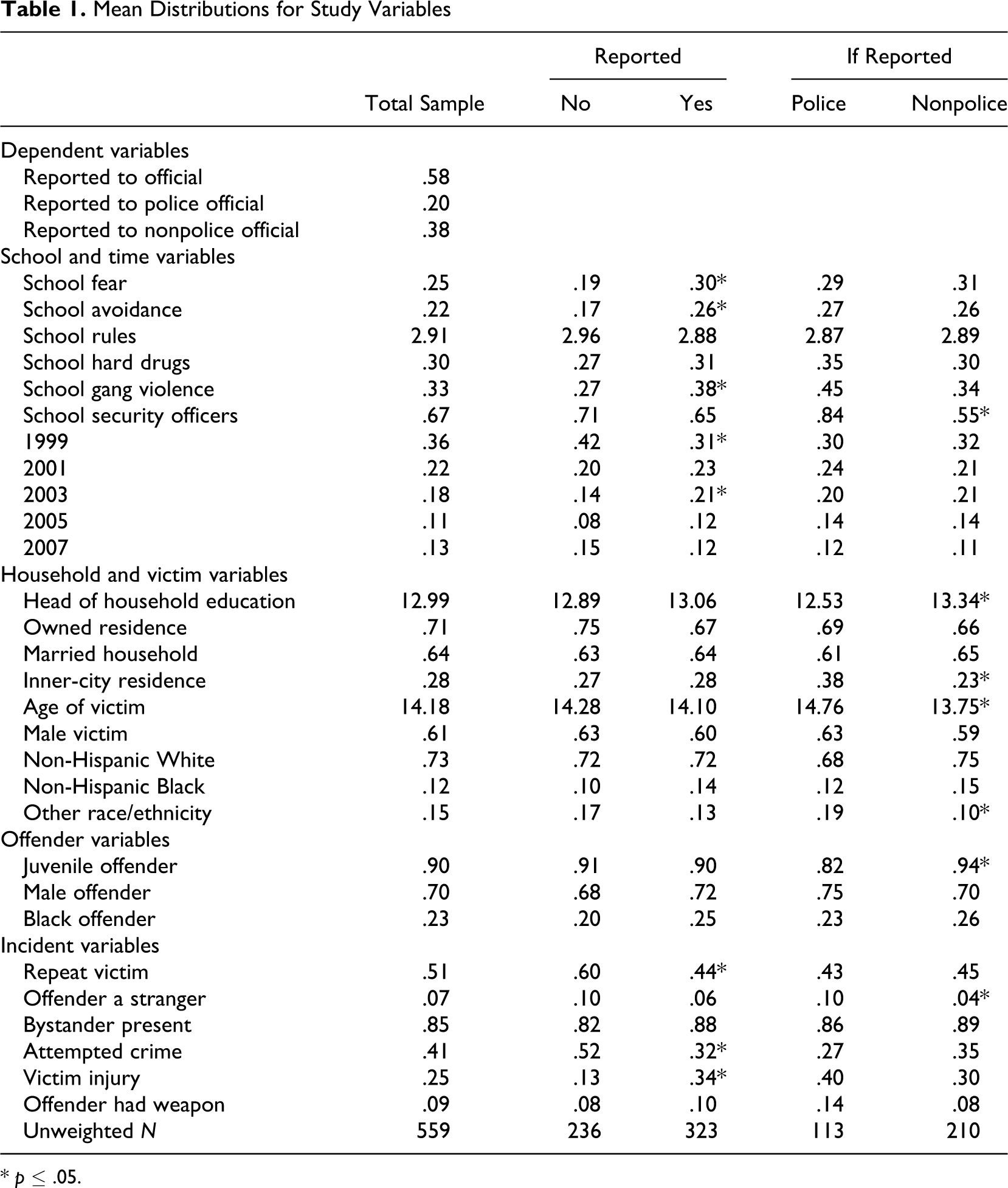
Table 1 displays the mean distributions of the study variables for the total sample, as well as disaggregated by reporting status (i.e., not reported vs. reported) and type of reporting (i.e., police vs. nonpolice). A total of 20% of the incidents were reported to the police, a finding which, consistent with previous studies of juvenile crime reporting, gives the impression that school-based victimization incidents are grossly underreported. But when we broaden the outcome to account for school incidents that come to the attention of authorities other than the police (namely, nonpolice officials), the data indicate that nearly twice as many school-based incidents are reported to nonpolice officials than to the police. Collectively, then, our data indicate that more than half (58%) of school-based violent crimes come to the attention of some authority.
Mean Distributions for Study Variables
* p ≤ .05.
With respect to disclosing a school crime to a police or nonpolice official, the findings in Table 1 indicate that a few school- and time-related variables are significantly associated with reporting. In particular, we find that a school crime was more likely to be reported to a police or nonpolice official if the victim indicated that he or she was often fearful of being harmed or attacked at school. We also find that while 36% of the school crimes in the current sample were committed in 1999, only 31% of school crimes reported to a police or nonpolice official were committed during this year, which suggests that school victimization incidents were more likely to be reported to a formal authority after 1999. But, in general, the findings in Table 1 suggest that reporting to a police or nonpolice official is primarily driven by the circumstances surrounding a school crime, such as whether a student was repeatedly victimized at school or suffered any injuries as a result of their victimization.
With regard to type of reporting, however, the findings in Table 1 indicate that such circumstances are less influential. In fact, the results in Table 1 suggest that household and victim characteristics (e.g., inner-city residence, victim age) are better at predicting which formal authority is informed of a school crime when these events are reported. For instance, we find that among the school crimes reported to a formal official, incidents involving older students were more likely to come to the attention of the police. Perhaps not surprisingly, we also find that when students reported the presence of security personnel at school, the police were much more likely to be informed of a school crime.
Binomial Logistic Regression
The results in Table 2 address whether these bivariate relationships persist after adjusting for the effects of the remaining variables. The first column of findings in Table 2 displays estimates from a binomial logistic regression model that regressed reported to official on all the independent and control variables. These estimates largely substantiate the descriptive findings in revealing that circumstantial aspects of a school crime are particularly relevant in determining whether a victimization incident was reported. For instance, net of other factors, school crimes that were completed or resulted in the victim sustaining an injury were more likely to be reported to a police or nonpolice official.
Logistic and Multinomial Logistic Regression Models Regressing Reporting on Study Variables

* p < .1
** p < .05
*** p < .01
**** p < .001
We also find once again that most school- and time-related variables are not strongly associated with reporting. One exception is that relative to school crimes perpetrated in 1999, Table 2 reveals that school crimes carried out in 2003 and 2005 were more likely to be reported to a formal authority. In addition, we also find that students who reported gang violence at school were more inclined to report a school crime to police or nonpolice official, while students who reported the presence of security personnel at school were less likely to report to a formal official. In other words, we do not find any evidence to suggest that the presence of gang violence or drugs at school (i.e., signs of disorder) increases the reporting threshold, nor do we find that school security personnel facilitate reporting.
Multinomial Logistic Regression
Table 2 also displays findings from a multinomial logistic regression model that compares the effects of the independent and control variables on type of reporting. These estimates indicate that only two of the school- and time-related variables prove statistically relevant in differentiating school crimes reported to the police from those not reported. In particular, we find that a school crime is more likely to be reported to the police (vs. not reported) if a student reported recent gang violence at school. We also find in Table 2 that school crimes were more likely to come to the attention of the police (vs. not reported) if a student avoided select places at school.
When comparing school crimes reported to a nonpolice official with those not reported, the gang violence and school avoidance variables are no longer statistically significant. Instead, we find that, relative to not reporting, nonpolice reporting was more likely in 2003 and 2005, as well as when students indicated that hard drugs were available at school. In contrast, we find that nonpolice reporting was less likely to occur when security present were present at school. In fact, the findings in Table 2 indicate that the presence of security personnel in schools does not improve reporting. But when school crimes were reported to formal officials, the results in Table 2 reveal that these incidents were more likely to come to the attention of the police when security personnel were present at school. This finding is consistent with the contention that when security officers (especially SROs) become a permanent fixture of the school environment, they, as opposed to teachers, bear most of the responsibility for resolving student disciplinary infractions (see Devine, 1995).
The multinomial findings in Table 2 also indicate that while a number of the circumstantial measures examined here (e.g., repeat victim, victim injury) are important in determining whether a school crime is reported, such measures appear less influential when the focus turns to whether a police or nonpolice official is informed of a school victimization incident. In fact, the results in Table 2 indicate that household and victim characteristics (e.g., inner-city residence, victim age) become more salient when examining whether a police or nonpolice official is apprised of a school crime.
Summary and Discussion
A provision of the No Child Left Behind (NCLB) Act of 2001 requires that states define and identify “persistently dangerous schools.” In order to complete this task, states must rely on school administrators to self-disclose student disciplinary infractions. A concern with this arrangement is that it creates an environment where school administrators have an incentive to underreport the actual number of student disciplinary infractions (i.e., avoid being labeled; Hernandez, 2007). This NCLB provision, therefore, calls particular attention to the role that school administrators play in accurately establishing the level of crime and disorder in U.S. schools. But not unlike the police, school officials are dependent upon victims and bystanders to inform them of misconduct when it occurs. In other words, if students are reluctant to report acts of aggression committed by other students at school, then even the most compliant school administrators are unable to provide the state or other stakeholders with accurate disciplinary data. Yet, few studies in the literature have focused on the reporting of school crimes to school or nonschool authorities (Unnever & Cornell, 2004), such as the police or educational personnel. With data from the SCS to the NCVS, this research undertook such a focus by assessing if select school- and time-related factors influenced whether school violent crimes were reported to police or nonpolice officials.
Two variables that we examined included whether victims of school crime regularly feared being attacked at school and whether students avoided certain places at school out of concern for their safety. It would seem that students who expressed such worries or took such precautions would particularly benefit from seeking formal help, but we found that, for the most part, school fear and avoidant behavior were unrelated to reporting after adjusting for other variables. Consequently, we also did not find any evidence to suggest that students become especially fearful or avoidant at school because they view formal authorities as unable to ensure their safety and thus represent an unpromising reporting option.
We also found no evidence to suggest that the presence of even serious forms of disorder (i.e., hard drug availability and gang violence) at school increases the threshold at which victims are willing to report. In fact, we found that students who were aware of gang violence at school were more likely to have their victimization incidents reported to a formal official, particularly the police. This finding suggests that students do not become more tolerant of violent behavior at school when exposed to drug or gang activity there.
Other school-related variables that we examined included a measure of whether students perceived school rules as clear and fair, as well as a measure of whether students reported the presence of security guards or police officers at school. With the rules variable, we anticipated that students who held more favorable impressions of school rules would be more likely to report because such students are presumably more informed and certain about how school policy would operate in the event of a victimization. We did not find, however, that this measure was related to reporting.
With the security personnel measure, we found that it was inversely associated with reporting to any official. The multinomial findings in Table 2 suggest that this inverse relationship materializes because the presence of security personnel at school impedes nonpolice reporting (e.g., informing a teacher) on the part of students. This finding is consistent with a reporting or disciplinary shift argument which maintains that when security guards or police officers are placed in schools, they acquire from teachers the primary responsibility of addressing student disciplinary infractions (Devine, 1995). A concern with such a shift in responsibility is that law enforcement and security personnel are not as trained or qualified as teachers to counsel or assist students. Indeed, some contend that compared to teachers, school security guards or police officers are more authoritative and punitive when they engage students (see, e.g., Jackson, 2002). Such an approach may explain why we find that students are less likely to report school crimes when security personnel are present at school. Unfortunately, the data used here do not allow us to directly address possible differences in how victimization incidents were handled or resolved after being reported to a police versus nonpolice official. But, we can conclude from our findings that the presence of security personnel alone in schools does not increase (indeed, even inhibits) the likelihood of a school violent crime being reported to a formal authority, particularly nonpolice personnel (e.g., teachers). Their presence does, however, greatly increase the chances that the police will be informed of such incidents once they are made public. Whether greater police involvement in school incidents is advantageous remains a topic of research and debate.
Apart from focusing on school-related variables, we also took interest in whether school crime reporting systematically varied across time. We proposed that the recent adoption of zero-tolerance and antibullying policies by many schools may have affected the reporting patterns of students. Specifically, we argued that common features of zero-tolerance policies (e.g., predetermined punishments) may have had a “chilling effect” on reporting, whereas antibullying policies may have facilitated reporting by underscoring the importance of disclosing even “low-level” forms of student aggression. In general, we found limited variation in reporting from 1999 to 2007. It is important to stress, however, that our analyses examine aggregate reporting patterns across students attending many schools that certainly varied in the extent to which they adopted and implemented zero-tolerance or antibullying policies. Stronger conclusions about the impact of these policies on student attitudes or behaviors could be drawn if such dynamics were considered in future research.
Examination of the remaining control variables generally revealed that circumstantial aspects of school crimes (mainly indicators of crime severity) were particularly salient in determining whether a violent crime was made known to a formal official. When the focus turned to which official was informed, however, we found that household and victim characteristics became more relevant. For instance, multinomial findings revealed that among reported school crimes, incidents that involved older or inner-city students were more likely to come to the attention of the police. These findings suggest that while the initial decision as to whether to report a school crime to a formal official is primarily driven by the severity of the incident, other factors may become more influential in subsequent decisions (i.e., who to tell). More research is needed that views crime reporting as a multidimensional process that encompasses more than one decision (i.e., report or not) on the part of a victim (see Greenberg & Ruback, 1985). Such an approach seems especially suitable with juveniles or adolescents given they have multiple authorities (i.e., reporting options) in their lives who bear responsibility for their safety and well-being (Finkelhor et al., 2001).
It is worth mentioning as well that we found that repeat victims of school violent crime (students who reported more than one incident in 6 months) were less inclined to report to police or nonpolice officials. This finding is discouraging for it is these students who schools likely desire most to come forward. The existing research offers at least two possible explanations for this finding. First, persons who are repeatedly victimized presumably have had at least some experience (perhaps indirectly) with formal authorities responding to crime. If such experiences were negative or produced no resolution, subsequent victimization incidents are less likely to be reported (e.g., Conway & Lohr, 1994). In addition, evidence suggests that victimization risk increases with criminal involvement (e.g., Lauritsen, Sampson, & Laub, 1991). It may be, therefore, that some repeat victims of crime are unlikely to approach police or nonpolice officials because of their current or past involvement in crime. Future research should control for the possible effects of prior experiences with school or police officials and criminal involvement on reporting.
Also absent from our analyses were measures that addressed the possible influence of peers or family members on reporting. As noted, adolescents are more likely to inform such “informal” sources of a crime if they do decide to confide in someone (Raviv et al., 2009). To what extent these individuals influence whether a crime is then reported to a formal official remains largely unaddressed in the literature. In addition, while our data were drawn from a nationally representative sample, we undertook cross-sectional analyses that were unable to fully discern the time ordering of variables. We were also unable to explicitly determine the identity of nonpolice officials. While it is likely that these officials were school personnel (e.g., teachers, counselors), stronger conclusions about “nonpolice” reporting could be drawn if the precise identity of these authority figures were known. In addition, because relatively few crimes were reported to the police, we did not have enough victimization incidents in the current sample to distinguish between victim and third-party reporting. Ideally, future research would be able to make such a distinction. Finally, we were unable to account for school-level composition (e.g., racial makeup) or climate (e.g., student cohesiveness) factors that may be related to reporting among students. Despite these weaknesses, this research contributes to an underdeveloped area of research on crime reporting; namely, the potential effects that school-related factors have on school crimes coming to the attention of police or nonpolice officials.
Footnotes
Notes
The authors declared no potential conflicts of interest with respect to the research, authorship, and/or publication of this article.
The authors received no financial support for the research, authorship, and/or publication of this article