







Abstract
Mental health screening data (Massachusetts Youth Screening Instrument version 2 [MAYSI-2]) and offense history were used to study levels of suicidal ideation in a sample of juvenile arrestees held in a large, urban detention center located in a predominately Hispanic Southwestern U.S. city. We used t-tests and multinomial logistic regression to examine the relationships with particular attention to temporal issues. Results indicated that offense history, the timing of arrests, and demographics did influence levels of suicide ideation. We discuss these findings, strengths and limitations, and directions for future research.
Introduction
Adolescent suicide is a complex and multidimensional problem with a high incidence in the United States. Suicide rates among adolescents and young adults nearly tripled between 1952 and 1996; and by 1999, the U.S. Surgeon General, David Satcher, deemed suicide a major public health concern (U.S. Department of Health and Human Services, 1999). In 2001, rates of suicide had risen so high that the U.S. Department of Health and Human Services reported that a greater number of adolescents and young adults were dying each year from suicide than from AIDS, birth defects, cancer, chronic lung disease, heart disease, influenza, pneumonia, and stroke combined. By 2011, suicide was the second leading cause of death among 15- to 24-year-olds with over 4,800 lives lost that year (Centers for Disease Control and Prevention [CDC], 2014a). Among that age-group, there is one successful completion for every 100–200 attempts made with 20% of all deaths attributable to suicide (CDC, 2012).
Suicidal behavior varies by gender. For example, when compared to boys, girls are at a higher risk for and have higher rates of suicidal behavior, attempts, and ideation (CDC, 2013; Lewinsohn, Rohde, Seeley, & Baldwin, 2001; Wagner, 2009). Boys however, have a higher rate of completion (CDC, 2014b), likely due to the use of more aggressive and lethal means during their attempts (Wagner, 2009). Differences also exist in suicidal behavior by race and ethnicity (Goldston et al., 2008). In 2012, for African American youth of age 12–18, suicide rates were 3.01 per 100,000, for Hispanic youth rates were 3.62 per 100,000, and for White youth rates were 5.86 per 100,000 (National Center for Injury Prevention and Control, CDC, 2014). Despite White youth having the highest rates of completion, Hispanic youth have the highest rates of suicidal ideation, plans, and attempts among all youth (CDC, 2013).
Suicide and Juvenile Offenders
It has been well documented that incarcerated youth in particular are at high risk for attempting and dying by suicide (Casiano, Katz, Globerman, & Sareen, 2013; CDC, 2014a; Gallagher & Dobrin, 2006; Mallett, DeRigne, Quinn, & Stoddard-Dare, 2012). Juvenile offenders are approximately 3 times more likely to die by suicide than youth in the general population (Gallagher & Dobrin, 2006). In fact, suicide is the leading reason juvenile offenders die when confined (Bureau of Justice Statistics, 2005). This is highly concerning because in 2011, there were almost 62,000 juvenile offenders in residential placement (Hockenberry, 2014). One of the most striking reasons for these higher rates for incarcerated youth are partially due to the violent means they often use during their suicide attempts (Rohde, Mace, & Seeley, 1997).
During the 15 years since suicide was deemed a public health risk for youth, there has been increased awareness about its occurrence, especially related to juvenile offenders. In 2006, Gallagher and Dobrin reported that 95% of facilities who had experienced a juvenile offender dying by suicide had instituted mental health screening. The need for such screening became even further highlighted in 2013, when the National Action Alliance for Suicide Prevention [NAASP] recommended that all youth who were arrested or detained be screened for suicidal ideation. Thus, juvenile justice systems in 47 states, and 44 statewide, accomplished that goal by implementing the Massachusetts Youth Screening Instrument version 2 (MAYSI-2; Grisso et al., 2012).
Research about instruments used to screen for suicide ideation (SI) in this population, such as the MAYSI-2, the Suicidal Ideation Questionnaire, the Suicidal Behaviors Questionnaire–Revised, and the Global Appraisal of Individual Needs–Short Screener, has mostly focused on the clinical application, validity, and generalizability of the measures across diagnoses, races/ethnicities, and gender (Archer, Simonds-Bisbee, Spiegel, Handel, & Elkins, 2010; Cauffman & MacIntosh, 2006; Ford, Hartman, Hawke, & Chapman, 2008; McCoy, 2014; McCoy, Vaughn, Maynard, & Salas-Wright, 2014; Vincent, Grisso, Terry, & Banks, 2008a). In addition, the focus in the literature about suicide and juvenile detainees has been primarily on clinical predictors such as the presence of psychiatric disorders, suicidal ideation and/or attempts, substance use, and trauma exposure (Abram et al., 2008; Archer, Stredny, Mason, & Arnau, 2004; Cauffman, 2004; Chapman & Ford, 2008; Nolen et al., 2008; Wasserman & McReynolds, 2006). Understudied is the relationship between suicidal ideation and the legal characteristics of juvenile detainees such as crime type and recidivism. This study aims to help fill that gap by paying special attention to some of the temporal issues in the relationship between offense history and suicidal ideation using MAYSI-2 and offense data from a sample of juveniles.
The Massachusetts Youth Screening Instrument, Version 2
As previously noted, the MAYSI-2 is often used to screen for the presence of SI. It is a brief, self-report, mental health screening tool designed to be administered to juvenile offenders, age 12–17, within 24–48 hr of entry into any decision-making point in the juvenile justice system (Grisso, Barnum, Fletcher, Cauffman, & Peuschold, 2001). It identifies current feelings, thoughts, and behaviors indicative of mental or emotional needs that necessitate immediate response or further assessment (Grisso et al., 2001; Grisso & Quinlan, 2005). Furthermore, it is used as a triage tool to identify youth whom report symptoms of distress (e.g., depressed mood) or who manifest feelings or behaviors (e.g., suicide potential) that may require immediate intervention or further assessment (Grisso et al., 2001). However, it is not designed to identify disorders from the Diagnostic and Statistical Manual of Mental Disorders (Grisso et al., 2001).
The MAYSI-2 has 52 yes or no questions and takes approximately 10 min to administer. All items are worded at the fifth-grade reading level and it contains the following 7 scales: Alcohol/Drug Use, Angry-Irritable, Depressed-Anxious, Somatic Complaints, SI, Thought Disturbance (boys only), and Traumatic Experiences. The number of items on each scale ranges from 5 to 9 and respondents answer each item using the time frame “in the past few months.” Six of the scales use the cutoffs Caution and Warning. Caution indicates clinical significance and a score of Warning means that the youth has scored in the top 15% of youth in the juvenile justice system (Grisso & Barnum, 2006). The Traumatic Events scale however uses a simple count where youth respond to whether they have ever experienced one of the identified events during their lifetime. The SI scale contains 5 items with potential scores ranging from 0 to 5. A score of 2 is designated as Caution while a score between 3 and 5 is designated as Warning. The 5 items are (1) “Have you wished you were dead?” (2) “Have you felt life was not worth living?” (3) “Have you felt hopeless?” (4) “Have you felt like hurting yourself?” (5) “Have you felt like killing yourself?”
A number of studies have examined the psychometric properties of the MAYSI-2’s scales, including comparing it with measures that were conceptually similar by using Pearson’s r and receiver operating characteristics (ROC) curves. From that research, the SI scale was shown to have strong correlations and good to excellent accuracy including the Children’s Depressive Inventory r = .51 (Tille & Rose, 2007); the Millon Adolescent Clinical Inventory Suicide Tendency scale r = .57 (Butler et al., 2007), r = .61 (Grisso et al., 2001), and when using the Caution cutoff, area under the curve (AUC) of .94 for boys and .91 for girls (Grisso et al., 2001); the Negative Suicide Ideation Index from the Positive and Negative Suicide Ideation Inventory r = .68 (Tille & Rose, 2007); the Suicide Ideation Questionnaire r = .58 (Chapman & Ford, 2008); and the Youth Self-Report Self-Destructive Scale r = .44 (Grisso et al., 2001).
When Archer, Stredny, Mason, and Arnau (2004) compared the respondent’s current suicidal ideation to the Caution cutoff on the SI scale, there was good specificity (.81) and sensitivity (.90). When the respondent’s history of suicidal attempts was compared to the Caution cutoff, sensitivity (.66) was weaker while specificity (.85) increased slightly. When compared to the Warning cutoff, results were similar, that is, current suicidal ideation, sensitivity = .90 and specificity = 0.88; and a history of suicidal ideation, sensitivity = .48 and specificity = .90. Archer, Simonds-Bisbee, Spiegel, Handel, and Elkins (2010) used data from detained adolescents (n = 1,192) to further examine the MAYSI-2’s validity. They used a standard of r = .15 to determine correlation at a meaningful level, and the SI scale was found to have convergent validity with prior suicidal ideation (boys r = .30 and girls r = .24), prior suicidal behaviors without medical attention (boys r = .27 and girls r = .28), prior suicide attempts with medical intervention (boys r = .23 and girls = .28), and a history of self-mutilating behavior (boys r = .28 and girls r = .30).
A study by Wasserman et al. (2004) of n = 325 detained youth examined how well MAYSI-2 scales mapped onto the Diagnostic Interview Schedule for Children-IV. Results showed that when prior suicide attempts were compared to SI, youth who scored Caution on the SI scale were more likely (OR [odds ratio] = 6.12, p < .001) to report lifetime suicide attempts. When SI and suicide attempts were examined on a continuum, youth who reported a recent suicide attempt were more likely (OR = 3.46, p < .001) to show an increase on the SI scale. ROC analyses were also used to determine whether a score above Caution on the SI scale could accurately identify recent suicide attempts, lifetime attempts, and no attempt both with and without a plan, results were AUC = 0.96, 0.73, and 0.55, respectively.
Past MAYSI-2 SI Scale Research Findings
A recent, and the only, meta-analysis of MAYSI-2 data was examined by Vincent, Grisso, Terry, and Banks (2008a) of sex, race, and ethnicity differences in a national sample of system-involved youth. The data contained 70,423 intake records with MAYSI-2 scores from 283 juvenile justice probation, detention, or corrections sites from 19 states across the country. On at least one of the five MAYSI-2 scales, 72% of girls and 63% of boys scored above Caution. On the SI scale, girls (29%) had a much higher prevalence of scoring above Caution than boys (15%). The pattern of girls consistently scoring higher than boys on the SI scale repeated in the numerous other studies where gender was examined (e.g., Archer et al., 2010; Archer, Stredny, Mason, & Arnau, 2004; Cauffman, 2004; Gretton & Clift, 2011; Hayes, McReynolds, & Wasserman, 2005; Kerig, Moeddel, & Becker, 2011; Nordness et al., 2002; Stathis et al., 2008; Wasserman et al., 2004).
Differences by race and ethnicity have also been examined. Vincent et al. (2008a) used a national sample of White (39%), Black (34%), and Hispanic (24%) youth and found that most youth scored below Caution on the SI scale. The differences by race or ethnicity were small to virtually nonexistent and the percentages of youth scoring above Caution on the SI scale were as follows: White (22%), Black (15%), and Hispanic (17%). In other studies (e.g., Archer, Stredny, & Arnau, 2004; Cauffman, 2004; Dalton, Evans, Cruise, Feinstein, & Kendrick, 2009; Grisso et al., 2001) when White youth were compared to Black youth on the SI scale, White youth had higher means or scored Caution at higher percentages. When Black and Hispanic youth were compared, Hispanic youth were more likely than Black youth to score higher on the SI scale (Cauffman, 2004; Grisso et al., 2001). However, results on the SI scale were varied across studies when Hispanic youth were compared to White youth. For example, Grisso, Barnum, Fletcher, Cauffman, and Peuschold (2001) found that White and Hispanic males had equal means, while Cauffman (2004) found that White males had lower means than Hispanic males. Grisso et al. (2001) also found that White females had lower means than Hispanic females while Cauffman (2004) found the opposite.
The Current Study
The current study will fill two important gaps in the literature about SI among youth involved in the juvenile justice system. First, where past research has uncovered many of the social and psychological correlates of SI, this study explores some of the legal and temporal correlates. To accomplish this, average scores on the MAYSI-2 SI scale are compared by crime type, crime severity, arrest frequency, and demographics. In addition, SI scores for repeat arrestees at two points within a 6-month time frame are examined to determine whether outcomes vary when a youth quickly recidivates. Second, while various recent studies conducted with MAYSI-2 data do include Hispanic youth (e.g., Aalsma, Schwartz, & Perkins, 2014; Cauffman & MacIntosh, 2006; Coker et al., 2014; Grisso et al., 2001; Vincent et al., 2008a), many others exclude them (e.g., Cruise, Marsee, Dandreaux, & DePrato, 2007), have a small sample size (e.g., Maney, 2011), or do not delineate the findings for Hispanics very well (McCoy et al., 2014). This study however includes youth residing in a large, Hispanic dominated urban county and will allow a unique and needed focus in Hispanic juvenile offenders.
Hypotheses
Our first hypothesis (Hypothesis 1): Offenders who commit serious crime (felonies or violent crimes) will have higher SI scores than less serious offenders who commit misdemeanors or status offenses. Engaging in more serious crimes reflects a higher level of dysfunction in a youth’s psychological or social background (Lynam et al., 2000; Valdez, Kaplan, & Codina, 2000). Thus, we posit there will be higher levels of distress, such as suicidal ideation, for youth entering the juvenile justice system for such crimes.
Our second hypothesis (Hypothesis 2): Having prior offenses will be negatively associated with SI scores due to a desensitization effect. The tests for this hypothesis are 3-fold, focusing on the difference in SI scores between (1) youth with priors versus those without (Prevalence test) and (2) Time 1 and Time 2 arrests for repeat arrestees (Frequency test) and then on examining the effect of the number of arrests on SI (Multivariate test). For the Prevalence test, we expect the mean SI score for youth with priors to be lower than that of first offenders. For the Frequency test, we used only the subset of youth arrested more than once during a specific 6-month time period (n = 222). We expect for scores at Arrest Time 1 to be higher than at Arrest Time 2. In the Multivariate test, we control for other legal and demographic items and expect for the number of arrests (ranging from 1 to 4) to be negatively associated with SI.
We posit the negative relationship between the number of detentions and level of suicidal ideation will be either an artificial or genuine institutionalization effect. Due to prior detention experiences, youth might expect that reporting certain symptoms could lead to further screening, unwanted intervention, and possibly a lengthier detention stay. That knowledge might cause youth to be deceptive in their responses in order to mask symptoms of psychological distress (McCoy, 2014; NAASP, 2013) or because they believe that services would be ineffective so it would be fruitless to report them (Coker et al., 2014). Regardless, this outcome would be categorized as an artificial effect. A genuine effect would occur when a youth’s psychological distress symptoms are genuinely lower and ultimately there is less fear and lower feelings of suicidal ideation related to potential long-term system involvement.
Our third hypothesis (Hypothesis 3): Younger offenders will score higher than older offenders on the SI scale. This hypothesis is supported from findings in a study conducted by Morris et al. (1995) of youth in 39 juvenile correctional facilities, where being younger was associated with higher levels of SI and more suicide attempts. Because younger offenders are less likely to commit acts leading to arrest and detention, their psychological distress levels are likely to be more acute than that of older, more experienced offenders. We posit that youth with less experience being processed (i.e., younger) are likely to view such an event as direr than older youth, who on average should be more desensitized to the process. In regression, we control for prior offenses, in order to avoid confounding age effects in Hypothesis 3 with the hypothesized desensitization effects in Hypothesis 2.
Our fourth hypothesis (Hypothesis 4): Race-ethnicity and gender will influence SI scores. Specifically, Hispanic youth will have higher SI means than White and Black youth and females will have higher SI means than boys. According to Zayas and Pilat (2008), Hispanic females report some of the highest levels of suicidal ideation of any demographic group. Based on prior research examining race-ethnicity and gender in the MAYSI-2, coupled with the identified stressors in Bexar County, we posit our results will also show that Hispanic youth, and girls in particular, will demonstrate higher levels of SI.
Method
Study Setting
Bexar County (i.e., San Antonio), Texas, is one of the nation’s largest urban hubs for U.S. Hispanics, who comprise 59% of its population (U.S. Census Bureau, 2014b). It has high rates of childhood poverty (U.S. Census Bureau, 2014a), teen pregnancy (City of San Antonio, 2012), and the state of child welfare there has been characterized as dismal (Stoeltje, 2014; The Stephen Group, 2014). This is particularly concerning because many youth who are involved in the child welfare system are often also involved in the juvenile justice system (McCoy & Bowen, 2014) and Bexar County has high rates of involvement in both systems (Bexar County Juvenile Probation Department, n.d.a.). The multitude of stressors and risks to youth that this entails likely increase levels of psychological and emotional distress for this group. Thus, the current family and social conditions experienced by Hispanic juvenile offenders in Bexar County are possibly more toxic than in many other contexts. Therefore, it might be expected that youth in Bexar County may show higher levels of distress, and SI in particular, than a national sample.
Sample Description
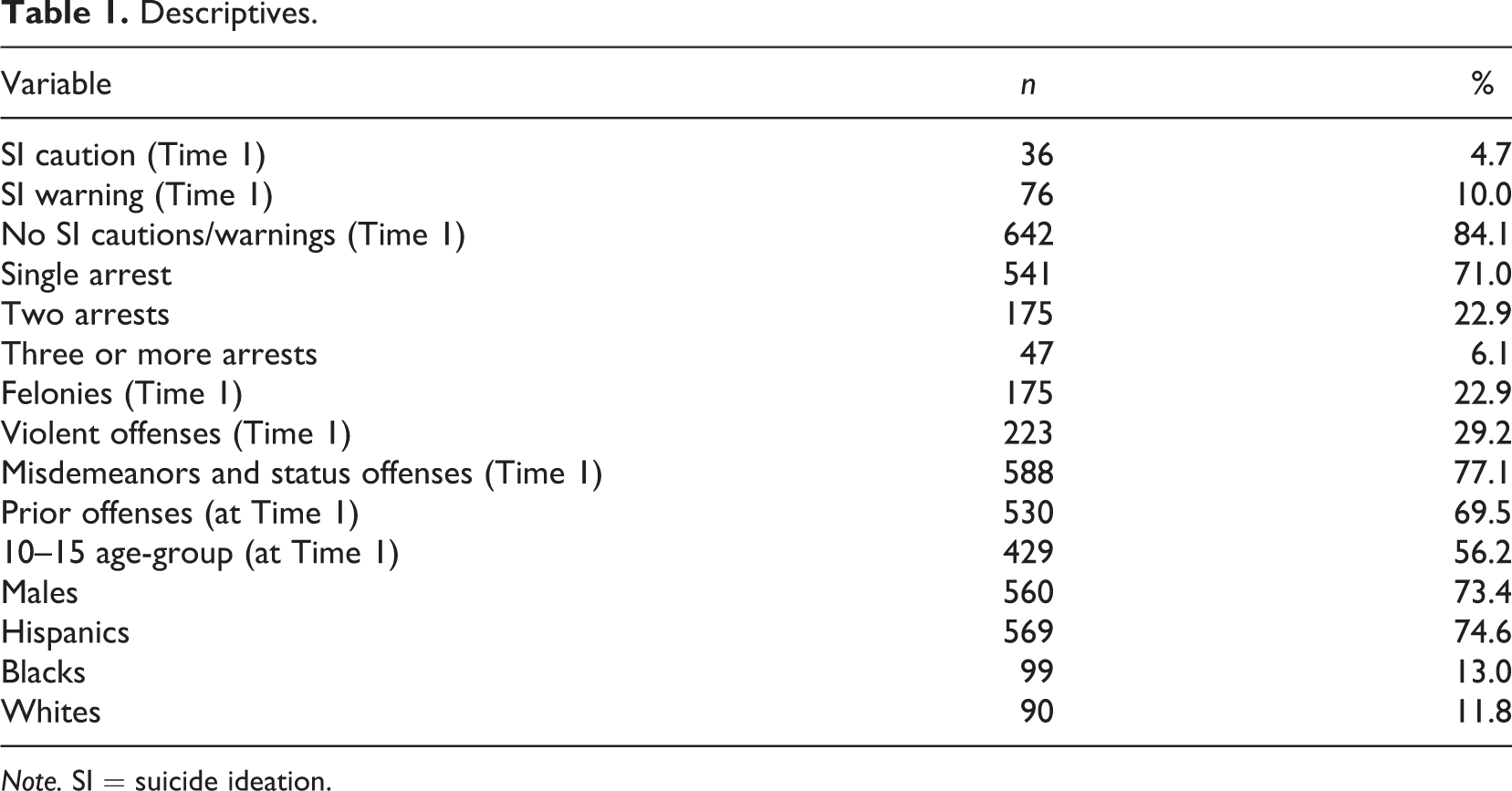
This study sample includes juveniles (N = 763), aged 10–18, who were apprehended, arrested, and detained in the Bexar County Detention Center for incidents occurring between December 1, 2009, and May 31, 2010. The race and ethnic composition of the sample is Hispanic (n = 569, 75%), Black (n = 99, 13%), White (n = 90, 12%), and Other (n = 5, 0.01%); the gender breakdown is male (n = 560, 73%) and female (n = 203, 27%). Regarding age, 56% of the sample is below age 15. Table 1 contains the complete descriptive data for each variable.
Descriptives.
Note. SI = suicide ideation.
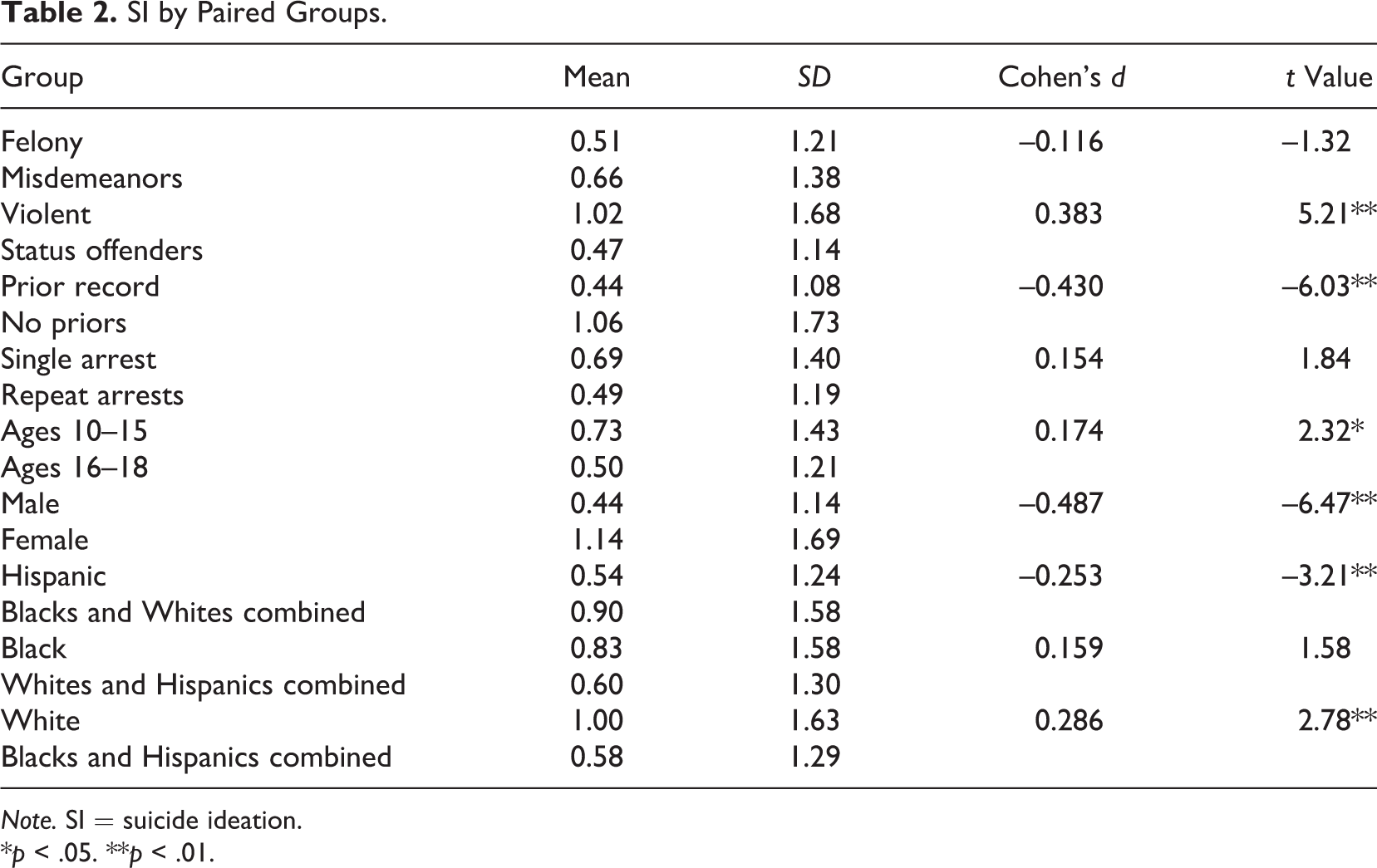
Notably, fewer youth scored Caution (5%) versus Warning (10%) on the SI scale. Most youth were 1 Time arrestees during the 6-month period (71%) and committed either misdemeanors or status offenses (77%). Table 2 contains the average SI scores of various subgroup pairs, which are compared with t-tests to determine whether subgroup differences are statistically significant. Table 3 contains the average SI scores of the subset of repeat arrestees at Arrest Time 1 and Arrest Time 2. Table 4 contains results of the multinomial logistic regression.
SI by Paired Groups.
Note. SI = suicide ideation.
*p < .05. **p < .01.
Repeat Arrestees, SI Means at Time 1 and Time 2.
Note. n = 222. SI = suicide ideation.
*p < .01.
Multinomial Logistic Regression of SI Cutoffs on Legal Items, Age, and Controls.
Note. N = 753. SI = suicide ideation; OR = odds ratio; CI = confidence interval.
We examined two types of data from the Bexar County Juvenile Probation Department as follows: (1) scores from each MAYSI-2 administered to arrestees as part of their detention intake and (2) related offense data for each juvenile offender. All noncustodial arrests, such as “paper arrest” cases where a youth was detained on a warrant for missing a court date or for violating probation, were dropped. In addition, cases with missing data on current and prior offenses were dropped. The study’s hypotheses were tested using t-tests and multinomial logistic regression; our analyses were conducted using SPSS 21.
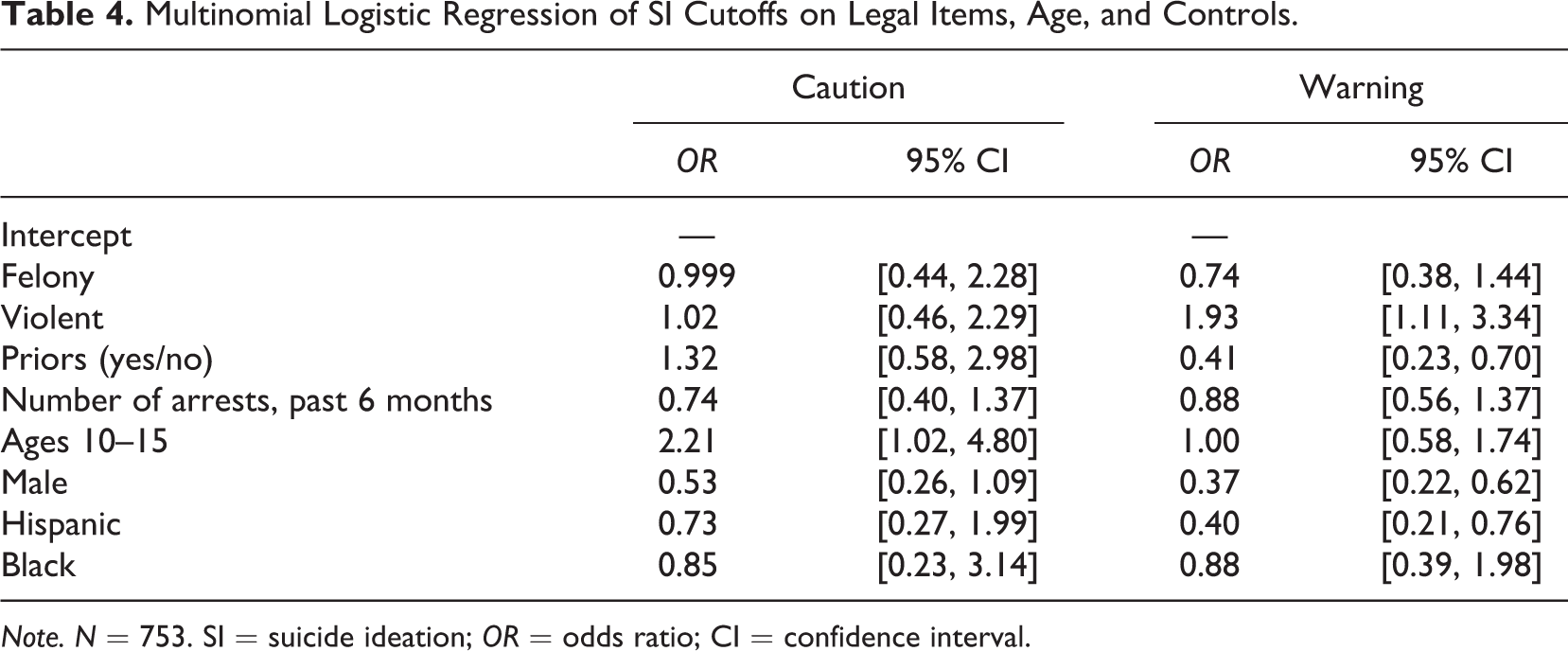
For each hypothesis, we compare the mean scores of youth on the SI scale and use t-tests assuming equal variances on items, to determine whether any observed differences are statistically significant for different groups according to demographic (e.g., race, gender, and age) and legal categories (e.g., offense type, severity, frequency, and history). Multinomial logistic regression is conducted with the independent variables and controls in a model predicting SI scores of Caution or Warning, with No Caution/No Warning as the reference category in order to evaluate hypotheses while controlling for potential confounds. The results will show which variables increase the odds that youth SI scores exceed the Caution and Warning cutoffs. For these analyses, the independent variables, namely, felony, violent, priors, and age 10–15 are measured as dummy variables, coded 0 and 1; the remaining independent variable, the number of arrests during the study’s 6-month period, has a range from 1 to 4. The control items, sex, and race-ethnicity are dummy coded 0 and 1 with female as the reference category for gender and White as the reference category for race-ethnicity.
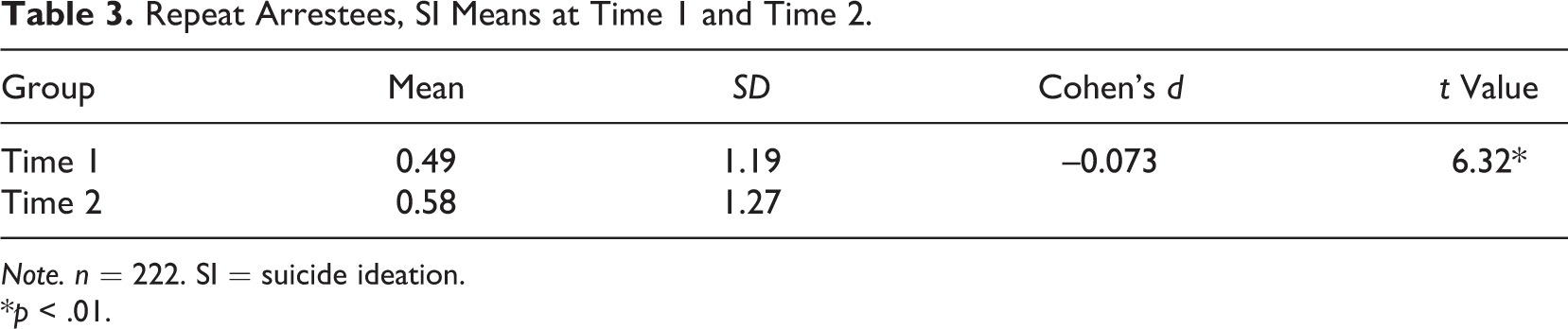
Additionally, for the second hypothesis, three analyses were conducted. First, we examine the difference in SI scores between youth with priors and those without using a t-test. This analysis uses a left-censored time frame because youth in this study range in age from 10 to 18 with some criminal histories extending retrospectively 8 years so the date of first offense is not measured. For the second analysis, the average SI scores at Arrest Time 1 and Arrest Time 2 were compared for a subset of repeat arrestees (n = 222), also using a t-test. This group had two or more arrests during a 6-month period, enabling a test of whether SI scores decrease when a youth reenters the system and retakes the MAYSI-2 within a short time frame (Table 3). Finally, the impact of the number of arrests on the SI thresholds of Caution and Warning is further reexamined using multinomial logistic regression (Table 4).
Results
Our first hypothesis was that offenders who committed serious crime (felonies or violent crimes) would have higher SI scores than less serious offenders who commit misdemeanors or status offenses. In partial support, youth who committed violent crimes had significantly higher SI scores than youth who committed status offenses (t = 5.21, p < .01). In addition, committing a violent offense significantly increased the odds of scoring Warning on the SI scale (OR = 1.93).
Second, we hypothesized that having prior offenses would be negatively associated with SI scores due to a desensitization effect. The first test conducted for this hypothesis (arrest Prevalence) was proven true. Table 2 shows that first offenders had significantly higher SI means ( = 1.06) than youth with priors (M = 0.44) and results were statistically significant (t = 6.03, p < .01). Furthermore, in regression, having prior offenses decreased the odds of a Warning score (OR = 0.40). On the second test (arrest Frequency), results were mixed. First, note that in Table 2, the multiple arrests category had a significantly lower SI mean than the single arrest category, indicative of a desensitization effect. However, when comparing SI scores at arrest time 1 and arrest time 2 only (Table 3), the average score increases significantly during this brief period, opposite of the desensitization prediction in Hypothesis 2. Finally, the multivariate test shows that the odds of scoring a Caution or Warning on the SI scale decrease with the number of arrests, which, although not significant, is indicative of desensitization. For this final test, there is no significant effect and the hypothesis is ultimately not supported.
Results supported the third hypothesis: Younger offenders would score higher than older offenders on the SI scale. The SI mean for the younger age-group (10–15) is significantly higher (t = 2.32, p < .05) than that of the older youth (16–18). Further, the only independent variable that significantly predicts the SI Caution cutoff is the young age-group (OR = 2.21).
The final hypothesis was that race-ethnicity and gender would influence SI scores. As hypothesized, females (M = 1.14) have a much higher SI average than that of males (M = 0.44) and results were statistically significant (t = 6.47, p < .01). Being male also decreased the odds of scoring a Warning on SI (OR = 0.37). Contrary to the second portion of the hypothesis, Hispanics have a significantly lower SI score than Blacks and Whites combined (t = 3.21, p < .01), Blacks had higher SI scores than Whites and Hispanics combined (t = 1.58, n.s.), and Whites had significantly higher scores than Blacks and Hispanics combined (t = 2.78, p < .01). Finally, when race-ethnicity was examined in regression, the only significant results were that being Hispanic decreased the odds of scoring a Warning (OR = 0.40) when compared to Whites.
Discussion
Most research about the MAYSI-2 has not focused on the offense characteristics of the detained youth to which it is administered. This study sought to highlight the relationship between several legal items and SI, with particular attention to some of the temporal issues therein. Ultimately, there was full or partial support for each of the four hypotheses. Where analyses of MAYSI-2 data on Hispanics are sparse in the literature, this study makes a unique contribution in that arena as well.
Contrary to our expectation, youth charged with felonies had lower SI scale means than those with misdemeanors and status offenses. Although the difference was not significant, prior research does show that youth who engage in more serious crimes have higher levels of psychological distress. However, felonies are a broad category and include numerous crimes that may not be perceived to be serious by a juvenile and that do not lead to self-injurious behaviors. For example, in Texas, many property crimes are designated as felonies, but there is no compelling reason to expect for such behavior to be associated with high levels of anxiety in young offenders.
As hypothesized, the SI scale mean for violent offenders was significantly higher than for nonviolent offenders. This finding has implications for direct service staff, particularly because it would not be unusual for these youth to be managed differently from other youth, such as being housed separately or engaged in more intensive services, which are targeted to youth with a history of violence. The training of these staff regarding how they assess and screen for suicidal ideation youth who commit violent offenses should account for the increased potential SI with this group. In addition, the ultimate disposition for a youth who has committed a violent felony versus a status offense is vastly different. It is the norm that youth adjudicated to have committed a violent felony can be sent to the Texas Juvenile Justice Department (TJJD) or a post-adjudication secure correctional facility (Texas Attorney General, 2014).
The second hypothesis addresses the following two competing assumptions: (1) youth with prior arrest experiences would be desensitized to the negative aspects of detention and therefore score lower on an SI scale and (2) anytime a youth is arrested, it is a negative experience, thus SI scores will show no difference or even be higher for those with prior arrests. It is important to note that only about 4–5% of national, representative samples of the youth population will report ever having been arrested (Tapia, 2012), making it a rather rare, and likely traumatic event. It would follow that regardless of the amount of time between arrests, a youth will experience distress about being rearrested and detained, particularly if they had been able to “stay out of trouble” for an extended period of time. Support for either of these ideas in this study was contingent on the timing and number of arrests.
The comparison of SI means for those with prior offenses and those without was a basic, general test in support of the second hypothesis. Indeed, it was a rather large effect, where the average SI score is over twice as large for first offenders as for those with priors. Then, in regression, having prior arrests significantly decreases the odds of scoring a Warning on the SI scale, further indicating that first time arrestees experience higher levels of SI because they fear the unknown about their detention experience. It may also indicate an awareness by repeat offenders of the possible limits of the sanctions that can be imposed by the system when they recidivate over a lengthy time frame. Ultimately, a youth might express feelings of failure or concern, but perhaps not to the extent of producing suicidal ideation.
Among the subset of repeat arrestees within a 6-month period (n = 222), however, there was no desensitization effect. In fact, the average SI scores at the second arrest were significantly higher than at Arrest Time 1. This challenges our ideas about institutionalization effects and emphasizes the importance of the temporal dimension in our study. Given the high prevalence of SI, thoughts, behaviors, and completions in the juvenile justice population, this may be genuine versus being an artificial survey effect. The higher scores are possibly attributed to feelings of failure about being rearrested so quickly or be due to concerns about legal consequences, particularly if the youth had multiple prior arrests and the latest, quickly occurring arrest could result in a more severe disposition. Psychological distress symptoms are also likely genuine since youth with a recent history of detention will have a fresh recall of its many negative aspects (see Mendel, 2009), especially in a large, urban county facility.
Interestingly, two arrests may be a threshold for the effect of multiple arrests on the SI score and the relationship seems to be curvilinear. When the number of arrests (ranging 1–4) within a 6-month time frame measure was used in regression, it did not increase the odds of a Caution or Warning reading. In fact, the number of arrests was negatively associated with SI scores (n/s), which is a reversal of the effect found with only two arrests as described earlier. These results again support our ideas about institutionalization effects where youth having frequent, repeat arrests are “experienced” and seem to have lower levels of mental crisis about this circumstance, yet we recognize the possibility of mis-specification. While we do not employ a squared term on this exploratory article, clearly there is a need to further test the relationship in that manner in future research.
Ultimately, we must also keep in mind that some part of the results may reflect youth manipulation of their responses to the SI items. As noted previously, some youth attempt to mask psychological distress symptoms with deceptive responses to avoid further screening, unwanted interventions, and possibly a lengthier stay in detention. The scores may reflect such savviness, thus more research, perhaps of the qualitative type is needed to further explore this issue with Hispanic youth in the way that it has been done for Black youth (McCoy, 2014).
As hypothesized, younger offenders did have significantly higher SI scores than older youth and being younger significantly predicted scoring Caution, although not Warning. Despite our effort to isolate the age effect in regression, these results may indicate that age serves as a proxy for desensitization due to a prior offense history; the older a youth is the less psychologically distressed they feel. It is also possible that younger offenders are more impacted by being separated from their support system and have concerns about what might happen to them during and after their detention. In a normative framework, the odds of having contact with the juvenile system can only increase with age and thus the age effect may ultimately be a function of past detention experiences.
As expected, females had much higher SI means than males, over twice as high. Those results support the fourth hypothesis and reflect the results from the detention portion of the 2003 national sample (n = 29,817) analyzed by Vincent, Grisso, Terry, and Banks (2008b). The females in the current study (M = 1.14) had almost equal means to those in Vincent et al.’s national sample (M = 1.15) whereas the males in the current study had lower SI means (M = 0.44) than males in that U.S. sample (M = 0.62). The results from our study continue to reinforce prior research that females in the juvenile justice system, and in this case who are detained, experience higher levels of suicidal ideation than their male counterparts. This is possibly because they are in a system that is primarily designed to respond to male needs (Veysey, 2003), leading to much higher levels of psychological distress. It may also be because girls are less likely to be detained and therefore those that are have higher levels of psychological distress (Veysey, 2003). Regardless, it is clear that female juvenile offenders may require a particular focus on feelings of suicidal ideation that may be present.
Finally, consistent with other recent research using MAYSI-2 data (Aalsma et al., 2014), Hispanics had the lowest scores among race groups. They had a significantly lower SI score than Blacks and Whites combined. Whites, meanwhile, had significantly higher scores than Blacks and Hispanics combined. When compared to the national-level data of Vincent et al. (2008b), the most noticeable difference was that Hispanic youth in our study (M = 0.54) scored far lower on the SI scale than they did nationally (M = 0.84). The patterns for White youth, on the other hand, were the same between the two studies (White M = 1.00 in Bexar County vs. M = 0.95 in United States). Finally, Black youth in Bexar scored much higher (M = 0.83) than their counterparts in the United States (M = 0.53). The scores for Hispanic youth stand out as being far lower than expected in Bexar County. These results may reflect that Hispanic youth in this particular context are resilient in the face of typical mental health stressors. Hispanic youth in this sample are nested in a predominately Hispanic community, perhaps echoing research by Locke and Newcomb (2005) showing that the sense of familial support can serve as a protective factor against suicidality. The centrality of family (i.e., familism) which is particularly important for Hispanics (Tienda & Mitchell, 2006) is likely reinforced by their community context. This and the possibility of strong cultural norms against this ideation and practice may help these youth to eclipse their feelings of suicidal ideation. This is all despite often experiencing a high rate of common stressors for depression and mental illness (Gallo, Penedo, Espinoza, & Arguelles, 2009; Umaña-Taylor & Updegraff, 2007), which are certainly present in Bexar County.
Strengths and Limitations
This study used self-report data from the MAYSI-2, which may be unreliable due to social desirability dynamics. Respondents can often answer self-report items in ways that make them appear more positive even when it is untruthful (Holtgraves, 2004). Regarding the MAYSI-2, prior research has shown that juvenile offenders have specifically provided untrue responses to items (McCoy, 2014). Our sample also does not reflect the typical population of the juvenile justice system nor does Bexar County reflect most communities in the United States. These unique features mean that our findings are not generalizable beyond this study or perhaps only to other large Hispanic-dominated counties. Finally, the longitudinal portion of our analyses was restricted to 6 months, which left the extent of repeat offending over a lengthier period unmeasured.
This study also had a number of strengths. We explored the underresearched influence of the level of SI experienced by youth actively engaged in a detention setting and the impact of age, race, ethnicity, gender, and legal offense history on those feelings. We also make a unique contribution by comparing the average scores on the SI scale by crime type, severity, frequency, and timing of detention in a large, Hispanic dominated urban county. The composition of Hispanic youth as the majority in the study sample and in a setting that is predominately Hispanic provided an opportunity to examine a rarely focused on group, particularly in studies about or using the MAYSI-2.
There is a paucity of research looking at the temporal relationship between offending behaviors and the presence of suicidal ideation. This study provides exploratory insight into that relationship as well as on gender and race-ethnicity differences. Finally, although the analysis of the 6-month time frame may have limited the findings, our comparison of SI scores for repeat arrestees at Arrest Time 1 and Arrest Time 2 to determine whether outcomes vary when a youth reenters the system frequently is certainly a unique contribution to the literature in this subarea of juvenile research. We now have some insight into the role that first offense and repeat arrests may have on suicidal ideation. This information can be instrumental in informing how direct service staff monitors such youth when they return to detention.
Future Research
This study’s population was youth detained in a county detention facility versus in a state correctional facility. This fact is important when considering the implications of our findings because in Texas, as in many other places, state corrections facilities are the most serious placement setting with only adult facilities classified as more serious (TJJD, 2013). State facilities range broadly in sentence severity; and in Texas, there are youth with indeterminate sentences who are placed in low, medium, or high security risk facilities and youth with determinate sentences that include an eventual transfer to an adult facility (TJJD, 2013). In addition, youth in a state correctional facility experience minimum length of stay requirements ranging from 9 to 24 months, dependent on severity of offense and risk to public safety. Conversely, the county detention facility, used during the pre-trial phase of juvenile processing, is where youth are taken by law enforcement when they have been arrested for a delinquent offense (Bexar County Juvenile Probation Department, n.d.b). Furthermore, after being seen by an intake probation officer, a decision is made regarding whether to release or detain the youth (n.d.b.).
The findings from this study begin to fill an important gap in the literature, but their applicability should be viewed in context—focused on youth who have not been adjudicated and sentenced. If we studied youth in state correctional facilities, we might expect for the impact of incarceration on SI to be even more evident than it was here. The difference between temporary confinement in one’s community versus removal from the community, and long-term incarceration causing separation from family and friends, should weigh more heavily on a youths’ state of mind and likely raise the odds of mental health crisis. Thus, it is important to acknowledge that this study captures a different contextual dynamic related to suicidal ideation for juvenile offenders. Future research should build on this study and explore how the temporal relationship between SI and offending behavior manifest for youth who have been adjudicated and are housed in state correctional facilities.
Future research on the county detention phase of incarceration should also further explore the relationship between offending behavior and SI using a squared term for the number of arrests to capture the nonlinearity of the effect that we seem to have detected here. More research is also needed to understand how detention may impact the suicidal ideation of youth arrested for violent offenses, younger offenders, and girls. At a minimum, for most youth, arrest and detention are serious events that may reflect engaging in other forms of risky, problematic behavior. Clearly, part of this dynamic may include careless, impulsive, and self-destructive tendencies. This possibility coupled with the potential outcome for failing to accurately identify a youth’s SI suggests the need for additional, or at minimum more in-depth, screening.
The relationship of race-ethnicity to SI also requires more study. The literature we reviewed on national-level estimates of SI by race-ethnicity contains conflicting estimates regarding which group has the highest levels of SI. Our results showing Hispanic ethnicity to be a protective factor against SI in detained youth appears to be the first such finding with MAYSI-2 data, albeit from a particular context and locale. We are nonetheless encouraged by this and call for continued research in this area that expands the model specification in the way we propose earlier and that replicates the model in other places with sizeable Hispanic populations.
Footnotes
Acknowledgment
The authors wish to thank Erin Wit for her early work on this project.
Declaration of Conflicting Interests
The author(s) declared no potential conflicts of interest with respect to the research, authorship, and/or publication of this article.
Funding
The author(s) received no financial support for the research, authorship, and/or publication of this article.