







Abstract
Scholars have tested Becker’s master status thesis on criminal justice system outcomes, yet have been unable to disentangle the label from behavioral characteristics. To clarify the effects of labels, we used archival juvenile court data to test Becker’s master status through the effects of gang affiliation on case disposition. Stratified multivariate regression models revealed consistent effects of predictors—mental health needs, offenses per case, felony offense, and pretrial detention—on case referral to juvenile court across the gang-affiliated demarcation. The static effects of legal predictors across the gang demarcation levy questions about the legal consequences of labels.
Labeling theories rely on the assumption that how one is treated is based on others’ perceptions of them and their individual characteristics. This label becomes the lens through which all future behavioral expectations are created. Labeling theorists posit that involvement in the criminal justice system has persistent consequences, especially when the criminal label becomes a “master status” (Becker, 1963). The master status—that social identity that trumps all other social statuses—is the linchpin connecting social status and consequences.
Scholars interested in the gang phenomenon have observed the determinants of gang association (gang membership), the magnitude of membership (frequency and length of membership), and the consequences—both criminal and legal—of gang membership (recidivism and master status). Studies on the determinants of gang association have identified several environmental and individual factors (Decker, Melde, & Pyrooz, 2013; Hoeben, Meldrum, Walker, & Young, 2016; Pyrooz, Turanovic, Decker, & Wu, 2016; Voisin, King, Diclemente, & Carry, 2014; Watkins & Taylor, 2016), and scholars have suggested gang membership is a fleeting experience for most (Gilman, Hill, Hawkins, Howell, & Kosterman, 2014; Merrin, Hong, & Espelage, 2015; O’Neal, Decker, Moule, & Pyrooz, 2016; Pyrooz, 2014). There is also evidence of criminal persistence associated with gang affiliation, suggesting gang involvement increases the risk of recidivism for those offenders already processed through the criminal and juvenile justice systems (DeLisi, Spruill, Peters, Caudill, & Trulson, 2013; Dong & Krohn, 2016; Dooley, Seals, & Skarbek, 2014; Drury & DeLisi, 2011). In conjunction with official recidivism measures, scholars have suggested that the gang member label, when applied by the criminal justice system, may override other social statuses (Brownfield, Sorensen, & Thompson, 2001; Miethe & McCorkle, 1997; Zatz, 1985).
Scholars interested in the legal consequences of gang affiliation have applied Becker’s (1963, p. 33) master status label, where being perceived as a gang member permeates and downgrades the influence of other identified correlates of formal processing through the criminal and juvenile justice system (Brownfield et al., 2001; McCorkle & Miethe, 1998; Pyrooz, Wolfe, & Spohn, 2011; Zatz, 1985). Studies concerning the effects of the gang affiliation status on case processing, however, have produced mixed findings. Inconsistent effects of the gang affiliation status across samples and statistical modeling have produced findings ranging from no independent effects of gang affiliation on case processing to gang affiliation serving to divert subjects from the criminal justice system.
The current study furthers the line of scholarship concerning the interplay between gang status and the application of law. Data originated from a large southern state’s juvenile justice case management system and included 5,111 (nongang = 4,399; gang = 712) subjects, with 31% of cases being formalized in the juvenile court. Reported here are the results, and related discussion, of a quasi-experimental research design comparing the influence of environmental (mental health and abuse history) and behavioral (number of offenses, weapon-involved offense, and offense level) characteristics on case formalization for nongang and gang status groups, while controlling for demographic and regional effects. Specifically, our analyses include stratifying the sample by the gang-affiliated marker and then comparing statistically the correlation between established predictors of formal case processing across these groups. This approach contributes to the understanding of gang status within the legal context through application of a unique statistical approach on case dispositional outcomes. The overarching interest is in the relationship between the social status of being gang affiliated and the application of law through legal formalization.
Literature Review
There has been a tendency in the scholarly work to suggest that the application of law is based on social status. From a social psychology perspective, Lemert (1951) theorized a process of criminogenic enhancement resulting from being labeled criminal, thus, suggesting the application of law inherently breeds individual criminality. From a sociolegal perspective, Black (1976) theorized the application of law upon individuals, in addition to macrolevel factors, was based on perceived social integration. In other words, one’s social integration (e.g., contribution to the workforce) has an influence on the magnitude of law they experience. Within both of these theoretical frameworks rest the concept of social labels, where social status affects self-perception and legal response. What is less clear in the sociolegal arena is what social factors drive the application of law.
Linchpin Consequences
The labeling paradigm is based on the idea that societal reaction to criminal behavior contributes to future criminal behavior. Lemert (1951) suggested deviance can be organized into primary and secondary, where primary deviance refers to the initial act of antisocial behavior and secondary deviance is the product of societal responses to individual deviance. The idea of secondary deviance suggests that primary deviance changes the lens through which others perceive that individual and the label of delinquent or criminal is applied. Over time, this transforms the delinquent’s self-image to define themselves as a criminal, thus perpetuating crime involvement. Lemert’s (1951, 1967) work focused on the consequences of being labeled a delinquent, but disentangling the delinquent label from the delinquent tendencies of those so labeled has presented a formidable obstacle in assessing the secondary consequences of this process (Barrick, 2014; Jackson & Hay, 2013; Ward, Krohn, & Gibson, 2014). In a novel attempt to isolate the delinquent label from behavior, Thomas and Bishop (1984) constructed an index of delinquent self-identity and explored the longitudinal consequences of self-identity on later delinquent involvement among middle school and high school students. Their findings did little to support the idea of a reactive delinquent self-image, where individual self-image is manipulated by formal sanctions. On the contrary, they discovered a correlation between previous delinquent behavior and later enhanced delinquent self-image, suggesting self-image was more closely tied to previous behavior than sanctioning.
Of particular interest in this context is the master status concept, first proposed by Hughes (1945) but further refined by Becker (1963). Master status is the role that one is most commonly identified with; essentially, it is the primary identifying characteristic for an individual that dictates societal responses. Hughes (1945) explained that the master status evolves into the dominant lens through which our behavior is interpreted or classified, causing us to be categorized in a way that constrains us to that label. Applying this concept to deviant behavior, Becker (1963) proposed that the “criminal” master status could have detrimental effects on outcomes not only for general societal acceptance but also throughout the criminal justice system. Applying the criminal master status could mean the justice system and society as a whole see this person as committed to a life of crime with little to no hope for change, resulting in disparate treatment. Accordingly, a person commits illegal acts due to the expectations for their behavior based upon this delinquent status, which further propagates such conduct—resulting in a self-fulfilling prophecy of continued criminal behavior (Becker 1963).
Despite its placement as a key criminogenic factor in labeling theory, the concept of master status has received little direct empirical attention in the criminal justice literature. Gang affiliation as a master status has only been tested by a couple of studies with mixed results. Miethe and McCorkle (1997) tested Becker’s master status concept and found that those labeled as gang members had a higher probability of having their charges dismissed and that, if they were found guilty, they received shorter prison sentences. They found support for gang membership as a master status in that a number of legal and extralegal factors, such as race, prior record, and offense severity, significantly predicted outcomes for nongang members; however, the only factor found to influence sentencing decisions for gang members was offense severity. The authors viewed this as evidence that decisions were based on a host of factors for nongang members, but for gang members, their status as a gang member superseded all other considerations.
Brownfield, Sorensen, and Thompson (2001) also tested Becker’s master status concept and found that gang and nongang affiliates had similar odds of arrest, which appears to be evidence against the consequences of the gang member label. Gang membership failed to significantly predict arrest when controlling for self-reported delinquency, while race and social class were independently associated with arrest. Their study did not separate gang and nongang members to assess the influence of key factors on arrest, as was done in Miethe and McCorkle’s (1997) study, so it may be viewed as an incomplete test of the master status concept.
The lack of a general consensus regarding gang affiliation as a master status in the limited available research served as a rationale for our current study. Further, the present analyses include a wider range of extralegal factors that may act upon the labeling process (such as mental health needs and abuse history), as suggested by prior research on the topic (Miethe & McCorkle, 1997).
Mastering Gang Status
While definitional issues concerning gang affiliation abound (Decker & Kempf-Leonard, 1991; Jacobs, 2009; Kennedy, 2009; Spergel, 2009), numerous studies conclude that gang-affiliated youth are more criminally involved as both offenders and victims (DeLisi, Barnes, Beaver, & Gibson, 2009; Esbensen & Huizinga, 1993; Gibson, Swatt, Miller, Jennings, & Gover, 2012; Webb, Katz, & Decker, 2005; Thornberry, Krohn, Lizotte, & Chard-Wierschem, 1993; Zhang, Welte, & Wieczorek, 1999). While there are competing perspectives regarding pregang delinquency among those who later join a gang and those who remain unaffiliated (see Esbensen & Huizinga, 1993; Thornberry et al., 1993), gang affiliation consistently appears to facilitate criminal opportunities and condone such behavior in its circles. Further, gang affiliates have been shown to be more likely to recidivate and do so sooner than their counterparts (Benda & Tollett, 1999; Caudill, 2010; Huebner, Varano, & Bynum, 2007; Benda & Tollett, 1999; Trulson, Marquart, Mullings, & Caeti, 2005). Indeed, Venkatesh (2008) portrayed the gang leader as the highest position, a position garnered through violence, on the social hierarchy in Chicago projects.
The overarching assumption concerning gang affiliation as a master status would be that such affiliation would lead to disproportionate responses from the criminal justice system. In support of this argument, there is evidence that gang-affiliated youth are more likely to be arrested (Katz, Webb, & Schaefer, 2000; Trulson et al., 2005), have contact with law enforcement (Curry, 2000; Klein, 1995), and experience formal processing and institutional commitment (Shelden, Snodgrass, & Snodgrass, 1992). Some scholars have found more nuanced results in their attempts to demonstrate disproportionality in rearrest between gang and nongang youth (Brownfield et al., 2001; Caudill, 2010). It is also possible, though, that gang-affiliated subjects experience less punitive system responses (Caudill, Trulson, Marquart, & DeLisi, 2017; Miethe & McCorkle, 1997; Pyrooz et al., 2011).
Interestingly, a dichotomy exists between the perceptions of prosecutors and the actions of the court concerning gang affiliates. Research suggests prosecutors consider gangs to be a priority issue (Maxon, Hennigan, & Sloan, 2005), where prosecutors generally regard gang-affiliated youth as more serious and chronic offenders and view any criminal involvement by a known affiliate to be a gang-related offense (Fox & Lane, 2010; Johnson, Webster, Connors, & Saenz, 1995). However, the operational definition of gang affiliation is one of little to no consensus, and gang affiliation may actually insulate offenders from harsher sanctions (Caudill et al., 2017; Pyrooz et al., 2011). Caudill, Morris, El Sayed, Yun, and DeLisi (2013), for example, showed that legal factors such as offense severity superseded extralegal factors (such as gang affiliation) when predicting juvenile court case disposition. Collectively, these findings suggest that gang affiliation contributes little to the processing of cases, and when it does, it acts to insulate the offender from deeper penetration into the system.
Previous studies on the coupling effects of gang affiliation as a master status on criminal justice system processing have suffered from methodological limitations. For example, Caudill, Trulson, Marquart, and DeLisi (2017) discovered that confirmed gang affiliation had disproportionate influence on prosecutorial outcomes compared to suspected gang affiliation among juvenile offenders, but the inability to statistically test this disproportionate effect limits inference. The same holds true for other studies focused on the influence of gang affiliation (Brownfield et al., 2001; Caudill et al., 2013; Pyrooz et al., 2011). Miethe and McCorkle (1997), in their test of gang membership as a master status, stratified their sample by gang membership to assess the disproportionate influences of covariates on case outcomes (charges dismissed in Model 1 and prison sentences in Model 2). While Miethe and McCorkle’s work comes closest to empirically assessing the effects of gang affiliation on case processing, their study used overall model fit statistics as the metric for disproportionality in outcomes: “the analysis of sentencing decisions revealed that an interactive model significantly improved the fit over the main effects model, and these differences existed because offender and offense attributes were more important in nongang cases” (p. 419). While model fit statistics provide evidence of how well the model works with the data structure, this approach lacks an ability to discern statistically the influence of covariates across stratified subsamples of nongang and gang-affiliated subjects. Collectively, previous studies have been limited by methodological design in their attempts to decouple labels from actions and thus estimate the consequences of labels.
Current Study
Although previous studies have discovered a master status effect where gang affiliation mediated the influences of other correlates of case processing, other studies have produced results counter to the master status thesis. These mixed findings concerning the gang affiliate label and limited methodologies served as the motivation for this study. The labeling theory paradigm has been hindered by the inability to disentangle criminal behavior from the criminal label. By using confirmed gang affiliation as the master status, this study permits estimation of the effects of a master status on case disposition while controlling for criminal behavior. According to the labeling theory framework, gang-affiliated subjects should experience more severe case dispositions through the master status coupling principle than nongang-affiliated subjects. Furthermore, the master status effects of gang affiliation should distort other relevant covariates of juvenile court referrals. Based on this orientation, this study compared statistically the correlations between predictors of formal case processing across nongang and confirmed gang subsamples.
Method
Data
Data originated from a large southern state’s juvenile justice case management software system. These data contained offense-related and demographic information for all juveniles under the age of 16 years referred to juvenile services during 2005 for delinquent and status offenses. 1 Included in this study were male offenders referred in four large metropolitan counties with robust reporting practices. All confirmed gang members meeting these criteria (n = 712) were compared to 4,399 nongang-affiliated youth. This allowed for the analysis of prosecutorial outcomes for 5,111 offenders.
Measures
Independent variable
The main independent variable in this study was a binary indicator of gang affiliation (0 = nongang, 1 = confirmed gang). While the gang-affiliated label required probation officers to triangulate information—through self-admission and parental confirmation, for example—this study was focused on the impact of the label as a master status rather than gang affiliation as a measure of actual gang activity.
Determinants of case processing
To estimate the effects of gang affiliation on case processing, we observed the variance of several extralegal and legal determinants of case processing. A number of extralegal indicators were included, such as race (a series of binary indicators for Black, Hispanic, and White, where White served as the reference category), mental health needs (0 = no mental health needs, 1 = confirmed mental health needs), experiences with abuse (0 = no abuse history, 1 = known physical, sexual, and/or emotional abuse), and admission age. Additionally, factors relevant to the offense were also included. The number of offenses committed, use of weapon (0 = no weapon, 1 = weapon), and felony offense (0 = nonfelony, 1 = felony) was controlled for in these analyses.
Dependent variable
The dependent variable in this study was formal case disposition measured as a binary indicator (0 = informal, 1 = formal). Informal dispositions included all case terminations not involving a court petition for charges and formal disposition included cases where the prosecutor filed a petition alleging delinquency. Previous studies have tested the master status of gang affiliation at arrest and sentencing with mixed results. These inconsistent findings provide the need to further explore this phenomenon from a prosecutorial processing prospective.
Analytical Procedure
Following the logic of Miethe and McCorkle (1997), logistic regression was used to assess the viability of gang association as a master status in referral to juvenile court. The first model included gang affiliation as a predictor variable in referral to juvenile court while holding constant other variables.
To test the notion of differential treatment for confirmed gang affiliates, the sample was stratified by gang membership status (nongang affiliates and confirmed gang affiliates) and separate logistic regression models regressed juvenile court referral on extralegal and legal factors. The analysis protocol included a comparison of the coefficients and standard errors describing the association between each covariate and the dependent variable across (nongang affiliated and confirmed gang affiliated) models (Brame, Paternoster, Mazerolle, & Piquero, 1998; Eliason, 1993; Paternoster, Brame, Mazerolle, & Piquero, 1998). Resulting statistically significant z-scores would lend support to the labeling hypothesis that confirmed gang affiliates receive disproportionate legal consequences compared to nongang-affiliated subjects, while holding constant legal and other extralegal considerations.
Results
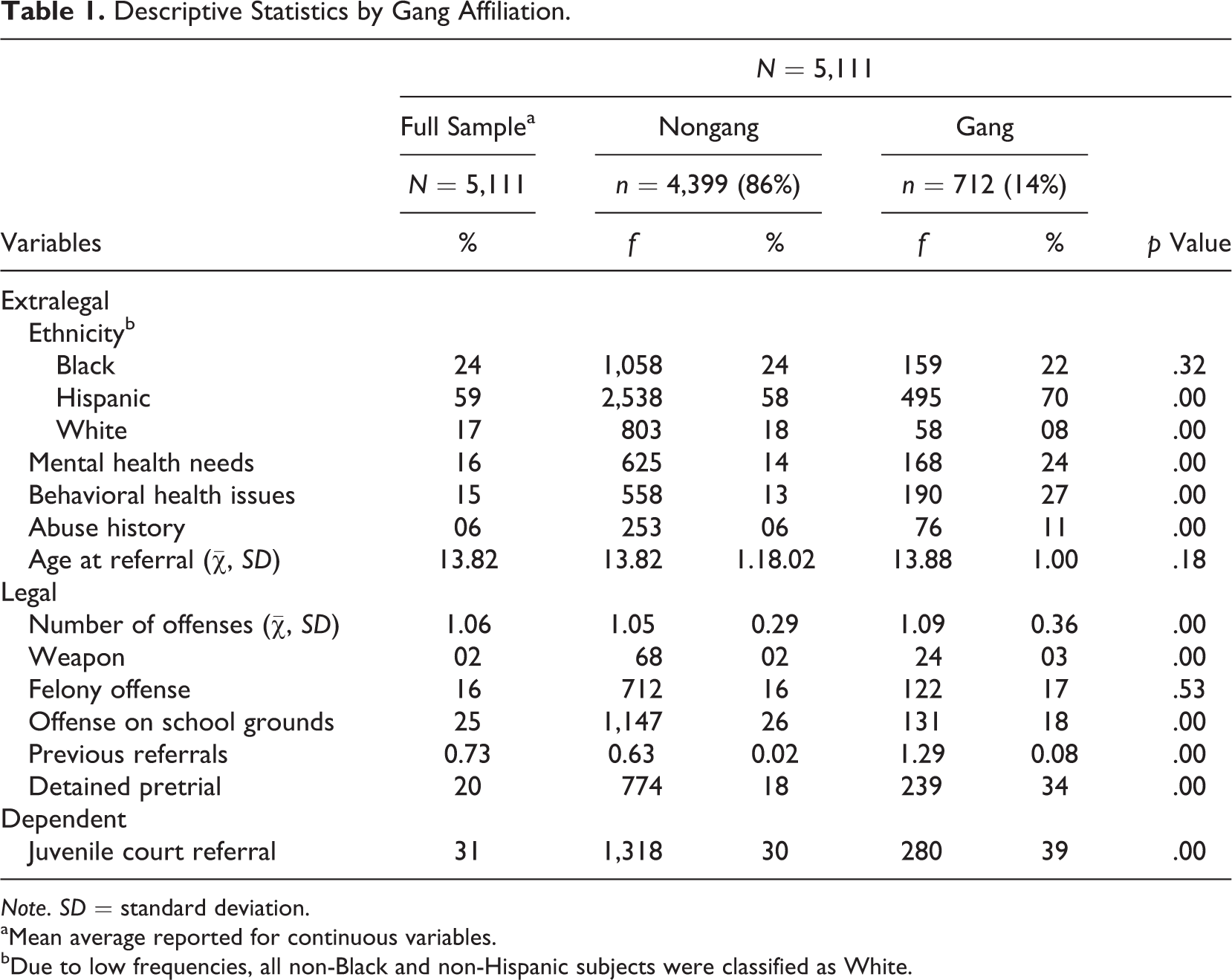
Table 1 provides sample descriptive statistics for the full sample and compares characteristics across nongang affiliates and confirmed gang affiliates. Of the 5,111 subjects in this study, approximately 14% (n = 712) were confirmed gang affiliates, with 24% classified as Black, 59% classified as Hispanic, and 17% classified as White. 2 Of the full sample, approximately 16% reported mental health needs, 15% reported behavioral health issues, and 6% reported previous abuse. On average, subjects included in this study were just younger than 14 (13.82) years old at referral. From a legal perspective, the average number of charges per case was just over one (1.06), 2% of the full sample were charged with using a weapon in the commission of their crime, approximately 16% were referred for a felony offense, and approximately one quarter of the full sample committed their referral offense on school grounds. Criminal histories of the full sample indicated the average subject had just one previous referral (0.73) and one fifth of the subjects were detained for their referral offense. Approximately one third (31%) of the full sample were referred to juvenile court for their current offense.
Descriptive Statistics by Gang Affiliation.
Note. SD = standard deviation.
aMean average reported for continuous variables. bDue to low frequencies, all non-Black and non-Hispanic subjects were classified as White.
Bivariate comparisons of the nongang affiliates and confirmed gang affiliates in Table 1 provide further statistical descriptions of the subsamples. While the nongang-affiliated subjects were statistically similar to their confirmed gang-affiliated comparison group in some respects (i.e., Black, age at referral, and current offense level [felony: 0/1]), these groups differed significantly in the majority of the covariates. Confirmed gang members were significantly more often Hispanic (70% compared to 58%, p < .01), reported more mental health needs (24% compared to 14 for nongang affiliated, p < .01), behavioral health issues (27% compared to 13%, p < .01), and abuse victimization (11% compared to 6%, p < .01) than their nongang-affiliated contemporaries. From a legal perspective, confirmed gang affiliates had a significantly greater number of charges pertaining to the current referral (1.09 compared to 1.06, respectively, p < .01), had significantly more weapons offenses (3% compared to 2%, respectively, p < .01), and significantly fewer committed their current offense on school grounds (18% compared to 26% of nongang-affiliated subjects, p < .01). Confirmed gang affiliate cases were more complex than nongang-affiliated cases in that gang-affiliated subjects had a significantly greater number of previous referrals (1.29 compared to 0.63) than nongang-affiliated subjects. Along those lines, confirmed gang affiliates more often experienced pretrial detention (34% compared to 18%, p < .01). Specific to the dependent variable, confirmed gang affiliates more often had their cases referred to the juvenile court compared to their nongang counterparts (39% compared to 30%, p < .01). These differences, in addition to describing the sample, help to clarify the importance of using multivariate modeling when comparing juvenile court referral outcomes.
Juvenile court referral regressed on legal and extralegal covariates
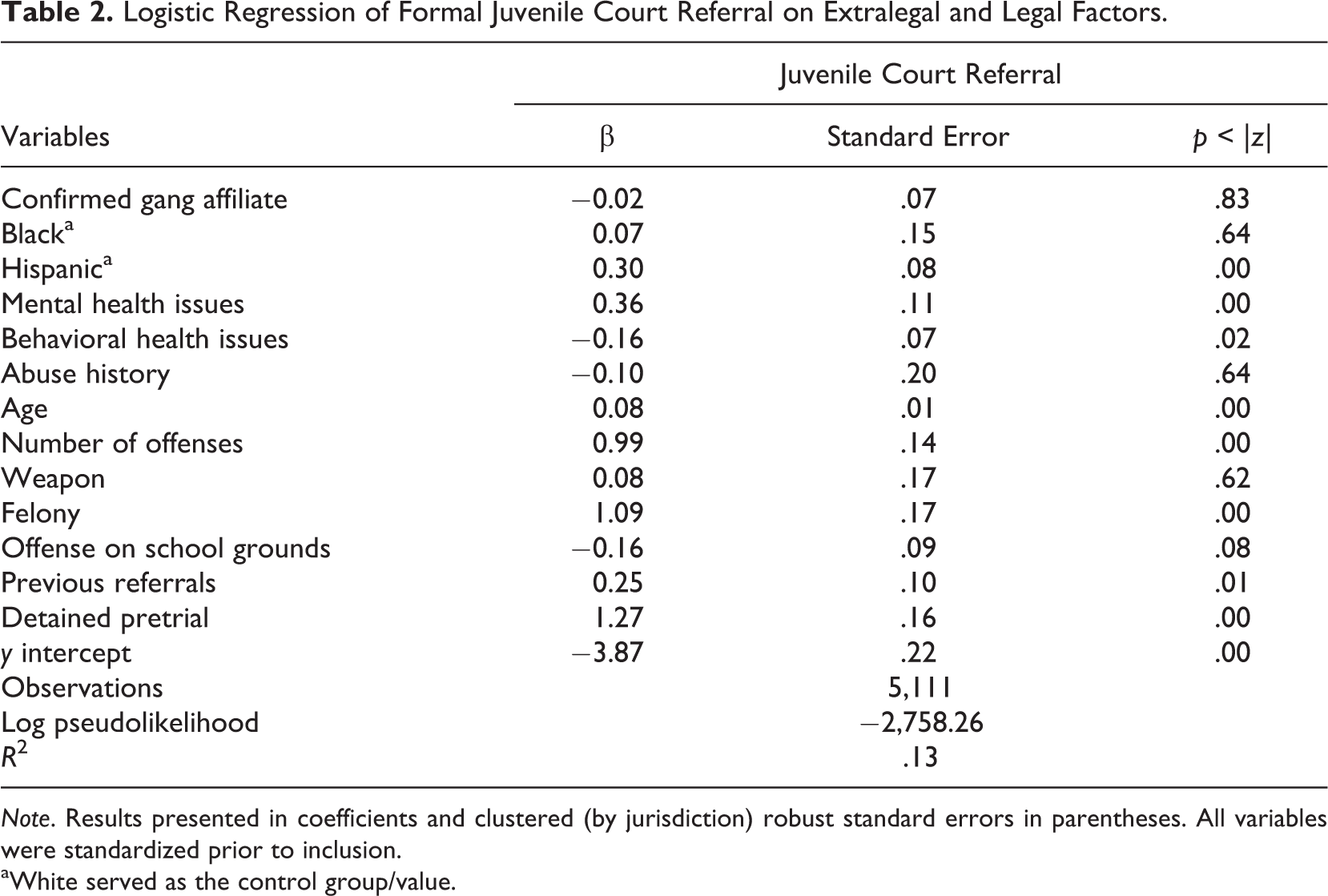
Table 2 presents the results of a multivariate logistic model regressing referral to juvenile court on confirmed gang affiliation and other extralegal and legal control variables. 3 After controlling for other covariates, confirmed gang-affiliated subjects were no more or no less likely to experience juvenile court referral compared to the nongang-affiliated subjects. Of note, though, are several findings. Hispanic subjects (b = 0.30, p < .01, compared to White subjects), subjects reporting mental health needs (b = 0.36, p < .01), and older juveniles (b = 0.08, p < .01) were significantly more likely to have their cases referred to the juvenile court. Conversely, those with behavioral health issues were significantly less likely (b = −0.16, p < .05) to experience juvenile court referral.
Logistic Regression of Formal Juvenile Court Referral on Extralegal and Legal Factors.
Note. Results presented in coefficients and clustered (by jurisdiction) robust standard errors in parentheses. All variables were standardized prior to inclusion.
aWhite served as the control group/value.
From a legal perspective, those subjects with a greater number of current offenses and those charged with a felony were significantly more likely to experience a juvenile court referral (b = 0.99, p < .01 and b = 1.09, p < .01, respectively). Those cases referred to juvenile court were significantly more likely to involve recidivists (previous referrals b = 0.25, p < .05) and offenders who were detained before referral to the juvenile court (b = 1.27, p < .01). These findings aside confirmed gang affiliates were no more or no less likely to have their case referred to the juvenile court after controlling for other relevant factors.
Stratified modeling by nongang and confirmed gang subsamples
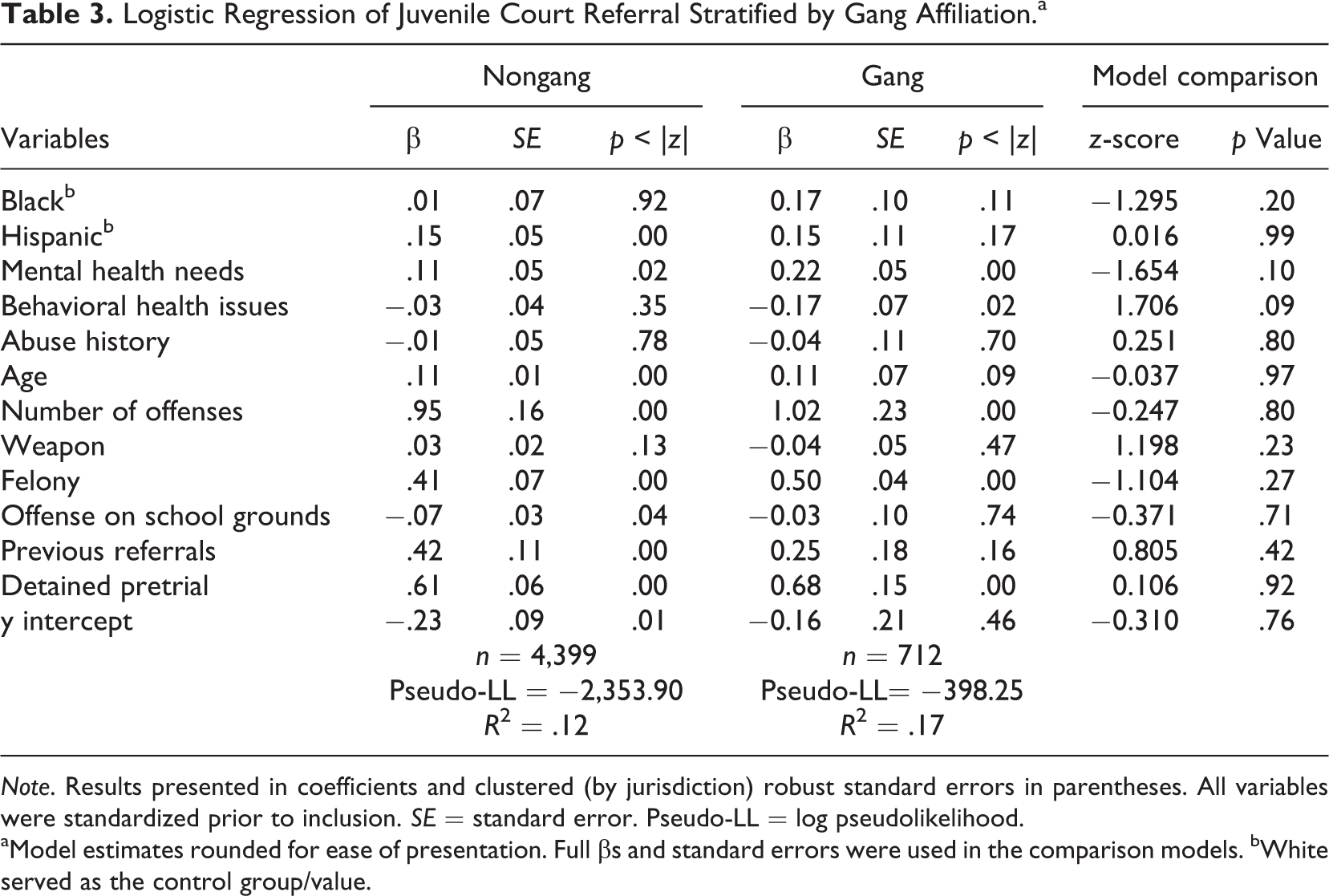
Stratifying the models by nongang members and confirmed gang members (see Table 3) allows for comparison of coefficients across subsamples. Many of the nongang and confirmed gang subsample coefficients mimicked one another, suggesting similar effects of the independent variables. For example, Black subjects were no more likely to have their case referred to the juvenile court than White subjects and mental health needs significantly increased the likelihood of juvenile court referral in both subsamples. Behavioral health issues was not a significant predictor of juvenile court referral among nongang-affiliated subjects, but it was among confirmed gang affiliates (b = −0.17, p < .05) and many of the legal factors (i.e., number of offenses, felony offense, and pretrial detention) remained stable across the subsamples. The number of previous referrals was significantly correlated with a greater likelihood of juvenile court referral for nongang-affiliated subjects (b = 0.42, p < .01) but not for confirmed gang-affiliated subjects.
Logistic Regression of Juvenile Court Referral Stratified by Gang Affiliation.a
Note. Results presented in coefficients and clustered (by jurisdiction) robust standard errors in parentheses. All variables were standardized prior to inclusion. SE = standard error. Pseudo-LL = log pseudolikelihood.
aModel estimates rounded for ease of presentation. Full βs and standard errors were used in the comparison models. bWhite served as the control group/value.
Z-scores were calculated to compare the effects of coefficients across the subsamples of nongang-affiliated subjects and confirmed gang-affiliated subjects (Brame et al., 1998; Eliason, 1993; Paternoster et al., 1998). 4 Resulting z-scores and associated p values provide a significance test comparison of the differences in coefficients and standard error values between subsample models. As reported in the last two columns of Table 3, the included covariates, while significantly correlated with referral to juvenile court, were statistically indifferent in their effects across the nongang and confirmed gang-affiliated subsamples.
Discussion
Previous studies focusing on gang affiliation as a master status have produced mixed results. Becker (1963) suggested certain deviant behaviors result in a master status, where criminal becomes the reference to those who commit crimes. In this description, the master status has a distinct negative connotation and should result in more negative or severe criminal processing. Brownfield and colleagues (2001) rejected the master status thesis for gang affiliation in their assessment of group hazard in arrest decisions. Miethe and McCorkle (1997), on the other hand, stratified their sample of felony cases processed by the Clark County, NV, District Attorney’s Office and discovered disparate effects for predictors of case processing across nongang and gang-identified defendants. Although gang affiliation mediated the effects of criminal history on charge dismissal and, likewise, the effects of criminal history and firearm-involved offense on the delivery of a prison sentence, it remains unclear if differences in coefficients for these predictors of case disposition were significantly different across gang status. More recently, Pyrooz, Wolfe, and Spohn (2011), while controlling for a host of offense-specific variables, found gang-affiliated suspects were significantly more likely to have their case dismissed, but this association failed to consistently predict case dismissal across the implementation of a specialized prosecution unit. Caudill et al. (2017) findings suggest a more complex effect of gang affiliation on case outcomes, where confirmed gang affiliation and suspected gang affiliation differentially impacted the range of potential case dispositions. However, like other previous studies of the gang-affiliated label and case processing, their study was unable to make a definitive conclusion about the master status of gang affiliation.
This study addressed this limitation by exploring the mediating effects of gang affiliation on other established predictors of case processing. Based on previous findings on gang affiliation and case dispositions (Caudill et al., 2017; Miethe & McCorkle, 1997; Pyrooz et al., 2011; Zatz, 1985), we included structural indictors of the individual (i.e., race, mental health, history of abuse, and age), several criminal history variables (i.e., number of offenses, offense level, and weapon-involved offense), and measures to control for local practices. Bivariate results comparing covariates (Table 1) across nongang and confirmed gang affiliation revealed several significant differences between these groups. While nongang and confirmed gang affiliates were statistically similar in regard to their age at referral and the severity of their charges (felony), confirmed gang affiliates were significantly more often Hispanic than White, to have recorded mental health needs and behavioral health issues, to have experienced some form of abuse, to be charged with more offenses per case, to have used a weapon in the commission of their current crime, to have more sophisticated criminal histories, and to experience pretrial detention and a juvenile court referral.
Preliminary multivariate findings (Table 2) indicate confirmed gang affiliation did not make a significant contribution to the decision to refer a case to juvenile court after controlling for other relevant factors. Table 3 reported the results of stratified (by nongang and confirmed gang affiliation) multivariate modeling of the covariates associated with juvenile court referral. Notably, some covariates produced static and significant influences on juvenile court referrals, including mental health needs, the number of offenses per case, the severity of the offense (as measured through the offense being classified as felony), and if the subject was detained during pretrial. While correlation statistics varied across these models, z-scores produced through comparing these results indicate no significant differences for the interactions between covariates and juvenile court referral across the nongang and confirmed gang affiliate subsamples. These findings suggest confirmed gang affiliates did not experience disproportionate treatment based solely on their known gang status.
The strong and unconditional influence of legal factors predicting case processing fits well with the expectations of the literature. Offense severity and the number of offenses weighed heavily in the decision to refer a case to the juvenile court, regardless of individual characteristics and independent of gang status. These findings are consistent with a deep body of literature on system response and recidivism (e.g., Brownfield et al., 2001; Caudill et al., 2013, 2017; Huebner et al., 2007; Ozkan, 2016; Pyrooz et al., 2011; Thornberry et al., 1993; Trulson et al., 2005). Ultimately, a history of criminality facilitated referral to the juvenile court, much like the relationship between criminal history and recidivism.
Contrary to the persistent influence of criminal history on the decision to refer a case to juvenile court, the influence of gang affiliation on juvenile court referral was, for all intents and purposes, nonexistent. As demonstrated here, confirmed gang affiliation was not a statistically significant factor in juvenile court referral. The lackluster effects of gang affiliation as a master status were demonstrated in the logistic regression model presented in Table 2 and in the stratified logistic regression models presented in Table 3. Collectively, these findings question the role of a master status label in facilitating secondary deviance as advanced by labeling theorists (Becker, 1963; Lemert, 1951, 1967).
Limitations
These analyses are subject to the limitations inherent in official data. Further, the measure of gang affiliation in these data is an informed, yet subjective, determination made by the probation officer through self-admission or observation of gang-related physical/visual evidence. While it may be argued that this measure may fail to capture the true presence of gang affiliation, we believe it to be a good measure for the present purposes because this study is interested in the perceptions of juvenile justice system actors regarding gang affiliation rather than the effect of actual gang involvement itself. These analyses were also constrained by gender, assessing this phenomenon for males only. Future analyses should endeavor to further understand the influence of gang membership for female offenders. 5 As to the structure of the data, this study was cross sectional in that it focused on only one decision point (prosecutorial formalization), and it could be that gang affiliation has an accumulative effect over the various legal processes. Future research should consider the longitudinal effects of gang affiliation. Finally, while these data span most of the major metropolitan areas of the state, they are still limited to a single southern state, at a specific period in time. As such, the relationship between gang affiliation and case disposition may differ in other regions of the state or country, which may yield results divergent from the ones presented here.
Implications
Even after considering these limitations, the findings presented here have both theoretical and policy implications. From a theoretical perspective, our findings do not provide support for the master status thesis presented by Becker (1963), and in the larger context of the labeling foundation of criminology, these findings lead us to question the validity of such propositions. If, as Lemert (1951, 1967) hypothesizes, a criminal label further propels an individual into a life of (secondary) deviance, where the individual is subjected to and succumbs to societal definitions of a deviant self and acts to reinforce this perception, then the results of this study should have revealed disproportionate consequences for gang-affiliated offenders. This was not the case, however. Findings of this study indicate no observable difference in prosecutorial dispositions for marginalized and mainstream subjects.
While the testability of the labeling framework has proven difficult given the operationalization issues presented in parsing the criminal label from the criminal act, the master status thesis provides an opportunity to test the fundamental expectation of labeling theories—that an individual’s most pronounced social role determines social outcomes. The observable similarities between the socially marginal subjects and mainstream offenders in this study stand in stark contrast to the expectations of a theoretical model built on social stratification.
Instead, the findings appear to correspond with a rational choice model, where social identities and labels were at best inconsistent predictors of case disposition. Behavioral and conditional factors, on the other hand, were more consistent in their effects on case disposition. Among this sample, documented mental health needs and several proxies for offense severity (number of offenses, felony offense, and experiencing pretrial detention) were the most consistent predictors of case referral to juvenile court. These findings were positive and evident in all three models used to predict case disposition. The notion that prosecutors are more likely to refer cases to court when juveniles present mental health needs or are accused of more serious crimes, although antithetical to the master status thesis fits well within a theoretical framework focused on applying finite resources to those violating social order (Gottfredson & Gottfredson, 1988).
Gottfredson and Gottfredson (1988) argued criminal justice decisions are rational actions, where criminal justice agents make decisions based on organizational goals and situational factors. Accordingly, they suggested the most persistent factors in a case penetrating the system are (1) the seriousness of the offense of record, (2) the criminal history of the suspect/offender, and (3) the social proximity of the offender and victim. This rational application of law postulates those individuals responsible for more serious crimes and with more complex criminal histories experience more formal social control. This orientation, where a criminal justice system acts rationally to reduce or prevent crime, is rooted in utilitarianism at a microlevel—individual criminal justice actors take steps to achieve what they perceive to be the goals of their organization and profession. Specific to prosecutors, the lure of being professionally successful and delivering just deserts for a violation of law are driving factors in their decisions to charge, with “the utilitarian aims of treatment, incapacitation, and deterrence” evidenced in their charging decisions (Gottfredson & Gottfredson, 1988, p. 266).
Beyond the theoretical considerations, the findings have important policy implications. These results support the notion that the facts of the case weigh more heavily on the criminal justice system than the structural characteristics of the individual. While there may be periods where criminal justice organizations focus on particular crimes or, as in this case, certain offenders and develop interagency support, operations, and/or specialized units (e.g., police gang units and special prosecution units), this focus may not result in disparate treatment across the entire criminal justice system. In other words, the practice of identifying those perceived to be disproportionately responsible for crime—for our focus, gang affiliates—is separate from the actual business of processing them through the criminal justice system. This would suggest that due process, at least in this context, trumps the effects of a moral panic (McCorkle & Miethe, 1998). This aligns with previous scholarly works, where criminal history and case characteristics were the most consistent predictors of case disposition (Caudill et al., 2013). Ultimately, the calls to indict the entire system on the grounds of discriminatory practices are illegitimate in the context of these findings.
The finding that prosecutors are more likely to refer a case to court for a juvenile with mental health needs than a case without the complications of a mental health diagnosis is a rational act consistent with the juvenile court’s parens patriae orientation. Regardless of their other characteristics, those juveniles presenting mental health needs were significantly more likely to be referred to the juvenile court. This trend may be part of the service orientation, where agencies have programs designed to benefit offenders with mental health concerns (Pullmann et al., 2006). While this would suggest that prosecutors might refer a juvenile to court for an often-stigmatized characteristic, it does not coincide with, nor support, the labeling perspective. On the contrary, the labeling perspective is rooted in an oppressive justice system, where the only motivation of the system is to serve mainstream society. Instead, propelling a juvenile into the juvenile justice system to secure intensive services would align with a more compassionate system of justice (Gottfredson & Gottfredson, 1988).
Conclusion
The legacy of the labeling foundation has remained a persistent focus of criminology even after the relatively poor performance in previous studies using both the criminal label and status proxies (Caudill et al., 2017; Miethe & McCorkle, 1997; Pyrooz et al., 2011; Thomas & Bishop, 1984). The thought of governmental agencies exacting punishment on individuals due to a subjective label rather than objective behavior attracts much attention, and there is little doubt this critical perspective has fed civil discourse around criminal justice legitimacy. While this study focused on the factors associated with referral to juvenile court, it has theoretical implications beyond juvenile justice. Our findings highlight a rational actor agent within a system designed to intensify with case complexity. Although our findings support the notion of rational agents in an environment of finite resources, this study’s design was developed to test the master status thesis. Thus, future research on a rational criminal justice system should consider factors scholars have linked to rational case processing.
In the end, the present study adds to the limited literature on gang affiliation as a master status in criminal justice processing. It provides insight into how this correlate mediates the effects of other predictors of prosecutorial outcomes. Our findings do not support the master status thesis and thus confirm serious concerns regarding the relevance of labeling theory.
Footnotes
Declaration of Conflicting Interests
The author(s) declared no potential conflicts of interest with respect to the research, authorship, and/or publication of this article.
Funding
The author(s) received no financial support for the research, authorship, and/or publication of this article.