







Abstract
Anderson’s Code of the Street thesis suggests that stronger belief in, and adherence to, subcultural “street code” norms increases the risk of criminal and aggressive behaviors, particularly among adolescents and young adults in urban communities. This study uses a meta-analysis to assess the overall relationship between individual belief in the street code and risk of offending. Effect sizes (n = 38) from 20 unique studies produced a weighted correlation (r) of .11, indicating a belief in the street code had a positive association with offending across all studies. The effect is strongest for violent offending (.13) and among samples comprised of adolescents (.14), as predicted by Anderson’s theory. Even after accounting for competing theoretical and established correlates of offending, modest effects of street code beliefs on offending remained. These findings indicate that overall, the street code is a more general theory than Anderson originally predicted. Directions for future research on the code are discussed.
For the past two decades, criminology has been experiencing a “cultural turn,” with renewed attention being directed to how subcultural norms and codes of conduct influence individual involvement in crime (Copes et al., 2013; see also Sampson & Bean, 2006; Small & Newman, 2001). Central to this turn were Anderson’s (1994, 1997, 1998, 1999) writings on the code of the street. Based on extensive ethnographic work conducted throughout the 1980s in Philadelphia, Anderson (1999) elaborated on “the code” as a means of explaining high rates of violence, particularly among adolescents and young adults, in urban communities. The street code was suggested to develop in disadvantaged communities, where conventional opportunities for success were scarce (Anderson, 1999; see also Wilson, 1987). Owing to a distrust of police and isolation from other major social institutions (e.g., Brunson, 2007; Carr et al., 2007), a subset of residents in these communities turned to violence to gain status on the street and discourage their own victimization. In the two decades since its elaboration, a sizable literature has examined the correlates and consequences of belief in the street code (e.g., Baron, 2017; Hirschinger et al., 2002; McNeeley et al., 2018; Moule et al., 2015, 2019; Stewart & Simons, 2006).
The growing body of research on the street code has corresponded with a broader view and assessment of the code, the individuals who may adhere to it, and its relative influence on offending. Some research has examined the influence of the code beyond “the street” to college, prison, and web-based settings; in doing so, this research has also moved beyond just examining interpersonal violence among urban residents (e.g., Allen & Lo, 2012; Henson et al., 2017; Intravia, Wolff, et al., 2017). Does the expansion of the code to more diverse contexts and types of offending dampen its effects on individual involvement in crime, or is the street code more generalizable than originally described by Anderson?
In addition to these considerations, much of the early research on the code was conducted using the Family and Community Health Study (FACHS), which is comprised entirely of African American youth (e.g., Stewart & Simons, 2006, 2010). The expansion of street code research to more diverse populations and contexts has enhanced the need to understand how the racial composition of samples (predominately White vs. non-White) influences the relationship between belief in the code and offending. Finally, we consider the extent to which the street code–offending relationship might vary across model specifications, particularly its influence when other prominent correlates of crime are accounted for (e.g., Akers, 2009; Gottfredson & Hirschi, 1990). Overall, given the accumulating body of research examining the street code and its influential place in criminology’s “cultural turn,” it is timely and necessary to “take stock” and evaluate its effects on individual involvement in crime.
To that end, the current study assesses the empirical status of Anderson’s (1999) theory of the code of the street in relation to criminal behavior. To do so, we conduct a meta-analysis of empirical studies examining the relationship between individual belief in the street code and involvement in offending (Borenstein et al., 2009; Lipsey & Wilson, 2001; Sutton & Higgins, 2008). We aim to address four research questions: (1) What is the general relationship between the code of the street and offending? (2) Does this relationship vary across types of offending (e.g., violent, nonviolent, mixed)? (3) Does this relationship vary by sample composition? and (4) Does this relationship vary by data and model specification? Our overall goal is to quantitatively evaluate the empirical status of the code of the street, a core component of the cultural turn in criminology (Copes et al., 2013). We begin by briefly discussing the cultural turn in criminology, and extant theory and research on the code of the street. Specific attention is paid to the research components examined in the current analysis.
The Cultural Turn in Criminology and the Code of the Street
The cultural turn in criminology reflects renewed interest in the developmental antecedents and criminal consequences associated with subcultural norms or beliefs (Copes et al., 2013; Sampson & Bean, 2006). “First-generation” subcultural theories emphasized place- or group-specific value systems (e.g., Cohen, 1955; Miller, 1958) but were criticized as either being overly deterministic or as simple post hoc justifications for antisocial behavior (e.g., Hirschi, 1969; Kornhauser, 1978; Matza, 1964; see Sampson & Bean, 2006). “Second-generation” subcultural theories, including Anderson’s (1999) code of the street, held that these norms emerged in response to deteriorating conditions associated with the deindustrialization of major U.S. cities (see also Small & Newman, 2001; Wilson, 1987). Recent interpretations of subcultural norms suggest these norms influence subjective understandings of situations and constrain choices within those situations (e.g., the appropriateness of violence; Copes et al., 2013; see Sampson & Bean, 2006; Swidler, 1986). The cultural turn in criminology concentrates primarily on “second-generation” subcultural theories, such as the code of the street.
Drawing on ethnographic work conducted in Philadelphia, Anderson (1999) elaborated on the code of the street, an influential subcultural theory. The code was suggested to develop in disadvantaged communities, where deindustrialization and unemployment were commonplace (Wilson, 1987, 2009). Declining neighborhood conditions, the absence of conventional opportunities for success, isolation from mainstream social institutions, rising crime rates, and mistreatment by law enforcement (Anderson, 1999; see also Brunson, 2007; Carr et al., 2007; Parker & Reckdenwald, 2008; Stewart & Simons, 2006, 2010) all provided the foundation for the code. The street code that developed in these communities emphasized self-help as a means of generating respect and protecting oneself from violence on the street (Anderson, 1999; Jacobs & Wright, 2006).
At its core, the code of the street refers to a series of norms governing interpersonal behavior in public spaces (Anderson, 1999; Stewart & Simons, 2006; but see Wacquant, 2002). These norms involve treating people with the deference and respect they feel they are entitled. Individuals, particularly adolescents and young adults, campaign and compete for respect on the street, demonstrating they are not to be trifled or messed with (Anderson, 1999, p. 130). They do so through displays of toughness and nerve (Anderson, 1999; Baron, 2017), the presentation of a threatening or aggressive demeanor in public (Mears et al., 2017), and by defending themselves against instances of disrespect and interpersonal aggression. Through these behaviors, individuals expect to dissuade any possible future problems on the street.
As respect plays a central role in the street code, to disrespect someone is to invite violence. Indeed, seemingly innocuous behaviors—prolonged eye contact, an unintended jostle, or a sneer—can spur conflict and interpersonal violence (see, e.g., Hughes & Short, 2005; Luckenbill, 1977; Moule & Wallace, 2017). These acts can appear to challenge the status or standing of an individual. To not address these slights, or to not “get even,” is to mark oneself as a “chump” or a “sucker,” and invite violence in the future (Jacobs & Wright, 2006; Stewart et al., 2006). These motivations associated with the street code—developing a reputation for toughness, responding to disrespect, and dissuading future victimization—all correspond with increased individual involvement in offending.
Although Anderson’s (1999) theory was developed by observing and interacting with urban residents in Philadelphia, research on the street code has explored its applicability to a variety of individuals across a number of contexts. Much of the early, and arguably most influential, assessments of the street code were conducted using the FACHS data set, a longitudinal study of over 800 African American youths and their families in Iowa and Georgia (Stewart & Simons, 2006, 2010; Stewart et al., 2002, 2006). More recent research has explored the influence of street code beliefs on offending among racially, ethnically, and geographically diverse samples of adults (Piquero et al., 2012), community- and school-based adolescents (Brezina et al., 2004; Carson & Esbensen, 2014; Drummond et al., 2011; Matsuda et al., 2013; McNeeley & Hoeben, 2017; Simons et al., 2012; Taylor et al., 2010), college students (Henson et al., 2017; Intravia, Gibbs, et al., 2017), and active or incarcerated offenders (Allen & Lo, 2012; Mears et al., 2013; Moule et al., 2017; Pyrooz et al., 2014). We consider, in part, the extent to which the diversity of these samples may influence the relationship between street code beliefs and offending.
The expansion of research on the street code beyond the confines of inner-city Philadelphia has also corresponded with examinations of its influence on different forms of offending. Originally intended to explain interpersonal violence (Anderson, 1999), recent research has explored the effects of street code beliefs on online antisocial behaviors (Henson et al., 2017), tax fraud and drunk driving (Piquero et al., 2012), and academic dishonesty (Intravia, Gibbs, et al., 2017), among others. This expansion has similarly coincided with diverse modeling specifications used to assess the street code–offending relationship. Some of these specifications involve particular research designs (e.g., cross-sectional vs. longitudinal), samples (e.g., community vs. inmate/offenders), while others involve accounting for competing explanations of criminal behavior, such as low self-control or deviant peers (e.g., Akers, 2009; Gottfredson & Hirschi, 1990). We consider the extent to which these various offending outcomes, as well as methodological considerations, influence the street code–offending relationship.
The current study uses a meta-analysis to quantitatively assess the empirical status of the code of the street and its relationship to criminal behavior. The meta-analytic approach has been highly successful, for instance, in evaluating the empirical status of literatures on other prominent theories of criminal behavior, such as self-control and social learning theories and their relationship to individual involvement in offending (e.g., Pratt & Cullen, 2000; Pratt et al., 2010). By assessing the “effect size” of the relationship between the street code and offending, we can better elaborate on whether the code of the street should be considered an important predictor of offending behaviors (and if the relationship varies when measures from competing theories and other empirical moderators are accounted for in the analysis; Pratt & Cullen, 2000). Thus, two broad considerations inform this analysis. First, what is the overall effect of street code beliefs on offending? Second, how does the effect of street code beliefs on offending vary across sample composition, model specifications, and types of offending? We detail the process and methods associated with our meta-analysis in the following section.
Data and Methods
This study aims to identify and analyze all published 1 studies on the relationship between individual-level street code beliefs and offending. The search period encompassed the two decades between January 1, 1999, and January 31, 2019. We use early 1999 as a starting point as it was the year of the original hardback edition of Anderson’s Code of the Street publication. To identify all studies fitting these criteria, a search of major electronic databases including EbscoHost, JSTOR, and Google Scholar was first conducted. Each database was searched using the keyword terms “code of the street” and “offending,” and synonyms and variants such as “street code,” “criminal,” “crime,” “violence,” “delinquency,” and “misconduct” in order to identify suitable scientific publications to be included in the analysis. References for all studies identified in this search were also reviewed to ensure that all pertinent studies were included.
Inclusion Criteria
All studies identified in the initial searches were screened to determine whether they met basic inclusion criterion. For instance, the study referenced the street code in text and was not simply citing the title of a study in the reference section. Of the 948 studies identified in the database searches, 326 met basic inclusion criteria for further evaluation.
Studies were maintained for use in the meta-analysis if they met three inclusion criteria. First, each study must be published empirical work and have been peer reviewed, appearing in outlets such as peer-reviewed journal articles, books, and book chapters. Second, the study must contain an individual-level empirical evaluation of the relationship of the code of the street and offending (i.e., not rely exclusively on a community-level measure of the street code). Third, the study must provide an effect size for this relationship (e.g., a correlation, odds ratio, or a β coefficient). 2
All identified publications were scanned to ensure that they met the inclusion criteria and were not mistakenly identified. For instance, articles which conceptually or qualitatively described the code of the street (but did not quantitatively measure it; e.g., Anderson, 2008; Bennett & Frasier, 2000; Benoit et al., 2003; Brunson & Miller, 2009; Brunson & Stewart, 2006; Kubrin, 2005; Mitchell et al., 2017; Stewart et al., 2008; Urbanik & Haggerty, 2018) and studies which did not evaluate or provide sufficient statistical information on the relationship between street code beliefs and offending (e.g., Erickson et al., 2019; Martin et al., 2011; Mears et al., 2017; Moule et al., 2015; Simons et al., 2011; Stewart et al., 2006) were excluded, so only individual-level studies quantifying the relationship between the code of the street to offending were included.
There are more effect sizes than total studies in the sample, as certain studies contained multiple results (e.g., certain studies included multiple analyses, such as using the street code to predict general offending and violent crime). Just as multiple studies in this analysis drew from the same sample (i.e. FACHS data), studies with multiple effect sizes from other distinct samples are also included for comprehensiveness. Additionally, a continuous random-effects model is used to allow estimates of the effects to vary across studies due to differences in “treatment effect” (i.e., influence of the street code) and sampling error and variability.
In total, 20 studies, which included 38 unique effect sizes for the relationship between street code beliefs and different types of offending, met the initial inclusion criteria for use in this meta-analysis. Publications used in this meta-analysis are denoted using an asterisk in the References section. A PRISMA diagram illustrating the identification, screening, eligibility, and inclusion stages is provided in Figure 1.
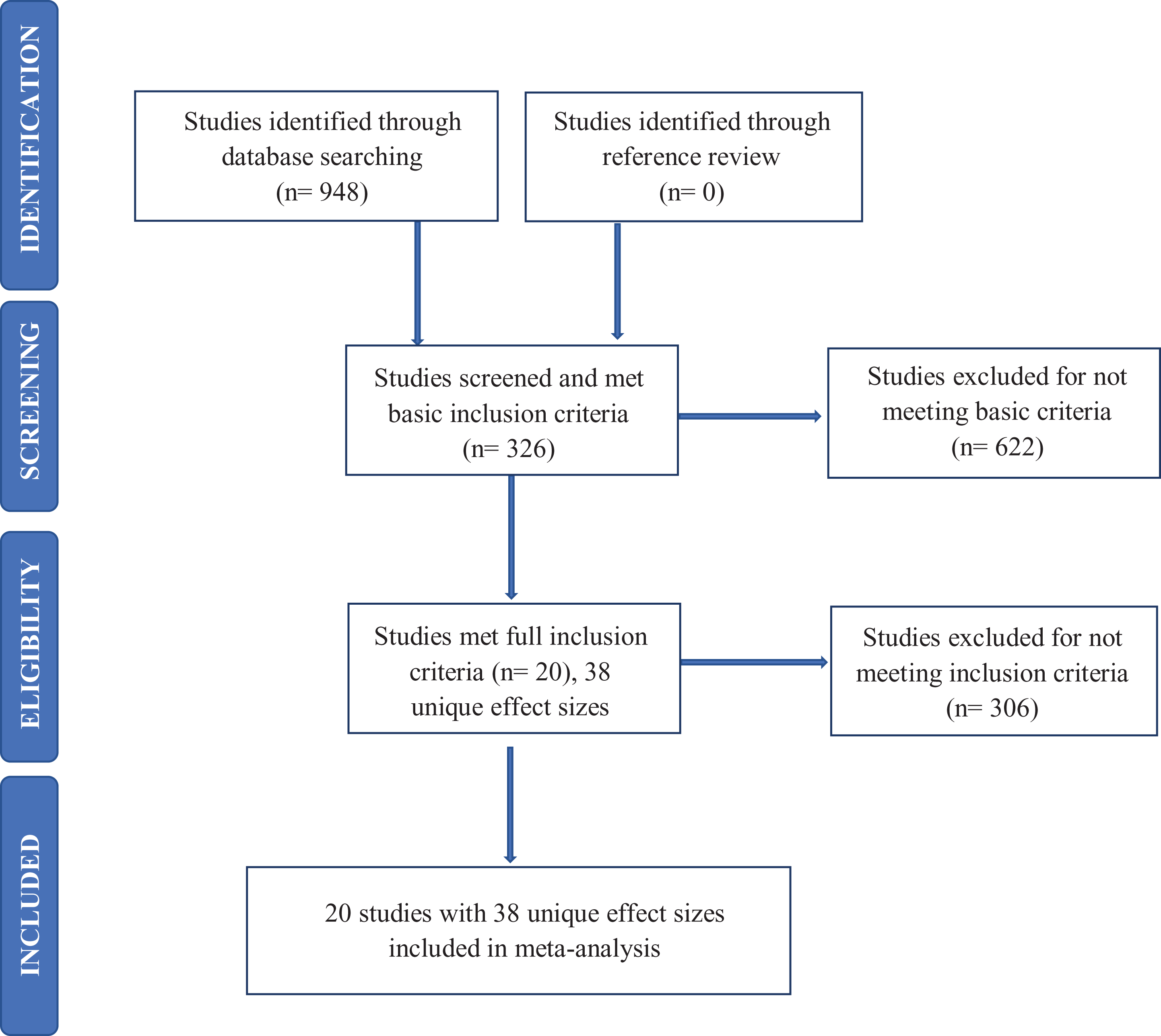
PRISMA diagram of study identification, screening, eligibility, and inclusion process.
Measures
To conduct the meta-analysis, standardized effect size measures and estimates of variance were collected and calculated for analysis (Borenstein et al., 2009; Lipsey & Wilson, 2001). Effect sizes, such as r (correlations), odds ratios, and B (regression coefficients) measuring the relationship between code of the street beliefs and offending were provided in each of the studies. To allow for comparability, each reported effect size was standardized to r values in the meta-analytical program (see formulas in Borenstein et al., 2009; Lipsey & Wilson, 2001). When an estimate of variance was not provided, estimated standard errors (SEs) were calculated so all effect sizes could be included in the pooled meta-analysis. 3
Each study was also individually coded for information relating to individuals’ street code beliefs, offending, sample composition, and methodological considerations. These characteristics were included for examination in our analyses. We describe each of these measures below:
Year of publication was recorded, as a means of identifying potential trends in the literature over time. The possible years of publication were between January 1, 1999, and January 31, 2019. These were divided into categories (1999–2004 = 1, 2005–2009 = 2, 2010–2014 = 3, and 2015–2019 = 4) for purposes of analysis.
Sample type refers to the population from which each sample was selected. Potential responses are community sample (= 1) or inmate/offender sample (= 2).
Sample age was coded into three categories, depending upon whether the sample in each data set consisted of adolescent aged participants 18 and under (= 1), adults (= 2), or mixed (= 3).
Sample size is a continuous variable reflecting the number of individuals present in each analysis for the studies included in this evaluation.
Offending type was collected from each study and characterized as violent (= 1), nonviolent/property (= 2), or general or mixed offending (= 3).
The data type was coded to indicate whether the relationship between street code and offending was measured using cross-sectional (= 1) or longitudinal (= 2) data.
As research examining the code of the street has been driven in large part by the FACHS data, which is comprised of a sample of all Black youth, we include a dummy variable indicating whether the study was primarily non-White in composition (= 2) or primarily White (= 1). Similarly, as early quantitative research on the street code was based upon the FACHS data, which used a 7-item measure of street code beliefs developed by Stewart and Simons (2010), a measure for whether the Stewart and Simons street code measure (or abbreviated version of it) was utilized (= 2) or if a different measure for the street code was used (= 1).
An accounting of control variables present in each analysis was also coded for. First, we account for whether the effects stemmed from bivariate (= 1) or multivariate (= 2) analyses, in order to reflect if there are any additional controls included in the study’s models. We also evaluate whether major competing explanations of offending are accounted for in each analysis (e.g., self-control, delinquent peers), as well as other covariates that may confound the relationship between the street code and offending (e.g., criminal history, prior victimization, gang membership, subjective perceptions of neighborhood problems, objective neighborhood crime rates, or other characteristics as measured by the U.S. Census or Uniform Crime Report).
Finally, the statistical significance of the relationship between the street code and offending was accounted for, with p < .001 (= 1), p < .01 (= 2), p < .05 (= 3), or nonsignificance (= 4), as the available options.
Results
Descriptive Statistics for Studies on the Street Code–Offending Relationship
Descriptive statistics for all measures are presented in Table 1. 4 The first studies measuring the relationship between street code and offending were published in 2002, with five total samples taken from studies between 1999 and 2004 (13.2%). The plurality of study samples was published between 2010 and 2014 (47.4%, n = 18), though a large portion (36.8%, n = 14) were published in the most recent years between 2015 and the first month of 2019.
Descriptive Statistics on Street Code and Offending Study Samples.
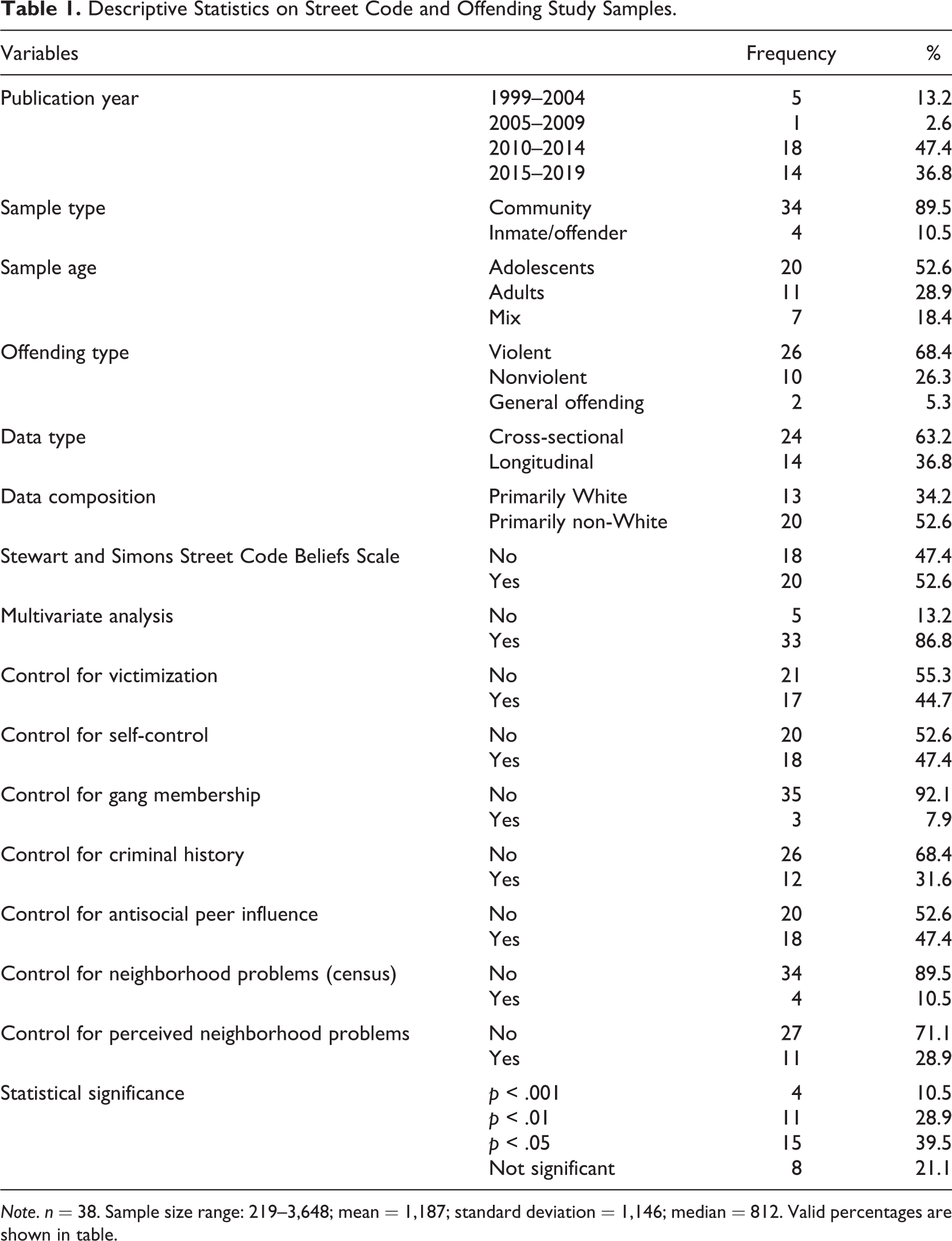
Note. n = 38. Sample size range: 219–3,648; mean = 1,187; standard deviation = 1,146; median = 812. Valid percentages are shown in table.
Study samples ranged in size from 219 to 3,648 participants, with a mean sample size of 1,187 (SD = 1,146) and a median size of 812. The vast majority of the studies used community-based samples (89.5%, n = 34), while just four were inmate/offender samples (10.5%). Study samples were largely made up of adolescents (52.6%, n = 20), nearly 30% were made up entirely of adults (n = 11), and 18% used a mixed sample of adults and adolescents (n = 7).
Results indicate that the primary form of offending evaluated in this literature is violent behavior (68.4%, n = 26), with nonviolent offending such as property crime comprising of 26.3% of the studies (n = 10) and general offending (nonspecified or mixed) comprising of 5.3% of the results (n = 2). Most results stemmed from cross-sectional data (63.2%, n = 24), while 14 effect sizes were produced from longitudinal data (36.8%). A majority of the data sets were primarily non-White in composition (51.4%, n = 19), while 14 were comprised primarily of White participants (36.8%). Five samples taken from one study (Piquero et al., 2012) did not include the total percentage of non-White participants and therefore were omitted from the subsequent moderation analyses on sample race/ethnicity composition (13.2%). Notably, the majority of the effects included in this study were drawn from analyses using the Stewart and Simons (2010) operationalization and measurement of the street code (52.6%), while 18 samples (47.4%) used new or highly adapted versions of this street code scale.
The majority of the effect sizes initially included in the analyses were derived from multivariate models (86.8%), with five (13.2%) resulting from bivariate analyses. Of the major control measures and variables representing competing theoretical explanations for the relationship between the code of the street and offending behavior, the items most commonly included in the models were delinquent peer influence and self-control, with 18 of the 38 effect sizes (47.4%) being taken from models including these important control variables. Fewer studies utilized models accounting for other major control or competing theoretical measures, as 17 effect sizes (44.7%) were taken from models which controlled for prior victimization, 12 effects (31.6%) were drawn from models which included individual’s criminal history, and just three (7.9%) effect sizes came from models which accounted for gang membership. While nearly 30% of the total effect sizes accounted for perceptions of neighborhood problems as a control measure (n = 11), only four resultant effects were taken from models measuring actual neighborhood problems through U.S. Census data (10.5%).
The vast majority of effect sizes (n = 30) indicated a statistically significant relationship between the code of the street and offending, as only eight (21.1%) did not. Of the statistically significant results, 15 effects were significant at the p < .05 level (39.5%), 11 were significant at the p < .01 level (28.9%), and four effect sizes were significant at the p < .001 level (10.5%).
Belief in the Street Code and Individual Involvement in Offending
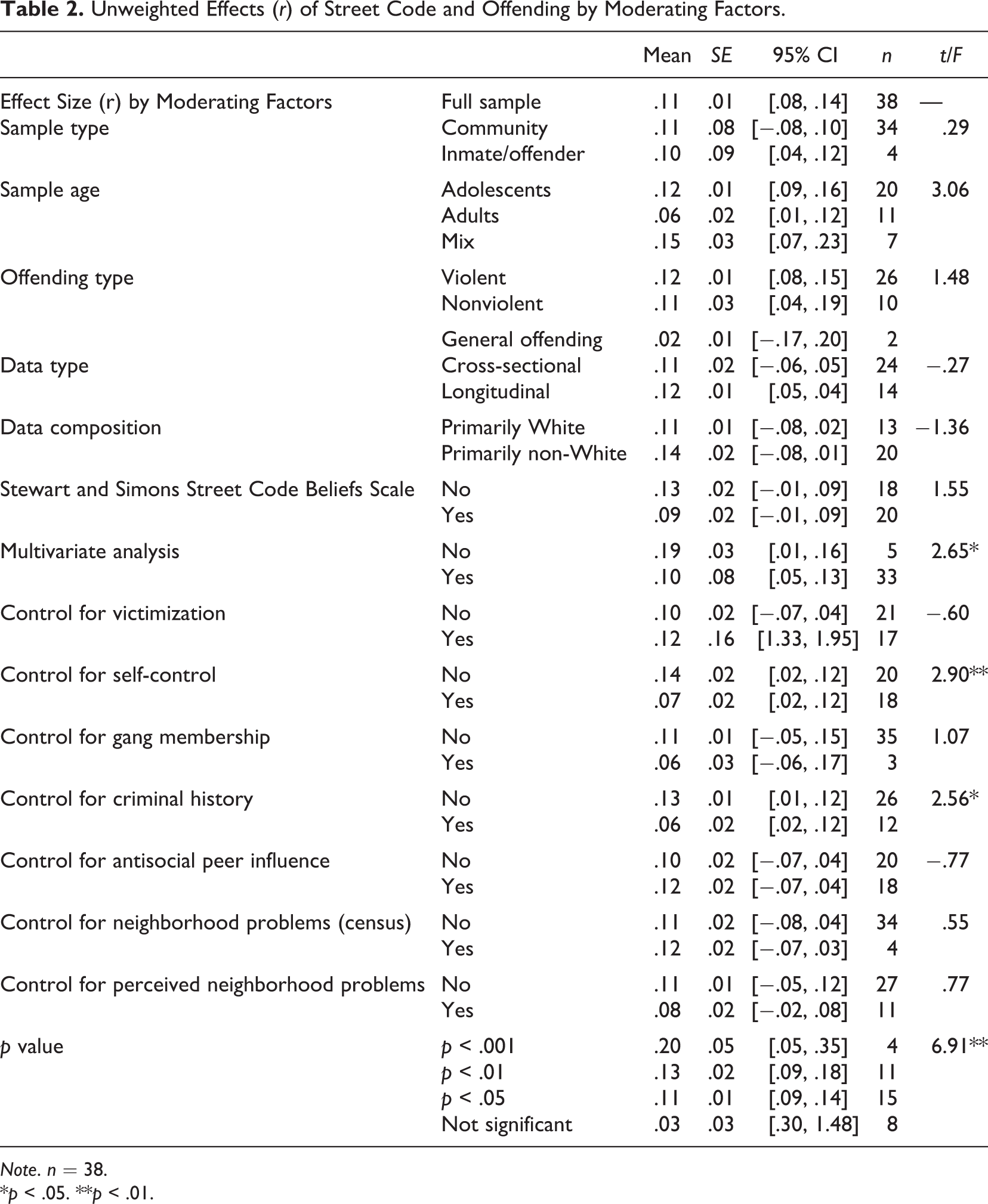
Analyses of the mean effect size using Pearson correlation (r), for the relationship between belief in the street code and individual offending in the 38 unweighted effect sizes, were initially conducted (for details on effect sizes in meta-analyses, see Pratt et al., 2014). In order to evaluate variations in the strength and direction of this relationship, and variance across moderating variables including the type of offending, type of sample, sample age, source and composition of data, measurement of the street code, use of multivariate analyses, control variables accounted for, and statistical significance of the findings, were also analyzed. Mean r values for the relationship between street code beliefs and individual offending across each level of the moderating variables were calculated and presented. Tests of mean differences in these values, assessed using t tests and analysis of variance to generate t and F statistics, respectively, are presented in Table 2.
Unweighted Effects (r) of Street Code and Offending by Moderating Factors.
Note. n = 38.
*p < .05. **p < .01.
Overall, the mean (unweighted) effect size for the relationship between code of the street and offending was r = .11 (SE = .01), with a 95% confidence interval (CI) of [.08, .14]. This indicates that as street code beliefs increase, the risk of offending also significantly increases. To determine whether the strength or direction of this relationship differs depending on the sample, study type, or type of offending, mean effect sizes were analyzed by each moderating variable.
Results indicate that the effect size is largest among the mixed group of adolescents and adults (r = .15, SE = .03), followed by the adolescent only sample (r = .12, SE = .01) and the adult only sample (r = .06, SE = .02). However, these differences were not statistically significant (F = 3.06, p = .06). Results also showed that belief in the street code was most strongly associated with violent offending (r = .12, SE = .01), followed by nonviolent criminal behavior (r = .11, SE = .03). The street code had the lowest effect size with general offending (r = .02, SE = .01), but the differences in these effects were not statistically significant (F = 1.48, p = .48). Notably, nearly identical effect sizes were found between the community (r = .11, SE = .08) and inmate/offender (r = .10, SE = .09) samples (t = 0.29, p = .77), and between cross-sectional (r = .11, SE = .02) and longitudinal (r = .12, SE = .01) data (t = −0.27, p = .79).
The type of composition of the sample and type of analyses utilized to evaluate the relationship between street code and offending was expected to impact the strength of the effect size. While results indicate that the primarily non-White samples showed slightly higher association between street code and offending (r = .14, SE = .02) compared to the primarily White samples (r = .11, SE = .01), these variations were again not statistically significant (t = −1.36, p = .23). The results of studies that used the Stewart and Simons (2010) measurement of the street code showed lower (r = .09, SE = .09) association with offending than the studies that used alternate measures of the street code (r = .13, SE = .08), but not statistically significant in magnitude (t = 1.55, p = .13).
An analysis of control variables in each model also indicate some variation in the size of the effects that were produced, with models that included any controls (i.e. multivariate analyses) producing significantly lower effect sizes (r = .10, SE = .08) compared to the bivariate models (r = .19, SE = .03, t = 2.65, p < .05). Studies that controlled for prior criminal history showed the lowest overall effect at .06 (SE = .02). By comparison, models that did not control for prior criminal history showed a significantly higher effect size for street code and offending at .13 (SE = .01, t = 2.56, p < .05). Similarly, models that accounted for gang membership produced an average effect size of .06 (SE = .03), while those that did not account for gang membership had a higher effect size of r =.11 (SE = .01, t = 2.56, p = .29). Models accounting for self-control showed the second lowest effect size at .07 (SE = .02), while those that did not account for this variable produced a significantly higher effect size of r =.14 (SE = .02, t = 2.90, p < .01).
Taking into account the community-level measures, we analyzed the effect of controlling for perceptions of neighborhood problems and actual level of neighborhood crime and problems according to the U.S. Census. Results indicated differential effects on the relationship between street code beliefs and offending, where controlling for actual neighborhood problems produced slightly higher effect sizes for street code beliefs on offending (r = .12, SE = .02) compared to those that did not include this measure (r = .11, SE = .02, t = −0.55, p = .45). When perceived level of neighborhood problems was controlled for, the effect size dropped to .08 (SE = .02) from .11 (SE = .01) when this item was not controlled for (t = 0.77, p = .56). The remaining moderators did not produce significant differences in effect sizes and showed only minor changes in the strength of the relationship between street codes and offending.
The most variation in effect sizes was found across varying levels of statistical significance for the relationship between street code beliefs and offending (F = 6.91, p < .01). Results that were not statistically significant showed an average effect size of .03 (SE = .03). However, at the lowest level of statistical significance, p < .05, the mean effect size rose to .11 (SE = .01) and increased to r =.13 (SE = .02) at the p < .01 level. The strongest effect size for all moderators in the analysis was found for the four studies effect sizes at the p < .001 level, as the association between street code and offending increased to .20 (SE = .05) in these models.
Heterogeneity and Meta-Analytic Effects
An analysis of heterogeneity based upon the Q statistic, an indicator of the magnitude of between-study variability in the street code–offending relationship, using the effect sizes across samples, sample sizes, and the SEs, was calculated. Q is distributed as a χ2 with n − 1 degrees of freedom (n being the number of samples in the meta-analysis; Hedges & Olkin, 1984). When Q is statistically significant, it suggests that there is variability between studies, typically caused by unaccounted-for variable(s) that moderates the relationship between the independent variable and the outcome (Hedges & Olkin, 1984).
In the present analysis, effect sizes were significantly heterogeneous (Q = 11.90, df = 30, p < .01) and not randomly distributed around the average effect size. Significant heterogeneity in the results suggests that the variability is unlikely to have been caused by sampling error alone. To account for this variability, DerSimonian–Laird continuous random-effects models are used to calculate the weighted mean effect sizes for the remaining meta-analysis calculations (Borenstein et al., 2009). A meta-analysis of the overall weighted effect size estimates 5 for the effect of street code beliefs on individual offending for all 38 effect sizes are presented in Figure 2.
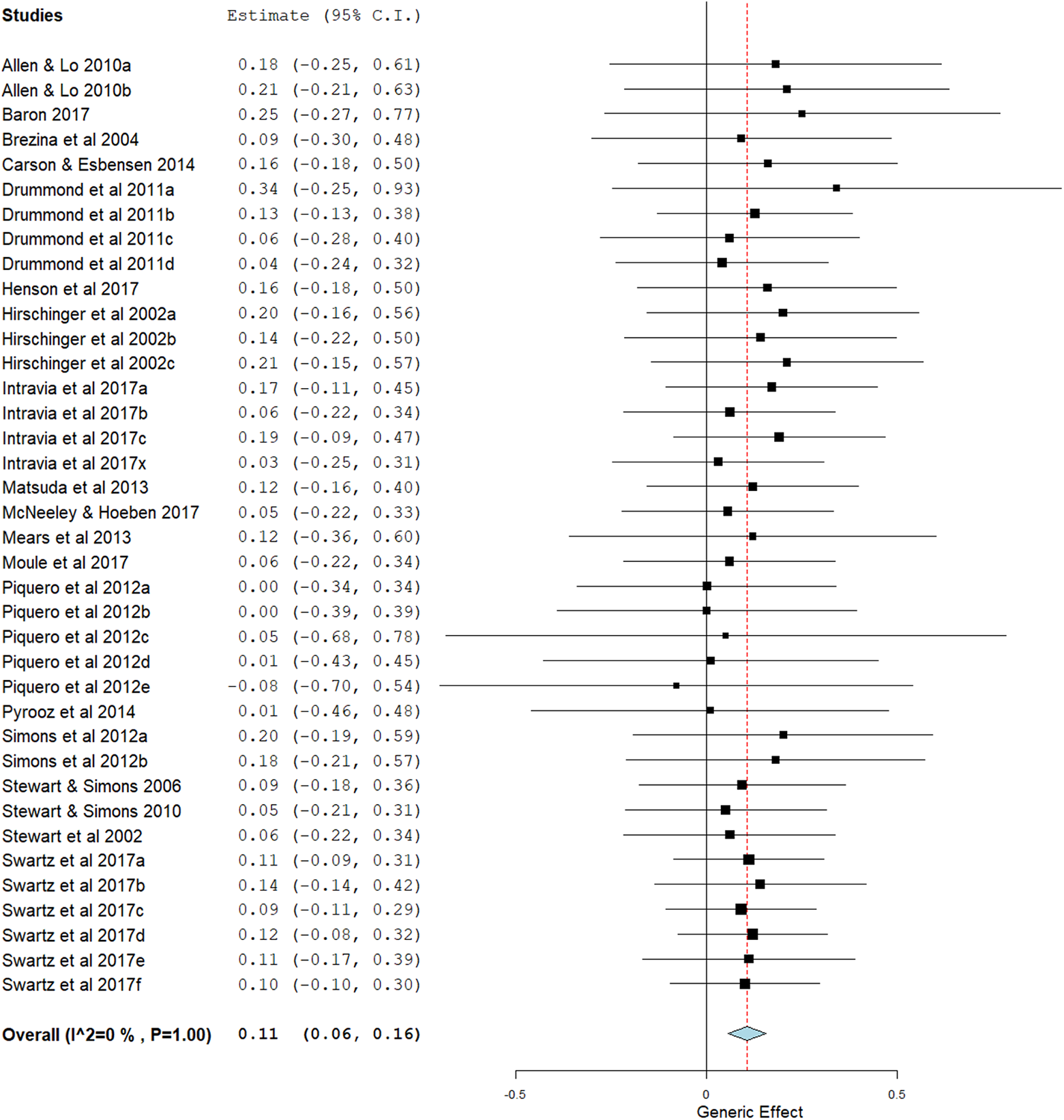
Forest plot of weighted effect sizes for street code adherence and offending across samples.
To evaluate whether there was a bias toward publishing studies with higher effect sizes, a funnel plot analysis was conducted (Light & Pillemer, 1984; Sedgwick, 2013). This plot (see Figure 3) visually depicts the relationship between samples’ resultant effect size and error rates. In this case, a near even distribution of samples with effect sizes above and below the mean can be observed, indicating that there is no positive skew toward stronger effects sizes in these published studies. This suggests publication bias, or the “file drawer” problem, is not an issue with respect to studies examining the relationship between street code beliefs and offending. In short, published research does not appear biased toward larger effects, and previous analyses indicate there is no bias toward statistically significant effects.
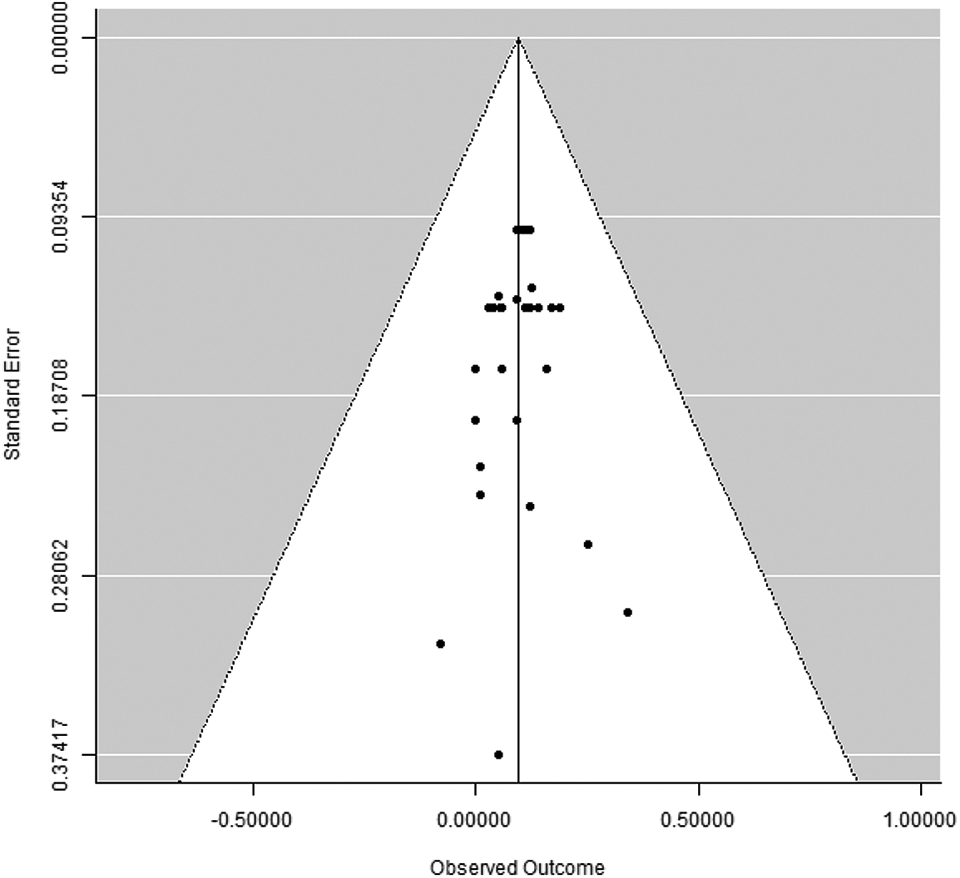
Plot to test publication bias.
Weighted Meta-Analytic Results Across Moderating Variables
Next, a series of meta-analyses were conducted using previously calculated effect size (r) values for the association between street code beliefs and offending across moderating variables using 38 weighted effect sizes from 20 studies. 6 Moderator variables included the type of offending behavior, type and age of sample and data, measurement of the street code, types and presence of control and theoretical measures utilized in the models, and statistical significance for the relationship between street code and offending. A continuous random-effects meta-analysis of effect sizes for the relationship between code of the street beliefs and offending resulted in an overall weighted effect size of r = .11, CI [.06, .16], SE = .02. If the 95% CI does not include 0, the effect size is significant at the p < .05 level. This suggests that when sample size and SE for all available published results are accounted for, the overall risk of offending increases, albeit modestly, as belief in the street code increases.
The remaining pooled effects sizes in the meta-analysis were also largely positive and significant, suggesting stronger street code beliefs almost uniformly increased the risk of offending, regardless of study, sample, data, or model characteristics. 7 To that end, meta-analytic results indicate that no Q values were statistically significant across all moderator analyses, indicating that the between-study variability was removed once the moderators were introduced.
Meta-analytic results indicate that street code beliefs had the lowest overall effect on general offending, r = .02, SE = .11, Q(1) = 0.89, followed by nonviolent offending, r = .11, SE = .06, Q(9) = 1.84. Overall, the street code was most strongly associated with violent behavior (r = .13) across all studies in the meta-analysis, SE = .06, Q(25) = 3.00. Results also indicate that adolescent samples show the strongest relationship between street codes and offending at r = .14, SE = .07, Q(19) = 2.16. The effect size for adult-only samples was r = .09, SE = .05, Q(10) = 2.11 and the mixed (adults and adolescents) sample produced an average effect size of .11, SE = .03, Q(6) = 1.09. In other words, the effect of the street code was found to be strongest on violent offending and among adolescent samples.
When sample type is used as a moderator variable, the primarily non-White samples showed an effect size of .10, SE = .04, Q(24) = 4.43, and the primarily White samples yielded a slightly stronger effect size, r = .11, SE = .04, Q(12) = 1.29, underscoring the generality of the street code as a risk factor for offending across populations.
Longitudinal data sets produced an average effect size of .11, SE = .04, Q(13) = 0.89, while cross-sectional data produced slightly lower overall effects for the relationship between street code and offending, r = .10, SE = .04, Q(23) = 4.83. Interestingly, inmate/offender samples yielded an average weighted effect size of .09, SE = .10, Q(3) = 0.49, while community samples produced a slightly larger effect at .11, SE = .03, Q(33) = 5.21, once again indicating the generality of the street code to a broader population.
An analysis of the effect of multivariate controls being included in the models suggested, predictably, that studies which included control measures in the models produced a substantially lower effect size, r = .10, SE = .03, Q(32) = 4.67, than the bivariate models which did not account for any potential confounding variables, r = .19, SE = .08, Q(4) = 0.10. Results of the moderator analyses based upon control and theoretical variables in the various models produced highly variant results. For instance, the strongest effect of street code on offending was found in studies which controlled for prior victimization, r = .11, SE = .03, Q(16) = 2.45, while not including this control produced a weighted effect of .10, SE = .04, Q(20) = 3.27.
Not accounting for gang membership produced stronger relationships between street code beliefs and offending, r = .11, SE = .03, Q(34) = 5.44, than studies that controlled for this important variable, r = .06, SE = .10, Q(2) = 0.11. Similarly, not controlling for criminal/delinquent peers also increased the overall effect size for the relationship between street code beliefs and offending, r = .11, SE = .04, Q(19) = 3.84, compared to those that included delinquent peer influence in their models, r = .10, SE = .03, Q(17) = 1.85, and controlling for individuals’ level of self-control, r = .10, SE = .03, Q(17) = 2.53, produced weaker effects than studies that did not control for this factor in the models, r = .12, SE = .03, Q(19) = 2.95.
Neighborhood problems measured using the Census produced an effect of .07 when included in the analyses, SE = .07, Q(3) = 0.10, while including subjective perceptions of neighborhood problems yielded a weighted estimated effect of 0.12, SE = .05, Q(10) = 1.49. Models excluding the neighborhood problems measures (using official and perceptual data) when assessing the relationship between street code beliefs and offending resulted in effect sizes of .11, SE = .03, Q(33) = 5.41, and .10, SE = .03, Q(26) = 4.17, respectively. Studies that used the Stewart and Simons (2010) measure of street code beliefs produced a weighted effect size of .09, SE = .04, Q(19) = 3.34, while those using alternate measures yielded an average effect size of .12, SE = .03, Q(17) = 2.12. Studies that did not control for prior criminal history yielded an overall weighted effect size of .12, SE = .03, Q(25) = 3.71. When criminal history was controlled for, the effect of street codes on offending dropped to .07, SE = .05, Q(11) = 1.42.
Finally, an analysis of the variation in effects according to significance of the relationship also indicated a wide variation in results. Overall, there was a general decline in effect size for street code and offending as the level of significance decreased, with effect sizes at the highest significance (p < .001) the strongest at r = .16, SE = .08, Q(3) = 0.43. The significance levels of p < .01 and p < .05, both showed an average weighted effect of .11, SE = .04, Q(10) = 1.64; SE = .04, Q(14) = 1.12, respectively. Nonsignificant results showed the lowest overall effect size for street code beliefs and offending at r = .05, SE = .07, Q(7) = 1.38. Discussion of these findings is reserved for the following section.
Discussion
Criminology is now two decades into its “cultural turn,” with a renewed emphasis on subcultural norms and codes of conduct (Copes et al., 2013; Sampson & Bean, 2006). A core component of this cultural turn was the code of the street (Anderson, 1999), and a sizable literature has now elaborated on the correlates and criminal consequences of individual belief in the code (e.g., Baron, 2017; McNeeley et al., 2018; Stewart & Simons, 2006). This body of knowledge has involved the expanded application of the street code beyond interpersonal violence in Philadelphia to diverse offending types, samples, locations, and model specifications. It is timely and necessary to “take stock” of the street code as an explanation of offending. The current study conducted a meta-analysis to quantitatively evaluate the empirical status of the street code–offending relationship at the individual level. A total of 38 valid effect sizes from 20 studies were included in this weighted meta-analysis. Our findings warrant four broader points of discussion.
First, the results of our weighted meta-analysis indicate that individual belief in the code of the street exhibits somewhat modest effects on offending (r = .11; see Figure 2). As a point of comparison, this is weaker than other well-established correlates of crime, such as self-control (Mz 8 = .25–.27; Pratt & Cullen, 2000), dimensions of social learning (differential associations, Mz = .25; delinquent definitions, Mz = .17; Pratt & Cullen, 2000; see also Pratt et al., 2010), gang membership (Mz = .22; Pyrooz et al., 2016), and aspects of deterrence (certainty, Mz = −.17; nonlegal sanctions, Mz = −.17; Pratt et al., 2006). The effect size of street code beliefs on offending is more comparable to those of legitimacy (r = .14) and procedural justice (r = .10; see Walters & Bolger, 2019). Despite these overall mild effects, consistent with Anderson’s (1999) theory, this effect is strongest for violent offending and offending among adolescents. The effects of the street code were weakest in adult-only samples and where outcomes involved nonviolent and general forms of offending.
Together, we interpret this first set of findings to suggest that street code beliefs exhibit greater generalizability than previously conceptualized. Research would do well to further explore the links between street codes and diverse forms of offending, including online antisocial behaviors, substance use, and better distinguishing between retaliatory and preemptory violence. Continuing to examine these effects across a variety of adolescent and adult samples, drawn from both the United States and abroad, would be worthwhile.
Second, despite these findings, it is clear that there is room for improvement in research examining the code of the street. Much of the existing research on the street code has failed to account for other well-established correlates of offending, including self-control (Gottfredson & Hirschi, 1990; see Pratt & Cullen, 2000; Vazsonyi et al., 2017), social learning/deviant peers (Akers, 2009; see Pratt et al., 2010), and victimization (e.g., Berg, 2012; Jennings et al., 2012; Lauritsen & Laub, 2007). The omission of these variables has resulted in overestimation of the influence of street code beliefs on offending (see Table 2). Future research should continue exploring the robustness of the relationship between the code and offending, with a number of promising directions for future research available. For example, research might focus on threshold, or nonlinear, effects of these beliefs on offending (Agnew & Messner, 2015), or incorporating competing cultural and normative orientations (e.g., legitimacy, legal cynicism; Reisig et al., 2011; Trinkner, & Cohn, 2014; Tyler, 2006). Evaluating street code beliefs and behaviors in the context of strain theory (Agnew, 2006) offers intriguing possibilities for research on retaliation. Finally, understanding street code beliefs and justifications for offending, such as techniques of neutralization (Sykes & Matza, 1957), would be worthwhile.
Third, the cultural turn also involved evolving understandings and interpretations of how cultural shapes behavior (Swidler, 1986; see Kirk & Papachristos, 2011; Sampson & Bean, 2006; Swartz et al., 2017). Cultural norms like the street code have been suggested to shape perceptions of situations, which in turn constrain choices about lines of action and subsequent behavior. At present, we are not aware of any research specifically examining the influence of street codes on perceptions of situations, although prior research has hinted at this (e.g., Moule & Wallace, 2017; Topalli, 2005). Understanding the extent to which street code beliefs shape perceptions of behavior as threatening, disrespectful, or aggressive would be useful. Perceptions of hostility and disrespect, and concerns about social status and fear of future victimization, are potential mechanisms linking belief in the street code and individual involvement in offending. These considerations offer valuable directions for future research on the street code.
Fourth, and finally, results from the current meta-analysis have implications for practitioners. Antisocial attitudes and beliefs are a key area for intervention and offender rehabilitation efforts (e.g., Andrews & Bonta, 2010), and growing evidence suggests that interventions can successfully reduce these attitudes and beliefs (Banse et al., 2013). Clearly, street code beliefs fall under the umbrella of antisocial attitudes. Despite this recognition, we are not aware of research explicitly examining whether street code beliefs are responsive to belief-oriented intervention programming, such as cognitive or dialectical behavioral therapies (e.g., Hoogsteder et al., 2015; Kendall, 1993; Linehan & Wilks, 2015). Exploring this responsiveness, both in interventions targeting street code beliefs specifically and in interventions targeting more general antisocial attitudes, would be worthwhile. This is especially the case for violent, adolescent offenders for whom the street code may be most salient and influential (Abt, 2019).
Of course, the current study is not without limitations. For all meta-analyses, the quality of the product depends on the quality of the studies included in the evaluation. Bias, inaccuracy, lower quality data, measures, and modeling can impact effect size estimates. Steps were taken to overcome this limitation by using effects contained in peer-reviewed publications, using a weighted meta-analytic model with continuous random effects, and assessing moderating effects on resultant effect sizes. The use of only peer-reviewed studies excluded some findings from the analysis, but also eliminated many of the potential problems previously noted. Analysis of publication bias indicated no inclination toward the inclusion of only strong significant effects. Finally, there are other elements of the street code that were not examined in the current study, including its impact on victimization (Stewart et al., 2006) and the role that neighborhood context and family dynamics play in fostering belief in the code (Anderson, 1999). These topics are worthy of more attention, but are beyond the scope of the current manuscript, as so few studies exist on these issues relative to the street code–offending relationship.
In the end, the influential nature of the cultural turn in criminology demands that subcultural explanations of offending receive continued empirical attention. This is especially true for the code of the street, a prominent component of this turn. As the results of this meta-analysis demonstrate, two decades into this turn, the code appears to be a fairly robust, if modest, correlate of individual involvement in crime, particularly violence. The current analysis has also highlighted important limitations of extant research on the code of the street and its relationship with various forms of offending. Suffice it to say, much remains to be learned regarding the street code, and we encourage criminologists to continue unpacking the correlates and consequences associated with it.
Footnotes
Acknowledgment
The authors would like to sincerely thank Editor Trulson and the anonymous reviewers for sharing their expertise and helpful suggestions, which greatly improved this article.
Author Contributions
The authors Richard K. Moule Jr. and Bryanna Fox contributed equally to this article.
Declaration of Conflicting Interests
The author(s) declared no potential conflicts of interest with respect to the research, authorship, and/or publication of this article.
Funding
The author(s) received no financial support for the research, authorship, and/or publication of this article.
