







Abstract
Background
Youth involved with the justice system are more vulnerable to trauma exposure and engaging in violent behavior. Trauma exposure is linked to increases in youth violence, however, the pathway from trauma to violence, including neurocognitive and neuropsychological mechanisms, is not well understood. The current study sought to test the influence of hostile attribution bias (HAB) and working memory on violence and whether these factors play a role in the link between trauma and violence among justice-involved youth.
Methods
Participants included 237 detained youth (Male = 81.0%, Mage = 15.22) who completed self-report surveys and working memory tasks.
Results
Trauma was significantly associated with violent behavior. HAB was related to physical violence; however, when trauma exposure was entered into subsequent models, HAB was no longer associated with violence. Lower levels of working memory were found to interact with HAB to increase the risk of physical violence. Mediation was not supported.
Implications
The current study supports universal trauma screening and trauma-informed care in justice facilities and suggests that neurocognitive functioning assessment and remediation are important to consider in treatment programming.
Youth violence is a type of aggression with the goal of extreme physical harm, such as injury or death (David-Ferdon & Simon, 2014). Youth violence is a serious public health issue with myriad adverse outcomes, including psychological distress, injury, and mortality, with an estimated cost of 21 billion dollars annually in medical care and lost days of work alone (Patel & Taylor, 2011). Youth involved with the justice system are often both victims and perpetrators of violence, the latter of which is associated with increased justice system involvement and escalating violence (Hahn et al., 2007). Trauma exposure is linked to increases in youth violence, and treatments aimed at reducing violence are limited because the pathway from trauma to violence, including neurocognitive and neuropsychological mechanisms, is not well understood. The current study was aimed at evaluating the role of hostile attribution bias and working memory in the relation between trauma exposure and violence among justice-involved youth.
Trauma Exposure and Violent Behavior
Trauma exposure, whether acute (e.g., being a robbery victim) or chronic (e.g., prolonged child maltreatment), has been linked to an increased risk of violence perpetration in adolescence and adulthood (Duke et al., 2010; Lansing et al., 2018). Studies have shown that each traumatic event experienced is significantly associated with various forms of violence, and this relationship is dose-dependent (Duke et al., 2010). Justice-involved youth typically experience higher levels of trauma exposure as well as a higher risk for engaging in violent behavior, making them a critical population to study this association within (Baglivio et al., 2014; Folk et al., 2021; Maschi et al., 2008). Indeed, a body of literature among nationally representative samples of youth involved in the justice system suggests that 45–90% of them witnessed and/or experienced traumatic events (Baglivio et al., 2014; Folk et al., 2021) and engaged in more violent behavior relative to community samples (Maschi et al., 2008). For example, Fox et al. (2015) found that youth who committed multiple violent crimes over time had more than double the total trauma scores compared to those who offended only once. Each traumatic event also increased the risk of being a chronic offender by more than 35% even after controlling for known risk factors (e.g., impulsivity, peer influence, and socioeconomic status).
From a developmental psychopathology approach, trauma exposure is understood to place youth at risk for violent behavior through myriad, compounding developmental processes wherein neurodevelopmental insults are understood to precipitate clinical outcomes, like violence (Rutter & Sroufe, 2000). Converging research has shown that trauma fundamentally alters the way potentially threatening or emotional information is prioritized and processed (McEwen & Morrison, 2013). However, the precise cognitive mechanisms by which trauma exposure increases the risk for violence perpetration are less clear.
The Mediating Role of Hostile Attribution Bias
One neurocognitive factor that links trauma exposure to violence is a hostile attribution bias (HAB), or a tendency to interpret the intentions of others as hostile (Dodge & Crick, 1990; Tuente et al., 2019). Consistent with the developmental psychopathology approach, social information processing (SIP) theory posits that a series of cognitive-emotional mechanisms, or social processing “steps” account for the link between risk factors (i.e., trauma exposure, increased threat processing) and subsequent use of aggression and violence (Crick & Dodge, 1994). The steps include (1) encoding of information from the environment, (2) assigning attribution to the behavior of others, (3) selecting an interaction goal, (4) generating alternative responses, (5) evaluating the responses and selecting a course of action, and (6) enacting the response. Consistent with a developmental psychopathology approach, HAB is a bias in the second step that inclines the individual to attribute the actions of others as hostile and has downstream consequences of selecting aggressive responses across the other steps (Dodge, 2003). Youth exposed to trauma develop a tendency to be hypervigilant to perceived threatening cues, which may be adaptive in certain situations but overgeneralized in others. This hypervigilance to threat, in turn, increases aggressive cognitions (i.e., attributions) and schemas and thus aggressive behavior (Verhoef et al., 2019). HAB is consistently linked to violence in youth and is thought to be the key element in the etiology and maintenance of violent behavior, as youth who respond with aggression and violence often find themselves in increasingly problematic situations that beget more violence (Dodge, 2003; Dodge & Coie, 1987; Orobio et al., 2002; Tuente et al., 2019). Illustrative of these compounding effects, Orobio de Castro et al. (2005) examined HAB, emotion regulation, and aggressive responses among clinic-referred aggressive boys and community controls (ages 13–17). They found that aggressive boys had higher HAB with more anger, employed less emotion regulation strategies, generated more aggressive responses to a perceived provocation, and evaluated those responses less negatively than community controls.
Importantly, HAB has been found to mediate the effect of child maltreatment on aggression. In Dodge and colleagues’ (1995) seminal study, 584 randomly selected kindergarten children across three geographic locations were interviewed to determine if physical abuse had occurred or not and then followed longitudinally. Each year, for four years, HAB and aggression were measured. Results revealed that children who were determined to be physically abused in their first five years of life later developed higher HAB patterns that predicted aggressive conduct problems. This pattern has also been found in adulthood (Richet et al., 2016; Zhu et al., 2020). However, the mediating effect of HAB on trauma exposure and aggression has been limited by a narrow focus on only child maltreatment relative to other potentially traumatic experiences. In addition, no known studies have investigated this mechanism within the context of adolescence or youth involved in the criminal legal system.
Importantly, HAB is a ubiquitous treatment target in violence reduction interventions used in outpatient and detention settings due to the ability to modify hostile attributions through teaching youth to benignly interpret social situations (Goldstein et al., 2016). However, current interventions are only partially effective, as evidenced by small to medium effect sizes among treatment groups and continued high rates of violent recidivism (Goldstein et al., 2016; Hiemstra et al., 2019). This strongly suggests new research is needed to identify additional cognitive factors that may be targeted therapeutically to improve outcomes or to track in clinical trials to understand treatment outcomes better. Failure to consider the impact of working memory may explain why interventions for these populations have been only partially effective.
The Mediating Role of Working Memory
Working memory is a key cognitive process that may mediate the relation between trauma exposure and violence and may have implications for interventions aimed at improving HAB. Working memory involves retaining and manipulating information for goal-directed actions and acts as a processing space that interacts with long-term memory during tasks (Barkley, 1997; Chai et al., 2018). There is a well-established connection between trauma exposure and deleterious effects on working memory (Bücker et al., 2012; Dodaj et al., 2017). Indeed, a recent meta-analysis found that children who experience trauma have lower working memory scores relative to non-trauma-exposed youth (Op den Kelder et al., 2018).
Working memory is theorized to be one of the cognitive abilities that has a particular bearing on social behavior, including aggression and violence (Barkley, 1997; Barrett et al., 2004). However, research to date has been sparse. For instance, McQuade et al. (2013) found that poor working memory was associated with social impairment and specific aggressive behaviors in school children. Similarly, Séguin et al. (2004) found that working memory was related to physical aggression in males, even after controlling for intelligence and ADHD status.
It is theorized that effective working memory enables individuals to learn, reason, and manage new situations by temporarily storing task-relevant information and selecting a behavioral response (e.g., reconsidering hostile intent; not reacting violently), and thus important to the study of violence. Working memory also requires accessing information in long-term memory, such as various social response options that have been adaptive in the past (McQuade et al., 2013). Thus, the inability to hold and process information rapidly causes youth to act quickly and without forethought to compensate for the rapid rate that mental representations fade (Kofler et al., 2011). Youth with higher working memory abilities are better able to adaptively avoid confrontation and inhibit aggressive impulses, whereas youth with reduced working memory abilities are less able to recall and select non-aggressive responses (Barkley, 1997).
Thus, trauma exposure has deleterious effects on working memory, and poorer working memory, in turn, is related to a higher risk for engaging in violent behavior. However, only two known studies to date have examined working memory as a potential mediator in the link between trauma exposure and violence with differing contexts and results. One study found that deficits in spatial working memory partially mediated the relationship between neglect and aggression in toddlers (Demeusy et al., 2018). In contrast, another study found no mediation effect of working memory on the association between early victimization and later sexual violence, suggesting that callous-unemotional traits might play a more significant role in this relationship (Yoder et al., 2019).
Interactive Effects of Hostile Attribution Bias and Working Memory
Working memory provides youth with the ability to consider multiple interpretations of an event as well as a multitude of behavioral responses quickly and simultaneously. Working memory, therefore, is may be an important cognitive component for mitigating HAB by supporting individuals’ ability to consider alternative interpretations and problem-solving approaches when presented with social decisions. Recently, theoretical models have posited that working memory is necessary for adaptive SIP processing (Van Rest et al., 2019). Conceptually, impaired working memory may impact a hostile attribution bias as this mechanism involves aggregating multiple pieces of contradictory information (e.g., “they are out to get me” or “maybe they didn’t mean to do that”). Further, working memory may impact response generation as it involves incorporating information from long-term memory (e.g., “Did this solution work well for me last time?”) into the current circumstances (Baddeley & Lieberman, 2017). Additionally, impaired working memory may affect self-efficacy and decision-making, as these actions require holding various responses and affiliated outcomes in mind (Klingberg, 2010).
There are two known studies that examined working memory, SIP processing steps, and aggression to date with conflicting results. First, Van Nieuwenhuijzen and colleagues (2017) examined executive functioning (focused attention, inhibition, and working memory) and SIP steps among 94 Dutch adolescents 12–20 years of age in secure residential care. The youth in this sample were characterized by elevated levels of externalizing problems (including aggression and violence) as well as problematic parenting/family situations. After controlling for age and I.Q., no significant findings for working memory and any SIP step were found. The authors situate the lack of findings for working memory to be the result of methodology. Specifically, the working memory task they employed included only a visual-spatial sequencing task that required monitoring information presented visually and could have been improved by an additional verbal working memory component and a central executive component (i.e., monitoring information and manipulating it). In their subsequent study, Van Rest and colleagues (2019) examined executive functioning (focused attention, inhibition, and working memory), aggression, and SIP steps among 168 Dutch adolescents aged 13–17 from rural and urban areas with mild to borderline intellectual functioning (intellectual ability scores between 50–84). Results revealed that better working memory was related to encoding more cues, fewer hostile interpretations, and fewer aggressive response generations. Further, in tests for mediation, impaired working memory was related to higher HAB, which was related to higher self-efficacy of aggression and higher aggressive behavior scores. In summary, better working memory acted as a buffer to mitigate HAB and downstream SIP steps as well as aggressive behavior. Conversely, impaired working memory was associated with higher HAB and aggression. Thus, it is also plausible that HAB and working memory may interact to portend risk for higher levels of violence or interact to buffer against the propensity to engage in violent behavior. That is, poor working memory combined with high levels of HAB may be associated with elevated levels of violence. Further, this interactive effect may partially account for the link between trauma exposure and violence.
Current Study
The overarching objective of the current study was to provide a more mechanistic understanding of HAB and working memory in the relation between trauma exposure and violent behavior. To meet this objective, the first goal of the current study was to understand if the interactive effects of HAB and working memory were associated with violence above and beyond their unique effects. It was hypothesized that higher HAB and lower levels of working memory would be associated with the highest levels of violence. Conversely, lower levels of HAB and higher levels of working memory would be associated with the lowest levels of violence. The second goal of the current study was to understand if HAB, working memory, and their interaction mediate the relation between trauma exposure and violent behavior. It was hypothesized that HAB and working memory would individually partially account for the link between trauma and violent behavior. In addition, it was hypothesized that the interaction between HAB and working memory would account for a significant amount of the variance in the link between trauma exposure and violence. Of note, age, sex, and race/ethnicity were included as control variables as these characteristics have been associated with differing levels of violence.
Methods
Participants
Youth (N = 258) were recruited for the current data collection, of those, 237 completed the supplemental battery and provided assent (91.9%) for their data to be used for research. Thus, the current sample was comprised of 237 newly admitted youth detained at two juvenile detention centers in the Midwest. The collaborating detention centers were state-funded, and youth admitted into these facilities were pending court-imposed sanctions, were serving court-imposed sanctions, in rare cases were deemed a child in need of care, or some combination thereof. The sample was predominately male (81%), with an age range of 10–17 (M = 15.12, SD = 1.54). The racial composition of the sample included White (60.8%), Black (37.1%), American Indian/Alaskan Native (2.2%) with 15.1% reporting Hispanic ethnicity. The average number of days in detention was 34.96, with a minimum of 1 and a maximum of 385.
A-priori power estimates were conducted through the Monte Carlo Simulation procedure. The results indicated that with a total of 200 subjects, the current study would have adequate power (≥.80) to detect medium to large effects of both direct and interactive effects; 270 participants would be needed to detect small effects.
Measures
Demographics
Youth age, race/ethnicity, sex, and number of days in detention was provided by the facility. Sex was coded as 0 (Male) and 1 (Female). Race/ethnicity was coded as 1 (White non-Hispanic) and 0 (Minoritized and/or Hispanic). The decision was made to dichotomize race/ethnicity as White versus non-White due to social implications, such as the prejudicial treatment and experiences of institutional racism faced by non-White individuals in carceral systems.
Trauma Exposure
Trauma exposure was assessed using the Child and Adolescent Trauma Screen (CATS) – Youth Report (Sachser et al., 2017). The CATS is a widely used trauma screening instrument with international use and validation as well as strong psychometric properties (Sashcer et al., 2017). Traumatic events were documented using a 15-item checklist. Of note, two items related to sexual abuse were modified slightly based on facility requests to reduce additional child abuse reporting (e.g., “sexual” changed to “unwanted behavior.“). The checklist follows the definitions of traumatic events for a diagnosis of PTSD (e.g., direct exposure or witnessing death, threatened death, actual or threatened serious injury). All items were coded 1 (Yes) or 0 (No), and a total sum score was created reflecting the number of unique events experienced. Given the dichotomous nature of the scale, no internal consistency is reported for the current sample.
Hostile Attribution Bias
Hostile attribution bias was assessed using the Hostile Attribution Bias Questionnaire (HABQ; Sorge et al., 2015; adapted from Tremblay & Belchevski, 2004). The HABQ is an experimental measure designed to assess an individual’s tendency to perceive hostility from others when the situation is ambiguous. The HABQ consists of six vignettes depicting daily situations involving intentional, unintentional, and ambiguous conflict. For example, youth imagine that they are at the movies, and someone keeps kicking the back of their seat even after their friend gives them a dirty look. For each item, participants were asked to rate on a 1-6 Likert scale how angry they would be (1 = Not at All, 3 = Somewhat, and 6 = Extremely) and how much the person meant to do the action (1 = No; 3 = Maybe; 6 = Yes). Among a similar sample of adolescent males clinically referred for offending behavior internal consistency within vignettes ranged from .71–.80 (Sorge et al., 2015). The intentionality rating of the four vignettes representing unintentional and ambiguous attributions (not the intentionally hostile vignettes, as perceiving these events as hostile would not be considered a bias) were used in the present analyses, with an internal consistency of
Working Memory
Working memory was assessed using two subtests (Digit Span, Picture Span) of the Wechsler Intelligence Scale for Children Fifth Edition (WISC-V; Weschler, 2014) for youth 16 and younger, which assesses verbal and non-verbal (spatial) working memory. The Digit Span and Arithmetic subtests of the Wechsler Adult Intelligence Scale Fourth Edition (WAIS-IV; Weschler, 2008) was administered for youth 17 years of age. Raw scores were summed and converted to the age-normed scaled scores. The Working Memory Index score, which is on a standardized scale (M = 100; SD = 15), was used in analyses. The Working Memory Index of the WISC-V and WAIS-IV have been found to have good internal reliability (.88, .91, respectively) and test-retest reliability (.86, .83), (Flanagan & Kaufman, 2009; Kaufman et al., 2006; Weschler, 2008).
Physical Violence
Self-report of violent behavior was assessed using the Buss-Perry Aggression Questionnaire (BPAQ; Buss & Perry, 1992). The physical and verbal aggression subscales were administered to youth, with the physical aggression (9 items) subscale as the focus of the analyses. In similar samples, the BPAQ has shown strong psychometric properties (e.g., high internal consistency, .73–.91; Gallagher & Ashford, 2016; Pechorro et al., 2016). Among previous justice-involved populations, the physical aggression subscale has been strongly associated with violent offenses (Pham et al., 2011). For present analyses, one item (16R) was removed, as it was negatively correlated with all other items on the scale and was the only positively worded item on the scale. Anecdotally, data collectors reported that youth did not understand this item. The internal consistency for the remaining eight items was
Procedure
Data was collected as part of an intake for the facilities, with the facility directors serving as legal guardian and providing consent for research. Youth were given the option to assent to their data being used for research. The facilities provided the research team with information on demographic variables, number of days detained, and behavior while detained at the end of the data collection period. The research staff were notified of newly admitted youth and complete the study battery within 24–72 hours of the youth being admitted. After completing the pre-existing study battery, youth were given the option to complete the current study for $5.00 compensation applied to their commissary accounts. Due to COVID-19, research staff met with youth in the no-contact visitation room, wherein both individuals were seated behind a glass partition and used a corded phone attached to the wall to speak to one another. The youth and the researcher then co-completed the survey and working memory task on their respective iPads. For the existing research project, the research staff read the measures out loud while the youth followed along with on their iPad to ensure comprehension. For this portion, the youth indicated their answers verbally, and the interviewer recorded their answers using Qualtrics. After which, the youth could choose to assent to complete the tasks of the current study for compensation. During this portion, the research staff continued to read the questions verbally to the youth to ensure comprehension and answer any clarifying questions, but the youth indicated their answers privately on their iPad. Finally, the working memory tasks were completed. Participation for the entire battery took approximately 35–45 minutes. All procedures performed in studies involving human participants were in accordance with the ethical standards of the University of Kansas Intuitional Review Board (approval number STUDY00003495).
Statistical Analyses
First, descriptive statistics for variables of interest and bivariate correlations among study variables, were evaluated using SPSS Statistics computing software (version 28, IMB corp., 2021). All variables were standardized to aid in interaction effect interpretation. Next, measurement models for HAB and physical violence were constructed. For the HAB and working memory interaction, product indicators were created by multiplying indicators of the latent focal predictor (HAB) by the observed moderator variable (working memory index score) to create a new latent variable representing the interactions between the two predictors. For the physical violence models, the moderation analyses and mediation analysis were conducted using structural equation modeling (SEM) with the Latent Variable Analysis (‘lavaan’) package in RStudio (version: 4.1.1; R Core Team, 2022), with statistical significance set at a p-value of 0.05. For the structural models, the current study used several fit indices to determine model fit: chi-squared test statistic, root mean square error of approximation (RMSEA; <.05), standardized root mean square residual (SRMR; <.08), Tucker-Lewis Index (TLI; >.95), and comparative fit index (CFI; >.95; Hu & Bentler, 1999). Significant interaction effects were probed by setting working memory at various levels (+/- .5, 1, and 1.5 SDs) to determine the nature of the effects, consistent with standard procedures (Muthén & Muthén et al., 2017). Effect sizes were interpreted according to the following common scales: Pearson’s r correlation (Negligible/Weak ± 0.2, Moderate ± 0.5, Strong ± 0.8); path coefficients (Weak ≤ 0.1, Moderate ± 0.3, Strong ≥ 0.5; Hancock et al., 2010).
Results
Descriptive Statistics
Means, Standard Deviations, Ranges, and Pearson Correlation Matrix of Study Variables.
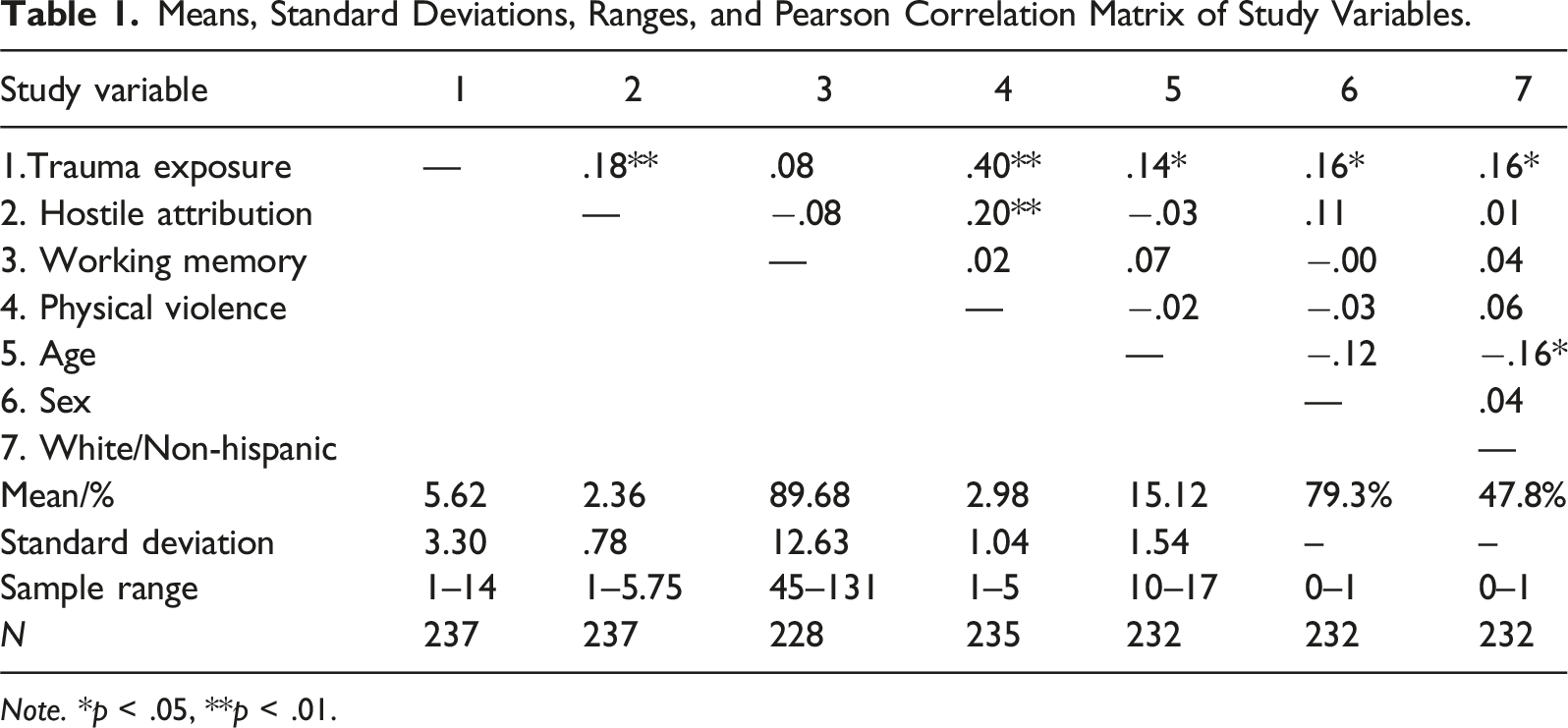
Note. *p < .05, **p < .01.
Correlations
As shown in Table 1, correlations were conducted to understand bivariate relations among variables. Trauma exposure was moderately positively correlated with physical violence, but not violent charges. Hostile attribution bias was weakly positively correlated with physical violence. Working memory was not correlated with either outcome (or any other variable). Trauma exposure was weakly positively correlated with HAB, age, sex, and being White/Non-Hispanic. Age was weakly negatively associated with being White/Non-Hispanic.
Measurement Models
Two measurement models were conducted for the latent factors of HAB and physical violence. See Table S3 for full details. For HAB, a single factor CFA revealed excellent fit
Physical Violence moderation model
The first goal of the study was to examine the unique and interactive effects of HAB and working memory on violence. As such, physical violence was regressed on HAB, working memory, and their interactive effects using a hybrid model within a structural equation modeling framework while controlling for sex, age, race/ethnicity. A first-order effects model was first estimated to evaluate the unique effects of HAB and working memory on physical violence. The first-order effects model revealed a good fit to the data Moderating Effect of Working Memory. Note. Variables were standardized and mean centered.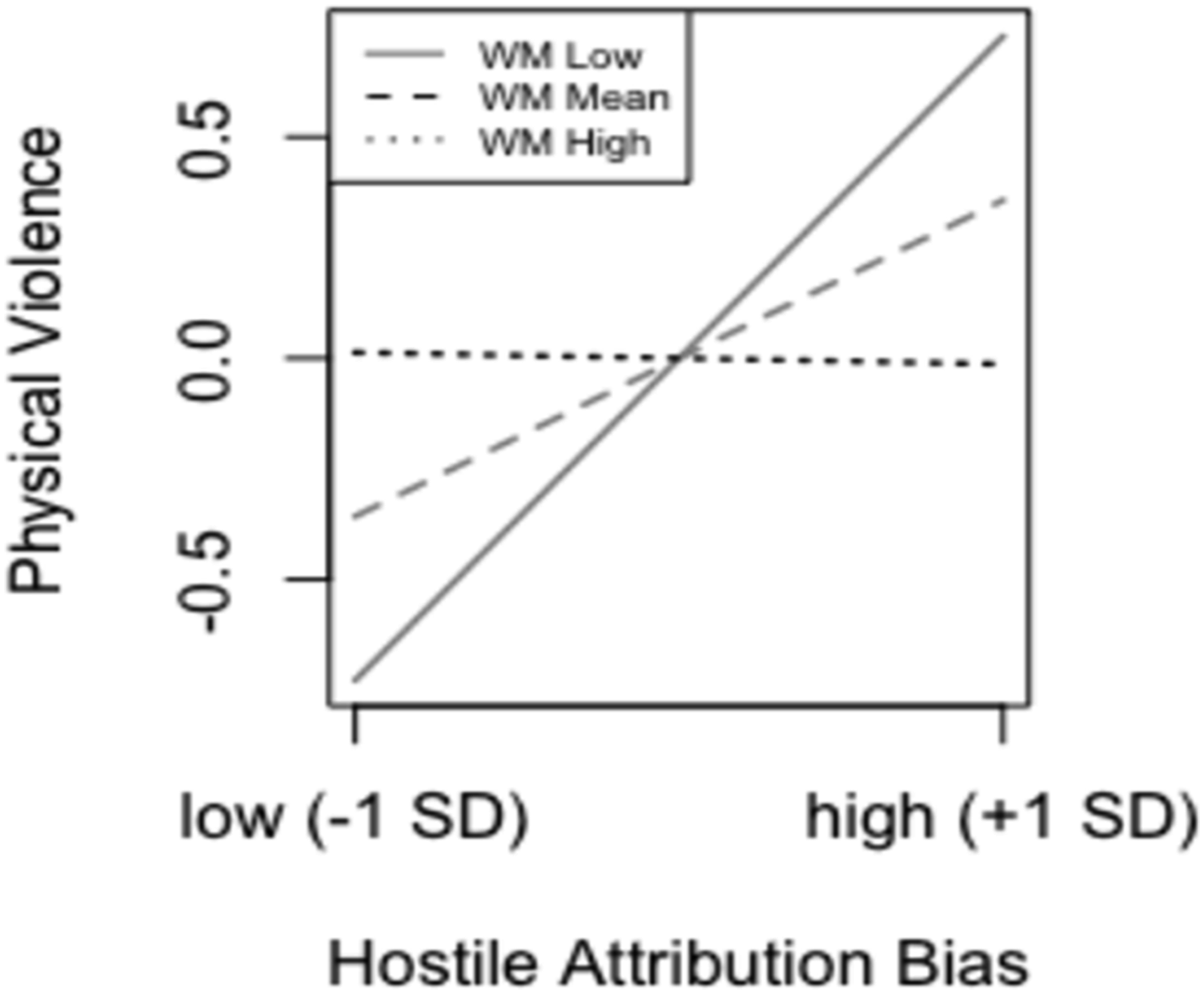
Physical Violence Mediation Model
HAB, working memory, and the interaction between HAB and working memory were then evaluated as parallel mediators of the link between trauma and violence. See Figure 2. The model revealed adequate fit to the data Moderated Mediation Models of Physical Violence. Note: Hostile Attribution Bias (HAB), Working Memory Index (WMI), *p ≤ .05; **p ≤ .001; ***p ≤ .001.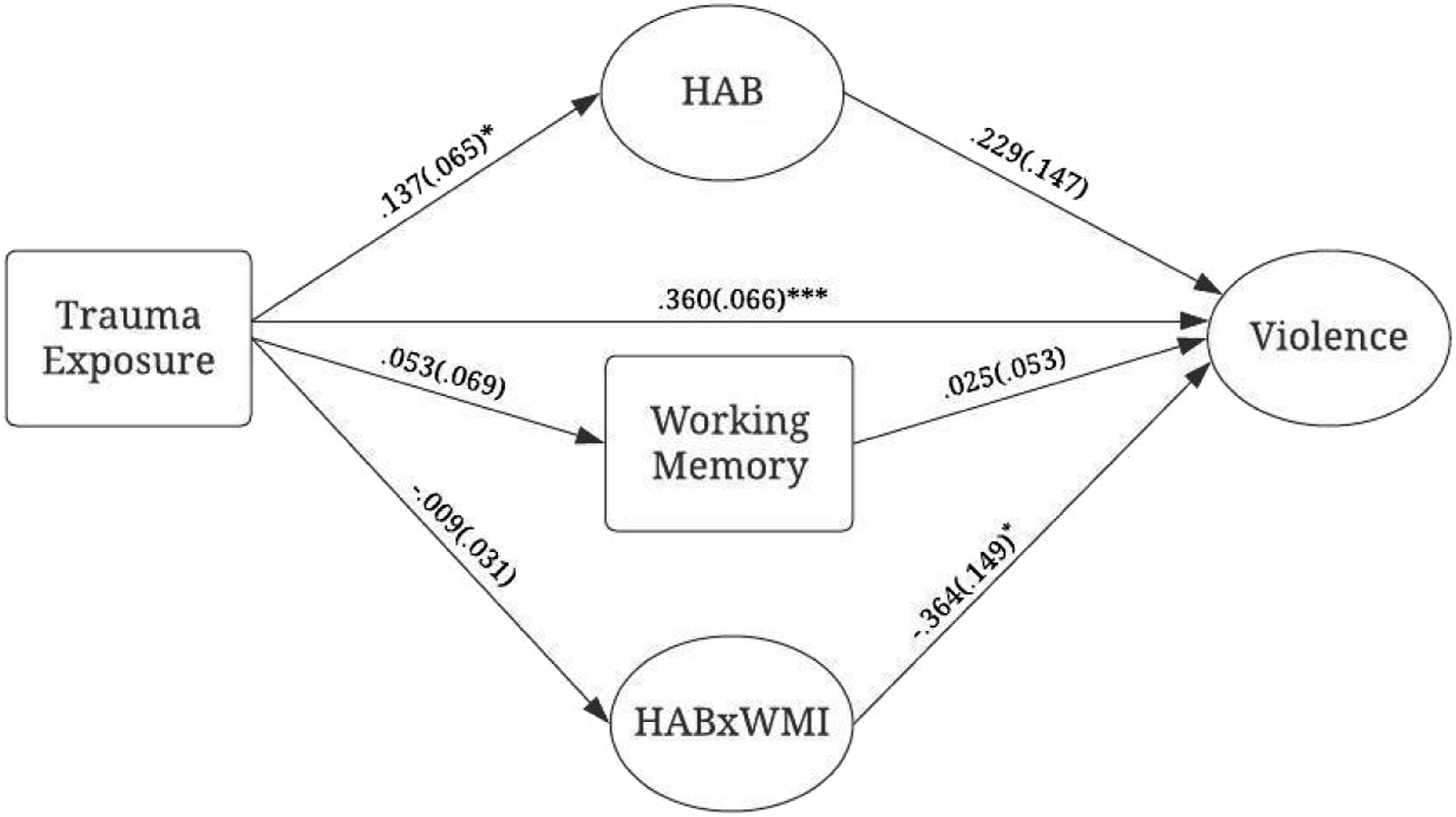
Discussion
Youth exposed to trauma are at a higher risk of engaging in violent behavior. Yet, there is limited research examining what mechanisms link experiencing trauma with engaging in violent behavior. Youth involved in the justice system are more vulnerable to traumatic experiences as well as engaging in violent behavior, making them an important population to explore this research question within. This study advances the field by examining HAB, working memory, and the interaction between HAB and working memory as potential mechanisms that may explain why trauma exposure increases the risk of violent behavior. Descriptive results indicated that youth reported high exposure to traumatic events. Nearly all youth (95.6%) endorsed at least one “Criterion A” event and, on average, experienced more than five such traumatic events, which is consistent with prior literature (Charak et al., 2019; Dierkhising et al., 2013). Some of the most commonly endorsed events were serious accidents or injury, sudden or violent death of a loved one, being a victim of violence, and witnessing a loved one experience violence. Consistent with hypotheses, trauma exposure was related to self-reported physical violence perpetration, consistent with prior literature (Folk et al., 2021). Indeed, youth who experience violence victimization are at higher risk for engaging in violent behavior, and this relationship is often dose-dependent and is consistent across various types of violence perpetration, such as intimate partner violence and firearm violence (Schmidt et al., 2019). These findings illustrate the consistency in levels of polyvictimization among youth involved in the justice system and the importance of universal trauma screening and trauma-informed care within justice settings.
Hostile attribution bias, or the tendency to (over)interpret social stimuli as hostile, was positively associated with both trauma exposure and physical violence. Consistent with previous research (Verhoef et al., 2019), trauma exposure was positively related to HAB at the bivariate level and in the first path of the physical violence mediation model. It is thought that trauma exposure hyper-activates brain centers related to perceived threat and overtime this results in the creation of cognitive distortions and biases, such as hostile attribution bias (Lee & Hoaken, 2007). Due to the cross-sectional nature of data collection, we are unable to test if the trauma exposure caused and maintained HAB, which has been posited theoretically and found in other research (Dodge et al., 1995). However, this association again illustrates the interwoven nature of trauma exposure and cognitive protective mechanisms/biases such as HAB.
Hostile attribution bias was also related to physical violence at the bivariate and first-order effects level, even when statistically accounting for working memory and demographic covariates. Consistent with the social information processing model (Crick & Dodge, 1994), individuals who engage in aggression and violence often (over)interpret incoming social cues as threatening or hostile and react with aggression to protect themselves. Overtime, this pattern is reinforced and can lead to cascading effects of maladaptive social interactions, overuse of aggression as a response mechanism, and missed opportunities to practice more adaptive behavioral strategies. The current results are consistent with theory and suggest that HAB indeed contributes to violent behavior among justice-involved youth.
Interestingly, HAB did interact with working memory in relation to physical violence. Probing that interaction revealed that HAB was strongly associated with physical violence at lower levels of working memory, and unrelated at high levels of working memory. This finding is in line with recent theoretical models, which suggest that working memory is necessary for adaptive social information processing (Van Rest et al., 2019). More specifically, impaired working memory may attenuate a youth’s ability to hold multiple interpretations in mind simultaneously (e.g., “they are out to get me” or “maybe that was an accident”) as well as in-the-moment choosing a behavioral response and incorporating needed information from long term memory (e.g., “Was I punished for this behavior in the past?”). The current study adds to the nascent literature in this area and is consistent with Van Rest and colleagues (2019), who also found that among youth, lower levels of working memory were associated with HAB, and HAB, in turn was associated with violence. However, contradictory to the current findings, they also found the inverse to be true, that higher levels of working memory buffered against hostile interpretations and, thus, violent responses. It is possible the current study did not have enough variance at higher levels of working memory to uncover an effect (only 6.6% of the sample was in the 1SD + range).
Inconsistent with hypotheses, HAB did not mediate the relation between trauma and physical violence. In fact, when trauma exposure was accounted for in the models, HAB was no longer uniquely associated with physical violence. While conceptually, the argument that trauma exposure leads to HAB, which in turn leads to violence, is an elegant one, it has only been tested and supported in the narrower context of child maltreatment (Dodge et al., 1995; Zhu et al., 2020) rather than a diverse set of traumatic experiences, and until now, has not been tested among justice-involved youth. In the current study, where a diverse set of traumatic experiences (e.g., including child maltreatment) were measured, HAB did not act as a mediator. In fact, results point to trauma exposure as the potent risk factor of physical violence and that HAB is not associated with physical violence when trauma is accounted for. It is possible that other aspects of SIP processing are more affected by trauma exposure at this developmental window relative to HAB, such as encoding cues, or more downstream steps, such as (aggressive) response generation, which would have a much more ingrained reinforcement pattern by adolescence. Further, it could be the case that other factors are more important to the linking mechanism between trauma exposure and violence within this highly vulnerable population that often has high rates of child welfare involvement, traumatic brain injury, and substance use.
Working memory was not uniquely related to study variables at the bivariate level. Inconsistent with prior work (Op den Kelder et al., 2018) and hypotheses, trauma exposure was unrelated to working memory at the bivariate level and in all models. Given that the average working memory score for youth in the sample was one point away from the “Average” range, the present results point to cognitive resilience in the context of high levels of trauma exposure, which should not be overlooked. Indeed, 80% of the sample was in the “Low Average” to “High Average” range, while this is a positive finding, it is possible it also attenuated the variability to detect effects at high and low levels of working memory. Although working memory was not uniquely related to physical violence, it did interact with HAB to increase associations with physical violence. There may be other contributing factors (such as those enumerated above) important to the interrelation of trauma exposure, working memory, and violence that warrant further investigation.
Limitations
The study’s findings should be considered in light of several limitations. Firstly, the study design was cross-sectional, although longitudinal designs are more suitable for the research question. However, including justice-involved youth in longitudinal designs in the United States is challenging due to a lack of large federally funded resources, support from state and local facilities, access to case records for prospective longitudinal designs, and follow-up post-detention. Despite these challenges, the current study offers initial insights into the relationship between trauma exposure and violence, providing a foundation for future longitudinal efforts.
Secondly, the study may have been underpowered to detect small effects, potentially missing meaningful associations. While a sample size of approximately 230 is relatively large, larger sample sizes would be beneficial for testing three simultaneous mediators. Another limitation is the measurement of HAB. The current measure was selected due to its limited previous use with justice-involved youth. However, the cultural appropriateness and ecological validity of the measure for this population are unknown, as well as potentially concerning psychometric properties, highlighting the need for future research in this area. Additionally, the study focused on Criterion-A like events and did not measure neglect, which is associated with violent behavior and impaired working memory. This omission may have attenuated the associations found. Lastly, the sample was predominantly male and White/Non-Hispanic, limiting generalizability to female populations and more diverse samples. Future research should include more individuals from minoritized backgrounds and consider additional traumatic events, such as racism and police brutality, which are common but were not measured in the current study.
Conclusion and Implications
The relation between trauma exposure and violent behavior is a chronic public health problem that warrants continued research. The current study found staggering rates of traumatic event exposure among justice-involved youth that were directly related to self-reported violent behavior. These findings are consistent with prior work (Baglivio et al., 2014; Folk et al., 2021) and underscore the need for universal screening and trauma-informed care in juvenile justice settings. The current study tested HAB and working memory as unique and interactive mediators in the link between trauma exposure and violent behavior. Overall, while mediation was not supported, important associations were found. First, HAB was found to be related to physical violence, supporting the continued connection between these variables and the clinical relevance of treating HAB in violence reduction treatments (Goldstein et al., 2016). However, when trauma exposure was entered into subsequent models, HAB was no longer associated with violence. This highlights the central importance of trauma exposure, indicating that trauma exposure should be top priority in assessment and treatment for violence prevention/reduction programming. More efforts in justice settings should revolve around measuring trauma exposure, treating trauma exposure, and preventing future trauma exposure for youth involved at any level of the juvenile justice system. As juvenile justice systems have become more responsive to the needs of youth in their care, trauma screeners have been adapted to the needs and administrative realities of justice centers (Weinberger et al., 2023), and trauma-informed treatment programs have been created for justice settings (Olaghere et al., 2021). A recent systematic review of trauma treatment programs for justice-involved youth revealed that treating trauma reduced trauma-related symptoms, behavioral infractions, and institutional violence, but research is still needed on how trauma treatment may be related to behavioral outcomes outside of residential facilities (Zettler et al., 2021).
Current findings suggest that impaired working memory abilities may be a risk factor for violent behavior. These initial findings need replication but point to important clinical opportunities for justice-involved youth. There is a tremendous opportunity to consider justice-involved youth’s neurocognitive functioning as both a risk and protective factor in risk assessment and treatment programming, especially given that the brain is still developing and cognitive remediation has shown promise in reducing future criminal behaviors (Romero-Martínez et al., 2022). For example, in a recent randomized control trial, individuals with histories of intimate partner violence who were treated with a SIP treatment and cognitive training (e.g., therapists taught cognitive skills such as attention, speeded processing, planning using previously established pencil/paper worksheets and activities) were less likely to recidivate relative to those that only received SIP intervention (Romero-Martínez et al., 2022).
Future Directions
The empirical investigation of HAB and working memory in relation to violence and trauma exposure among justice-involved youth is in the earliest phases. As such, there are a multitude of future directions for this line of inquiry. Foremost, prospective longitudinal research designs where trauma exposure and cognitive functioning can be assessed over time and before violent behavior in samples at risk for justice involvement or violent behavior would be ideal. Given that violent behavior often occurs in complex situations with many factors occurring simultaneously (e.g., social stimuli, emotion, biological factors, contextual factors, opportunity), it would also be advantageous to employ ecological momentary assessment or daily diary methods to better understand the precipitating factors involved in violent behavior.
Another avenue would be to expand beyond HAB and/or working memory to measure other highly related social-cognitive and cognitive factors. For HAB, it could be important to measure the SIP step before HAB, encoding cues, as research has shown individuals with significant trauma histories have difficulty encoding context in the presence of threat, and HAB is downstream of this encoding (Lambert et al., 2017). Similarly, working memory is interrelated with many facets of cognitive processing, such as attention and response inhibition, as one must be able to attend to the stimuli and block out competing cognitive demands to first hold information in mind for working memory utilization. It would be advantageous to expand the cognitive assessment in future work and be able to control for known cognitive covariates such as attention-deficit/hyperactivity disorder diagnosis, intellectual quotient, and traumatic brain injury.
Parallel to these empirical and theory-driving investigations, it would be interesting to understand how factors such as working memory and other neurocognitive processes are related to outcomes in violence prevention/reduction programming that is often required of individuals involved in the justice system. Many of these interventions rely on modifying HAB to reduce violence in their programming and rely heavily on cognitive skills to be successful with treatment. Yet, cognitive strengths/limitations are often not tested at the outset of treatment, nor are treatments tailored to individualized skills/deficits, and this may be an important facet of why interventions have had modest success rates (Olaghere et al., 2021).
Supplemental Material
Supplemental Material - Hostile Attribution Bias and Working Memory in the Link Between Trauma Exposure and Violence in Justice-Involved Youth
Supplemental Material for Hostile Attribution Bias and Working Memory in the Link Between Trauma Exposure and Violence in Justice-Involved Youth by Rebecca L. Griffith, Paula Fite, and Zuchao Shen in Youth Violence and Juvenile Justice.
Footnotes
Declaration of Conflicting Interests
The author(s) declared no potential conflicts of interest with respect to the research, authorship, and/or publication of this article.
Funding
The author(s) disclosed receipt of the following financial support for the research, authorship, and/or publication of this article: This research was supported by funding from the Eunice Kennedy Shriver National Institute of Child Health and Human Development, grant 5F31HD1067450-02 awarded to Rebecca L. Griffith, M.A. Dr. Griffith was supported by grant T32 MH018269 from the National Institute of Health.

Supplemental Material
Supplemental material for this article is available online.
Author biographies
References
Supplementary Material
Please find the following supplemental material available below.
For Open Access articles published under a Creative Commons License, all supplemental material carries the same license as the article it is associated with.
For non-Open Access articles published, all supplemental material carries a non-exclusive license, and permission requests for re-use of supplemental material or any part of supplemental material shall be sent directly to the copyright owner as specified in the copyright notice associated with the article.
