






Abstract
This qualitative case study focuses on the transition made by three career-changing women moving from science and engineering fields into secondary teaching. The findings indicate that all three women exhibited unexpected levels of fear, anxiety, and shame in response to new learning. Supported by the literature on adult learning and transformative learning, the findings reveal that the participants underwent perspective transformations in their thinking about themselves as professionals and their philosophy of teaching. The study concludes with recommendations for support in order to increase the likelihood that this valuable professional cohort reaches their goal of becoming teachers.
Introduction
Women career-changers now constitute a large number of students in higher education secondary teacher education programs. Sixty-one percent of all career-changers going into teaching are women, and the average age of new teachers is 29 (Woodrow Wilson Fellowship Foundation, 2008b). Within that group, women from science, technology, engineering, and math (STEM) fields are the most prevalent (Sawchuk, 2008; Woodrow Wilson National Fellowship Foundation, 2008a). Combining these facts with known teacher shortages in STEM fields, and women career-changers become a cohort to which attention should be paid (Goddard, 2003; Schuerman, 2000).
The current dialogue in the United States about teacher education focuses on teacher accountability, learning measurements, and teleological quick fixes for curriculum reform. Few participants in the national debate are considering the challenges faced by individuals learning to teach at the secondary level. Research indicates that STEM professional transitions to other fields require considerable identity shifts (Freidus, 1994; Grier & Johnston, 2009; Williams, 2010). This research contributes to the conversation by illuminating the challenges faced by highly skilled adults striving to become highly effective secondary teachers. It might be assumed that three women who previously worked in demanding STEM fields would have little difficulty transitioning into a secondary classroom. In fact, the proliferation of career-changer fast-track programs designed to stem the tide of retirements and of those who withdraw from teaching would lead one to believe that moving from any professional career into secondary education is an easy transition. The research presented here reveals that this is not the case.
Using Jack Mezirow’s and Associates (2000) theory of transformative learning, this study focuses on the transition made by three career-changing women moving from STEM fields into secondary teaching. The findings indicate that all three women exhibited unexpected levels of fear, anxiety, and shame in response to new learning. Supported by the literature on adult learning and transformative learning, the findings reveal that the participants underwent perspective transformations (Mezirow & Associates, 2000) in their thinking about themselves as professionals and their philosophy of teaching. The study concludes with recommendations for support in order to increase the likelihood that this valuable professional cohort reaches their goal of becoming teachers.
The Adult Learner and Transformational Learning
There is one point that seems to be consistently overlooked in the national conversation about teacher education: adults learn differently (Brookfield, 1986; Gorham, 1985; Kegan 1994; Knowles, 1980; Mezirow & Associates, 2000). While this seems obvious, very few teacher educators surface this notion as a lens through which to structure curriculum. Since the 1980s, several researchers have focused on the needs of adult learners, creating a body of work that is reliable, valid, and seemingly overlooked in the realm of teacher education. Several adult education researchers apply principles of andragogy to many useful fields (skills retooling, community college learning, on-the-job training, professional development, to name a few); but relatively few studies apply these findings to teacher education (Brown, 2005, 2006; Calloway & Jorgensen, 1994; Drago-Severson & Aravena, 2011; Hayes & Flannery, 1997; Speer & Dorfman, 1986). Given the statistics on career-changers and women entering higher education, the need to consider this body of literature is evident.
Key aspects of how adults learn can be found in research conducted in the 1970s and 1980s as andragogy emerged as a discrete field of study in the United States. Malcolm Knowles (1980) highlighted the differences between adult learners compared to other age ranges and their need to be a part of their learning, both in terms of what is to be learned and how it is to be learned. While adults, adolescents, and children might learn in similar ways physiologically, what they bring to their learning is dramatically different in terms of experience, opinions, preconceptions, and frameworks. These differences change how a teacher can approach adults’ learning and how adults react to new learning. The theoretical framework employed in this research stems from the foundational work in adult learning by Brookfield (1986), Daloz (1999), Dirkx (1998), Kegan (1994), and Knowles (1980).
While still open to debate in the academy, it is my belief based on 20 years of experience teaching adolescents and adults that one must approach the teaching of adults differently. Adults bring to their learning a complex set of assumptions, experiences, and preconceptions that younger learners have not yet had time to develop. That is not to say that younger learners do not have assumptions, experiences, and preconceptions, but rather that younger learners have not yet had the time, generally speaking, to test and validate that thinking to the extent that adults have. That difference in experience provides adult learners with a simultaneous advantage and disadvantage. On one hand, adult learners have much more knowledge and experience at their disposal to frame new learning. On the other hand, adults have experience that might preclude them from being open to new learning. Teachers of adults need to be aware of this fundamental notion in order to teach adults effectively.
Brookfield (1986) explained that the key to successfully helping adults reach their educational goals is balance between the goals and needs of the learner and the needs and goals of the instructor’s institution. Brookfield explains: The point is that facilitating learning is a transactional encounter in which learner desires and educator priorities will inevitably interact and influence each other. In most educational programs there will be some curricular areas and programmatic activities that represent a direct response to the expressed needs of the learners, others that reflect the educator’s view of what ought to be minimally present in any education or training program. (Brookfield, 1986, p. 98)
These themes have been echoed by later researchers. Berger (2004) honed in on what she referred to as the “growing edge” of the adult learner (p. 336). To evaluate the participants’ transformative journeys, Berger used Kegan’s (1982, 1994) Subject–Object interviewing methodology. Berger wanted to understand what adult learning looks like on the verge of a transformation. She studied the edge of transformation, and did so clearly, presenting readers with an intimate look at the learner at the point of transformation. Berger’s “edge” might be likened to what Fetherston and Kelly (2007) referred to as the learner’s “tentative/partial situatedness at the limits of discursive knowing/being” (p. 281). Berger’s (2004) research focuses on a vulnerable moment in an adult learner’s transformative process which warrants close attention by those who teach adults.
Concurrent with the work of Brookfield, Kegan, and Knowles was the work of Jack Mezirow. In the 1970s, Jack Mezirow conducted a large-scale study of community colleges and the programs they were developing to accommodate and assist women as they began to enter the work force. This study provided the data from which transformative learning theory originated (Mezirow, 1978). Mezirow paid close attention to how the women in his study were learning. The theory that he derived from his observations supports feminist conclusions that for many, learning is associative and encompassing rather than solitary and delimiting (Gilligan, 1982).
Mezirow’s transformative learning theory identifies frames of reference that we all establish as we move through life. Those adult frames of reference are constantly tested, altered, and validated through our experiences. Frames of reference that become especially reliable are referred to as meaning perspectives. Mezirow claims that true transformation requires shifts in those meaning perspectives, shifts that change not what one knows, but how one knows what she knows (Mezirow & Associates, 2000).
Jack Mezirow defines transformative learning as follows: Transformative learning refers to the process by which we transform our taken-for-granted frames of reference (meaning perspectives, habits of mind, mind-sets) to make them more inclusive, discriminating, open, emotionally capable of change, and reflective so that they may generate beliefs and opinions that will prove more true or justified to guide action. Transformative learning involves participation in constructive discourse to use the experience of others to assess reasons justifying these assumptions, and making an action decision based on the resulting insight. (Mezirow & Associates, 2000, pp. 7–8)
Perspective transformation is the result of transformative learning: Perspective transformation involves a sequence of learning activities that begins with a disorienting dilemma and concludes with a changed self-concept that enables a reintegration into one’s life context on the basis of conditions dictated by a new perspective. The sequence of transformative learning activities is not made up of invariable developmental steps; rather, the activities should be understood as sequential moments of “meaning becoming clarified.” (Mezirow, 1991, p. 193)
According to Mezirow and Associates (2000), adults engaged in transformative learning move down a predictable pathway involving a prompt, intake of new knowledge and reintegration. In other words, the learner changes her way of knowing. Mezirow states, learning is the “process of using prior interpretation to construe a new or revised interpretation of the meaning of one’s experience as a guide to future action” (Mezirow & Associates, 2000, p. 5). According to Mezirow, because habits of mind and points of view are so personal, learning must be transformative to change a learner’s thinking. The phases of transformation include: A disorienting dilemma, self-examination with feelings of fear, anger, guilt or shame, a critical assessment of assumptions, recognition that one’s discontent and the process of transformation are shared, exploration of options for new roles, relationships, and actions, planning a course of action, acquiring knowledge and skills for implementing one’s plans, provisional trying of new roles, building competence and self-confidence in new roles and relationships, and finally a reintegration into one’s life on the basis of conditions dictated by one’s new perspective. (Mezirow & Associates, 2000, p. 22)
The focus of this research is the first three phases: “a disorienting dilemma, self-examination with feelings of fear, anger, guilt or shame, [and] a critical assessment of assumptions” (Mezirow & Associates, 2000, p. 22). Through case study analysis, the journey through these phases of transformation are richly documented; allowing for a dramatic disclosure of the learning needs of career-changers pursuing secondary teaching as a new profession.
Method
The setting for this study is a small independent graduate college offering a Master of Arts in Teaching (MAT) in several disciplines. The program lasts 12 months and is technically considered a fast-track program, although the faculty and school do not frame the program in that way. Because most teachers in the state are certified through undergraduate programs, the MAT is a more unusual pathway. The cornerstone and appeal of the program is its full-year teaching internship, something not encountered in many teacher education programs. The program also requires five graduate-level content courses in the teacher candidate’s discipline, a research component as well as the state’s mandated pedagogy classes. Due to the program’s flexible nature, it tends to attract career-changers; in any given class, up to 30% of the students would be considered nontraditional graduate students. The remaining 70% are typically between 22 and 25 years of age. Despite the program’s thoughtful design, however, conversations with faculty revealed that few had thought overtly about the differences in the way adults learn. While all recognized there were differences, and could readily discuss those differences, no research had been done into this area in an attempt to surface or hone in on ways to better meet students’ learning needs.
This 3-year study followed three women career-changers from STEM fields as they entered the MAT program, graduated, and entered the work force as secondary teachers. The research was conducted in three primary phases: analysis of archived data, participant-generated photography, and face-to-face interviews. Archived data were gathered from participants and analyzed for evidence of transformative learning (Application Essays, Field Work Journals, Summer Journals, Trimester Evaluations, Philosophy of Teaching Narrative, and The Teacher I Have Become Narrative). In total, 150–200 pages of archived reflective writing were collected from each of the three participants. These data were requested of the participants at the time they were invited to participate in the study, which was after their degree completion. Once Institutional Review Board (IRB) approval was granted, participants invited to participate supplied hard and/or electronic copies of the data for review. In this way, the researcher, also a professor in the program, removed herself from influence over the participants while they were students; the study was not conceived of until the participants were in their last 2 months of the program. The 12 career-changers in that cohort of students were invited to participate in the study via an e-mail invitation. Six responded in the affirmative and four completed the study. The three participants presented here participated in all aspects of the study. The archived data were coded using a coding (Rubin & Rubin, 1995) and constant comparative method (Merriam, 1998).
Added to that archive were the photographs taken by the participants in their second year of teaching as well as the written reflections of those photographs. The incorporation of participant-generated photography was approved by the IRB board. Participant-generated photography (Perka, Matherly, Fishman, & Ridge, 1992) was used in order to triangulate the themes that were emerging from the archived data. Participants were simply asked to “take pictures of the teacher you have become” in order to capture their thinking about themselves as professional teachers in their first year of teaching. The photos were then printed on paper and sent back to the participants with the request to describe how each photo represents an answer to that prompt. Those written responses were then folded into the data analysis and used to either confirm or challenge emerging themes. Member checking (Carlson, 2010; Maxwell, 1996) using e-mail was also commenced during this phase in order to allow participants to support or clarify their words.
Finally, in the third year of the study during the participants second year of teaching following degree completion, face-to-face semistructured interviews (Rubin & Rubin, 1995), were conducted with IRB approval. The interviews were transcribed and folded into the analysis already underway with the archived data and photograph responses. Analytical notebooks (Charmaz, 2006; Gerstl-Pepin & Patrizio, 2009; Glaser & Strauss, 1967; Maxwell, 1996; Tuleja, 2002) were kept throughout the 3-year time line.
It should be noted that I am a full-time instructor in the MAT program, the setting for the first year of the study, and have taught the classes from which most of the archived data are taken. I taught the cohort under study; however, during that time period I did not consider using their work in a study. From that perspective, I view my analysis as reasonably objective. Additionally, my personal experience and interaction with the participants in many ways enhanced my insights into the transformative process experienced by the participants.
Study Participants
The three participants in this study, Mary, Tosha, and Rebecca (pseudonyms) were all well established in their former careers before making the decision to enter the field of secondary education (see Table 1 below). All three clearly stated that the reasons for their career change had to do with their desire to make a difference and their need to balance family and career. They each felt that they had reached a point in their careers where they simply were no longer fulfilled professionally. They saw teaching as a way to give back and in turn have a sense of fulfillment that aligned with their values and family commitments. As Mary reflected in her second year of teaching: I got to the point where I felt like I wasn’t giving back, I wasn’t contributing anything to society. And that’s what made me start thinking about it . . . and at the same time my marriage is falling apart and so I was like, well, you know, I could move back up to [home state] and finally get to teach ‘cause it had been like four years between deciding that’s what I wanted to do and making the move. Um, but it was what I was doing, it didn’t seem important, you know. I wasn’t doing anything to contribute to society and help people. So that’s why.
Overview of Participants
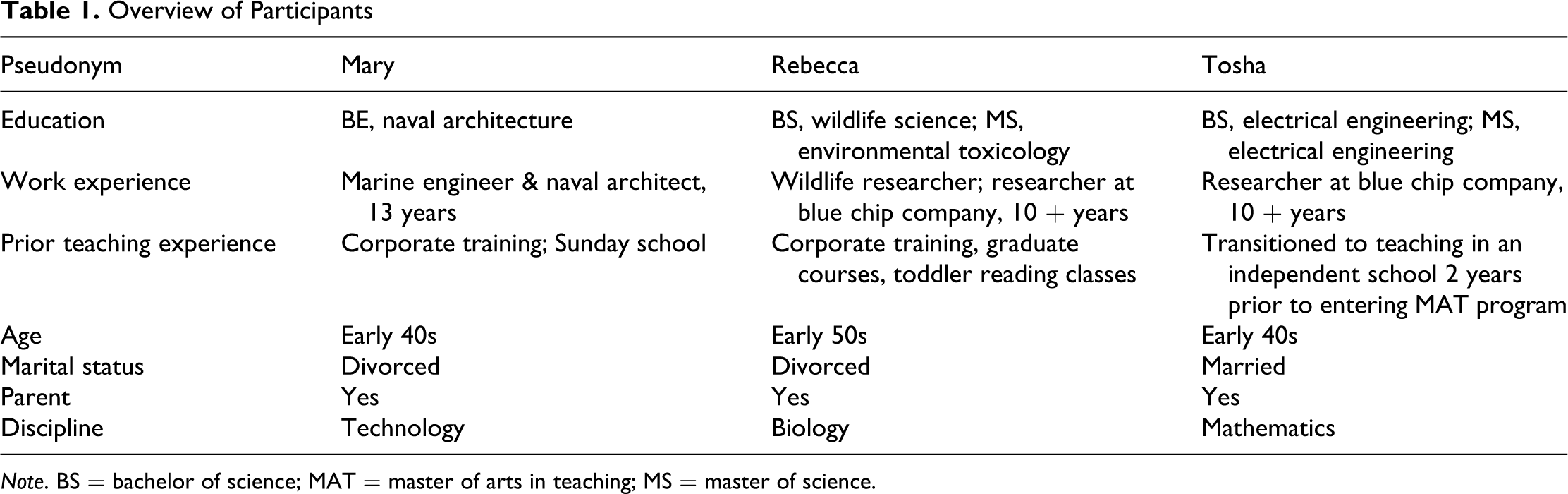
Note. BS = bachelor of science; MAT = master of arts in teaching; MS = master of science.
Like Mary, Rebecca came to realize what she wanted, a job that would combine her love and knowledge of science with her desire to interact with people. She noted: I remember literally pushing papers when I was a wildlife technician . . . I had to sit at my desk, and I would shuffle and fall asleep and then shuffle. I mean, I was very literally, a paper shuffler. I remember being bored at [blue chip company], it wasn’t that I didn’t have stuff to do, but I just lived for the weekend. And that was 11 years.
Ultimately, Rebecca realized she could combine her love of science with her strong skills and training in communication to achieve her goals: I now realize that “saving the world” depends on more than scientific facts. Environmental problems arising over misuses, abuse and depletion of our natural resources can only be solved with more communication in our society, and more science awareness. Resolving these problems, and conflicts, depend on deepening science literacy in our children. Becoming a teacher will put me in a place to share my love and excitement of science, as well as my concern for the environment. Instead of being a trainer to adults, I will be a teacher for children. I want to guide students to learn communication skills and science to shape the world in which they live.
Tosha knew she had made the right decision to leave her engineering job even before she received the phone call for her first teaching position. In her summer journal writing, Tosha shared a poignant reflection between herself and her son: I had just finished off my work at [the research and development company] and was a few days from starting a new career as a teacher. I was taking a walk with my 6-year-old son, who told me how glad he was that I’d “retired” from [the research and development company] and that I’d be a teacher. I told him it meant a lot to me to hear him say that, but that I was a bit sacred about it. He said, “Mr. M said he was scared when he first started teaching, too, but then it turned out to be FUN!” It’s important to let yourself acknowledge that new undertakings are difficult, and to recognize that they can also be very rewarding.
Three case studies: Mary, Tosha, and Rebecca
Mary
Mary is a middle school technology teacher, in her fourth year of teaching at the time of this writing. She is in her mid-40s, divorced with a son in elementary school. Prior to entering the MAT program, she was a marine engineer and naval architect working in Washington, DC. Using her Bachelor’s degree in Naval Architecture, she spent 13 years designing ships. While Mary had some experience with teaching before deciding to become a technology teacher, she trained new engineers and company customers and taught young children in a Sunday school setting, she had no experience working with adolescents. Mary grew up in one region of the United States and has spent most of her life there surrounded by a supportive family who encouraged her to become an engineer. Mary explained: My dad and his brother both went to [X] College and my uncle, he’s retired now, but he was a professor of engineering at [X] Institute and my dad’s an engineer. And I was daddy’s girl, come on. . .I liked to help my dad work on the car, when I was a kid, my dad and my uncle would. . .set up the garage to look like an engine room and my brother and I would dress up in little coveralls and run around and my dad would be like, we’re blowin’ steam and we’d run and we’d . . .pretend to close the valves.
Mary went on to tell more stories about her early childhood: I used to love to like building stuff in the basement and we built a tree house. . .when I was . . .12 my dad and I built this gorgeous doll house, but when I was done building it, I, I didn’t want to play with it, you know (laughter). One year for Chanukah I guess I was . . .seven or eight and my brother was. . .four or five, [I got] one of those orange record players. . .in the pleather case and. . .he got a tool set. And so I promptly took the tool set and took the record player apart. . .
Mary’s family and her parents in particular, were very supportive of her decision to go into engineering. There appeared to be no gender boundaries in her home in the 1970s and 1980s. Mary said: I was lucky because I had people around me who fostered that. . .my parents were always, pushed. . .the math and the science. . .the attitude of you can do whatever you want. So, you know, I decided I wanted to design ships, so I did that for a number of years.
Mary presents herself as a professional, confident woman who has made personal and career decisions based on what is best for her and her son. She has a solid family support network, an excellent education, and a remarkable career path. Mary initially expressed confidence in her teaching skills based on her past experience: During my years in the industry, one of my prime responsibilities was to train our company’s newly hired engineers and our customers’ shipboard personnel. Because of these responsibilities, I worked with an incredibly diverse array of learners. Onboard the ships, I encountered people with language barriers, as well as people at varying levels of intellect. I learned very quickly that material needed to be presented in ways so that everyone could succeed, regardless of their personal styles of learning.
Just prior to actually entering a classroom for observation, the confidence expressed above dissipated. In an early journal entry, Mary became concerned and self-reflective as she wrote: I expect that I will feel nervous and overwhelmed. I will be nervous because I am entering into a complete unknown . . .it seems that technology teachers are teaching a much more advanced curriculum than I ever learned. The experience will be a lot to take in and absorb and I am concerned I won’t be looking for what I need.
It might seem surprising that a naval engineer with 13 years of experience would second guess her ability to teach a technology curriculum. The angst Mary expressed points to the fragility of the adult learner when encountering a new environment. As Mezirow explains, it is precisely because of the well-established frame of reference Mary has with regard to technology and engineering that she felt this angst. The potential to have to understand what she knows in a different way was destabilizing, even for an experienced engineer. This destabilizing feeling prompted in Mary moments of self-reflection as she came to realize how little she knew about her new career. Mary wrote in her journal, “I am not 100% sure what is meant by activities, nor am I 100% sure what exactly technology teachers are teaching currently.”
After observing one high school technology class Mary exclaimed, “The part that was even more surprising (and a little embarrassing) was that they seemed to have a better grasp of the ideas [than] I did.”
Mary’s anxieties extended into her initial coursework and laboratory teaching experiences. Mary was so nervous during her first teaching experience she was shaking. She reflected, “I thought to myself, “What was I thinking?! How am I ever going to do this?”” Later, in her interview during her second year of teaching, Mary laughingly recalled, “I really thought that . . .I would walk in and just start teaching, and I forgot that you had to deal with kids.”
Tosha
Prior to becoming a teacher, Tosha was an engineer working in industry. She obtained her bachelor’s and master’s degrees from an Ivy League school by the age of 21. In describing her work before entering teaching Tosha recalled: After finishing up [college], I worked in [an engineering research position] for four years while my husband finished up with his Ph.D. And then we were lucky enough to solve a two body problem with him finding the academic job he wanted and my getting a high powered engineering position at the [research and development company]. And, [I] worked there for ten years, had three kids during that time. You know, I’ve had things patented; I’ve given papers in foreign countries. You know, I’ve won awards for engineering work. But, once the third kid came along, I was getting in early and leaving at five o’clock. You really need to be home and taking care of things. And then I’d go back to work in the evening when the kids were in bed, and I’d stay there from nine till midnight. I realized after a while that it was no longer putting as much into my life as much as it was taking out.
Like the other participants, Tosha began to weigh her career against her priorities, “. . . I slept on the notion of teaching for about a year. Probably having some sense that it was a more manageable schedule, which of course, it is and it isn’t.” Tosha ultimately sought a job at an independent school and taught part time for 2 years before entering the MAT program. Her family, both husband and children, were very supportive of the career change. She recalls her first year of teaching: Even though I made every mistake in the book and then some that probably aren’t in the book. I knew I was doing the right thing. And you know, I don’t think beginnings are graceful in the best of circumstances. And particularly when you are as unlettered as I was, but [I] did win those students over, and they did well, and you know, I’ll always care about them.
As she entered the MAT program that summer, she already recognized that the transition she made was dramatic and meaningful, and began to overlay her experience with that of her more novice peers. While reflecting on the high ropes course experience during the MAT camping trip, she drew an analogy between her experience starting out as a new teacher and what her peers were about to experience, I do know just how hard that first year of teaching can be. I hope that those of my classmates who haven’t taught before remember how it feels to fly through the air once you’ve taken the step off the platform.
Likening her teaching to repelling through the air seemingly unsupported provides insight into how Tosha felt that first year of teaching. When considering the life experiences she had entering the field, it is important to recognize that even seasoned, accomplished professionals need and seek out support. While Tosha had already experienced her disorienting dilemma and moved through a period of self-examination prior to entering teaching, she still recognized and hoped for guidance in her newly chosen profession.
Not long after this observation, Tosha admitted to self-doubt in her journal, “I have had thoughts of “I’m still so inadequate to be teaching, I’m sure others would do it so much better.”” In reaction to her comment, a professor responded with a conversation about how her feelings were normal and shared by her peers. She appreciated a professor’s acknowledgment of the difficulties she was experiencing, commenting later in her journal that he clearly understood the “. . . wow, I’m in over my head here. . .” feeling she was living with at the time. Her professor’s support, and validation that what she was experiencing was normal, meant a lot to Tosha. Her insecurities were not pushed aside, but rather validated within the context of an extraordinarily difficult challenge she set before herself. Had her insecurities been brushed aside, she might have been left wondering if her anxiety was not shared. Because of a perceptive professor, though, she left the moment confident that what she was experiencing was indeed shared and in fact quite expected.
She concluded that day’s journal entry a few paragraphs later with a flashback of her “heroine,” the high school math teacher who had taught for 50 years. After reflecting on what kept her former math teacher going that long she quoted the Talmud to reinforce a realization she came to in her understanding of what teaching is all about. She quoted, “We do not see things as they are. We see them as we are,” (Tosha’s italics). Her ability to come to terms with her crisis in confidence was tied to the support she received from her professor and the support she rallied from the image of her heroine she carries with her, combined with her faith, and her faith in herself.
At one point, a classmate approached Tosha for advice. Tosha was happy to lend a hand and to have been considered a source of support by her classmate. Tosha recalled, …today caps a somewhat bruising week in terms of both workload and emotional impact. Today a fellow student . . . came to me in tears, wondering if the next 5 years were going to be as intense as this next year was shaping up to be. (I told the person yes and no; it was safe to assume that the student would be working very hard for some time to come, but that the rewards were substantial and that after the first year, I began to see things getting easier. The learning doesn’t stop, but the competent days really outnumber the incompetent ones and the whole process is less manic.) I’ve been thinking about the exchange and what I can learn from it. The bottom line, I think, is that there really is no royal road to learning to teach (to borrow Euclid’s line about geometry). However, it meant a lot to me that another student sought me out to talk—it says a lot about the community that’s being created in the classroom. It has become an environment where people feel comfortable exposing what they don’t know, which is critical both to being able to learn (since all of us will feel and/or look dumb at some point in the process) and to being able to support each other.
A couple of weeks later, Tosha wrote more about the progress she felt she made over the first 2 years of teaching as she was pushing her thoughts forward to her internship year, her third year of teaching. She wrote: I found that my first year teaching, I was barely staying on top of the next day’s lesson planning (I did not have the luxury of a summer to plan in advance). The second year, I could stay at least a week ahead of myself . . . and actually do something resembling unit planning. So I am cautiously optimistic that I will be able to get still a little further ahead this year.
In the last few pages of her summer journal, Tosha reflected on the importance of sharing the journey toward becoming a teacher with peers. She reflected: …this whole teaching gig works a lot better when you share ideas and support your colleagues. I’ve mentioned this before in these journals—it is very easy to chain yourself to your teacher desk because there’s so much to do, especially early in a career when you’re figuring a lot of things out. The great irony is that this might be when you most need the support of your colleagues. (Ahem—I would not be writing these lines if I had not experienced this. Like many things, I got better at this my second year teaching, but I had to learn it on the fly.).
This quote helped to explain why she entered the program looking for peers. Not unlike many new teachers, her first 2 years were difficult. She instinctively knew that peers would make the journey easier, for her and for them. Getting to know her younger peers also turned out to be a learning experience. Initially, Tosha assumed that there would be little to learn from her 20-something classmates. However, after a class discussion, Tosha realized she had a lot to learn and a long way to go when she wrote that she needed to, “. . . simply shut up, be excellent, and be gracious, and share.”
Rebecca
Rebecca is a biology and chemistry teacher in her fifties. She is divorced with three children ranging from middle to high school. Rebecca has a bachelor’s degree in wildlife science from an Ivy League university and a master’s degree in environmental toxicology. She held several jobs in the environmental sciences. Rebecca recalled: …the first profession right after the bachelor’s was a lab technician. So, I was doing research, but it was outside . . . And after that, I eventually became a chemist at [blue chip company]. I was a laboratory technician and then became a chemist. But I was in the laboratory all time with [blue chip company], and then I was lucky enough to work at a non-profit environmental organization, putting together a program on environmental communications.
After my bachelor of science in Environmental Sciences, I realized I enjoyed working with people too much to immerse myself in a laboratory. I also wanted a career that would “save the world.” Working with the [state] Department of Environmental Conservation, as a wildlife technician, was the result. I researched ring-necked pheasants with all the crazy hours, and working conditions of wildlife research (a thunderstorm blizzard in February at 11 PM comes to mind). Research work involved science; but even more, it involved people: communicating, persuading, teaching, demonstrating, surveying, or policing.
After leaving the blue chip company, she consulted in the field of environmental communication and taught graduate courses. It was in these positions where teaching started to become an option for her. With the divorce at hand, Rebecca decided teaching would afford her a fulfilling career and one that would help her manage her new status as a single parent. The transition to secondary teaching, however, was not as easy as she thought it would be.
Rebecca wrote poignantly about her feelings and lack of confidence in herself as a teacher. After the very first day in the program Rebecca wrote: The end of the first day left me feeling excited but much more scared and intimidated than I expected. I was second-guessing my choice to become a teacher, wondering if I had what it took. . .
She later wrote: I also find I am not “having fun” any more with the MAT program. Stress, workload . . . have taken its toll. [A classmate] noticed it and voiced his concern, helping me realize that the stress is showing visibly on my face. My energy level is down.
By the end of the intensive summer of coursework and teaching labs, Rebecca’s writing would almost make one think that she might not complete the program: I am tired and worn out at the end of this summer session. I feel defeated and unable to meet the high standards and pressures of teaching. To date, I am still wrestling with these issues. I had thought a love of science and a love of working with adolescents were strong qualities for becoming a teacher. The MAT program has proved there are many more skills and strengths needed . . . While pushing myself to stagger toward the summer finish line (I can not conceive of how far away the June finish line lies), I am confused by too much undigested information and too much feedback from too many people.
And later she wrote: Part of my struggle is to realize that I cannot escape having to learn through mistakes. Experience and time appear to be the primary teachers of this profession and I have to accept that I cannot change the inevitability of learning the hard way.
My pride badly shattered, I am now much more humble.
During her interview, at the end of her second year of teaching, I asked Rebecca about her year in the graduate program and the emotional stress it caused. Thinking back, Rebecca laughed to herself and recalled, I can remember the day that you all greeted us with “Good morning, teachers,” and it was like, no way. Who are you kidding? I am not a teacher. I am just a fake, you know. I don’t have the abilities to be a teacher.
It was not until long into her teaching work that Rebecca allowed herself the confidence she deserved to support her work. At the end of her second career, she was willing to admit that she had a firm handle on the skills needed in her new career, but just barely, writing under many of her photographs, “The teacher I want to be” to signify, in her mind, a glimpse at the teacher she wanted to be but was not yet.
Discussion
Tosha, Mary, and Rebecca all exhibited varying degrees of emotional vulnerability during their year in graduate school. As returning students and experienced professionals, one would not anticipate that the demands of a rigorous graduate school program might affect people as prepared as my participants. This research showed that clearly the strain was high and impacted the quality of their work and their lives.
The study participants’ words support the tenants put forth by researchers of adult learning. All three showed a need and concern for those around them (It meant a lot to me that another student sought me out to talk. . .). The recognition that what they were experiencing was normal and shared helped these novice teachers work through their feelings of inadequacy (. . . Wow, I’m in over my head here. . .).
A characteristic that might be common to this specific cohort is the transition they are making from a field with clear goals and outcomes to one with a high degree of uncertainty (Hargreaves, 2009; Lortie, 1975). The transition to an environment where so much is out of one’s control is destabilizing. It is understandable that professionals used to working in environments with other highly skilled adults might find the unpredictability of their new environment destabilizing. While this transition is dramatic for anyone going into secondary teaching, because career-changers have deep and reliable frames of reference (Mezirow & Associates, 2000), they are forced to make more dramatic changes to the way they think about their work and themselves professionally compared to their younger, less experienced peers.
Making the learning process transparent to all learners could alleviate the anxiety career-changers have regarding their feeling of separateness from their peers. In hand with this is the need to continually reinforce confidence. The women in this study held patents, trained naval engineers, conducted workshops where hundreds of blue chip company employees attended, and yet they all lost confidence in themselves at some point (My pride, badly shattered. . .; . . .What was I thinking?! How am I ever going to do this? . . .; I am still so inadequate to be teaching. . .) Mezirow’s transformative learning theory points out that not only is this common in adults taking on this kind of new learning but it should be anticipated by those in the learning environment. Recall phase two of transformative learning theory states that the learner conducts a “[self examination] with feelings of fear, anger, guilt or shame” (Mezirow & Associates, 2000, p. 22). These emotions are evident in the participants’ words and need to be anticipated and acknowledged by the faculty and mentors shepherding novice teachers into the profession.
The program in which these women participated worked hard to build community and collegiality among the participants and with the faculty. During the first week of the program, the teacher candidates and faculty go on a two night camping trip with structured team and leadership building activities. Tosha’s reference to the high ropes activity is one example of how the school builds common experiences among the students. Gilligan’s (1982) observations about the associative nature of adult learning and need for learning to consider all aspects of learners’ lives resonates with what the participants’ experience as challenges and ultimately successes in the program.
The three participants are now all teaching. Tosha is in her sixth year (having taught for 2 years prior to the study’s start) of teaching mathematics to middle school students at an independent school. Not only has she grown into a confident teacher, she is now pursuing National Board Certification. Mary is in her fourth year of teaching middle school technology. She accepted her first middle school job reluctantly. Now, in her second school in an urban district, she is still a middle school technology teacher and enjoys her work very much. Rebecca initially had difficulty securing a teaching job; the market for biology teachers working against her. She is now in a full-time biology position at a large suburban school. All three women, at the time of this writing, confirmed without a doubt that they were happy with their decision to become secondary teachers, that they found the work to be much more fulfilling than their previous careers and that the work, while demanding, was a better balance with their family priorities.
Conclusion
In the current environment of accountability and measurability, it is important to remember that teaching is still very much a human endeavor. The women in this study were only a couple of classes short of meeting the standards for highly qualified teachers (http://www2.ed.gov/admins/tchrqual/learn/hqt/edlite-slide008.html) even before their entrance into the MAT program. And yet, they all needed careful mentoring and support from their colleagues and family in order to develop into successful secondary science educators. Measuring teachers more often and more thoroughly does not make them better educators. Better teachers are the result of attentive, planful, guided teaching and learning. It is the responsibility of those of us in the field of teacher education to be “good company” (Berger, 2004) to those choosing to become teachers; and also to continue to communicate what this entails clearly and loudly outside the academy.
Questions about the nature of adult learning, seemingly far removed from the concerns of teacher retention, actually dig deeply into that issue by seeking a better understanding of the journey of becoming a teacher. By paying close attention to these questions, researchers, policy makers, and teacher educators can better assist highly qualified adults in their transformative journey toward becoming, and remaining, teachers. As this group enters teacher training programs in larger numbers, institutions need to know how to react to and meet their learning needs. This can only be accomplished with a better understanding of how they learn and develop into teachers.
Footnotes
The author(s) declared no potential conflicts of interest with respect to the research, authorship, and/or publication of this article.
The author(s) received no financial support for the research, authorship, and/or publication of this article.