







Abstract
This study explores the intersection of transformative learning theory with the educational philosophies of select Indian philosophers and educationists, including Mahatma Gandhi, Rabindranath Tagore, and Jiddu Krishnamurti. Utilizing a qualitative mode of hermeneutic inquiry, the study focuses on how their educational philosophies have emerged or evolved within colonial and postcolonial India. By doing so, the study proposes an Indian model of transformative learning that integrates spirituality, humanism, and ecological sustainability. This model contributes to the development of transformative learning theory, focusing on personal and social transformation in contemporary education, thereby offering meaningful insights into reimagining education to foster global citizenship, sustainable practices, and equitable societies.
Keywords
Introduction
One of the most phenomenal educational theories of contemporary times, transformative learning, involves an analysis of the meaning structures of adults and the ways in which they are transformed through the process of reflection, examination, questioning, validating, and revising perceptions (Mezirow, 2000). While the recognition of learners’ lived experiences as a site of learning is laudable, it becomes somewhat limiting due to the overemphasis on rational and cognitive aspects. This apparent limitation led to the framing of different approaches to transformative learning, such as social-emancipatory, developmental, psycho-spiritual, and extra-rational. Spread across three decades, most of these approaches emerged dominantly from Western contexts and epistemes. Within the context of Asia, this theory thus remains relatively underexplored, except in East Asia, where researchers have attempted to understand this theory through the lens of Confucian and Buddhist thought (Wang & King, 2008). The intricate intersection of educational philosophy and theology in Asia is evident in its research traditions within the area of education. However, not much attempt has been made to understand the contemporary educational scenario through the lens of theories that have originated mainly in the postmodern and postcolonial contexts of the 20th century. Within such a context, the present study develops a critique of a few select educational theories emerging from South Asia, especially India, within the 20th century to understand how they are shaped and, in turn, shape the theory of transformative learning.
Educational discourses in the Indian context were kindled by luminaries such as Mahatma Gandhi, Rabindranath Tagore, and Jiddu Krishnamurti, among many others. These philosophers and educators emphasized the importance of transformative learning in overcoming the adverse effects of colonial educational systems, thereby significantly shaping the learning practices in contemporary India. They advocate for the philosophy of transformative learning not as a naturalistic approach, but as an integral one, to promote social justice and empower individuals. Their visions underscored the relevance of education in cultivating critical reflection, holistic development, and ecological consciousness throughout the educational journey—attributes that also form the core of the transformative learning theory. Transformative learning within the Indian context shares specific, similar overarching goals with the West. However, we can note that the unique approach and philosophical underpinnings, rooted in India’s socio-political and cultural landscape set it apart because of the historical epochs of colonial and postcolonial eras that have significantly influenced India’s educational philosophy, leading to distinctive and discursive perspectives on transformative learning. Thinkers and philosophers in India decolonized education by incorporating inclusive practices and Indigenous knowledge systems with a special emphasis on ecology, thereby situating education within India’s unique socio-political and cultural context. Therefore, understanding transformative learning through the lens of a non-Western, specifically an Indian viewpoint, contributes uniquely to the broader discourse on transformative learning.
Our undertaking here becomes relevant because there is an increasing awareness over the past three decades for recognition of local educational traditions and practices (Hooks, 1994), and given the fact that the educational scenario of the present times has radically altered due to the all-pervasiveness associated with digitality (Chattaraj & Vijayaraghavan, 2024). Digitality and the ongoing AI revolution have raised unforeseen questions on the meaning and purpose of education that have been highly vocalized to cater to the rising qualms associated with the internationalization of higher education, rising academic capitalism, and changing “job market.” The marketization of education also raises questions about the inadequacy of the present educational practices, which have remained unchanged for the longest time, especially in India, where there has been an inordinate focus on rote learning and lecture-based education. In such a context, a theory like transformative learning becomes highly relevant to understanding, questioning, contesting, revisiting, and reshaping contemporary educational practices.
Transformative Learning: Theories and Research Trends
The transformative learning model was developed by Mezirow, who reflected on questions like “How do adults learn?” and “What factors contribute to transformative learning experiences?” (Mezirow, 1994), thereby centering his model in a cognitive-rational or psycho-critical approach. This was later critiqued for overemphasizing rationality and ignoring the affective and social aspects of learning. Several scholars addressed this gap by framing different approaches to transformative learning. Daloz and Holt (1988) presented transformative learning from a developmental perspective, emphasizing growth and transformation within the sociocultural educational contexts. Drawing on Jungian theory, Boyd (1991) and Boyd and Myers (1988) responded with an extra-rational lens and addressed the aspects of feelings, emotions, intuition, imagination, and dreams, which were overlooked in discussions on adult education. More recently, we have noticed that scholars have expanded transformative learning within a broader sociological framework. Mayo (2003) challenges neoliberal educational models that are built on a capitalistic foundation and reduce learners to consumers. He argues that such models prioritize workforce adaptability over democratic and emancipatory values. In response, he proposes a sociological framework for transformative learning, which reclaims education as a liberatory practice. He conducts case studies and highlights the potential of education, particularly within under-resourced and marginalized communities. Drawing from Gramsci and Freire, Mayo roots transformation in civil society, social movements, and grassroots participation, and frames them as legitimate and vital spaces where dominant ideologies can be contested and alternative visions of justice and democracy can be cultivated. By doing so, Mayo advances a shift in focus from individualized learning experiences to collective, socially embedded processes of learning rooted in emancipation.
Educational theories have often been shaped and reshaped by dominant philosophies and conditions across time. Within the last 10 years, factors like digitality, digital mediations, and digital integrations have dominated educational experiences. Recent studies in transformative learning thus focus on unraveling how digital skills and interactions can enable a transformative educational experience through (1) problem-solving in digital learning environments (Lund et al., 2019), (2) project-based learning, classroom debates, and critical thinking (Yeboah & James, 2012), and (3) promoting critical media literacy by contesting dominant narratives, stereotypes, biases, and power asymmetries (Tisdell, 2008). Researchers across the world, including Asia, are reimagining transformative learning through innovative and culturally grounded frameworks. In this context, the “mandala model of transformative learning” by Chang (2021) and the spiritually located model of transformative learning by Wang and King (2008) stand out for situating learning into spiritual and relational dimensions of learning. Chang’s (2021) model emphasizes knowledgeability and reflexivity as two core aspects for problem-solving in various learning contexts. By integrating knowledge into personal and societal contexts, the learners engage in generating wisdom and positive interpersonal outcomes. Wang and King (2008) explored transformational learning from ancient Chinese perspectives and drew upon the philosophies of Confucianism and Buddhism to illustrate the importance of inner experience and learning through reflection as key to personal growth.
Beyond this handful of studies, not much research engagement is made in transformative learning within Asia. Shaped by traditions of spirituality located in ecology, South Asia, specifically India, then becomes a fertile site to locate, analyze, and understand the potential of transformative learning.
Evolution of Indian Educational Philosophy
The diverse cultures, languages, religions, geography, and economies of India have coexisted, commingled, and shaped the educational landscape for centuries. The earliest educational philosophy dates back to the Vedic period (1500–500 BCE), where educational thoughts were derived from foundational texts like the Manusmriti and the Vedas (Sharma, 2022). During this period, upper-caste men designed and implemented the educational practices, which adversely affected lower-caste individuals (Sharma, 2022). Education here became a means of exclusion, where the masses were denied its transformative power. Although Vedic traditions influenced early thought during the 5th and 6th BCE, the doctrines of Buddhism and Jainism offered a more inclusive perspective. They foregrounded the ethos of equality, intellectual freedom, and wisdom, and simultaneously reshaped thoughts and philosophies in both social and educational domains (Lysenko, 2018). Following this, the medieval period envisaged the growth of Islamic traditions with the establishment of the “Madrassah” system of education. This, too, was centered on the spiritual framework of “adab/ta’dib”—a set of moral practices guided by spiritual and religious aspects of education—and contributed to newer knowledge paradigms (Sahin, 2018). This was followed by the British administration drastically reshaping Indian educational history by commissioning missionaries to deliver informal and formal education (Ellis, 2020). This initiative was primarily intended to serve the political and economic interests of their administration, as Macaulay said, “We must impart education in such a way that the society must remain Indian in blood and colour but English in taste, opinions, intellect, and morals” (Jackman, 1974, p. 45). These measures impacted the existing knowledge systems that evolved over centuries. In response, philosophers like Sri Aurobindo, Swami Vivekananda, and many others articulated a religious and spiritual approach to revive Indian educational thought during the 19th century (Sharma, 2022).
Rooted in the neo-Vedantic and humanistic tradition, Swami Vivekananda emphasized the development of character, morality, and spirituality (Maheshkumar & Soundarapandian, 2024). Vivekananda voiced for religious education as he asserts, “Religious education is the innermost core of education,” and “an individual can explore the true purpose, existence, and meaning in one’s life through the religious path” (Bourai, 1993, p. 147). By religion, he does not emphasize any particular sect, but he refers to the “religion of man,” in other words, the universal aspect of humanism. Aurobindo believed that “true” education should connect the learner with the mind and soul. His philosophy is rooted in a futuristic aspect that aims to transform human consciousness by training the senses to have the accuracy, sensitivity, and comprehensive understanding of the circumstances around them (Shankar, 2024). While the 19th century carried strong overtones of spiritualism, the 20th century was characterized by various socio-political movements grounded in the pursuit of social justice and liberation, shaping the educational landscape of India.
Indian Educational Philosophies in the 20th Century
During the 20th century, the socio-political scenario in India was marked by a rigid caste system that excluded lower-caste individuals from educational and social mobility (Velaskar, 2012). Against this backdrop, thinkers like Savitribai, Jyotirao Phule, Dr. B.R. Ambedkar, and later intellectuals like Gayatri Spivak, Vandana Shiv, Arundhati Roy, and Ratna Ghosh, not only challenged the structural violence of the caste system but also redefined education as a means of liberation and social justice. At a time when the educational system was dominated by upper-caste, patriarchal norms that excluded lower-caste communities and women from accessing education, Savitribai and Jyotirao Phule foregrounded women’s education as an act of social transformation by establishing the first girls’ school in Bhide Wada, Pune, Maharashtra, South-Western India (Wolf, 2011). They offered free education and created a learning space where students, especially from Mahar and Mang (low-caste) communities, could learn, grow, and criticize injustices (Das & Das, 2021). As a member of the Mahar community, Dr. Ambedkar too experienced caste discrimination that pervaded the society of his time, which later drove him to transform his personal sufferings into a collective mission of emancipation of the oppressed (Reddy, 2023). Ambedkar was influenced by his professor Dewey and his philosophy of democratic and experiential learning. Later, he reinterpreted and extended his philosophy by foregrounding justice and equality as two-fold paths to achieve transformation among oppressed communities (Stroud, 2017). As a result of this perspective, Zene (2023) reads Ambedkar alongside Gramsci and Freire, recognizing in him a thinker who fused pedagogy with social critique. Interestingly, his philosophy extends Freire’s “critical pedagogy” and Gramsci’s “class-centric hegemony” by centering education not just as a struggle for knowledge acquisition, but for epistemic and social recognition. This orientation gives him the right to exist as a knower within a system that historically denied the Dalits (marginalized low-caste communities) the status of human subjects. In this sense, Ambedkar’s principles transcended the Western-humanist thinkers, therefore, grounding and strengthening the emancipatory education movements in contemporary India.
While some scholars have drawn similarities, others have delineated Ambedkar’s educational philosophy from his contemporaries, particularly Gandhi. Rodrigues (2011) and Singh (2014) show both commonalities and differences between Ambedkar’s principles—svaavalamban (self-reliance) and aatma-vikaas (self-development) with Gandhi’s philosophy of aatma-nirbhara (self-sufficiency), sarvodaya (upliftment), and aatma-samman (self-respect). Although they aimed for the betterment of society, they differed fundamentally in their approaches and methodologies. Deb and Bhattacharya (2023) highlight Ambedkar’s assertion that without access to education, lower-caste groups will be excluded from democratic participation. This exclusion not only reflects administrative failure but also reveals a systemic denial of dignity and agency. To counter this, Ambedkar positioned education within the legal and constitutional framework, which challenged the Brahmanical monopoly over knowledge. This paved a way for the oppressed communities to become active and informed participants in a democratic society (Sahiti & Srinivas, 2019). Gandhi’s educational philosophy, on the other hand, was a direct response to the colonial model of learning, which aimed at producing clerks in the British administration. To counter this, Gandhi promoted moral and self-reliant learning through community and craft-based learning rooted in the Indian sociocultural context. This approach sought to restore dignity to manual labor and foster holistic development rooted in indigenous knowledge and community life (Baniwal & Sharma, 2021).
In addition to the above-mentioned educational philosophers, thinkers like Arundhati Roy, Vandana Shiva, Gayatri Chakravorty Spivak, and Ratna Ghosh have challenged dominant, colonial, misogynistic, and hegemonic frameworks of learning, thereby contributing to the domain of transformative education. Heinemann (2023) observes that Spivak has reconceptualized adult education in response to India’s postcolonial need for inclusive and decolonized pedagogies. She analyses Spivak’s works, speeches, and lectures by particularly emphasizing teaching at both ends of the spectrum, esthetic and ethical education, and destabilizing identity and positionality, all of which challenge hegemonic norms and open space for subaltern agency. Vandana Shiva linked ecological sustainability with lifelong learning by encouraging environmental consciousness as both a form of resistance and empowerment among farmers, especially women from rural and agrarian communities (Tizzoni, 2018). Similarly, Arundhati Roy’s political essays engage deeply with the role of critical literacy, which empowers marginalized communities to become politically aware and socially engaged. Ratna Ghosh’s contribution in comparative education elucidates the importance of equality, pluralism, and intercultural understanding, and through inclusive pedagogical practices, attempts to empower learners to become agents of social change (Deb & Bhattacharya, 2023).
While research engagements on the contributions of Dr. Ambedkar, Sri Aurobindo, Swami Vivekananda, Savitribai Phule, and Jyotibai Phule on the educational philosophies are noticeable, the same cannot be said for other educational reformers like Gandhi, Tagore, and Krishnamurti, whose thoughts and philosophies significantly shape education, especially higher education practices in contemporary times. Although research exists on the individual contributions of these philosophers, there is a notable gap in synthesizing their approaches within a unified framework. By exploring naturalistic, holistic, and emancipatory approaches to learning, this study contributes a novel dimension from the perspective of Indian educational thinkers, thereby bridging the gap between theory and practice.
Methodology
This study adopts a hermeneutic approach to investigate and interpret the educational philosophies of Mahatma Gandhi, Rabindranath Tagore, and Jiddu Krishnamurti. In doing so, it develops a non-Western theoretical model of transformative education. Drawing on the hermeneutic tradition informed by Dilthey, Heidegger, and Gadamer, this approach is suited for the present study because it not only allows for an in-depth understanding of Gandhi, Tagore, and Krishnamurti’s philosophies but also facilitate dialogical engagement with their texts through which meaning is continuously reinterpreted in relation to context (Heyting et al., 2001; Matikainen, 2024). According to Makkreel and Rodi (2010), every text is the product of its time, reflecting the specific historical, cultural, and ideological contexts in which it was written. Following this, the study deconstructs selected texts by situating the authors and their writings within their unique sociocultural milieu. The analysis extends beyond written works and includes their speeches, documented educational practices, and reflections rooted in historical and social contexts.
The primary sources for analysis include Gandhi’s works like Hind Swaraj (Gandhi, 1909) Towards New Education (Gandhi, 2021), Harijan (Gandhi, 1937), Tagore’s writings, speeches, and essays such as Personality, My School, Siksar Herper, and reflections on Santiniketan, which are collected in “The English Writings of Rabindranath Tagore” (Das, 1996) and Krishnamurti’s discourses on The Revolution from Within (Krishnamurti, 2013) and Freedom from the unknown (Krishnamurti, 2010). These texts are supplemented by secondary sources like scholarly articles, critiques, and historical documents that provide context and additional layers of meaning to their work. The primary and secondary sources are read with an emphasis on understanding their expressed meanings and implications through the “hermeneutic circle”—a process involving a continuous movement between the whole text and its parts to deepen understanding (Brinkmann, 2017), as is reflected in Figure 1. The hermeneutic circle.
The study utilizes this approach to analyze the key components of their philosophy, such as critical consciousness, emancipation, and ecological integration. It explores how each philosopher’s vision of education was shaped by and responded to the colonial and postcolonial challenges of their time. By applying this approach, the study provides insights into the integrated visions of education of Gandhi, Tagore, and Krishnamurti to not only understand how their philosophies responded to the challenges in the educational practices during colonial and postcolonial eras but also laid a foundation for a transformative model of learning relevant to contemporary times.
Indian Educational Reformers and Transformative Learning
Gandhi’s Philosophy of Nai-Talim
Mahatma Gandhi’s educational philosophy combined nationalistic ideals of emancipation with nature-centric educational practices, which made him a multifaceted thinker in the Indian educational context (Bourai, 1993). His concept of Nai-Talim (new education) and Sarvodaya (welfare of all) conceptualizes learning as a moral and ecological pursuit of freedom and empowers everyone to challenge oppression and become agents of collective societal change (Baniwal & Sharma, 2021). Gandhi’s approach is similar to Freire’s (2020) emancipatory model of transformative learning, which emphasizes education as a praxis through which learners can deconstruct reality, develop conscientization, and challenge injustice. Gandhi also believed that true education must engage learners in nature-based activities to develop character that is rooted in community resilience and environmental consciousness. He established educational institutions like Ananda Ashram and Phoenix Farm and promoted a deep connection with nature, positioning his philosophy within the larger ecology.
Gandhi initiated an educational model—Nai-Talim, as “the spearhead of a silent social revolution fraught with the most far-reaching consequences” (Gandhi, 1937, p. 55; NEP, 2020). This approach highlighted the importance of a hands-on approach to learning, which integrates head, heart, and hand (3H’s), thereby creating a practical learning model where learning is not limited to cognitive development but involves spiritual and physical growth (Geethika, 2022). Gandhi asserted that “practical education awakens the mind, body, and spirit of the learners” (Gandhi, 1937, p. 24), and to achieve this, he positioned “crafts” at the center of learning. The craft-based pedagogy, therefore, fosters innovation, reflection, and critical introspection on one’s experience, promoting freedom in learning—a hallmark of the emancipatory dimension of transformative learning (Lawrence & Dirkx, 2010). Nai-Talim acts as a catalyst for both individual and social transformation, as a “harmonious combination of head, heart, and hand is required for the making of a holistic individual and, consequently, the transformation of society” (Gandhi, 2021, p. 14). As a result, Nai-Talim gained prominence against the backdrop of a rigid, caste-dominated educational system, as it discarded hegemonic models and integrated crafts and tools from all social strata.
Gandhi critiqued the Macaulayian-Brahmanical model of education, which upheld hierarchies of knowledge by devaluing the labor and craft of lower-caste communities, thereby excluding them from access to education (Sadgopal, 2019). He condemned this practice and argued that “Labor is the source of all wealth, and all higher castes live on the exploitation of the lower caste” (Gandhi, 1937, p. 44). Gandhi revolutionized education by proposing a craft-centric 1 approach by placing crafts and occupations of the lowest social order at the heart of the curriculum, where the individuals remain deeply rooted in their sociocultural milieu (Baniwal & Sharma, 2021). Gandhi linked manual labor to knowledge and skills in classrooms, which challenged the caste-based hierarchy that valued certain professions over others (Sharma, 2022). By restoring dignity in labor, this method elevated the status of marginalized communities, which encouraged them to question the elitist model of education. Ghosh (2019) notes that Gandhi sought to subvert the “caste-based monopoly” on education and advanced a model of learning that intertwined intellectual awakening with collective emancipation. This idea is similar to the emancipatory model, which banks on Freire’s (2020) idea that education should break the culture of silence among the oppressed and should cultivate critical consciousness, where students can recognize their agency and challenge dominant power relations in society.
Gandhi conceptualized sarvodaya, that is, welfare of all, against the British educational system that was designed to perpetuate colonial dominance and limit the intellectual growth of Indians (Bhattacharya, 2010). In response, he advocated for autonomous, self-sufficient education that liberated both the mind and society. Like Tagore’s Sriniketan, he envisioned educational institutions as autonomous bodies, free from central authority, yet deeply rooted in their local communities. These centers addressed their own socio-economic problems and fostered self-reliance and community development. This model of self-governance and community-rooted educational practices mirrors the central tenet of transformative learning—education is the practice of human freedom, and the learners must utilize this freedom to critically engage with their social realities. Gandhi did not restrict freedom to be merely political; instead, he saw it as a means to transform consciousness. He believed “true freedom meant breaking free from the mental and physical boundaries of colonialism, self-doubt, and societal norms” (Finnegan, 2019, p. 22). Therefore, he argued that education is the key to unlocking this freedom to empower individuals to recognize their potential and act in harmony with nature. Furthermore, his emphasis on freedom of mind, self-dependency, and practical learning continues to inform Indian educational frameworks, and this is exemplified in the most-recent National Educational Policy (NEP) 2020. Although Nai-Talim was discontinued post-independence, NEP 2020 has revived its core principles, like experiential learning and sustainable eco-centric practices. Furthermore, institutions like Poorna Learning Centre, Anand Niketan, and Puvidham included yoga, woodwork, and gardening within their curriculum, thereby carrying Gandhi’s vision of education within the contemporary educational practices (Dey, 2022).
Gandhi condemned the modern notion of “progress,” rooted in industrial development that led to the destruction of the environment and cultures. Against this, he advocated building a harmonious relationship between nature and humans through sustainable practices. He then redefined progress not as a process of material accumulation but as a lived reality that fulfilled human needs without compromising ecological balance. He translated this vision into practice by immersing experiential, hands-on learning within the context of the natural world. He argued that the true purpose of learning must go beyond the instrumental goal of employability and cultivate ecological consciousness through active participation in nature (Dey, 2022). This method upheld the principles of Sarvodaya as it aimed to help communities live sustainably within their local environment while working for the welfare of society. He included activities like spinning and farming to teach mathematics and science. These educational practices were practically implemented in Gandhi’s ashrams like Phoenix, Tolstoy, and Anandaniketan. The guiding principles of these ashrams were that people should renounce materialistic desires and surrender their lives to a simple lifestyle, guided by spiritual and moral ethos (Mukherjee, 2020). The ashrams, therefore, became a symbol of “biospherical egalitarianism,” where people from various castes, professions, and genders worked freely and harmoniously in the lap of nature, demonstrating a model of emancipatory and sustainable living (Mukherjee, 2020).
Tagore’s Philosophy of Brahmcharyashram/Shantiniketan
Rabindranath Tagore is one of the significant contemporary educational philosophers whose contributions reflect a unique blend of naturalism, humanism, and idealism (Sharma, 2022). He established an educational trinity—Santiniketan, Sriniketan, and Visva-Bharati by adopting principles like naturalism/spiritualism, humanism, and cosmopolitanism, developing his educational themes in three complementary directions (Bourai, 1993). His educational philosophy derived its distinctiveness from his close relationship with the natural world, where nature serves as the setting and an integral component of pedagogy and curriculum at Santiniketan. He extended his naturalistic philosophy into an emancipatory approach by offering informal education to rural learners, aiming to reconstruct villages through self-reliance and self-respect in Sriniketan. At Visva-Bharathi, he advocated for a cosmopolitan approach through the synthesis of Eastern and Western cultures, traditions, and values, ultimately shaping the educational goals that reflect humanistic principles in his educational philosophy.
Tagore believed in the spiritual unity of individuals with the cosmos, and this is reflected in his nature-centric approach, where students were encouraged to learn “from and within” nature (Dey, 2022). To put these thoughts into action, he established an institution—Brahmacharyasram 2 in Santiniketan in 1901. He opposed the traditional classroom setting, which produced machine-made lessons, and built it away from “human habitation, in solitude, under the open sky amidst trees and plants” (Mukherjee, 2020, p. 114). Das (1996) states that “Brahmacharyasram” denotes the interplay of imagination and the emotional faculties of the mind to nurture learners’ natural curiosity and creativity within the lap of nature. It enabled the students to explore creative realms such as music, poetry, art, and meditation and engage with their inner voices to achieve self-realization. This approach resonates with extra-rational/spiritual dimensions of transformative learning, promoting self-awareness and self-realization through learners’ imaginative and emotional faculties. The Brahmacharyasram embodied a vision of education in which nature was considered sacred and served as a medium for introspection, enabling learners to enter into a dialog within themselves. This reverence for nature as a spiritual force shaped Tagore’s vision of education that everyone must cultivate an inner harmony between the self and the cosmos. He created an educational environment where students could connect with the “Universal Spirit” 3 by deeply engaging with nature. He conceptualized that nature acts as a catalyst through which an individual can tap into his/her consciousness to experience an association with their imminent experience (a sublime harmony with nature) and transcendent experience (an awareness of the learner’s place in the larger cosmos) (Das, 1996). This approach aligns with Lawrence and Dirkx’s (2010) model of the extra-rational/spiritual approach of transformative learning, where spiritual and imaginative processes transcend technical-rational boundaries of the self, cultivating interconnectedness, which fosters a spiritual awakening, allowing individuals to recognize their place within the broader web of life.
Tagore’s philosophy of education extends beyond academic learning to embrace humanistic ideals such as love, friendship, community life, self-sufficiency, and ecological responsibility (Das, 1996). Building on these principles, Tagore established Sriniketan in 1922, and it was dedicated to rural reconstruction through sustainable models of cultivation, informal education, and social harmony. Tagore viewed industrialization as a dehumanizing force that produced economic dependency and cultural hegemony within rural communities (Dey, 2022). To counter this, he transformed education at Sriniketan, by developing an innovative pedagogical model that was inseparable from the everyday life of the village. For instance, he encouraged learners to experiment on farms and share their practical knowledge of agriculture, crafts, and community-based work as a mode of inquiry and service. Through practical engagements, Sriniketan promoted economic self-reliance and sustainable development to restore dignity and solidarity within the community. In this way, Tagore’s educational philosophy restored a sense of obligation while reconnecting individuals with the cultural and ethical traditions that sustained their everyday existence. This process exemplifies emancipatory learning, where education becomes a means of self-realization through which learners cultivate responsibility, self-awareness, and critical consciousness within their communities and social responsibility. In India’s postcolonial context, where empowerment and justice remain paramount, the pedagogical models and curriculum at Sriniketan became an example of a transformative education that linked learning with lived experiences, fostered individual agency and social change, and empowered marginalized communities to challenge social inequalities.
Tagore founded Visva-Bharati (an international university) with a motto—“where the world makes its home in one nest,” representing cosmopolitanism, where learners are grounded in their own culture yet engaged as citizens of the world (Acharya, 1997). Visva-Bharathi’s vision became a symbol of embodiment and nurtured cognitive, emotional, and spiritual growth, aligning closely with the extra-rational dimension of transformative learning. It promoted humanistic and emancipatory principles such as free will, empathy, and cultural relativism, thereby empowering learners to engage meaningfully with themselves and the world. By adopting this integrated model, Tagore’s educational philosophy instils a strong sense of purpose and social responsibility in colonial and postcolonial India. This approach directs learners toward transformative engagement with their communities and the world, therefore, juxtaposing principles of transformative education with Tagore’s philosophy—“education as a lifelong journey of inner growth and outward action” (Das, 1996, p. 136).
Krishnamurti’s Philosophy of Rishi Valley
Jiddu Krishnamurti’s educational philosophy redefined the purpose of learning by displacing the traditional models that conceived education as an epistemic enterprise devoted to the accumulation of knowledge. Instead, he asserted that, “true education goes beyond knowledge acquisition; it aims at the holistic development of individuals by integrating cognitive, emotional, and ethical dimensions fostered in a natural world that promotes both personal and collective transformation” (Krishnamurti, 2010, p. 143). His philosophy embodies two central aspects: learning as a profoundly transformative experience that emerges through freedom, and the transformative role of nature in the holistic growth of learners. He highlighted the tension between psychological freedom and external pressures, and insisted that the cultivation of inner freedom becomes impossible when the mind is conditioned by comparison, competition, and compulsion. This vision took shape in Rishi Valley, which emerged not as an institution of instruction, but as a space for inquiry, where education meant liberation from the knowledge accumulated through books, social influences, inherited patterns of thought, and institutionalized beliefs that hindered a true learning experience (Baniwal & Sharma, 2021). The institution aimed to move beyond rigid educational frameworks, placing freedom at the heart of the learning, whereby students learn to explore, question, and grow without external constraint. This method promotes natural growth, where an individual gets the freedom to learn, unlearn, and relearn, thereby awakening the inner intelligence and wisdom to critically examine their surroundings, which corresponds with the emancipatory approach of transformative learning. Krishnamurti rejected the epistemological foundations of knowledge that shaped the conventional educational system. He refused the idea that knowledge can be acquired by depending on prescribed books, ideologies, or predetermined doctrines of living. For Krishnamurti, dependence on such fixed sources resulted in conformity, therefore, dulling the learner’s innate capacity for wonder and self-inquiry. To move beyond this culture of conformity, he fostered an environment that valued freedom of thought, open-mindedness, and critical inquiry, which set his institutions apart from traditional educational models in India (Kaikini, 2022).
This emancipatory model of education set forth by Krishnamurti is truly revolutionary, because he advances an educational philosophy upon a non-methodological pedagogy, which emphasizes the transformative ideals of “choiceless awareness” 4 (Baniwal & Sharma, 2021). As Krishnamurti (2010) argues, standard teaching methods are mechanical routines that treat students like machines. His educational philosophy, however, aligns closely with the principles of constructivism 5 —not as a strict method but as a theory about how children naturally build their understanding. Similar to constructivism, Krishnamurti’s educational approach emphasizes the significance of a learner’s internal experiences in the learning process, recognizing that learners arrive at the educational institutes with a conditioned mind 6 . Both Krishnamurti’s approach and constructivism acknowledge the significance of a child’s inner life and the role of pre-existing knowledge in the learning process. While constructivism functions within the established social framework and addresses current academic needs, Krishnamurti’s vision aims to cultivate self-aware individuals who can transform society by liberating themselves from unquestioned beliefs rooted in the status quo. He states that “...our whole upbringing and education have made us afraid to be different from our neighbours and afraid to think contrary to the established pattern of society, so to condition the student to accept the present environment is quite obviously stupid” (Krishnamurti, 1992, p. 69). Krishnamurti’s educational philosophy, therefore, corresponds with Tagore’s in its shared emphasis on freedom to explore, question, and discover within the natural environment to realize their full potential. He further asserted that individuals who are educated in this way would also transform society.
Along with freedom, Krishnamurti equally prioritized the significance of communion with nature, where learning occurs beyond the confines of conventional classrooms. Therefore, he established his educational institutes near the countryside or parks as he believed a close connection with nature would lead to a balanced life and nurture a sense of the sacred. Unlike Tagore, who believed that individuals should immerse themselves in the natural world, Krishnamurti had a more flexible view of education in urban environments because he saw nature as a whole rather than just a collection of individual elements. Therefore, he was not against the construction of educational institutions in urban settlements as he believed that nature could be found even in the tiniest forms—such as a blade of grass, a houseplant, or a goldfish—and emphasized that every aspect of nature contributes to our understanding and connection with the natural world (Krishnamurti, 2010, p. 43). He mentions, The healing of the mind unfolds gradually when you are in the presence of nature, whether it is the orange hanging from the tree, the blade of grass breaking through the cement, or the hills concealed by clouds. This is not mere sentiment or romantic fantasy, but a genuine reality rooted in a relationship with all living beings on the earth (Krishnamurti, 2010, p. 57).
Primrose (2011) highlights gardening as one of the examples of nature-based learning in Krishnamurti’s institutions. She says gardening teaches patience and humility as students learn to collaborate with nature, encouraging them to work in harmony with the natural processes rather than impose their will upon it. This hands-on activity awakens the senses, develops practical skills, and most importantly, teaches the significance of harmony with nature. Although gardening seems a simple act of labor, Krishnamurti reimagined it as a discipline of observation and care. This philosophy of education, “through” and “within” nature, resonates with Gandhi’s vision of education, where nature deepens compassion and restores a sense of ethical responsibility within learners. Krishnamurti propounds, “If you build a relationship with nature, you establish a connection with humanity. But if you have no relationship with the natural world, you may lose your connection to humanity itself” (Krishnamurti, 2013, p. 36). Therefore, Krishnamurti’s vision not just seeks psychological or social reform, but it rather calls for a radical awakening of consciousness in which harmony with nature becomes integral to personal liberation and collective transformation (Mukherjee & Agrawal, 2021).
Discussion
Based on the deliberations so far, the following model of transformative learning rooted within selected educational philosophies in India is conceptualized and presented in Figure 2. Indian model of transformative learning rooted in ecology and emancipation.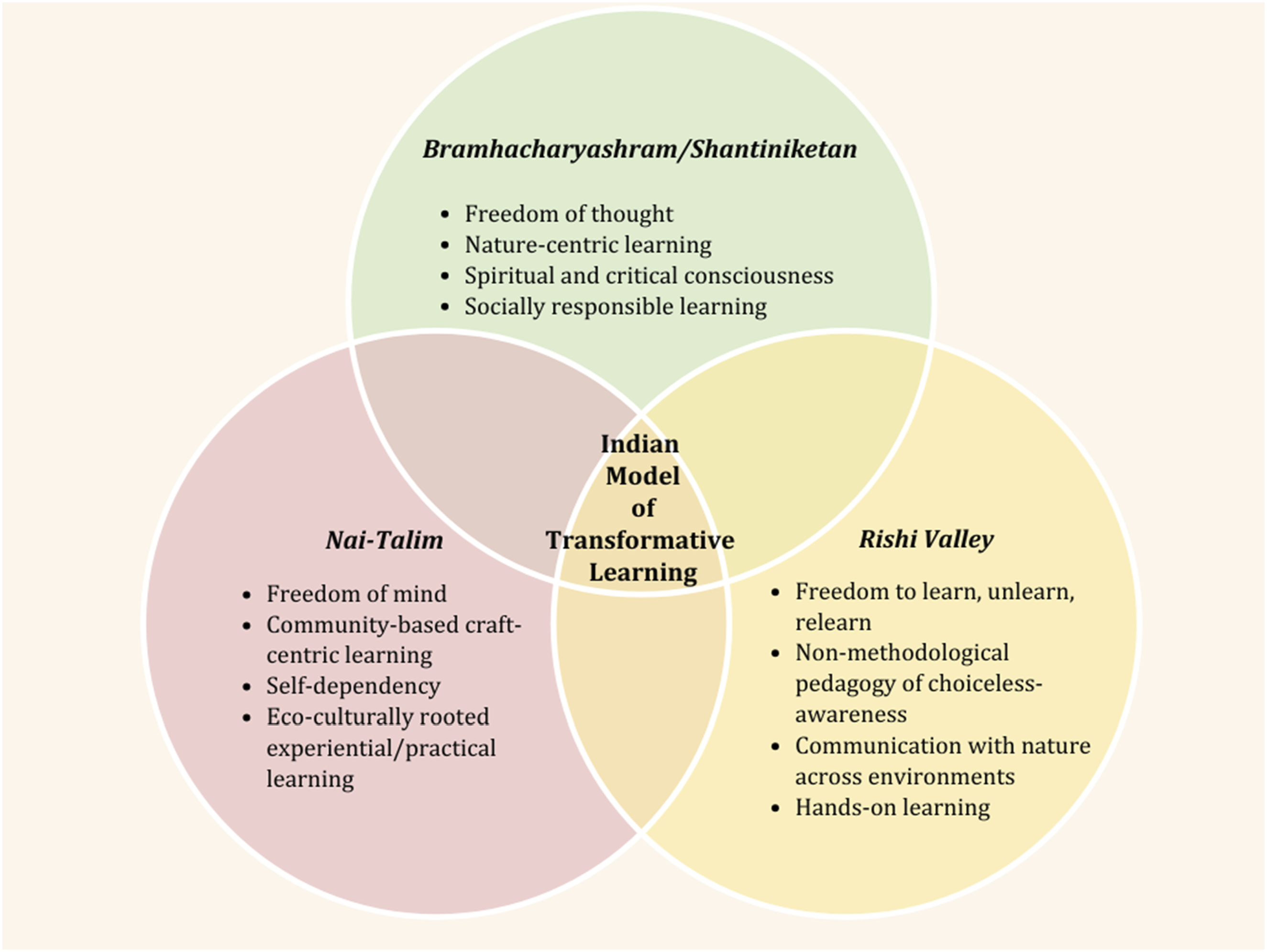
The model integrates the educational philosophies of Tagore’s “Shantiniketan,” Gandhi’s “Nai-Talim,” and Krishnamurti’s “Rishi Valley,” highlighting their contribution to developing an Indian model of transformative learning. Each circle shows a distinct educational vision encompassing ideas like freedom of thought, self-dependence, and practical and nature-centric learning. These visions often overlap among thinkers, forming a robust foundation for reimagining education in postcolonial India. This model integrates the core principles of 20th-century Indian educational philosophers and aligns with some aspects of the Western theoretical models, such as Lawrence and Dirkx’s (2010) extra-rational approach, and Peter Mayo’s (2003) sociological framework of transformative education. Dirkx’s approach centers on “immanent and transcendent experiences” (Taylor & Cranton, 2012)—focusing on connection with oneself and the broader world. This study further advances Dirkx’s framework by situating the transformative learning experiences within craft-based or eco-cultural modes of learning, as seen in Gandhi’s teachings. In contrast to the dominant Western paradigms, which often focus on cognitive and individualistic transformation (Mezirow, 1994) or theories that focus on critical reflection or psycho-spiritual perspective (Boyd, 1991; Boyd & Myers, 1988; Daloz & Holt, 1988), the Indian model offers a distinct and inherently holistic approach. This model goes beyond individualistic transformation and highlights the significance of the interconnectedness of an individual with nature, culture, and community, integrating spiritual traditions located in ecology and aiming to produce a socially equitable educational system. Mayo (2003) prioritizes a democratic and emancipatory approach by situating education as a vital space where marginalized voices are heard, and democratic engagement flourishes. These ideas resonate closely with the Indian model of transformative learning proposed in this study, where learning is not isolated from social realities but grounded in cultural, ecological, and community-based practices. By situating education within lived experience and collective action, the sociological approach affirms that transformation is not only about changing how we think but also about reshaping the world we share.
This model uniquely contributes an ecological dimension to the existing body of transformative theories. Indian society has always been rooted in nature, from ancient educational practices to the Gurukul model of education, and nature is considered a sacred and integral part of education. In contrast, the contemporary period disregards these principles by opting for mechanical, industrial, and capital aspects of learning. The proposed model then highlights that contemporary educational institutions require an education model that moves beyond the enhancement of market-driven skills to incorporate prakriti anusandhana (study and respect for nature) as a fundamental principle. It is in such a context that the present study holds significant relevance as it proposes a theoretical model for an eco-centric knowledge system by drawing upon the Indian educational philosophies of the 20th century, which enables learners to experience transformative learning while immersed in nature. Examining the current challenges in the world, ranging from environmental degradation to the loss of cultural and ethical grounding, it is crucial to reexamine and incorporate the core principles of ecological awareness and the importance of agency and freedom within the curriculum to have a transforming experience in the learning process.
Conclusion
This study contributes to the existing frameworks of transformative learning by foregrounding Indian educational philosophies of Mahatma Gandhi, Rabindranath Tagore, and Jiddu Krishnamurti, and further demonstrates how their work is crucial to both historical and contemporary educational paradigms. In this way, we illustrate the unique interplay of emancipation, spirituality, and humanism in Indian educational discourse. This philosophical orientation finds an early manifestation through Gandhi’s educational philosophy, which emphasizes experiential learning through a craft-centric approach that harmonizes the head, heart, and hand. Furthermore, he preached and practised education that was rooted within learners’ immediate surroundings to develop community resilience and environmental consciousness. Tagore’s vision of education, grounded in nature-centric learning, rural reconstruction, and cosmopolitanism, is reflected in institutions like Santiniketan, Sriniketan, and Visva-Bharati. What distinguishes Tagore from other thinkers is his conception of education as an esthetic and spiritual quest within the natural world. Krishnamurti advocated for freedom of mind and harmony with nature, where he preferred an inquiry-based approach to learning over conventional methods.
The fact that all the thinkers advocated for integrating ecological consciousness and spiritual depth helped this study build a transformative educational model that is deeply rooted in India’s sociocultural milieu, thereby contributing a novel approach to frameworks of transformative learning. The thinkers discussed in the current study address contemporary concerns such as environmental degradation, capitalism, and socio-economic inequities, thereby showing the relevance of their thought across the centuries. A synthesis of their educational philosophies, therefore, provides a framework for reimagining education to foster global citizenship, sustainable practices, and equitable societies. Here, it is important to acknowledge the contribution of thinkers like B.R. Ambedkar, Vandana Shiva, Arundhati Roy, Gayatri Spivak, Ratna Ghosh, and others, whose educational contributions, particularly in social justice, ecological consciousness, and postcolonial thought, add depth to the discourse on adult education. Due to the scope of this paper, their perspectives could not be addressed in detail. However, the literature review has offered brief engagement about these thinkers, identifying their philosophies as critical directions for future research. Furthermore, the present research provides new inroads to examine this model’s practical application in diverse educational contexts, particularly its adaptability in addressing global environmental and social challenges.
Footnotes
Acknowledgment
We appreciate the library for providing access to resources, and we sincerely thank the reviewers whose insights strengthened this work.

Funding
The authors received no financial support for the research, authorship, and/or publication of this article.
Declaration of Conflicting Interests
The authors declared no potential conflicts of interest with respect to the research, authorship, and/or publication of this article.