







Abstract
Clergy can have a negative impact on churches and other individuals when they knowingly or unknowingly attempt to save face, that is, try to protect their standing or reputation. The desire to gain face and the fear of losing face and feeling ashamed will likely permeate clergy’s decision-making processes without even being noticed. This study explores the essence of face and face management and the relationship between face management and two characteristics of servant-leadership—awareness and healing—in both Chinese and American churches through the methodology of hermeneutic phenomenology. Prior to this study, to my knowledge, no hermeneutic phenomenological research of face management has been conducted in a church setting. Through a review of the literature, four areas are explored: face and shame, face management, servant-leadership, and face, shame, and face management within the church. This study obtained approval from the Institutional Review Board and informed consent from the participants. Three Chinese and three American Christian ministers were chosen to complete a question sheet and participate in two semi-structured interview sessions. A first cycle of open coding and second cycle of pattern coding were used during data analysis. Face experiences are discussed in light of eight major themes: body, triggers, becoming, face concepts, strategies, emotions, servant-leadership, and the church. Findings from the study help build a servant-leadership and face management model, which can offer an anchored approach for clergy and pastoral counselors to address face and shame and to develop therapeutic interventions.
Clergy can have a negative impact on churches and other individuals when they knowingly or unknowingly attempt to save face, that is, try to protect their standing or reputation. Clergy who lack understanding of face, shame, and self cannot effectively handle their own emotions, which may lead to impaired functioning in church leadership and pastoral care roles (Friedman, 2007; Scazzero & Bird, 2003; VanVonderen, 1989). First, the underdevelopment of knowing self leads some clergy to work extremely hard while repressing their inner struggles. They are more likely to experience burnout (Grosch & Olsen, 2000; Maslach, Schaufeli, & Leiter, 2001; Virginia, 1998). They rarely realize the effort required to look beneath the surface of their own emotions and seldom know how to break the power of the past and bring healing to the present (Scazzero & Bird, 2003). Within a face culture, they become trapped in the cycle of working harder in order to measure up and gain honor (VanVonderen, 1989; Ward, 2011).
Second, without knowing self, a minister cannot handle leadership well. Unaware of their own brokenness (Scazzero & Bird, 2003), faith group leaders can easily fall into the power struggle trap in order to gain face or avoid losing face. Lacking both strong self-confidence and humility, they more likely use the will to power to attempt to fix people or stay in charge (Friedman, 2007). Claiming church leadership by representing God, they may spiritually abuse others or be abused (Johnson & VanVonderen, 1991; Ward, 2011).
Third, without knowing self, ministers and pastoral counselors can neither deliver good pastoral care nor heal others. If a counselor has not entered his or her own world, the capacity for entering the world of others remains undeveloped (Scazzero & Bird, 2003). If they cannot build wholeness in themselves, how can they lead others and their community to wholeness (Greenleaf, 2002)? They also need to have strong self-differentiation in order to keep separate while remaining connected to others (Coplan, 2011). They must manage their own reactivity without becoming lost in the anxious process (Friedman, 2007).
Last but not least, with the fear of losing face, clergy in need may tend not to look for help or communicate their needs (Cupach & Metts, 1994; Goffman, 1955). Asking for help means confessing inability, which leads to shame (VanVonderen, 1989). A closed attitude leaves many ministers lost in their own struggles without getting help.
This study explores the essence of face and face management and the relationship between face management and two characteristics of servant-leadership—awareness and healing—in both Chinese and American churches through the methodology of hermeneutic phenomenology. Prior to this study, to my knowledge, no hermeneutic phenomenological research of face management has been conducted in a church setting. The significance of this study is to extend the research of face management into church settings, to build a servant-leadership and face management model, to add to the understanding of the concepts of face and shame and the dynamics of face management, and, ultimately, to support the development of healthy church communities in both China and the United States through scholarship. In this article, I will introduce literatures in the areas of face and shame, face management, servant-leadership, and face, shame, and face management within the church. Then I will discuss my study with regard to methodology, methods, participants, findings, suggestions, limitations, and recommendations for further research. This article ends with conclusions.
Literature Review
Face and Shame
The concept of face arises from and is situated within the process of socialization. Face is something that can be given and taken (Goffman, 1955; Lin, 1935). In Chinese language, face consists of lian (or lien, 脸) and mianzi (or mien-tzu, 面子) (Ho, 1976; Hu, 1944; Zhai, 1995); the concept of mianzi is similar to Mead’s (1934) concept of “me,” constituted by the attitudes of others, while lian resembles Mead’s “I,” the one reacting toward “me.” Mianzi and lian can also be understood in Tajfel and Turner’s (1979) concept of social identity and Giddens’ (1991) concept of self-identity. Furthermore, Taylor’s (1989) notion of how we have become and where we are going gives the concept of face a temporal dynamic.
In the West, face can be traced back to the Greek word προσωπον, which refers to face, figure, and a person’s position in society (Lohse, 1968). Goffman’s (1959) dramaturgical perspective and impression management bear considerable resemblance to Chinese author Lu’s (1948) metaphor of spectacle. A virtual stage exists in social interactions with the individual at the back stage and generalized others at the front stage. The individual’s body and mind are involved both at the back stage and the front stage (Song, 2018c). During a social interaction, an individual moves out of his or her perceived mianzi/me/social identity at the back stage and acts as a lian/I/self-identity at the front stage in front of others. The self, represented by face, is a product of social interactions rather than an isolated organic entity.
Face is also closely related to shame. The experience of shame reflects the loss of face—frozen now shame (Karlsson & Sjöberg, 2009), the desire to maintain face or avoid losing face—future-oriented shame, and the regret of losing face or the desire to restore face—past-oriented shame. Face-saving and shame are mostly regarded as negative and to be avoided. However, just like face, shame is about the self (Broucek, 1991; Morrison, 1989; Zahavi, 2012) and is a fundamental fact and compelling force in human life (Dolezal, 2015; Straus, 1980). There are protective forms of shame and concealing forms of shame (Straus, 1980). Shame can be related to morality and has its valuable dimension in ethics (Aristotle, 2009; Plato, 1973). Also, shame is interpersonal (Aristotle, 1992; Elias, 1994; Sartre, 1956) and has a bodily aspect (Aristotle, 2009; Sartre, 1956). How we experience shame and adapt to others’ attitudes contributes to the development of self, and may even constitute the self (Zahavi, 2012).
Face Management
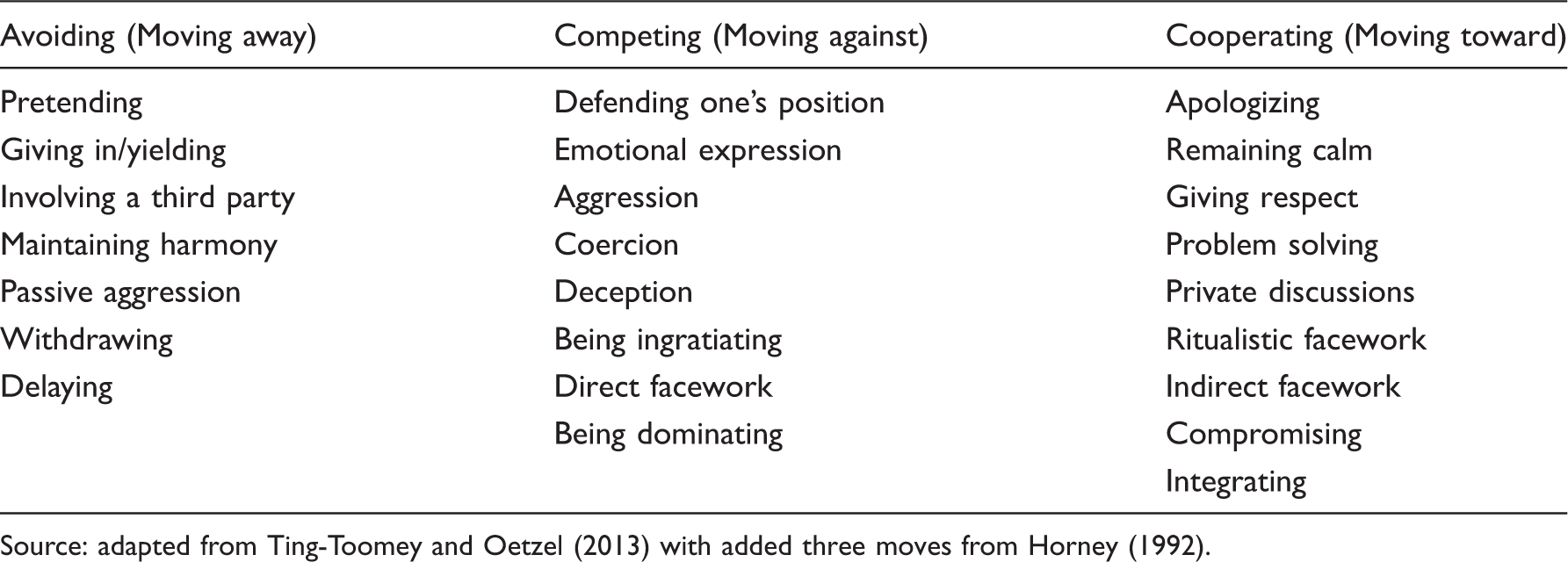
Goffman (1955) pointed out that each individual during the interactions is obligated to support a given face and avoid destroying the other’s face. The concern of face becomes especially problematic when people are in conflict situations and face-saving strategies are needed in these interpersonal encounters (Oetzel & Ting-Toomey, 2003; Rahim, 1983; Ting-Toomey & Kurogi, 1998). I adopt the term face management to describe the communicative strategies people take to manage face during social interactions. These strategies can be: preventive strategies through avoiding, ignoring, or using disclaimers (Cupach & Metts, 1994); restorative strategies through humor, remediation, apologies, excuses, or being aggressive (Cupach & Metts, 1994; Ting-Toomey, 2005); or a third-party mediator (Ting-Toomey, 2005; Ting-Toomey et al., 2000).
Face management strategies.
Source: adapted from Ting-Toomey and Oetzel (2013) with added three moves from Horney (1992).
Servant-Leadership
Servant-leadership is a term coined by Greenleaf, but this concept has deep cultural roots. In ancient China, a servant-leader was praiseworthy, and his or her followers would take credit for tasks they accomplished under his or her leadership (Lao Tzu, 2005). In the Bible, Jesus himself was a servant-leader (Philippians 2:6–7, The New Revised Standard Version) who called his disciples to become servant-leaders (Mark 10:42–45). The founding father of the Republic of China, Sun Yat-sen, proposed the concept of public servants, which is still being used in China today (Sun, 1927).
Greenleaf’s concept of servant-leadership is more a philosophy of life than a leadership theory (Beazley, 2003). Drawing from his experiential leadership practice and deep Quaker spirituality, he coined the term servant-leadership and defined it as “The servant-leader is servant first … It begins with the natural feeling that one wants to serve, to serve first. Then conscious choice brings one to aspire to lead” (Greenleaf, 2002, p. 27, emphasis in original). The best test is that those being served become healthier, wiser, freer, more autonomous, more willing to serve, and the least privileged in society will not be further deprived (Greenleaf, 2002).
I use the characteristics of awareness and healing from Greenleaf’s concept of servant-leadership as the main tools to understand the nature of face, shame, and face management. In the Oxford English Dictionary (OED), awareness is defined as consciousness (Awareness, 2017). Consciousness is always consciousness of something or an object (Husserl, 1983). The awareness of a servant-leader, as a vigilant type of consciousness, can be aware of self, others, relations, spirit, situation, and time. Thus I propose four conceptual dimensions of awareness: (a) upwardness—spirit-awareness; (b) inwardness— self-awareness; (c) outwardness—other-awareness, relation-awareness, and situation-awareness; and (d) onwardness—time-awareness. The importance of awareness cannot be denied in Greenleaf’s (1966, 2002, 2003) writings. When one is intensively aware, foresight and serving others become possible (Greenleaf, 2002). “If the doors of perception were cleansed everything would appear to [humans] as it is, Infinite” (Blake, 1975, p. xxii). This is why Palmer (1998) appealed to leaders to lead from within, to become aware of our own shadow and light, and, in so doing, to become healers of this wounded world.
Greenleaf (2003) claimed that the growth of a person’s entheos can lead to awareness. Entheos was originally a Greek word, ένθɛος, which literally means “in God.” OED defines it as “an indwelling divine power” and “inspiration” (Entheos, 2017). The growth of entheos can be achieved through reflexivity, listening, and healing. Adopting an organic, rather than a mechanistic, view of people and organizations, servant-leaders can become healers of self and others. Healing may come from listening (Barbuto & Wheeler, 2006), empathy (Barbuto & Wheeler, 2006; Liden, Panaccio, Meuser, Hu, & Wayne, 2014), awareness (Liden et al., 2014), and forgiveness (Ferch, 2012; Fitzgibbons, 1998; North, 1998; Ramsey, 2003). Thus these characteristics of servant-leadership interweave with one another to bring out better awareness in a servant-leader, in order to tackle whatever issues are in front of him or her (Song, 2018b). In my study, the issue is face management.
Face, Shame, and Face Management Within the Church
Both face and shame are about the self (Broucek, 1991; Goffman, 1955; Morrison, 1989; Zahavi, 2012) and can be experienced as a result of body shame, mental struggles, or spiritual abuse. The experiences of face and shame regarding body, mind, and spirit are found within church settings, as they exist in any setting. But within the church, face and shame can be experienced differently because of theological beliefs and doctrines.
Face and Body Shame
Homosexuality (Gushee, 2017), ethnicity (West, 2006), and patriarchy (Miller, 2017) are the foremost issues concerning face and body shame within the church. Exclusion, discrimination, and inequality based on sexual orientation, ethnicity, and gender can cause loss of face and shame concerning one’s body. The question of homosexual practice and same-sex marriage has been one of the most controversial biblical debates (Gushee, 2017; Hays, 1997; Webb, 2001). In spite of the overall increased social tolerance toward homosexuality, sexual minority individuals have experienced being stigmatized by society and unwelcome in religious groups (Cheng, Wu, & Adamczyk, 2016; Pew Research Center, 2013). Sexual minority individuals have higher risks for depression, anxiety, suicide attempts or suicides, and substance-related problems compared with heterosexuals (Ploderl & Tremblay, 2015).
Exclusion based on ethnicity can result in shame (West, 2006). According to McGavran’s (1990) homogeneous unit principle, “People like to become Christians without crossing racial, linguistic, or class barriers” (p. 163). This principle gives an excuse for maintaining ethnocentricity of culture within churches (Branson & Martinez, 2011). Garces-Foley (2007) argued that a color-conscious approach rather than a color-blind approach can help build multiethnic churches, which will carry an ethnic inclusion strategy into the public sphere.
As embedded in the Bible, patriarchy has been a powerful set of conceptual tools used to understand, maintain, enforce, contest, and adjudicate social order (Miller, 2017). The Council on Biblical Manhood and Womanhood (1988) clearly states in its Danvers Statement: “some governing and teaching roles within the church are restricted to men” (Affirmations 6.2). Although biblical scholars (Bailey, 2000; Belleville, 2003; Kroeger, 1979) have pointed out that we have misread the relevant passages concerning women in the New Testament and have been misled by assumptions and traditions, the loss of face and shame generated from gender discrimination still impacts many women. Christianity has the seeds of equality and dignity for all people, but an emphasis on the maleness of God, the hierarchy of Christ over the church, and women’s subjugation is still prevalent in many churches (Ruether, 1989). Patriarchy is intertwined with sexual violence against women (Bloomquist, 1989; Miller, 2017) and the control over women’s bodies (Griffith, 2004). The Christian teaching of God as a father with absolute authority and freedom can make children relate God to their human father, and sometimes even an abuser (Kennedy, 2000). Many abusers use “God’s will” to justify their abuse of children; they use guilt and shame to keep the victims silent; and some survivors are pressured into forgiving (Kennedy, 2000).
Face and Shame from Mental Struggles
When disagreement over Christian teachings or doctrines rises to a certain level, combined with a refusal to listen, the ferment of disagreement, and people taking sides, this can result in church division (Holden, 1988). Church division can cause strong emotions, such as anger, confusion, grieving, the sense of losing face (for those people who leave), and the shame of failure for the leaders. Huwelmeier (2013) argued that the process of church splitting is about religious boundary making, which results in the loss of social relations with former congregants. Dialogue is necessary to build binding Christian relationship (Hutcheson & Shriver, 1999).
According to Schirrmacher (2015), sin leads to both guilt and shame before God. As Bunyan (1903) said, “One leak will sink a Ship, and one Sin will destroy a Sinner” (p. 190); “[People] by Sin has brought [themselves] into a State of Captivity and Misery” (p. 210). Broomhall (2015) pointed out the existence of healthy shame and chronic shame in Bunyan’s writing: healthy shame reflects a healthy conscience, which can lead to the conviction of sin prior to conversion; if healthy shame is constrained, it can lead to chronic shame—prolonged personal and spiritual agony.
Face and Shame from Spiritual Abuse
Mental illness sometimes is regarded as the result of too little faith or of not getting right with God (Bobgan & Bobgan, 1979). Spiritual abuse can result in shame (Oakley & Kinmond, 2014) and separation from religious groups (Ward, 2011). The phenomenon of spiritual abuse is not well researched (Ward, 2011). Through interpretative phenomenological analysis, Ward (2011) studied the lived experience of six individuals who left Judeo-Christian groups and found that leadership representing God was the cornerstone for spiritual abuse.
Within the church, clergy may take different approaches—giving up, trying harder, or resting—to manage face.
Giving Up
With the existence of face and shame, clergy may choose to give up (VanVonderen, 1989), avoid the issues (Ting-Toomey & Oetzel, 2013), or move away from people (Horney, 1992). Giving up is not cowardly or lazy. On the contrary, this response may come from having been trying too hard for a long time, resulting in burnout (Maslach et al., 2001). Maslach et al. (2001) defined three key dimensions of burnout: emotional exhaustion, depersonalization (cynicism), and reduced personal accomplishment. Chronic emotional and interpersonal stressors at work are considered major contributors to burnout (Maslach et al., 2001). Christian ministry stress can result from acceptance via performance (Ward, 2011), trying to measure up (VanVonderen, 1989), the quick-fix mentality and a lack of differentiation (Friedman, 2007), factors from both personal family development and the current work system (Grosch & Olsen, 2000), a lack of social support and sense of isolation (Virginia, 1998), and interpersonal relationships and personal spirituality (Jackson-Jordan, 2013).
Trying Harder
In a performance-based system, one’s worth is measured in terms of productivity or achievement; acceptance via performance leads to a relentless pursuit to perform (Ward, 2011). Clergy may try harder (VanVonderen, 1989), compete with others (Ting-Toomey & Oetzel, 2013), or move against people and determine to fight (Horney, 1992). When individuals base their identity and face solely on others’ evaluations, they tend to choose either fight or flight; both are motivated by fear (Patterson, Grenny, McMillan, & Switzler, 2012). One form of trying harder is workaholism. Few studies focus on clergy workaholism or work-related stressors (Meek et al., 2003; Sterland, 2015). Workaholism may be derived from dispositional traits, socio-cultural experiences, and behavioral reinforcements (Ng, Sorensen, & Feldman, 2007); and conscientiousness (Jackson, Fung, Moore, & Jackson, 2016). In addition, Sterland’s (2015) survey study of 461 Australian ministers showed that working compulsively, rather than working excessively, can lead to clergy burnout.
Resting
Clergy have a third way out: resting, by breaking the cycles of giving up and trying harder (VanVonderen, 1989), cooperating with others (Ting-Toomey & Oetzel, 2013), and moving toward people (Horney, 1992). Moving toward people does not mean attaching to the most powerful person or group and complying with them, as Horney (1992) discussed, but embracing and cooperating with others. This restful form of cooperation can come from Greenleaf’s (2003) concept of entheos—the feeling of oneness, wholeness, and rightness. According to VanVonderen (1989), rest comes from believing the truth of our identity in God and having faith in our acceptance by God. The restful clergy live by the messages of being loved, accepted, and forgiven, and their identity is not based upon their performance (VanVonderen, 1989). Their socially constructed selves, represented by face, can hold onto and move toward this anchored identity in God. Entheos stretches an individual’s awareness in four dimensions: upwardness, inwardness, outwardness, and onwardness. All humanity is broken, damaged, and imperfect. An anchored identity can move people from pride and defensiveness toward staying firm in their brokenness and vulnerability. The force generated by entheos can move clergy from giving up and trying harder to resting—an anchored approach.
Hermeneutic Phenomenological Study
Methodology, Methods, and Participants
The purpose of this hermeneutic phenomenological study is to explore the essence of face and face management and the relationship between face management and two characteristics of servant-leadership—awareness and healing—with a sample of Christian ministers in China and the United States. I adopted a qualitative approach because: it can offer a better understanding of the situational context of face management (Tracy & Baratz, 1994); it is able to bring unanticipated perspectives into the study, instead of being tightly prescribed (Creswell, 2013); and it can provide a holistic picture of the phenomenon, rather than looking for causal relationships among variables (Creswell, 2013).
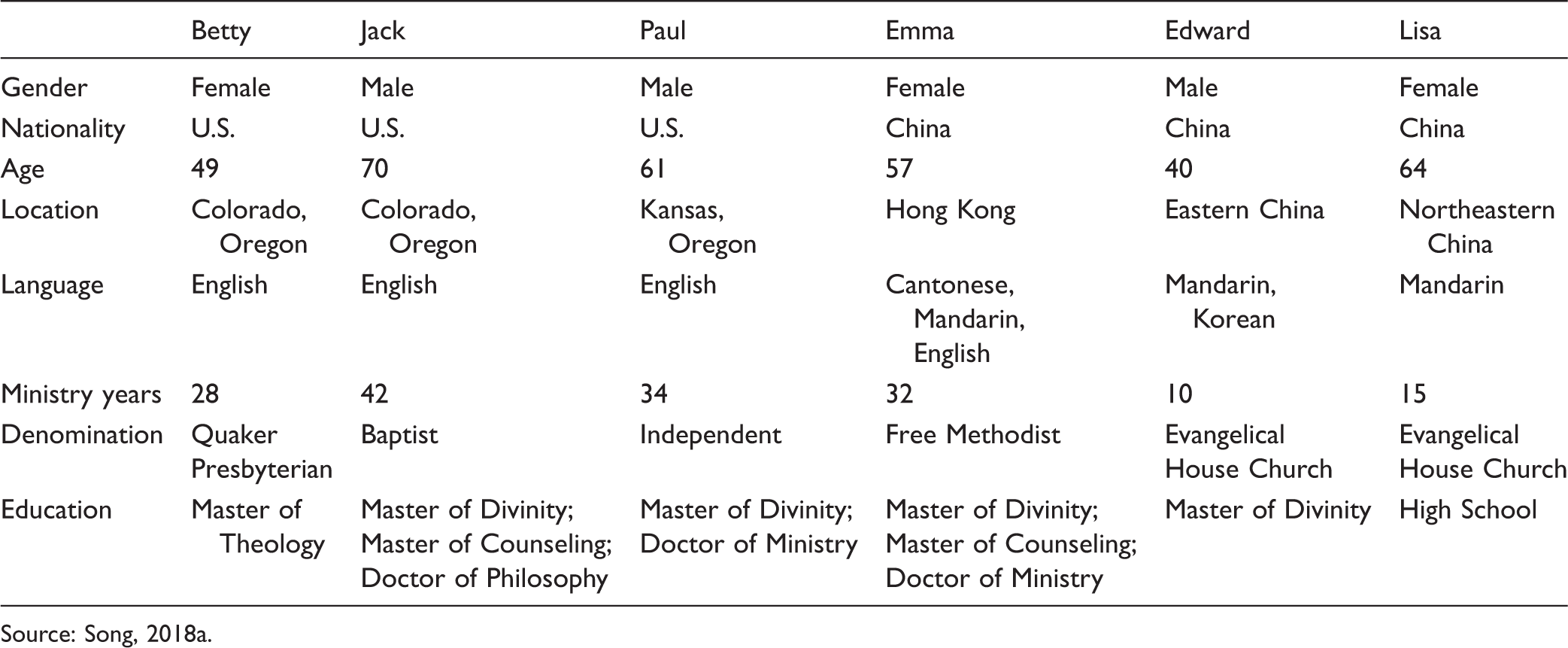
This study employs multiple data-collection methods to gain an in-depth understanding of face and face management. I obtained Institutional Review Board approval and participants’ informed consent before collecting the data. Question sheets were used to collect participants’ demographic information and provoke them to start thinking about the study topic. Two interview sessions with each participant were conducted to understand their lived experience. Through pilot studies, interview questions were tested and updated as needed. The interviews were audio recorded and transcribed. I conducted a first cycle of open coding and a second cycle of pattern coding during data analysis.
Participants’ demographic information.
Source: Song, 2018a.
Discussion and Interpretation of the Findings
Eight major themes emerged from my study: face experiences and body, face experiences and triggers, face experiences and becoming, face experiences and face concepts, face experiences and strategies, face experiences and emotions, face experiences and servant-leadership, and face experiences within the church.
Body is an important dimension of face, not only because the self is embodied (Giddens, 1991) and body is ontological (Sartre, 1956), but also because, in my study, face experience can result in acute body reactions (e.g., blushing, lowering the head, crying, stuttering, pausing, and sighing), chronic illness (e.g., panic attacks, post-traumatic stress disorder, compassion fatigue, and burnout), and body shame (e.g., sexual harassment and discrimination based on gender and sexual orientation). My findings touch on homosexuality and patriarchy, but not on ethnicity as I expected. This study reflects that, although most Christian groups have become more accepting of gay people, sexual minority individuals still experience being unwelcome in religious groups (Cheng et al., 2016; Pew Research Center, 2013). In my findings, patriarchy is reflected through resistance to women in ministry (Cowles, 1993; Howe, 1982), sexual harassment against women (Bloomquist, 1989; Miller, 2017; Ruether, 1989), and male-preference.
All face experiences shared by the participants involved others through either bodily presence or participants’ unspoken thoughts. This is in line with the concepts of face (Goffman, 1955; Ho, 1976; Zhai, 1995), self (Mead, 1934), and shame (Aristotle, 1992; Elias, 1994; Sartre, 1956). Through inductive coding, four types of face experience triggers appeared: acceptance from others, attack from others, what I do or fail to do, and what I think or am. Acceptance and affirmation resulted mostly from what a person had done well; sometimes acceptance involved accepting the person as who he or she was. Attacks occurred along a continuum of severity: positive advice, criticism, accusation, verbal attack, internet attack, physical attack, and being totally rejected. What I do or fail to do appeared in three forms: achievement, failure, and other-face related. What I think or am emerged in five categories: gender, burnout, socioeconomic status, self-judgment, and imaginative judgment from others.
Becoming is a common theme for all participants—past face experiences have shaped them, and they will address the same or similar situations differently. The “I” of this moment exists in the “me” of the next moment (Mead, 1934). In other words, the me/mianzi/social identity generated from past experience influences the I/lian/self-identity of the present; the I/lian/self-identity of the present will keep a particular narrative going and be present in the me/mianzi/social identity of the next moment. Self, represented by face, is not static, but moves along a trajectory from the past, into the present, and toward the future (Giddens, 1991; Mead, 1934).
Face concepts emerging from the data include negative factors, such as embarrassment, humiliation, shame, hypocrisy, vanity, and from sinfulness; neutral factors, such as reputation, evaluation from others, self-worth, self-image, and confidence; and factors with two parts: self-identity as internal face and evaluation from others as external face. Overall, participants’ understandings of the concept of face confirm Zhai’s (1995) definition of lian and mianzi, Mead’s (1934) understanding of “I” and “me,” and self-identity and social identity (Giddens, 1991). Furthermore, most of participants’ experiences triggered by attacks from others caused frozen now shame. Some participants also mentioned past-oriented and future-oriented shame. My findings confirm that shame involves others and has a bodily aspect (Sartre, 1956); and it relates to morality (Aristotle, 2009; Plato, 1973).
The four face management strategies coming out of this study are avoiding/moving away through yielding, involving a third party, maintaining harmony, or withdrawing; competing/moving against through defending one’s position, trying harder, or confronting others; cooperating/moving toward through apologizing, giving respect, or communicating; and transcending. Comparing with the face management strategies in Table 1, I found transcending as an additional strategy. Transcending reflected the participants’ inner peace and emerged from a stable self-identity. My study confirms that during a face-related incident, people may take communicative strategies to manage the situation (Goffman, 1955, 1969; Oetzel et al., 2001; Ting-Toomey, 1999).
Emotion is a constant theme in this study. During face incidents, participants felt humiliation, pain, fear, and dismissal; or peaceful, proud, grateful, empowered, good, and freed; or humbled and surprised. My findings confirm that face-related incidents can be very emotional (Ting-Toomey & Oetzel, 2002). Ting-Toomey and Oetzel (2013) considered emotional expression to be a type of conflict style, which I did not find in my study. I understood emotion to be one of the main factors of face management along with strategies at the situational or mesolevel.
Seven characteristics of servant-leadership emerged from the data: listening, empathy, forgiveness, healing, reflexivity, entheos, and awareness. All participants shared stories of listening and empathy, which related to each other. My findings confirm that listening and empathy can lead to better awareness (Barbuto and Wheeler, 2006), listening involves compassion and empathy (Koskinen & Lindström, 2013), and true listening empowers others (Greenleaf, 2002; Koskinen & Lindström, 2013). Four participants touched on forgiveness, which connected with listening and empathy. As Tutu (1999) said, forgiveness involves empathy. My study also confirms that emotional forgiveness does not always occur along with decisional forgiveness (Worthington, 2006). Healing emerged in four participants’ stories. This study affirms that healing may come from listening (Barbuto & Wheeler, 2006), empathy (Barbuto & Wheeler, 2006; Liden et al., 2014), awareness (Liden et al., 2014), and/or forgiveness (Ferch, 2012; Fitzgibbons, 1998; North, 1998; Ramsey, 2003). All participants mentioned reflexivity, which was closely tied to awareness. My study affirms that reflexivity is highly associated with awareness in all four dimensions. Entheos appeared in four participants’ interviews and related to upward awareness. My study confirms that entheos involves a feeling of centering down and a view of people that changes and develops with time and experience; and the growth of entheos can lead to better awareness (Greenleaf, 2003). All participants demonstrated awareness through inward awareness (i.e., self-awareness), onward awareness (i.e., time-awareness), outward awareness (i.e., other-awareness, relation-awareness, and situation-awareness), and upward awareness (i.e., spirit-awareness).
Within the church, participants’ experiences of their church splits found support in Holden’s (1988) and Huwelmeier’s (2013) writings. The disagreement over the issue of homosexuality caused church splits for both Jack and Betty. Emma’s church split was also over disagreement, but the issue was unknown from the data. Betty’s struggle of conviction and condemnation affirms the distinction Broomhall (2015) drew between healthy shame and chronic shame. Betty’s experience of spiritual shame is supported by Oakley and Kinmond’s (2014) research. All participants’ need for a support network affirms that Christian ministry stress may come from a lack of social support (Virginia, 1998) and affirms the idea that healthy support systems can lead to healing (Sturnick, 1998). In one interview, power emerged as a unique theme, but this focus lies outside the scope of my literature review and this study.
Through the process of theorizing and comparing my research findings with my literature review, I present a servant-leadership and face management model as an anchored approach (Figure 1).
Servant-leadership and face management model.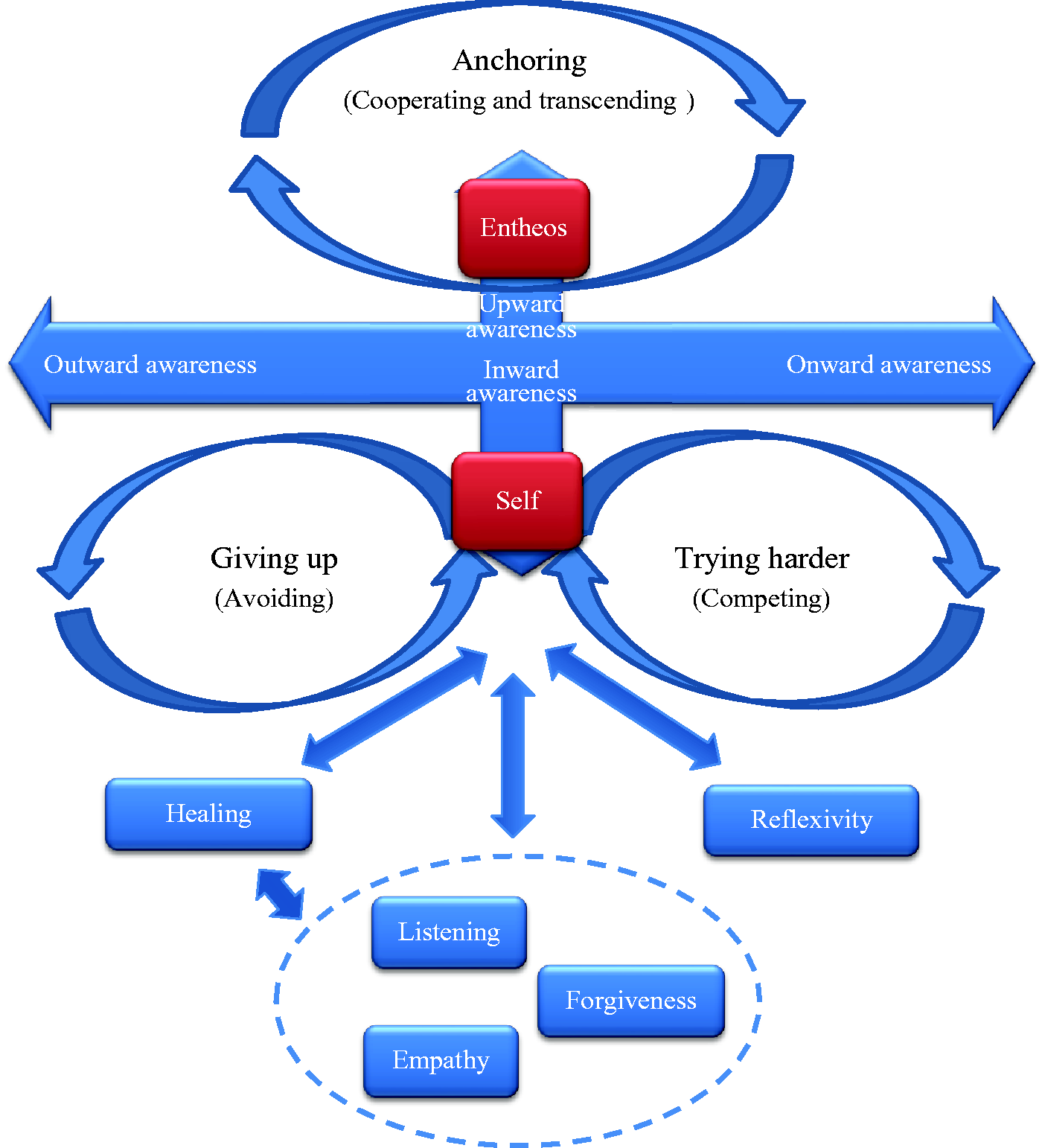
Suggestions, Limitations, and Recommendations for Further Research
Based on my findings and development of theory, some suggestions may be helpful to clergy and pastoral counselors. First, clergy with clear entheos can anchor themselves and are ready and able to cooperate with others and stand firm in conflicts. Entheos, as an indwelling divine power, can serve as an anchor that strengthens one’s self-identity. Entheos can be reached through upward awareness. The sense of upwardness involves being connected to a higher power than oneself (Frankl, 1970). Second, ministers and pastoral counselors can enhance their relational capacity by recognizing and being comfortable with their own emotions as well as others’. Reflexivity, listening, empathy, and awareness can be helpful, but it takes time to reach forgiveness and healing. On the one hand, the strong emotions shown through this study serve as a reminder to ministers and counselors that face incidents can be charged with emotions. On the other hand, the study shows that ministers and counselors are not alone with their emotions. Last but not least, clergy can move their face management approach from giving up and trying harder to anchoring through developing deeper and more contextual awareness. My research supports the idea that awareness has four dimensions: inwardness, upwardness, outwardness, and onwardness. When clergy encounter a face incident or other leadership issue, it would be helpful to examine these four dimensions in order to learn what has stirred inside through reflexivity; what resources can help us anchor down through entheos; what others are experiencing; how we should interact with others through listening, empathy, and forgiveness; what lessons we have learned from the past; and what we foresee in the future.
Some limitations emerged from my study and further research is needed. First, my research design did not cover the relationship between face and power. I did not approach face from the perspective of power structures. Paul’s confrontation with the elders could threaten church leaders’ face, which might result in his being fired. Paul never got an answer to confirm his assumption, but this power struggle played an important role in his case. The relationship between face and power is an important area for further research. Second, in spite of all my participants being from different churches or denominations, this study is limited to Christian churches. Generalization is not the purpose of hermeneutic phenomenological studies, but transferability is important for the theory of face and face management. Further investigation into the phenomenon under my study within other religions and spiritual traditions is needed to enrich the understanding of face, shame, and face management. Finding entheos in one’s own tradition can anchor people and move them from avoiding and competing to cooperating and transcending during conflicts.
Conclusions
Face is not a unique Chinese cultural phenomenon, but is distinctively human. This hermeneutic phenomenological study offers deeper understanding of face, shame, face management, and servant-leadership. This study affirms that body shame, mental struggles, and spiritual abuse exist within the church. Charged with emotions, people may take the strategies of avoiding, competing, cooperating, or transcending to manage face during conflicts. Servant-leadership can provide tools for face management through listening, empathy, forgiveness, healing, reflexivity, entheos, and awareness. With the growth of entheos and better awareness, clergy can move from the cycles of giving up and trying harder to anchoring. An anchored identity can alleviate the experience of losing face and being ashamed and transcend sexual orientation, ethnicity, and gender. This can make possible the bridging of church division, mitigation of chronic shame, and avoidance of spiritual abuse. The development of entheos can also heal burnout and prevent workaholism. The significance of this study is to offer a servant-leadership and face management model as an anchored approach for clergy and pastoral counselors to address face and shame and to develop therapeutic interventions.