







Abstract
This study examined how Christian Counsellors with a calling manage their work–non-work boundaries. A calling offers satisfaction, meaning and purpose but can lead to overwork. Using a qualitative approach with seven experienced counsellors, we identified demands that a calling can create, resources that counsellors use to manage these demands, and strategies for maintaining a balance between work and non-work. Maintaining balance required deliberate attention and giving oneself permission, and strategies were learned over time.
There is evidence that providers of mental health care are experiencing increased workloads and longer working hours, and may find it challenging to maintain healthy boundaries between work and non-work or to prioritize their own well-being (Lin & Wilson, 2019; Manthei et al., 2020). Those affected include psychologists, physicians, counsellors, nurses, social workers, and others providing professional care, support, and pastoral and spiritual care. The demands of high workloads and a supportive caring role can be exacerbated when work is perceived as a calling. Having a calling can offer satisfaction, meaning, and purpose, but it can also lead to overwork, and this is the issue that this research hopes to explore.
Bellah (1985) suggested there are three distinct positions people can take toward their work: work as a job, as a career, and as a calling. Jobs provide material benefits and resources, but reward is not sought beyond money. A career provides income as well as advancement, recognition, self-mastery, and self-esteem. A calling, however, is not carried out for monetary gain or self-achievement but is driven by meaning and purpose.
There are several definitions of what constitutes a calling. For the purposes of this study, a calling is seen as containing the following elements: Work must contain individual meaning and purpose for the person, it must help others or contribute to the common good and there must be felt sense of being compelled either internally or externally toward the work. (Duffy et al., 2019, p. 328)
People who perceive a calling to their work tend to have higher work and life satisfaction, likely because they find their work meaningful and providing a sense of significance and identity which supports personal fulfilment, happiness and engagement (Duffy et al., 2016, 2018). People perceiving a calling are also likely to be successful at work due to high engagement and accomplishment of work goals (Chen et al., 2018). A calling may act as a stress buffer through providing meaning and purpose (Allan et al., 2016). However, people perceiving a calling can over-invest in work life, take less time off work, and have poor work-life balance out of a sense of commitment to the call and, as a result, can be at increased risk of burnout and relationship problems (Duffy et al., 2016, 2018). Finding meaning in work may lead people to be more willing to sacrifice time and energy, over-invest in work, and remain in difficult work settings (Vinje & Mittelmark, 2007). Commitment to work be especially strong when there is a sense of religious meaning to the work. People are likely to invest more energy if they see their role as serving God or fulfilling a divine purpose and may feel supported by the notion of being gifted and enabled for the role and at risk of underestimating their vulnerability to over-commitment (Bickerton et al., 2015).
Those who perceive a calling and experience satisfaction and meaning from their work may need to be vigilant around maintaining their work-life balance. Globally, the availability of communications technology and expectations about workplace flexibility can lead to expectations that employees will be available “anywhere, anytime” (Adkins & Premeaux, 2014; Pudaruth et al., 2017). While flexible work arrangements can support work-life balance by enabling employees to decide when and where to work, they can also increase the risk of burnout due to a blurring of the boundaries between work and home (Eddleston & Mulki, 2017; Gisler et al., 2018; Sirgy & Lee, 2018). People who see their work as a calling are likely to find it difficult to disconnect from work, especially when their role is part of their identity and an outworking of their faith, and so work is more likely to spill over into home life and leisure time (Bott et al., 2017). Work-life imbalance can lead to reduced satisfaction with work and non-work life, increased stress, worse physical and mental health, reduced family time and increased conflict (Carlson et al., 2019; Sirgy & Lee, 2018). At work, work-life imbalance can lead to increased absenteeism, reduced productivity and worse workplace safety (Mohd et al., 2016). The aim of the present research is therefore to collect qualitative data on how Christian counsellors who experience their work as a calling manage work-life balance and well-being.
Method
Ethical approval for the study was gained via a Low Risk Notification from Massey University's Human Ethics Committee. Purposive and snowball sampling were used to identify participants. An initial email was sent out via the Auckland counselling network, and those who expressed interest in the study were emailed further information and an invitation to take part.
There were seven participants (one male, six female), with from 10–20 years’ counselling experience. Their counselling roles included full-time (n = 1) and part-time social service agency roles (n = 1), private practice roles (n = 2), and a combination or both agency and private practice work (n = 3) in a variety of settings. The counsellors’ qualification levels ranged from Bachelors to Masters levels and with the exception of one counsellor, all were trained in Christian training Institutions. Three interviews took place face to face and four via Zoom, during July and August 2020.
Interviews ranged from 40 to 120 min in length, and were recorded. The focus of the semi-structured interviews was on “what it's like” for counsellors as they attempt to maintain balance while living a calling. A natural conversational flow was encouraged, with each conversation containing the following four questions: What does it mean to you to be called? How would you describe the degree of work, non-work life separation/integration you prefer? Does work ever creep into non-work life? and How do you maintain balance? The focus was on seeking stories and anecdotes and gaining a sense of the lived experience of each participant. All recordings were transcribed with identifying information removed, and each participant was offered the opportunity to review their transcript.
Data analysis used interpretive phenomenological analysis (IPA) (Smith et al., 2009). The transcripts were read repeatedly to identify words and phrases related to the study aims. Coding and analysis used the NVivo software package to explore, collate, and code the transcripts, identifying themes and subthemes.
Results
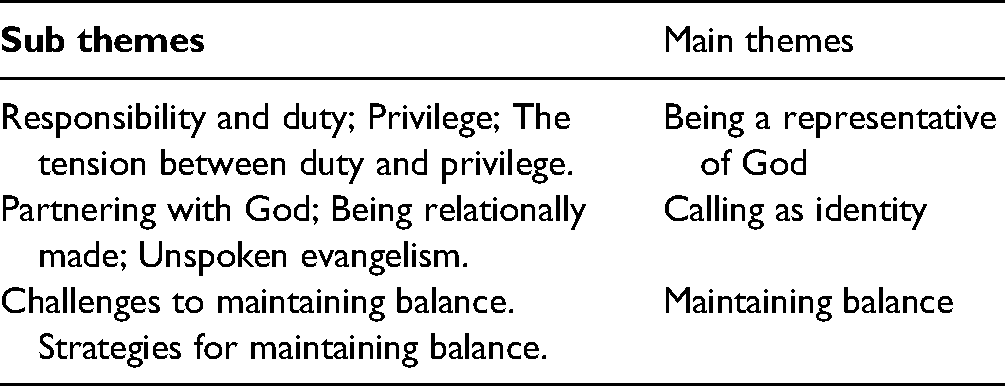
Three main themes emerged, each with subthemes as outlined in Table 1.
Themes and Subthemes.
Theme 1: Being a Representative of God
Participants reported that the call to counselling was accompanied by a sense of responsibility to represent God to clients. Three subthemes emerged: responsibility and duty, privilege, and the tension between the sense of privilege and the sense of duty.
Underpinned by Christian faith beliefs, all participants viewed their work as a commission of sorts, one given by God and for which they had been enabled. I have responsibility to do it well. And I'm responsible to someone else, like not only - not only myself, and not my managers or anything, it's different to even them. I have a responsibility as a job. Yes, but my responsibility to God is different (Participant 4).
Alongside the sense of responsibility was a sense of immense privilege in feeling called to the role of counselling. The notion of calling provided a connection with God and was considered a personal endorsement by God to the role. The interviews suggested that this added strength to participants’ faith relationship, offering a personal sense of being identified with skills and a role to play in God's plan for humanity: I'm working with the God of the universe. And that He trusts me to do it, that He's with me doing it… it's quite awe inspiring really, to think what the God of the universe said, you can do this, and I'd like you to do it. I think that's why I want to do it. … I'm glad I'm a part of it and the people's lives who I’m in. It's a privilege to be able to do that (Participant 4).
A tension emerged, however, between the sense of duty and that of privilege, and this tension had implications for work-life balance. Participants reported feeling ambivalence about whether they were free to say no to the work they felt God was asking them to do, to maintain their own personal well-being. At times participants reported that their own needs could be overlooked or minimized in order to ensure clients were supported. Discourses of service and self-sacrifice were evident when participants spoke about expectations of continual service stemming from Christian Church teachings: I just thought in my calling I had to keep giving, I thought if you had something from God, you should never pull back from it. You should be giving it all the time (Participant 4).
Theme 2: Calling as Identity
Participants reported that their calling and service to God were key parts of their personal and professional identities. Participants expressed a sense of “Partnering with God” in their work; they described feeling as though they had been “Relationally Made” with relational strengths being gifts they had been given to enable them to perform their roles, and they reported a desire to reveal God to clients as an expression of their faith.
The sense of partnering with God in their work provided personal meaning and purpose. There was a sense of being created for this purpose. When I'm in the counselling scenario, when I'm sitting with another person, it feels like sacred space. And it's that depth that I love, that depth that I can go to with another person. And I've just a sense it's such a sacred place to be. And that is how I want to live my life with depth and meaning and that sense of God's presence, which I always feel when I'm sitting with someone. When I'm sitting with broken people, I just think this is what I'm created to do. This is just it's so I just feel so right’ (Participant 6).
The experience of partnering with God was reported to offer access to supernatural wisdom and a sense that something bigger than themselves was taking place within the room. Participants reported having a greater sense of their own adequacy within the therapeutic space, and suggested that gifts enabling effective counselling had been given to them by God for the purpose of the calling. The idea that relationships can be healing was at the core of their calling. Participants spoke of being curious about others, empathic, compassionate, and being sought out for support, and that these were gifts and talents they had been given to support their calling. I think part of the identity thing has to do with because I am quite an empathic person and I'm gentle and I think I'm quite kind and I'm a natural. I like to listen and curious about people's story. So I have all of that naturally (Participant 2).
These capabilities were reported to be part of both their work and non-work life, as participants were sought out by friends and family for support. Skills were understood to be God given and provided a sense of validation of the identity as a counsellor. When you're working with people so deeply, to a certain extent you do carry them in your heart like… you know, a client's face will come to my mind or think about them or something like that, and I wonder how they doing? I sometimes pray for them. So, in that way, it's integrated into my, my personal life. I think it gives me quite a bit of identity as to who I am, you know that I am a compassionate caring person integrates well with my personality’ (Participant 2).
Participants’ personal faith and their understanding that God is the ultimate source of healing could give rise to a desire to reveal God as part of the counselling process. This could create an ethical dilemma as the Counselling Code of Ethics cautions counsellors to respect religious diversity and refrain from sharing personal beliefs. Participants tried to find ways to reveal God to clients through the relationship and conditions of therapy as an environment in which God could be experienced rather than spoken about. I guess the responsibility that I feel today is to be able to create an environment where, you know, they can experience a sense of love if I can say love. Yeah, that isn't necessarily saying I love you, but it's kind of like well you know, God is present. We don't have to talk about God or use God. I guess some of the learning has been when someone has had a loved experience and they can connect with that love the experience. I believe it's just a representation of God's love (Participant 3).
The participants’ reported they hoped to model God's qualities to clients rather than speak about them in order to remain ethical. Doing so, however, implied challenges for maintaining work non-work life balance. This will be discussed in the next section.
Theme 3: Maintaining Balance
Having a calling, representing God and modelling His relational qualities to clients meant some participants remained available to clients after hours, especially when the client was in distress. A tension was apparent between the desire and duty to model relational qualities with clients while maintaining boundaries between work and non-work time. I’ve had clients who’ve been suicidal and have called me at night and that's never bothered me, it's always been about the clients, so that's, never bothered me. I guess it's all part of this calling, larger calling, bigger picture, maybe I’ve just got a bigger picture of what Gods calling is for me (Participant 1).
The calling brought a perceived pressure to achieve outcomes with clients. Following sessions where they felt clients had not made change or where they felt appropriate therapeutic interventions had not been offered, participants were likely to research interventions or answers in non-work time. Working in non-work time could interfere with hobbies and other activities and at times impacted family members. Well, my husband … he's a very tolerant man. But there's also times that he says, okay, we need to go for a weekend away or we need to go on a holiday or in the beginning, he was a bit frustrated with me being on the computer so much (Participant 7).
The sense of being called had participants connect deeply with their clients. As such their clients’ stories had an impact on them which continued into non-work time: I see everyone that I work with as the imago dei, as the image of God. So, I wonder about people's stories, they stay with me about how they got to where they got to, how they arrived in our sessions, how they arrived at this point in time in thinking about my part, you know, and then this part of their lives… (Participant 3).
Participants reported they were recognized as good listeners and were often being sought out for support by others in their non-work time: Often friends will call up and say ‘oh, look, I've got a friend who's got this, what do you think’ and, you know, it's part of helping people, it's part of who I am anyway, but sometimes it's tiring. Yeah, it's tiring. It's tiring helping people all the time (Participant 5).
Participants identified several strategies they had discovered for maintaining balance, recognising that without balance, their own well-being and ability to perform in accordance with the calling would be at risk. The relationship with God was viewed as a source of energy and support. Church attendance, reading scripture, and personal prayer were highlighted as useful for maintaining the personal faith relationship that sustained the calling. Being able to leave a client in God's hands enabled a letting go in non-work time. Prayer was a valued way of engaging in self-care. I learned to put my hand on my heart and pray, this is too heavy for me God, can you carry it? And I don't know if it's for me because it's a tangible action. But actually, that works for me. And then for some reason, I can let it go, not let it go but I've made peace with it. I'm not going around and around in my head about it (Participant 4).
Family, friends, and professional supervision also provided support, accountability, and an opportunity to be nurtured and cared for. Participants suggested that they tended to give a lot in relationships and therefore relationships which did not require them to give care or support were seen as a form of self-care. One of the ways I’m caring for myself now I think is spending more time with friends… So it's actually part of care for myself, is separating myself from reaching out to others (Participant 1).
Relationships that provided space for fun and laughter were valued for balancing client relationships which were seldom light and playful. Because it's quite serious and tense work… I've discovered what I really need is I need a lot of fun, and you said you can't necessarily organise that. Yeah, it's often quite spontaneous (Participant 2).
Peers and colleagues, supervisors, friends, and family conversations were very helpful in offering feedback and accountability, with friends and family particularly able to provide feedback on the impact when balance was not being maintained. I find it very helpful for me to process things with somebody else who's in the profession… I kind of like the processing, the kind of the questioning … I really appreciate these times because I'm not having to explain what counselling is (Participant 3).
Participants revealed that it took time to find out what worked for them. Although self-care had been discussed in training for many participants, it was through experience that participants came to realize the importance of balance. When I first started counselling, I felt that I had to say yes to everybody. And actually, we were laughing about it the other day, you know, we'd turn ourselves inside out to try and fit our clients in and would work at all different hours and, and I just realised that that actually wasn't working for me. I just wasn't I couldn't sustain it anymore (Participant 5).
Strategies included seeing fewer clients in a week, reducing client contact outside work, doing fewer work-related tasks outside work time, taking time off from work or, for those in private practice, deciding how many weeks a year they were available to their clients. Balance, however, required constant adjustment and was still an ongoing everyday work in progress.
Participants also reported that they needed to set boundaries around their time and non-work interactions. Some aimed to clearly separate their work from non-work time. I won't answer any queries after six o'clock at night. So, if they text me after six and before, say 8.30 in the morning, I'm a no-go zone. And weekends, I won't reply to anything either. And this lets, you know, unless it's a crisis situation, but I'm a no-go zone. I've set very strong boundaries about that (Participant 5).
And I tell them that you know, if you have any questions or if anything turns up before the next session, I'm quite happy for them to, to email me and I tell them and I will reply (Participant 7).
Participants spoke of placing limits on how much of themselves they gave to others in social settings or in conversations. When they felt energized and able, they chose to initiate and engage more deeply in non-work conversations, but when they felt depleted, they chose to be more withdrawn and not engage beyond simple courtesy. But what I find as soon as someone from church comes up to me and I get a hint that they wanting me to listen to them I'm just like that's just something inside of me goes on to nip that in the bud because… I don't want that to be used (Participant 2).
I'm talking to a lady at the picture theatre the other night. And we went into a conversation. There could be a time if I had gone in and I had been tired, I might not have carried on in the conversation. I may have turned back around whereas that day I wasn't, I was excited about going to the movies. I loved her story, I loved it! But if I was feeling the need for a little self-care I may have, depending on the story, if it felt a little like, fractious or a little heavy, or it could have gotten a little sad. I give myself permission to tag out (Participant 4).
Due to the emotional nature of the counselling role, physical activity was seen as important for well-being. Participants described the benefits of walking, attending gym glasses, doing yoga or engaging in trauma release exercises as a way of experiencing their bodies, offering a change of focus, and a way to release the emotions held from sessions: I'm using my emotions and my intuition and my thinking a lot. So actually, I need to then get into different parts of my being, so my body, exercising and walking and trauma release exercises. I found all body components very good and that was all very new for me because I've not been a sporty person in the past so it was new for me to access the body as a way of refreshing myself (Participant 2).
Participants spoke of the emotional impact the stories they heard from clients had on them. At times self-care entailed expressing their feelings in supervision, in prayer or privately. I drove to the beach where I always go. And I walked and walked and talked to God and lamented to God. And by the time I came back an hour later, had lifted somewhat (Participant 6).
The counselling role with its need for cognitive and emotional engagement meant that that relaxation was important. And so I remember someone saying, when you're tired out emotionally, then you need to use another part of your body. So when you're exhausted physically, then you need to go and read a book or something. So you use your mind or your imagination. So you use another component of yourself and I remember thinking, its real wisdom (Participant 2)
Discussion
For Christian counsellors whose work is their calling, work-life imbalance could be exacerbated if Christian discourses of continual giving and self-sacrifice created uncertainty about whether, and when, it was acceptable to refuse work. Another demand was the desire to reveal God to clients as the ultimate source of healing while being constrained by Codes of Ethics and best practice in doing this. Issues of transference and counter-transference arose when clients expected that, as Christian Counsellors, the counsellor would offer spiritual guidance, prayer support, or deliverance. In these situations, participants needed to be guided by their Code of Ethics. The Code requires counsellors to refrain from offering counselling based on personal values or beliefs, instead exploring and illuminating the value and beliefs systems of clients, exploring clients’ own knowledge of Scripture, or where appropriate referring clients to experts in spiritual matters such as clergy for additional support.
Participants were comfortable with the idea of modelling the qualities of God rather than speaking about God. The ability to help others was highly valued as a gift from God that provided satisfaction, meaning, purpose, and a strong sense of identity. This aligned well with both their training and their faith but it could create a felt need to be continuously available to meet clients’ needs, as God does not become unavailable out of hours. The Code of Ethics and the counselling contract helped participants manage work/non-work balance. At the start of the counselling relationship, the therapeutic contract is established and documented to establish therapeutic goals, boundaries, and expectations, for example around contact outside of sessions. This made it easier for counsellors to manage their work/non-work boundaries than may be the case for professions without similar codes or contracts. However, counsellors’ skills and abilities to help were also recognized by others outside work. Counsellors were seen as able to offer emotional safety and support and were often called on to do so in social settings, which could be both rewarding and difficult to refuse.
Better balance between work and non-work, and better well-being, came from supportive supervisors, peers, and social relationships, as well as a focus on self-care. While counsellors themselves may not be concerned about working in non-work time, it may be impacting family members and friends and reducing opportunities for respite. Participants especially valued having someone they could confide in or having a turn “in the chair” where it was their turn to be the sharer. Participants also identified that inviting supervisors, peers, and family/friends to offer feedback and accountability was very helpful in keeping them aware and deliberate about their self-care practices and helped with maintaining well-being. Quiet recreation such as reading, music and art, and enjoyable socializing were all vital for balance. Exercise also had key role by caring for physical well-being when the role was emotionally and cognitively demanding.
Participants felt a tension between the need to support distressed clients after hours and to maintain personal boundaries around non-work time, while being concerned that such boundaries violated a personal value of maintaining genuine relationships. Saying “no” to a person in need could give rise to a sense of failing or falling short. However, counsellors risked experiencing exhaustion, guilt, and feelings of inadequacy. Although self-care and well-being are discussed during training and counsellors often aim to educate their clients about the need for balance, participants seemed to struggle with using these approaches themselves. Underpinned by notions of service, participants spoke about how they had begun their practice by taking as many clients as they could and only realizing later that this would lead to burnout. Counsellors’ self-care developed over time as they learned from their mistakes and made conscious decisions based on a developing understanding of their personal needs.
Participants reported a range of approaches. Some allowed client contact outside of sessions by phone or email while others permitted no contact. Some set specific times in which they could be contacted while others were completely unavailable after hours except in circumstances of risk. Participants also needed to decide when and how to interact with others outside work. This could mean allowing themselves to withdraw from or avoid a social interaction that was becoming a “work” type conversation. All approaches brought some level of dissatisfaction. Flexibility could mean overload and exhaustion; strict separation of work and non-work could bring a feeling of not meeting God's standards. When things got difficult, participants reported that God was able to support them. Spiritual resources included prayer, use of scripture, calling on God for wisdom during sessions, and lamenting to God after difficult sessions. The calling offered a sense of satisfaction and a connection to the sacred through daily work. The ability to rely on God to help, to leave at least some of a client's care in God's hands was also a valued self-care strategy.
Limitations
This was a small-scale qualitative study with seven self-selected participants. The participant group lacked diversity in terms of location, ethnicity, and culture. In Aotearoa New Zealand, Māori and Pasifika peoples are underrepresented in the counselling profession as well as in the mental health care field more broadly, and none were included in this study. Māori and Pasifika counsellors tend to work within their own contexts and communities, where expectations around work–non-work balance and boundaries may be different. Although the findings suggest ways in which counsellors with a calling maintain balance, they cannot be broadly generalized. They do, however, provide the basis for further qualitative and quantitative research with larger sample sizes. A wider sample would be useful to better understand work/non-work balance among healthcare professionals with a calling, and this better understanding could support expanded training and support provision. Other demands also present challenges to healthcare professionals including workloads, limited resources, role conflict, and managing and maintaining constructive relationships with clients, peers, friends, families, and other professionals. There is scope for considerably more research in these areas.
Conclusion
The study has identified that Christian counsellors face similar demands to other roles in mental health care, along with unique demands and resources that arise from the calling itself. Participants reported effective strategies for managing work–non-work balance, including self-care, boundary management, and managing their social worlds for increased support and fewer demands outside working hours. Further research would be useful for understanding how having a calling impacts mental health workers’ ability to maintain balance and how it relates to views of their capacity and capability. While the interviews are representative of seven unique lived experiences of participants who especially feel a call from the Christian God and as such are individual to the speaker, it is hoped that readers with callings in other areas may identify with the experiences that are shared.
Footnotes
Declaration of Conflicting Interests
The authors declared no potential conflicts of interest with respect to the research, authorship, and/or publication of this article.
Funding
The authors received no financial support for the research, authorship, and/or publication of this article.
