







Abstract
A faith-based healthcare system implemented a Leadership as Wholeness formation program, including a spiritual formation curriculum described here. The spiritual formation curriculum intends to connect leaders with their purpose and identity to ensure mission stability in the organizational culture, now and in the future. More research must be done to understand how, or even if, these types of programs make a meaningful difference in organizational mission initiatives and workforce stability.
Keywords
Introduction
Healthcare organizations must adopt management and leadership techniques in the face of industry pressures to save money, maximize efficiency, and deliver on quality standards (Aij & Rapsaniotis, 2017). The current literature on leadership demonstrates a wide array of appropriate and effective methods and styles (Aij & Rapsaniotis, 2017), highlighting an effective leadership style is essential to an enterprise's success (Chen et al., 2022, p. 2). An effective leader generally identifies and addresses organizational culture issues while demonstrating adaptability to change and developing situations (Aij & Rapsaniotis, 2017). To develop and equip leaders for the ever-changing industry landscape, many institutions rely on leadership development programs to help leaders connect with trends and maintain perspective (Hillig & Teigen, 2020).
Background
In a recent synthesis review of healthcare leadership literature, 35 studies highlighted the integral role of investment in leadership development (Lega et al., 2017). Scholars have identified leadership as a significant organizational factor affecting employee burnout (Chen et al., 2022). One study suggests that employees’ innovative behavior can be enhanced through leadership training (Laguna et al., 2019). Effective leadership development encourages skills like emotional intelligence, executive presence, decision-making, and deep introspective knowledge of the leader's personality, philosophy, beliefs, and values (Hillig & Teigen, 2020).
Individual values consist of enduring beliefs where a personal or social result is preferred over an alternative (Malbašić et al., 2015). Organizational values are derived from the collectively shared values of individuals within the organization (Malbašić et al., 2015). Faith-based organizations originated to express the social, moral, and spiritual values of their founders, but have developed through institutionalization to address a broader set of values (Askeland et al., 2019). Organizational spirituality is an example of such broadened focus which consists of organizational identity resulting from its values and practices composed of workplace and individual spirituality guided by the leader (Rocha & Pinheiro, 2021). Interest in organizational spirituality is growing (Crossman, 2016), due to its capacity to generate value and social good that is visible in an organization's mission, vision, and organizational values (Rocha & Pinheiro, 2021). In his article on the widespread usage of leadership discourse, Newstead argues that there is a reticence to deal explicitly with virtue-based leadership within the business domain for fear of archaic norms and religious connotations (Newstead, 2022). Similarly, in their article addressing the neglected ethical and spiritual motivations in the workplace, Guillén et al. state clearly that individuals have moral, ethical, and spiritual dimensions of their lives that may affect their work (Guillén et al., 2015). Therefore, managers or leaders should be aware of ethical and spiritual motivations in the workplace (Guillén et al., 2015). “In the diverse workplace of the twenty-first century, a good manager works at creating an inclusive workplace where whole-person expression is welcomed” (Ghazzawi et al., 2016, p. 1). Research suggests this whole-person expression includes accommodation of spirituality, which leads to a general understanding of an employee's religious faith and helps to mitigate against misunderstanding, increasing job satisfaction (Ghazzawi et al., 2016). Employees bring their whole selves into the workplace and desire meaningful contributions that complement their spiritual values (Jolliffe & Foster, 2022). These needs will undoubtedly vary from generation and faith background, yet “if an organization wishes its employees to live out their values, they need to equally ascribe to their values” (Jolliffe & Foster, 2022, p. 466).
All of this speaks to the importance of an organizational culture. Azzolini and colleagues suggest that culture is one of the most challenging aspects of an organization to affect (Azzolini et al., 2018). Leadership's crucial role in driving organizational performance suggests that it significantly shapes an organization's culture (Azzolini et al., 2018). “Culture is a medium through which leadership travels and impacts organizational performance” (Azzolini et al., 2018, p. 1).
Rationale
Based on the preponderance of literature suggesting the need to encompass a spiritual component in leadership development, a spiritual formation curriculum was created and implemented during program intensives. These components, embedded in the leadership development framework, are this paper's focus.
Definition of Terms
Spirituality
In some cases, the available literature interchangeably references key concepts which can lead to confusion when trying to understand the intricacies of each respective concept and the relationship between concepts. The authors of this paper, along with the program represented therein, have adopted the broad definition determined by the international conference of Improving the Spiritual Dimension of Whole-person Care, which states, “Spirituality is a dynamic and intrinsic aspect of humanity through which persons seek ultimate meaning, purpose, and transcendence, and experience relationship to self, family, others, community, society, nature, and the significant or sacred. Spirituality is expressed through beliefs, values, traditions, and practices” (Puchalski et al., 2014, p. 646).
Values
The Leadership development program presented in this paper focused on connecting individual leader values with the organizational values foundational to its desired organizational culture. Individual values are long-standing beliefs that one way of behaving or living is better for you than the alternative way (Malbašić et al., 2015). Organizational values reflect the shared values and norms of its members and provide guidelines for behavior and resource allocation (Malbašić et al., 2015). Organizational values explain what an organization stands for and believes, guiding the behavior and decision-making of its leaders and members (Malbašić et al., 2015).
Specific Aim
The purpose of this report is to describe the structure, process, and outcomes of the spiritual formation curriculum within the Leadership as Wholeness Formation program (LWFP).
Context
The LWFP provides organizational departments with several participation slots to make a cohort. The leadership of those organizational departments then must recommend a leader to participate in the LWFP. Cohort membership varies but typically ranges between 38 and 45 members per cohort. Once cohort membership is finalized, they participate in six in-person intensives over 18 months. Each intensive session consists of three consecutive 8-hour day sessions. Although cohorts are numbered and run concurrently through the prepared modules, every effort is made to ensure that each cohort maintains consistent membership. Each of the first five intensives includes a spiritual formation component where LWFP participants are assigned to a smaller spiritual formation breakout group of 8 to10 leaders.
Methods
The following methods were utilized to evaluate the LWFP spiritual formation curriculum. Unstructured interviews with the spiritual formation program developers, facilitators, and reflective partners were primary sources of information for this article. Quantitative and qualitative data presented in the results section of this report were derived from anonymous LWFP program evaluation reports for Cohorts II, III, and IV gathered between 2019 and 2021. These feedback forms were disseminated electronically to participants after each intensive session and were provided as deidentified secondary data for this report. The data from Cohort I was excluded from analysis due to program evaluations not including a developed qualitative assessment equivalent to what was collected in Cohorts II to IV. The topic of this article regards the Spiritual Formation component of the LWFP; thus, the LWFP program evaluations were examined to extract all the information about spiritual formation.
Intervention
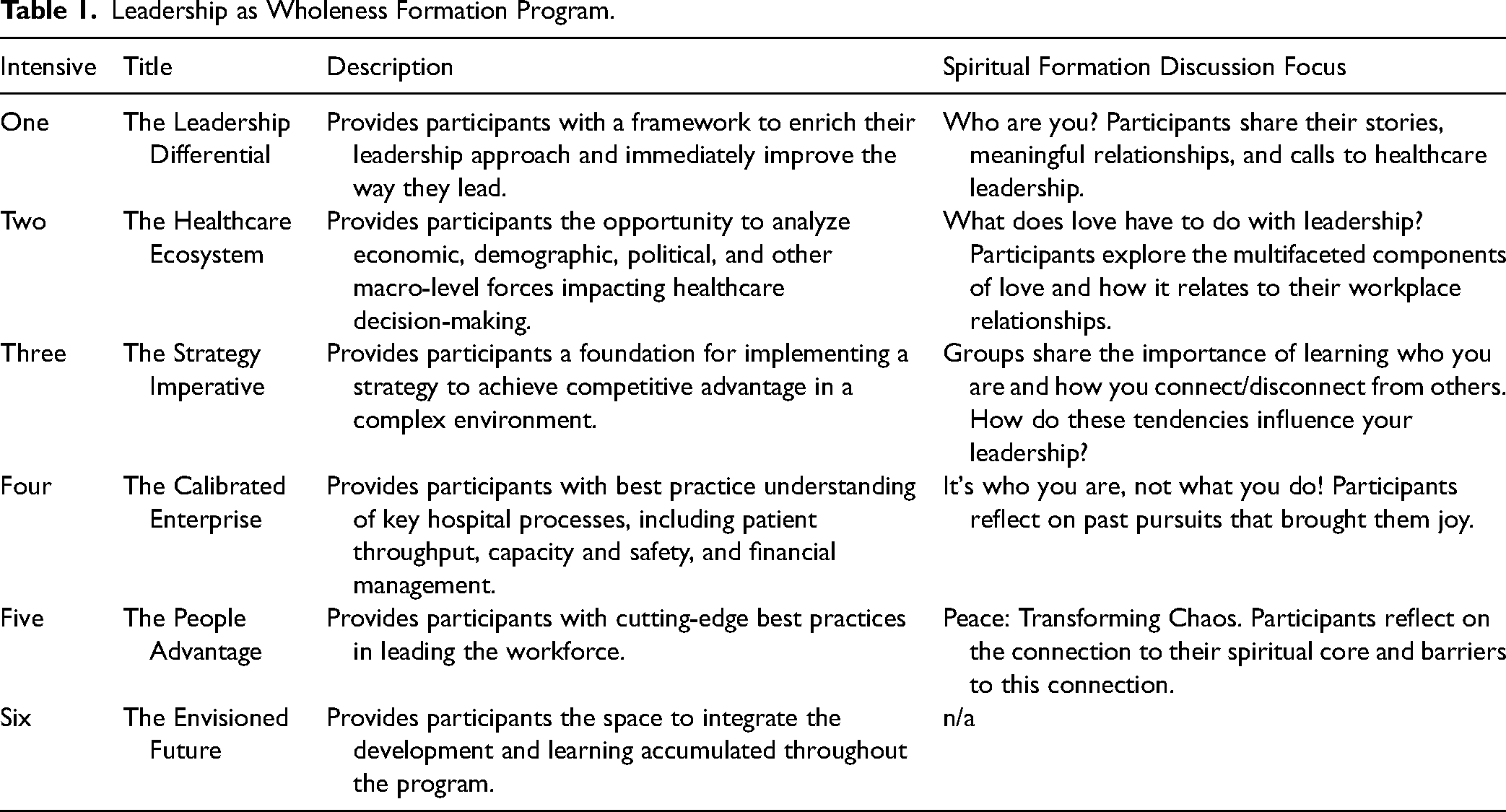
The spiritual formation curriculum of the LWFP embraces the clinical method of learning operationalized in Clinical Pastoral Education (CPE) circles (Hirschmann et al., 2022). The methodology emphasizes practical learning accompanied by reflection (Hirschmann et al., 2022). It comprises group facilitations, guided discussions, reflective partners, and reflective journaling. The spiritual formation curriculum has five main sessions (Table 1). The first session introduces the participant to the concept of spiritual formation as it reinforces how the human spirit contributes to a person's leadership identity. The second session promotes love as an essential component of a leadership model that values relationships. In the third session, participants reflect on who they are and how that influences their leadership. The fourth session on joy emphasizes the importance of an effective leader's purpose. The final session focuses on peace highlights the importance of developing principled, less emotionally driven, and more emotionally grounded leadership. The delivery format of the Leadership as Wholeness Formation component is as follows:
1-hour group sessions during the five in-person
1
LWFP Intensive sessions held every other month. Between the intensives, LWFP participants have one-on-one shadowing and reflection time with a reflective partner at or near their worksite. The time spent between intensives is dedicated to reflection and integration, led by reflection partners. Questions related to the topics covered in the previous in-person group session are included in the individual journaling assignment.
Leadership as Wholeness Formation Program.
Group Facilitation and Guided Discussion
The facilitator of the spiritual formation groups functioned as a moderator who guided and held space for group participation. Group sessions were organized around the spiritual formation curriculum theme for each session. Group members were invited to share their feelings and experiences, particularly about their spiritual formation and leadership. Facilitators moderated the group through transitions, allowed each member to share, and acknowledged participants ready to speak. Often, there was no need to intervene as meaningful conversation and engagement were ongoing. Group members modeled vulnerability and authenticity in their sharing. Trust was established by connecting through shared experiences, fostering more profound and authentic sharing. Participants demonstrated the ability to share contradictory and mixed feelings regarding their leadership reflections. These were high-functioning, mature, and motivated leaders. Their engagement in the reflective process, their investment in developing as a leader, and their desire to deliver compassionate care were readily apparent.
Reflective Partners
The intensive sessions are just one aspect of the spiritual formation curriculum. Participants are also individually assigned a reflective partner (mainly hospital chaplains), whom they shadow and interact with for about two hours each month. Shadowing offers the future executive a close-up view of the role of reflection and the importance of adhering to one's spirit in fulfilling the company's mission.
Reflective partners allow leaders to reflect on implementing their learning in a private, one-on-one setting. The leader directs the sessions based on their experience, and the reflective partner guides the conversation in a judgment-free and safe space. Most sessions resemble a conversational approach exploring the needs and crises of the leader through active and empathic listening, rapport building, and positive regard (Lewis, 2002).
Results
In Cohorts II, III, and IV, 160 responses were recorded to the evaluation question: What comments do you have regarding spiritual formation? The analysis did not consider 19 (12%) comments due to insufficient context. Of the 141 comments analyzed, 20 (14%) of respondents expressed appreciation, 11 (8%) indicated enjoyment, and 28 (20%) made comments regarding the spiritual formation program as most impactful, helpful, or meaningful.
The most prevalent positive themes suggest that small group breakout discussions were beneficial to engage leaders in their spiritual formation. Small group discussions fostered a safe place for executive leaders to be vulnerable and share experiences with others experiencing similar struggles. The facilitators were most appreciated, while time spent with the chaplain in reflection on leadership practice was largely helpful and a pivotal component of executive leaders’ spiritual formation. An interesting emerging theme in the evaluation data demonstrated that leaders identified the spiritual formation program component, particularly the integration of their faith in leadership, as a critical organizational differentiator.
Several themes were also apparent among program critiques. The first theme suggests the breakout group experience was highly contingent on the facilitator's modeling of and comfortability with vulnerability. The second surrounded how the spiritual formation components did not always topically align with the rest of the Executive Leadership curriculum. Finally, due mainly to the advent of the COVID-19 pandemic between Cohort II and III, there were many comments regarding the difficulty of facilitating group discussions and cultivating vulnerability via online video calls. Figures 1 and 2 demonstrate that almost all respondents strongly agreed or agreed that they understand the role and benefits of the spiritual formation curriculum.
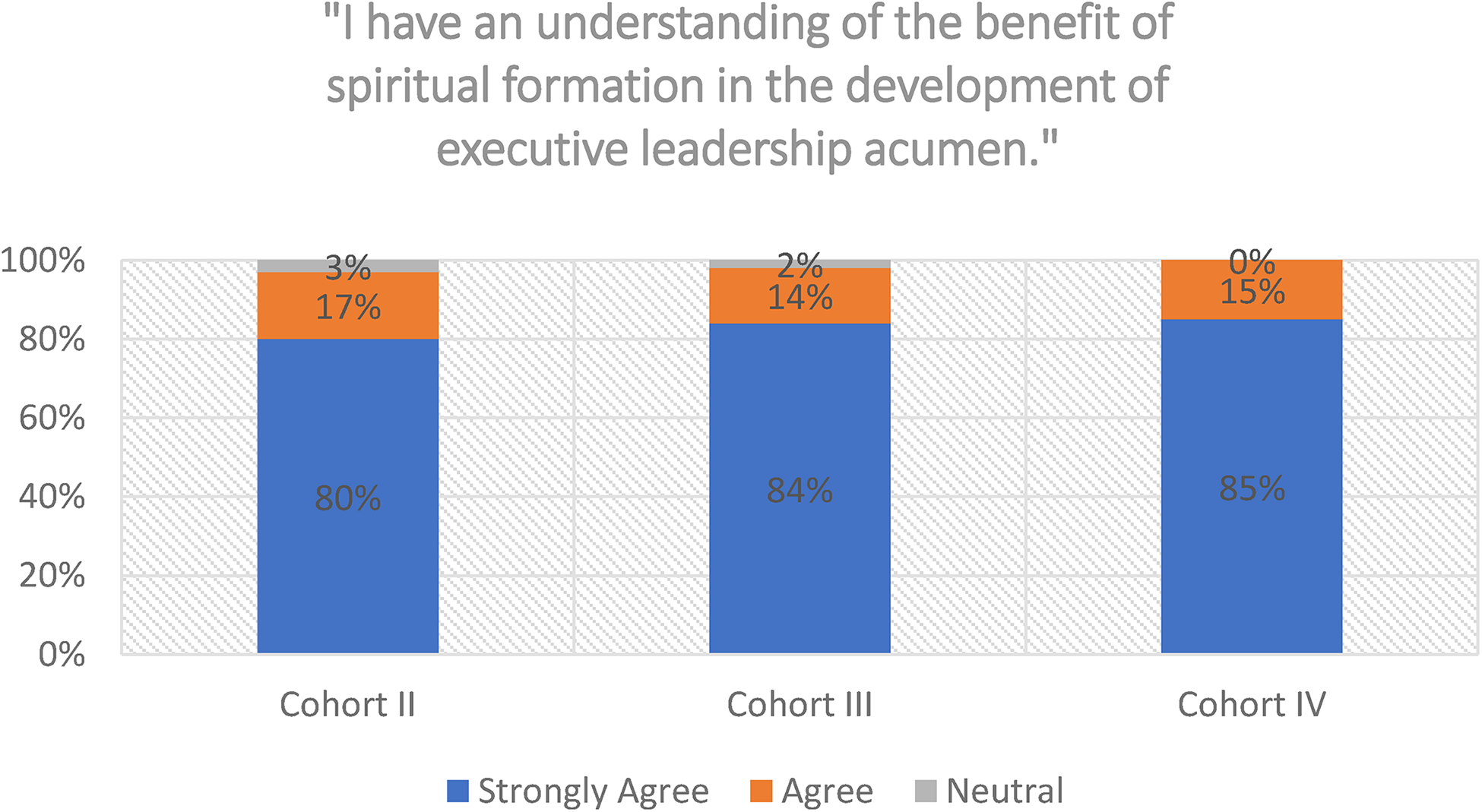
Spiritual Formation and Leadership Development.
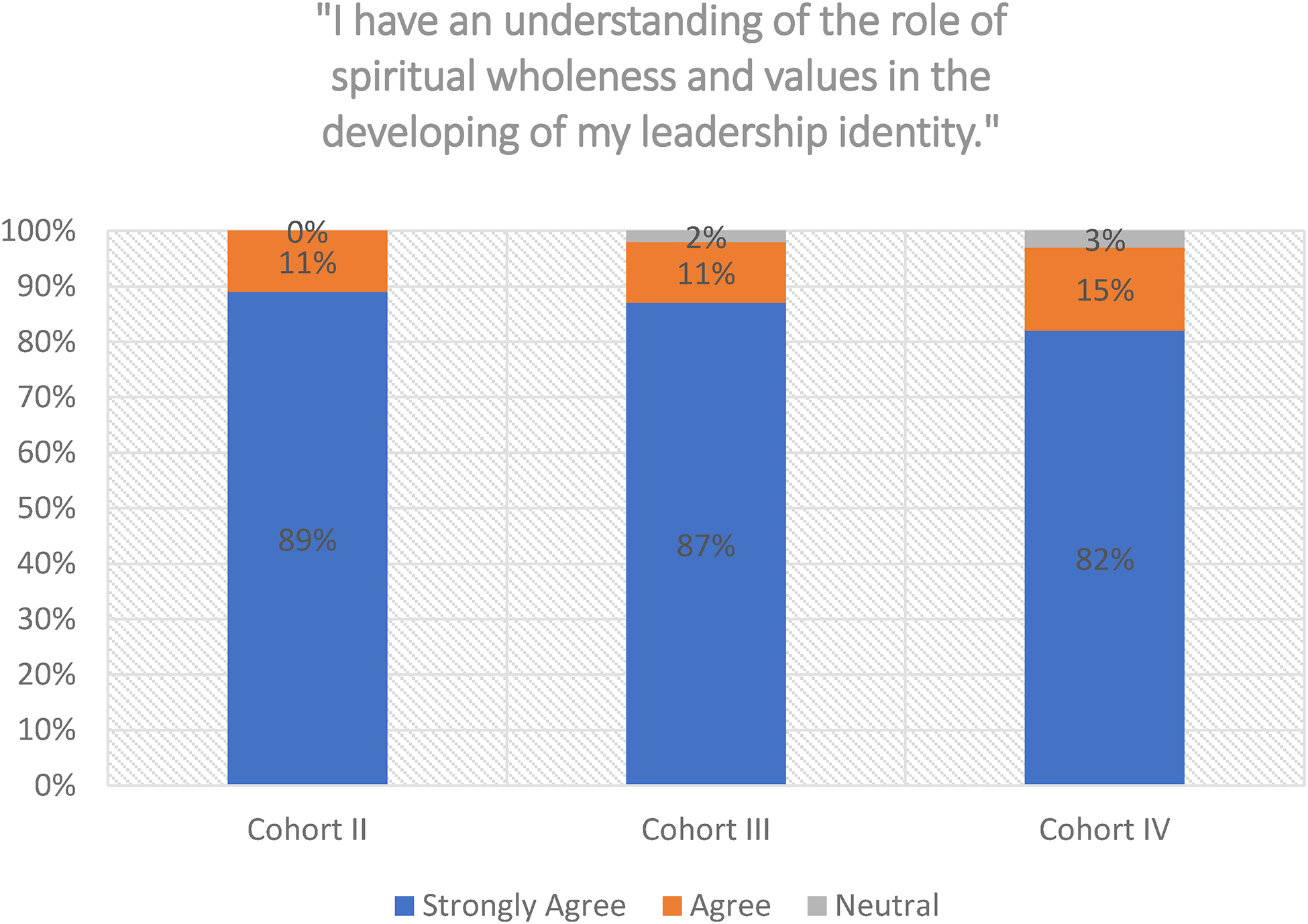
Spiritual Wholeness and Leadership Identity.
Discussion
Current literature supports leadership development in the healthcare setting (Aij & Rapsaniotis, 2017; Hillig & Teigen, 2020; Lega et al., 2017). Increasingly, there are expectations for these leadership development programs to impact leaders’ decision-making, philosophies, beliefs, and values (Hillig & Teigen, 2020). An accounting of the spiritual dimension of leader's lives must not be ignored to encompass the whole-person expression of leaders (Ghazzawi et al., 2016; Guillen et al., 2015). The above iteration of leadership development incorporates spirituality in its curriculum and ascribes to the literature's support of addressing an employee's whole self to facilitate meaningful contributions from participants (Jolliffe & Foster, 2022). A spiritual formation component in the executive leadership program is a tacit acknowledgment that “leadership and organizational culture are inextricably intertwined. They are two sides of the same coin” (Azzolini et al., 2018, p. 1). Consequently, leaders must intentionally cultivate a culture that preserves the organizational mission. Ultimately, intentional spiritual formation should produce authentic leaders who “…understand that leadership is not a position, but a competence” (Maziero et al., 2020, p. 2). Even still, the current leadership literature could benefit from the consistent definition and use of key terms such as spirituality, faith, values, ethics and leadership. Similarly, future research would do well to use rigorous methodologies to help examine the relationship and directionality between these terms. Such work could result in a better understanding of where these elements align or conflict with personal leadership styles or organizational culture.
The LWFP presented above integrates CPE educational methodologies within the spiritual formation component to maximize reflection and group interaction. There are many documented cases of adaptations of CPE to fit various needs of organizations (Hirschmann et al., 2022; Mai, 2016; Zollfrank et al., 2015). Like Hirschmann et al., the design of this project intended to “help deepen their capacity for attunement to self and others in their role as healthcare leaders” (Hirschmann et al., 2022, p. 512). However, it is essential to note that Hirschman et al. differs from the above project, as they adapted a program accommodating diverse participation in CPE. The above project utilized CPE techniques and methods and implemented them within a leadership development process, but it is not considered CPE for leaders. We are unaware of other publications highlighting the unique usage and deployment of the Association of Clinical Pastoral Education (ACPE, www.acpe.edu) Educators in a healthcare leadership development program. Although ACPE Educators are highly skilled and trained to perform the task, leadership group facilitation marks a fundamental detour from the traditional role of certified educators (Clevenger et al., 2021). Also, the LWFP program utilizes healthcare chaplains as reflective partners for leaders, further illustrating the ability to utilize internal organizational staffing resources to enhance leadership development. Organizations may consider utilizing mental health professionals to facilitate similar reflective roles.
As with any educational development program, there are some limitations worth highlighting. Mainly, the leaders from this faith-based healthcare system who were selected for participation may be more inclined to report highly on the spiritual formation component, as mission imperatives are emphasized across the organization. There is also a concern for desirability bias, as it stands to reason that leaders projected for organizational growth within a faith-based system may feel more pressure to embrace faith-based practices. These concerns are worth stating; however, the impact is likely mitigated due to the anonymous evaluation surveys. The above report exemplifies a novel approach into introducing spirituality into a leadership development program but also represents limitations when a program is not developed with research-specific goals. The evaluation's current capacity does not cultivate in-depth or specific knowledge of the program's impacts on individual participants. Future work can address this by using in-depth interviews (Myers et al., 2022) and more targeted evaluation questions. Also, establishing clear linkages between program components and potential individual and organizational benefits should be explored (Hendriks et al., 2020). In general, the findings above should be presented in the context of participant appreciation for the spiritual components of LWFP with the suggestion that future research adopts methodologies that evaluate the effectiveness of utilizing observable and measurable outcomes in leadership practice (Black & Earnest, 2009; Njah et al., 2021).
Conclusion
The LWFP outlined above is one of the few examples in current literature that aims to provide a whole-person perspective on executive leadership development. The program demonstrates usefulness because the participants find it meaningful and valuable for their development. However, there is still much room for improvement and future study into this program's effectiveness. The preliminary results suggest that including a spiritual formation component in an organization's leadership development can be beneficial and help link corporate mission initiatives to individual leader identities.
Footnotes
Declaration of Conflicting Interests
The authors declared no potential conflicts of interest with respect to the research, authorship, and/or publication of this article.
Funding
The authors received no financial support for the research, authorship, and/or publication of this article.
