







Abstract
The Abyei area, which straddles the border of the two Sudans, had been a theatre of war since 1965. In 2016, the Amiet market emerged from a remote forest grove to initiate a new kind of social contract making. It has quickly become a melting pot of various communities and created space for nurturing new relations but has also generated tensions that may threaten its own survival. As stakeholders negotiate a solution to the political dispute over Abyei, this article explains how agro-pastoral resources, including the market itself, factor in both conflict and cooperation. It cites evidence that social capital dynamics are changing along the lines of age and gender. It argues that these may present an opportunity for realigning interests amongst competitive communities, with Amiet market as a possible point of entry for policymakers. It concludes with recommendations for conflict transformation through commercialisation of the traditional agro-pastoral sector.
Keywords
Patterns of rain, ecology, and topography have shaped the agro-pastoral livelihoods of the semi-nomadic communities of the Abyei area who seasonally move their herds with the ebb and flow of the Kiir river system. Under customary agreement with the host Ngok Dinka (Ngok) community regarding grazing corridors, the Misseriya Humr (Misseriya) to the north and the Twic Dinka (Twic) to the south come through Abyei seasonally with their cattle. The Misseriya are Islamic, Arab, and citizens of the Sudan, whilst the Twic are linguistically, culturally, and politically identified with the Ngok, and their territory and allegiance is firmly with South Sudan.
The Ngok have had their permanent settlements for more than two centuries in the Abyei Area, whilst the neighbouring Misseriya and Twic shared its resources (Chris, 2012). Interactions between them have been historically peaceful, until 1964 when, reportedly, “Misseriya killed a Dinka man, cut his hands off and used them as drum sticks.” 1 This story marks the Ngok account of the onset of wars, which have lasted until the present day. The period of 2008 to 2015 was “a dark period when many Ngok and Misseriya nomads were killed.” 2 That period included two burnings of Abyei town (2008 and 2011) by the Sudan Armed Forces and Misseriya accomplices and the killing of the Ngok Paramount Chief by a Misseriya militia. 3 Although the 2005 Sudan Comprehensive Peace Agreement had already ended the North/South civil war and made provisions to ensure the free movement and right of access to pastures and waters in Abyei for the livestock of Misseriya and other nomadic communities in southern Sudan, most of the vegetation and water resources would fall within the territory of the new country of South Sudan if Abyei were to join it. This challenge for the Misseriya was compounded by the eruption of war between the two countries in 2012 over the oil-producing border area of Panthou (Heglig). As a result, the border of the two countries was closed, causing enormous loss of livestock and trade for the Misseriya.
As the 2016 dry season arrived, the Misseriya cattle herders were facing a drought and wanted to move south to graze their cattle. The Ngok were clustered in Abyei without services and wanted to return to villages in the north of Abyei from where they had been displaced, in order to farm. So, with the assistance of the United Nations Interim Security Force in Abyei, 10 elders from each side met in February 2016 inside the Abyei “box,” 4 in Noong village, north of Abyei town, where they agreed on the following principles: mutual respect and peaceful coexistence; sharing information on the movement of militias; compensation for stolen cattle and murders; Misseriya herders’ access to water, pastures, and grazing in Abyei area; and to cease all hostilities between the two neighbouring communities and allow free movement between north and south of Abyei. 5
Misseriya traders took the opportunity of the talks to try to sell some bags of sugar. When they succeeded, they brought more commodities and in larger quantities. With the repeated success of these commercial transactions, a market emerged that quickly expanded over the next months. 6 In July 2016, the market was moved to Amiet, several kilometres to the east, for the access to an all-season road. Whilst entrepreneurial Misseriya traders initially sold basic commodities to the Ngok, the latter reciprocated by then selling livestock, which, following historic trade patterns, allowed for the market’s growth, aligning commercial interests of the two communities. 7 Since its creation, the market has grown rapidly from a remote forest grove to house approximately 1,500 stalls and 5,000 residents from the Ngok and their neighbouring communities.
Literature Review
Changing intergenerational roles are impacting social contract making along the borders of the two Sudans. Amongst the area’s agro-pastoral communities, youth, women, men, and elders cooperate traditionally through age sets. Leinhardt (1967) and Evans-Prichard (1951a, 1951b, 1940a, 1940b, 1953) first documented how these institutional players had complementary roles fixed around management of land, forests, rivers, grazing, cattle, home, and community. Deng (1972) studied these same structures in the context of changes due to modernity. Pendle (2015) and Hutchinson and Pendle (2015) show how traditional youth structures have been integrated into military structures in recent decades, reconfiguring bonds of territory, kinship, and age set. Once only family cattle could provide for marriage and this kept youth subservient to the male elders, but now the market, education, and military provide alternatives that are shifting power dynamics.
De Waal (2014) depicts a political marketplace in South Sudan where politicians and generals are patrons to tribal clients; however, the same politicians and generals rely on their communities for legitimacy (Hutchinson & Pendle 2015). Rolandsen (2007), Young (2003, 2012), and Pantuliano (2010) show how both the Government and rebels have instrumentalised youth structures, mobilised them into violence, and then left them vulnerable when peace is signed. This institutional capacity for warfare based in the age set system constitutes what Deleuze and Guattari (1984, 1987) refer to as “war machines”—local mechanisms by segmentary societies who affirm rights in relation to the state and, despite being exterior to the state, are nonetheless vested with potential power, in this case, for collective action, which the state seeks to capture and use. As politicians use the threat of youth violence for political leverage, the question of who is principal and who is agent becomes obscure.
In the literature, youth are presented as becoming stronger and more independent in relation to elders on the one hand and, paradoxically, more marginalised and vulnerable on the other. Whilst there is a growing evidence of the role of business in promoting peace (Jamali and Mirshak, 2010; Miklian et al., 2016), there is limited research on the role of markets in forging social contracts in the context of a fragile environment like that of the Abyei area.
As presented in Figure 1, McCandless (2018) argues that a resilient social contract is the outcome of three drivers: (i) inclusive political settlements that address core conflict issues; (ii) increasingly effective, fair, and inclusive institutions; and (iii) broadening and deepening social cohesion (social capital). Whilst there is no unified definition of social capital, it is generally understood as a value that is formed and accumulated in society by considering “trust,” “network,” and “norm” as capital. Substantial empirical research demonstrates the importance of social capital as a factor of reliable politics and administration, free market economy, cooperative behavior, and community development (Knack & Keefer, 1997; La Porta, Lopez-de-Silanes, Shleifer, & Vishny, 1997; Tabellini, 2010). However, measurement of social capital is difficult because it refers to an intangible quality, so it can only be detected by proxy.
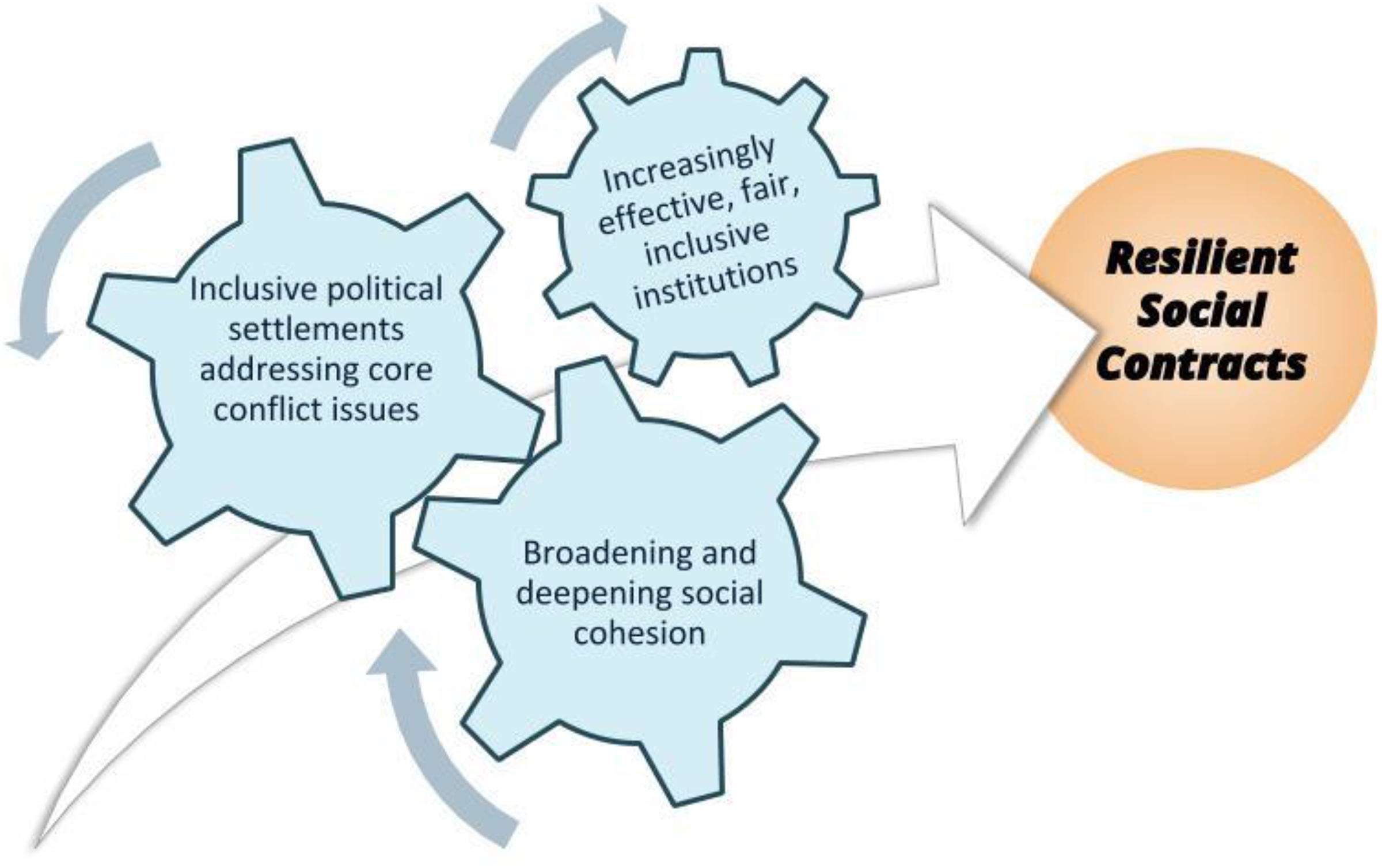
Three drivers of resilient social contracts. Source: McCandless (2018).
Social capital includes three interdependent and inextricably linked elements: bonding within like-minded communities, bridging to bring together different communities with less shared interests, and linking to connect communities and local networks with formal institutions and governments (Putnam, 2000; see also Aldrich, Daniel P, Meyer 2015; Bernier, Quinn, & Narayan, 2014; Cooley & Papoulidis, 2017; Cote & Healy, 2001, p. 42; and more broadly Woolcock & Deepa, 2000, pp. 225–250).
Arguing that cultural capital can be converted into social capital and then social capital can be converted into economic capital, Vuković, Kedmenec, Postolov, Jovanovski, and Korent (2017, p. 24) highlight the importance of cultivating entrepreneurial intentions by deliberately targeting policies at attitudes towards entrepreneurship, subjective norms, and perceived behavioural control. They argue, “the problem of youth unemployment shifts the focus on education and the issue of the kind of knowledge and skills that young people should acquire in order to conform to an environment of uncertainty, complexity and quick changes.” Their study provides interesting findings on the link between structural and cognitive forms of social capital and entrepreneurial intention, as a proxy of entrepreneurship.
All these dimensions of social contract making and social capital are relevant to the conflict in Abyei; however, empirical analysis of the social capital dynamics has not been conducted. This article tries to identify how members of the Ngok community, as central players in the Abyei issue, perceive key relationships across major assets of the agro-pastoral economy. Understanding such perceptions across age sets may inform policies to build community resilience to the drivers of conflict.
Method
The research applies the following model (Figure 2): When two parties, either individuals or political communities (identity groups), interact in a shared space as in the case of Ngok and Misseriya, with both claiming rights to livelihood assets, a process of negotiation (social contract making) begins on assets that fall within the shared rights zone, such as water and pastures. In this case, the assets are agro-pastoral resources. The outcomes of negotiations will be agreement or non-agreement in an unfolding process of negotiations, that is, social contract making, which produces social capital. In the case of non-agreement, competition will tend towards conflict, ultimately requiring more negotiations, and potentially triggering cycles of violence. Agreement in turn can be either forced or consensual along a continuum. In the case of forced agreement, conflict remains latent and psychological hurt may be deep. Consensual agreement sets the framework for cooperation and the continuous transformation of conflicts as they arise.
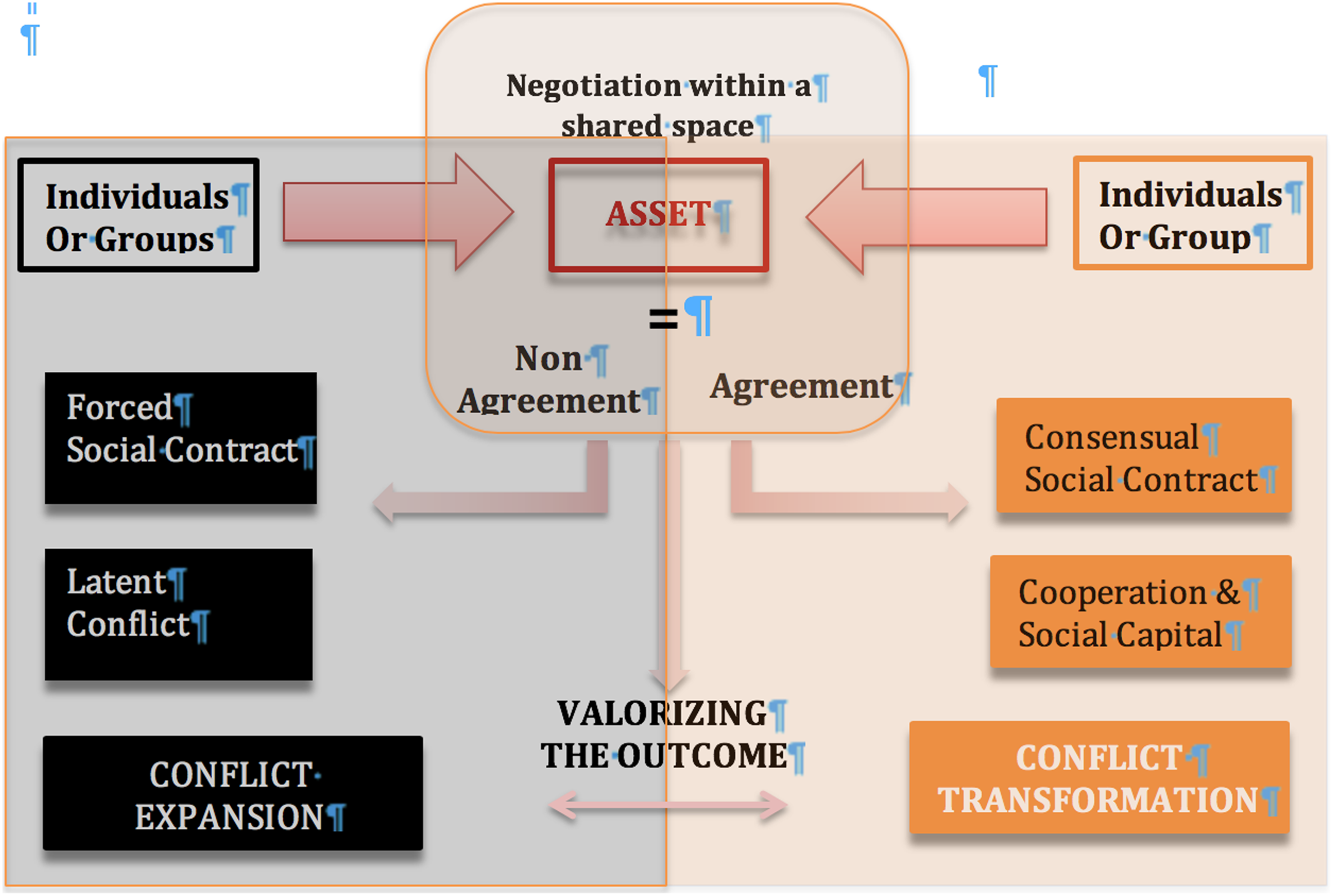
Social contract/conflict transformation model.
This article attempts to clarify whether the agro-pastoral economy is a conflict factor and/or a source of cooperation, by adapting the social capital typology to the Abyei context, then introducing an economic factor (assets). For the measurement of social capital, it uses two tools, one quantitative and one qualitative. The conceptual framework defines bonding to include trust accrued within the same ethnic community, bridging to include trust accrued amongst different ethnic communities, and linking to include trust accrued between an ethnic community and the state. In terms of key stakeholder groups whose construction of social capital is required for the solution of the Abyei conflict, it considers the Ngok (as host community), the Misseriya, the Twic, the Government of the Republic of South Sudan (South Sudan), and the Government of the Republic of Sudan (Sudan). From the perspective of the Ngok, it distinguishes bonding to include relations within families, between families, with the traditional leadership and with the civil administration. For bridging capital, it considers relations with the Twic and the Misseriya. For linking capital, it considers relations with the South Sudan and the Sudan.
The conceptual framework further identifies the key assets (resources) within the agro-pastoral economy that the local communities depend upon for their livelihoods. These include land, livestock, agricultural resources, forests, fishing sites, and markets, all of which exist in a shared administrative space where different parties claim rights. To render the bonds, bridges, and links of social capital measurable, the methodology considered the extent to which the key stakeholder groups perceive either conflict or cooperation over these assets. The quantitative survey queries the perception of the Ngok as host community, which leaves the perception of the other stakeholder groups regarding the same relationships as a potentially valuable future research. Being that the market aligns all of these interest groups and assets, the research took a deep qualitative approach to understanding how the market impacts the bonds, bridges, and links of social capital. The overall framework that emerges when considering the construction of social capital within the agro-pastoral economy informs an approach to social contract making at the subnational level where negotiations over assets are the core process under consideration.
The quantitative tool is divided into two parts. The first part asks questions about personal attributes such as age, sex, education level, living environment, and agricultural factors (crop type, cultivated land area, livestock holding situation, etc.). In the second part, respondents were presented with a number of statements in the Dinka language and asked to either strongly agree (= 1, Gam apei), agree (= 2, Gam amath), remain undecided (= 3, Akuoc), disagree (=4, Akac Gam), or strongly disagree (=5, Akach gam apei). The statement was framed for each agro-pastoral resource and for each set of relationships. The same questions were also asked in the positive to determine the extent to which respondents perceive assets as a unifying factor. Then, positive and negative statements were combined and recalculated to create a measure of social capital across assets between different actors using a range from −1.0 to 1.0 that can be visually depicted on a bar graph with conflict falling below the zero line and cooperation sitting above it. Survey responses were also disaggregated by age, gender, educational status, and socio-economic status, in addition to asset groups, and whether the relations refer to bonding capital, bridging capital, or linking capital. The survey was targeted at a random sampling of 243 households in Abyei town and its immediate surroundings.
To clarify correlates with other key factors and attributes, the methodology formulated the following regression equation.

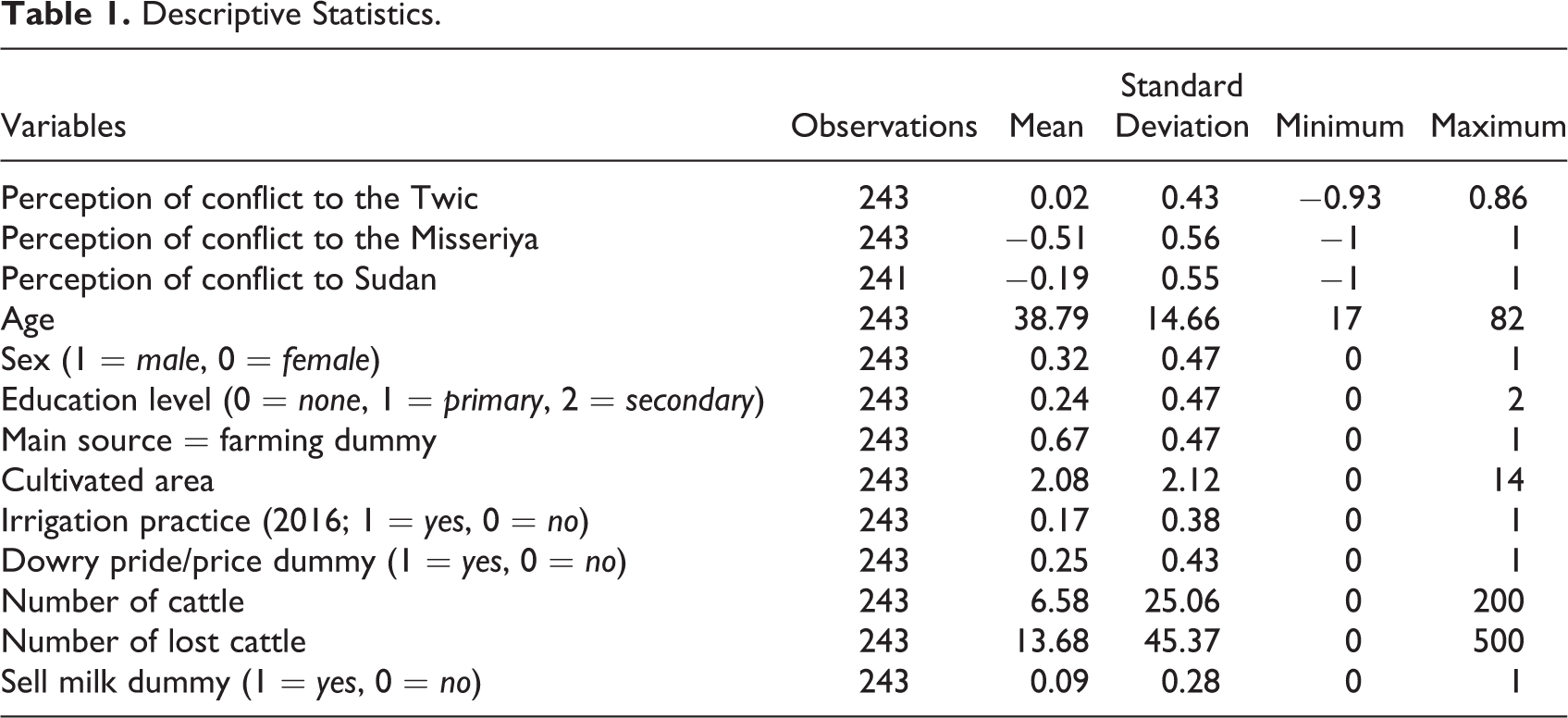
where y is an average of the total of the conflict/cooperation perceptions per major livelihood assets of the Ngok against the Twic, the Misseriya, and Sudan, respectively. Dependent variables consist of personal attributes, agricultural, and cattle-related, considering these are important for agro-pastoral populations. Personal represents personal attributes such as age, sex, and educational level. Agriculture represents whether agriculture is the primary source of income (1 = yes, 0 = no), cultivated area and whether irrigation practiced in 2016 (1 = yes, 0 = no), livestock represents cattle-related variables, such as status of marriage by cattle (1 = yes, 0 = no), number of cattle possessed, number of cattle losses, and the presence or absence of milk sale (1 = yes, 0 = no); ∊ represents the error term. Table 1 presents descriptive statistics.
Descriptive Statistics.
In order to interpret the quantitative findings and draw some preliminary conclusions, approximately 50 key informant interviews and group discussions with a total of 79 individual respondents were conducted in November and December 2017. These focused on dynamics related to social contract making around the Amiet market, from the point of view of the various communities that interact in the market. The qualitative component of the study intends to bring the quantitative findings more clearly into a policy perspective, triangulate them, ground the interpretation, and deepen its sense of context.
Research Findings
About 93% of respondents were displaced in 2011 after the large-scale destruction to Abyei and its surroundings, with 76% having returned to their place of origin as of May 2017; 97.1% were living in temporary dwellings, with 84% having roofs made from thatch and 14.4% made from tarpaulin. This indicates a high rate of return of the Ngok and their low socio-economic status after the displacements of 2008 and 2011.
Nearly two thirds depend on subsistence farming as a principal source of livelihood (67%), and 83% were engaged in some form of agricultural production, primarily sorghum, during the 2016 agricultural season, with a mean area cultivated per household of 2.5 feddans (1 feddan = 1.038 acre), and an average of 25 heads of cattle, 19 heads of sheep, 27 heads of goats, and 1 donkey. Since 2011, the Ngok have lost more than 60% of their livestock due to cattle raiding, and the few cattle remaining are kept outside the boundaries of the Abyei administrative area for safety. This indicates whilst Ngok are poor, there is a solid subsistence sector, high productive potential, low production efficiency, and low access efficiency.
In terms of livelihood opportunities, men’s first choice at 65.8% is livestock, whilst women’s first choice is food processing (54.7%). Women have a relatively lower interest in livestock at 29.6%, whilst men have a lower interest in food processing at 20.2%. This indicates that commercial opportunities are seen in agro-pastoral development diversified along the lines of gender and age.
In terms of livelihood challenges, all social groups (adult men [59.5%], adult women [60.5%], and youth [62.1%]) see insecurity as the major challenge; however, youth (65%) and adult women (67.1%) include also the lack of employment, whilst this perception is lower amongst adult men (37.4%). Entrepreneurial intention of women and youth, therefore, faces a lack of opportunities and insecurity, whilst adult men seem more contented with keeping cattle, perhaps for marriage and prestige in accordance with custom.
Figure 3 shows the average of the sum of the Ngok perception of conflict and cooperation across all major assets of livelihood by key actors.
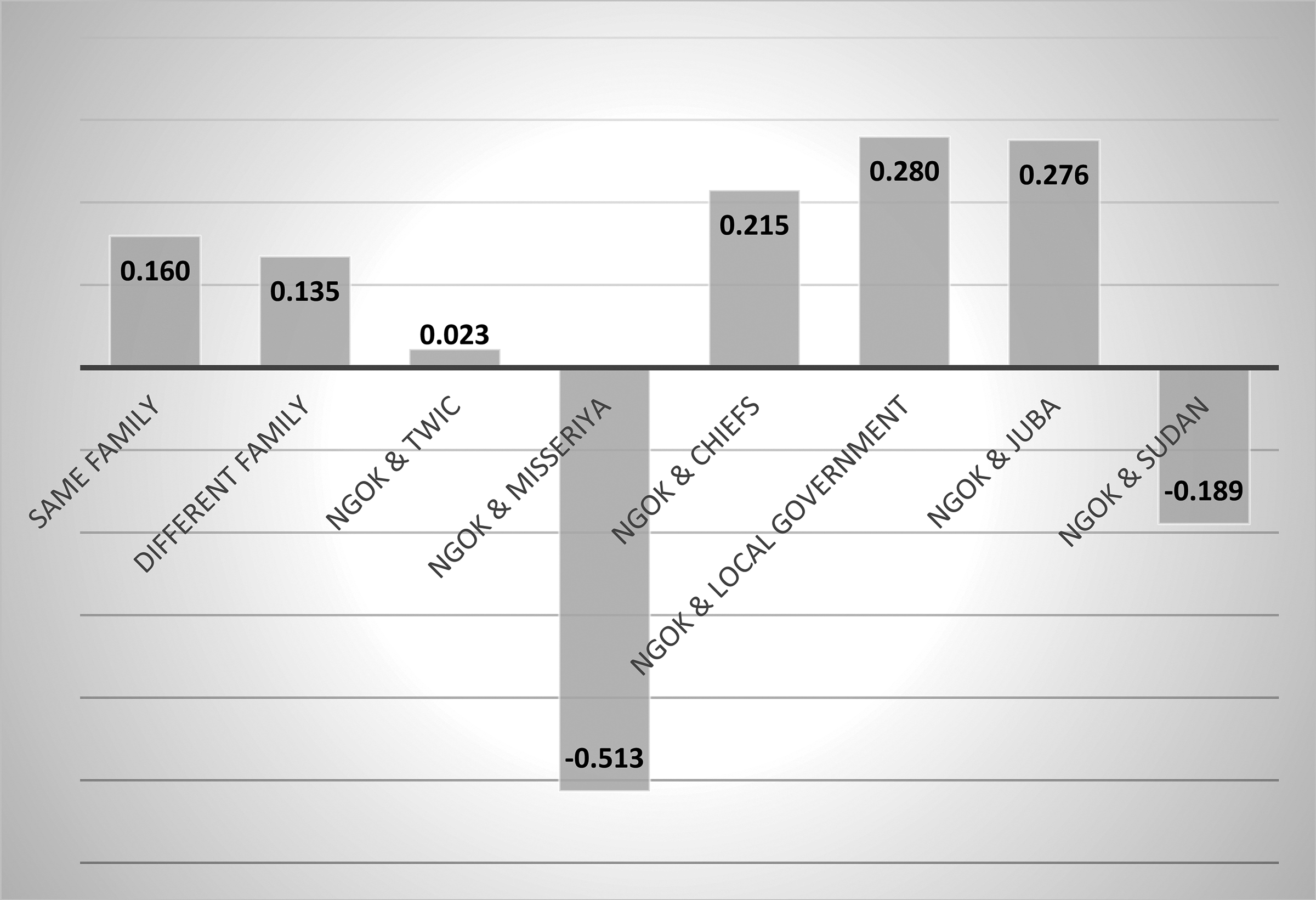
The perception of conflict and cooperation around major assets of livelihood.
Ngok perceive cooperation across all asset groups for the same family, different families, chiefs, local governments, and South Sudan. On the other hand, there is a big difference in Ngok perception of the southern neighbour (Twic) and of the northern neighbour (Misseriya). For Misseriya, assets are perceived as a source of conflict (−0.513), whilst perceptions are relatively neutral (0.023) in relation to Twic. For Sudan, although not as much as for Misseriya, Ngok perceive moderate conflict around assets (−0.189). For South Sudan, Ngok perceive moderate levels of cooperation (0.276), second only to the local government (0.280) where they see the most cooperation. As Ngok chiefs and local government are part of the community, their relations are considered as part of bonding capital.
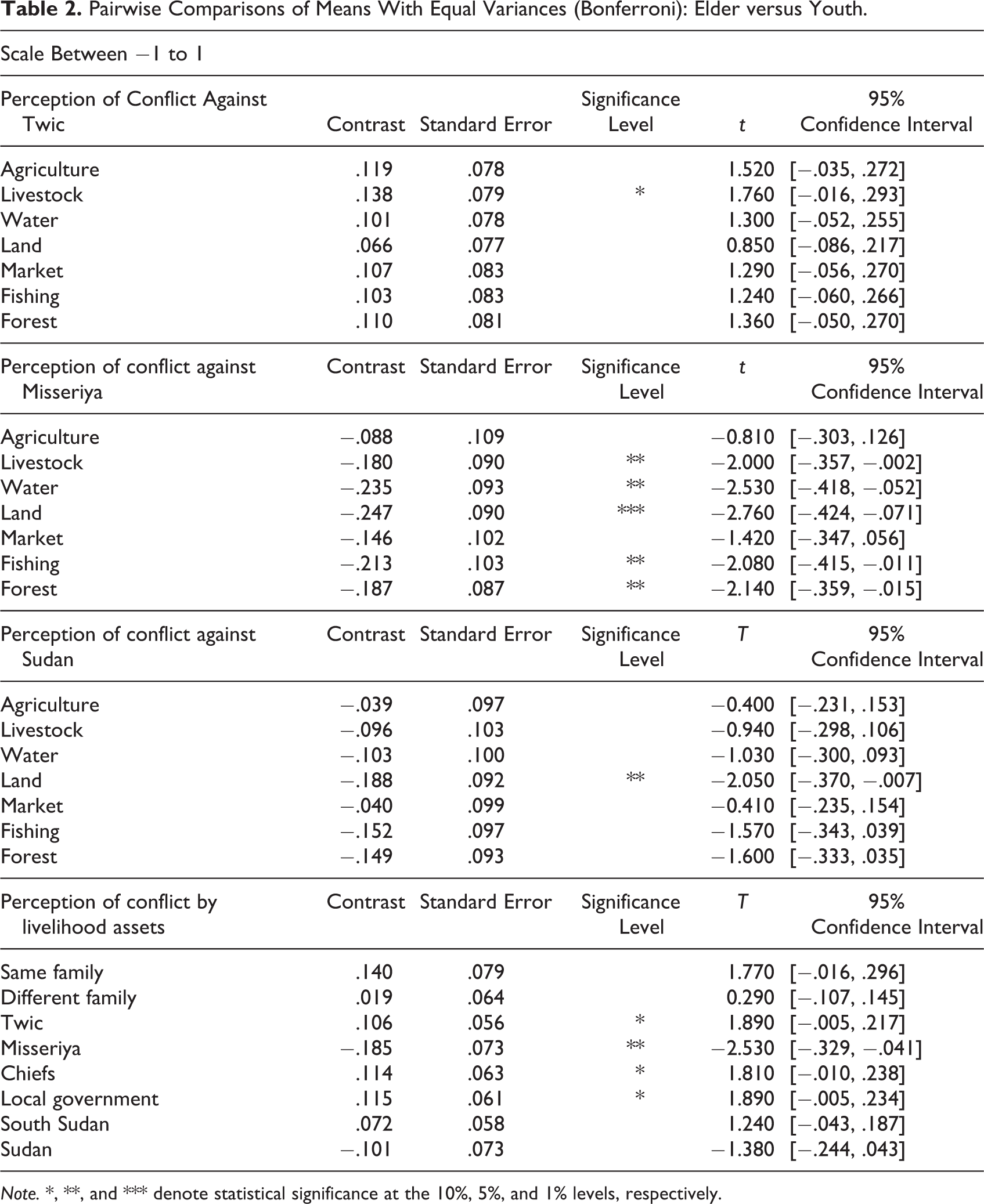
Since Ngok see assets as conflict factors with the Misseriya and relatively neutral with the Twic, one-way analysis of variance confirmed statistically significant difference in perception between youth (until 30 years old) and elders (31 years old and above) for those groups. 8 In addition, one-way analysis of variance was conducted between male and female. The results of pairwise comparisons of means between the youth and the elders are shown in Table 2.
Pairwise Comparisons of Means With Equal Variances (Bonferroni): Elder versus Youth.
Note. *, **, and *** denote statistical significance at the 10%, 5%, and 1% levels, respectively.
As Table 2 shows, for Twic, there is significant difference of perception of conflict around livestock between youth and elders. Compared to elders, youth have a significantly higher perception of livestock as a conflict factor. Next, for Misseriya, there is a significant difference in perception between the youth and the elders for assets other than agriculture and market. Contrary to perception of Ngok vis-à-vis Twic, for Misseriya, Ngok elders have significantly higher perception that livestock, water, land, fishery, and forest are conflict factors compared to youth. For Ngok perceptions of their relationship with Sudan, elders have a significantly higher perception that land is a cause of conflict compared to youth. This is notable because the current Ngok male adults, when they were still youth, fought a war over land where they allied with the Sudan People’s Liberation Movement/Army (SPLM/A) that liberated southern lands, whilst leaving the case of Abyei unsettled. The current youth who were not active in the war are now more focused on entrepreneurship, and their concern over land is more localised than their warrior parents because they are competing with other returnees and an older generation that controls land under customary law.
Furthermore, one-way analysis of variance confirms statistically significant difference in perception between youth and elders for Twic, Misseriya, chiefs, and local government across all major agro-pastoral assets. For Twic, chiefs, and local governments, Ngok youth have a significantly higher perception than elders that assets are a source of conflict. On the other hand, for Misseriya, elders have a significantly higher perception than youth that assets cause conflict. This may indicate that youth have a more centrist view towards historically antagonistic groups, whilst elders maintain a more extreme view, perhaps suggesting that youth are losing faith in old approaches and looking for new solutions to their marginal economic status.
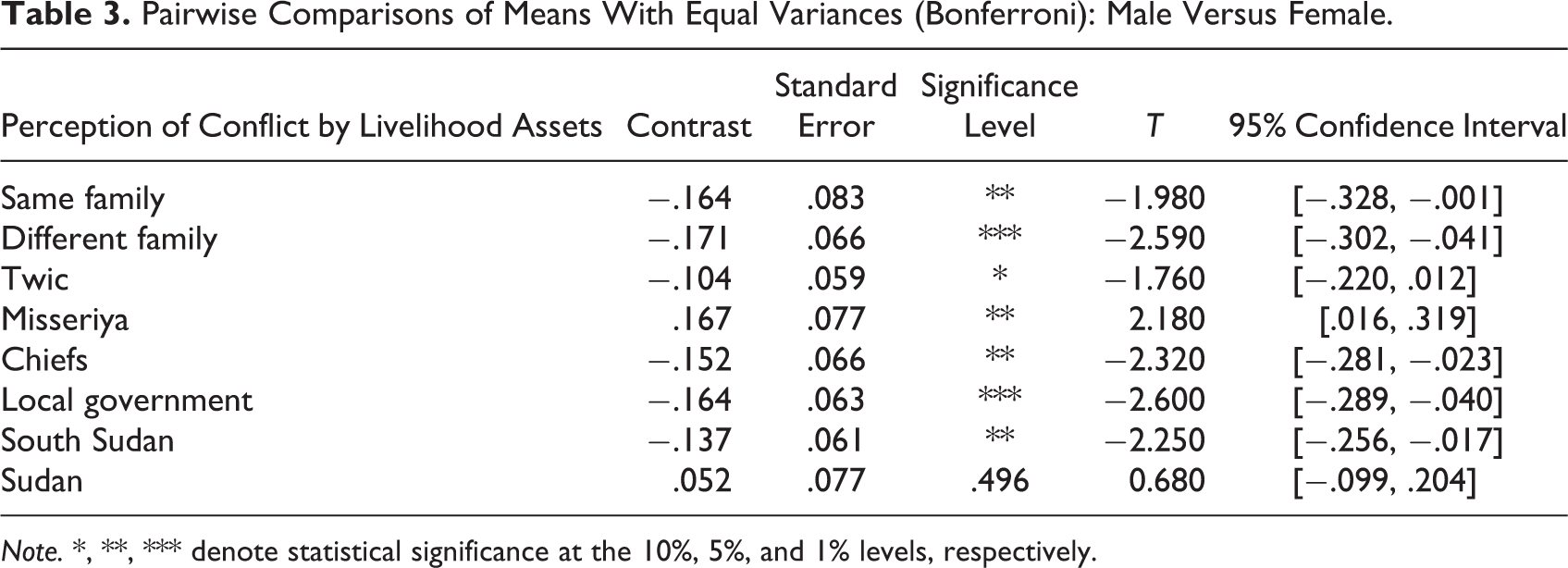
In addition, one-way analysis of variance confirms statistically significant difference in perception between male and female across all major agro-pastoral assets for all stakeholder groups except for Sudan. For same family, people of different families within the Ngok community, between Ngok and Twic, chiefs, local government, and South Sudan, males have a significantly higher perception than females that assets cause conflict. On the other hand, for Misseriya, females have a significantly higher perception than males that assets cause conflict. Female views tend to be more extreme—where they see conflict, they see more of it; and where they see cooperation, they see more of it. The results of pairwise comparisons of means between male and female are shown in Table 3.
Pairwise Comparisons of Means With Equal Variances (Bonferroni): Male Versus Female.
Note. *, **, *** denote statistical significance at the 10%, 5%, and 1% levels, respectively.
Variance inflation factor to examine multicollinearity of all explanatory variables is below five, which shows no signs of multicollinearity. In addition, regression to identify possible reverse causality by switching dependent variables and explanatory variables identified no reverse causality. However, there is certain limitation to rid the data of reverse causality for the lack of good instrument variables. Before showing the estimation results, expected signs of the coefficients are shown in Table 4.
The Expected Signs of the Coefficients.
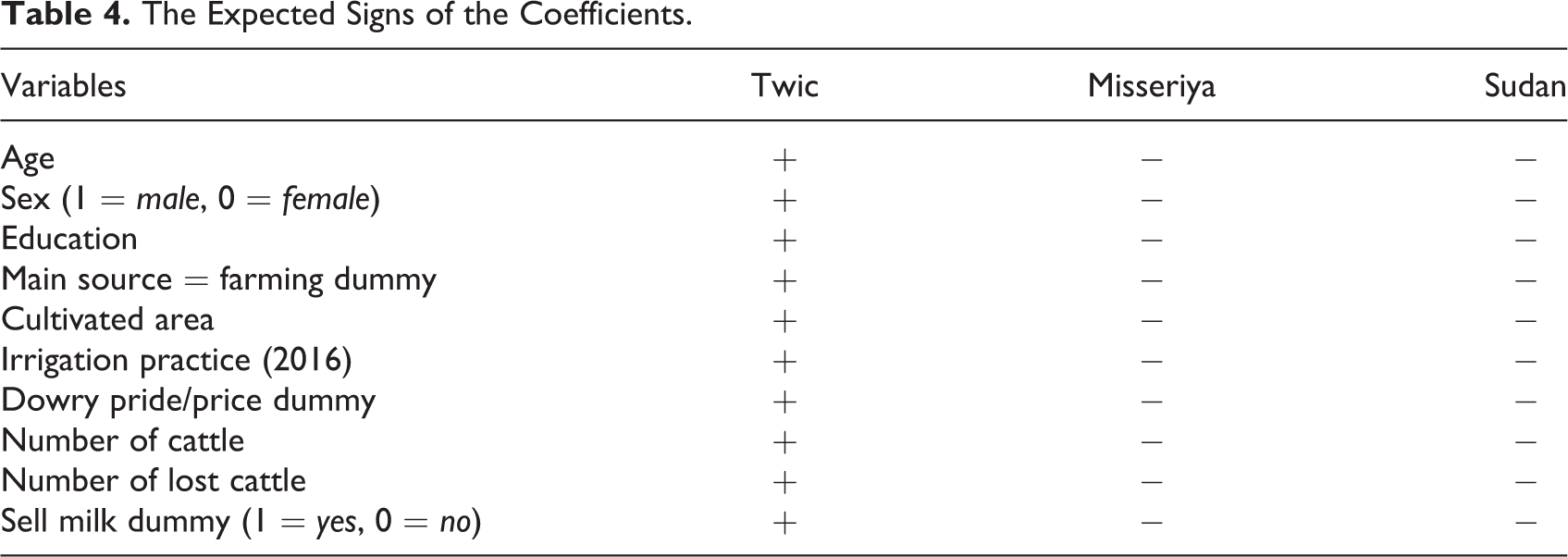
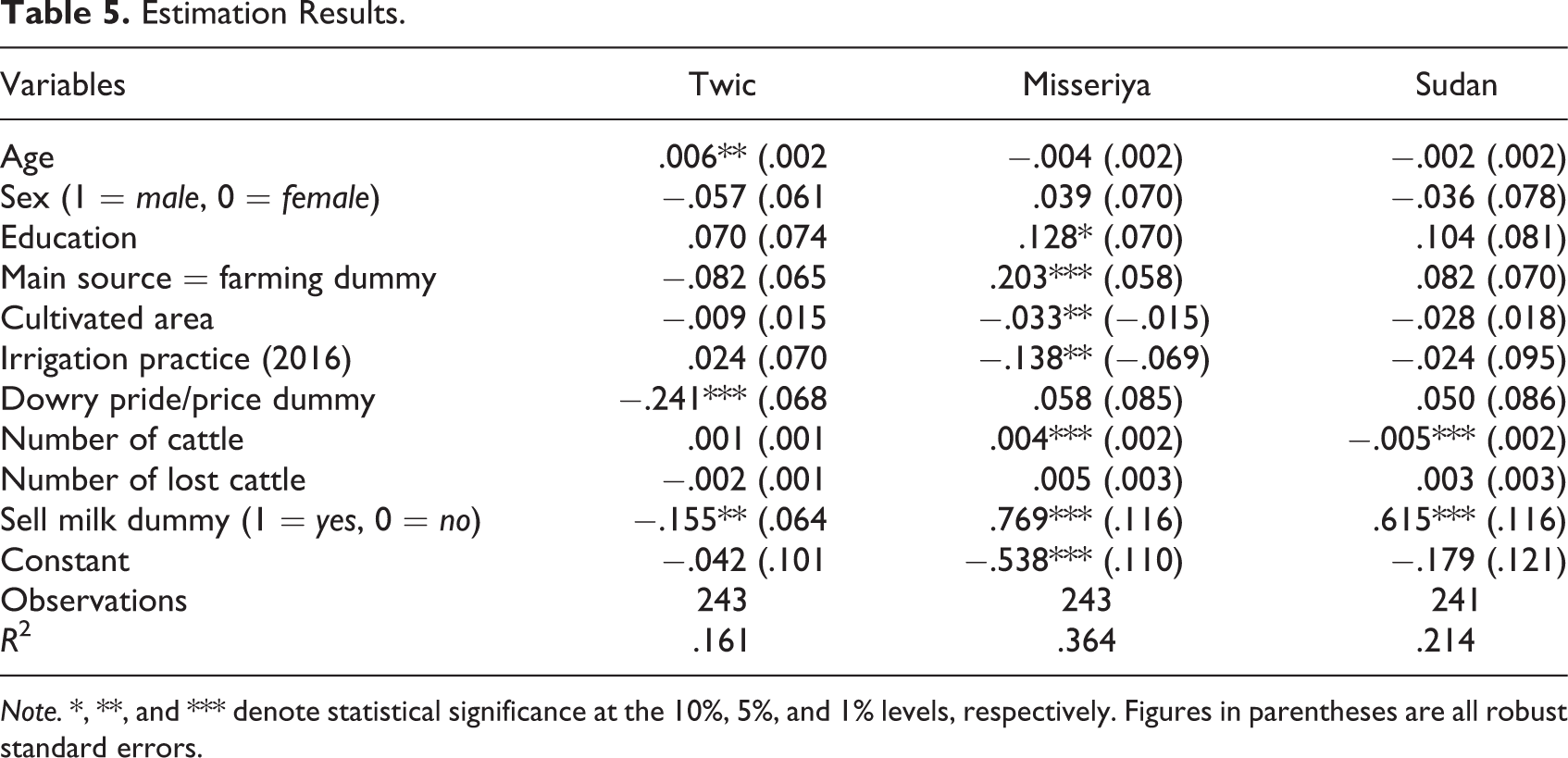
The perception of Ngok is considered negative for Misseriya and Sudan; however, signs of coefficients are expected to be positive for Ngok and Twic who are of the same Dinka tribe and political affiliation. Actual estimation results are shown in Table 5.
Estimation Results.
Note. *, **, and *** denote statistical significance at the 10%, 5%, and 1% levels, respectively. Figures in parentheses are all robust standard errors.
The results show that Ngok elders have a significantly higher perception of cooperation with Twic, whilst those who presented cattle for marriage have a significantly higher perception of conflict with Twic. Hence, Ngok adult men seem to consider Twic men as competitors for marriage. Additionally, those who sell milk hold a significantly higher perception of conflict with Twic than those who don’t sell milk. This may indicate competition in the market, where many Twic are concentrating. Statistically significant results were not obtained for other variables.
The interviews indicate other areas of competition including over control of market taxes. Politicians are pushing for the Twic new state to share in the revenue from Amiet with Ngok, which Ngok are refusing. 9 One Ngok stated that “from our side, the Dinka, some elements are opposed to the market because the other counties are not benefiting from the taxes collected from the market; hence they are working hard so the market is relocated to their areas” (see Note 6).
Next, for the perception of Ngok regarding whether the main livelihood assets cause conflict between them and Misseriya, results show that those with higher education levels perceive significantly more cooperation with Misseriya and that those whose primary source of income is agriculture perceive significantly more cooperation with Misseriya than those whose primary source of income is not agriculture. On the other hand, Ngok with more cultivated areas have significantly higher perception that assets cause conflict with Misseriya. This may be because Misseriya do not practice agriculture in Abyei, so for a Ngok smallholder, they present no competition, but for large landowners, who would have departed from customary smallholdings, their land more likely falls across migration routes. They are also more likely to be of the political class, with perceptions conditioned by the period of war. Non-agriculturalists too are likely to be more politically aligned elites, finding livelihoods in politics and/or government contracting.
Contrary to the expected signs of coefficient, both Ngok who possess more cattle and those who sell milk perceive that the main livelihood assets cause more cooperation with Misseriya. Livestock keepers across lines have historically maintained big herds and cooperated with each other under customary agreements that demarcate migration routes and agricultural lands. Those who also sell milk demonstrate entrepreneurial initiative and, therefore, are likely to be more inclined towards the market where livestock trade is also increasing northwards from the south.
Finally, Ngok who possess a larger number of cattle have a significantly higher perception that the main livelihood assets cause conflict with Sudan. According to the Focus Group Discussions, most stakeholders in Amiet market perceive insecurity in the market to be caused by Government of Sudan-supported militias and their political backers.
10
These politicians are alleged to be pressurising the state to block relations between Misseriya and Dinka and are encouraging criminals within the Misseriya community who live on cattle rustling (see Note 9). Some respondents argue that militia leaders are finding benefit in the market, as echoed by a Misseriya member of the Peace Committee: “In fact, this peace has brought on board some elements from these militias…. Nowadays many militiamen have come to this market and they are enjoying the benefit of abandoning those groups.”
11
The alignment of interests, including those within security sector around the economic benefits, may ironically disarm agents who would otherwise serve as spoilers.
12
One Misseriya community leader explained: Many young Misseriya have abandoned their weapons and some have purchased for themselves three-wheel motorcycles and are transporting fuel (or let me say smuggling fuel) using routes in the bush. They are making a lot of money and are no longer interested in hostility because they have seen the benefit of peace. So, they have realized that peace has more benefit than war. So, most of the youth have become agents of peace and they are telling their peers how much they are earning. Come 2018, we hope that most if not all the young people will have become businessmen rather than fighters.
13
Conclusions and Policy Implications
From 1983 to 1987, Abyei’s Ngok youth joined the SPLM/A in large numbers, whilst the women, children, and elderly were largely displaced, mostly into northern Sudan. Abyei’s young men spent the next 21 years fighting as part of a guerrilla insurgency during which time they forewent education and careers and were inculcated into war-time narratives where the Misseriya and the Government of Sudan were enemies. Many achieved positions of influence in the SPLM/A that became the dominant force in the South Sudanese state upon its independence, and some built enough capital during South Sudan’s first phase of (post-independence) primitive accumulation that they are more likely to have secured large lands in Abyei using a combination of political, financial, and social influence. They are also less likely than the current youth or smallholder farmers to seek livelihoods in the market and have in most cases already married.
Meanwhile, the boys and girls who grew up in displacement are now young adults, often well educated, and back in Abyei looking for land, employment, and marriage opportunities but without capital, political influence, or job opportunities. The young men compete with Twic and other southerners for limited, mostly low-level, Non-Governmental Organization and United Nations jobs, marriage, and market opportunities. They also see some southerners questioning whether they really belong in the Sudan or South Sudan, even though their parents fought for the independence of South Sudan. Moreover, the reality of independence has been a civil war in South Sudan. Women in general remain steadfast in their faith in the South Sudan and their suspicion of northerners, including the Misseriya. Now, their main interest is to secure their families, and to do this, they face harsh realities of a rudimentary economy in Abyei, dominated by subsistence, permeated by conflict, lacking formal employment opportunities, and requiring them to make ends meet in the market where their erstwhile enemies appear dominant. To convince them to pivot towards a more centrist view would be to also shift the voices of women, who are amongst the main storytellers that valorise agreements, for better or worse. The oldest members of the community, who were already elders when the SPLM/A generation took to the bush, are also amongst the Ngok returnees to Abyei, but they were never inculcated into the same narratives of war. Rather, they represent an older experience, when cooperation internally, with the neighbours and even with the state were the order of the day. In conclusion, Ngok youth, who are more centrist than their parents and more concerned with pragmatic bread-and-butter concerns, are more likely to build bridges with Misseriya for mutual interest. They may also, however, erode social capital internally and with the Twic if competition for employment, marriage, and market opportunities degenerates into conflict. Those with entrepreneurial intention and also some means are more likely to be well disposed towards bridging and linking across lines, which is why milk sales is an important proxy for a cooperative disposition. Ngok political elites, however, risk tilting the land tenure and migration systems towards their narrow interests of largescale land acquisition and away from a more coherent system of equitable land distribution. If their economic interests are also accommodated transparently and within reason, then links to governments will be strengthened. Social contract making that establishes foundations for peace requires a coherent policy and institutional framework for a distributed, inclusive, dynamic, and sustainable agro-pastoral economy.
Overall Policy Recommendation
To strengthen the bonds, bridges, and links of social capital in the Abyei Area, social contract making can encourage strategies, policies, programmes, and plans across agencies and sectors towards a vertically integrated agro-pastoral economy that puts youth and women at the centre. Their entrepreneurship in building the dairy value chain could induce a revival of traditional migration corridors, trade routes, and productive areas from a modern commercial orientation. Education of the Ngok and neighbouring communities to participate fully in the agro-pastoral transformation might include the range of skills and vocations needed for peace markets, such as Amiet, to serve as conflict transforming institutions, organising social contract making that deliberately constructs social capital along the bonds, bridges, and links where cooperation and conflict both appear to take root. In this way, Abyei’s diverse natural and cultural resources might pivot away from their current function as a factor of genocidal conflict into a source of enrichment and strength for all communities that share the resources of Abyei.
Footnotes
Acknowledgement
Professor Luka Biong Kuol from the U.S. War College helped to conceptualise the application of social contract to South Sudan.
Declaration of Conflicting Interests
The author(s) declared no potential conflicts of interest with respect to the research, authorship, and/or publication of this article.
Funding
The author(s) disclosed receipt of the following financial support for the research, authorship, and/or publication of this article: The U.S. Agency for International Development provided financial support to Management Systems International (MSI) for the data collection on behalf of South Sudan’s Partnership for Recovery and Resilience.