






Abstract

The field of peacebuilding—contrary to the fields of development and humanitarian action—remains to adopt data standards for what constitutes peacebuilding. The challenge relates in part to the absence of agreed-upon definitions of peace itself. Consequently, peacebuilding activities are often fragmented with limited transparency and coordination among activities and actors. Defining peacebuilding exclusively by what peacebuilders do would not capture the full breath of activities and actors that indeed contribute to peacebuilding outcomes—including actors that are not traditionally labelled as peacebuilders. Defining peacebuilding by achieved outcomes would also not be practical, given the dearth of evaluations in peacebuilding.
This brief takes a different approach and focuses on identifying categories of peacebuilding areas and tracking of their associated expenditures based on recurring priorities of the United Nations (UN) in peacebuilding contexts. These are essential for coordination, planning, policy making, assessing peacebuilding needs, and developing lessons learned and may help illuminate the concept of peace. We discuss the methodologies developed to this effect by the UN Peacebuilding Support Office (PBSO) in the Department of Political and Peacebuilding Affairs (DPPA). We provide an overview of peacebuilding areas, peacebuilding categories within Official Development Assistance, and the interlinkages between peacebuilding and the Sustainable Development Goals (SDGs). Data on these items are presented in a dashboard developed at the request of the UN Secretary-General.
Peacebuilding Priorities
In the UN context, peacebuilding became prominent following Secretary-General Boutros Boutros-Ghali’s Agenda for Peace of 1992. Unfortunately, it was often accompanied by the prefix “postconflict,” most notably in the Security Council. In 2016, Member States introduced the sustaining peace concept, which relates to activities focused on prevention of “the outbreak, escalation, continuation and recurrence of conflict” (UN, 2016, A/RES/70/262 and S/RES/2282) and goes beyond the mere absence of violence. As societies are always oscillating along a pathway between stability and conflict (UN and World Bank, 2018), sustaining peace does not end with the cessation of hostilities or the signing of an agreement but is “understood as a goal and a process to build a common vision of a society, ensuring that the needs of all segments of the population are taken into account” (UN, 2016, A/RES/70/262 and S/RES/2282). 1 In many countries—conflict-affected and nonconflict-affected alike—different actors engage in different peacebuilding areas according to the needs, their own mandates, capacities, and expertise, often with limited coordination or strategic direction. This often results in competition over resources and a fragmentation of peacebuilding efforts (UN, 2015). As a contribution to increased transparency and coherence, PBSO has identified a set of recurring peacebuilding priorities to help categorise peacebuilding areas.
In lieu of internationally agreed definitions of peace 2 —and activities that contribute to it—we approach the question of peacebuilding from the vantage point of the recurring priorities of practitioners within the UN to advance data standards and transparency. The building blocks for such standards can be found in the 2009 Report of the Secretary-General on peacebuilding in the immediate aftermath of conflict (UN, 2009a), the Peacebuilding and Statebuilding Goals established under the New Deal for Engagement in Fragile States (International Dialogue on Peacebuilding and Statebuilding, 2011), the Secretary-General’s Peacebuilding Fund (PBF) priority areas established by the UN General Assembly, 3 and the Official Development Assistance (ODA) Creditor Reporting System (CRS) purpose codes of the Development Assistance Committee (DAC) of the Organisation for Economic Co-operation and Development’s (OECD).
Based on these sources, PBSO developed 40 categories for areas under six peacebuilding priorities (see Table 1): political processes, safety and security, rule of law and human rights, core government functions, basic services, and economic revitalisation (UN, 2009). Building on previous research (Institute for Economics and Peace [IEP], 2017), activities in the first four areas are generally focusing on building and sustaining peace, 4 while the last two areas may contribute to peacebuilding and sustaining peace when these objectives are considered in the design and measurement of outcomes.
An analysis based on practitioners recurring priority areas can unpack what peace practitioners intend to build but cannot be used to answer the question of which type of peace should be built in any or all contexts. In fact, classifying peacebuilding areas does not imply that templates or uniform designs are relevant in all contexts—peacebuilding requires contextualisation and local ownership (Baumgardner-Zuzik et al., 2018; Leonardsson & Rudd, 2015). Moreover, the peacebuilding categories do not imply any prioritisation among them, which also should depend on the context and determined by national and local actors. The peacebuilding areas do not give preference to what can be counted over what is more difficult to measure, as the categories are very broad and would often include activities that are easy to measure (e.g., number of people trained) and activities that are difficult to measure (e.g., meaningful participation of excluded groups). The areas also allow for activities that focus on national as well as local peacebuilding activities. As the 2009 Report of the Secretary-General suggests, decade’s worth of peacebuilding experience of UN entities and other practitioners highlight that conflict management requires that “international actors are, at a minimum, capable of responding coherently, rapidly and effectively to above mentioned recurring areas” (UN, 2009).
Peacebuilding Expenditures
Providing an empirical basis for recurring priorities can help practitioners compare and adapt, systematically and transparently, existing peacebuilding activities against the multitude of conflict risks and peacebuilding needs in the specific contexts.
The next step is aligning the identified peacebuilding priority areas with ODA allocations. The OECD DAC CRS purpose codes enable us to track investments in peacebuilding using the CRS database (see Table 1). In combining the methodologies and applying them to the portfolio of projects funded by the PBF, PBSO identified a number of potential improvements to the CRS purpose codes related to conflict—allowing for a more granular tracking of peacebuilding areas as per the below table. In addition, transitional justice, including mechanisms that have no direct CRS purpose code, could be linked both to subcategories of legal and judicial development (15130.4) or reconciliation (15220.2). The current CRS system has no codes related to youth empowerment and participation as they pertain to political processes, and protection of civilians is only partially covered under CRS purpose codes 15230 and 72010.
Overview of Peacebuilding Priorities and Organisation for Economic Co-Operation and Development/Development Assistance Committee CRS codes.
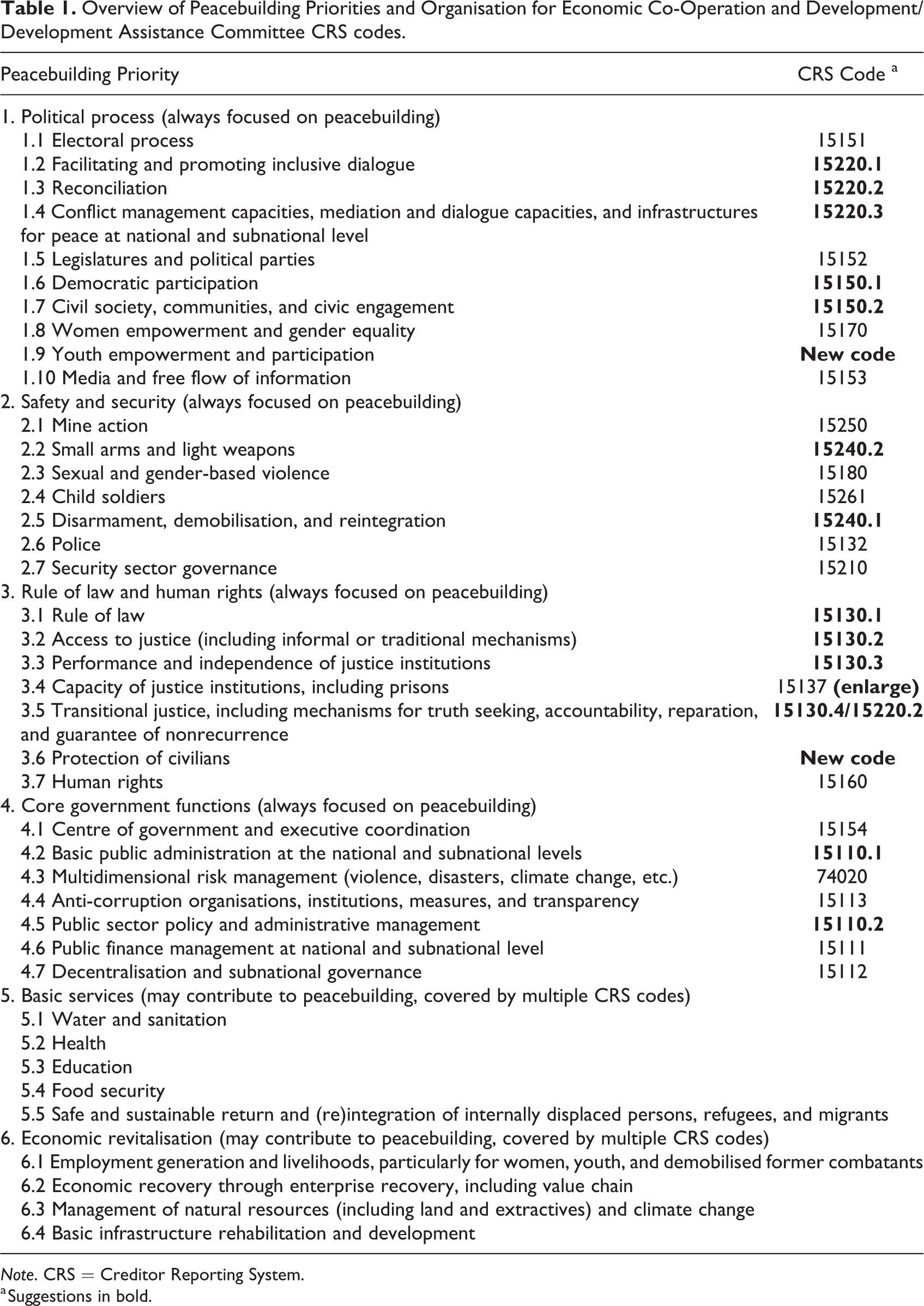
Note. CRS = Creditor Reporting System.
a Suggestions in bold.
Use Case 1: Snapshot of ODA Related to Peacebuilding
The alignment of peacebuilding priorities with existing CRS purpose codes allows for the calculation of ODA flows directed at peacebuilding areas (IEP, 2017). The results, shown in Figure 1, are used in the Secretary-General’s report on peacebuilding and sustaining peace to track financing for peacebuilding (UN, 2018, 2019, 2020). The analysis shows that the share of total ODA allocated to conflict-affected countries and territories 5 has increased in recent years, reaching 31.2% in 2018, from 25.3% in 2014. Yet, the share of ODA in these settings committed to peacebuilding declined to 11.4% in 2018 from 19.7% on 2009.
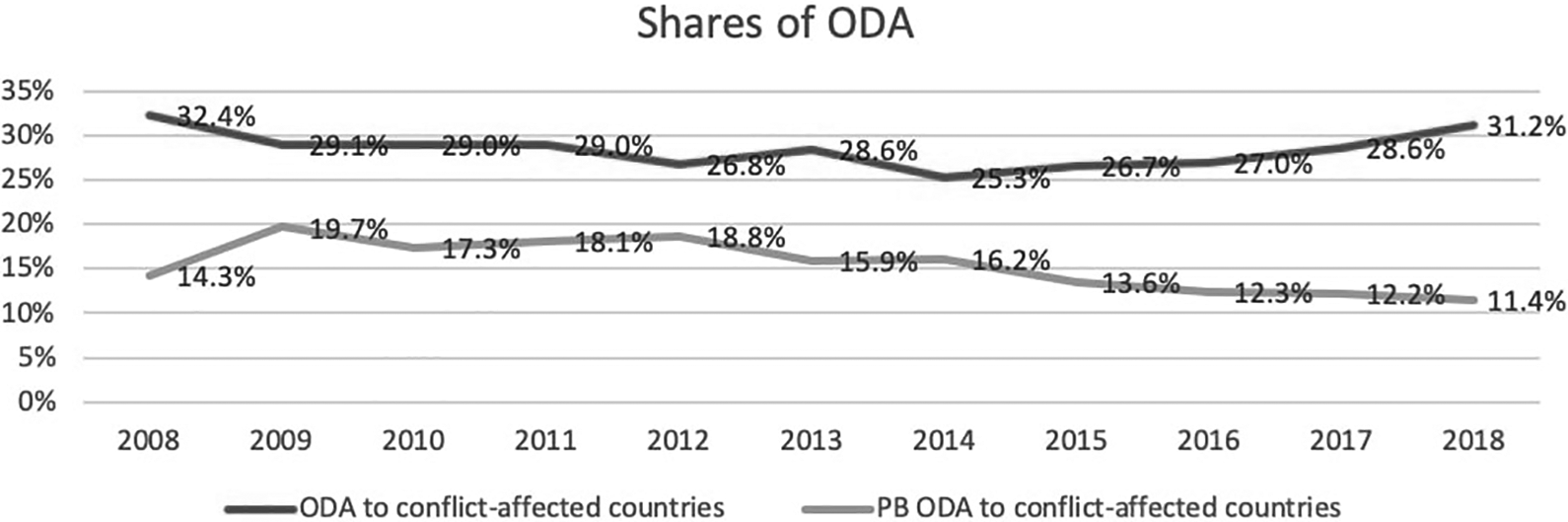
Official development assistance (ODA) for conflict-affected countries, 2008–2018. Source: OECD.Stat Creditor Reporting System. Analysis prepared by UN Department of Political and Peacebuilding Affairs/Peacebuilding Support Office.
Further to the use of the CRS and building on previous papers (IEP, 2017; UN, 2018, 2019), PBSO developed an online data visualisation tool, providing snapshots of ODA disbursements related to peacebuilding (UN PBSO, 2020b) on a per country basis. The ODA snapshots (see Figure 2) provide analysis and insights on the source, purpose, and channel of peacebuilding-related ODA disbursements. The snapshot allows policy makers to dynamically understand ODA flows to inform evidence-based discussions and advocacy around peacebuilding expenditures as well as programmatic and planning purposes. Organizing the visualisation around a relational database empowers users to tailor analysis to their needs—whether programmatic or policy related.
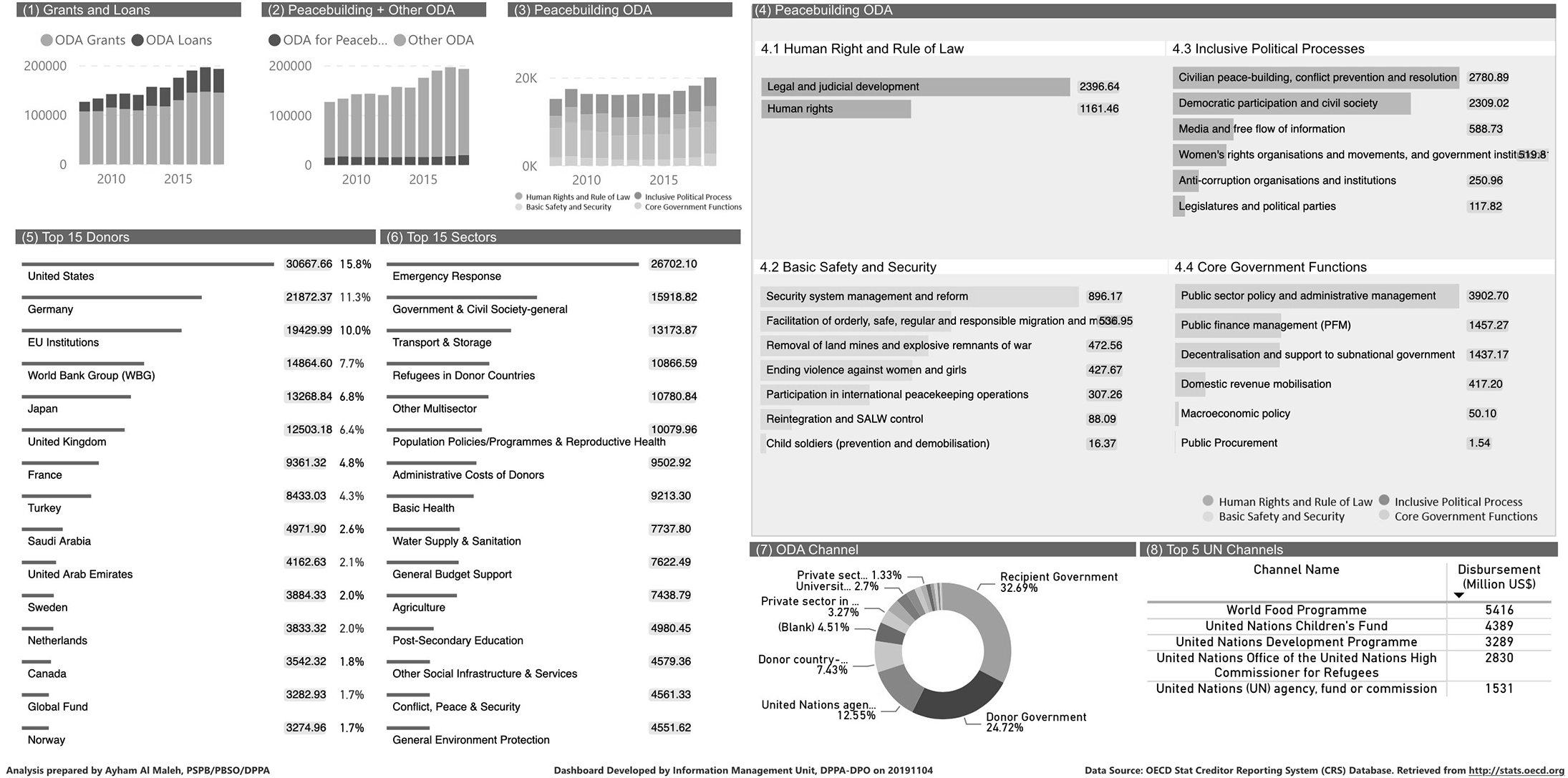
Snapshot of official development assistance (ODA) related to peacebuilding (global). Source: OECD.Stat Creditor Reporting System. Analysis prepared by UN Department of Political and Peacebuilding Affairs (DPPA)/Peacebuilding Support Office and the Information Management Unit of UN DPPA and the Department of Peace Operations.
Use Case 2: Peacebuilding Priorities and the 2030 Agenda for Sustainable Development
Our analysis of the contributions of peacebuilding to SDGs provides an empirical foundation for how sustainable development and peacebuilding should be considered mutually reinforcing and how peacebuilding is an investment in SDGs in conflict-affected countries. Evaluating 384 PBF projects for 2015–2019, with a total budget of more than $666 million, we found that 96% of the expenditures directly contributed towards SDGs. 77% of the PBF budget supports targets under four SDGs: SDG 16 on peace, justice, and inclusive institutions, SDG 10 on inequalities, SDG 5 on gender equality, and SDG 4 on education (see Figure 3). The analysis highlights how the contribution of the PBF to SDGs is complementary to other development efforts (UN PBSO, 2018).
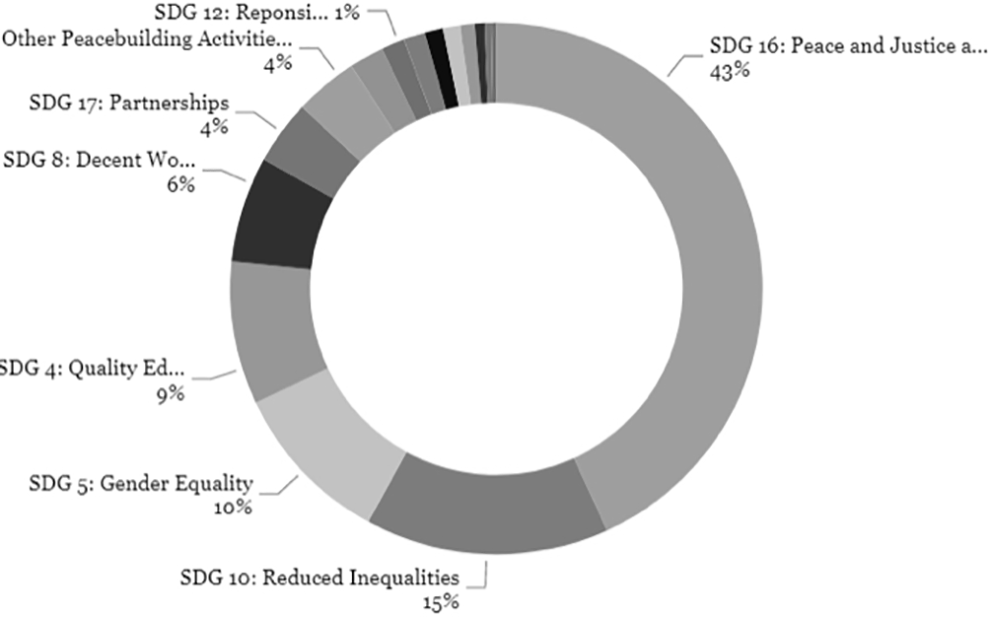
Distribution of PBF expenditures to Sustainable Development Goals (SDGs), 2015–2019. Source: UN PBSO (2020a).
Use Case 3: The Peacebuilding Funding Dashboard
Meeting a commitment of the Secretary-General of increasing coherence among various trust funds (UN, 2018), the peacebuilding funding dashboard seeks to catalogue existing UN headquarters–based financing instruments focused on peacebuilding or related activities. The dashboard visualises peacebuilding expenditures from 2015 to 2019 (see Figure 4). Based on a relational database of all peacebuilding-related projects and a qualitative and quantitative analysis of peacebuilding areas and SDGs, it displays information at the level of funds and recipient entities, countries and regions, projects, and individual outcomes. In addition, it allows to filter for multiple parameters and offers an outcome-based search function.
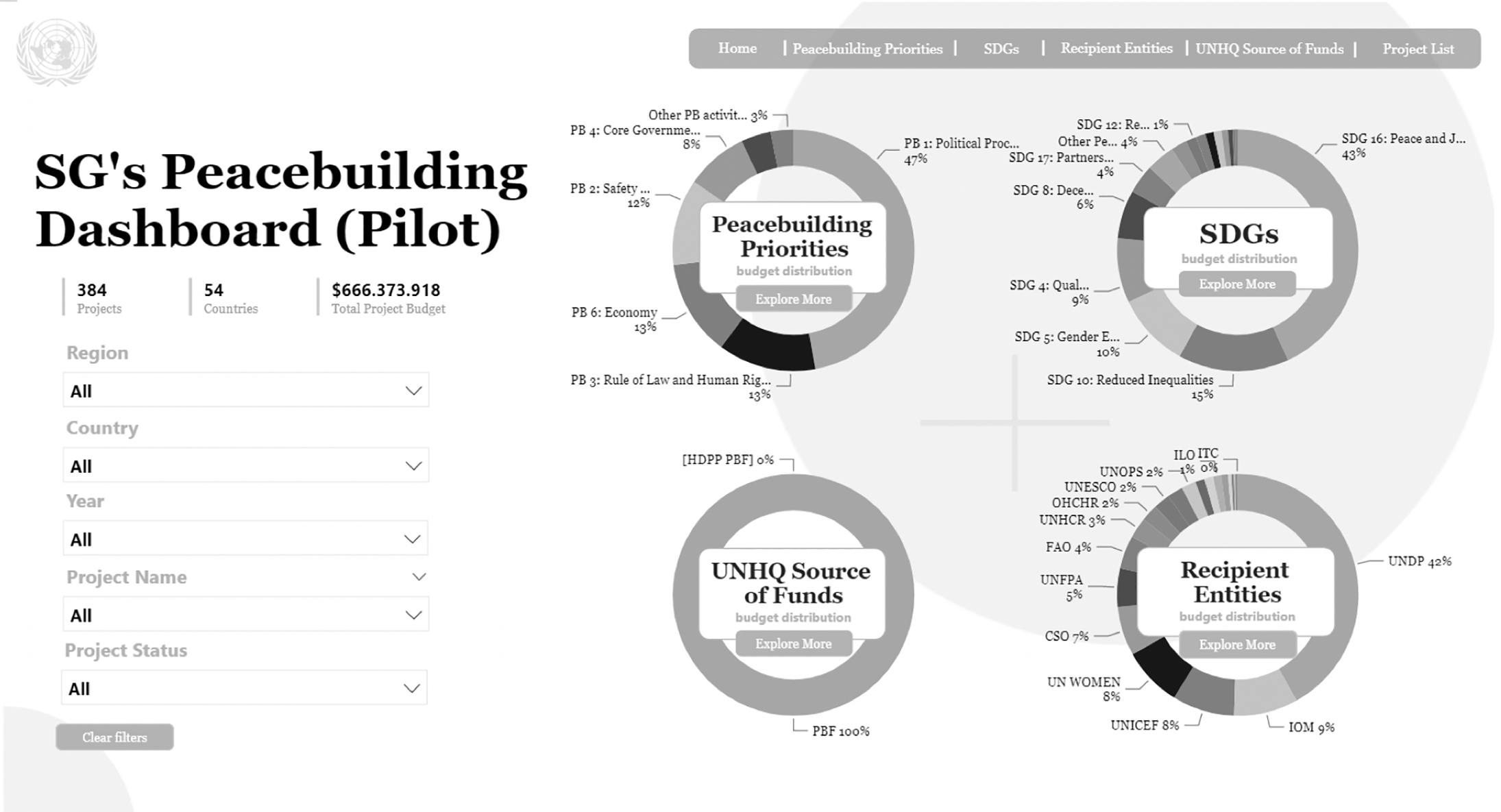
Peacebuilding funding dashboard (pilot). Source: UN (2020b).
In constructing the database, each project outcome was attributed to one or several peacebuilding priorities and SDG targets according to the project’s theory of change and outcome. 6 PBSO analysed 384 projects of the PBF in 54 different countries for the years 2015–2019 and found that 96.9% of the budget was allocated against these recurring priorities (UN PBSO, 2020a)—thus validating the method of categorizing peacebuilding areas. 7
At the time of this briefing, PBSO is in the process of adding other UN trust funds’ information to showcase their contributions towards peacebuilding in the dashboard, including ones on human security, women and peacebuilding, and small arms and light weapons. Once the dashboard provides a comprehensive picture of peacebuilding expenditures of UN headquarter–based funding mechanisms and is used to enable cooperation and inform management decisions, the added value of a classification for recurring peacebuilding priorities may soon become part of the modus operandi of UN peacebuilding efforts.
Conclusion and the Way Forward
PBSO’s categorisation of peacebuilding areas and the analysis and visualisation of peacebuilding expenditures have multiple benefits—depending on the quality of data. It creates some clarity within the UN system on what is included in peacebuilding. It allows to capture the breadth of peacebuilding areas and track developments across time, space, and actors by extracting and analysing qualitative information on peacebuilding in a standardised and reliable way. Nontechnical staff can easily engage with and tailor analysis to their policy and planning needs. By enhancing transparency, it allows for more accurate tracking of the UN’s own efforts and paves the way for greater coordination among different activities, actors, and funding instruments, including through joint assessments, analysis, and common initiatives. Thus, it may contribute to reduced fragmentation and competition over resources by increasing the visibility and comparative advantage of different approaches. Critically, it allows donors, implementing agencies, host governments, and other actors to identify focus areas and gaps in peacebuilding finance and compare existing peacebuilding expenditure to risk analysis and other conflict-prevention priorities. It may also lead to greater collaboration with research partners and provide entry points for synergies between academic institutions and peacebuilding practitioners.
Footnotes
Authors’ Note
The views and interpretations in this article do not necessarily represent the views of DPPA, PBSO, the Secretary-General, the United Nations, or its Member States.
Acknowledgement
The authors would like to thank current and former colleagues who have supported data analysis and presentation, including Hannah Hell and Mengqi Ma.
Declaration of Conflicting Interests
The author(s) declared no potential conflicts of interest with respect to the research, authorship, and/or publication of this article.
Funding
The author(s) received no financial support for the research, authorship, and/or publication of this article.