






Abstract
In humans, the inappropriate occlusal vertical dimension (OVD) causes several orofacial disorders, such as bruxism and pain in the masticatory muscles and temporomandibular joint. However, it is still unclear how strictly the OVD is adjusted. To answer this question, we studied the temporal change of the OVD in bite-raised young guinea pigs. The OVD was raised by fixation of a bite-raising appliance to the lower incisors, and increased by either 3 or 1.5 mm at the first molars. After the space produced between the upper and lower molars was filled within 10 days due to eruption of the molars, the appliance was removed. In the bite-raised animals, the raised OVD was reduced until it attained that observed in the control animals, after which the OVD increased according to cranial growth. These results show that the OVD is developmentally changed and strictly controlled.
INTRODUCTION
In humans, occlusal vertical dimension (OVD) may be set at a position appropriate to the conduct of oral functions: mastication, deglutition, and conversation. When it is increased excessively, patients often complain of headache, bruxism, pressure pain of the masticatory muscles, and pains during jaw movements and around the temporomandibular joint (Christensen, 1970). In animal studies, the excessively raised OVD induced some acute and chronic pathological changes in the oral-facial structures, including mandibular deformation (McNamara, 1973; Rowe and Carlson, 1990) and changes in muscular attachments (McNamara, 1973) and muscle fiber compositions (Paik et al., 1993; Kawasaki et al., 1997; Ohnuki et al., 1999). These findings indicate the importance of keeping an appropriate OVD. It is not clear, however, how strictly the OVD is regulated. To answer this question, we studied the temporal change of the OVD in naïve control and bite-raised guinea pigs, whose teeth erupt continuously (Holmstedt et al., 1977).
MATERIALS & METHODS
All experimental procedures were approved by the Committee on Animal Research of the Osaka University Graduate School of Dentistry. Twenty-eight male Hartley guinea pigs (4-5 post-natal wks old) were used; half of them were used as controls, and in the other animals, the dimension between the upper and lower molars was increased by ∼ 3 mm (3-mm-raised animals, n = 7) or ∼ 1.5 mm (1.5-mm-raised animals, n = 7). A resin bite-raising appliance was fixed to the lower incisors with bonding resin. A flat stainless steel metal plate (4x4 mm2) was attached to the upper surface of the appliance to prevent reduction of its height due to abrasive movements of the incisors. The appliance was removed 10 days after being fixed. All surgical procedures were performed while the animals were under sodium pentobarbital anesthesia (30 mg/kg; i.p.).
Using the soft x-ray system (HA-80R, High Textile Fabrics, Osaka, Japan), and with the animals under ether anesthesia, we took lateral radiographic cephalograms 10 days before and 0, 1, 2, 3, 4, 5, 6, 7, 10, 15, 20, 25, and 30 days after the appliance was removed (Fig. 1). Each animal’s head was fixed to a stereotaxic apparatus when radiographs were taken. The radiographs were digitized and fed into a computer hard disk by means of a scanner (GT-9500, Seiko Epson, Nagano, Japan). They were analyzed by image-processing programs (Photoshop, Adobe Systems, Tokyo, Japan; Corel DRAW, Media Vision, Tokyo, Japan). Nine reference points on the maxilla and the mandible were marked on each radiograph, with reference to the rat’s cephalometric points (Hanada, 1967; Engstrom et al., 1988) (Fig. 1A). Two other points, V and T in Fig. 1A, were determined as the crossing of two lines, as follows: A line was settled perpendicular to the line E-A via U1. The crossings of this line with the line E-A and Gn-Pg were settled as points V and T, respectively. The distance between V and T was taken as the OVD in the present study, while the distances between A and Po and between Mu and Ml were also measured for the analysis of skeletal and dental changes, respectively (Fig. 1A). The errors associated with measurements on the landmarks of the cephalometric radiographs were assessed by double determination on 160 randomly selected films out of a total of 448 radiographs. The standard error of the mean (SEM) was calculated by the formula of Dahlberg’s method (Dahlberg, 1940; Cohen, 1984; Vincenzo and Athanasiou, 1995): SEM2// = ∑d2/2(n-1), where d is the difference between double determinations and n is the number of radiographs—here, 160. The SEM of the points ranged from 0.01 to 0.11 mm (Table), indicating that these errors are negligible considering the dimensional changes in the OVD.
Statistical comparisons were performed by two-way ANOVA and with the HSD method of Tukey’s test. The level of p < 0.05 was taken as significant. All statistical values are presented as mean
RESULTS
The mean body weights of control animals increased continuously throughout the experimental period. Although there was a small weight loss in the 3-mm-raised and 1.5-mm-raised animals for a few days after fixation of the appliance, they gained weight after the appliance was removed and soon caught up with the control animals.
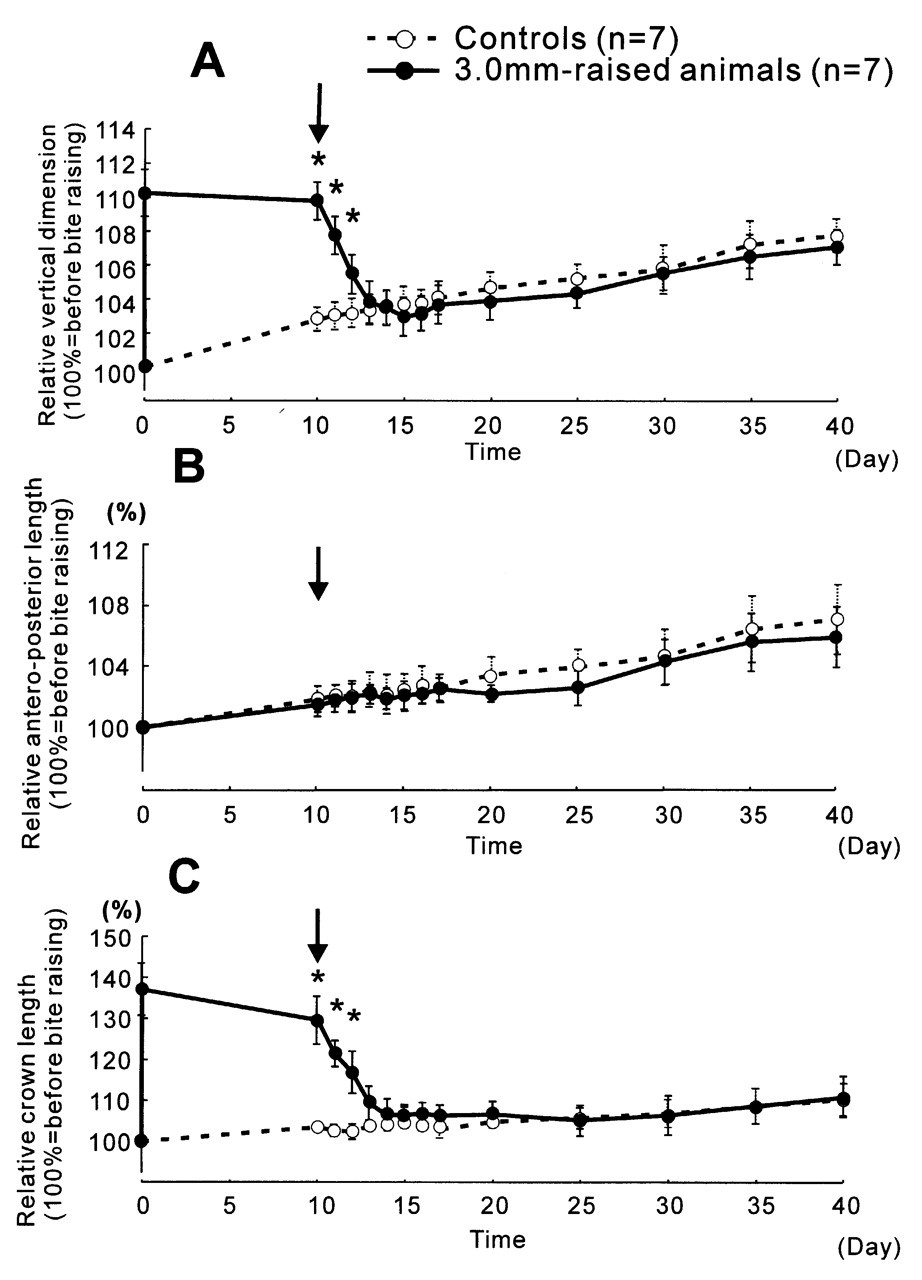
Changes in the OVD of the control and 3-mm-raised animals are shown in Fig. 2A. The increase in the OVD was 2.9
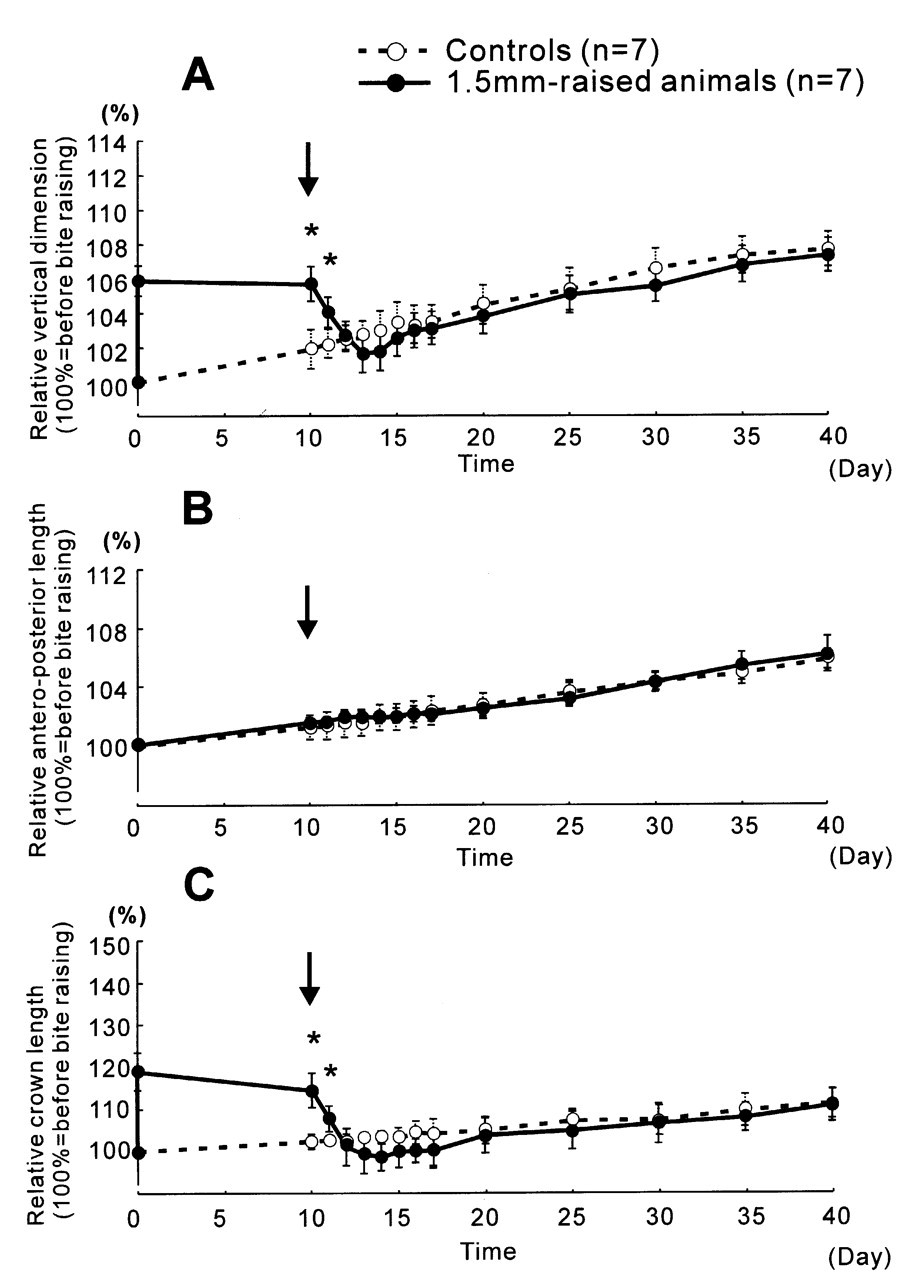
The results obtained from the 1.5-mm-raised animals (Fig. 3) are similar to those observed in the 3-mm-raised animals. The actual increases in the OVD and the crown length for these animals were 1.4
DISCUSSION
The present study, with juvenile guinea pigs, showed that raising the OVD by 3 mm or 1.5 mm caused rapid reduction until it reached the control level after appliance removal. This reduction was attributed to the decrease in the tooth-crown length, not to cranial skeletal change.
The guinea pig is an animal with continuously erupting molar teeth (Holmstedt et al., 1977). Its teeth grew so rapidly that the intermolar space of 3 mm was filled within a week. However, the OVD in the control animals grew gradually under natural conditions. These facts suggest that the guinea pig may continuously adjust the dimension of its growing teeth by attrition, probably dependent on the sensation on the OVD. In the bite-raised animals, the increased force from the stretched jaw-closing muscles might intrude the molar teeth in addition to attrition (Carlson and Schneiderman, 1983).
The present findings also showed that after the raised OVD was reduced to the level in the control animals, the OVD was left to grow naturally. After a month’s growth, the reduced OVD grew to reach almost the same dimension as the raised OVD in the 1.5-mm-raised animals. These findings indicate that even the same OVD is perceived differently, depending on the stage of growth. In other words, the sensation on an optimal OVD changes developmentally. This may be due to the developmental change in the sensory threshold of the comfortable zone of the OVD. However, whether such change occurs in the brain or peripherally in the sensory receptors was not evaluated.
When the OVD is increased excessively for a long period in animals, some pathological changes occur, including mandibular deformation and changes in muscular attachments (McNamara, 1973; Rowe and Carlson, 1990; Paik et al., 1993; Kawasaki et al., 1997; Ohnuki et al., 1999). Although the raised OVD was kept for 10 days in the present study, it was enough to induce changes in the contractile properties of the masticatory muscles, as follows: When the OVD was increased by 5.7 mm for a week, the rate of cross-bridge cycling and the tension cost of the masseter muscle decreased (Paik et al., 1993), and the turnover rate of the actin-myosin interaction in the masseter muscle decreased (Kawasaki et al., 1997). These results may be ascribed to the change in the composition of the myosin light-chain and tropomyosin (Ohnuki et al., 1999). It is probable, therefore, that the contraction properties of the masticatory muscles may have been affected in the present experiments, though the finding of the OVD recovery suggests that the effect of increasing the bite on the contractile properties of the masticatory muscles was actually not significant.
Another notable finding was that an adjustment was made even for the bite-raise of 1.5 mm, suggesting that the range of the optimal OVD is strictly limited. Using removable bite-blocks, Abekura et al. (1996) found that the OVD of existing dentures in edentulous subjects is close to the upper border of the comfortable zone. If this is the case in the guinea pig, even a slight increase in the OVD may be uncomfortable for the animals, even though the experimental animals had no trouble eating.
SEM of Measurements on Landmarks (n = 160)
Landmarks on a cephalometric radiograph and temporal changes in the OVD after fixation of the bite-raising appliance. Temporal changes in the OVD, skeletal, and dental structures in the animals with the raised bite of 3 mm. 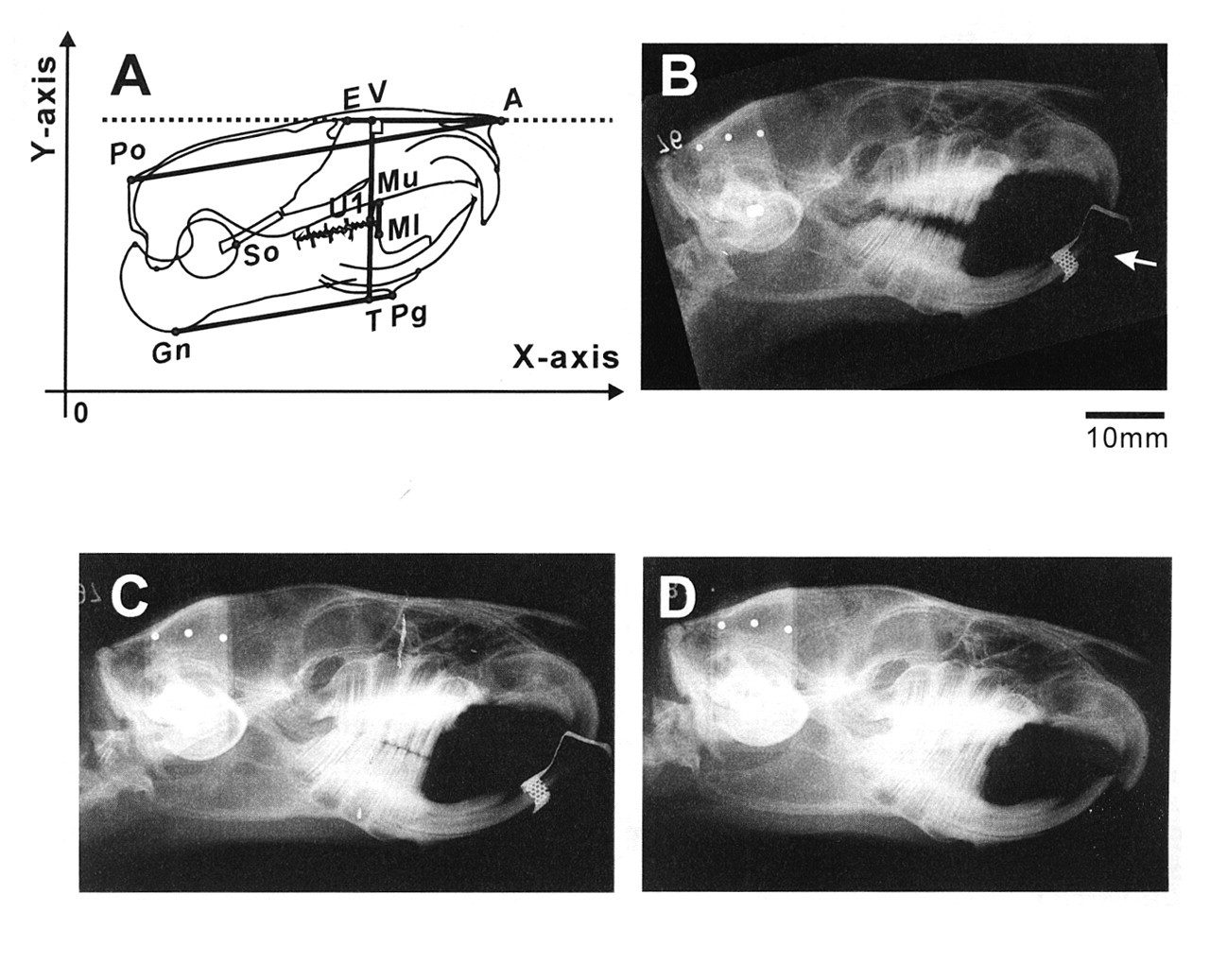
Footnotes
Acknowledgements
This study was supported by grants from the Japan Society for the Promotion of Science (Grant-in-Aid for Science Research, Nos. 11357017 and 13307056).