






Abstract
Introduction
Hospitals today face an immediate need for caregivers and support staff and an even more threatening long-term shortage of qualified workers. There are many reasons for this problem. Examples include an aging U. S. workforce, fewer potential workers behind the “baby boomers” generation, and the perception that careers in healthcare are less attractive to those entering employment.
Although other U. S. industries are suffering a downturn in employment, health professions are trying desperately to fill open positions. It has been reported that overall U. S. employment fell by more than 1 million jobs in 2001, but the healthcare industry added 200,000 jobs during the same time span. Reasons for the long-term demand for qualified health care workers include:
aging of the U. S. population in general, resulting in an increased need for medical services;
aging of the U. S. labor force;
fewer potential workers coming behind the aging “baby boomers” generation;
careers in health care are seen as less attractive to those entering employment;
many in the current hospital workforce are dissatisfied with their work.
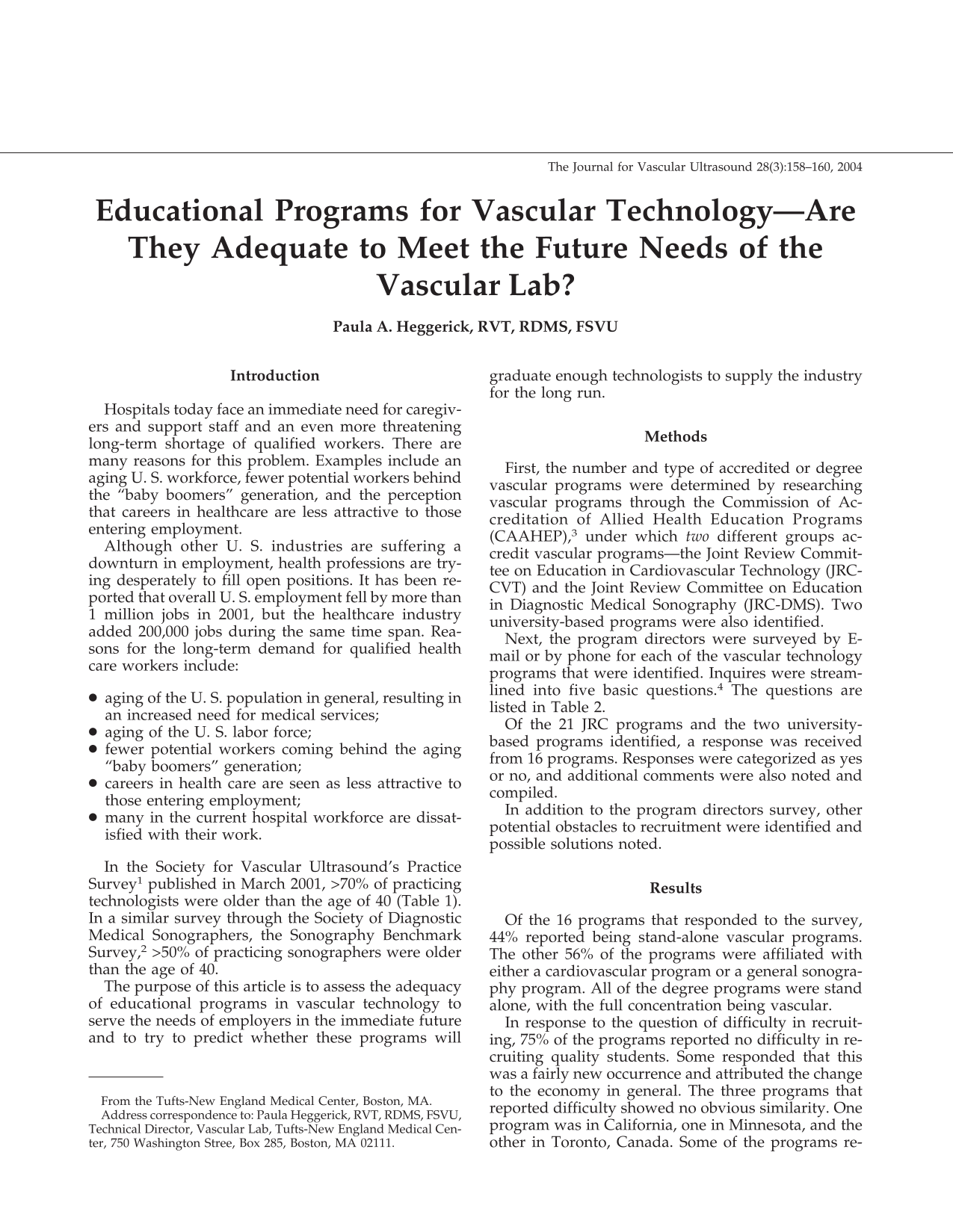
In the Society for Vascular Ultrasound's Practice Survey 1 published in March 2001, >70% of practicing technologists were older than the age of 40 (Table 1). In a similar survey through the Society of Diagnostic Medical Sonographers, the Sonography Benchmark Survey, 2 >50% of practicing sonographers were older than the age of 40.
Program Director's Survey
The purpose of this article is to assess the adequacy of educational programs in vascular technology to serve the needs of employers in the immediate future and to try to predict whether these programs will graduate enough technologists to supply the industry for the long run.
Methods
First, the number and type of accredited or degree vascular programs were determined by researching vascular programs through the Commission of Accreditation of Allied Health Education Programs (CAAHEP), 3 under which two different groups accredit vascular programs—the Joint Review Committee on Education in Cardiovascular Technology (JRC-CVT) and the Joint Review Committee on Education in Diagnostic Medical Sonography (JRC-DMS). Two university-based programs were also identified.
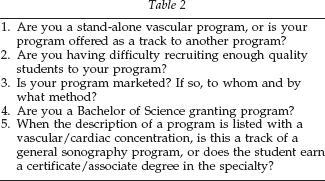
Next, the program directors were surveyed by Email or by phone for each of the vascular technology programs that were identified. Inquires were streamlined into five basic questions. 4 The questions are listed in Table 2.
Of the 21 JRC programs and the two university-based programs identified, a response was received from 16 programs. Responses were categorized as yes or no, and additional comments were also noted and compiled.
In addition to the program directors survey, other potential obstacles to recruitment were identified and possible solutions noted.
Results
Of the 16 programs that responded to the survey, 44% reported being stand-alone vascular programs. The other 56% of the programs were affiliated with either a cardiovascular program or a general sonography program. All of the degree programs were stand alone, with the full concentration being vascular.
In response to the question of difficulty in recruiting, 75% of the programs reported no difficulty in recruiting quality students. Some responded that this was a fairly new occurrence and attributed the change to the economy in general. The three programs that reported difficulty showed no obvious similarity. One program was in California, one in Minnesota, and the other in Toronto, Canada. Some of the programs reported that they were forced to turn students away, with one program director stating that it was due to a “lack of clinical sites.” One program director noted that “last year we had 72 applicants for 16 slots.” Another said, “We have more students than we can accept. Our admission process is very competitive.”
Some marketing was done for 75% of the programs. This varied from something as minimal as the college web site to more aggressive marketing such as mailings to local or national professional society memberships, professional journals, through CAAHEP's web site (all accredited programs are listed), and some only by staff and advisors. One director, who has a Bachelor of Science degree program, states “we've been marketing at the 7 colleges that we are affiliated with for the bachelor's program.” Other methods of marketing included college and health fairs on a local level. At hospitals and schools that recognize sonographer's week, local schools would be a presence at the informational table. One program used both radio and newspaper advertising on a local level. Other ideas included shadowing programs for middle and high school students, high school college fairs, and special events such as Tech Expos. One director wrote, “All DMS faculty members function as ambassadors to the DMS programs and are our most successful marketing tools.”
To the question “Are you a Bachelor of Science granting program,” not surprisingly only 38% said they granted a degree. Most programs granted either a certificate or an associates degree. Interestingly, a comment made was that “when we started granting a Bachelor of Science in DMS, that's when our applicant pool made a huge jump.” One impression is that today's high school students are more inclined to consider a program that offers a degree. For the population of students who are changing careers or are reentering the workforce, an associate degree is more appealing. The certificate programs are generally an extension of a general sonography program.
The last question asked, “When the description of a program is listed with a ‘vascular and cardiac concentration,’ is this just a track of the general sonography program or does the student earn a certificate/associate degree in the specialty?” The responses varied and were very interesting. Some did state that the program was “an extension of the general sonography studies.” Another comment was that they had “no idea what that's about; it sounds bogus, like the general ultrasound programs that include a smattering of echo and/or vascular, give their students the idea that they are ready to do real work.” In one program, the director writes “The student earns an AS degree in ultrasound, and the specialty is not specified. Their ARDMS exams tell that story.” Another program director states, “It could be either. CAAHEP and the JRD-DMS accredit each learning concentration separately. It is up to each individual program if they want to operate them as stand alone programs or combine them.” So, the explanation and interpretation of this question seemed to vary from program to program, with no “set-in-stone” standards.
Discussion
In the United States, there are only 21 accredited Vascular Technology Programs. Under the Commission of Accreditation of Allied Health Education Programs, there are two different groups who accredit vascular programs: the JRC-DMS and the JRC-CVT. Under both commissions, vascular programs are described differently, have different standards, and even when described the same, may have different meanings to different programs, which became apparent through the program directors survey. For a student attempting to research a career in vascular technology, it can become very confusing. In addition, there are various programs such as certificate, associate degree, and Bachelor of Science programs. It does not seem possible that each of these programs would be covering identical material, so the education of the student would vary widely.
In addition to the lack of standardization for vascular education across the country, there is the issue of how a vascular technologist is viewed by the Department of Labor (DOL). Vascular technology continues to be categorized by the DOL under the category of Cardio-Vascular Technician. Diagnostic Medical Sonographers has just recently been identified by the DOL as a separate profession. 5
There are also three agencies that offer a credential for those individuals doing vascular testing. The requirements differ per agency and again are not standardized. The qualifications of the applicant can also vary widely. The agencies are the American Registry for Diagnostic Medical Sonography (ARDMS)-RVT; Cardiovascular Credentialing International (CCI)-RVS; and the American Registry of Radiologic Technologists (ARRT)-RT(VS). This can also be confusing to students who may be researching the career of a vascular technologist.
Only about half of the accredited programs are dedicated to vascular technology exclusively. In many situations, the program is a “track” of a general sonography program. Frequently, the student, who thinks that taking this specialized training would make him or her less marketable versus more in demand, avoids a specialized “track,” such as vascular or cardiac. As a result, few students wish to take the extra time and effort to become a “specialist” and just manage to learn the basics of vascular testing. Will a student who studies vascular technology as a “track” be as well trained as a student graduating from a dedicated program? The answer would be “no.” Should vascular technology be a stand-alone program? In some situations, absolutely “yes.”
Considering the question of an adequate number of programs, this answer can be inferred by the number of job vacancies and length of time it takes an employer to fill a vacancy. In one survey of 25 managers of vascular laboratories in the Chicago area, it took an average of 8 months to fill a position. It some cases, it took up to 3 years. At the time of the survey in the summer of 2000, 40% of vascular laboratories in Chicago had openings. This single survey would suggest that there are not enough qualified applicants to support the existing laboratories.
On the basis of the responses from the program directors regarding the quality of the students applying to their programs, it seems that many are adults, making career changes, and are well educated and highly motivated. Because most programs are adequately filled or turning students away, they are able to choose the best and brightest.
Conclusion
Not only is vascular technology competing with a large number of other allied health professionals for a small number of students, there are also a number of other issues within the ultrasound community itself that may discourage students from entering this profession. It is clear that there are currently not enough programs in this country that can meet the present or the future need for qualified/registered vascular technologists. Different committees under the larger Commission of Accreditation of Allied Health Education Programs accredit the programs that do exist. The standards of these two committees are not the same. The length of the programs varies, as does the curriculum. As a result, students graduating from these accredited programs do not possess the same knowledge of vascular testing. This will affect the ultimate educational outcome, which is to become credentialed.
In addition to these obstacles, there remains the problem of having enough clinical sites for these students. It seems that more students could be accommodated by the existing programs, and possibly by new programs, if there were an adequate number of qualified clinical sites. Accredited laboratories need to be willing to accept and help train our future colleagues if we expect our profession to survive and grow in the future.