






Abstract
Behavioral biotests with larval zebrafish and small aquatic invertebrates are predominantly conducted using digital video recording combined with specialized animal tracking software to extract quantitative locomotor and behavioral endpoints. Such assays commonly rely on commercially available polystyrene multi-well test plates, which, despite their convenience, present several limitations: fixed well geometry, meniscus-induced shadow artifacts at well edges, absence of customization options, and suboptimal optical transmittance for orthogonal sidelight illumination with infrared light. Here, we describe a rapid and low-cost technique for fabricating highly customizable test chambers for behavioral experiments with small aquatic model organisms. The method employs infrared laser cutting of biocompatible poly(methyl methacrylate) thermoplastic followed by thermal bonding under controlled compression in a standard laboratory oven. The speed and low cost of fabrication enable the production of large numbers of test plates with considerable flexibility in chamber geometry, including complex miniaturized maze configurations. As a proof of concept, we demonstrate how test chamber geometry influences both baseline locomotor activity and stimulated sensory-motor responses in larval zebrafish. Relatively little is currently understood about how larval zebrafish—with their tractable and well-characterized nervous systems—perceive and respond to spatial environmental features or how chamber geometry modulates common behavioral responses. The fabrication technique described here provides researchers with a flexible and accessible tool for developing novel behavioral biotests with broad applications across ecology, ecotoxicology, and experimental neurobiology.
The analysis of behavioral phenotypes is increasingly recognized as an essential tool in the discovery of neuroactive compounds, experimental neurobiology, and aquatic ecotoxicology. 1 The use of small model organisms offers considerable advantages for high-throughput phenotypic screening at scale. Among these, zebrafish (Danio rerio) has emerged as a particularly effective platform for rapid chemobehavioral screening and is now widely utilized across many fields of the biosciences. 1 Digital video recording has become the standard approach for acquiring such behavioral datasets, with subsequent analysis performed using specialized software to detect and reconstruct animal locomotor trajectories and extract quantitative behavioral endpoints associated with specific behavioral traits. 2
Behavioral tests with larval zebrafish, as well as diverse invertebrate species, commonly rely on commercially available polystyrene multi-well test plates. Although convenient and cost-effective, these test chambers present several limitations that may constrain the design and outcomes of behavioral experiments. Due to global standardization across imaging platforms, multi-well plates conform to a fixed footprint of approximately 85 × 127 mm, with well geometries that are invariably circular and vary only in diameter and number per plate (ranging from 6 to 96 wells).
The fixed chamber height of standard multi-well plates prevents adjustment of the water column depth without introducing undesirable artifacts, most notably meniscus-induced shadows at the well circumference, within which animals can become occluded from the camera’s field of view and undetectable to tracking software due to insufficient contrast. Furthermore, standard multi-well plates cannot be modified to incorporate features such as inter-chamber channels for choice preference experiments, complex miniaturized mazes, or wells of unconventional geometry. Additionally, the injection-molded construction of these plates results in a significant volume of air-filled interspaces between chambers, producing nonuniform optical transmittance that is particularly problematic for orthogonal sidelight illumination with infrared light, an illumination strategy recently demonstrated to offer substantial advantages for shadow-free behavioral imaging. 3
Given these limitations, there is a significant unmet need for accessible and affordable methods enabling rapid, inexpensive fabrication of custom test chambers for diverse sensory-motor biotests. Commercially available custom fabrication services are limited in scope, lack the flexibility to accommodate diverse analytical requirements, and are frequently cost-prohibitive. To address this gap, we developed a rapid technique for fabricating highly customizable poly(methyl methacrylate) (PMMA) test plates for behavioral experiments. Plates were designed using Shapr3D CAD software (Shapr3D Zrt., Budapest, Hungary) with standard outer dimensions of 85 × 127 mm, ensuring compatibility with virtually all commercial imaging and behavioral analysis platforms. Plates were fabricated from optically transparent, biocompatible PMMA thermoplastic using a 30 W CO2 laser machining system (Universal Laser Systems, Scottsdale, AZ, USA; Fig. 1A). PMMA is widely employed in rapid prototyping and microdevice fabrication owing to its optical transparency, machinability, and suitability for low-cost fabrication workflows. 4
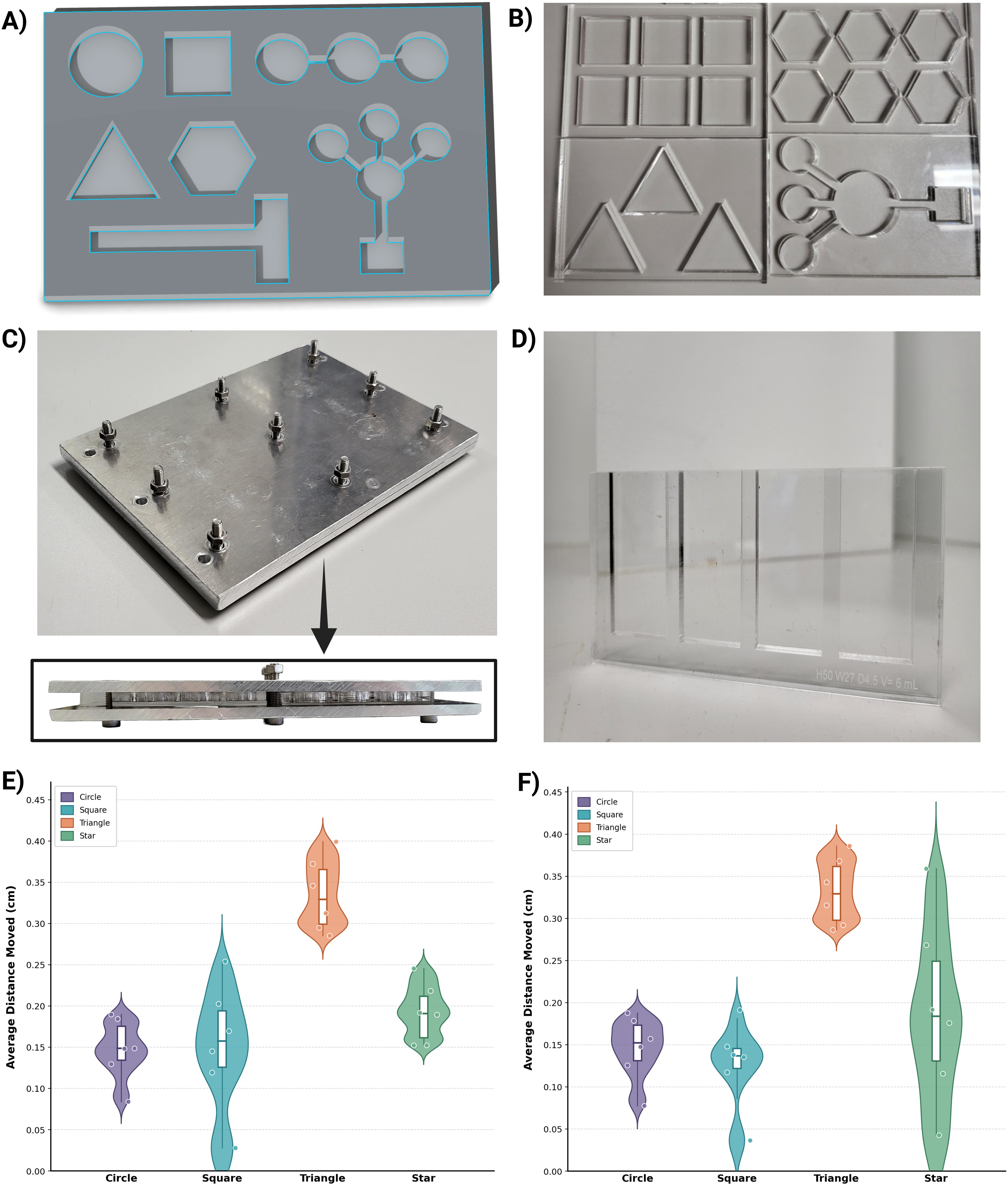
Rapid fabrication of customizable test chambers for behavioral experiments.
While PMMA has previously been employed in the fabrication of microfluidic Lab-on-a-Chip devices for fish embryo toxicity (FET) testing under continuous microperfusion, 4 such systems are optimized for controlled chemical delivery, embryo trapping, and immobilization rather than unconstrained behavioral exploration. The fabrication approach described here represents a deliberate scale transition: from microfluidic chip to mesoscale behavioral test chamber. Here, “mesoscale” refers to open, centimeter-scale behavioral arenas, such as 3.6 cm-diameter 6-well-plate-like chambers fabricated within a standard 85 × 127 mm plate footprint, in contrast to microfluidic FET-style devices in which local channel and embryo-trap features range from approximately 0.3 to 2.5 mm. The approach retains the material advantages of PMMA—optical transparency, biocompatibility, and machinability—while addressing a distinct set of experimental requirements. Unlike microfluidic systems, the chambers described here are designed for animals that move freely across millimeter-to-centimeter spatial scales, require standardized footprint compatibility with commercial behavioral imaging platforms, and benefit from readily customizable geometry without the need for photolithographic or soft-lithography infrastructure. The principal novelty of this approach lies in the combination of: (i) accessibility, using widely available CO2 laser cutting rather than cleanroom fabrication; (ii) scalability, as the compression bonding apparatus enables simultaneous production of multiple plates; (iii) behavioral versatility, as the chamber geometry is unconstrained and can accommodate mazes, choice chambers, and vertical configurations; and (iv) imaging compatibility, through high optical transmittance under orthogonal infrared sidelight illumination, a geometry not available with injection-molded commercial multi-well plates.
The design comprised two principal layers: the main chamber body and a bottom sealing plate. The main body can accommodate any number and geometry of test chambers, including simple arenas and complex miniaturized mazes (Fig. 1B), and can be laser cut from a PMMA sheet of varying thickness to produce chambers of different depths and working volumes. The bottom sealing plate thickness can similarly be varied to suit specific optical or structural requirements. Importantly, the bottom plate can also be laser-engraved with zone markings or fiducial registration features denoting defined regions of interest within each chamber, substantially improving the reproducibility and user-friendliness of automated behavioral analysis in animal tracking software.
To create a watertight seal between layers, PMMA components were bonded using a thermal compression bonding technique performed in a standard laboratory oven, a scaled-up adaptation of a method originally developed for the fabrication of PMMA-based microfluidic Lab-on-a-Chip devices in our laboratory. 4 However, given the considerably larger surface area of these devices relative to microfluidic chips, a dedicated compression apparatus was developed to ensure reproducible and uniform bonding (Fig. 1C). This apparatus comprised two mirror-polished 4 mm thick aluminum plates (230 × 170 mm; Action Aluminium Pty Ltd, Melbourne, VIC, Australia) with a highly planar surface finish to prevent the introduction of surface artifacts into the PMMA during bonding. The plates were drilled to accommodate nine uniformly spaced stainless steel M4 bolts (Fig. 1C), each tightened to 2 Nm using a calibrated mini torque wrench (Model 1492Q005 Q Series; Teng Tools International, Alingsås, Sweden) to ensure uniform distribution of clamping force. Each apparatus accommodated two custom PMMA plate assemblies simultaneously. Bonded assemblies were thermally processed at 105°C for 60 min, followed by a controlled relaxation stage at 50°C for 30 min and a final cooling stage at room temperature for 15 min.
We demonstrated the versatility of this fabrication technique by producing custom test plates that conform to the standard multi-well plate footprint (85 × 127 mm) while offering chambers of diverse custom geometries and high optical transmittance under orthogonal infrared sidelight illumination. One particularly important capability enabled by this fabrication approach is the production of vertical chamber configurations, in which the chamber is oriented such that the water column constitutes the primary spatial axis observed by the imaging system (Fig. 1D). This geometry, which is not currently available from any commercial source, creates an experimental context in which depth, rather than the horizontal plane, functions as the key behavioral dimension. Vertical chambers are especially suited to assays of depth-preference behavior, buoyancy regulation, dive responses, and dorsoventral spatial exploration in aquatic organisms. In larval zebrafish specifically, depth preference has been linked to light–dark preference gradients, predator-avoidance responses, and gravity-sensing vestibular function. In small invertebrates such as Daphnia carinata and Artemia franciscana, vertical phototaxis and geotaxis are ecologically and toxicologically relevant endpoints that are difficult to quantify using conventional horizontal chamber configurations. In the prototype described here, the vertical chamber provided a 60-mm water column height with a 6-mm optical path length. The ability to rapidly prototype vertical chambers of defined dimensions therefore opens new experimental possibilities for three-dimensional spatial behaviur analysis and represents a capability gap that custom PMMA fabrication is uniquely positioned to fill. Importantly, the vertical configuration can be fabricated using the same PMMA laser-cutting and thermal bonding workflow, allowing chamber height, width, and water-column depth to be adjusted according to the organism and behavioral endpoint of interest. Although the present study demonstrates this geometry as a fabrication capability rather than a fully validated behavioral assay, it illustrates how custom PMMA fabrication can extend chamber design beyond the fixed horizontal geometries available in conventional multi-well plate formats.
To demonstrate proof of concept of the fabrication technique, we investigated how test chamber geometry influences both unstimulated and stimulated sensory-motor behaviors in larval zebrafish at 7 days post-fertilization (Fig. 1E, F). Four chamber geometries were examined: circle, square, triangle, and star. For each assay condition, six larvae were tested per chamber geometry, corresponding to n = 6 larvae per group and N = 24 larvae in total. The extent to which arena geometry affects behavioral readouts in larval zebrafish remains incompletely characterized, although assay design is known to influence locomotor outcomes in high-throughput studies.2,5,6 Our results demonstrate that chamber geometry measurably influences larval zebrafish behavior even in the absence of active environmental stimuli.
Specifically, we compared unstimulated locomotor activity across four chamber geometries: circle, square, triangle, and star (Fig. 1E). Chamber geometry significantly affected mean distance moved under unstimulated conditions, one-way analysis of variance (ANOVA), F(3, 20) = 6.438, p = 0.0076. Tukey’s post hoc comparisons revealed that larvae in triangle-shaped chambers moved significantly more than those in circle (p = 0.0067) and square chambers (p = 0.0111), while remaining pairwise comparisons were nonsignificant. Triangle chambers also produced the highest mean locomotor output and the greatest interindividual variability, whereas circle and square chambers yielded lower and more tightly clustered movement values, and star-shaped chambers showed intermediate responses. These findings indicate that chamber geometry influences spontaneous locomotor behavior independently of external stimulation, with acutely angled geometries associated with elevated baseline activity.
We next examined how chamber geometry influenced locomotor output under stimulated conditions using the same group structure (n = 6 larvae per geometry; N = 24 larvae total; Fig. 1F). Chamber geometry again significantly affected mean distance moved, one-way ANOVA, F(3, 20) = 12.26, p = 0.0006. Tukey’s post hoc test confirmed that larvae in triangle-shaped chambers moved significantly more than those in circle (p = 0.0010), square (p = 0.0005), and star chambers (p = 0.0347), with remaining pairwise comparisons nonsignificant. As in the unstimulated condition, triangle chambers produced the highest movement values, circle and square chambers remained comparatively lower, and star chambers showed intermediate responses—indicating that chamber geometry influences not only baseline locomotion but also the magnitude of stimulus-evoked locomotor responses.
Together, these results demonstrate that assay chamber geometry is not behaviorally neutral and shapes both spontaneous and stimulus-associated locomotor output in larval zebrafish. The consistently elevated movement observed in triangle-shaped chambers suggests that acutely angled environments alter how larvae interact with arena boundaries, potentially disrupting smooth wall-following trajectories and promoting more frequent reorientation and burst-like exploratory movements. By contrast, regular geometries such as circular and square chambers appear to provide a more predictable spatial context, associated with lower and less variable locomotion. From a methodological standpoint, this is an important finding, as it demonstrates that test chamber architecture can independently influence behavioral readouts, irrespective of the experimental stimulus. Chamber geometry should therefore be explicitly standardized and reported when designing and interpreting high-throughput behavioral assays.2,5,6
The present study was designed as a proof-of-concept demonstration of rapid PMMA chamber fabrication and its application to behavioral assay design, rather than as a formal side-by-side comparison with commercially manufactured behavioral test chambers. A direct comparison under identical imaging and experimental conditions, while beyond the scope of this study, would strengthen quantitative benchmarking of the system and should be addressed in future work. Such comparisons would allow systematic assessment of optical performance, tracking reliability, fabrication reproducibility, durability, cost, and compatibility with different behavioral imaging platforms. In the present study, the proof-of-concept behavioral data provide an initial demonstration that chamber geometry itself can measurably influence larval zebrafish locomotor readouts, supporting the methodological value of customizable chamber architecture.
The number of animals that can be accommodated per chamber is not a fixed threshold but depends on chamber geometry, floor area, water depth, working volume, species, life stage, and experimental endpoint. In the present proof-of-concept assays, zebrafish larvae were tested individually to minimize animal–animal interactions, body overlap, collision events, social influence, and ambiguity in trajectory reconstruction. This low-density approach is particularly appropriate for larval zebrafish assays where individual locomotor trajectories are the primary endpoint. By contrast, smaller aquatic invertebrates such as Daphnia carinata or Artemia franciscana nauplii may be tested at higher densities, particularly when the endpoint concerns group distribution, collective movement, phototactic redistribution, or population-level occupancy rather than individual identity tracking. For experiments involving multiple animals per chamber, density should be optimized empirically for the species, developmental stage, chamber geometry, water volume, and tracking workflow. Excessive density may alter behavioral endpoints through crowding-induced behavioral interference, social interaction, avoidance behavior, thigmotaxis, oxygen depletion, waste accumulation, or reduced tracking performance due to overlapping animals. We therefore recommend that future applications report the number of animals per chamber, chamber volume, water depth, and, where relevant, animal density per unit surface area or volume. Pilot tracking validation should also be performed to confirm that detection accuracy remains acceptable under the selected density conditions.
The fabrication technique described here offers a flexible, rapid, and low-cost approach to producing custom test chambers of arbitrary geometry for behavioral experiments with small aquatic model organisms. The neural mechanisms underlying spatial habitat sensing and environmental integration across early developmental stages in larval vertebrates remain substantially undercharacterized; custom chamber fabrication provides an accessible experimental tool to begin addressing these questions systematically. More broadly, the ability to rapidly prototype and validate novel chamber geometries will support the development of increasingly sophisticated behavioral biotests across ecology, ecotoxicology, and experimental neurobiology, contributing to a richer mechanistic understanding of sensory-motor function in small aquatic model organisms.
Institutional Review Board Statement
The study was conducted in accordance with the guidelines of the Declaration of Helsinki and was approved by the Monash University Animal Ethics Committee (ERM22161 and ERM17993).
Supplemental Material
sj-docx-1-zbf-10.1177_15458547261468987 — Supplemental material for Rapid Fabrication of Highly Customizable Test Chambers for Behavioral Experiments with Small Aquatic Model Organisms
Supplemental material, sj-docx-1-zbf-10.1177_15458547261468987 for Rapid Fabrication of Highly Customizable Test Chambers for Behavioral Experiments with Small Aquatic Model Organisms by Hy Do, Florian Kreuder, Xuhui Han, Michael Didham, Savita Kumari, Oskar Wasielewski, Jan Kaslin, Paul A. Ramsland, David Mawdsley, and Donald Wlodkowic
Footnotes
Acknowledgments

Disclosure Statement
The authors declare no competing conflicts of interest.
Funding Information
J.K. is supported by National Health and Medical Research Council (GNT1068411) and Australian Research Council (DP210103501, DP240101647) grants, a strategic grant from the Monash University Faculty of Medicine, Nursing and Health Sciences, and Operational Infrastructure Support from the Victorian Government. The Australian Regenerative Medicine Institute is supported by grants from the State Government of Victoria and the Australian Government. D.W. is supported by funding from the Australian Government Department of Defence, Defence Science and Technology Group, and Melbourne Water through the RMIT A3P Aquatic Pollution Prevention Partnership.
References
Supplementary Material
Please find the following supplemental material available below.
For Open Access articles published under a Creative Commons License, all supplemental material carries the same license as the article it is associated with.
For non-Open Access articles published, all supplemental material carries a non-exclusive license, and permission requests for re-use of supplemental material or any part of supplemental material shall be sent directly to the copyright owner as specified in the copyright notice associated with the article.
