






Abstract

Murakami Y, Honaga K, Kono H, et al. New Artificial Intelligence-Integrated Electromyography-Driven Robot Hand for Upper Extremity Rehabilitation of Patients With Stroke: A Randomized, Controlled Trial. Neurorehabilitation and Neural Repair. 2023; 37(5): 298–306. DOI: https://doi.org/10.1177/15459683231166939
We would like to clarify several points in our original article regarding data presentation and statistical analysis. We conducted further statistical analysis and have made revisions to enhance the clarity and transparency of our methodology and findings. Changes have been made to the Abstract, Methods, Results, and Discussion sections of the original article.
Abstract – Methods
We clarified the primary outcome in the first sentence of the Methods section as follows: "The primary outcome was the total score of the Fugl-Meyer Assessment of Upper Extremity motor function (FMA total)."
Abstract – Results
To clearly indicate that most results reflect within-group comparisons, we revised this section as follows: "Within-group differences showed that FMA total was significantly improved at both post-intervention (P = .011) and 4 weeks post-intervention (P = .021) in the active group. The control group did not show significant improvement in FMA total at the post-intervention time point. In the active group, MAL-14 AOU scores improved significantly at the post intervention time point (P = .03). Also in the active group, wrist MAS scores improved significantly at both post-intervention (P = .024) and 4 weeks post-intervention (P = .026). No statistically significant between-group differences were found in the changes in FMA total, MAL-14 AOU, or MAS."
Methods
Outcome Measures, Clinical Assessments section (page 300)
“As a primary outcome, upper extremity motor function was assessed using the total score of the Fugl-Meyer Assessment of Upper Extremity motor score (FMA total).”
Data Analysis (page 301)
"Post hoc analyses were conducted to evaluate both within-group and between-group effects. Paired t-tests were used for normally distributed outcomes, and Wilcoxon signed-rank tests were used for non-normally distributed outcomes, based on the Shapiro–Wilk test. Between-group comparisons of change scores were conducted using the Mann–Whitney U test."
Results
Due to the small sample size and to address concerns about statistical power and transparency:
1) We have added Table 1R, which shows individual participant scores for each outcome in both groups.
2) Table 2R has been updated with a new column showing between-group differences in change scores.
3) Additionally, on page 302, we added:
"We found no significant between-group differences in changes in FMA total from baseline to post or baseline to post-4w, as assessed by Mann–Whitney U tests."
Clinical details of participants.
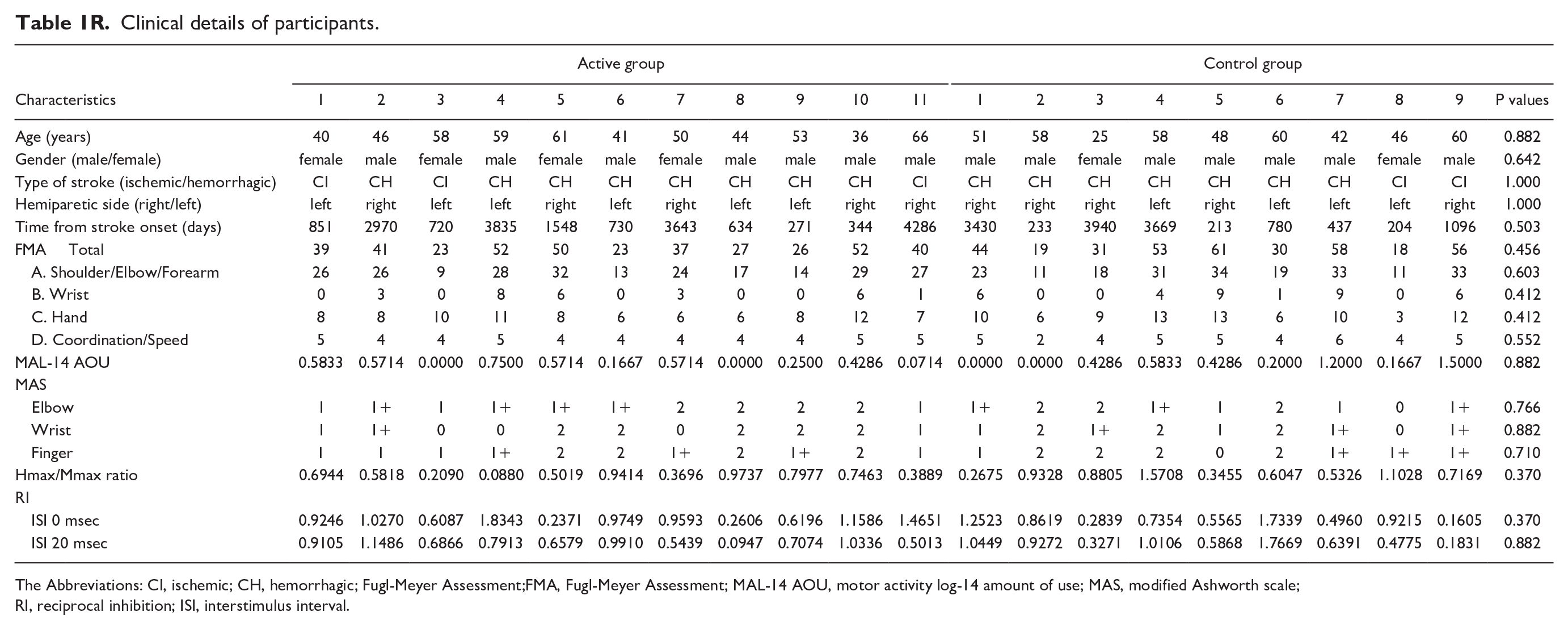
The Abbreviations: CI, ischemic; CH, hemorrhagic; Fugl-Meyer Assessment;FMA, Fugl-Meyer Assessment; MAL-14 AOU, motor activity log-14 amount of use; MAS, modified Ashworth scale; RI, reciprocal inhibition; ISI, interstimulus interval.
Before, Post, and Post-4w scores of outcome measures in the active and control groups.
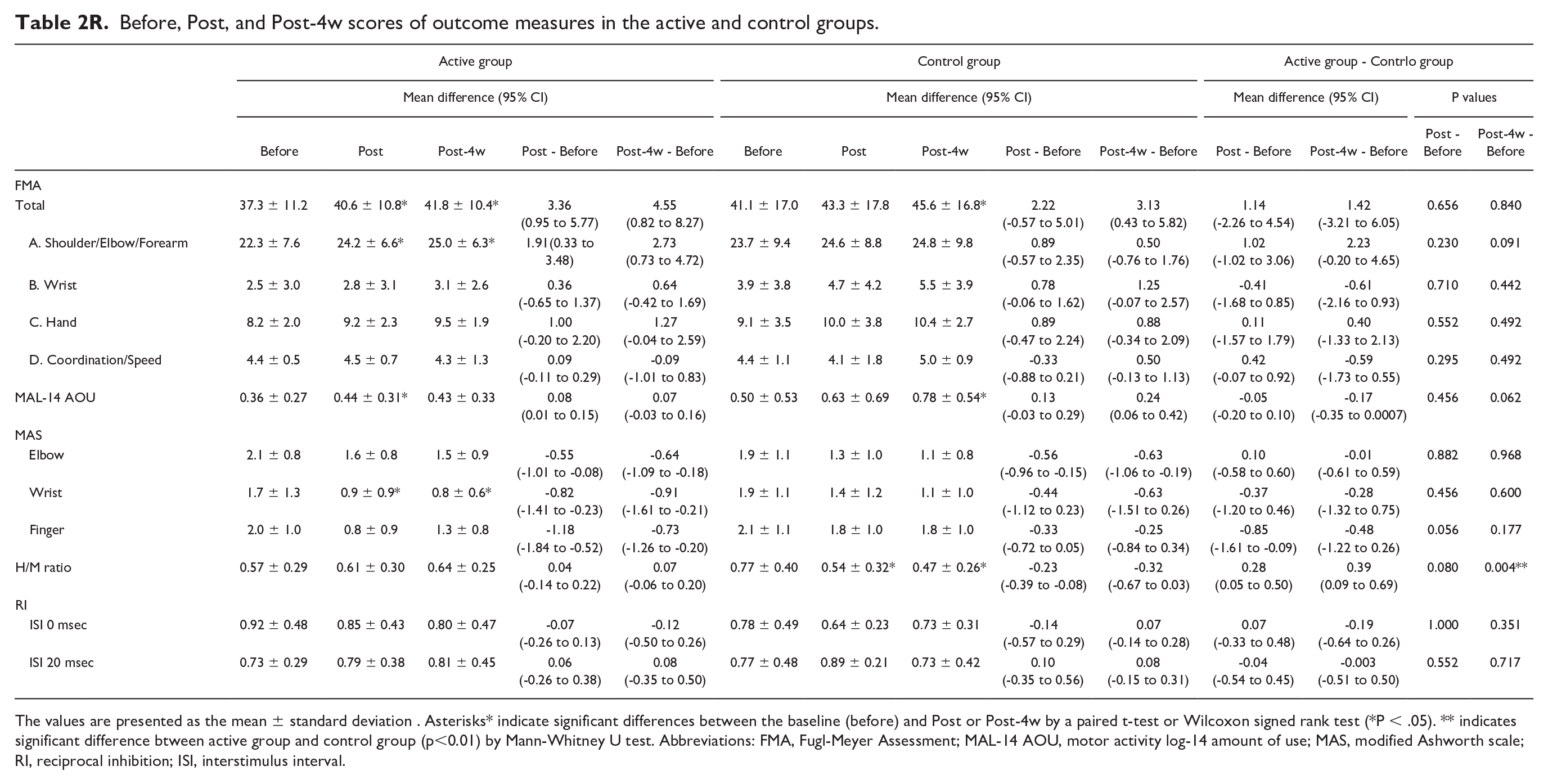
The values are presented as the mean ± standard deviation . Asterisks* indicate significant differences between the baseline (before) and Post or Post-4w by a paired t-test or Wilcoxon signed rank test (*P < .05). ** indicates significant difference btween active group and control group (p<0.01) by Mann-Whitney U test. Abbreviations: FMA, Fugl-Meyer Assessment; MAL-14 AOU, motor activity log-14 amount of use; MAS, modified Ashworth scale; RI, reciprocal inhibition; ISI, interstimulus interval.
Discussion
To better clarify findings regarding interaction effects and the limitations of the study design, the following revisions were made
"Although improvements were observed in the active group, the difference between the active and control groups was not statistically significant. Further research with larger sample sizes is warranted to determine the comparative effectiveness of AI-integrated EMG-driven robotic hand therapy relative to passive robotic interventions."
Additional clarification of ANCOVA interaction terms
“Although a formal interaction between time and group was detected only for the MAL-14 AOU in the ANCOVA analysis, the pattern of within-group improvements in FMA seen in the active group, but not in the control group, suggests a potential time × group interaction that may not have reached statistical significance due to limited sample size and power. These patterns should be interpreted cautiously and explored in future trials.”
Supplementary Material
Tables 1R and 2R, including individual outcome data and between-group differences, are available in the supplementary material to support transparency and reproducibility.
Final Note
We apologize for the lack of clarity in the original reporting of our statistical methods and results. These revisions aim to clarify our approach and improve the interpretability of the findings. The original article has been updated accordingly, and the Journal Editor, alongside consultation with a statistician have confirmed that the overall conclusions still remain.