







Abstract
The appropriate way to define and measure ethical leadership has been a source of conceptual confusion in the leadership literature. Different measures have been developed, but they all have limitations. Some questionnaires are missing key indicators of ethical leadership, or they include behaviors that do not seem directly relevant. In this study, the authors assess the validity of a new questionnaire for measuring essential aspects of ethical leadership independently of other types of leader behavior. The research also examines how ethical leadership is related to leader–member exchange and work unit performance. Although the primary purpose of these analyses is to assess criterion-related validity for the new questionnaire, the results help answer important questions about the benefits of ethical leadership. The authors found that ethical leadership makes a small but significant contribution to the explanation of leader–member exchange and managerial effectiveness.
Introduction
Repeated scandals involving corporate and public sector leaders over the past decade have increased interest in studying ethical leadership (e.g., Brown & Treviño, 2006; Sims & Brinkmann, 2003). Ethical values and behavior are an important aspect of several currently prominent theories in the leadership literature, including servant leadership (e.g., Avolio & Gardner, 2005; Liden, Wayne, Zhao, & Henderson, 2008; Russell & Stone, 2002; Smith, Montagno, & Kuzmenko, 2004), spiritual leadership (Frey, Hannah, Noel, & Walumbwa, 2011; Fry, 2003), and authentic leadership (Gardner, Avolio, Luthans, May, & Walumbwa, 2005). Research on ethical leadership lagged behind other subjects for most of the past half century (Cuilla, 1998), but in the past decade, interest in studying the antecedents, outcomes, and processes of ethical leadership has been growing steadily.
Ethical leadership has been described in a variety of ways. Kanungo (2001) noted that ethical leaders engage in acts and behaviors that benefit others, and at the same time, they refrain from behaviors that can cause any harm to others. Brown, Treviño, and Harrison (2005) suggested that the combination of integrity, ethical standards, and fair treatment of employees are the cornerstones of ethical leadership. Treviño and Brown (2004) proposed that ethical leadership, in its true sense, promotes ethical conduct by practicing as well as managing ethics and holding everyone accountable for it. Khuntia and Suar (2004) suggested that ethical leaders incorporate moral principles in their beliefs, values, and behaviors.
The construct domain of ethical leadership is broad, and several different types of values may be relevant including altruism, compassion, honesty, fairness, and justice. Ethical leadership is also indicated by behaviors reflecting these values. Examples include being very supportive and helpful when someone has a problem, being fair when distributing rewards and benefits, being open and honest when communicating to people, making sacrifices to benefit others, talking about the importance of values, setting clear ethical standards for the work, keeping actions consistent with espoused values, and holding people accountable for ethical and unethical actions.
It is obvious that ethical leadership behavior overlaps to some extent with relations-oriented behavior constructs in the leadership literature, such as providing supportive or considerate leadership, empowering leadership, developing subordinate skills and self-confidence, and representing subordinate interests (Yukl, 2010). A few questionnaires have been developed in recent years to measure aspects of ethical leadership, but they differ in important ways and they all have limitations. The question of how to define and measure ethical leadership has not been resolved, and there is substantial conceptual confusion about this construct. The purpose of our research was to identify the most essential qualities to include in a measure of ethical leadership and to develop a measure that minimizes confounding with other constructs. We begin by reviewing earlier measures of ethical leadership and research on the consequences of ethical leadership. We then describe the development of an improved measure of ethical leadership called the Ethical Leadership Questionnaire (ELQ) and provide validation evidence for it.
Review of Research on Measures of Ethical Leadership
Three instruments designed to directly measure ethical leadership include the Ethical Leadership Survey (Brown et al., 2005), the Perceived Leader Integrity Scale (Craig & Gustafson, 1998), and the Ethical Leadership Work Questionnaire (De Hoogh & Den Hartog, 2008). Two other instruments were designed to measure types of leadership that include some ethical values and behaviors: the Authentic Leadership Questionnaire (Walumbwa, Avolio, Gardner, Wernsing, & Peterson, 2008) and the Servant Leadership Questionnaire (Barbuto & Wheeler, 2006). Each instrument will be described and the limitations identified.
Ethical Leadership Survey
Treviño, Brown, and Hartman (2003) asked people to describe characteristics of ethical leaders, and the descriptors included honesty, fair treatment, communication of ethical values, role modeling of ethical behaviors, rewarding ethical behavior, and holding subordinates accountable for unethical conduct. Their investigation showed that ethical leadership is not only about traits such as integrity and honesty but also about efforts to make subordinates accountable for behaving ethically. Similar results were found in a second study, and based on these findings and earlier literature, Brown et al. (2005) developed a new questionnaire to measure these characteristics called the Ethical Leadership Scale (ELS). The ELS has 10 items, each with a 5-point Likert-type response format (1 = strongly disagree, 5 = strongly agree). The validation research found support for the ELS, and a leader’s overall score on the ELS predicted outcomes such as perceived effectiveness of leaders, employees’ satisfaction with job, employees’ willingness for putting extra effort into their work, and reporting problems. However, one limitation is that some relevant aspects of ethical leadership (e.g., honest communication, behavior consistent with espoused values, fair allocation of assignments and rewards) were not explicitly included. Another limitation is that two of the items (i.e., listens to what employees have to say, has the best interests of employees in mind) were rated more representative of consideration than of ethical leadership. Finally, the test for discriminant validity with honesty was flawed because (unlike the ELS items) honesty was only measured with two negatively worded items; it is likely that positively worded items would load primarily on the ethical leadership factor.
Perceived Leader Integrity Scale
Craig and Gustafson (1998) reviewed literature on ethical aspects of leadership and developed a questionnaire to measure integrity called the Perceived Leader Integrity Scale (PLIS). The objective in selecting items was to measure ethical aspects of behavior that can be observed by a leader’s subordinates. The PLIS has 31 items describing several types of unethical and abusive behavior (e.g., is vindictive, would lie to me, would blame me for his/her mistakes, would steal from the organization, would take credit for my ideas, gives special favors to “pet” employees). The four response choices indicate how accurately the items describe the supervisor (1 = not at all, 2 = somewhat, 3 = very much, 4 = exactly). Favorable validation evidence was obtained in their initial study and a follow-up study (Parry & Proctor-Thompson, 2002). However, one major limitation of the PLIS is the lack of positively worded items. The absence of unethical behavior does not necessarily imply a high level of ethical behavior. Another limitation is the use of vague conditional wording (“would steal”) for many items, which involves an inference about possible behavior rather than wording that describes actual observed behavior. Finally, a questionnaire that only has negatively worded items is less likely to be answered by respondents who worry that it may have adverse consequences for themselves or their bosses.
Ethical Leadership Work Questionnaire
De Hoogh and Den Hartog (2008) conducted a study of Dutch managers using interviews and questionnaires. The researchers developed a preliminary questionnaire to measure ethical leadership, and it was used in a study of ethical leadership in top management teams. The factor analysis found that morality and fairness was distinct from power-sharing behavior and also from negatively worded despotic behaviors (e.g., punitive, vengeful, and tyrannical). Some limitations of the early questionnaire include the use of items with multiple components and vague wording and mixing of positive and negatively worded items in a way that can confuse respondents and complicate data analyses (Rorer, 1965; Schriesheim & Eisenbach, 1995).
Follow-up research (Kalshoven, Den Hartog, & De Hoogh, 2011) was conducted with a revised and extended questionnaire called the Ethical Leadership Work Questionnaire (ELW). The questionnaire had 38 items, and each item had a 7-point anchored Likert-type response format (1 = strongly disagree, 7 = strongly agree). The ELW has seven subscales: fairness, integrity, ethical guidance, people orientation, power sharing, role clarification, and concern for sustainability. The three subscales that seem most relevant for ethical leadership are fairness (e.g., my leader has clear favorites among subordinates), integrity (5 items; e.g., my leader keeps his/her promises), and ethical guidance (e.g., my leader clearly explains integrity-related codes of conduct). The subscales for role clarification, power sharing, and people orientation are similar to leadership behaviors that have been studied for decades. Role clarification is a core task behavior, and the other two subscales are relations behaviors. These behaviors are not inherently ethical, and they can be used for unethical purposes. The subscale for sustainability involves social issues, and it is only one of many social issues that leaders may elect to endorse and support (e.g., democracy, free speech, global health, free enterprise, animal rights, world peace). The definition and measurement of ethical leadership should not be complicated by debates about which social issues deserve to be included in the definition.
Authentic Leadership Questionnaire
The Authentic Leadership Questionnaire was developed to measure the core qualities of authentic leadership (Walumbwa et al., 2008). The Authentic Leadership Questionnaire includes four scales (self-awareness, relational transparency, internalized moral perspective, and balanced processing), each with four items that describe leader behavior and have a frequency response format. Walumbwa et al. (2008) found some overlap between measures of authentic leadership and ethical leadership. Two subscales appear especially relevant for ethical leadership. An internalized moral perspective means that leader behavior is guided by internal moral standards and personal values (e.g., makes decisions that are based on core beliefs, expresses beliefs that are consistent with actions). Relational transparency means that the leader reveals values and beliefs accurately (e.g., says exactly what he/she means, admits mistakes openly). However, the other two components of authentic leadership do not appear to describe essential aspects of ethical leadership. Self- awareness appears similar to trait and skills included in emotional maturity and emotional intelligence. A leader can be self-aware without also being honest, caring, or open with others, and a leader can be caring and open without having a full understanding of unconscious reasons for his or her core beliefs and values. Balanced processing refers to objectivity and pragmatic openness to relevant information and ideas when making decisions. This quality involves personality traits and cognitive skills that can facilitate problem solving but do not necessarily result in decisions that are ethical. Moreover, the flexibility implied by being highly receptive to new information and ideas seems inconsistent with some aspects of ethical leadership, such as communicating values in a strong, persuasive way and insisting on their application in the work involved.
Servant Leadership Questionnaires
Barbuto and Wheeler (2006) developed a questionnaire to measure servant leadership, and it includes five subscales: altruism, organizational stewardship, persuasive mapping, wisdom, and emotional healing. Each scale has four to five items that have a 4-point Likert-type response format (1 = strongly disagree, 2 = somewhat agree, 3 = somewhat disagree, 4 = strongly disagree). The subscale for altruism involves behaviors that reflect altruistic values and is very relevant for ethical leadership (e.g., puts my best interests ahead of his/her own, does everything he/she can to serve me, sacrifices his/her own interests to meet my needs, goes above and beyond the call of duty to meet my needs). Organizational stewardship involves social responsibility values and the belief that the organization should contribute to society (e.g., believes that it needs to play a moral role in society, encourages me to have a community spirit in the workplace, is preparing the organization to make a positive difference in the future). Not all scholars will agree that ethical leadership should be defined so broadly as to include advocacy of corporate social responsibility objectives. The remaining three servant leadership scales do not seem very relevant for ethical leadership. “Persuasive mapping” is an interpersonal skill involving ability to influence people, and “wisdom” involves situational awareness and social intelligence. Both these skills can be used for either ethical or unethical purposes. “Emotional healing” is a very specialized and probably somewhat rare interpersonal skill that could be useful for some leaders but is not essential for ethical leadership.
Overview
In summary, the prior theory and research on ethical leadership has created substantial conceptual confusion about the scope of the ethical leadership construct domain and the appropriate way to measure it. The topics that appear most relevant for a specific focus on ethical leadership include (a) honesty and integrity (including consistency of actions with espoused values), (b) behavior intended to communicate or enforce ethical standards, (c) fairness in decisions and the distribution of rewards (no favoritism or use of rewards to motivate improper behavior), and (d) behavior that shows kindness, compassion, and concern for the needs and feelings of others (rather than attempts to manipulate, abuse, and exploit others for personal gain). Except for some supportive behaviors, these qualities appear distinct from the types of behavior included in most prior research on effective leadership.
Consequences of Ethical Leadership
Previous research has investigated how ethical leadership is related to a variety of outcomes, including deviant behavior (Mayer, Aquino, Greenbaum, & Kuenzi, 2012; Mayer, Kuenzi, Greenbaum, Bardes, & Salvador, 2009), task performance (Walumbwa et al., 2011), voice behavior (Walumbwa & Schaubroeck, 2009), and organizational citizenship behavior (Mayer et al., 2009). Our validation research involves two specific indicators of leadership influence that are well established in the organizational behavior literature, namely, leader–member exchange (LMX) and overall effectiveness.
Leader–Member Exchange
LMX quality depends on the degree of emotional support and exchange of valued resources between a leader and a subordinate (Liden, Sparrowe, & Wayne, 1997; Sparrowe & Liden, 1997). A high-quality exchange relation has beneficial effects for both the leader and the subordinate (Erdogan, Liden, & Kraimer, 2006; Wayne, Shore, Bommer, & Tetrick, 2002). A high-quality exchange relationship is more likely to occur for a leader who is honest, trustworthy, fair, and genuinely concerned about the well-being of followers (Erdogan et al., 2006; Wayne et al., 2002).
Several studies have examined how leaders can influence LMX. In one study, transformational behavior influenced LMX, which then mediated the effects of leader behavior on employee performance (Wang, Law, Hackett, Wang, & Chen, 2005). Another study (Yukl, O’Donnell, & Taber, 2009) examined the effects of several specific behaviors, including relations-oriented and change-oriented components of transformational leadership. LMX was related to four specific relations-oriented behaviors (supporting, recognizing, consulting, delegating) and leading by example (which can be viewed as an indicator of integrity).
Research on the implications of ethical leadership for LMX is still sparse. One recent study found a strong positive association between ethical leadership and LMX (Walumbwa et al., 2011), and LMX partially mediated the effects of ethical leadership on ratings of subordinate performance by the leader. Another study by Mahsud, Yukl, and Prussia (2010) found that a six-item measure of ethical leadership had both direct and indirect effects on LMX, and the indirect effects were partially mediated by relations-oriented behavior.
Managerial Effectiveness
Leadership effectiveness is a multidimensional construct, but an important aspect is the manager’s influence on work unit performance. Ethical leadership that increases follower loyalty and trust may result in more follower effort, and one survey study found a relationship between ethical leadership and employee effort (Piccolo, Greenbaum, Den Hartog, & Folger, 2010). However, there are several reasons why an improvement in unit performance may not occur. Member motivation is not the only determinant of work unit performance, and leaders can influence the determinants in several ways (Yukl, 2009). Three broad categories of leadership behavior relevant for influencing performance include task-oriented behaviors (e.g., clear roles, challenging goals, coordination, efficient use of resources), relations-oriented behaviors (e.g., empowering, coaching, praise and recognition), and change-oriented behaviors (strategy formation, enhancing collective learning). The relevance of specific aspects of these behavior metacategories depends on the situation. The change-oriented behaviors are usually more important for executives, whereas the task-oriented behaviors are usually more important for lower level leaders. Several studies (see Judge & Piccolo, 2004) found positive association between composite scores of transformational leadership and measures of effectiveness, and the composite scores usually include a mix of relations-oriented and change-oriented behaviors. As yet no study has examined the extent to which ethical leadership can enhance work unit performance independently of relevant leadership behaviors.
A leader’s influence on work unit performance also depends on how he or she balances competing objectives (Quinn, 1988; Yukl, 2010). In some situations ethical leadership may have negative effects on work unit performance, and sometimes unethical leadership has positive effects, if only for a limited time. For example, some decisions made to reduce costs and increase profits may not be viewed as ethical leadership by employees. In recent years, many leaders of companies and public sector organizations have been trying to cut costs by reducing employee rights and benefits or by outsourcing many jobs. Sometimes the process involves a lack of honest communication, failure to honor commitments, and unfair treatment for different groups of employees. Other leaders try to improve unit performance with practices that are clearly unethical. Examples from past scandals include the following: selling products known to be defective, charging customers for unnecessary auto repairs or parts not actually provided, inflating reports of income from agreements for future delivery of services, denying a weakness that make a product dangerous, and falsifying information on applications for loans or mortgages. If ethical leaders (“whistle-blowers”) dare to challenge these practices, they are likely to be punished or dismissed by the organization. The influence of unethical practices on unit performance depends in part on the time frame used to assess effects. Unethical practices may boost performance indicators in the short term but are likely to have negative effects that will only become apparent over a longer period of time. All these complexities make it difficult to determine how ethical or unethical leadership will influence unit performance.
Empirical studies on the consequences of ethical and unethical leadership for work groups or organizations are still limited. Several studies have found a positive linkage between ethical leadership and perceived leader effectiveness (Brown et al., 2005; De Hoogh & Den Hartog, 1998; Kalshoven et al., 2011). Most studies only examined relationships for a composite measure of ethical leadership rather than assessing how each ethical component is independently related to the criterion variables. However, Kalshoven et al. (2011) reported results for component scales. In the multiple regression analysis, leader ratings of subordinate performance were predicted by only two of the seven ELW subscales, namely, fairness and power sharing. As noted earlier, fairness is a relevant component of ethical leadership, but power sharing is a leadership behavior that has been studied for more than half a century and is not necessarily ethical (it can be used in a very manipulative way). Subordinate ratings of leader effectiveness were predicted by two essential aspects of ethical leadership (integrity and ethical guidance) and by two leader behaviors (role clarification and people orientation) that are not necessarily ethical. Role clarification is a task-oriented behavior, and people orientation is a relations-oriented behavior similar to consideration.
Summary
No previous study has investigated how ethical leadership is related to LMX and overall leader effectiveness while simultaneously controlling for a comprehensive measure of task, relations, and change behaviors. In survey studies, it is important to include other relevant behaviors and identify their separate and joint effects on unit performance.
Research Objectives
The primary objective of the current study was to assess the validity of a new questionnaire for measuring ethical leadership. Discriminant validity is demonstrated when subordinates can rate the ethical leadership of their immediate boss independently from their ratings of how much the boss uses leadership behaviors that do not directly involve ethical issues. Evidence of criterion-related validity is provided by showing that ethical leadership can explain additional variance in indicators of the leader’s influence on the quality of relationships with subordinates and on unit performance. There are credible explanations and some prior evidence to support the proposition that an ethical leader will elicit more trust and have more favorable exchange relationships with subordinates. However, the implications of ethical leadership for work unit performance are much less certain. Examining these relationships is only an exploratory aspect of the research, and the study was not designed to formally test any specific hypotheses about them.
Method
Sample and Data Collection Procedures
The sample for this study were 192 graduate students, 147 of whom were enrolled in the MBA program of a private university in the northwestern part of the United States and 45 respondents were enrolled in the Master of Public Administration program of a large public university in the Midwestern part of the United States. The students had full-time jobs during the day, and they rated their immediate supervisor. Almost half of the respondents were between 25 and 30 years old, and the average amount of time respondents had worked for their current organization was 2 to 4 years. The average work experience ranged from 7 to 10 years. The gender composition of the respondent sample was 49% males, and 44% of the supervisors rated by respondents were females. More than half of the respondents (55%) held professional/technical jobs, 26% held first-level management positions (team leader, supervisor, and section head), 14% held middle-management positions, and only 3% were upper level executives. The respondents represented diverse organizations; 51% of them worked for medium to large corporations, 32% worked for government or nonprofit organizations, and 14% worked for small businesses. The organizations were from a large variety of industries (e.g., aerospace, technology, pharmaceutical, media, consulting, retail, software, telecommunications, banking, government, and nonprofit). This student sample is unique in the sense that they attended only one or two classes per week and kept their full-time job as prime responsibility. Being entry- to mid-level managers their education was mostly funded by their employers.
Data were collected in two time periods to reduce biases that typically manifest when same source data are used to assess both the predictor and criteria measures (Podsakoff, MacKenzie, Lee, & Podsakoff, 2003). In the first wave of data collection, respondents completed the ELQ and a behavior description questionnaire. Two weeks after the first wave of data collection, respondents completed another questionnaire about the quality of their exchange relation with their supervisors as well as the overall managerial effectiveness of their boss and unit performance.
Measures
The ELQ was measured with 15 items, and each item has a 6-point Likert-style format (the ELQ is shown in the appendix). The items describe several different aspects of ethical leadership, including honesty, integrity, fairness, altruism, consistency of behaviors with espoused values, communication of ethical values, and providing ethical guidance. To maintain some continuity with the earlier research, whenever possible we tried to adapt items from earlier scales on ethical leadership, including the ELS (Brown et al., 2005), the PLIS (Craig & Gustafson, 1998), and the morality and fairness scale developed by De Hoogh et al. (2008). However, we did not include any items that appear to be confounded with task and relations-oriented behaviors (e.g., clarifying roles and responsibilities, empowering and developing subordinates) or with items in the LMX-7 scale (e.g., trust the leader to defend your interests).
Leader task, relations, and change-oriented behaviors were measured with 33 items from the Managerial Practices Survey (MPS) developed by Yukl and colleagues (Kim & Yukl, 1995; Yukl, Gordon, & Taber, 2002). All items have the same 5-point response format with an anchor for each choice indicating how much the behavior described by the item is used by the focal manager (1 = Not at all, 5 = To a very great extent) and with a “Don’t Know or Not Applicable” option. Relations-oriented behaviors (supporting, recognizing, developing, consulting, and delegating) were measured with 13 MPS items (α = .95). Task-oriented behaviors (clarifying roles, short-term planning, and monitoring operations) were measured with 10 MPS items (α =.86). Change-oriented behaviors (envisioning change and encouraging innovative thinking) were measured with 10 MPS items (α = .92).
LMX was measured with the LMX-7 instrument developed by Scandura and Graen (1984; see also Graen & Uhl-Bien, 1995). Each item had five anchored response choices with unique anchors that are appropriate for the item. The wording for the response choices in a few items was slightly changed to reduce ambiguity. Sample items included (a) how well does your boss understand and appreciate your talents and potential, (b) how much confidence does your boss have in your ability to do the work, (c) how willing are you to do extra work to help your boss deal with a difficult problem, and (d) how would you describe the relationship between you and your boss? Internal reliability consistency for this scale was high (α = .91).
Overall leader effectiveness was measured with four items (α =.74). The first two items asked subordinates to rate the overall effectiveness of their manager in carrying out his or her job responsibilities (1 = The least effective manager I have known and 9 = The most effective manager I have known) and in terms of his or her overall effectiveness as a manager (1 = Ineffective and 9 = Very effective). Each item had a 9-point anchored scale (1 = The least effective manager and 9 = The most effective manager). The other two items asked subordinates to assess their manager’s work unit performance relative to past performance (1 = Increased a lot and 7 = Decreased a lot) and comparing it with similar work units (1 = Much better and 7 = Much worse). These two items were recoded such that higher values reflected greater effectiveness. To equalize the influence of items with different score ranges and variances, the scores for each item were standardized before computing a composite score on overall leader effectiveness.
Results
Factor Analyses
Exploratory and confirmatory factor analyses were used to assess discriminant validity for the ELQ. The exploratory factor analysis using principle components and oblique rotation resulted in four distinct factors corresponding to task, relations, and change behaviors and ethical leadership. The factor loadings for the ELQ are shown in Table 1 and demonstrate a clear distinction among the items. Only three ELQ items had cross-loadings on the MPS relations- oriented factor that exceeded .30, and none of those loadings reached .40.
Factor Loadings for ELQ Items
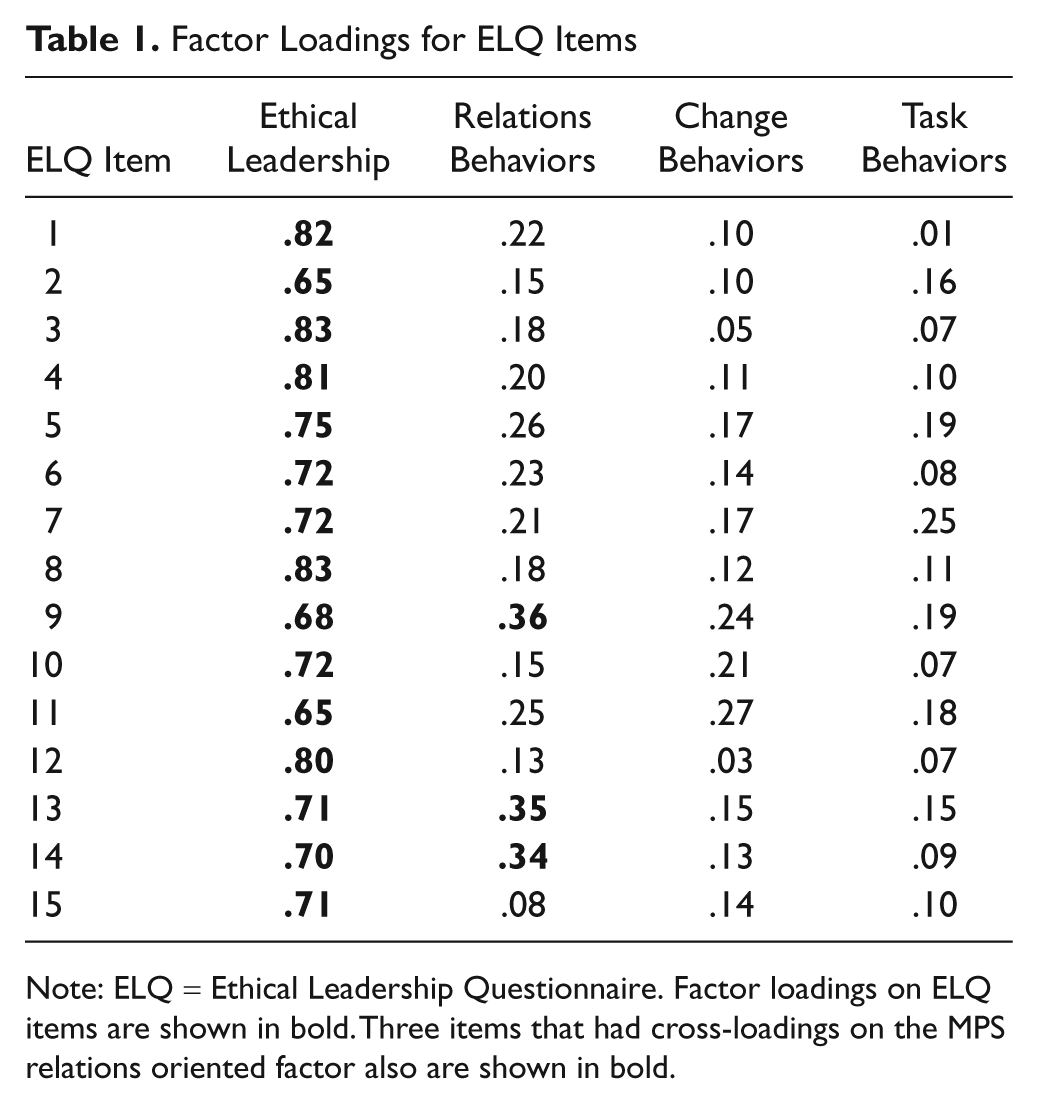
Note: ELQ = Ethical Leadership Questionnaire. Factor loadings on ELQ items are shown in bold. Three items that had cross-loadings on the MPS relations oriented factor also are shown in bold.
Confirmatory factor analysis for the proposed four-factor model (see Table 2, Model 1) showed adequate fit given the number of indicators per construct. We then compared the four-factor model with three possible alternative models: (a) a model with a single underlying construct suggesting common method variance (Podsakoff et al. 2003), (b) a two-factor model with MPS items in one factor and ethical leadership items in the other, and (c) a three-factor model with ethical leadership loading on relations behavior and separate factors for task and change behaviors. The fit indices for the proposed four-factor model (see Table 2) were better than for any of the rival models.
Fit Indices for Alternative Measurement Models
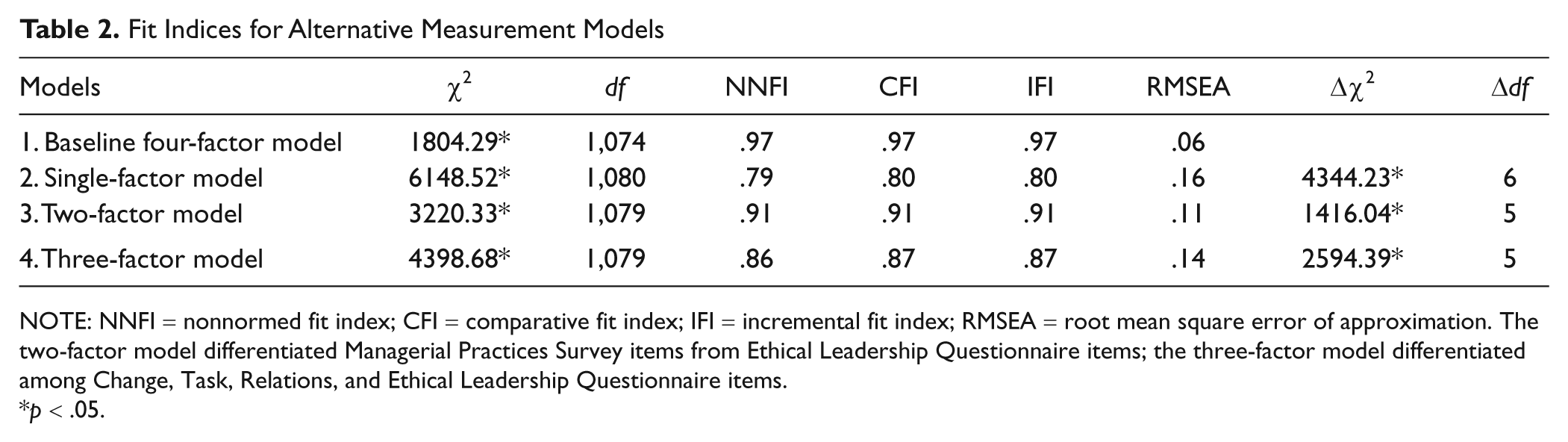
NOTE: NNFI = nonnormed fit index; CFI = comparative fit index; IFI = incremental fit index; RMSEA = root mean square error of approximation. The two-factor model differentiated Managerial Practices Survey items from Ethical Leadership Questionnaire items; the three-factor model differentiated among Change, Task, Relations, and Ethical Leadership Questionnaire items.
p < .05.
Correlations and Regression Analyses
Table 3 presents means, standard deviations, correlations, and internal reliability estimates (i.e., Cronbach’s alpha) for all six measures included in the study. Although composite scores for all measures were slightly negatively skewed, the differences between the average scores and the scale midpoints were not very large. Furthermore, the standard deviations for all of the measures were relatively high, indicating adequate variability in the data sufficient for further analysis.
Means, Standard Deviations, and Correlation Coefficients of Measures
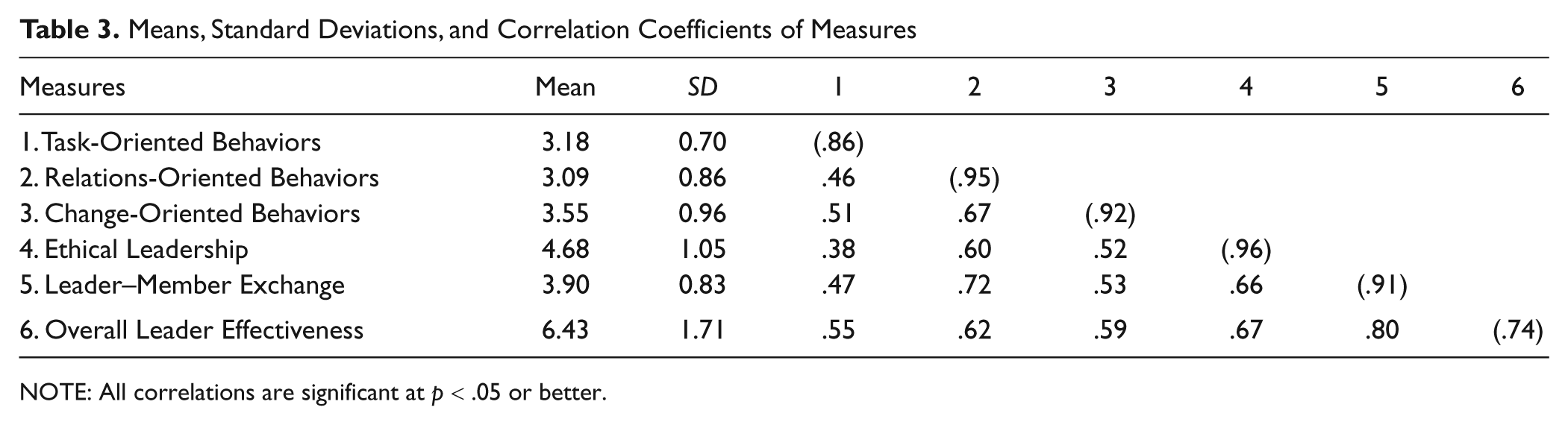
NOTE: All correlations are significant at p < .05 or better.
Two hierarchical multiple regression analyses were conducted to assess the effect of ethical leadership on LMX and overall leader effectiveness. Table 4 summarizes results of the regression analysis for LMX. In the first step, relations and task-oriented leader behaviors were found to be significant predictors of LMX, and they accounted for 52% of the criterion variance (F = 60.63, p < .05). In the second step, after controlling for the effects of the three leader behaviors, ethical leadership was a significant predictor of LMX (β = .38, p < .05), and it explained an additional 7% criterion variance (F = 61.40, p < .05).
Hierarchical Regression Analysis on Leader–Member Exchange
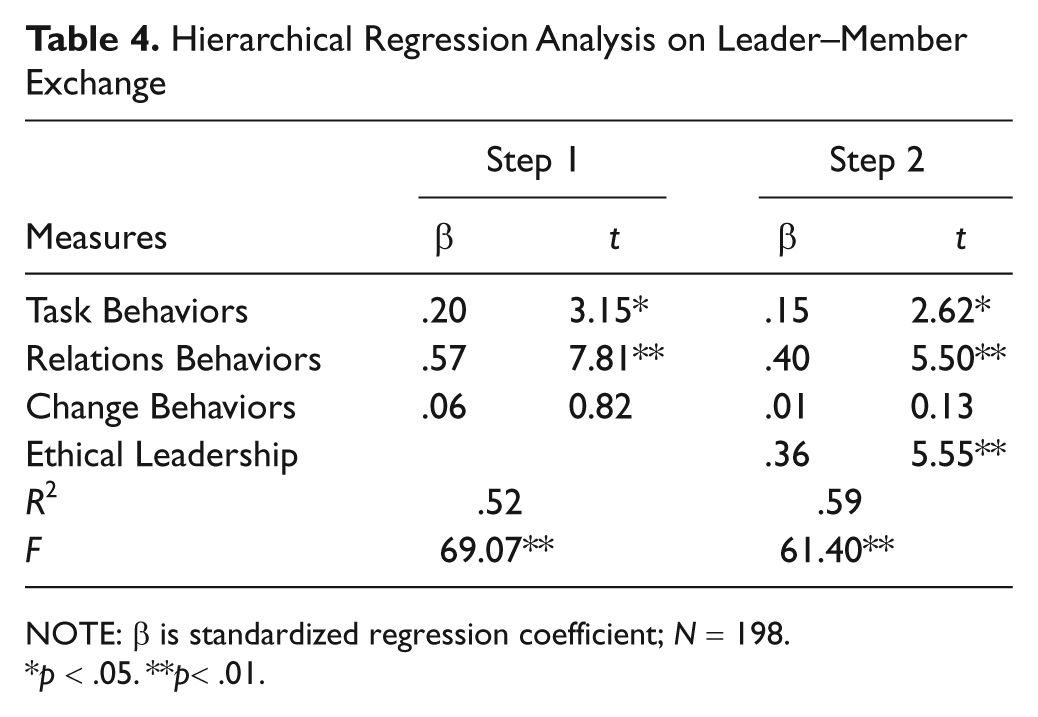
NOTE: β is standardized regression coefficient; N = 198.
p < .05. **p< .01.
Table 5 summarizes results of the hierarchical regression analysis for overall leader effectiveness. In the first step of the regression analysis, the three leader behaviors together accounted for 46% variance in leader effectiveness. In the second step, after controlling for the effects of the three types of leader behaviors, ethical leadership was found to be a significant predictor of leader effectiveness (β = .39, p < .05), and it explained an additional 10% variance in leader effectiveness (F = 41.55, p<.05). The regression analyses provided evidence for the criterion-related validity of the ELQ.
Hierarchical Regression Analysis on Overall Leader Effectiveness
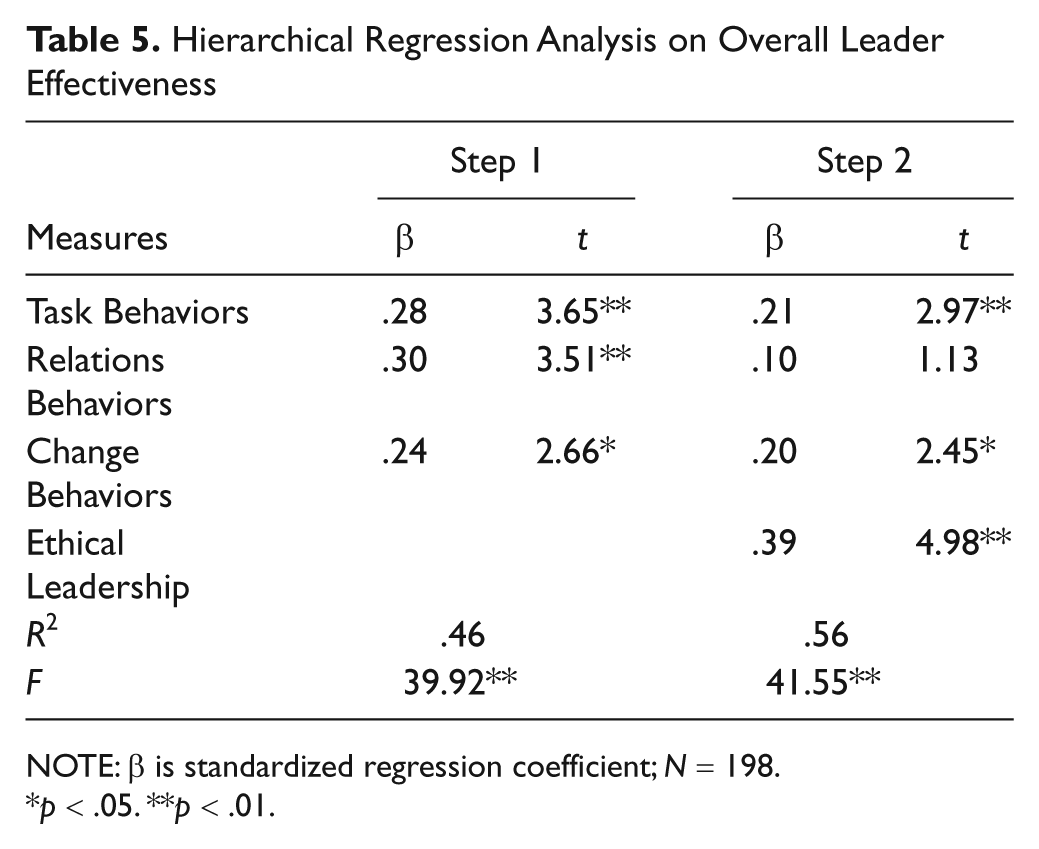
NOTE: β is standardized regression coefficient; N = 198.
p < .05. **p < .01.
Discussion
Researchers are paying increasing attention to the importance of ethical leadership in both private and public sector organizations. However, progress in this research is impeded by problems in the questionnaires used to measure ethical leadership. One limitation of the earlier measures is overlap with other leadership constructs such as supportive and empowering leadership, which are known to be related to LMX. When a correlation is found between a confounded measure of ethical leadership and LMX, it is difficult to interpret the results. Another limitation in earlier studies was the use of an ethical leadership measure that did not include some relevant aspects of ethical leadership. The relationship between ethical leadership and outcomes such as LMX and unit performance may be underestimated by an incomplete measure of ethical leadership.
Based on previous theory and research, we developed and assessed a new ELQ designed to provide a more useful and valid measure. The ELQ is comprehensive with regard to the most important elements of ethical leadership, including integrity, honesty, fairness, communication of ethical values, consistency of behavior with espoused values, ethical guidance, and altruism. At the same time, with only 15 items and one composite score, the ELQ is parsimonious and easy to administer.
Our study showed that the ELQ has high reliability as well as discriminant and criterion-related validity. The factor analyses confirmed that the items in the ELQ are distinct from task- and change-oriented leader behaviors, and there is minimal overlap with relations-oriented leader behaviors such as supportive and empowering leadership.
As in a few earlier studies that used different measures, we found that ethical leadership is significantly related to LMX and leader effectiveness. Unlike the earlier studies, our study minimized any confounding between ethical leadership and other relevant predictors such as supportive leadership. After controlling for the effects of task-oriented, relations-oriented, and change-oriented leader behaviors, the ELQ explained additional variance in both LMX and overall leader effectiveness. Similar to Zhu, May, and Avolio (2004), our finding that ethical leadership is related to an effectiveness measure that includes unit work performance provides evidence that being ethical is not only commendable but also effective.
Limitations and Future Research
There are four particular limitations of the current study. First, like any survey study, the results reflect correlations rather than causation. A strong test of causality requires a research design with experimental manipulation of independent variables. It is difficult to manipulate ethical leadership in a field setting, but a scenario study could be used for a laboratory experiment on some research questions about ethical leadership.
A second limitation of this research is the possibility of same-source bias. To reduce such bias, we separated the collection of the independent and dependent variables of our study by approximately 2 weeks (Neubert, Carlson, Kacmar, Roberts, & Chonko, 2009), and we used different response formats for the predictor and criterion measures (Podsakoff et al., 2003). Furthermore, confirmatory factor analysis results suggested that our data were better explained by the proposed four-factor model than by a common factor or plausible alternative models. Finally, Doty and Glick (1998) and Spector (2006) have concluded that problems caused by common method variance are overstated and seldom serious enough to invalidate research findings based on the type of methods used. Just the same, future investigations should conduct longitudinal research using independent measures of the predictors and outcome variables derived from different sources to further limit potential problems associated with common method variance.
The third limitation of our study was the assessment of leader attributes from the perspective of a single subordinate. The ratings of leader ethical behaviors may be biased by a subordinate’s general evaluation of the leader, but the alternative of using leader self-ratings of ethical behaviors entails an even greater likelihood of biased responses. Having multiple subordinates rate each leader’s ethical conduct could provide a more accurate assessment of ethical behavior. Future research should ask leaders to provide behavior self-assessments and then check for agreement with the ratings of leader behaviors made by subordinates, peers, and bosses. The study can be nested within a multisource feedback intervention that includes other relevant behaviors and competencies.
A final limitation is that we did not include other common measures of leadership (e.g., transformational leadership). However, most leader behaviors captured by these other measures are included in the MPS. Nonetheless, future research should include alternative measures of leader behaviors to further examine the discriminant, incremental, and predictive validity of the ELQ.
Another future study that would be worthwhile is to compare different ethical leadership scales with regard to their content validity and accuracy in predicting different criterion variables. It would also be useful to assess how consistent the ELQ fits conceptions of ethical leadership in different cultures, and for different types of leaders in both the private and public sector. Finally, dilemmas involving competing values and the needs of different stakeholders deserve more attention in future theory, research, and applications. Ethical leadership is more than a list of best practices; it also involves the way ethical dilemmas are resolved and what is done when all the available options have negative consequences. We should avoid the temptation to oversimplify the meaning of ethical leadership by equating it to the composite score on a short questionnaire.
Conclusions
To be effective, leaders should demonstrate ethical leader behaviors in addition to task-, relations-, and change-oriented leader behaviors. The ELQ measure developed in this study has several advantages over earlier versions. It includes the key types of ethical behaviors, it is not confounded by other leader behaviors, and it is short and easy to use. The ELQ can be used along with other measures of behavior and skills in feedback workshops for leaders, and it can be adapted for use as a self-monitoring instrument.
Footnotes
Appendix
Declaration of Conflicting Interests
The authors declared no potential conflicts of interest with respect to the research, authorship, and/or publication of this article.
Funding
The authors received no financial support for the research, authorship, and/or publication of this article.