







Abstract
Researchers and practitioners have devoted little attention to the impact of different sources of leadership support on follower outcomes. The present study is the first to examine the relationship between two levels of leadership support—immediate supervisors and senior management—on follower motivation and intent to stay. Although positively related, support from each level exerted an independent, positive influence on follower motivation and intent to stay, with senior management support showing greater impact. These findings emerged for employees in low- and high-status positions; however, the levels of support had stronger impact on intent to stay for workers in high-status positions.
The importance of leadership support is widely acknowledged in the leadership literature (e.g., House & Mitchell, 1974). Supportive leader behaviors can help reduce stress (Ganster, Fusilier, & Mayes, 1986; Skakon, Nielsen, Borg, & Guzman, 2010) and result in subordinate reports of greater satisfaction with their leader and their job (Borgogni, Russo, & Latham, 2011; Yukl, 2010). Supportive leadership may even have a positive impact on follower performance (Lloréns-Montes, Ruiz-Moreno, & García-Morales, 2005), perhaps in part because it may increase followers’ motivation to do extra work for their leader. Numerous studies examining perceived supervisor support find it to be negatively associated with turnover, intention to quit, and burnout (e.g., Hatton & Emerson, 1998; Kalliah & Beck, 2001; Munn, Barber, & Fritz, 1996). Reductions in staff turnover because of supportive supervisors can benefit organizations by retaining valuable employee knowledge, reducing hiring costs, and minimizing unnecessary training expenses (e.g., Eisenberger, Stinglhamber, Vandenberghe, Sucharski, & Rhoades, 2002; Gentry, Kuhnert, Mondore, & Page, 2006; Maertz, Griffeth, Campbell, & Allen, 2007).
Although research has found perceptions of supervisor support to have important organizational consequences, the influence of different levels of leadership support has not received much empirical attention (e.g., Borgogni et al., 2011; Thomas, Bliese, & Jex, 2005). This lack of study of the impact of support from different sources in the organizational hierarchy reflects a general trend in most leadership research, which tends to focus on the effectiveness of one leadership source rather than those across multiple levels (O’Reilly, Caldwell, Chatman, Lapiz, & Self, 2010). In particular, many researchers (e.g., Hunt, 1991; Shamir, 1995; Yammarino, 1994) contend that most leadership theories concentrate on the impact of immediate supervisors on their direct followers, rather than on other levels of leadership.
Countering this trend, we emphasize the value in incorporating different leadership levels into theory, research, and practice. We concur with Hunter, Bedell-Avers, and Mumford’s (2007) assertion that a full understanding of leadership requires examining multiple levels simultaneously. In the case of leader support, we suggest that considering the source of leader support in terms of the level of the leader providing it can be important. Leaders at different levels presumably have different kinds of support to offer, from on-the-job coaching to developing work–life policies that ease worker stress. Thus, there is both theoretical and practical value to examining different sources of leadership support. Taking a multilevel perspective can increase awareness of the differences in support provided at different leadership levels and provide insightful suggestions about how to develop programs to increase support that are tailored to a leader’s hierarchical level. In addition, a better understanding of leadership support by level can be instructive in helping practitioners focus training efforts on those leaders most likely to improve worker performance and influence retention decisions.
To better understand the effects of leadership support at different levels, the present study examines the impact of support from two levels of leadership, immediate supervisors and leaders in senior management roles, focusing particularly on follower motivation and intent to stay. Though expecting perceptions of leader support across these two levels to be related, we predict that followers’ perceived support from each leadership level exerts an independent influence on their motivation and intent to stay. We also investigate whether one of these levels of leadership support has a stronger impact than the other. Finally, we test the potential moderating role that employee job status may play on the relationships between both levels of perceived leadership support and intent to stay. To our knowledge, this is the first study to examine the influence of different levels of perceived leadership support on employee motivation and intent to stay, as well as the first to consider the impact of both sources of support on the motivation and intent to stay of employees at different occupational levels.
Relationship Between Levels of Leadership Support
As noted above, research has not typically distinguished between perceptions of support from immediate supervisors and perceptions of support from more senior leaders. Instead, most studies on perceived supervisor support treat it as a single construct, examining it in conjunction with other forms of support, such as perceived organizational support or coworker support. One of the few exceptions to this trend was a study by Thomas et al. (2005), who examined perceptions of support of first-line and midlevel supervisors with a sample of predominately young males in the military. They found a .48 correlation between individual perceptions of first- and midlevel leadership support, indicating that soldiers who perceived their first-line supervisor to be supportive also tended to consider their midlevel supervisor to be supportive. Although a similar relationship might be expected between immediate supervisor support and senior management support, this relationship was not assessed in their research. In addition, the generalizability of these results outside the military to less structured, private organizations with a sample more representative of the American workforce in terms of gender and age is unknown.
Recently, Borgogni et al.’s (2011) research examining perceptions of immediate supervisors and top management has added additional insight into the relationship between these two sources of support. Similar to Thomas et al.’s (2005) report of a relationship between first-line and midlevel supervisors, Borgogni et al. (2001) found a strong positive correlation of .60 between immediate supervisor and top management support. However, these researchers drew their sample from a private company in Italy, a less individualistic country with higher power distance and far greater uncertainty avoidance values than the United States (Hofstede, 1983). Matching one’s behavior to that of one’s hierarchical superiors might be expected to be more common in societies wishing to minimize uncertainty and where individual discretion in action may be less well tolerated. Thus, investigating the relationship between immediate supervisor and senior management support in an American sample can provide benefit in assessing the generalizability of such findings in a different cultural environment.
A positive association between perceptions of senior leadership support and immediate supervisor support appears likely. As Schneider’s (1987) attraction–selection–attrition model would predict, supportive supervisors may be attracted to organizations with reputations of highly supportive senior leaders, and supportive leaders may be more likely to hire supervisors who they perceive share their core values in terms of supporting staff. Once hired into an organization with supportive senior leaders, immediate supervisors may model their manager’s behavior, which tends to coincide with organizational norms (Bartol, Martin, & Kromkowski, 2003), and subscribe to company standards. Immediate supervisors who do not conform and fail to show support to their followers may be reprimanded and accordingly alter their behavior, quit, or be terminated from the organization. As consequence, those immediate supervisors who remain in the organization are likely to demonstrate levels of support to their followers that positively correspond to that displayed by senior management.
Although all these components of Schneider’s (1987) model likely contribute to a positive relationship between the two forms of support, the influence processes that occur between immediate supervisors and senior managers appear especially critical. Though this relationship may be partially explained by employees’ tendency to form global beliefs about their organization and its characteristics (Eisenberger, Huntington, Hutchison, & Sowa, 1986), other processes seem likely to also be at play. In particular, examining the processes of behavioral reciprocity (Cialdini, 2009) and crossover (Bakker, Westman, & Emmerik, 2009) provides for a better understanding of how immediate supervisors and senior managers mutually influence each other.
People tend to respond to other’s behavior in kind. That is, individuals often reciprocate another party’s positive behavior with positive behavior of their own; likewise, they frequently return negative actions with negative reactions (Cialdini, 2009). Such behavioral reciprocity plays an important role in a number of psychological theories (e.g., leader–member exchange, Graen & Uhl-Bein, 1995; perceived organizational support, Eisenberger et al., 1986) and applies to this research as well. That is, immediate supervisors who feel supported by senior managers will reciprocate with supportive behaviors, and senior managers will respond favorably by showing more support in return for these displays of immediate supervisor support.
Not only does this process of reciprocity clearly show how senior managers and immediate supervisors exchange support between each other, it may also help explain how these leaders provide support to their followers. Research indicates that leaders tend to feel an obligation to repay favorable treatment or support, leading to a “trickle-down effect” (Shanock & Eisenberger, 2006, p. 690). In other words, immediate supervisors, feeling supported by their senior management, may be more likely to forward on this support to followers. Similarly, senior managers who receive support from immediate supervisors may also pass on this support to followers. Thus, a positive relationship between follower perceptions of immediate supervisor and senior management support is expected.
Also, Bakker et al. (2009) note that employees influence each other at work through a process they describe as “crossover.” Although often conceptualized as “a dyadic, inter-individual transmission of stressors or strain,” research indicates that crossover can also involve positive experiences, such as work engagement (Bakker et al., 2009, p. 207). Immediate supervisors and senior managers working together within an organization seem susceptible to crossover, with the supportiveness of one enhancing the supportiveness of the other. For instance, a supportive senior manager’s affect and actions may crossover to an immediate supervisor, influencing that supervisor to display a similar supportive style. Likewise, a supportive immediate supervisor might enhance the supportiveness of a senior manager. Altogether, such social influences lead us to predict that perceptions of senior management support are positively related to perceptions of immediate supervisor support.
Hypothesis 1: Follower perceptions of immediate supervisor support and perceptions of senior management support will be positively related.
Impact of Levels of Leadership Support on Follower Motivation and Intent to Stay
Despite likely being positively related, immediate supervisor support and senior leadership support may have independent effects on followers’ motivation and intent to stay. For instance, an employee may have a friendly working relationship with her immediate supervisor but also perceive the maternity leave policies instituted by senior management to be unfair. Or consider a worker who respects his senior leaders for promoting diversity but wishes his immediate boss would recognize his hard work more often. Both situations present examples of instances in which followers might perceive differing amounts of support from different levels of leadership.
These examples also indicate that the actual types of support these leadership levels provide may be different. Indeed, Kroeck, Lowe, and Brown (2004) note the distinctiveness of leaders at different levels in the organization and assert that the leader behaviors or competencies that are associated with success at lower levels may be less relevant at higher levels in the organization. These authors propose that effective leadership at lower organizational levels revolves around implementation and efficiency, with the success of immediate supervisors largely dependent on their ability to competently carry out practices and assignments. Thus, immediate supervisors can communicate support to workers on a daily basis by providing feedback, answering questions, showing recognition, and treating their employees fairly. Though senior leaders can also demonstrate these supportive interpersonal behaviors, their greater social hierarchical distance from most of their followers typically manifests in physical distance as well (Uk Chun, Yammarino, Dionne, Sosik, & Moon, 2009). Senior leaders likely have fewer daily interactions with lower level staff and thus may have fewer opportunities to express support in the same direct manner as immediate supervisors (Zaccaro & Marks, 1999). Instead, leadership success at higher organizational levels revolves more around vision and effectiveness, as evidenced by the greater strategic and business skill requirements characterizing upper-level leadership positions (Kroeck et al., 2004; Mumford, Campion, & Morgeson, 2007). Unlike immediate supervisors, senior leaders have greater power to demonstrate support on a strategic and systems level (Kroeck et al., 2004). For instance, senior leaders may express support by providing equal benefits and advancement opportunities to all workers, showing transparency in decision making, and acting on employee suggestions for organizational improvement (e.g., allocating funds for an on-site day care center or instituting flexible work schedules).
Thus, we hypothesize that employees’ perceived support from immediate supervisors may have a different impact from that of their perceived support from senior leaders, something that to our knowledge has yet to be examined. In this study, we specifically ask the question of whether immediate supervisor support and senior management support independently contribute to followers’ motivation and plans to remain at an organization. We expect that they will.
First, we propose that immediate supervisor support and senior management support each independently affect follower motivation. Immediate supervisors can provide their employees with praise for a job well done, positively reinforcing desirable behaviors and motivating workers to achieve. Senior management support can also be motivating, though the nature of the positive reinforcement offered by senior management may vary from that of immediate supervisors. For instance, senior managers might develop a performance management system that rewards hardworking followers or design jobs that provide high levels of motivating potential (Hackman & Oldham, 1976). Thus, since immediate supervisors and senior management have different reinforcers at their disposal, follower motivation is likely uniquely affected by each source’s demonstration of support. Though researchers have studied the motivating role of each support source on its own (e.g., Marvel, Griffin, Hebda, & Vojak, 2007; Wagner & French, 2010), additional investigation assessing these sources together is needed to evaluate the unique effects of these leadership support sources on follower motivation.
Second, we predict that immediate supervisor support and senior management support independently affect follower intent to stay. Though other investigators have yet to examine this specific question, limited research suggests that different levels of leadership support may exert unique influences on employee commitment. In their work with the U.S. Army, Thomas et al. (2005) examined the role of different levels of leadership support on affective commitment and continuance commitment, finding that unit first-line supervisor support and unit midlevel supervisor support were each uniquely positively related to soldiers’ affective commitment. The researchers also reported that unit perceptions of first-line supervisor support were positively related to continuance commitment, whereas unit perceptions of midlevel supervisor support were not.
Despite Thomas et al.’s (2005) inability to document a relationship between midlevel supervisor support and continuance commitment in the military, we contend that both immediate supervisor and senior management support affect intent to stay. Investigators studying leadership support in private organizational contexts note the importance of support from immediate supervisors in reducing turnover (e.g., Chenot, Benton, & Kim, 2009; Claffey, 2006), describing how immediate supervisors may help retain workers through direct actions, such as engaging employees in meetings, seeking employee feedback in problem solving, and maintaining frequent communication (Claffey, 2006). Likewise, researchers also stress the key role upper management support plays in increasing retention, emphasizing the unique opportunity senior leaders have to create positive climates and set retention targets (Cohen, 2006). Though such literature offers valuable insight into each source of support, research that examines both sources of support in conjunction is necessary to assess the independent impact of these two sources of leadership support on intent to stay.
In sum, we expect to find immediate supervisor and senior management support independently influence both follower motivation and follower intent to stay. To our knowledge, this is the first study to examine if these two sources of leadership support exert unique effects on these outcome variables.
Hypothesis 2: Follower perceptions of immediate supervisor support and perceptions of senior management support will each have unique positive effects on follower motivation (Hypothesis 2a) and follower intent to stay (Hypothesis 2b).
If independent effects of different levels of leadership support on these outcomes are found, the next logical question becomes: Which matters more? Does perception of support from immediate supervisors have a greater impact on motivation and intent to stay than perceptions of support from senior leaders, or is it likely the other way around? The literature to date does not provide a clear answer.
Immediate supervisors are typically considered more proximal forces in the working lives of most workers than senior leaders, as they tend to have more direct contact with their followers. Thus, seeing and interacting with one’s immediate boss more frequently may make perceptions of that immediate supervisor more salient and enhance the supervisor’s impact on the follower’s behavior (Lawler, 1992). Chen and Bliese’s (2002) work suggests that the leadership climates fostered by lower level supervisors are more strongly related to employees’ psychological strain than the climates fostered by higher level supervisors. Similarly, Offermann and Malamut (2002) found that although support from both immediate supervisory and senior leadership levels predicted willingness to report sexual harassment, immediate supervisory support had greater impact. However, in another study, researchers were unable to find that perceptions of first-line noncommissioned officer support exerted a stronger impact on commitment than perceptions of midline officer support (Thomas et al., 2005). Overall, the evidence that proximal forces exert greater influence on employee outcomes than distal forces is not conclusive, possibly differing by organizational context and/or outcomes studied (e.g., stressors, commitment, turnover).
Contrary to the proximal rule of attraction, the “distal rule” proposes that “the more distant, remote, and all-encompassing collectivity is the primary source of individual empowerment or constraint” (Lawler, 1992, p. 334). According to this perspective, support from more distal sources—such as senior management—should have a greater impact on follower motivation and intent to stay than support from the more proximal stimuli of immediate supervisors. Expressions of senior management support, more so than those of immediate supervisors, can have broad effects across multiple levels of an organization. For instance, senior management can institute policies and programs that facilitate or hinder the efforts of everyone within an organization. Although immediate supervisors will typically have influence over the implementation of these policies, if the distal rule holds, the all-encompassing potential effect of senior management support may afford it greater impact on follower motivation and intent to stay.
Furthermore, organizational support theory (Eisenberger et al., 1986) posits that employees form global beliefs about the degree to which an organization fulfills their socioemotional needs. In so doing, workers tend to personify their organization, viewing it as kind and supportive or dispassionate and unsupportive. Eisenberger et al.’s (2002) work suggests that senior management may play an especially important role in this process. These researchers found that perceptions of supervisor status moderate the relationship between perceptions of supervisor support and perceptions of organizational support, such that as perceptions of supervisor status increase, so does the strength of the relationship between perceived supervisory support and perceived organizational support. High-status leaders may be viewed as more representative of their organization than their lower status counterparts, and thus perceptions of senior leaders may affect perceptions of overall organizational support more than those of lower level supervisors. In fact, perceived senior management support might be nearly indistinguishable from perceived organizational support under certain conditions, with the amount of support employees perceive from top-level leaders characterizing the amount of organizational support they perceive overall.
The impact of this distal source of support is likely stronger if high-status leaders are very salient to workers. Thus, even though senior leaders are often removed from direct, daily contact with much of their workforce, those that are visible and communicate their presence through image and policy may still have a significant impact on their followers’ perceptions. As Antonakis and Atwater (2002) note, leader distance involves far more than a leader’s position in the organization hierarchy. They contend that high-level leaders who interact with followers on a relatively frequent and individualized basis, such as is the case in the organization from which our sample was obtained, may reduce perceptions of social distance and act as important sources of influence.
In addition, Lawler (1992) suggests that distal rules tend to take effect more in highly centralized environments. If senior leaders are perceived to hold a large amount of power in an organization, perceptions of their support may be particularly likely to affect follower motivation and intentions to stay. For instance, feeling supported by senior management may lead to the perception that there are alternatives to dealing with unsupportive immediate supervisors other than quitting. For example, employees might believe they could report their grievance to more senior leaders, ask to be reassigned to another boss, or seek advancement opportunities, which would allow them to distance themselves from their unsupportive immediate supervisor. In contrast, perceptions of low levels of support from the most senior organizational leaders may make employees feel stuck. Employees without senior management support might lose motivation or opt to quit because they fear that if their immediate manager left they could be transferred to a less supportive supervisor, or that other negative circumstances that neither they or their lower level immediate supervisor could do anything about may arise. Given that our sample was employed in a private organization recognized for its supportive leadership culture, and that senior leaders were accessible to them physically and socially if desired, we propose that perceptions of senior management support will have a greater impact on follower motivation and intent to stay than perceptions of immediate supervisor support.
Hypothesis 3: Followers’ perceptions of senior management support will have a greater impact on their motivation (Hypothesis 3a) and on their intent to stay than their perceptions of immediate supervisor support (Hypothesis 3b).
Moderating Effect of Follower Job Status
Just as leaders can be categorized by different status levels, so too can their followers. Prior research highlights the importance of including occupational status in models of turnover and turnover intention. For example, Cohen and Hudecek’s (1993) meta-analysis suggests that organizational commitment is a better predictor of turnover for white-collar employees than for blue-collar workers. However, the potential moderating effect of occupational status on the relationship between supervisor support and intent to stay has not received sufficient research attention.
We propose that the strength of the impact of leadership support perceptions on intent to stay varies depending on employees’ job status level in the organization. It has been suggested that the organizational commitment of employees in low-status and high-status positions may originate from different sources and, therefore, may be responsive to different types of support. Cohen (1992), in a meta-analysis of 98 samples, found that personal characteristics such as age, education, and marital status tended to affect the organizational commitment of workers in low-status occupations more than that of those in higher status jobs. Conversely, work experiences such as autonomy and organizational communication had a greater impact on the organizational commitment of employees in high-status occupations than workers in low-status positions.
These findings suggest that workers in high-status positions may enjoy the luxury of being able to base their commitment on work experiences more than their counterparts in lower status jobs. Therefore, perceptions of immediate supervisor support and senior management support might substantially affect the intent to stay of high-status employees. In contrast, at lower job status levels, perceptions of leadership support may exert less of an impact on intent to stay than the ability to satisfy basic financial responsibilities and immediate needs. When concerned about basic needs, the question of leadership support may carry less weight in retention decisions.
In addition, employees in high-status positions may have different job expectations from those of employees in low-status positions. High-status workers may feel entitled to leadership support and only intend to stay when they find it adequate. Conversely, workers in low-status jobs may hold lower expectations, perceive less control over their work environment, and be less comfortable challenging authority. Hulin, Roznowski, and Hachiya (1985) suggest that these perceptions of lack of control could lead to learned helplessness (Seligman, 1975), making lower status workers less likely react to unsupportive leaders by searching for alternative options.
Altogether, these factors suggest that the impact of perceptions of immediate supervisor support and senior management support on intent to stay may not be the same for employees of all occupational status levels. To best understand the relationship between leadership support and intent to stay, differences in employee occupational status must be considered. Specifically, we hypothesize that higher status employees are especially prone to return senior leader and immediate supervisor support with intention to stay; lower status employees’ intentions to stay may depend less on leadership support.
Hypothesis 4: Followers holding higher status job positions in an organization will show stronger relationships between both perceptions of immediate supervisor support and intent to stay and perceptions of senior management support and intent to stay than those working in lower status job positions.
Unlike intent to stay, we found little literature leading us to believe that the relationship of leader support and follower motivation would differ between individuals at different levels of job status. Bakker and Demerouti (2007) present evidence that job resources, such as leader support, are especially impactful and motivating when job demands are high. Although we concur that support may be particularly motivating for employees in stressful, demanding jobs, we assert that employees at both lower status and higher status positions can face high demands. Though the nature of these demands may differ by status level, the experience of strain may be similar across status levels and leadership support should therefore be similarly motivating. Thus, we do not expect to find that followers’ occupational job status moderates the strength of the relationship between these sources of leadership support and follower motivation.
Method
Sample and Procedure
Employee survey data were collected from 677 locations of a large U.S. service sector organization, with a response rate of 93%. Employee responses were collected voluntarily, with employees receiving their normal compensation for time taken to complete the survey. Responses were anonymous. The total sample included 69,568 employees (61,284 hourly, 8,284 salaried), ranging from 16 to 78 years old (M = 36.74 years). Demographically, it was composed of 54.41% women, 45.59% men; and 21.97% African American, 9.77% Asian, 30.60% Hispanic, 31.11% Caucasian, and 6.55% other.
Measures
Four scales from the company’s employee attitude survey were used: intent to stay, motivation, perceptions of immediate supervisor support, and perceptions of senior management support. For our purposes, self-report data provide the best assessment of employee perceptions of the degree of support they receive from supervisors and senior leaders. Responses were examined at the individual level and were not aggregated because of the study’s focus on better understanding the impact of an employee’s feelings of support on that person’s work outcomes. All scales were developed by industrial/organizational psychologists after a thorough literature review, content validation with subject matter experts, and a series of exploratory and confirmatory factor analyses.
Intent to stay was measured with a two-item scale. Participants read the statements (“I rarely think about leaving this company to go work somewhere else” and “It would take a lot to get me to leave this company”) and responded on a 6-point Likert-type scale ranging from strongly disagree to strongly agree. Adequate scale reliability was found (α = .71).
Motivation was also measured on a two-item scale, composed of the items “This company motivates me to contribute more than is normally required to complete my work” and “This company inspires me to do my best work every day,” which participants responded to on the same 6-point Likert-type scale. The scale showed strong reliability (α = .81).
Perceptions of immediate supervisor support was measured on a six-item scale including items such as “My immediate supervisor is available to answer my questions or concerns,” “My immediate supervisor gives helpful feedback on a regular basis so I can improve my performance,” and “My immediate supervisor gives the support I need to succeed.” Again, participants responded on a 6-point Likert-type scale ranging from strongly disagree to strongly agree. This scale demonstrated strong reliability (α = .95).
Perceptions of senior management support was measured on a six-item scale, including items such as “Suggestions made by employees are listened to and acted on by senior management,” “Senior management is open and honest in communication,” and “Senior management acts in ways that inspire commitment to our goals.” Respondents were informed that “senior management” was defined as the executive committee members at their work location, a very small group led by a general manager. The same 6-point Likert-type scale ranging from strongly disagree to strongly agree was used. This scale was also shown to be highly reliable (α = .90).
Job status was treated as a dichotomous variable, with hourly-paid, nonmanagerial employees assigned to the lower status occupational group and salaried, managerial workers assigned to the higher status occupational group.
Results
As summarized in Tables 1 and 2 (for Motivation and Intent to Stay, respectively), a series of nested hierarchical linear models were tested following the procedures recommended by Singer and Willett (2003). Model A (an unconditional means model) estimated the independent random effects of worksite (Level 2) and individuals nested within worksites (Level 1). The intraclass correlation coefficient derived from Table 1’s Model A (ρ = .0580) indicates that most (94.19%) but not all of the variance in motivation was between individuals within worksite, and the intraclass correlation coefficient derived from Table 2’s Model A (ρ = .0495) indicated that most (95.05%) but not all of the variance in intent to stay was between individuals within worksite, underscoring the importance of the hierarchical modeling analytical approach employed here.
Hierarchical Linear Models of the Support–Motivation Relationship (Standardized Parameter Estimates)
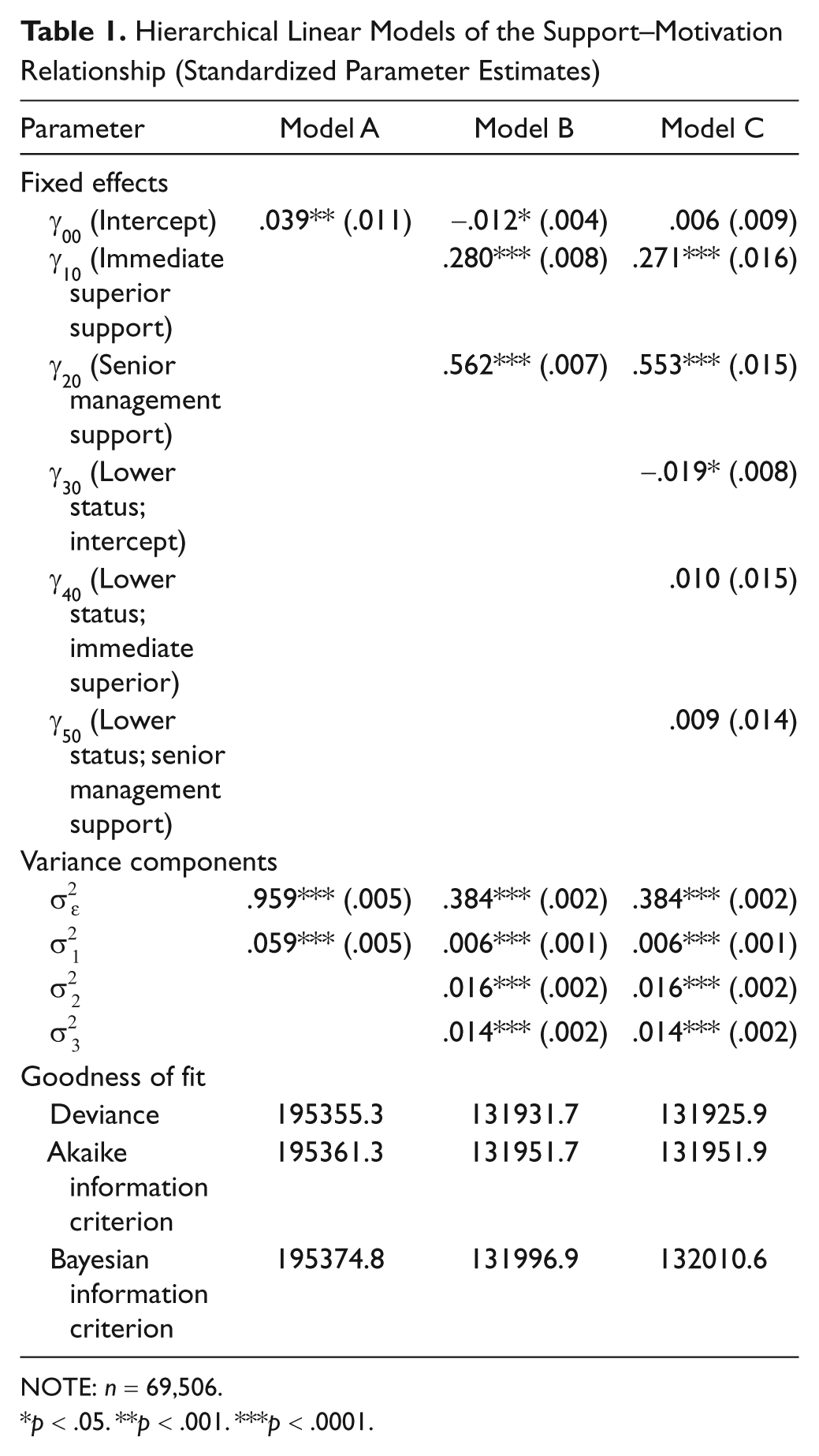
NOTE: n = 69,506.
p < .05. **p < .001. ***p < .0001.
Hierarchical Linear Models of the Support–Stay Relationship (Standardized Parameter Estimates)
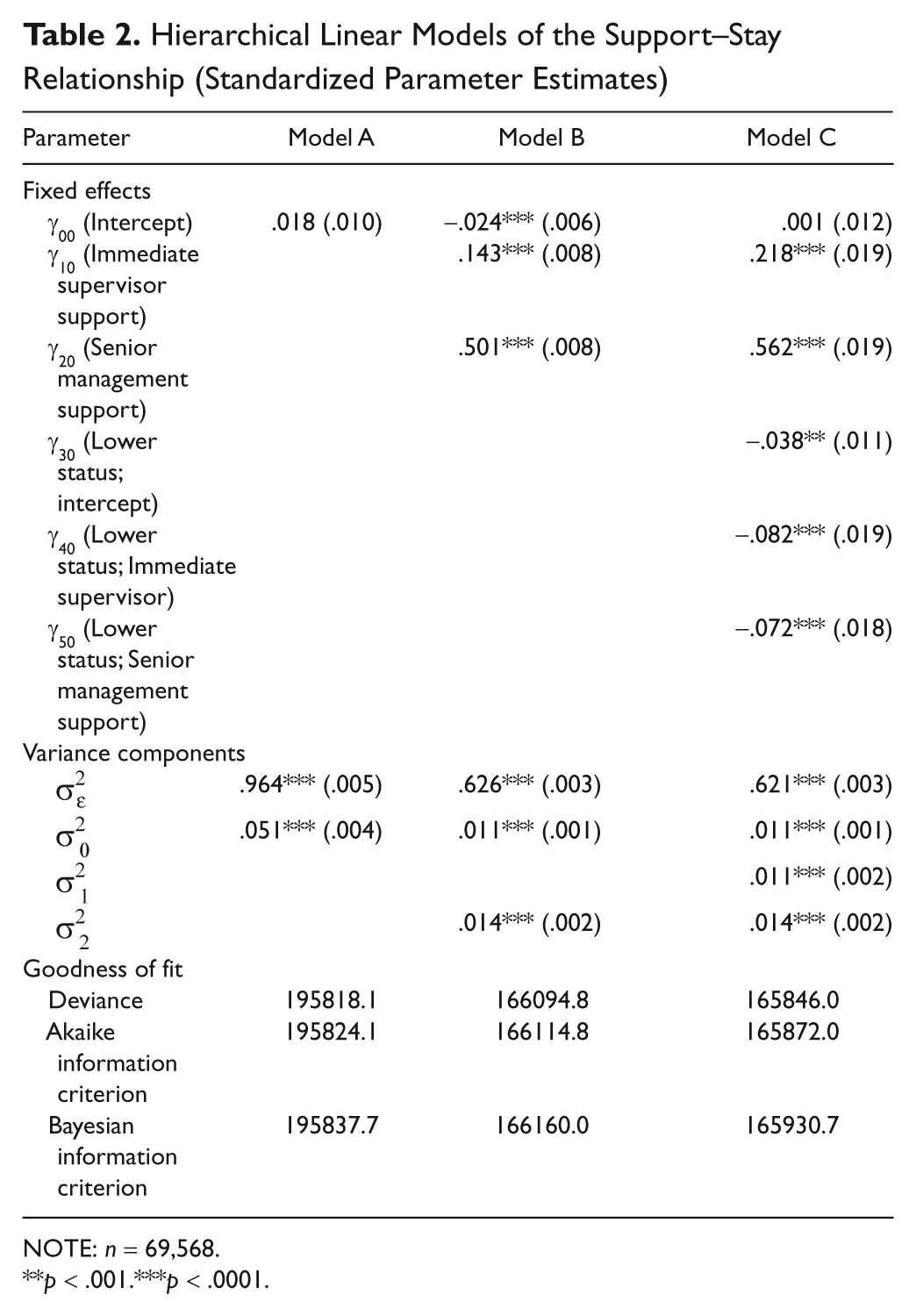
NOTE: n = 69,568.
p < .001.***p < .0001.
Table 3 presents the correlation matrix for these Level 1 variables. Followers’ perceptions of immediate supervisor support and senior management support were found to be significantly and positively related (r = .73, p < .0001), supporting Hypothesis 1. The strength of this correlation, greater than Borgogni et al.’s (2001) finding, was surprising. As previously discussed, Borgogni et al.’s (2001) Italian sample was expected to show a stronger relationship between these sources of support, since matching one’s behavior to that of one’s superior was predicted to be more common in countries valuing greater power distance and uncertainty avoidance. The most plausible explanation for the magnitude of the correlation obtained in this research is the organization’s strong, supportive culture. Senior managers, subscribing to the company’s emphasis on support, may have particularly stressed and reinforced this quality in immediate supervisors. Along with this correlation, significant relationships were found between perceptions of immediate supervisor support and motivation (r = .67, p < .0001) and between perceptions of immediate supervisor support and intent to stay (r = .49, p < .0001). Significant relationships were also found between perceptions of senior management support and motivation (r = .75, p < .0001) and between perceptions of senior management support and intent to stay (r = .59, p < .0001).
Means, Standard Deviations, and Correlations
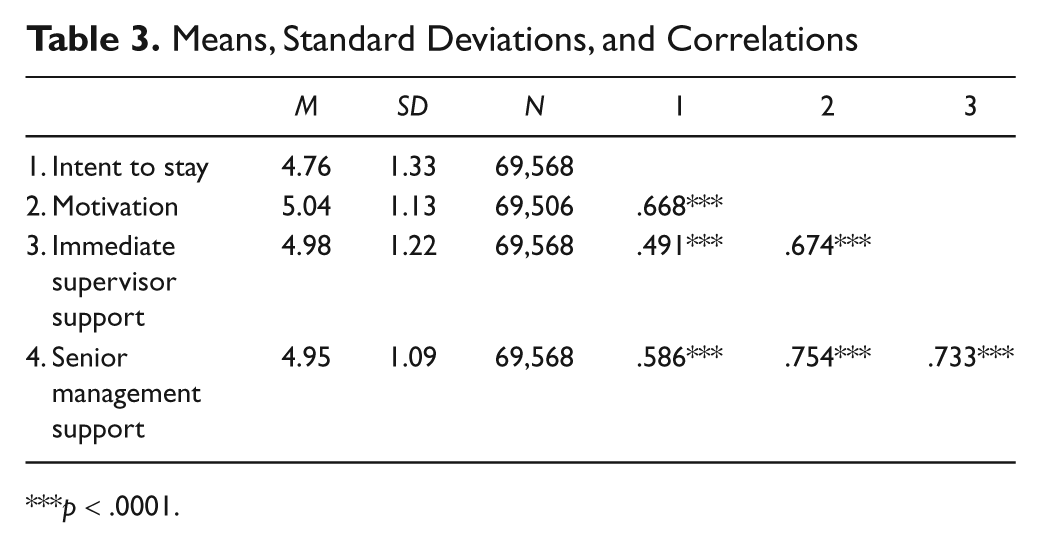
p < .0001.
Though both forms of support were highly correlated with each other, our analyses indicate that perceptions of immediate supervisor support and perceptions of senior management support represent two separate constructs. A confirmatory factor analysis found support for the two construct model. The adjusted goodness-of-fit index (.94) exceeded the critical value of .90 and Bentler–Bonett normed fit index (.98) exceeded the critical value of .90, suggesting this two-factor model has good fit. When the relationship between the two factors was constrained to 1.0, the adjusted goodness-of-fit index dropped to .61 and Bentler–Bonett normed fit index decreased to .86, suggesting that the single-factor model had poor fit. The difference in the chi-square values between these two models (77237.7) was large enough to exceed the critical value, χ2 = 3.841 (α = .05, degrees of freedom = 1). Because most of the variance in our sample was within site, the fact that these confirmatory factor analyses do not account for Level 2 between-site variation is not of great concern.
In Model B of Tables 1 and 2, immediate supervisor support and perceptions of senior management support were also introduced as random effects and allowed to vary between sites. As shown in Table 1’s Model B, employee perceptions of immediate supervisor support and perceptions of senior management support were both found to have independent positive main effects on motivation, lending support to Hypothesis 2a. Perceptions of immediate supervisor support still had a significant positive effect on motivation in the population after controlling for perceptions of senior management support (β = .28, p < .0001). Also, perceptions of senior management support still had a significant positive effect on motivation in the population after controlling for perceptions of immediate supervisor support (β = .56, p < .0001). Comparing this model with the unconditional means model (Model A) in Table 1, shows that the within-site variance is reduced from .957 to .384. The pseudo Rε2 of Model B was found to be .5987, indicating that 59.87% of the original within-site variance in employee motivation can be explained by adding immediate supervisor support and senior management support into the model.
As shown in Table 2’s Model B, employee perceptions of immediate supervisor support and perceptions of senior management support were both found to have independent positive main effects on intent to stay, supporting Hypothesis 2b. After controlling for perceptions of senior management support, perceptions of immediate supervisor support still had a significant positive effect on intent to stay in the population (β = .14, p < .0001). Likewise, after controlling for perceptions of immediate supervisor support, perceptions of senior management support still had a significant positive effect on intent to stay in the population (β = .50, p < .0001). When this model is compared with the unconditional means model (Model A), the within-site variance is reduced from .96 to .63. The pseudo Rε2 of Model B was .3506, indicating that 35.06% of the original within-site variance in employee intent to stay can be explained by adding immediate supervisor support and senior management support into the model.
Supervisory Versus Senior Leadership Support
Hypotheses 3a and 3b also found support, indicating that follower perceptions of senior management support had greater impact on their motivation and intent to stay than perceptions of immediate supervisor support. Looking at follower motivation, in examining the estimated main effects in Table 1’s Model B, we find that the best population estimate of the standardized beta for senior management support after controlling for immediate supervisor support (β = .56, p < .0001) is greater than the best estimate of the standardized beta for immediate supervisor support after controlling for senior management support (β = .28, p < .0001). Similarly, for intent to stay, comparing the estimated main effects in Table 2’s Model B shows that in the population, the best estimate of the standardized beta for senior management support after controlling for immediate supervisor support (β = .50, p < .0001) is greater than the best estimate of the standardized beta for immediate supervisor support after controlling for senior management support (β = .14, p < .0001). These are fairly large and compelling differences, supporting the view that senior management support may have a greater impact on both follower motivation and intent to stay than immediate supervisor support. The correlation matrix in Table 3 lends further support to Hypothesis 3a in that it reports a larger correlation between senior management support and motivation than between immediate supervisor support and motivation (r = .57 and r = .47, respectively; ps < .0001). Using Meng, Rosenthal, and Rubin’s (1992) formula to compare correlated correlation coefficients, the difference between these two correlations was found to be significant (Z = 44.84, p < .0001). Similarly, further supporting Hypothesis 3b, the correlation matrix also shows a larger correlation between senior management support and intent to stay than between immediate supervisor support and intent to stay (r = .59 and r = .49, respectively; ps < .0001). Meng et al.’s (1992) formula shows the difference between these two correlations to also be significant (Z = 42.22, p < .0001).
Follower Job Status
To test Hypothesis 4, job status was introduced in Table 2’s Model C as a fixed effect and allowed to affect the intercept, immediate supervisor support slope, and senior management support slope. The pseudo Rε2 of Model C was found to be .3558, indicating that 35.58% of the original within-site variance in Model A can be explained by adding immediate supervisor support, senior management support, and job status into the model. Results support Hypothesis 4, suggesting job status moderates both the relationship between perceptions of immediate supervisor support and intent to stay and the relationship between perceptions of senior management support and intention to stay. After controlling for the main effect of job status on intent to stay, employees holding lower status jobs had a slightly but significantly weaker slope (−.08, p < .0001) between perceptions of immediate supervisor support and intent to stay than employees holding higher status jobs in the organization. Additionally, workers in lower status positions showed a slightly but significantly weaker relationship between perceptions of senior management support and intent to stay (−.07, p < .0001) than those in higher status positions. As expected, job status was not shown to moderate the relationships between leadership support and follower motivation when it was introduced as a fixed effect and allowed to affect the intercept, immediate supervisor support slope, and senior management support slope (Table 1, Model C).
A comparison of the models of the Support–Motivation relationships in Table 1 suggests that Model B has the best fit. The model with the smallest information criterion is generally thought to be the best fitting model. That of Model B (Akaike information criterion [AIC] = 131951.7, Bayesian information criterion [BIC] = 131996.9) is the smallest, followed by Model C (AIC = 131051.9, BIC = 132010.6) and Model A (AIC = 195361.3, BIC = 195374.8). Table 1’s Model B, which includes both immediate supervisor and senior management support but excludes occupational status, best models follower motivation.
Examining the Support–Stay models in Table 2 indicates that Model C has the best fit. The model with the smallest information criterion is generally thought to be the best fitting model, and that of Model C (AIC = 165872.0, BIC = 165930.7) is the smallest, followed by Model B (AIC = 166114.8, BIC = 166160.0) and Model A (AIC = 195824.1, BIC = 195837.7). Table 2’s Model C, which includes perceptions of immediate supervisor support, senior management support, and occupational status, best explains employee intent to stay.
Analyses were also run controlling for gender, ethnicity, age, and tenure, because of their potentially confounding effect. All hypotheses held even after controlling for these demographic variables.
Discussion
Our study examined how perceived support from different levels of leadership affects the motivation and intent to stay of employees in different job status positions within an organization. Overall, results found value in breaking apart the broad perceived supervisor support construct into two subconstructs, perceptions of immediate supervisor support and perceptions of senior management support, when examining employee motivation and intent to stay. Since support from immediate supervisors and senior management were both shown to have independent positive impacts on follower motivation and retention prospects, considering both sources may help provide a more comprehensive understanding of the support–retention relationship and guide organizations in developing appropriate leadership training at different hierarchical levels.
Although we argue that researchers should more often distinguish between forms of leadership support in future studies, we do recognize why perceived supervisor support has often been treated as a single construct. Our results show a strong positive correlation between employees’ perceptions of immediate supervisor support and senior management support. As previously discussed, there are a number of explanations for why workers may hold similar perceptions of the support they receive from different levels of leadership. Supportive supervisors may be especially attracted to job openings at organizations with comparable reputations of support, and supportive managers may be more likely to hire supervisors who they perceive share their values. Also, immediate supervisors may model the behavior of their mangers, and supervisors who fail to match managers’ support styles may quit or be terminated.
However, in seeking to more fully investigate the impact of leadership support on employee outcomes, we found additional value in measuring leadership support at different levels separately. Our results suggest that employees’ perceptions of support from their immediate supervisors and from their senior leaders independently affect their motivation and intention to stay. Employee perceptions of the extent to which both their immediate supervisors and senior leaders offered support uniquely affected both their motivation and retention plans. When one leadership level is not sufficiently supportive, support from another leadership level may help motivate an employee to perform well and ultimately to stay at an organization. In addition, by providing leadership support at multiple levels, both motivation and future retention may be enhanced compared with relying on support to come exclusively from either one. Thus, our research indicates that organizations stand to benefit from encouraging leaders at all levels to communicate support to their employees, each in the manner in which their resources best allow.
Comparing the relative impact of two levels of leadership support, we found that the relationship between senior leader support and motivation was significantly stronger than the relationship between immediate supervisor support and motivation. Similarly, senior leader support was shown to exert a stronger impact on employees’ intent to stay, as compared with immediate supervisor support. This trend emerged for employees in both lower status and higher status positions, though employees in the lower status occupational group had weaker relationships between each level of leadership support and intent to stay than their counterparts in the higher status group. Such findings may help inform organizational policies and initiatives. Although enhancing the support offered by leaders at all levels is important, companies wishing to promote employee motivation and retention may need to devote special attention to leaders at senior management levels. Developing strategies to ensure that senior leaders demonstrate support and stressing that it must be effectively communicated from the top down may be especially important in increasing valued follower behaviors.
We do not doubt that immediate supervisors influence employee motivation and retention nor does our data suggest this; rather, our results indicate that in at least some organizational settings senior leadership support may have an even greater impact. Even if workers have unsupportive immediate supervisors, employees feeling supported by senior leaders may perceive that instead of quitting they have other options to successfully address problems. Low levels of support from powerful senior leaders may make people feel like they have little control over their work environment, which could reduce both their motivation and intent to stay.
The finding that senior management support affects employee motivation and retention more than immediate supervisor support may be encouraging to many organizational leaders. Creating a supportive upper-level leadership culture may be easier than ensuring that every immediate supervisor demonstrates support, since there are generally fewer senior managers than immediate supervisors to be targeted. Also, fostering support at higher levels of leadership may drive lower level supervisors to also engage in supportive behaviors. Shanock and Eisenberger (2006) found that supervisors’ perceptions of organizational support positively related to their subordinates’ perceptions of supervisor support, which then in turn positively affected subordinate’s perceived organizational support and performance. If organizations invest in helping their senior leaders demonstrate support, those senior managers may feel more supported themselves and communicate some of this support to immediate supervisors who may also in turn reciprocate by showing more support as well. Along with creating relationships of reciprocity, this top-down approach may help build leadership support at all levels of the organization by setting expectations for immediate supervisors who often model the behavior of more senior leaders.
That said, our findings may not be generalizable to all organizations. In organizations where senior management is not salient, is too physically or socially distant, or is perceived to have little power, perhaps the “proximal rule” may be more applicable (Lawler, 1992). However, our sample was drawn from an organization with a strong, supportive leadership culture where employees know they have the right to raise issues to levels above that of their supervisors, and indeed have done so. Senior leaders are physically located on-site, are easily recognizable, and are encouraged to participate in social events involving all staff. However, in a context with a weaker culture, or with more physically and socially distant leadership, it is possible that immediate supervisor support might have a greater impact on employee motivation and intent to stay, particularly if they are seen as able to help buffer workers from the demands of senior management. Greater investigation into the situational factors that may affect the relative impact of different levels of leadership support is necessary.
The finding that leadership support from both immediate supervisors and senior management exerts a slightly weaker, but still significant, impact on the retention of employees in lower status occupational groups highlights the need to devote additional study to increasing the retention of these workers. Most private companies, including the one from which this study’s sample was drawn, employ far more nonmanagerial than managerial workers. Consequently, understanding how to increase intent to stay of nonmanagerial employees is extremely important for keeping turnover-related costs to a minimum.
Organizations may be pleased to see that the strength the impact of leadership support on employee motivation did not differ according to occupational status. Although we cannot conclude that the relationships between both sources of support and follower motivation are identical, our results suggest that the motivating effect of leadership support is similar for followers at different levels of the organizational hierarchy. Whether an entry-level worker or a rising executive, feeling supported by immediate supervisors and senior leaders can be motivating.
Although these findings offer useful information regarding the impact of different sources of leadership support, certain limitations of this study must be addressed. First, because data were collected via an organizational survey developed in-house at the company, longer, well-known, publicly validated research measures could not be used to assess the constructs of interest. Even so, these scales were developed by psychologists trained in psychometrics who have done considerable internal validation work. However, though researchers often view motivation as a multifaceted construct, this organization’s scale focuses more narrowly on the effort expenditure aspect of motivation since that is the company’s primary area of concern. Thus, our motivation results should be interpreted as affecting effort rather than necessarily inducing intrinsic or other aspects of motivation. Second, like all studies relying on self-report questionnaire data, the possibility of common method bias should be considered. However, recent work suggests that using different measurement methods does not necessarily improve the validity of findings (Conway & Lance, 2010) and that concerns about common method variance may be overstated (Spector, 2006). Rather, Conway and Lance (2010) assert that studies relying solely on self-report data can be highly valuable, if efforts are taken to reduce the likelihood of common method bias. In our case, we incorporated elements to counter common methods bias into our design and analysis as suggested by Conway and Lance (2010) and Podsakoff, MacKenzie, Podsakoff, and Lee (2003), including the following: providing a rationale of why self-reports were appropriate; ensuring respondents of anonymity to reduce evaluation apprehension; using straightforward, clear, and unambiguous items; taking care that items did not overlap between scales; and presenting reliability and validity information for measures.
Overall, our findings indicate that examining different levels of leadership support and different levels of employee job status improves the ability to predict employee motivation and intent to stay. We suggest that researchers should more frequently consider incorporating levels of leadership into their study design, measures, and analyses. Doing so will refine our knowledge of how leadership behavior influences employee outcomes and will yield clearer implications for leadership training and for developing organizational practices designed to increase desirable follower behaviors. Leadership is not inherently monolithic, and examining it by levels can be more helpful in providing evidence for which behaviors will, in the end, lead to greater leadership success.
Footnotes
The authors declared no potential conflicts of interest with respect to the research, authorship, and/or publication of this article.
The authors disclosed receipt of the following financial support for the research, authorship, and/or publication of this article: This material is based in part upon research supported by the National Science Foundation under grant # 0519802 to the second author. Any opinions, findings, conclusions, or recommendations expressed in this material are those of the authors and do not necessarily reflect the views of the National Science Foundation.