







Abstract
To advance research on how leaders influence followers and organizational performance, we proposed and tested a multilevel mediation model whereby authentic leaders influence follower fairness perceptions and create a fair climate, which in turn relates to subordinate well-being, turnover intention, and organizational commitment. Survey data from 187 employees, clustered under 37 leaders, were tested using a multilevel structural equation modeling approach. Results show that authentic leaders relate to follower outcomes in part through directly relating to subordinates’ perceptions of justice and justice climate. Implications include development of authentic leadership as an actionable strategy for bolstering followers’ well-being and performance.
Keywords
In an age when corporate corruption and CEO scandals are common news stories (e.g., Crawford, 2005), organizational stakeholders demand that leaders not only generate a profit but also act with high integrity and demonstrate fairness while doing so (Walumbwa, Avolio, Gardner, Wernsing, & Peterson, 2008). Leadership scholars are responding to the need for understanding and developing such leaders with a surge of research on authentic leadership, a process of leadership based on integrity and ethical behavior that is transparent and considerate of all stakeholders (e.g., Walumbwa, Avolio, et al., 2008). Accumulating evidence suggests that authentic leadership can be developed (see Avolio & Gardner, 2005; Avolio & Hannah, 2008) and relates to numerous organizational outcomes (e.g., Walumbwa, Avolio, et al., 2008). However, little work has yet examined how authentic leadership creates perceptions of fairness or its relationship with outcomes illustrative of the integrity and fair leadership that stakeholders demand (e.g., well-being or low turnover intentions; Prottas, 2013). Moreover, it has been argued that understanding multilevel phenomena and cross-level effects is critical to the study of leadership, where a leader’s interactions with both individuals and groups are essential to the process (Schriesheim, Castro, Zhou, & DeChurch, 2006; Walumbwa, Wu, & Orwa, 2008).
Therefore, to address the need for research demonstrating the efficacy of ethical and high integrity leadership, and for a theoretical framework explaining the process and impact of such leadership on individuals and groups, we integrated authentic leadership framework with principles of organizational justice (i.e., fairness in the workplace) to propose that authentic leadership is a type of fair leadership (Figure 1). Specifically, we hypothesize that authentic leadership behaviors generate fairness perceptions among subordinates, and that these fairness perceptions in turn act as the mechanism through which authentic leadership relates to organizational outcomes indicative of high integrity and ethical leadership. Furthermore, we examine the process of authentic leadership and fairness using a multilevel lens. Through the application of multilevel structural equation modeling (MSEM), we simultaneously examine leadership and justice phenomena from the perspective of individual employees as well as the shared perspective of a group of employees working under the same leader, thereby making a methodological contribution to the study of leadership and fairness literatures. By creating a fair climate for followers and directly affecting individuals’ perceptions of fairness in the workplace, authentic leaders promote the type of workplace that today’s stakeholders demand.
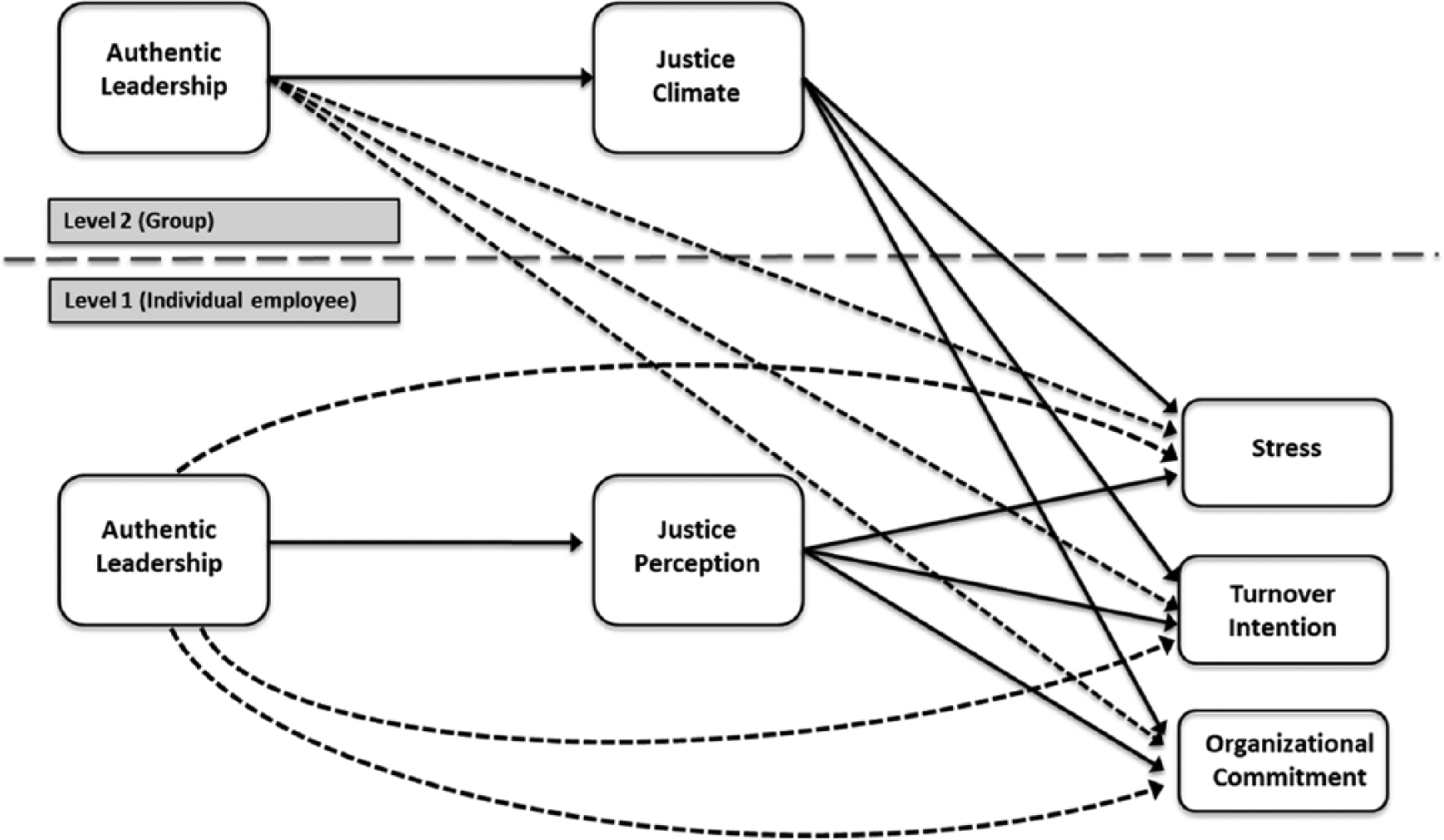
Proposed multilevel mediation model of authentic leadership and fairness.
Conceptual Background and Theoretical Framework
Authentic Leadership
Authentic leaders are those who are perceived as authentic (i.e., trustworthy, genuine, honest) by followers. Authentic leaders are transparent and consistent in decision making and in interactions with followers. They situate themselves to make well-informed decisions by encouraging followers to voice diverse viewpoints and by incorporating those viewpoints into their decision-making process (Avolio, Reichard, Hannah, Walumbwa, & Chan, 2009). Authentic leaders’ behavior is consistent with their values and morals, upholding high integrity and trust among followers. They are in tune with their strengths and weaknesses as well as how their strengths and weaknesses are perceived by others, so that they can use this self-knowledge to develop and lead most effectively (Walumbwa, Avolio, et al., 2008).
Research has shown that authentic leadership positively relates to organizational citizenship behaviors, organizational commitment, and satisfaction with the supervisor (Walumbwa, Avolio, et al., 2008) as well as unit sales performance (Clapp-Smith, Vogelgesang, & Avey, 2009). However, more research is still needed to confirm the hypothesized range of positive outcomes resulting from authentic leadership (e.g., Cooper, Scandura, & Schriesheim, 2005). For example, with the focus on authentic leadership filling a need for ethical leaders, the next logical outcomes to study are those reflective of high integrity and fairness: namely, turnover intention and employee well-being.
Theoretical Frameworks for Multilevel Authentic Leadership Outcomes
Employees who perceive their leader as authentic feel as though they are the recipients of trustworthy decision-making processes and outcomes as well as moral and ethical treatment. According to social exchange theory (Blau, 1964), employees respond to authentic leadership with commitment to the organization and performance. Social exchange theory posits that when individuals receive favorable noneconomic transactions from organizational agents, their natural drive (i.e., the norm of reciprocity, Gouldner, 1960) is to respond with comparable noneconomic transactions beneficial to the organization (e.g., performance, citizenship behaviors; Walumbwa, Avolio, et al., 2008). In addition, employees with authentic leaders feel supported in achieving their work goals and are given autonomy to do so, which together contribute to lowering their job demands enabling them to reciprocate with higher performance levels. Specifically, the job demand–control–support model (JDCS; Johnson & Hall, 1988) suggests that employee well-being (and its counter-points, employee stress and strain) is partially determined by a combination of job demands, perceived control over the environment, and social support resources. Thus, having an authentic leader promotes positive levels of commitment, performance, and well-being (i.e., lower levels of stress) in their employees.
Through the application of social exchange theory and the JDCS, we can propose that authentic leadership negatively relates to employees’ stress and intentions to leave and positively relates to their organizational commitment. However, there are multiple levels of analysis at which leadership phenomena can operate (Schriesheim et al., 2006), including the individual level (i.e., one follower’s perceptions of the leader) and the group level (i.e., all followers’ perceptions of the leader). Social information processing theory (Salancik & Pfeffer, 1978) suggests that consideration of both individuals’ perceptions and the group’s shared perceptions is necessary to fully capture and understand these perceptions and associated reactions, because an individual’s perception may be influenced by the group’s and vice versa. Searle and Barbuto (2013) recently called for increased investigations of the multiple levels of positive leadership (such as authentic leadership), and there is initial empirical support for the relationship between group-level perceptions of authentic leadership and group performance (Clapp-Smith et al., 2009). Consequently, we conceptualize authentic leadership at both individual and group levels and hypothesize that it will relate to our outcomes at both levels (see Figure 1):
Organizational Justice
Consistent with the focus placed on ethics and transparency in the authentic leadership literature, we propose that organizational justice serves as the explanatory mechanism (i.e., mediator) by which authentic leadership demonstrates multilevel effects of on employee well-being, commitment, and turnover intentions (Figure 1). Organizational justice refers to people’s perceptions about fairness in the workplace. Researchers have identified four specific types of justice, each referring to fairness perceptions at the individual level and in a specific set of work contexts (e.g., Byrne & Cropanzano, 2001): distributive justice, procedural justice, informational justice, and interpersonal justice. Distributive justice is the fairness perceptions of outcomes and resources (e.g., pay and rewards) received at work (J. S. Adams, 1963). Procedural justice refers to the perceived fairness of the process followed by authority figures, such as supervisors, to distribute resources and outcomes (Thibault & Walker, 1975). Interpersonal justice reflects the perception of fairness related to being treated with respect and propriety, and informational justice is the perception of fairness related to the adequacy and justification for procedures and outcomes (e.g., Bies & Moag, 1986; Colquitt, 2001; Greenberg, 1987).
The various types of individual-level justice perceptions have been associated with a wide range of positive organizational outcomes, such as job performance (i.e., in-role performance) and organizational citizenship behaviors (Cohen-Charash & Spector, 2001). Justice perceptions are also inversely related to employee burnout and work-related stress (e.g., Fox, Spector, & Miles, 2001).
Justice perceptions have also been examined at the group level, termed justice climate (e.g., Colquitt, Noe, & Jackson, 2002; Naumann & Bennett, 2000). Justice climate, one of many potential forms of organizational climate (Schneider & Reichers, 1983), refers to the shared fairness perceptions of a group of employees about the organization’s policies, practices, procedures, and rewards. Similar relationships to those found at the individual level have also been supported at the group level as outcomes of justice climate (see Whitman, Caleo, Carpenter, Horner, & Bernerth, 2012, for a review). Furthermore, there is evidence that justice climate relates to these outcomes above and beyond individual perceptions, providing support for the uniqueness of group-level from individual-level justice perceptions (Chen, Lam, Naumann, & Schaubroeck, 2005). Though promising, the bulk of existing research on justice climate is limited to examining procedural justice climate (e.g., Naumann & Bennett, 2000). Considerably less is known about group-level perceptions of distributive, informational, or interpersonal justice. The current study, therefore, builds on this growing body of justice climate research by exploring both the individual-level and group-level effects of all four types of justice perceptions.
Theoretical Frameworks for MultiLevel Justice Outcomes
Positive findings of individual justice perceptions and justice climate outcomes can be explained using group value theory (Lind & Tyler, 1988). Group value theory states that the level of fairness experienced by a worker (or group of workers) serves as an indicator of how much the organization values him or her (or group). Being valued by one’s organization meets one’s need for social belonging (Baumeister & Leary, 1995) and positively affects psychological well-being by fostering self-worth. When feeling valued, employees seek to build their status within the group and the larger organization and do so through their contributions to the group (e.g., Blader & Tyler, 2009).
Whereas group value theory may be used to explain the positive effects of both individual- and group-level justice perceptions, social information processing theory (Salancik & Pfeffer, 1978) explains why justice climate remains an important predictor beyond individual-level justice perceptions. Take, for example, a situation wherein an employee is treated fairly in interpersonal communications with his or her supervisor, but sees the same supervisor treating coworkers with disrespect and reduced information sharing. Considering individual-level perceptions of fairness alone, we might expect, based on social exchange theory or group value theory, that the employee who was treated fairly responds with greater effort and commitment at work. However, based on social information processing theory, when the employee considers how his or her coworkers were unfairly treated (hence considering the entire fairness context), the employee will most likely have a much less positive response.
Consequently, applying both group value theory and social information processing theory, as well as building on existing empirical evidence, we propose that
Authentic Leadership as Fair Leadership
Our conceptual framework for authentic leadership as a critical antecedent to justice climate and individual justice perceptions relies on two main arguments: (1) the common theoretical underpinnings of justice and authentic leadership in morality (suggesting a relationship between authentic leadership and fairness) and (2) the ability of authentic leadership behaviors to meet justice criteria and influence justice perceptions (suggesting authentic leadership as an antecedent to fairness and not a consequence of fairness).
The first argument is grounded in fairness theory (Folger & Cropanzano, 1998) and the foundational research in authentic leadership (e.g., Luthans & Avolio, 2003). Fairness theory (Folger & Cropanzano, 1998; Folger, Cropanzano, & Goldman, 2005) proposes that moral accountability and ethical assumptions regarding how others should be treated are central features to organizational justice and the formation of fairness judgments. Similarly, moral capacity is one of the central components of being an authentic leader (e.g., May, Chan, Hodges, & Avolio, 2003), and authentic leaders behave in ways that demonstrate integrity and moral virtue (e.g., George, 2003; Luthans & Avolio, 2003). In sum, morality is theorized to be at the heart of authentic leadership and is also a critical component of organizational justice. It is this common foundation that we propose is one key reason why authentic leadership should create perceptions of organizational fairness.
The second argument builds on the proactive research in organizational justice (e.g., Levy & Williams, 2004), which has shown that fairness perceptions are formed based on how well elements in one’s work environment (e.g., the behaviors of one’s leader) meet fairness rules specified in distributive, procedural, informational, and interpersonal justice definitions. For example, procedural justice criteria (i.e., consistency, bias suppression, accuracy, correctability, representativeness, ethicality; Leventhal, 1980) are met by authentic leaders because they are open, transparent, and consistent in decision making (e.g., Avolio et al., 2009). Leaders fully demonstrating authentic leadership are likely to behave in ways that meet the fairness criteria for all four justice types. Hence, followers experience these authentic leadership behaviors and then form positive justice perceptions accordingly, thus making authentic leadership a type of fair leadership. These justice perceptions, in turn, lead followers to react positively with pro-organizational attitudes and behaviors and to develop well-being, making organizational justice an important mediator of authentic leadership processes.
Method
Multilevel Considerations
In our multilevel model of authentic leadership and organizational justice, the variables of interest are hypothesized to exist in some form at the individual level and group level of analysis, and all are measured exclusively at the individual level. By using MSEM (Preacher, Rucker, & Hayes, 2007; Preacher, Zyphur, & Zhang, 2010), the constructs in our model can be measured at the individual level and then allowed to vary at both the individual and group levels of analysis. Specifically, in MSEM, the individual-level, or “within-group” variance of each variable (to use MSEM terminology), is separated from the group-level or “between-group” variance and correlation/covariance matrices are estimated for each of the two levels. This set of correlation/covariance matrices is then used as the basis for testing all MSEM models. In an MSEM framework, the group-level form of a construct is considered a latent construct, inferred from the shared variance in observed individual-level responses. This method of inferring the group-level construct from individual-level indicators accounts for the error involved in this cross-level inference, acknowledging that the individual-level responses are imperfect indicators of the group-level perception.
Participants and Procedure
Participants
A total of 187 employees working under 37 supervisors in 25 different organizations provided usable data. Because of missing information, an exact response rate is not available; however, we estimate at least 50% response rate for smaller participating organizations (ranging from 12 to 50 employees) and a range between 10% and 40% for larger organizations (ranging from 50 to 100,000 employees). The average age of participants was 38.31 years (SD = 11.21), the average organization tenure 4.94 years (SD = 6.02), and the average hours worked per week was 43.36 (SD = 6.47). Participants were 44.3% female, 23.7% male, and 32% chose not to report their gender. Most participants identified as Caucasian (50.3%), with other ethnic groups represented in smaller numbers (1.6% Black/non-Hispanic, 2.1% Asian/Pacific Islander, 8.0% Hispanic, 1.1% Other); 36.9% did not indicate their ethnicity. Participants worked in a wide variety of occupations, including customer service, management, human resources, hospitality, marketing and sales, and legal counsel. Participants were based in a wide range of industries (e.g., health care, banking, information technology, public safety, social service, legal, and accounting).
Procedures
Organizations across the United States and Canada were recruited through a common acquaintance of the first author, as well as through referral from full-time working adults enrolled in masters courses at a Western University. All participants were then recruited via an e-mail invitation to complete the online survey. As a small incentive and gesture of gratitude, each participant had the opportunity to enter his or her name (sent separately to the researcher) into a drawing with the chance to win a $25 gift card.
Measures
Authentic Leadership
Participants rated their direct supervisor using the Authentic Leadership Questionnaire (ALQ; Walumbwa, Avolio, et al., 2008). Participants rated 16 behaviorally based leadership statements by indicating how frequently each statement fit their supervisors’ leadership style. Ratings were made according to a 5-point Likert-type scale where 1 = not at all and 5 = frequently if not always. Validity evidence for the ALQ is provided by Walumbwa, Avolio, et al. (2008).
Organizational Justice
Perceptions of organizational justice were assessed using Colquitt’s (2001) measures of distributive justice (four items), procedural justice (seven items), informational justice (four items), and interpersonal justice (five items). Responses were given on a 5-point Likert-type scale where 1 = to a small extent and 5 = to a large extent. Colquitt (2001) provided validity evidence for his scale.
Perceived Stress
Perceived stress was assessed with the 5-item short version of the Perceived Stress Scale (PSS; S. Cohen, Kamarck, & Mermelstein, 1983). Participants were asked to consider how often they have experienced certain stressors and stress related cognitions and feelings in the past month, responding on a 5-point Likert-type scale where 1 = never and 5 = very often. Validity evidence for the measure was provided by S. Cohen et al. (1983).
Affective Organizational Commitment
Affective organizational commitment was assessed via the 8-item affective subscale of the Organizational Commitment Questionnaire (OCQ; Allen & Meyer, 1990). Participants responded to statements regarding their emotional attachment to their organization. Responses were given on a 5-point Likert-type scale, where 1 = strongly disagree and 5 = strongly agree. Validity evidence for the measure is available in A. Cohen (2007).
Turnover Intention
Turnover intention was measured with three items from G. A. Adams and Beehr (1998). These three items assessed actively planning to leave one’s job as well as desire to leave one’s job. Responses indicated agreement with each statement and ranged from 1 (strongly disagree) to 5 (strongly agree). G. A. Adams and Beehr provided validity evidence for their measure.
Results
Preliminary Analyses
All analyses were conducted using Mplus Version 6.0 (Muthén & Muthén, 1998-2010). Prior to testing the proposed model of multilevel effects with MSEM, we first evaluated the intended measurement model with confirmatory factor analysis (CFA) to ensure that each variable represents a unique factor, with the intended survey items as its indicators (Anderson & Gerbing, 1988). Scales with more than five items were parceled so that each intended factor had between three and five indicators (e.g., Bandalos, 2002). The CFA results of the intended structure (including a one-dimensional authentic leadership factor and four distinct justice factors) fit the data well, χ2(592) = 878.31, p < .01, root mean square error of approximation = .05, comparative fit index = .95, Tucker–Lewis index = .94.
Means, standard deviations, alpha coefficients, and intra-class correlation coefficients (ICCs) were calculated for all study variables (see Table 1). All ICCs were in the appropriate range for testing multilevel effects, thus justifying the examination of both Level 1 (within group) and Level 2 (between group) effects. 1 The within- and between-level correlation matrices used as the basis for all MSEM analyses are reported in Table 1.
Individual- and Group-Level Correlations for MSEM Analyses with Descriptive Statistics.
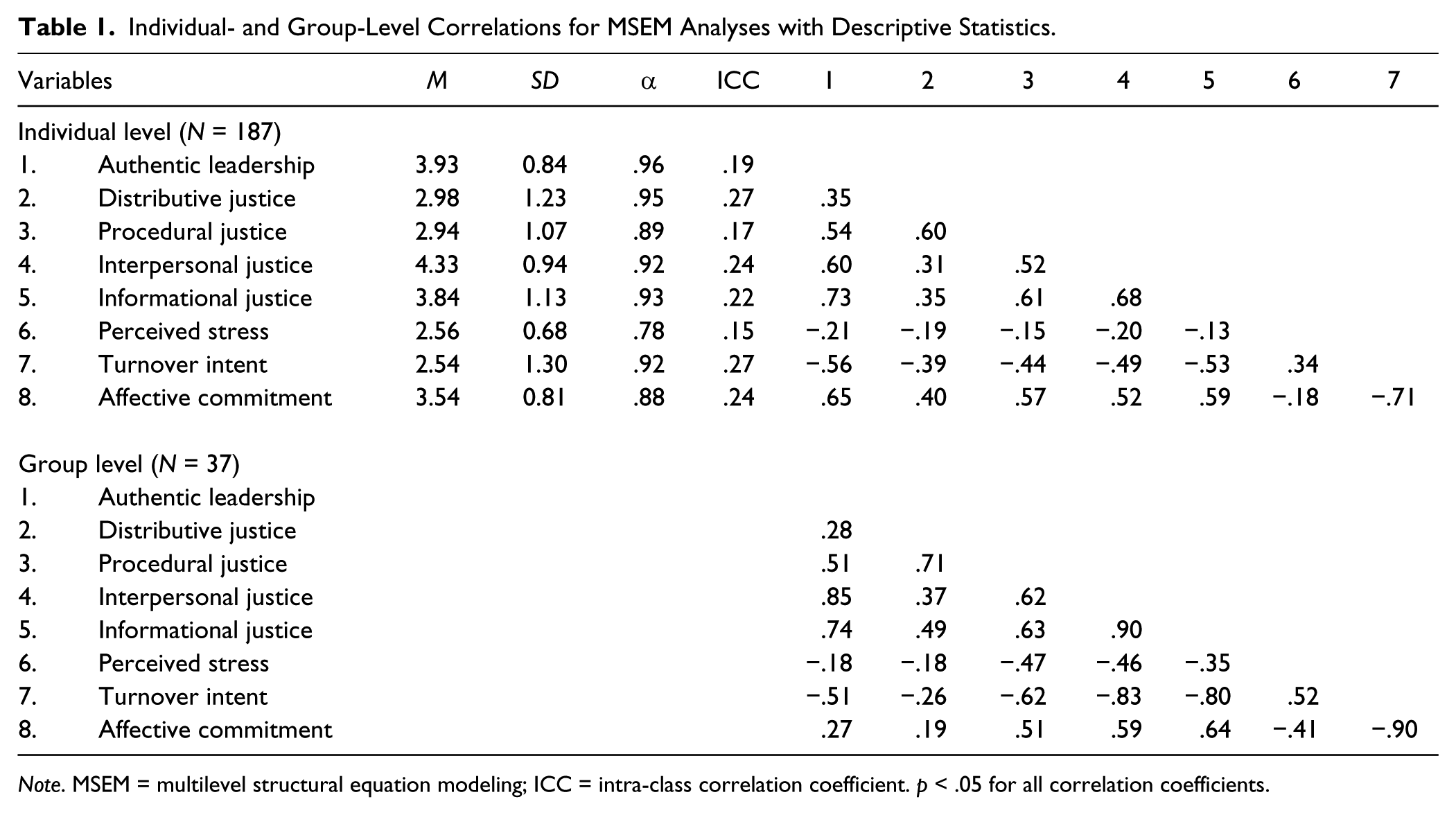
Note. MSEM = multilevel structural equation modeling; ICC = intra-class correlation coefficient. p < .05 for all correlation coefficients.
Testing the Proposed Model
To test the proposed model, we followed a MSEM analysis process adapted from the methodological tutorial by Preacher et al. (2010). As is common in MSEM analyses (e.g., Muthén & Asparouhov, 2011; Muthén & Muthén, 1998-2010), the variables were group-mean centered at Level 1 (the individual level) for all analyses. Consequently, Level 2 effects are interpreted as “group-level” or “between-group” effects rather than “contextual effects” (e.g., Muthén & Asparouhov, 2011). Hypotheses were tested via examination of path coefficients in MSEM models. 2
As is common in structural equation modeling and path analysis applications of MSEM, the terminology used to discuss model results can be indicative of a causal relationship between independent variables and dependent variables (i.e., the “direct effect of an independent variable on the outcome variable”). Regardless of our use of this terminology, we acknowledge that causality cannot be supported based on these data alone because of our use of cross-sectional survey methodology.
Main Effects of Authentic Leadership and Justice
Hypotheses 1 through 4 proposed main effects of authentic leadership and organizational justice on all outcome variables, at both individual (within) and group (between) levels of analysis. Results for authentic leadership predicting the three outcome variables (perceived stress, turnover intention, and affective commitment) indicated that individual-level perceptions of authentic leadership significantly predicted stress (b = −0.20, p < .01), affective commitment (b = 0.55, p < .01), and turnover intention (b = −0.71, p < .01) at the individual level supporting Hypotheses 1a to 1c, and turnover intention at the group level (b = −1.07, p < .05), supporting Hypothesis 2b but not 2a or 2c (Table 2).
Unstandardized Path Coefficients for Models With Authentic Leadership or One Justice Dimension Predicting the Three Outcome Variables.
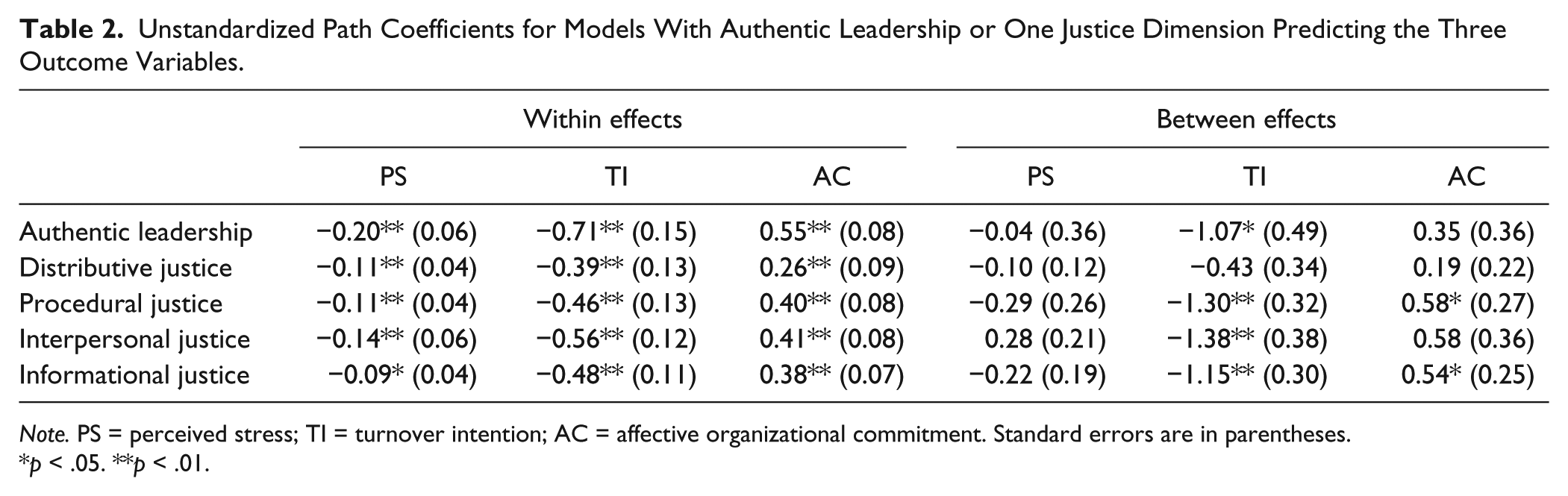
Note. PS = perceived stress; TI = turnover intention; AC = affective organizational commitment. Standard errors are in parentheses.
p < .05. **p < .01.
Hypotheses 3a to 3c, predicting the individual-level effects of justice on outcomes were supported for all four justice dimensions (see Table 2). Specifically, individual-level perceptions of distributive, procedural, interpersonal, and informational justices predicted perceived stress (b = −0.11, p < .01; b = −0.11, p < .01; b = −0.14, p < .01; b = −0.09, p < .05; respectively), turnover intention (b = −0.39, p < .01; b = −0.46, p < .01; b = −0.56, p < .01; b = −0.48, p < .01; respectively), and affective commitment (b = 0.26, p < .01; b = 0.40, p < .01; b = 0.41, p < .01; b = 0.38, p < .01; respectively).
None of the group-level justice climates significantly predicted employee stress, showing no support for Hypothesis 4a. Procedural justice and informational justice climates predicted turnover intentions (b = −1.30, p < .01; b = −1.15, p < .01, respectively) and affective commitment (b = 0.58, p < .05; b = 0.54, p < .05; respectively). Group-level interpersonal justice climate predicted turnover intentions (b = −1.38, p < .01). These results demonstrate partial support for Hypotheses 4b and 4c.
Mediation Models
To test Hypotheses 5a to 5c and 6a to 6c, separate mediation models were examined for each justice dimension, with all three outcomes (perceived stress, turnover intention, and affective commitment) included in each model. The individual- and group-level effects of authentic leadership on stress were not significantly mediated by any justice dimension, nor was the group-level effect of authentic leadership on affective commitment. However, shown in Table 3, partial mediation by all four justice dimensions was supported for the within effect (individual level) of authentic leadership on affective commitment, with indirect effects of .06 for distributive justice, .14 for procedural justice, .12 for interpersonal justice, and .17 for informational justice. Additionally, shown in Table 3, the relationship between authentic leadership and turnover intention was partially mediated at the individual level with indirect effects for distributive (−.10) and interpersonal (−.19) justice perceptions, and fully mediated at the group level with an indirect effect of −2.22 for interpersonal justice climate. These results do not support Hypotheses 5a, 6a, and 6c; partial support is given for Hypotheses 5b (which is supported for distributive and interpersonal justices) and 6b (which is supported for interpersonal justice); Hypotheses 5c and 6c are supported for all four justice types. Figure 2 illustrates the cumulative findings of our study.
Within and Between Effects for Justice Types as Mediators of Authentic Leadership-Outcome Relationships.
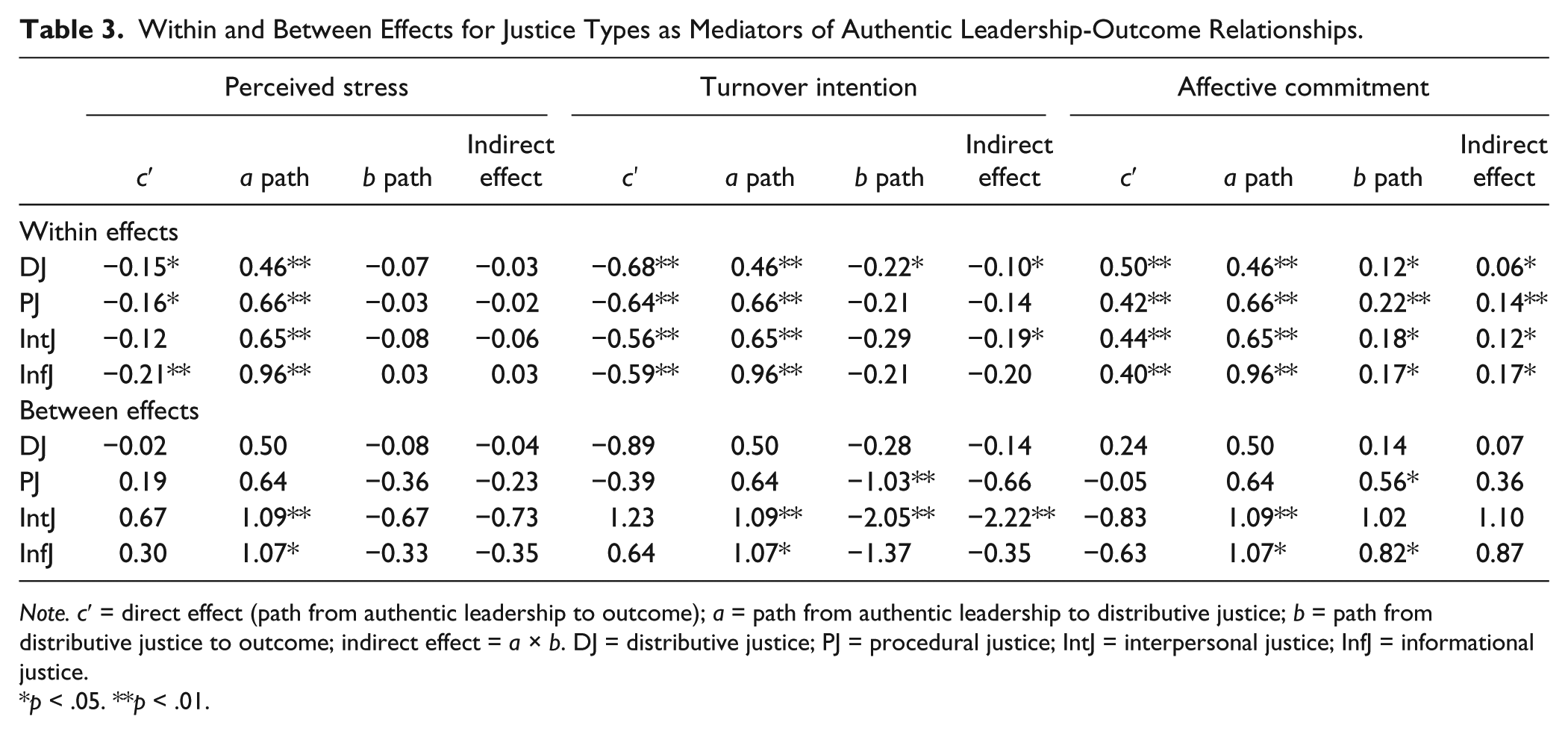
Note. c′ = direct effect (path from authentic leadership to outcome); a = path from authentic leadership to distributive justice; b = path from distributive justice to outcome; indirect effect = a × b. DJ = distributive justice; PJ = procedural justice; IntJ = interpersonal justice; InfJ = informational justice.
p < .05. **p < .01.
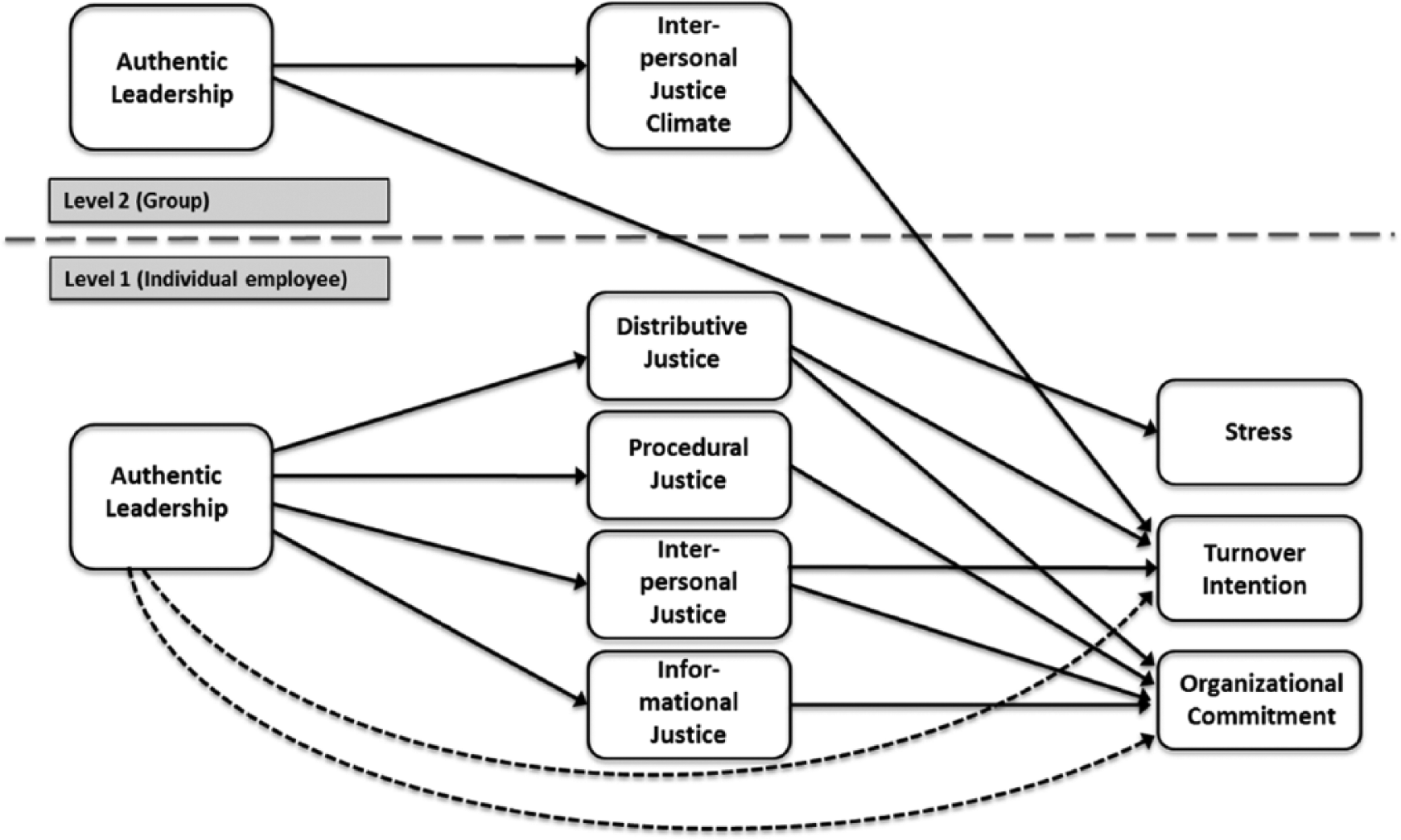
Model of authentic leadership and fairness supported by study findings.
Discussion
Overall, our results showed that the relationship between authentic leadership and distributive, procedural, interpersonal, and informational justice perceptions contributed to explaining the process of authentic leadership at the individual level. Results also indicated that at the group level, there are direct relationships between authentic leadership and some outcomes (e.g., affective commitment) as well as indirect relationships via interpersonal justice climate, which fully explains the relationship between authentic leadership and other outcomes (e.g., turnover intention).
Our mediation results suggest that, first, the best explanation for employee stress in our model stems from individual’s perceptions of authentic leadership. Specifically, under conditions where employees perceive they have some control and job demands are held constant, the social support offered by authentic leaders make a significant difference (JDCS model; Johnson & Hall, 1988; Karasek, 1979).
Second, when employees develop their affective commitment to the organization, they consider both the authentic leader, himself or herself, and how fair the leader is in terms of decisions, processes, sharing of information, and interpersonally. Employees do not appear to form their emotional attachment to the organization based on how the group perceives the authentic leader or how the group perceives the leader’s fairness. Rather, the formation of attachment to the organization is a very individualistic attitude; employees’ identification with the organization is personal. This pattern of results fits within a social identity perspective of organizational commitment (e.g., Fuller, Barnett, Hester, & Relyea, 2003). Social identity theory (Tyler, 1999) explains that employee’s affective commitment to the organization is a response to feeling valued and appreciated by the organization. Applied to the interpretation of our results, social identity theory would suggest that individual employees perceive authentic leadership and fairness in decision making and interpersonal interactions as signals that the organization values them, respects them, and views them as having a high status within the organization or group. This high level of respect and status, in turn, enhances employees’ social identity, and through enhanced social identity, creates organizational commitment.
Third, when employees form turnover intentions, they consider not only their own individual perceptions of distributive and interpersonal justice from their authentic leader but also the shared climate of interpersonal justice that the authentic leader creates. Relationships between turnover intentions and justice are well-established (Cohen-Charash & Spector, 2001; Colquitt, Conlon, Wesson, Porter, & Ng, 2001), thus the replication of individual-level relationships here offers validity evidence for this portion of our model. However, novel and exposed only because of our use of MSEM is that shared or group-level perceptions of interpersonal justice mediated the relationship between group-level perceptions of authentic leadership and turnover intention. In previous studies aggregated within a meta-analysis by Colquitt et al. (2001), individual-level interpersonal justice was not significantly related to turnover intention. In fact, it was the only individual justice perception not related. Thus, we conclude that it may be that others’ justice perceptions are particularly relevant, as interpersonal justice is the most visible form of justice to others and may be considered socially informed (Skarlicki & Kulik, 2005).
Implications for Theory and Practice
Our findings have implications for theory and practice in the areas of authentic leadership, justice, and the integration of leadership and justice (e.g., van Knippenberg & De Cremer, 2008). First, our multilevel approach and results extend theory regarding the complex nature of authentic leadership (Searle & Barbuto, 2013). Though many have called for modeling leadership as a multilevel phenomena with cross-level effects (e.g., Avolio, Sosik, Jung, & Berson, 2003), few have done so both conceptually and empirically. Second, research has empirically supported various leadership variables as important antecedents of individual justice perceptions and group-level justice climates (e.g., Ansari, Hung, & Aafaqi, 2007; Cho & Dansereau, 2010); however, the theoretical justification for these links appears as post hoc explanations of the effects rather than well-grounded a priori arguments. We developed a conceptual model for authentic leadership intertwined with fairness that was largely supported, though causal direction cannot be inferred. By building on fairness theory (Folger & Cropanzano, 1998), foundational research in authentic leadership (e.g., Luthans & Avolio, 2003), and proactive research in organizational justice (e.g., Levy & Williams, 2004), our model theoretically and empirically supports authentic leader’s behaviors as predictive of organizational justice, creating a fair climate that encourages high integrity.
Our study has strong implications for practice in that our results can form the basis of actionable strategies for organizational leaders hoping to increase the fairness in their workplaces and to meet society’s heightened expectations of fairness, morality, and ethicality in business. Taking into account the mediation results of this study, an effective leadership development program might be one that integrates authentic leadership training principles with fairness training concepts (i.e., justice-based leadership development, Byrne, Kiersch, Weidert, & Smith, 2012; Skarlicki & Latham, 2005). For example, the leadership development program could integrate knowledge-based training on organizational justice criteria for each justice type as well as skills-based training on how to enhance fairness perceptions and fairness climates in a variety of organizational settings into an authentic leadership development program.
Limitations and Strengths
The cross-sectional design of our study precludes any inference of causal relationships among variables. The field setting can be a limitation due to the lack of control, but also a strength in that all the effects of interest were examined in their naturally occurring states and environments, amidst all the complexities of organizational life. We sampled individuals and groups from a variety of organizations and did not statistically control for organizational-level variables such as organizational culture or structure, which represents another limitation. We aimed to explore the process of authentic leadership and organizational justice at the individual and group levels; however, broader contextual variables could also be of importance to the relationships of interest. Although the wide range of jobs, companies, and industries could be viewed as a strength of this study, future research needs to tease out potential interactive relationships between these demographic variables, climate perceptions, and key organizational outcomes.
Our constructs were measured using self-report surveys at the individual level. Consequently, some may argue that common method variance confounded the supported relationships among study variables (e.g., Podsakoff, MacKenzie, Lee, & Podsakoff, 2003). Though we do not discount that common method variance should be considered a potential limitation, the role of common method variance in group-level effects is thought to be different from its role in individual-level effects (though it is otherwise largely unknown). Moreover, the MSEM analyses used in this study may mitigate the potentially confounding effects of this common methodology in that the group- and within-level variation are separated within each variable using a latent variable decomposition approach.
The method of separating the group and individual-level variance and examining multilevel effects of leadership and fairness using MSEM is a unique strength of this study. Although it is widely discussed that leadership and justice phenomena operate at multiple levels within an organization (e.g., Avolio et al., 2003), few studies have empirically examined multilevel effects of leadership and justice and only one published example of research in either area could be found that conducted multilevel analyses within the MSEM framework (Hoffman, Bynum, Piccolo, & Sutton, 2011).
Conclusion
Organizational leaders are faced with the challenge of running a financially successful business while meeting expectations of ethical, moral, and fair behavior. Our results offer a new conceptual framework for authentic leadership as a fair leadership, and novel findings with regards to the ways in which authentic leaders play a role in individual- and group-level perceptions that are relevant to the organization. Our study makes a significant contribution to building the theoretical framework of authentic leadership, as well as to filling substantial gaps in the integrative literature on leadership and organizational justice. Additionally, our study makes a unique contribution to demonstrating the power of MSEM, allowing us to accurately depict and study the dual-level role of authentic leadership—forming individual- and group-level perceptions that can be studied simultaneously. A clear conclusion from the results of our study is that both individual- and group-level effects of authentic leadership and organizational justice must be examined to fully understand the complex roles of these phenomena in the lives of employees and the success of organizations. In sum, authentic leadership represents a fair style of leadership with complex, multilevel relations with follower well-being, organizational attitudes, and behavioral intentions; thus, being authentic is being fair!
Footnotes
Declaration of Conflicting Interests
The author(s) declared no potential conflicts of interest with respect to the research, authorship, and/or publication of this article.
Funding
The author(s) received no financial support for the research, authorship, and/or publication of this article.