







Abstract
Drawing on social identity theory and conflict theory, this study develops a research model that explains the development of team performance. In the model, team performance is indirectly related to authentic leadership and empathy via the full mediation of team identity and relationship conflict. Meanwhile, the positive relationship between team identity and team performance and the negative relationship between relationship conflict and team performance are hypothetically moderated by passion. Empirical testing of this model, by investigating team personnel from high-tech firms, confirms the integrative applicability of social identity theory and conflict theory for improving team performance. Last, the managerial implications and limitations of this study based on its empirical findings are provided.
Defined as identifiable social aggregates of employees who share responsibilities for the outcomes of their organization (Gundlach, Zivnuska, & Stoner, 2006; Millward, Haslam, & Postmes, 2007), teams have been found to substantially influence business firms in terms of their competitive advantages, productivity, profits, market share, and so on (e.g., M. L. Liu, Liu, Ding, & Lin, 2015). For that reason, to date, employees are required to work collectively in teams more than ever before (Eby & Dobbins, 1997; Gundlach et al., 2006). Nevertheless, managing employees to work collectively in teams usually comes across great challenges. A primary challenge is what a team should do to increase team identity and to reduce relationship conflict simultaneously (Bezrukova, Jehn, & Zanutto, 2002; Desivilya, Somech, & Lidgoster, 2010).
In evaluating the associations between team identity and team performance and/or between relationship conflict and team performance, many empirical studies have confirmed the positive effect of team identity and the negative effect of relationship conflict. However, theoretical understanding of whether they may coexist and be also affected by their respective predictor still remains unknown, suggesting an important research gap in the literature. To complement previous findings by addressing this gap, this study develops a research model that explains how team performance is influenced by team identity, relationship conflict, and their predictors by integrating two complementary theories, namely social identity theory (e.g., Gundlach et al., 2006) and conflict theory (De Dreu & Beersma, 2005). Using social identity theory as a theoretical foundation, this study indicates how team identity plays an important role that fully mediates the relationship between team performance and its predictor. At the same time, relationship conflict based on conflict theory is integrated into our model as an equally important mediator in the model. Collectively, social identity theory and conflict theory are incorporated together in developing our model.
Complementing the conflict theory that explains the perception of team members’ animosities and incompatibility within a team (Peterson & Behfar, 2003), social identity theory explains the perception of team members through their social categorizations of near versus distant people in other teams (Turner & Reynolds, 2001). It can be found that conflict theory and social identity theory are highly complementary (Brief et al., 2005), with the latter providing a cognitive explanation of how social identity is embedded in interpersonal relationships and social group memberships and the former addressing the consequences of interpersonal conflict (Brewer & Hewstone, 2004; Hornsey, 2008).
Meanwhile, this study advances to assess passion as a key variable that hypothetically moderates the effects of team identity and relationship conflict on team performance, which is a research gap that has not been examined in previous literature. Passion is defined in this study as a strong inclination toward a team’s activity that its members love, find important, and invest a substantial amount of time and energy in (De Clercq, Honig, & Martin, 2013; Lafrenière, Vallerand, & Sedikides, 2013). According to broaden-and-build theory (Fredrickson, 2001), passion has the virtue of broadening team members’ thought–action repertoires and selves, leading to the inclusion of other people in one’s selves and consequently the mitigation of interpersonal conflict (e.g., Philippe, Vallerand, Houlfort, Lavigne, & Donahue, 2010; Shiota, Campos, Keltner, & Hertenstein, 2003; Walter & Bruch, 2008; Waugh & Fredrickson, 2006). On the other hand, passion can strengthen the relationship between team identity and team performance because passion of a team encompasses both its affective and cognitive ambiences in which team identity can stimulate team performance more easily (e.g., Ho, Wong, & Lee, 2011). Vallerand et al. (2003) suggest that employees who constitute central features of their identity with passion (Schlenker, 1985) can be more successful in inventing or creating new things.
In summary of the aforementioned research gaps, this study aims to develop a novel team-level model that takes into account both team identity and relationship conflict as full mediators by simultaneously including passion as a moderator. The theoretical rationales and justifications for developing our hypotheses are provided in next section.
Research Model and Hypotheses
This study proposes a research model (see Figure 1) based on social identity and conflict theories to justify the development of team performance. In the model, whereas authentic leadership relates to team performance indirectly via the full mediation of team identity, collective empathy relates to team performance indirectly through the full mediation of relationship conflict. At the same time, the positive association between team identity and team performance and the negative association between relationship conflict and team performance are hypothetically moderated by passion.
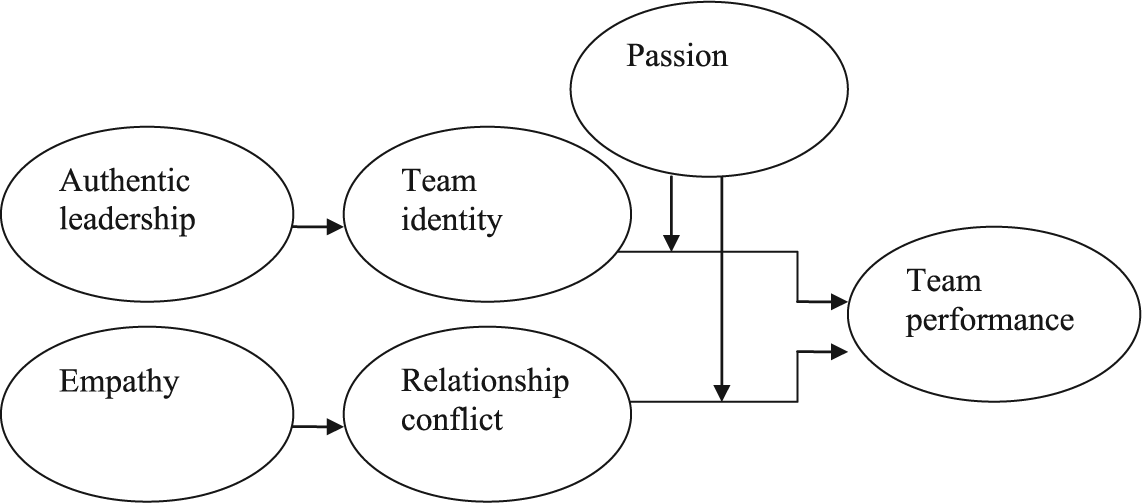
Research model.
This study focuses on the team level of analysis so as to capture the social construction of authentic leadership and collective empathy. Authentic leadership and collective empathy are included as key predictors in this study because they are both important social contagious factors in teaming contexts according to social contagion theory. Authentic leadership represents a managerial contagion for building the collective connectedness and attachment of the team (Clapp-Smith, Vogelgesang, & Avey, 2009; Rego, Vitória, Magalhães, Ribeiro, & e Cunha, 2013), whereas collective empathy is a within-team contagion for improving relational distress among team members (Chiaramonte, 2008; Westman, Brough, & Kalliath, 2009) and reducing relationship conflict in the team (King, 2002; Roberge, 2013).
This study focuses on group management to capture what previous research (Clapp-Smith et al., 2009) deemed essential for understanding a team’s establishment in depth under authentic leadership. Scholars examining authentic leadership have found a great value in studying this leadership style at the team level (Hmieleski, Cole, & Baron, 2012). Similarly, Walumbwa, Avolio, Gardner, Wernsing, and Peterson (2008) have indicated that authentic leadership has a great potential for team-level analyses or organization-level analyses. Meindl (1995) provides a strong theoretical justification for research in leadership to consider variables at the team level to appropriately capture the social group construction of leadership. Taken together, the prior literature shows that team identity is likely reinforced by the authenticity of team leaders.
It is important to note that authentic leadership is strongly relevant to team process (Wong & Cummings, 2009) and collective social categorization (i.e., team identity; Gardner, Avolio, Luthans, May, & Walumbwa, 2005) instead of interpersonal relationship issues (e.g., relationship conflict). On the contrary, collective empathy is highly relevant to prosocial behavior and interpersonal understanding (i.e., social relationship and conflict; Zahavi & Overgaard, 2012) but less relevant to group-specific social identity (i.e., team identity).
Social identity theory explains how employees classify themselves into a certain team with the emotional and value significance of this team’s membership to them (Ku, 2014). This theory is very useful for understanding how employees’ membership of a certain team influences their behavioral outcome (e.g., team performance; Benckendorff & Pearce, 2012). For example, Klein, Spears, and Reicher (2007) have suggested that social identity plays a major role in the elaboration and coordination of a team’s action because it shapes collective power in unison for achieving the team’s goal. Meanwhile, social identity theory is effective in explaining how team identity is driven by authentic leadership because such leadership stresses the idea of leading by example (i.e., role modeling) to strengthen employees’ identity through setting high moral standards, honesty, and integrity (Avolio, Gardner, Walumbwa, Luthans, & May, 2004). Collectively, based on social identity theory, this study justifies the relationships among authentic leadership, team identity, and team performance in the following.
Team identity is defined as individuals’ affective bond and perceived connectedness to a team by their considering the successes and failures of the team as their collective experiences (Somech, Desivilya, & Lidogoster, 2009). While team identification is viewed as an individual-level factor, Lembke and Wilson (1998) introduced team identity as a team-level factor that represents the collective identification aggregated across all the members of a team (e.g., Desivilya et al., 2010).
Lembke and Wilson (1998) have applied social identity theory to help explain the importance of team identity for team performance. Social identity theory suggests that team members’ self-concept is dependent on affiliation with their team, facilitating the members’ collective effort and performance (Gundlach et al., 2006). Specifically, team identity not only enhances team performance by unifying team members as a socially identifiable whole but also prevents individual members from being distracted by their own personal goals that constrains collective performance (Gundlach et al., 2006; Van Der Vegt, Van De Vliert, & Oosterhof, 2003).
Having its direct effect on team performance, team identity is motivated by authentic leadership. Authentic leadership is defined as a team leader’s ability to promote positive psychological capacities and an ethical climate in the team to strengthen collective self-awareness, internalized moral aspects, balanced processing of information, and a sense of “togetherness” and “oneness” (e.g., Nielsen, Eid, Mearns, & Larsson, 2013; Walumbwa et al., 2008). Authentic leadership extends beyond the authenticity of the leader as a person to encompass authentic relations with his or her subordinates (Nielsen et al., 2013) and instills powerful social processes that stimulate the members’ states, identification, and behavior, consequently motivating team performance (Walumbwa, Luthans, Avey, & Oke, 2011; Walumbwa, Peterson, Avolio, & Hartnell, 2010). The first hypothesis regarding the mediating role of team identity is thus stated as below.
Relationship conflict is defined herein as overall interpersonal incompatibilities in the team (Auh, Spyropoulou, Menguc, & Uslu, 2014). Previous literature suggests that the damaging effect of relationship conflict in a team can trickle upward and negatively influence team performance (de Jong, Curşeu, & Leenders, 2014) due to in part that such conflict induces various dysfunctional, sabotage, or antagonistic behaviors that constrain team performance improvement (e.g., De Dreu & Beersma, 2005; Friedman, Tidd, Currall, & Tsai, 2000; Medina, Munduate, Dorado, Martínez, & Guerra, 2005), suggesting a negative relationship between relationship conflict and team performance.
Defined as the ability to comprehend each other’s feelings and to reexperience them oneself (Clapp-Smith et al., 2009), collective empathy promotes social bonds and alleviates interpersonal tension (Plutchik, 1987), thus reducing relationship conflict. Management literature has emphasized empathy as the fundamental competence of social relationship in workplaces (McCullough, Worthington, & Rachal, 1997). The ability to be empathetic and to understand the different perspective of others can increase a team’s learning capacity (Guinot, Chiva, & Mallén, 2015) for reducing relationship conflict, eventually improving team performance. Hence, relationship conflict is posited as a full mediator that explains how collective empathy indirectly affects team performance. Accordingly, the second hypothesis is derived as below.
Passion is defined in this study as an inclination toward team activity that team members love and value (and thus find important), and in which they invest time and efforts together (Vallerand et al., 2003). Passion (e.g., harmonious passion) represents a strong motivating force to take part in team activities (Vallerand et al., 2003). Vallerand (1997) has indicated that the activities team members are passionate about can be incorporated in the members’ self-concept and thus strengthen the relationship between team identity and team performance. Passion can make a difference in team outcomes through its impact on team processes (Lee, Bassellier, & Faraj, 2014) in which the effect of team identity on team performance is amplified more highly. For example, previous research has argued that passion is a stronger motivator than simple intrinsic motivation, because team members possessing it internalize the team activity as part of their identity (Amabile & Pillemer, 2012). Given higher passion, team members become more sensitive to their perceived connectedness to a team and care more for the team’s success or failures, ultimately leading to higher team performance. Accordingly, the third hypothesis is derived as below.
Team members with a passion can find themselves in the position of experiencing an exciting urge to partake in the activity they view as important and enjoyable. Literature indicates that passion can improve the quality of the interpersonal relationship (Vallerand, 2008). Previous research (Lafrenière, Jowett, Vallerand, Donahue, & Lorimer, 2008; Philippe et al., 2010; Vallerand, 2008) revealed that passion made a significant contribution to the level of satisfaction for partners’ relationship. Analogous to the findings in prior research on passion for partners’ relationship (Vallerand, 2008; Yim, Tse, & Chan, 2008), this study argues that passion can mitigate the potential threat of relationship conflict on team performance. This is understandable because when team members have a higher passion about their teamwork, they are more likely to have a strong tolerance during social interaction in the team. As a result, the effect of relationship conflict on team performance is weakened, leading to the following hypothesis.
Method
Subjects
This study conducted a survey of professionals working in service teams from high-tech and financial firms in three major industrial zones and science parks in Taiwan for the purpose of empirically testing its hypotheses. Initially, this study invited the alumni of one of top universities in Taiwan who work professionally in financial or high-tech firms to help with data collection, targeting a total of 25 large firms. As suggested by Jackson et al. (1991) that the minimum size for studying a team should be at least three members, this study excluded teams smaller than five people in its investigation so that four members and one team leader from each team can be surveyed. In this study, a total of 100 teams were surveyed, with 348 usable questionnaires from 70 teams (i.e., responses from 70 leaders and 278 team members) returned eventually for a team-based response rate of 70%.
To avoid common method variances (CMV), this study survey different respondents for measuring different variables. Specifically, authentic leadership, empathy, and passion were measured by team members, while team performance, team identity, and relationship conflict were measured by team leaders. It is proper to measure team performance and its relevant variables (such as team identity and team conflict) by team leaders in this team-level research because previous literature has stressed that team leaders often have a flexible and holistic view for objectively evaluating the entire team’s collective tension or outcomes (Cooper & Wakelam, 1999). Previous literature has emphasized that the specific level of analysis depends on what type of data we collect and who we collect the data from (Bhattacherjee, 2012). For example, CEO pay may seem like an individual-level variable, but in fact, it can also be an organizational-level variable because each organization has only one CEO pay at all time (Bhattacherjee, 2012). As another example, Sung and Choi (2012) has examined team creativity measured by team leaders in their study. Similarly, in the study by X. Y. Liu & Härtel (2013), group performance, group efficacy, and workgroup emotional labor were all measured by team leaders. With regard to team performance (i.e., team-level performance), it has been commonly measured by team leaders across many previous studies (Kirkman, Tesluk, & Rosen, 2001; X. Y. Liu & Härtel, 2013; Pearce, Gallagher, & Ensley, 2002; Sui, Wang, Kirkman, & Li, 2015; Webber & Donahue, 2001; Yang & Zhang, 2014).
The method of measuring different variables by team members and their leaders in this study is far superior to any other post hoc statistical methods for detecting CMV (Baruch & Lin, 2012). Prior research has strongly recommended that the best way to avoid CMV is just to arrange different respondents to measure different variables (Chang, Van Witteloostuijn, & Eden, 2010). Moreover, testing moderating effects hypothesized in this study has the advantage of mitigating the threat of CMV (Chen & Lin, 2013), because complex relationships caused by a moderator are less susceptible to CMV given that such relationships are unlikely to be a part of respondents’ cognitive maps (Chang et al., 2010).
Measures
The variables in this study were measured using 5-point Likert-type scales drawn and modified from existing literature. The questionnaires were repeatedly refined by a focus group of five researchers familiar with organizational behavior, including four graduate students and one professor. Based on our pilot test using exploratory factor analysis, inappropriate items due to substantial cross-loading were modified or removed from our survey questionnaire. Respondents for the pilot study were excluded from the actual survey. Appendix A lists all the scale items used in this study and their sources.
The survey data in this study were aggregated to the level of teams for data analysis. This approach is strongly recommended by Rousseau (1985), who argued that the level of analysis should be chosen on the basis of the focal unit of the research—the teams (e.g., Baruch & Lin, 2012; Dirks, 2000; M. L. Liu et al., 2015). Concentrating on the team-level analysis is essential in this research, since the outcome variable (i.e., team performance) herein is a function of the collective outcome of team members (i.e., the aggregated result of individuals). Because it is necessary to determine whether data aggregation is properly justifiable, this study computed ICC1 (intraclass correlation coefficient), ICC2, and rwg of its factors (see Appendix B), showing that our ICC1 values were larger than the 0.12 criteria suggested by James (1982) and our ICC2 values were all above the 0.6 criteria suggested by Glick (1985; e.g., Salamon & Robinson, 2008).
Given the acceptable results of team-level aggregation above, team-level data were first analyzed using exploratory factor analysis. The results of team-level exploratory factor analysis and reliabilities are provided in Appendices C and D. In the two appendices, three factors measured by team members and another three factors measured by team leaders emerged from the analysis with all eigenvalues greater than 1.0, corresponding to the hypothesized factor structure. All same-factor loadings were greater than 0.60, meeting the standard acceptance criterion for convergent validity (Hatcher & Stepanski, 1994). Moreover, all the possible cross-factor loadings were less than 0.40 (the traditional acceptance criterion for discriminant validity). In addition, reliability analysis indicates that each factor had a Cronbach’s alpha of .87 or higher, and the reliability is thus supported. These results show that the empirical data capture substantial variances in the underlying factors of this study. For that reason, these data would be properly used for our further analysis to provide the final empirical results in the next section.
Results
To confirm the full mediation effects hypothesized herein, this study conducted an analysis with three steps proposed by Kenny, Kashy, and Bolger (1998), which had been popularly applied in the literature (e.g., Frazier, Tix, & Barron, 2004). It is important to note that even though Baron and Kenny (1986) initially proposed four steps for testing mediation models, they and many other scholars further found in recent research that the first step was not required for verifying mediation (Barraud-Didier, Henninger, & El Akremi, 2012; Carmeli & Paulus, 2015; Emsley, Dunn, & White, 2010; Frazier et al., 2004; Kenny et al., 1998; MacKinnon, 2008; Staats et al., 2009). A typical example is a situation in which a treatment does not appear to be effective (i.e., insignificant effects of predictor on outcomes), because multiple mediators produce inconsistent effects (Collins, Graham, & Flaherty, 1998; MacKinnon, Krull, & Lockwood, 2000). For that reason, we follow the aforementioned studies by using their three steps for testing mediation models with team-level data.
This study tested mediation models with team-level data by simultaneously including five control variables (e.g., industry type, the ratio of members’ difference in gender, the tenure of the team’s leader; see Table 1). These control variables are adequate for empirically justifiable reasons due to their high relevance to teamwork (e.g., Goldsmith, Flynn, Goldsmith, & Kim, 2013).
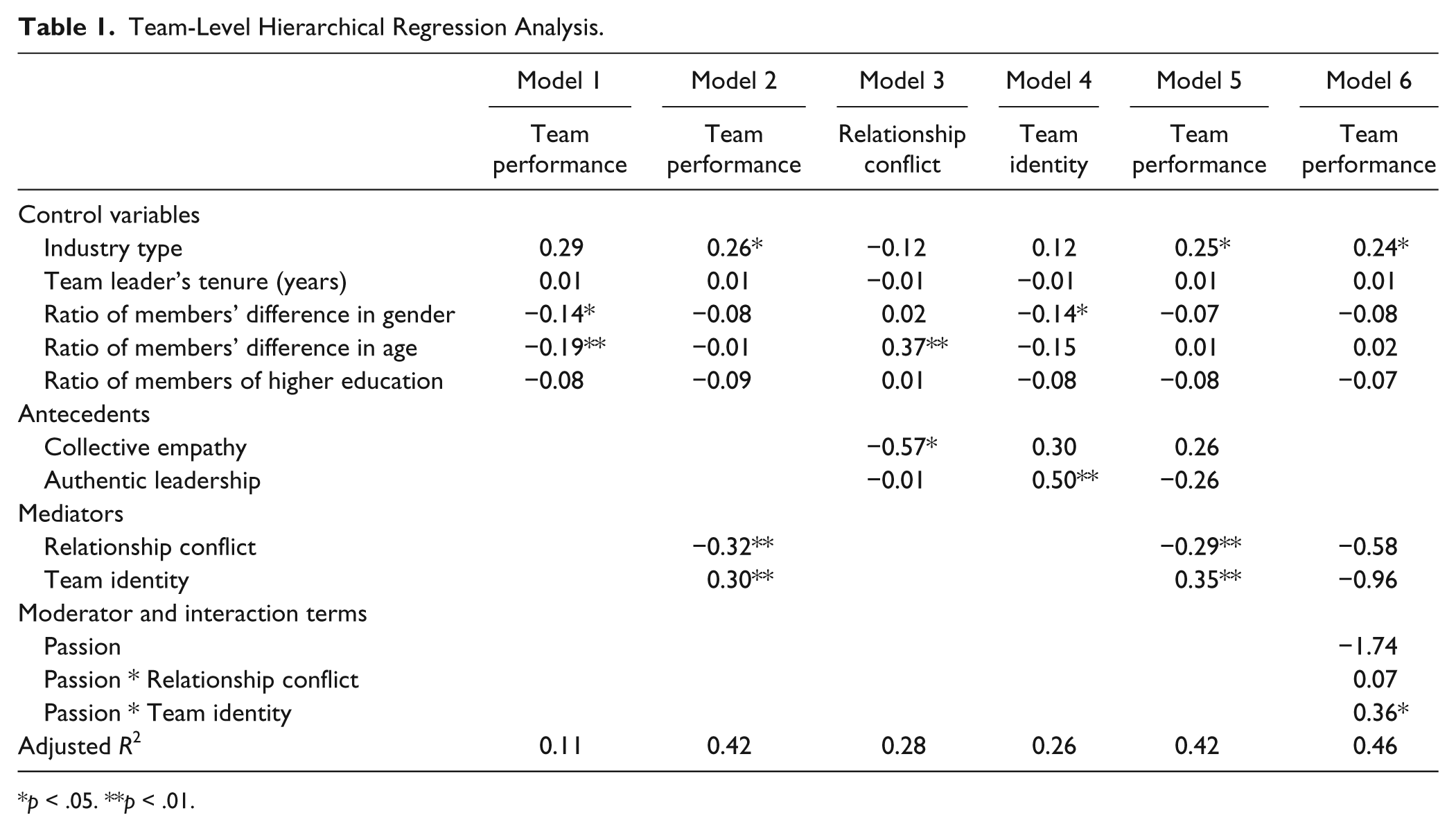
Team-Level Hierarchical Regression Analysis.
p < .05. **p < .01.
This study first includes our five control variables to explain team performance in Model 1 and then adds its two mediators (i.e., team identity and relationship conflict) in Model 2. The test results (see Models 1 and 2) show that team identity and relationship conflict are indeed positively related to team performance. In Models 3 and 4, this study includes collective empathy and authentic leadership to explain the two mediators. The test results in Models 3 and 4 shows a negative association between collective empathy and relationship conflict and a positive association between authentic leadership and team identity. The test results in Model 5 show that only the mediators rather than antecedents are significantly related to team performance, supporting the full mediation of relationship conflict and team identity (thus, Hypotheses 1 and 2 are supported). Collectively, the empirical results are twofold: (a) Authentic leadership indirectly relates to team performance only through the significant mediation of team identity and (b) Empathy indirectly relates to team performance only through the significant mediation of relationship conflict.
Finally, in Model 6, this study includes the interaction terms of passion to test its moderating effects. The test results show that passion significantly moderates the association between team identity and team performance, suggesting that Hypothesis 3 is supported but Hypothesis 4 is not supported. Hence, the empirical results show that passion positively moderates the relationship between team identity and team performance, such that the relationship is stronger when passion is higher.
The unsupported Hypothesis 4 implies a steady influence of relationship conflict on team performance regardless of different levels of passion. The empirical result for this unsupported hypothesis warrants further study in depth so that the true reason behind the unsupported moderation of passion herein would not be misinterpreted.
Finally, this study performs Sobel tests (Preacher, Rucker, & Hayes, 2007) as a post hoc assessment for further confirming the hypothesized mediating roles of team identity and relationship conflict. The Sobel test is a specialized t test that offers a statistical method to determine whether the reduction in the effect of the independent variable, after the inclusion of the mediator, is a significant reduction and therefore confirms whether the mediation effect is significant (Chen & Lin, 2013; Preacher & Hayes, 2004). When testing the mediation of team identity between authentic leadership and team performance, we obtained the Sobel test statistic of 3.36 (standard error [SE] = 0.096; p = .001). Meanwhile, when testing the mediation of relationship conflict between empathy and team performance, we obtained the Sobel test statistic of −2.70 (SE = 0.110; p = .007). All in all, the test results support the mediating roles of team identity and relationship conflict.
Discussion
Although much literature has studied team identity and relationship conflict, there exists a critical research gap regarding their simultaneous mediation in the formation of team performance. This study is a pioneer that provides important findings to complement the literature by empirically verifying these two full mediators and their predictors for explaining team performance, and how their relationship with team performance is moderated by passion.
Theoretical Implication
The findings of this study have two crucial theoretical implications. First, this study assesses the development of team performance by integrating social identity theory and conflict theory in a single model setting, which has not been tried in previous literature. While conflict theory effectively explains the struggles of interpersonal relationships (Kellermanns & Eddleston, 2004), social identity theory elaborates the process by which team members identify with their team in unison (Ashforth & Mael, 1989; Hogg & Terry, 2000). Complementing previous research, this study advances to integrate these two theories and find that (a) Team identity can be fostered specifically from a holistic point of view based on ethics and value (i.e., authentic leadership) and (b) Relationship conflict can be substantially alleviated through an empathy-based understanding from a reciprocal perspective (Björkqvist, Österman, & Kaukiainen, 2000).
Second, this study bridges the interaction between social identity theory and broaden-and-build theory by showing how the influence of team identity on team performance is moderated by passion. Previous research based on broaden-and-build theory has indicated the importance of positive emotion for team performance (Demerouti & Cropanzano, 2010). This study extends the traditional application of broaden-and-build theory and finds that the resilience and coping within the social environment in which people tend to classify themselves into the same social group can be reinforced through passion experiences. For that reason, passion boosts the effect of team identity on team performance.
Managerial Implications
The full mediation of team identity between authentic leadership and team performance suggests that team identity can be used as an indicator for team leaders to learn the degree to which their authenticity style needs to be further addressed. Previous research (Avolio & Gardner, 2005) has described social identification processes that are affected by how followers come to identify with authentic leaders and their values. Extending the previous research, this work presents the role of authentic leadership as a key predictor to clarify how team identity channels the effect of authentic leadership in the formation of team performance. Management responsible for training and education may need to provide assistance to team leaders when their team’s identity is found to decrease sharply. Management should develop learning programs for leaders by taking their team members’ opinions about authenticity into account. Authentic leadership can positively motivate team identity when such leadership is strongly perceived from the viewpoint of team members instead of that of their team leader.
The full mediation of relationship conflict between collective empathy and team performance suggests that managers should do their best to nurture collective empathy by activities such as mindfulness training, exposure to human stories involving interpersonal communication, and so on. People’s collective empathy can be increased by their perspective taking of others’ thoughts and feelings and the mutual understanding of each other’s moods in workplaces. For that reason, team members’ social interaction skills in terms of nonverbal cues should be reinforced because it has been documented that empathy counts heavily on nonverbal cues in face-to-face communication (e.g., Ickes, 1997; Ickes, Stinson, Bissonnette, & Garcia, 1990). Meanwhile, managers should also keep an eye on relationship conflict to avoid its negative effect on team performance.
The significant moderating effect of passion on the relationship between team identity and team performance suggests that maintaining a team’s passion helps amplify the influence of team identity that eventually motivates team performance to a large extent. Management should strengthen the aggregated passion of team members by providing multiple opportunities for them to speak out regarding the barriers to increase their passion. For example, drastic changes in workplaces may be a typical kind of barrier for maintaining passion (e.g., Phelps & Benson, 2012), team members should hold a positive stance toward unexpected changes and learn to adjust themselves to cope with the change process. Being optimistic about potential changes in workplaces and to handle the changes for self-renewal purposes will enhance the feasibility for passion improvement.
Limitations
There are two limitations in this study. The first limitation relates to its survey in a single country setting—Taiwan. For that reason, the generalizability of the findings may be limited. Second, while this study focuses on two key exogenous predictors (i.e., authentic leadership and collective empathy) from the aspect of social contagion, it does not include variables from other theoretical perspectives such as coopetition (e.g., De Dreu & Van Vianen, 2001), team structure, or social network (e.g., Henttonen, Johanson, & Janhonen, 2014).
Future scholars are advised to include more control variables (e.g., competence, personality, traits, etc.) and explore other potential predictors (e.g., interdependence, self-leadership) or teams’ characteristics (e.g., heterogeneity) beyond the scope of the social identity theory and conflict theory. Additional research across different nations for comparison may be helpful to complement the findings of this study. As the effects of mediation and moderation discussed in this study may vary across cultures or values, future research may conduct comparison studies across different regional cultures (e.g., Eastern vs. Western), national cultures (e.g., individualism, power distance, uncertainty, etc.), or industrial sectors (e.g., traditional manufacturing, tourism, etc.) so as to effectively increase the applicability of our research results across various contexts.
Footnotes
Appendix A
Declaration of Conflicting Interests
The author(s) declared no potential conflicts of interest with respect to the research, authorship, and/or publication of this article.
Funding
The author(s) disclosed receipt of the following financial support for the research, authorship, and/or publication of this article: This research was supported by Ministry of Science and Technology, Taiwan.