







Abstract
This study adds to the existing literature by empirically demonstrating that psychological climate is an important variable in understanding the relationships between abusive supervision and employee outcomes. Using psychological contract theory as a framework, we examined the relationships among abusive supervision, psychological climate, felt violation, and three work outcomes: organizational commitment, job satisfaction, and turnover intentions. Results from a survey of 448 civilian managers employed by the U.S. government showed that the relationship between abusive supervision and felt violation was moderated by psychological climate, suggesting that an abuse-intolerant climate heighted rather than buffered the effects of abuse on felt violation. Felt violation also partially mediated the relationship between abuse and the outcome variables. Using Muller, Judd, and Yzerbyt’s method for testing moderated mediation, we found partial support for felt violation mediating the effect of the interaction between abuse and psychological climate on job satisfaction and organizational commitment. This model was not supported for turnover intentions. Implications of the results and suggestions for future research on abusive supervision are discussed.
Abusive supervision has been defined by Tepper (2000) as “subordinates perceptions of the extent to which supervisors engage in the sustained display of hostile verbal and nonverbal behaviors, excluding physical contact” (p. 178). Much of the research on abusive supervision has investigated its consequences, and a substantial body of work indicates that such behavior is negatively associated with job satisfaction (Tepper, 2000), organizational commitment (Duffy, Ganster, & Pagon, 2002) and psychological well-being (Bowling & Beehr, 2006; Tepper, 2000; Tepper, Moss, Lockhart, & Carr, 2007) and positively related to turnover intentions (Tepper, 2000). Abusive supervision has also been found to adversely affect in-role job performance (Xu, Huang, Lam, & Miao, 2012), citizenship behaviors (Zellars, Tepper, and Duffy, 2002), and employee deviance (Brees, Mackey, Martinko, & Harvey, 2014; Lian, Ferris, & Brown, 2012; Mitchell & Ambrose, 2007; Tepper, Henle, Lambert, Giacalone, & Duffy, 2008).
Given the destructive consequences associated with abusive supervision, it is necessary to more fully understand the factors that lead to its occurrence. Compared with the consequences of abusive supervision, much less is known about the underlying causes or antecedents of this phenomenon, and the factors that may moderate the impact of abusive supervision on employee outcomes (Martinko, Harvey, Brees, & Mackey, 2013; Mitchell & Ambrose, 2007; Tepper, 2007). The present study addresses these shortcomings by investigating the role of psychological climate as an antecedent of abuse and as a moderator of employee responses to such abuse. We also examine the role of felt violation in explaining how supervisory abuse and psychological climate combine to affect work attitudes. As shown in Figure 1, we propose a moderated mediated model whereby felt violation mediates the effects of abuse on worker attitudes and psychological climate moderates the effect of abuse on perceptions of felt violation. The direct links between abuse and the three outcome variables in our model have been previously established in prior research as has the relationship between felt violation and the outcome variables. The incremental contributions of our model are twofold. One, we test the mediating role of felt violation in explaining the abuse/outcome relationships. While some prior work has theorized about the role of contact breach and violation in understanding reactions to abuse (Ahmed & Muchiri, 2014; Parzefall & Salin, 2010; Restubog, Scott, & Zagenczyk, 2011), we know of no empirical work that has tested this position. Second, we examine psychological climate as an antecedent of abuse and as a moderator of its effect on felt violation. As we elaborate on in the following sections, while increased attention is being devoted to uncovering the antecedents and moderators of abusive supervision, situational factors like climate have been underresearched.
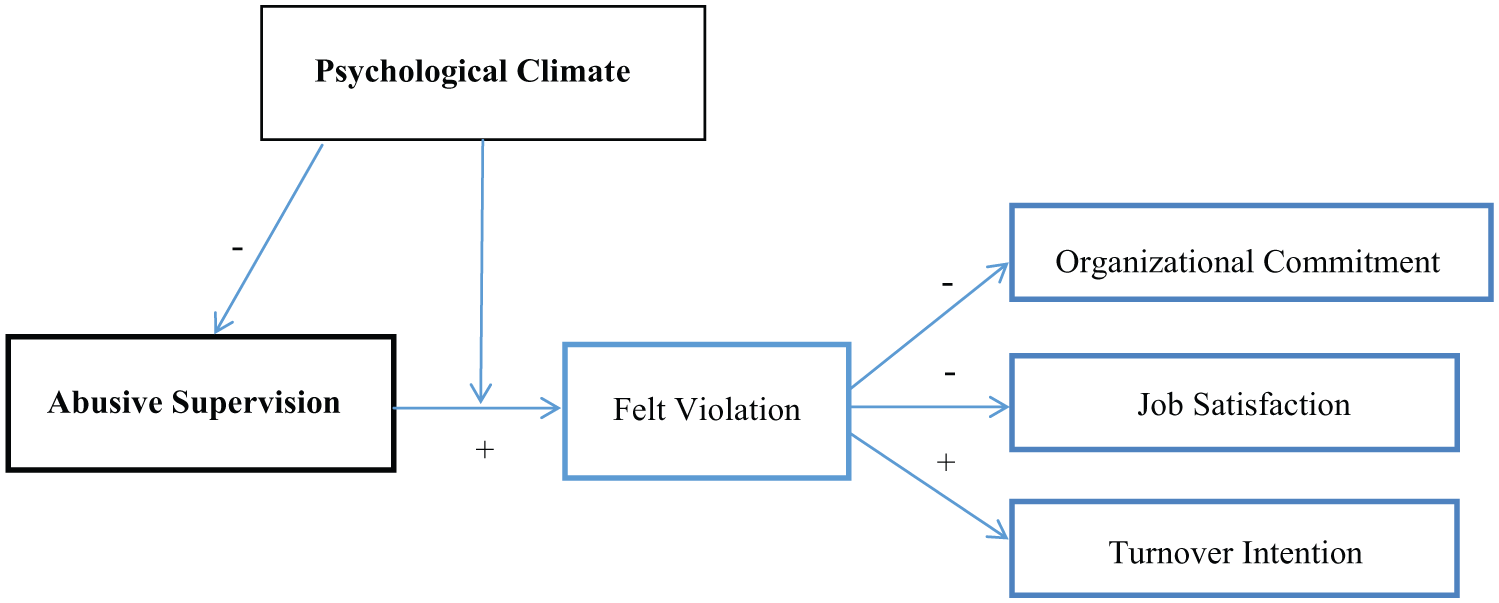
Hypothesized model.
Climate as an Antecedent to Abusive Supervision
The role that broader workplace environment or contextual factors play in abusive supervision has been underemphasized relative to supervisor characteristics (Ayree, Chen, Sun, & Debrah, 2007; Garcia, Restubog, Kiewitz, Scott, & Tang, 2014; Tepper, Duffy, Henle, & Lambert, 2006). In this study, we investigated one potential work environment factor, namely, psychological climate. According to Schneider and Reichers (1983), climate is a set of shared perceptions regarding the policies, practices, and procedures that an organization rewards, supports, and expects. Kuenzi and Schminke (2009) made an important distinction between psychological versus organizational climate. Psychological climate is an individual-level construct and reflects an individual’s perceptions of the psychological impact of the work environment on his or her well-being, while organizational climate represents shared perceptions (aggregated from individual-level data) among a group of employees regarding their perception of the work environment. As noted by Schneider, White, and Paul (1998) and others (Kuenzi & Schminke, 2009; Victor & Cullen, 1988; Zohar, 2000), climate is best viewed as facet-specific since different climates exist for particular aspects of the organizational environment (e.g., safety climate, diversity climate). Consistent with this perspective, we investigated the impact of an organization’s climate for abuse by higher status individuals, like supervisors, on employee perceptions of and reactions to abuse. We refer to a more positive climate as abuse intolerant and consider a more negative climate for abuse as an abuse-tolerant environment.
Attention to psychological and organizational climate as a determinant of employee attitudes and behavior has grown in recent years, as researchers have recognized the importance of organizational context in shaping individual attitudes and behavior in the workplace (Kopelman, Brief, & Guzzo, 1990; Kuenzi & Schminke, 2009). While some recent work has examined the effects of abusive supervision climate on group-level phenomena, such as cooperation and collective efficacy (Priesemuth, Schminke, Ambrose, & Folger, 2014), at present, there is very little work that empirically connects aspects of climate and abusive supervision at the individual level. A number of scholars have theorized about the role that organizational context may play in the frequency of abusive supervision and aggressive behavior (Bowling & Beehr, 2006; Salin & Hoel, 2011; Tepper, 2007). For example, overly hierarchical organizations may promote an environment where bullying and abusive supervision can flourish, are often rewarded, and become embedded into an organization’s culture, leading employees to view such behavior as normal and acceptable for goal accomplishment (Aquino & Lamertz, 2004; Brodsky, 1976; Einarsen, 1999; Langan-Fox & Sankey, 2007). Management may tolerate rude and abusive behavior, fail to establish clear policies and standards for acceptable behavior, and/or do little to punish perpetrators.
In a recent empirical study, Restubog et al. (2011) found that supervisors who perceived stronger norms toward aggressive behavior in their organization were perceived as more abusive by their subordinates, providing support for the role of organizational context in triggering abusive supervision. Studies in the broader workplace victimization area also support the importance of organizational context as an antecedent to employee hostility and aggression. Cooper-Thomas et al. (2013) found that antibullying initiatives in organizations led to less bullying behavior, and Giorgi (2010) reported a negative relationship between overall workplace climate and reports of bullying. Thus, we predicted that a psychological climate that was perceived to be abuse intolerant rather than abuse tolerant would be associated with lower levels of abusive supervision.
Abusive Supervision, Felt Violation, and Work Outcomes
Aside from directly influencing the level of supervisory abuse, we argue that perceived climate surrounding the organization’s tolerance for abuse can also influence employee responses to this behavior. We examined three work outcomes in this study: organizational commitment, job satisfaction, and turnover intentions. We focused on affective organizational commitment, one’s psychological attachment to the organization, because it is the type of commitment that has been studied most frequently in the organizational behavior literature (compared with normative or continuance commitment), has been shown to be an outcome of abusive supervision (Ayree et al., 2007; Tepper, 2000; Tepper, Duffy, Hoobler, & Ensley, 2004), and has exhibited the strongest, most consistent links to other outcomes of interest, like performance (Judge & Kammeyer-Mueller, 2012; Meyer, Stanley, Herscovitch, & Topolnytsky, 2002). Abusive supervision has also been negatively linked to job satisfaction (Kessler, Spector, Chang, & Parr, 2008; Palanski, Avey, & Jiraporn, 2014; Tepper, 2000). It is not surprising that exposure to negative treatment from one’s supervisor can lead to dislike for a job, especially given the impact that supervisors exert on an employee’s day-to-day work life. Measuring both job satisfaction and organizational commitment allows for an investigation of the effects of abuse and climate on attitudes directed at different targets—the job and the organization. Greater intentions to leave the organization have also been linked to abusive supervision (Harvey, Stoner, Hochwarter, & Kacmar, 2007; Palanski et al., 2014; Tepper, 2000). Turnover intentions are an important outcome to consider since they are one of the most important predictors of actual withdrawal behavior (Griffeth, Hom, & Gaertner, 2000; Holtom, Mitchell, Lee, & Eberly, 2008).
Several authors in the workplace aggression literature have suggested that positive contextual factors in the work environment can buffer the negative effects of abusive behavior. Law, Dollard, Tuckey, and Dormann (2011) and Bond, Tuckey, and Dollard (2010) argued that a positive psychosocial safety climate, defined as employee perceptions of management’s commitment to protecting workers’ psychological health and safety, can serve to decrease the effects of mistreatment, resulting in lower levels of psychological distress and strain. Law et al.’s (2011) results indicated that high levels of psychosocial safety climate decreased the effects of bullying/harassment on employee perceptions of psychological distress, emotional exhaustion, and work engagement. In Bond et al.’s (2010) study of police officers, high psychosocial safety climate lessened the effects of bullying on officers’ posttraumatic stress symptoms. In a related vein, Cooper-Thomas et al. (2013) found that organizational initiatives against bullying that were judged effective decreased the negative effects of bullying on psychological well-being and organizational commitment.
It should be noted that the aforementioned three studies looked at the effects of workplace bullying, a related but sufficiently distinct construct from abusive supervision (Tepper, 2007). Workplace bullying can be considered more wide ranging since respondents may be asked to report instances of bullying from coworkers at all levels (supervisors, peers, and/or subordinates; Hoel, Cooper, & Faragher, 2001). Many of these studies do not separate out the effects of hostile actions committed by supervisors alone. Thus, these studies do not address the independent effects of abusive supervision per se and suggest that additional work is necessary. In fact, some of the positive effects of contextual factors, like psychological safety climate, may be weakened when first-level supervisors (as opposed to peers) are the actual perpetrators of the abuse. In other words, supervisors may be viewed as part of the problem rather than a viable solution. Any positive signals emanating from an abuse-intolerant organizational climate may be contradicted if one’s supervisor is seen as abusive.
We draw on psychological contract theory (Robinson & Morrison, 2000; Rousseau, 1995) to argue that working for an abusive supervisor when the organization promotes an abuse-intolerant environment may actually heighten, as opposed to buffer, negative subordinate reactions. Psychological contract theory is predicated on the assumption that employees form perceptions regarding the mutual obligations that exist between themselves and their employer. A psychological contract is defined as “individual beliefs, shaped by the organization, regarding terms of an exchange agreement between individuals and their organization” (Rousseau, 1995, p. 9). This construct is seen as an important lens in which to understand the quality of employer–employee relationships (Zhao, Wayne, Glibkowski, & Bravo, 2007). Exchanges can involve both transactional (e.g., obligations about pay or benefits) and relational content (e.g., obligations about career development opportunities, personal support from managers). Relational exchanges are most relevant to the quality of subordinate–supervisor relationships and instances of abusive supervisory behavior.
Two important components of psychological contract theory are the concepts of breach and violation. According to Robinson and Morrison (2000), breach is the cognitive evaluation that one’s organization has failed to fulfill its promises or obligations, whereas violation is the emotional and affective state that follows from breach cognitions, frequently leading to feelings of disappointment, anger, and betrayal. We see supervisor abuse as a salient workplace event that is likely to be seen as breaking the employee’s relational contract with his/her employer, triggering strong affective reactions in the form of felt violation. As noted by Parzefall and Salin (2010), being subjected to abusive supervision defies conventional expectations of fair treatment and violates the norm of reciprocity governing most employee–employer exchange relationships. As such, we hypothesize the following:
A substantial body of work has demonstrated that felt violation is significantly related to the outcomes of interest in this study. Thus, consistent with prior research, we expect felt violation to be positively correlated with turnover intentions, and negatively associated with job satisfaction and organizational commitment (Dulac, Coyle-Shapiro, Henderson, & Wayne, 2008; Robinson & Rousseau, 1994; Suazo, 2009; Zhao et al., 2007).
Climate as Moderator of Abuse-Felt Violation Relationship
We predict that climate will moderate the relationship between abusive supervision and felt violation. Mistreatment from one’s supervisor is likely to be perceived as a violation of an employee’s relational contract with the organization more so under an abuse-intolerant as opposed to an abuse-tolerant organizational climate. Victims of abusive supervision often hold the organization partially responsible for a supervisor’s bad behavior (Aquino & Lamertz, 2004; Bowling & Beehr, 2006; Shoss, Eisenberger, Restubog, & Zagenczyk, 2013), and this effect may be exacerbated when employees believe that the organization has failed to follow through on implied promises for a supportive, abuse-free work environment. Rather than buffering the effects of abuse, we predict that an intolerant, relative to a tolerant, climate toward abuse will heighten employee reactions. Lian et al. (2012) found that the negative effects of abusive supervision on employee deviance were exacerbated, rather than weakened, under high levels of leader–member exchange. These authors reasoned that negative treatment from a supervisor would have a more powerful effect when the behavior occurred as part of a generally supportive relationship than when it occurred in the context of a generally unsupportive relationship. We make an analogous argument for understanding the potentially conflicting signals emanating from a supervisor and the organization’s psychological climate. In a generally supportive psychological climate, instances of supervisory mistreatment may be seen as more surprising and unusual, leading to more negative effects than the same treatment experienced in a less supportive or abuse-tolerant environment.
In sum, as shown in Figure 1, we predict that abusive supervision is positively related to perceptions of felt violation, and this positive relationship is moderated by climate. Felt violation, in turn, relates negatively to organizational commitment and job satisfaction and positively to turnover intentions. Our model predicts the following relationships:
Method
Sample and Procedures
We tested our hypotheses using survey data collected from members of the Senior Executive Association, a professional organization for managers employed in the U.S. federal government’s departments and agencies. Approximately 1,300 members of this organization received a mail survey; we received 443 completed surveys for a response rate of 34%. The mean age of our sample was 55, and 32.7% were women. Eighty-five percent of the respondents were Caucasian, 6.5% were African American, 3.8% were Hispanic or Latino, and 4.6% were Asian. Our respondents were highly educated, with 73% of them holding graduate degrees. Eighty-three percent had been employed by the federal government for more than 20 years, and 56% had been working for their current department or agency for more than 20 years.
Measures
Abusive Supervision
We used nine items from Tepper’s (2000) abusive supervision scale to measure this variable. Respondents rated how often their immediate supervisor had engaged in a number of undermining behaviors, with response categories for each item ranging as follows: 0 = never, 1 = occasionally (less than monthly), 2 = monthly, 3 = weekly, and 4 = daily. Cronbach’s alpha for this measure was .90.
Job Satisfaction
This variable was assessed with the three-item overall satisfaction subscale from the Michigan Organizational Assessment Questionnaire (Cammann, Fichman, Jenkins, & Klesh, 1979), using the following response scale: 1 = strongly disagree to 5 = strongly agree. Cronbach’s alpha was .90.
Felt Violation
We used two items from Robinson and Morrison’s (2000) four-item felt violation scale using a 7-point scale ranging from 1 = strongly disagree to 7 = strongly agree. The two items were highly intercorrelated, r = .80.
Organizational Commitment
This variable was assessed by the six-item affective commitment scale developed by Meyer, Allen, and Smith (1993). Respondents indicated their agreement with each item on a 7-point scale ranging from 1 = strongly disagree to 7 = strongly agree. Cronbach’s alpha for the sample was .86.
Turnover Intentions
Turnover intentions were measured using a two-item scale (1 = strongly disagree, 7 = strongly agree); respondents were asked how likely it was that they would search for a position with another employer and how likely it was that they would leave the organization in the next year. The two items were intercorrelated, r = .57.
Psychological Climate (Tolerance for Abuse)
The dimension of climate we focused on reflected employee perceptions of how tolerant the organization was toward supervisor abuse and harassment. One aspect of this climate facet can be seen in the steps taken by the organization to develop strong policies against abusive behavior and to educate the workforce about these policies and the consequences of violating them. We developed four items to capture this climate dimension, including “Most people are aware of policies that prohibit harassment at work” and “The availability of formal complaint channels for dealing with workplace harassment have been publicized.” Respondents indicated their level of agreement with each item, using a 7-point scale ranging from 1 = strongly disagree to 7 = strongly agree. We defined the term workplace harassment for our respondents to ensure that it focused on supervisor abuse and would not be confused with actions that would more appropriately fall under the scope of Title VII of the U.S. Civil Rights Act of 1964 and other major pieces of legislation aimed at curbing workplace discrimination. Cronbach’s alpha for this scale was .89. Higher numbers represented climates that were perceived as abuse intolerant, and lower numbers were associated with climates that were perceived to be more tolerant of supervisory abuse.
Data Analysis
Zero-order correlations were used to examine support for Hypothesis 1, Hypothesis 2, and Hypotheses 3a, 3b, and 3c. However, the full model shown in Figure 1, where we can examine the proposed mediated and moderating effects, was tested with the method described by Baron and Kenny (1986) and recommended by Muller, Judd, and Yzerbyt (2005). First, mediation was tested using Baron and Kenny’s approach. According to Baron and Kenny, three equations are used to test for mediation. First, the dependent variables are regressed on the independent variable; second, the mediator is regressed on the independent variable; and third, the dependent variables are regressed on both the independent variable and the mediator. To meet the conditions of mediation proposed in Figure 1, in the first equation, X (supervisor abuse) must significantly predict Y (organizational commitment, job satisfaction, and turnover intention). In the second equation, X (supervisor abuse) must significantly predict the mediator (felt violation). Full mediation occurs when the effect of the independent variable (supervisory abuse) on the dependent variables (organizational commitment, job satisfaction, turnover intention) is nonsignificant in Equation 3 (after the mediator, felt violation is added), even though it was significant in Equation 1. If the effect of the independent variable (abusive supervision) in Equation 3 is still significant, but smaller compared with the effect in Equation 1, then partial mediation is said to occur.
The second step in testing the hypothesized model followed the procedure recommended by Mueller et al. (2005). This approach requires three additional regression equations. In the first equation, the dependent variables (organizational commitment, job satisfaction, and turnover intentions) are regressed on the independent variable (supervisory abuse), the moderator variable, (psychological climate), and their product (supervisory abuse × psychological climate). In the second equation, the mediator (felt violation) is regressed on the independent variable (supervisory abuse), the moderator variable (psychological climate), and their product (supervisor abuse × psychological climate). In the third equation, the dependent variables are regressed on the independent variable (supervisory abuse), the moderator variable (psychological climate), their product (supervisor abuse × psychological climate), the mediator (felt violation), and the product of the moderator and mediator (felt violation × psychological climate). Moderated mediation is indicated when the mediator (felt violation) and interaction of the independent variable and moderator term (supervisor abuse × psychological climate) are significant in Equation 3. Three separate sets of regression analyses were conducted, one for each of the dependent measures. All variables were standardized prior to running the regression analyses.
Results
A confirmatory factor analysis using Amos 22.0 was conducted to provide support for the distinctness of the constructs of the variables measured in the study. Model fit was assessed using the root mean square error of approximation (RMSEA). According to Hu and Bentler (1999), good fit is suggested by an RMSEA value of no greater than .08. Results of the confirmatory factor analysis suggest that the hypothesized six-factor model (abusive supervision, psychological climate, felt violation, organizational commitment, job satisfaction, and turnover intention) provided a good fit to the data (χ2 = 884.95, p < .001, RMSEA = .071). Examination of the regression weights also indicated that the items in each scale loaded appropriately on their respective factors. All regression weights for the items (observed variables) on their respective scales (latent variables) were significant at p < .001 level.
Descriptive statistics and zero-order correlations for the study variables are provided in Table 1. Hypothesis 1 is supported by the significant negative correlation between psychological climate and supervisory abuse (r = −.46, p < .001). In support of Hypothesis 2, there was a significant correlation between supervisor abuse and felt violation (r = .60, p < .001). Felt violation was significantly associated with organizational commitment (r = −.63, p < .001) job satisfaction (r = −.63, p < .001), and turnover intentions (r = .61, p < .001), supporting Hypotheses 3a, 3b, and 3c.
Descriptive Statistics and Zero-Order Correlations for Study Variables.
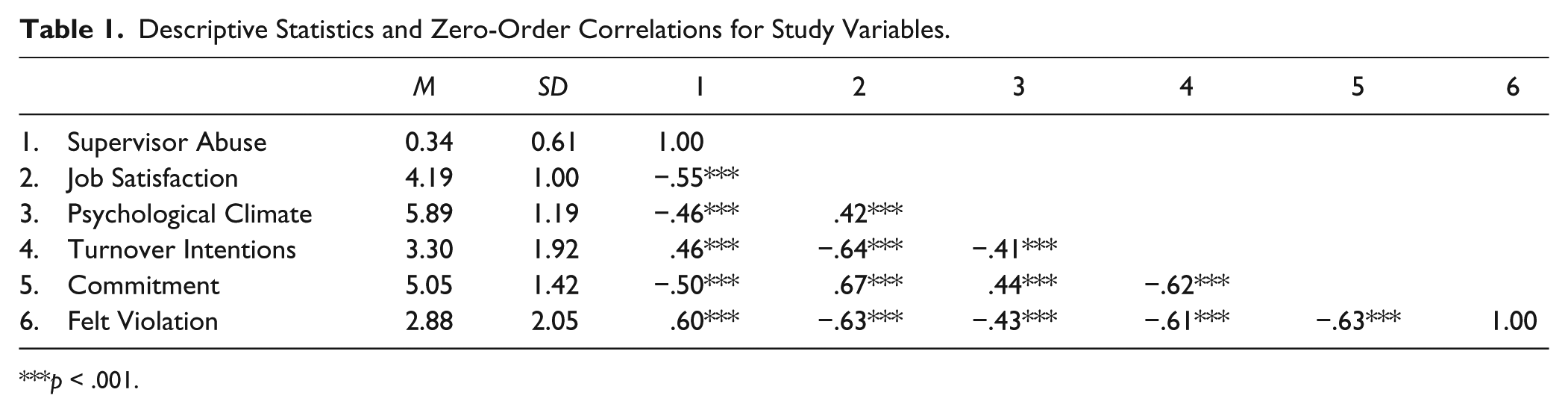
p < .001.
Hypotheses 4a, 4b, and 4c predicted that abusive supervision is positively related to perceptions of felt violation, and this positive relationship is moderated by climate. Felt violation, in turn, relates negatively to organizational commitment and job satisfaction and positively to turnover intentions. We assessed this moderated mediation model using the approach described in the Data Analysis section. The first set of regression equations was used to test for mediation. Results of the regression indicated that supervisor abuse significantly predicted organizational commitment (β = −.499, p < .001), job satisfaction (β = −.551, p < .001), and turnover intention (β = .457, p < .001). Thus, the first condition of mediation was met. Results from Equation 2 where felt violation was regressed on supervisor abuse were also significant (β = .597, p < .001). Thus, the second condition of mediation was met. To assess whether full or partial mediation occurred, the effect size of supervisor abuse on the dependent measures was compared when felt violation was added to the regression equation. The results are presented in Table 2. Although the effect of supervisor abuse remained significant for all dependent variables, the effect size was much smaller when felt violation was added to the equation, suggesting partial mediation. Thus, the first step in testing moderated mediation resulted in partial support for our model.
Regression Analysis Assessing the Mediation Effect of Felt Violation on All Dependent Measures.
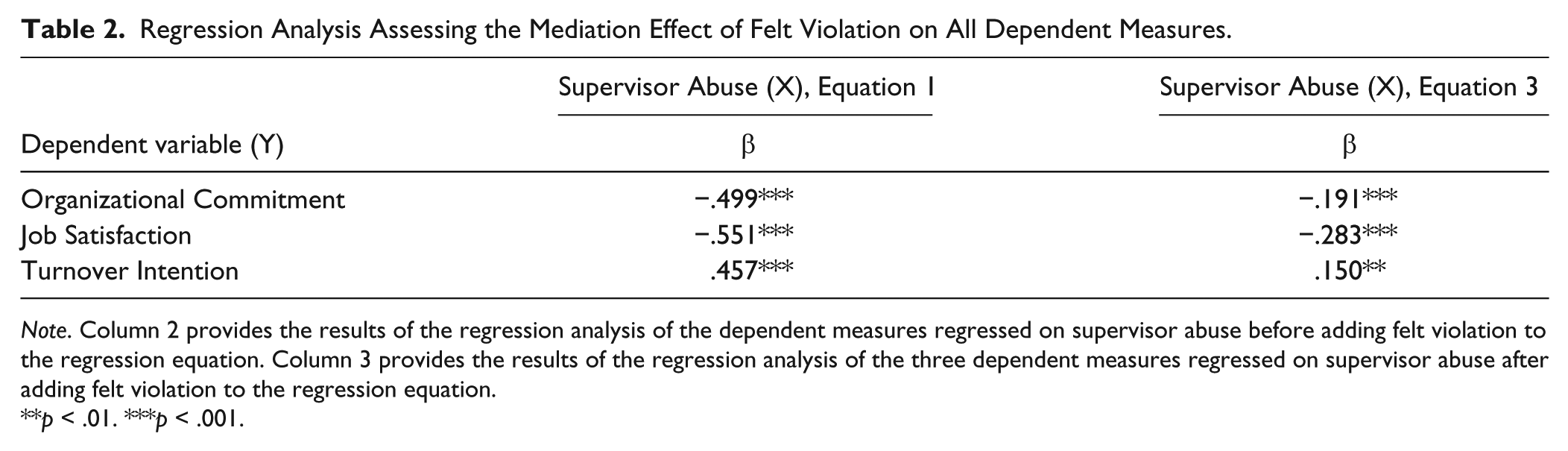
Note. Column 2 provides the results of the regression analysis of the dependent measures regressed on supervisor abuse before adding felt violation to the regression equation. Column 3 provides the results of the regression analysis of the three dependent measures regressed on supervisor abuse after adding felt violation to the regression equation.
p < .01. ***p < .001.
The second step in testing the hypothesized model involved testing for moderated mediation (see Data Analysis section for a description of Muller’s method). The results of the regression analyses for organizational commitment, job satisfaction, and turnover intentions are presented in Tables 3, 4, and 5, respectively. The results of Equation 1 indicated that organizational commitment was predicted by supervisor abuse, psychological climate, and the interaction term (supervisor abuse × psychological climate). The results of Equation 2 indicated main effects of supervisor abuse and psychological climate and a significant interaction (supervisory abuse × psychological climate) on felt violation. In support of moderated mediation, Equation 3 showed that there was a significant interaction of supervisor abuse and psychological climate as well as a main effect of felt violation on organizational commitment. However, the main effects of both supervisor abuse and psychological climate remained significant in Equation 3, suggesting that while moderation occurred, the direct effects of both climate and abuse are still important in predicting organizational commitment. Thus, Hypothesis 4a was partially supported.
Least Squares Regression Results for Moderated Mediation for Organizational Commitment.
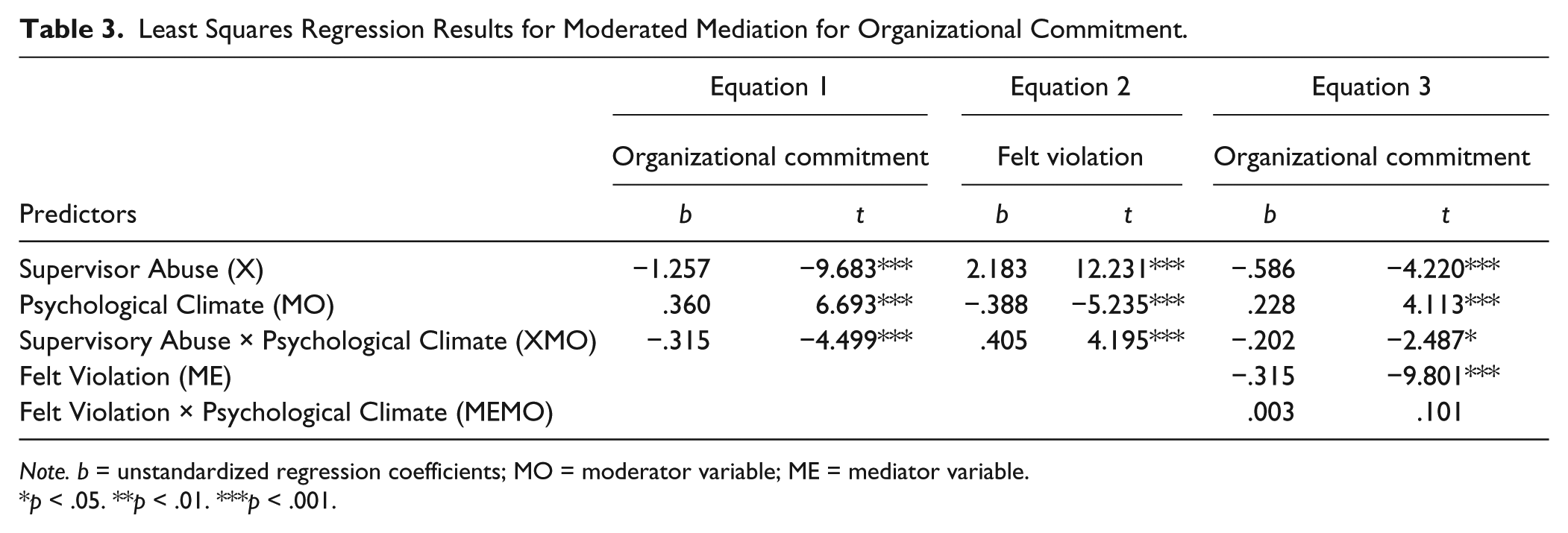
Note. b = unstandardized regression coefficients; MO = moderator variable; ME = mediator variable.
p < .05. **p < .01. ***p < .001.
Least Squares Regression Results for Moderated Mediation for Job Satisfaction.
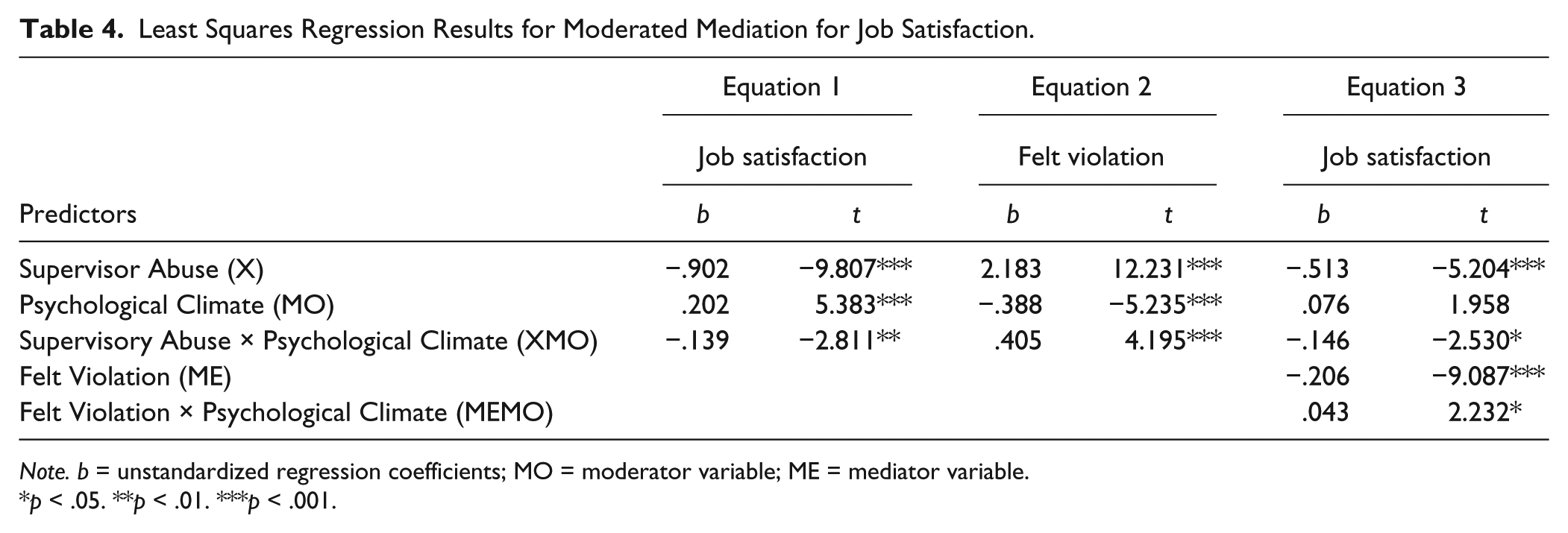
Note. b = unstandardized regression coefficients; MO = moderator variable; ME = mediator variable.
p < .05. **p < .01. ***p < .001.
Least Squares Regression Results for Moderated Mediation for Turnover Intention.
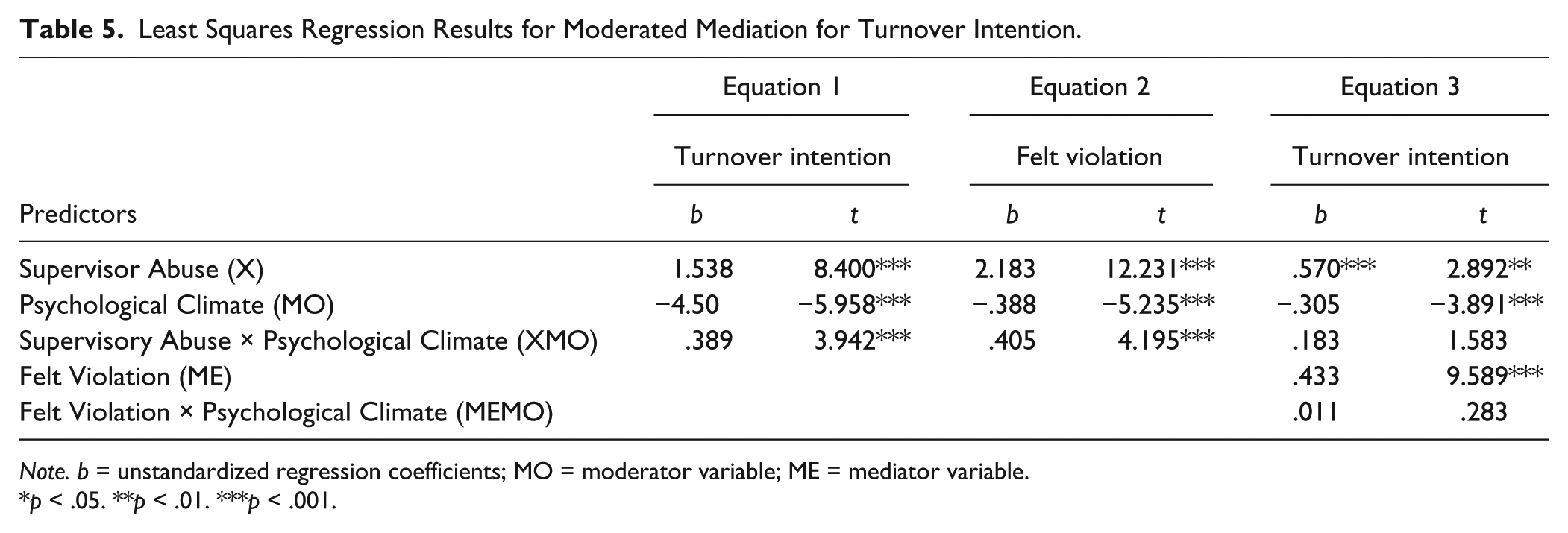
Note. b = unstandardized regression coefficients; MO = moderator variable; ME = mediator variable.
p < .05. **p < .01. ***p < .001.
For job satisfaction, the main effects of supervisor abuse, psychological climate, and their interaction term were significant in Equation 1. The results of Equation 2 indicated main effects of supervisor abuse and psychological climate, and a significant interaction (supervisory abuse × psychological climate) on felt violation. In support of moderated mediation, Equation 3 showed a significant main effect of felt violation and a significant interaction between supervisor abuse and psychological climate on job satisfaction. Again, the main effect of supervisor abuse remained significant in Equation 3. In addition, the interaction between felt violation and climate was found to be significant. This interaction suggests that in addition to moderation of the path between supervisor abuse and felt violation, moderation is also occurring in the path connecting felt violation to job satisfaction. Thus, partial support for Hypothesis 4b was found.
With respect to turnover intention, we again found main effects of supervisor abuse and psychological climate as well as a significant interaction in Equation 1. Equation 3 revealed that while felt violation was significant in predicting turnover intention, the interaction between supervisor abuse and psychological climate was not significant. Thus, Hypothesis 4c was not supported. The main effects of abuse and psychological climate were significant, but moderated mediation was not supported for turnover intention.
To illustrate the moderating effect of psychological climate on felt violation, the procedure recommended by Cohen, Cohen, West, and Aiken (2003) was used. We interpreted the interaction by plotting their simple slopes at one standard deviation above the mean and one standard deviation below the mean of the moderator variable, psychological climate (see Figure 2). The form of the interaction was consistent with our hypotheses, indicating that the impact of supervisor abuse on felt violation was stronger when climate scores were higher (i.e., the climate was abuse intolerant).
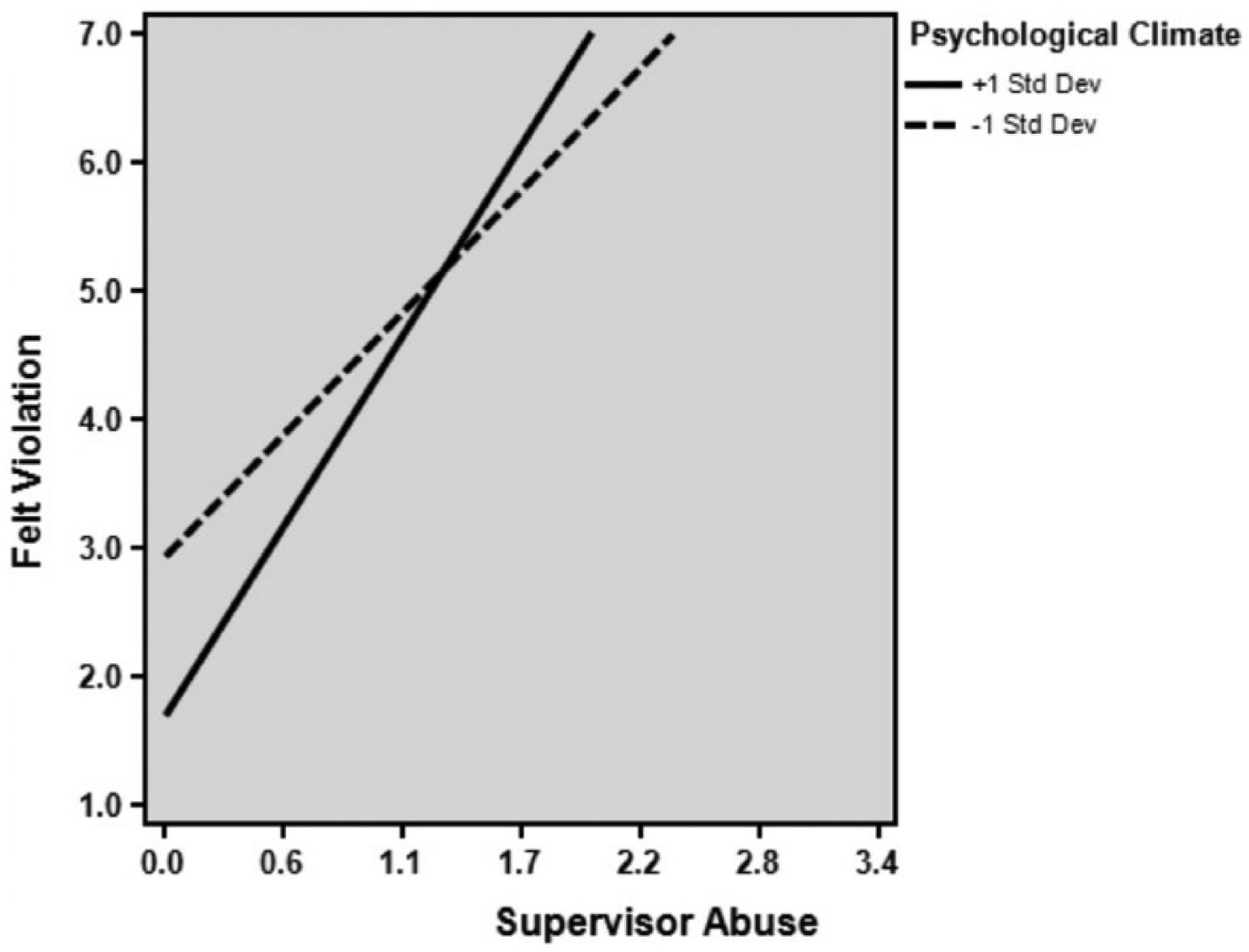
Interaction between abusive supervision and psychological climate on felt violation.
Supplemental Analyses
Hierarchical regression analysis was used to explore the incremental variance accounted for by the inclusion of both the moderator (psychological climate) and the mediator (felt violation). Results indicated that inclusion of both variables resulted in a significant change in R2 for both organizational commitment and job satisfaction. For organizational commitment, the R2 increased from .25 to .46 when felt violation and the interaction between climate and supervisory abuse were included in the regression equation, and from .30 to .46 for job satisfaction. Thus, inclusion of the mediator and moderator accounted for significant variance in organizational commitment and job satisfaction over the main effect of abusive supervision alone.
Discussion
Using psychological contract theory as a framework, we examined the relationships among abusive supervision, psychological climate, felt violation, and three work outcomes. We found that psychological climate had a significant impact on perceptions of supervisory abuse. Employees working in an abuse-intolerant climate perceived lower levels of abuse than those working in a more abuse-tolerant climate. This result is consistent with earlier work, showing the influence of organizational contextual factors (e.g., organizational norms, antibullying initiatives) in contributing to workplace hostility and aggression (Giorgi, 2010; Restubog et al., 2011).
Our results also extend prior research by demonstrating that climate affects employee reactions to abuse as well. Climate moderated the relationship between abuse and felt violation, such that when the climate was abuse intolerant, the relationship between abuse and felt violation was stronger. Thus, employees saw supervisor mistreatment as more troubling when it occurred in an otherwise supportive organizational climate than when it occurred in an organizational environment more tolerant of abuse. The negative consequences of abusive supervision on work outcomes are well documented (Martinko et al., 2013; Tepper, 2007), and greater attention is now being directed at the mechanisms responsible for these effects. Our results contribute to this work by suggesting that perceptions of felt violation may be an additional mechanism underlying reactions to abusive behavior. Felt violation partially mediated the relationship between abusive supervision and our three outcome variables: organizational commitment, job satisfaction, and turnover intentions.
Overall, the results are consistent with psychological contract theory. Employees reacted strongly to instances of abuse because they see this behavior as highly inconsistent with conventional expectations associated with supervisor–employee relationships, and this is more likely when the overall psychological climate is positive. Supervisors are often the primary representative of the psychological contract, given the frequency and proximity of supervisor–subordinate interactions (Parzefall & Salin, 2010). Encountering an abusive supervisor in an abuse-intolerant climate may be seen as unexpected and surprising, making mistreatment more egregious than if it occurred in a more abuse-tolerant organizational climate. This is consistent with findings of a study by Lian et al. (2012) who reported that the negative effects of abusive supervision on employee deviance were exacerbated, rather than weakened, under high levels of leader–member exchange. It is clear that the effects of an abuse-intolerant organizational climate may be undermined without consistent and positive signals about acceptable practices and behaviors across all levels of an organization.
In general, tests of the full model (Figure 1) indicated only partial support for the proposed moderated mediated relationships. First, with respect to turnover intentions, only the direct effects of abuse, climate, and felt violation were significant in the full model. Second, for job satisfaction and organization commitment, although moderation occurred between abuse and felt violation, as predicted, the direct effects of abuse still remained significant. The direct effect of climate also remained significant for commitment. Furthermore, as predicted, there was evidence of first-stage moderation for commitment and job satisfaction, but contrary to expectation, the path between felt violation and job satisfaction was also moderated by climate.
The fact that the main effects of abuse remained significant for all three outcomes indicates the potential dangers of turning a blind eye to abusive supervision. Furthermore, recent work on trickle-down theory suggests that lower level workers can model the negative behaviors of their supervisors, leading to an environment also characterized by high levels of coworker abuse. Mawritz, Mayer, Hoobler, Wayne, and Marinova (2012) found that abusive manager behavior was associated with greater levels of work group deviance. At this point, it is unclear whether the processes underlying the determinants and consequences of coworker/peer (horizontal) abuse are the same as hierarchical (vertical) abuse, and examining this issue is an avenue for future research.
How do the current findings compare with other studies that have examined similar constructs in the context of supervisor abuse (e.g., Bond et al., 2010; Law et al., 2011)? Our model included both a moderator (climate) and a mediator (felt violation) of abuse-outcome relationships. The aforementioned existing works proposed that climate moderated abuse-outcome relationships but did not specify any underlying mediator variables. The dependent variables also differ. We focused on work-related attitudes, while the prior cited works focused primarily on psychological health indicators (i.e., posttraumatic stress symptoms, emotional exhaustion). Thus, it is difficult to directly compare results. As mentioned earlier, we found a moderating effect for climate on the felt violation–job satisfaction link, which was not hypothesized. The nature of this interaction is somewhat consistent with the moderating relationships reported by Bond et al. (2010) and Law et al. (2011), where positive climates buffered the negative effects of abuse. Although some buffering effect may exist for the relationship between felt violation and job satisfaction in an abuse-intolerant climate, the effect is small, and further research should be conducted to better understand this relationship. One potential explanation for the buffering effect may lie in how job satisfaction is measured. We measured general job satisfaction. If specific facets of satisfaction (e.g., satisfaction with the work itself; satisfaction with coworkers) were measured instead, one may find that some job elements that are deemed satisfactory can compensate for elements of dissatisfaction, such as working conditions or the supervisor. Thus, whether a positive climate acts to buffer the negative effects of abuse on satisfaction may depend on the facet of satisfaction that is examined.
Most striking in the current study is the strength of climate as a moderator of the abuse-felt violation (mediation) relationship. As noted above, we found that a positive climate (abuse intolerant) did not buffer feelings of violation; instead, it heightened them. Future research should replicate this finding and further investigate in what situations climate may exacerbate or buffer the relationships between abuse and work attitudes and behaviors.
Practical Implications
The main effects of psychological climate and abuse on organizational commitment, job satisfaction, and turnover intentions, while not surprising, underscore the importance of monitoring both individual behaviors and organizational policy. Supervisors who exhibit abusive behavior and organizational climates that fail to support employees can expect to have higher rates of turnover and lower levels of job satisfaction and organizational commitment. However, our results also suggest that abusive supervisor behavior may have negative effects on job satisfaction and commitment even when psychological climate is perceived to be more positive. Thus, ensuring a more positive climate through organizational policy may not be enough to prevent negative outcomes. It is possible that employees infer climate based more on the behavior of supervisors than what is communicated by organizational-level policies and actions, and are especially sensitive to inconsistent signals from these two sources. Training programs that explicitly teach supervisors how to replace abusive behavior with supportive behaviors would help reduce abuse and also enhance consistency between organizational intentions and supervisor actions. In addition, companies may be able to combat bullying by designing training programs that raise awareness of the problem and teach employees how to recognize and respond to abusive behavior (Fox & Stallworth, 2009).
In addition to fostering an abuse-intolerant climate through organizational practice, it may be important for organizations to monitor supervisor behavior more closely and provide mechanisms such as grievance procedures and employee surveys so that abusive behavior can be reported. Since employees may be hesitant to communicate negative information to higher status individuals, it is important for management to be more proactive, providing specific channels for reporting abuse (Morrison, 2011; Morrison & Milliken, 2000). Empowering employees by providing a formal complaint process can positively affect job satisfaction and organizational commitment (Gardner, Moynihan, Park, & Wright, 2001). If employees are given a voice to report such behaviors through easy channels, without fear of retaliation, the abusive behaviors can be addressed before employee attitudes are affected and long-term negative behavioral effects occur.
Limitations and Suggestions for Future Research
Our study is not without limitations. Although the data were collected from workers that spanned many distinct units and agencies of the federal government, the generalizability of our findings to private sector organizations should be investigated. In addition, our study is cross-sectional, which limits our ability to infer causality between abuse and the outcome variables. A final limitation concerns the self-report nature of our data and the potential problem of common method variance. In an attempt to minimize common method bias, we followed several recommendations made by Podsakoff, MacKenzie, Lee, and Podsakoff (2003). For example, all survey responses were anonymous to reduce social desirability, item order was counterbalanced, verbal anchors were used on all scales, and different scales contained different anchor points (i.e., 4-, 5-, and 7-point scales). While we cannot definitively rule out the presence of common method variance, the pattern of correlations in our data is quite consistent with firmly established relationships in the abusive supervision literature (e.g., negative correlations of abuse with attitudinal consequences). Moreover, as noted by Siemsen, Roth, and Oliveira (2010), the fact that we obtained significant interaction effects suggests that common method variance is not a large concern. Even so, future studies that incorporate non–self-report measures or triangulate evidence from multiple sources would provide additional support for our model.
Despite the limitations of our study, we think that the results make an important contribution to research on abusive supervision. Our study extends work on abusive supervision by identifying an important contextual antecedent and moderator of the effects of abuse. The inclusion of felt violation as a potential mediator adds to our understanding of the mechanisms that are responsible for these effects.
Future research is needed to better understand the complex relationship between abusive supervision, contextual factors, and outcome variables. There are several streams of literature that focus on the impact of bullying, abusive supervision, coworker abuse, and harassment on job satisfaction and turnover, organizational commitment, and other important outcomes. Future research should focus on incorporating multiple measures that would enable us to understand how this broad array of behaviors affects organizational outcomes. In addition, while we focused on one mediating variable, felt violation, future research should examine the impact of multiple mediators to improve our understanding of the mechanisms through which the individual behaviors (e.g., abuse) and organizational context (e.g., psychological climate) exert their effects.
Footnotes
Declaration of Conflicting Interests
The author(s) declared no potential conflicts of interest with respect to the research, authorship, and/or publication of this article.
Funding
The author(s) received no financial support for the research, authorship, and/or publication of this article.