







Abstract
Popularity in the workplace is relatively unexplored but has multiple potential applications in organizations. This field study uses data collected from 223 supervisor–subordinate dyads at various organizations in China to examine core self-evaluation (CSE) as an antecedent of employee popularity, the ability of political skill and work engagement to predict popularity above and beyond CSE, and the moderating roles of political skill and work engagement on the relationship between CSE and popularity. The current research also extends potential effects of workplace popularity beyond coworker-related outcomes to supervisor trust and task performance ratings for popular employees. Results showed that political skill and work engagement relate to popularity above and beyond CSE and moderate the CSE–popularity relationship. Employees’ popularity is also positively associated with supervisor trust and task performance ratings. Theoretical and practical implications of these findings are discussed.
One of the primary characteristics differentiating organizations from other social contexts is that workplace relationships revolve around nonsocial activities (e.g., job-related tasks) and goals (e.g., promotion). Members base their interactions around both formal and informal ties that must function within a set of cultural norms dictated by organizational constraints. Popularity, a condition in which one is generally admired or supported by many people, entails indicators of widely acceptable behaviors, cognitions, or attitudes (Scott & Judge, 2009) and may lead to increased levels of influence, prominence, and respect from others (Ozer & Benet-Martínez, 2006). Because it is simultaneously oriented toward both individuals and groups, employee popularity can potentially offer a unique perspective on the formation, maintenance, and outcomes of social connections in the workplace.
However, popularity as applied to employees only recently began to receive attention from organizational researchers when Scott and Judge (2009) examined predictors of employee popularity and the connection between popularity and coworker treatment. They found that core self-evaluation (CSE) and work communication centrality predicted employees’ popularity ratings, while higher popularity affected the occurrence of organizational citizenship behaviors (OCBs) and counterproductive work behaviors from coworkers. Scott (2013) also supplemented the existing body of literature with a theoretical and empirical review of popularity in the workplace while calling for further study to understand the nuances of the construct.
The present study aspires to continue building on the work of these researchers and further extend their research (see Figure 1 for the overall conceptual model). First, following Scott and Judge’s (2009) lead, we replicate their hypothesis regarding CSE as an antecedent of popularity and add to their findings by identifying two additional constructs more directly related to the work environment (i.e., political skill and work engagement) that may both predict workplace popularity above and beyond CSE and moderate the relationship between CSE and popularity. Focusing on these variables advances the understanding of which employees attain popularity in the workplace as well as the boundary conditions of the linkage between CSE and workplace popularity. The current work also aims to complement the coworker-related outcomes studied in previous organizational research by focusing on supervisor-ratings of trust and task performance. While not a comprehensive collection of popularity’s potential outcomes, we seek to expand our understanding of how this pervasive social phenomenon influences leaders’ attitudes toward employees and perceptions of their effectiveness.
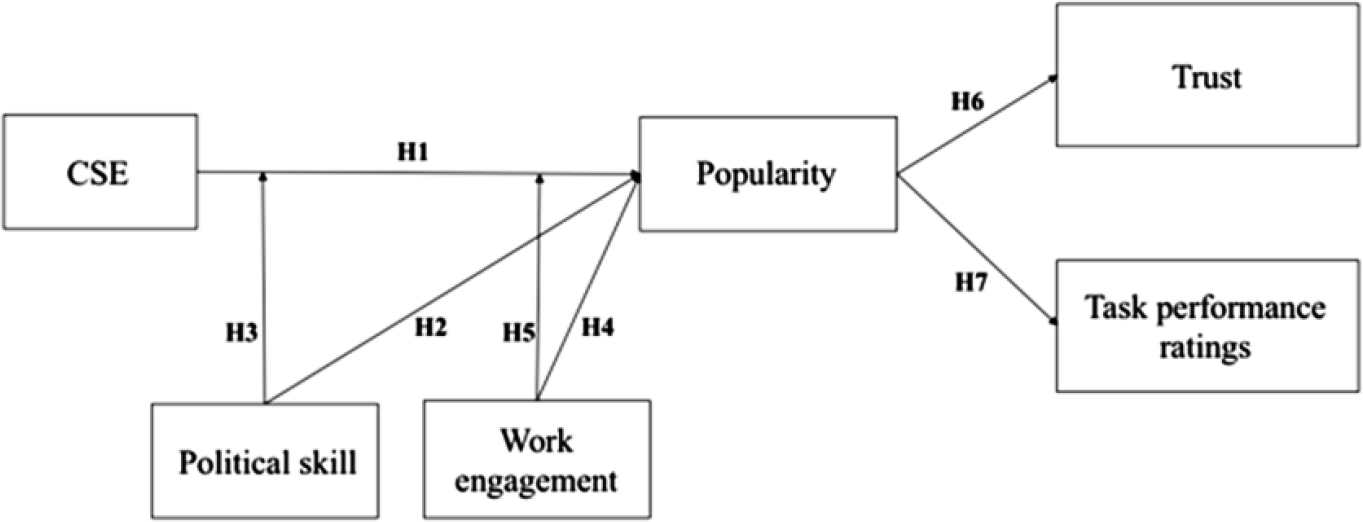
The overall conceptual model of the current research and hypotheses.
In the subsequent sections, we first offer a comprehensive definition of popularity and distinguish it from similar constructs, followed by a discussion of each study variable, and how it may relate to workplace popularity. Next, we delineate the methods utilized by the current field study and present the findings based on these data. Finally, we discuss the theoretical contributions, practical implications, and future research directions based on the results.
Defining Popularity
In order to fully grasp the role of organizational popularity, or a condition in which one is widely accepted, admired, or receives disproportionate amounts of attention from others (Scott, 2013), it is important to first distinguish it from seemingly similar constructs: interpersonal liking, status, and reputation. First, the level of analysis characterizing popularity separates it from interpersonal liking (Scott, 2013). The conditions for popularity require targets to be socially visible, socially preferred, and to receive disproportionate amounts of attention from others. Because it influences both the actor and surrounding groups (Festinger, 1954; Scott & Judge, 2009) despite the fact that it targets specific individuals, it partly depends on the broader social environment. As Scott (2013) indicated, popularity differs from interpersonal liking in that the former uses group members as the referent for (i.e., other-referencing) rather than representing one’s feelings toward another individual (i.e., self-referencing).
Status also shares similarities with popularity but is a theoretically distinct construct, in part because the latter is defined more broadly (i.e., does not target any one feature). For example, while popularity focuses on general acceptance by others, status, or one’s standing relative to others (Scott, 2013), only has meaning when applied to a particular characteristic (e.g., socioeconomic status, political status, etc.). In the work setting, status often derives from one’s formal position within the organizational hierarchy (e.g., relative to subordinates, managers automatically have higher status; Chen, Brockner, & Greenberg, 2003; Scott, 2013). This is not a condition for popularity, for which employees may be widely accepted or preferred by others regardless of their formal title.
Likewise, another seemingly similar variable, reputation, is a function of the specific characteristic for which an individual is known (e.g., reputation for fairness; Jones & Skarlicki, 2005). In other words, reputation captures differences in perceived or actual quality (Washington & Zajac, 2005). Reputation may also result in either positive (e.g., a reputation for being hardworking) or negative (e.g., a reputation for being bad-tempered) evaluations of the target (Scott, 2013), whereas the overall judgments of popular targets are usually positively valenced (given that popularity indicates general acceptance).
Core Self-Evaluation
Popular individuals often possess certain desirable traits (Judge, Locke, & Durham, 1997); CSE combines some individual characteristics that are also closely related to one another (i.e., self-esteem, self-efficacy, emotional stability, and locus of control; Kammeyer-Mueller, Judge, & Scott, 2009) into a compound dispositional trait that helps define one’s self-construal (Judge, Erez, Bono, & Thoresen, 2003). Although organizational researchers originally focused on CSE as an antecedent of job attitudes or behaviors (e.g., job satisfaction, contextual performance; Bono & Judge, 2003; Judge & Bono, 2001), CSE is also likely to influence the nature of social interactions and relations in the workplace (Scott & Judge, 2009). Employees with high CSE should be more popular in organizations than those with low CSE because of their generally positive characters. People who interact with high CSE individuals likely find them pleasant to be around; exchanges are desirable and rewarding (Scott & Judge, 2009) as individuals with high CSE tend to express self-confidence, efficacy, and positivity (Judge et al., 2003). In contrast, employees with low CSE may not bring as many positive qualities to interpersonal interactions (Judge et al., 1997) due to greater overall anxious and negative dispositions. In other words, it is unlikely that the negative emotions or behaviors exhibited by these individuals as a consequence of low self-esteem and high neuroticism endear them to others at work (Scott & Judge, 2009). Based on these ideas, we propose the following hypothesis.
Political Skill and Work Engagement
While dispositional traits such as CSE may play an important role in attaining popularity, certain skills or motivational variables related to the organizational context may provide a clearer picture. In the current study, we focus on political skill and work engagement as two additional predictors of workplace popularity because they more directly reflect features of the work context. As elaborated on further, the workplace has some salient characteristics (i.e., an inherently political atmosphere and a focus on cooperation to attain a common goal) that distinguish it from other social environments. Furthermore, as previous research has noted that interpersonal influence tactics and work-related involvement constitute effective strategies for creating a positive impression with other organizational members (Wayne & Ferris, 1990), individual traits that mesh with these characteristics are likely important to acquire general acceptance in the workplace. More specifically, political skill touches on navigating social situations and influence behaviors, while work engagement is centered on activities that emphasize job-related goal attainment. We expand on these ideas and how each construct may be associated with popularity in more detail below.
Political Skill
Organizations are “inherently political arenas” (Ferris, Perrewé, Anthony, & Gilmore, 2000) in which influence behaviors are essential to effectively accomplishing objectives (Cullen, Fan, & Liu, 2012). Political skill, or the ability to influence colleagues through an understanding of others’ actions at work for personal gain, involves social astuteness, interpersonal influence, networking ability, and apparent sincerity (Cullen et al., 2012; Ferris et al., 2007; Wu, Kwan, Wei, & Liu, 2013). According to Pfeffer (1992), this individual characteristic entails interpersonal sensitivity, and “it is this capacity to identify with others that is actually critical in obtaining things for oneself” (p. 173). Since Pfeffer (1981) first defined political skill in the academic literature, considerable empirical evidence has supported the notion that it is needed to become successful in organizations (e.g., Ferris et al., 2000; Gentry, Griggs, Mondore, & Cox, 2011; Shi, Johnson, Liu, & Wang, 2013). As summarized by Cullen et al. (2012), “influence behaviors are essential to achieving workplace objectives” (p. 1174).
When interacting with coworkers, politically skilled employees may cultivate favorable impressions because they understand what others want or need and can accurately anticipate reactions to their behaviors (Cullen, Fan, & Liu, 2014). Given their social astuteness and savvy, these employees likely offer various benefits (e.g., timely task and/or emotional support, exchange of helpful information) to workplace interaction partners with apparent sincerity (Treadway, Ferris, Duke, Adams, & Thatcher, 2007) leading to greater acceptance. Thus, employees’ political skill should be positively associated with popularity in the workplace. Consistent with these ideas, recent research by Cullen et al. (2012, 2014) examined linkages between political skill and popularity as predictors of interpersonal mistreatment and found a positive relationship between political skill and popularity. The current study builds on this research by explicitly considering the incremental validity of political skill on workplace popularity, as it seems to operate through different mechanisms than CSE (i.e., influence interpersonal sensitivity rather than positive self-construal). Thus, we expect that political skill influences popularity above and beyond CSE.
In addition, we also expect political skill to moderate the relationship between CSE and workplace popularity. As discussed above, CSE equips individuals with the general positive character to obtain a high social position in interpersonal contexts. In a political environment such as the workplace, the extent to which CSE can eventually lead to better social relationships and increased acceptance may be influenced by one’s political skill. The overall positive and self-efficacious attitudes engendered by CSE are even more likely to effectively build relationships when employees are politically skilled, as they not only know what to express in the organizational context but also understand how to do it in a way comes across to coworkers as sincere and interpersonally sensitive (Cullen et al., 2014; Ferris et al., 2000). However, for those with lower levels of political skill, such attitudes may not necessarily enhance the quality of social interactions. When strong confidence exhibited by high CSE employees is combined with a lack of social astuteness, it may be viewed as stubbornness or even arrogance by work colleagues. Highly confident employees lacking political skill are unlikely to adjust their behaviors in different interpersonal situations, making it difficult for them to attain general acceptance and admiration in the political environment of the workplace.
Based on these ideas, we propose the following hypotheses.
Work Engagement
Besides political skill, work engagement may also have an impact on employee popularity. This positive state involves vigor, dedication, and absorption to task-related activities at work (Schaufeli, Salanova, González-Romá, & Bakker, 2002). Engaged employees connect positively with work activities and tend to exhibit emotional strength and willingness to invest effort at work (Schaufeli et al., 2002). They devote their full selves to work role performance by actively and persistently allocating personal energy and resources to the completion of work goals (Kahn, 1990, 1992). Fundamentally speaking, organizations are entities that require individuals to work together collaboratively toward collective goals (Jennings & Hannah, 2013). The degree to which an individual strives for the attainment of common goals likely influences how he or she is viewed by others in the organizational context.
Employees with higher work engagement not only directly provide benefits to coworkers through their dedication to the completion of collective goals but also tend to exhibit collaborative behaviors; they are actively connected with other organizational members and activities (Ferrer, 2005). In addition, the positive attitudes toward one’s job as reflected in work engagement may signal a capacity to handle stress in the face of job demands and a dedication to solve workplace problems (Xanthopoulou, Bakker, Demerouti, & Schaufeli, 2009). Such traits should be well-accepted and preferred by other organizational members who are also working toward the same goals. Thus, employees’ work engagement is expected to be positively associated with their levels of popularity in the workplace above and beyond CSE.
Additionally, we expect work engagement to moderate the relationship between CSE and workplace popularity. When employees have high levels of work engagement, CSE essentially manifests itself through attitudes or behaviors (e.g., managing stress in the face of job demands and challenges; Xanthopoulou et al., 2009) that facilitate effective achievement of work goals. Because these individuals enthusiastically devote themselves to work-related activities, their positive self-construal is more likely to incur widespread recognition and acceptance. Conversely, employees lower on work engagement may have positive characters in general, but coworkers are unlikely to overlook their apparent apathy toward the job. In fact, if individuals feel that they have the capacity to complete tasks but do not apply themselves to achieving workplace goals, the lack of effort might leave other organizational members with a negative impression. Thus, CSE may have a weaker relationship with popularity for these employees. Based on these ideas, we propose the following hypotheses.
The Relationship Between Popularity and Supervisor-Rated Outcomes
In order to fully understand the role of popularity in the workplace, it is important to examine its potential impact in addition to the characteristics that promote its occurrence. Previous organizational research has thus far focused on examining the connection between popularity and treatment from coworkers (e.g., Cullen et al., 2014; Scott & Judge, 2009), and while popularity directly relates to coworker interactions, its impact on workplace outcomes may be broader than that. As Hornung, Rousseau, and Glaser (2009) indicated, “supervisors are important organizational agents whose legitimate power permits a wide range of resources to be granted to workers on behalf of their employer” (p. 741). Thus, we cannot fully comprehend the role of popularity in the workplace without understanding how it pertains to supervisors’ views of employees. To that end, the current work aims to contribute to the growing body of workplace popularity literature by assessing outcomes based on supervisors’ ratings rather than peer ratings. In the current study, we selected supervisors’ trust and task performance ratings as outcomes of interest. In the following paragraphs, we discuss why employees’ popularity is expected to be positively associated with these outcomes.
First, analyzing the influence of popularity on trust, a psychological state comprising the intention to accept vulnerability based on positive expectations (Colquitt, Scott, & LePine, 2007), could add clarity to the interpersonally oriented outcomes of popularity examined in previous research (e.g., interpersonal organizational citizenship behaviors; Scott & Judge, 2009), especially because trust is a fundamental piece of positive relationships (Lau & Liden, 2008). Most organizations expect employee interdependence to achieve workplace goals (Lau & Liden, 2008). Thus, attaining general acceptance (i.e., popularity) is highly desirable, given that these employees may visibly facilitate collaboration to a greater degree than nonpopular employees. Supervisors’ perceptions of popularity are highly relevant to this point, since trust formation between leaders and employees are shaped, in part, on observations of interactions between the trustee and third parties (Ferrin, Dirks, & Shah, 2006). Because supervisory job roles entail responsibility for subordinates’ behaviors (Zapata, Olsen, & Martins, 2013), they must have faith in employees’ abilities to effectively carry out tasks (Lau & Liden, 2008). For employees, the results of this faith can have substantial practical implications, given that supervisors’ trust may directly influence work arrangements, task allocation, and future relationship dynamics (Deluga, 1994; Hornung et al., 2009; Lau & Liden, 2008; Zapata et al., 2013). Taken together, popular subordinates likely incur supervisors’ trust based on the latter’s observations that these employees possess qualities that benefit those around them in the work environment, and may stand to benefit from subsequent positive expectations.
In addition to this interpersonal outcome, this study also explores how employees’ popularity relates to their supervisors’ performance ratings. Examining task performance ratings takes into account the tendency of organizational members to prioritize goal attainment in work contexts by considering the impact of popularity on subjective achievement benchmarks. The support popular employees receive (e.g., OCBs; Scott & Judge, 2009) in the course of collaborating with coworkers by virtue of their position as generally preferred may enable task completion, which should positively influence task performance ratings. Furthermore, because of this dynamic, popular employees may seem proficient in their job role. Thus, popularity can become an indicator of competence for supervisors (Bauer & Green, 1996); however, this possibility has gone unexamined by organizational researchers.
For both trust and task performance ratings, supervisors’ assessments may also be partially explained by the halo effect (Jackson & Furnham, 2001; Nisbett & Wilson, 1977; Viswesvaran, Schmidt, & Ones, 2005), or the possibility that initial global judgments of target employees cognitively bias subsequent appraisals of other, more specific attributes. The positive or negative valence of overall judgments usually skews ensuing attitudes regarding employee competence or personality in the same direction (Bauer & Green, 1996). As related to popularity, leaders tasked with making decisions may perceive coworkers’ widespread acceptance of an employee and use the information to form a generally positive impression. A positive bias based on the employee’s popularity may thus influence more specific evaluations (e.g., trustworthiness and task performance), regardless of the employee’s actual qualities and competence. For example, supervisors’ overarching judgments derived from perceptions of widespread preference for popular employees may translate to feeling that popular subordinates may be relied on for loyalty or support (i.e., they accept vulnerability based on positive expectations; Colquitt et al., 2007). Additionally, as previously mentioned, supervisors may consider popularity as an indicator of competence (Bauer & Green, 1996). This general perception may ultimately direct the leader to believe the employee can successfully execute tasks, regardless of whether he or she deserves it (Bhal, Bhaskar, Ratnam, 2009; Kang & Stewart, 2007).
Based on these points, we propose the following hypotheses.
Method
Participants and Procedure
Data were obtained from employees and their supervisors within different companies located in Shanghai, China. We distributed questionnaires to 250 supervisor–subordinate dyads among whom 223 dyads returned their completed questionnaires, resulting in a response rate of 89.2%. The final sample included these 223 followers and their direct supervisors. Among the 223 employees, 46.6% were men. 4.9% were 18 to 25, 27.8% were 26 to 35, 30.0% were 36 to 45, 10.8% were 46 to 55, and 2.7% were older than 55 years. They worked in 26 companies from a variety of fields such as manufacture, finance, real estate, service, and commerce.
Employees responded to a paper-and-pencil survey containing measures of popularity, CSE, political skill, job engagement, and demographic information. Their popularity, task performance, and promotion potential were rated by their direct supervisors. Employees’ popularity was rated by both their supervisors and themselves to minimize concerns of common method bias, as explained in the Results section. Participants were ensured that their responses would be confidential and would only be used for research purposes.
Measures
All measures were translated and back-translated from Chinese and English (Brislin, 1981). A 7-point response scale ranging from 1 (completely disagree) to 7 (completely agree) was used for all items.
Popularity
Popularity was measure by eight items from Scott and Judge (2009). A sample item is “the person for whom I am completing this survey is generally admired.” Coefficient alphas for this scale were .85 (self-rating) and .82 (supervisor-rating).
Core Self-Evaluation
The CSE Scale developed by Judge et al. (2003) was used. This scale contains 12 items (e.g., “Overall, I am satisfied with myself”; “When I try, I general succeed”). Coefficient alpha for this scale was .84.
Political Skill
Political skill was measured by Ferris et al. (2005). This scale contains 18 items (e.g., “I always seem to instinctively know the right thing to say or do to influence others”). Coefficient alpha for this scale was .92.
Job Engagement
Job engagement was measured by 18 items from Rich, LePine, and Crawford (2010). A sample item is “I exert my full effort to my job.” Coefficient alpha for this scale was .93.
Trust
Trust was measured by Mayer and Gavin (2005). This scale contains 10 items (e.g., “I would be willing to let ___ have complete control over my future in this company”). Coefficient alpha for this scale was .89.
Task Performance Ratings
Supervisors rated followers’ task performance using seven items from Williams and Anderson’s (1991) measure. A sample item is “adequately completes assigned duties.” Coefficient alpha for this scale was .89.
Results
Given that we used popularity ratings from different sources (i.e., self-rating and supervisor-rating) in hypothesis tests concerning the predictors and consequences of popularity, we conducted two sets of hierarchical regression analyses as opposed to using a general path-analytic approach; the cutoff point for significance in all tests was p < .05. To minimize concerns of common method bias, we used supervisor-ratings of popularity when examining antecedents of popularity, given that all predictor variables were self-rated. Since outcome measures in the current study were completed by employees’ supervisors, we used self-ratings of popularity when analyzing the relationships between popularity and outcome variables. Table 1 displays means, standard deviations, and correlations among study variables.
Means, Standard Deviations, and Correlations of Study Variables.
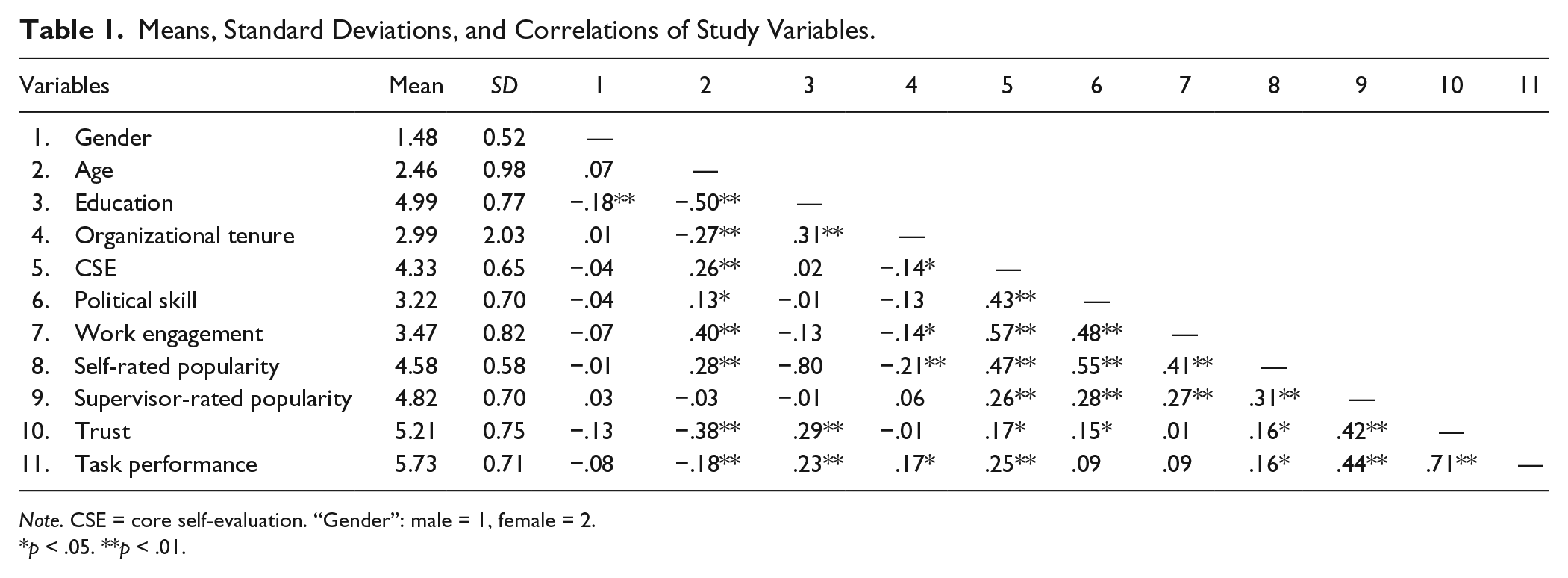
Note. CSE = core self-evaluation. “Gender”: male = 1, female = 2.
p < .05. **p < .01.
Hypotheses 1, 2, and 4 concern the direct effects of CSE, political skill, and work engagement on workplace popularity. Hierarchical regression analysis was conducted to test these hypotheses. Hypothesis 1 predicts that high CSE is positively associated with popularity. As seen in Table 2, this hypothesis was supported (β = .15, p < .05). Hypotheses 2 and 4 state that political skill and work engagement positively predict workplace popularity above and beyond CSE. As seen in the regression results presented in Table 2, both of these hypotheses were supported (political skill: β = .17, p < .05; job engagement: β = .17, p < .05).
Moderated Multiple Regression Analyses Predicting Supervisor-Rated Popularity.
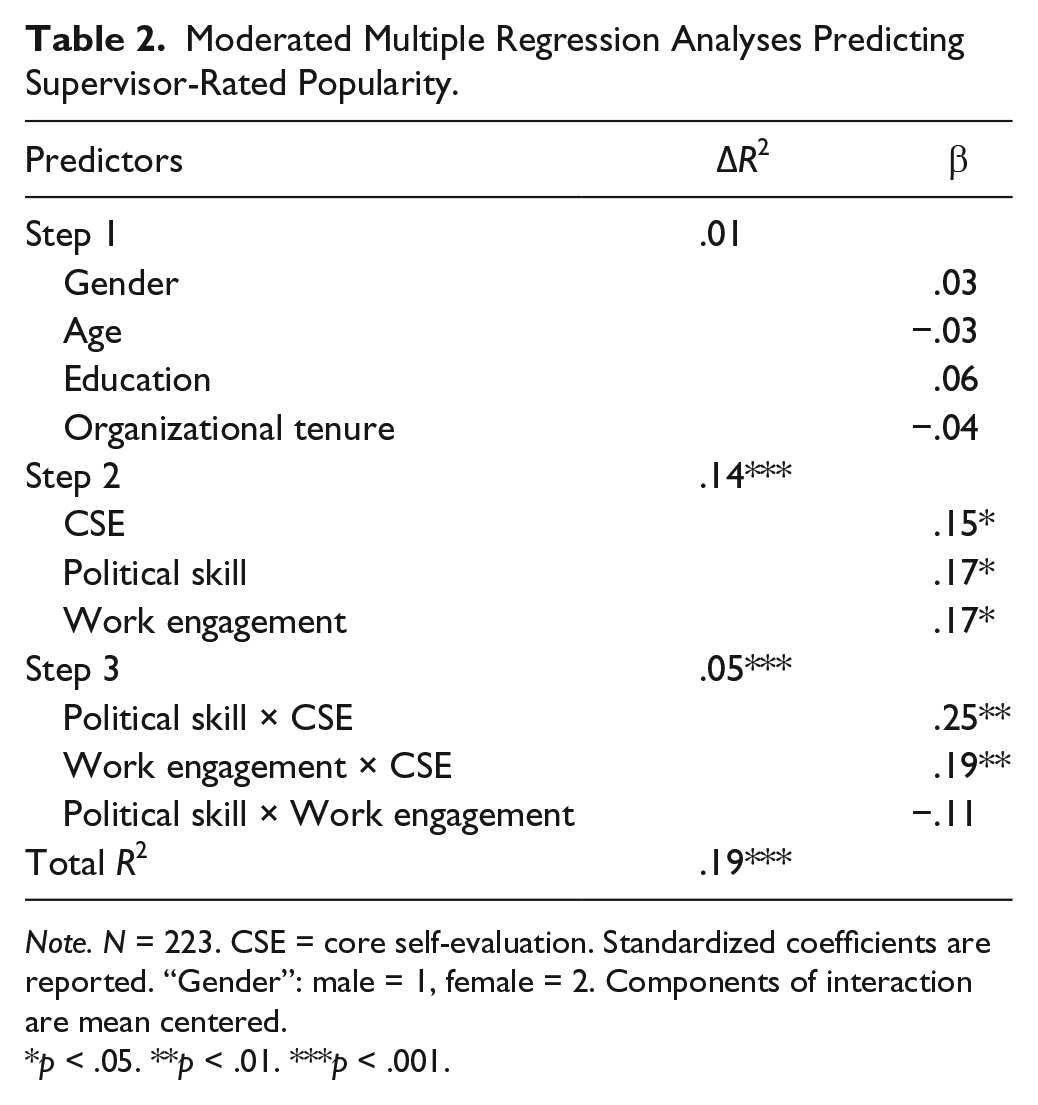
Note. N = 223. CSE = core self-evaluation. Standardized coefficients are reported. “Gender”: male = 1, female = 2. Components of interaction are mean centered.
p < .05. **p < .01. ***p < .001.
Hypothesis 3 predicts that political skill moderates the effect of CSE on popularity. As displayed in Table 2, the final step of the hierarchical regression analysis indicated that as employee political skill increased, the association between CSE and popularity increased (β = .25, p < .05), supporting Hypothesis 3. This moderation effect is presented in Figure 1. We also computed the simple slopes predicting popularity with CSE for two levels of political skill: 1 SD above and below its mean. Results showed that CSE was positively related to popularity when political skill was 1 SD above its mean (β = .28, p < .001). However, when political skill was equal to 1 SD below its mean, the relationship between CSE and popularity was not significant (β = −.04, p > .05).
Hypothesis 5 predicts that work engagement moderates the effect of CSE on popularity. The results from the hierarchical regression analysis also showed that as employee work engagement increased, the association between CSE and popularity increased (β = .19, p < .05), supporting Hypothesis 5. This moderation effect is presented in Figure 2. Simple slope tests revealed that CSE was positively related to popularity when work engagement was 1 SD above its mean (β = .26, p < .001). However, when work engagement was equal to 1 SD below its mean, the relationship between CSE and popularity was not significant (β = −.02, p > .05).
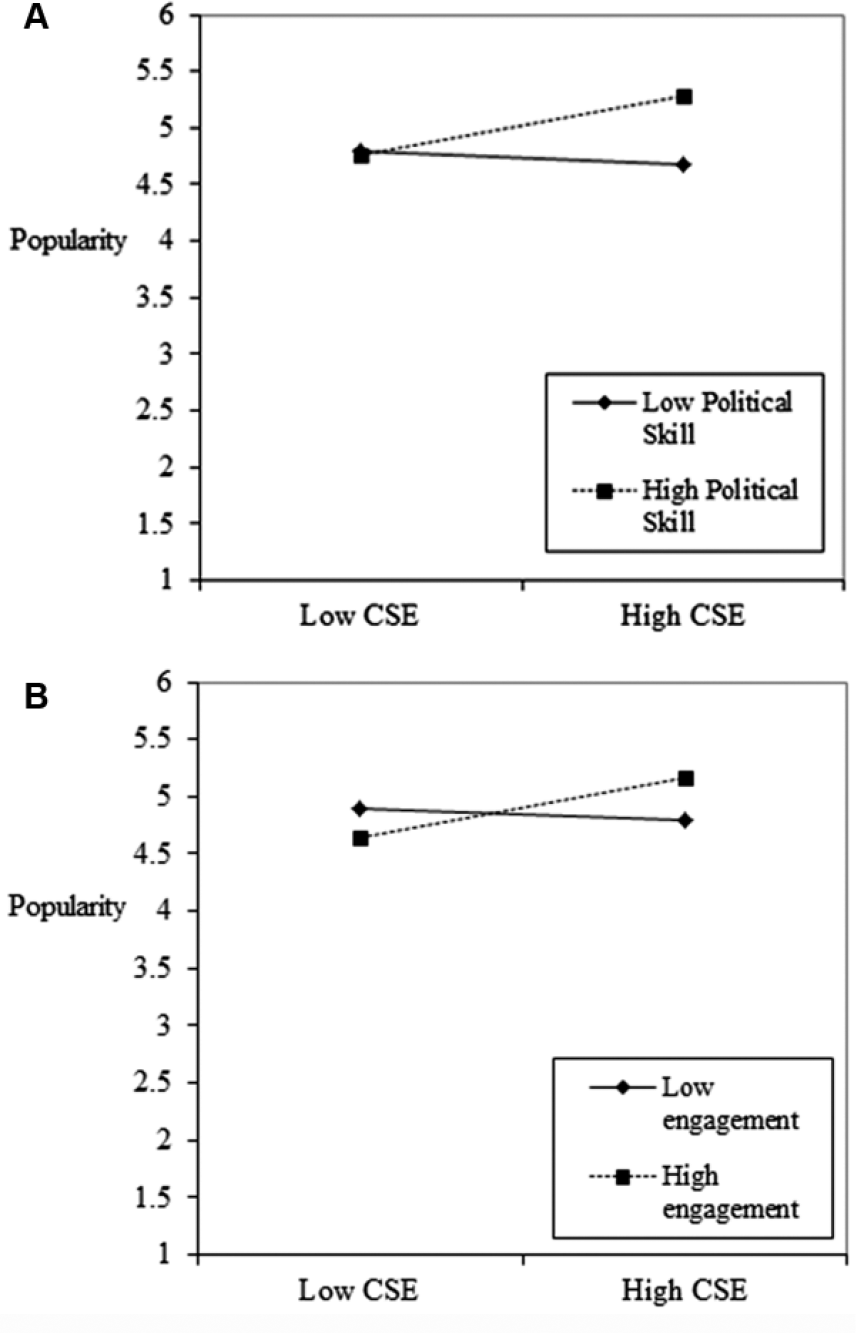
Interaction graph for (A) Hypothesis 5: Shows the moderating effect of political skill on the CSE–popularity relationship such that the positive relationship between CSE and popularity is enhanced when individuals have higher levels of political skill and (B) Hypothesis 3: Shows the moderating effect of work engagement on the CSE–popularity relationship such that the positive relationship between CSE and popularity is enhanced when individuals have higher levels of work engagement.
Hypotheses 6 and 7 predict that employees’ popularity has a positive relationship with supervisor-rated trust and task performance. As displayed in Table 3, results from hierarchical regression analyses showed that both hypotheses were supported. Specifically, employees’ popularity is positively associated with trust (β = .27, p < .001) and task performance ratings (β = .24, p < .01).
Multiple Regression Analyses Predicting Outcome Variables.
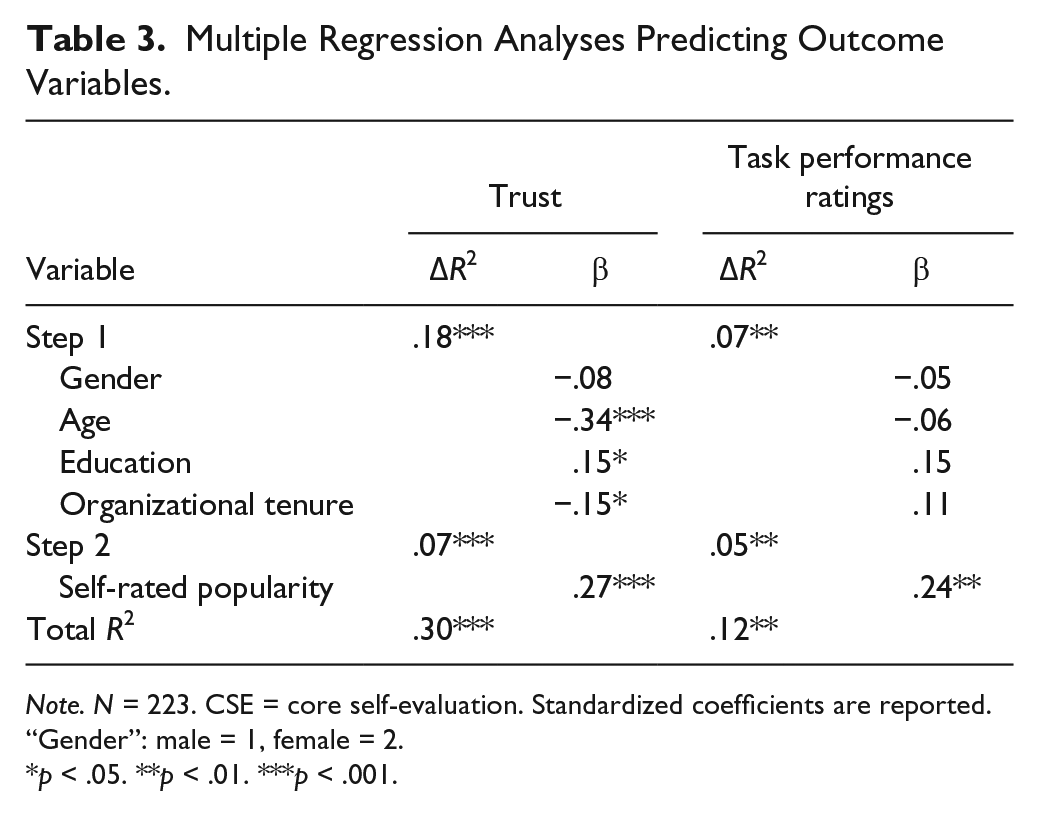
Note. N = 223. CSE = core self-evaluation. Standardized coefficients are reported. “Gender”: male = 1, female = 2.
p < .05. **p < .01. ***p < .001.
To summarize, all hypotheses were supported. More specifically, the current results provide support for the positive relationships between popularity and CSE (Hypothesis 1), political skill (Hypothesis 2), and work engagement (Hypothesis 3). Furthermore, both political skill (Hypothesis 3) and work engagement (Hypothesis 5) positively moderate the effect of CSE on popularity such that the positive relationship between CSE and popularity is enhanced when individuals have higher levels of political skill or work engagement. Finally, the data demonstrate that popularity is positively related to task performance (Hypothesis 6) and supervisor trust (Hypothesis 7).
Discussion
The current field study demonstrates that popularity is a pertinent social construct to consider in organizations by investigating connections between employees’ individual characteristics and workplace popularity, as well as how workplace popularity may relate to supervisor attitudes and perceptions. Popularity is widely studied in other psychological domains but has only started to gain traction as it applies to the workplace. The present results are consistent with previous studies (Scott, 2013; Scott & Judge, 2009), and also extend prior research by demonstrating connections that literature has thus far overlooked. First, the current findings show that certain work-related skills and attitudes (i.e., political skill and work engagement) relate to employee popularity above and beyond the general individual characteristic of CSE. Second, the strength of the relationship between CSE and popularity varies across employees; it is stronger for employees with better political skill or higher levels of work engagement. Third, the current findings expand the scope of outcomes of workplace popularity such that popularity is positively associated with and supervisor trust in supervisor-rated task performance.
Theoretical Implications
Concerning the factors that may facilitate the occurrence of employee popularity, this study advances the current literature by demonstrating the ability of political skill and work engagement in to predict popularity over and above CSE. Unlike CSE, which is an inherent dispositional trait reflecting the positivism of one’s general self-construal, political skill, and work engagement are closely related to features of the organizational context. In other words, these two variables make several contributions to our understanding of workplace popularity by explaining the work-specific portion of the variability of workplace popularity.
First, the discovery of a broader set of antecedents suggests that employees have multiple potential avenues to attain workplace popularity. CSE represents a dispositional characteristic which tends to be stable across situations and time. Some individuals are born to have positive self-construal and by nature they have the tendency to be the center of the social groups they belong to. Political skill and work engagement are more state-like and their behavioral, cognitive, and motivational components directly focus on aspects central to the work environment. Individuals high on political skill may gain popularity through their interpersonal influence tactics and network building abilities rather than personal positive charisma. In addition, the finding that work engagement is an antecedent of popularity suggests that another way to gain acceptance and admiration from coworkers is through one’s task-related attitudes and behaviors exhibited at work. An individual may be popular in one work setting but not another depending on the degree to which he or she is dedicated to the work goals of that setting. In sum, while CSE presents one explanation of popularity that may be applicable across interpersonal contexts, the findings regarding political skill and work engagement shed light on popularity in a specific social situation. Additionally, by examining these constructs as antecedents of popularity above and beyond the effects of CSE, this study reveals multiple pathways toward popularity in the workplace.
Second, in conjunction with the main effects of political skill and work engagement, the current results also demonstrate their moderating effects on the CSE–popularity link. According to results from simple slope tests, the two work-related characteristics affect this relationship such that CSE is influential only for employees with high political skills or employees with high work engagement. This suggests that the different pathways toward workplace popularity may cross. Both moderators supplement CSE in a way that reflects features of the work context. The significant main effects and moderation effects found for political skill and work engagement highlight the importance of examining work-related individual characteristics in understanding the formation of workplace popularity.
Another contribution of this study stems from the support for the hypothesized outcomes of workplace popularity (i.e., supervisors’ trust and task performance ratings). Previous research (e.g., Cullen et al., 2012, 2014; Scott & Judge, 2009) concentrated on coworker behavior, which is an important outcome based on popularity’s relational nature. The current research extends this study by examining the implications of popularity for supervisor attitudes toward employees and subjective ratings of employee performance in that the data show leaders’ evaluation of trust and task performance may partially derive from the impression of the employee’s overall social position. Since supervisors rely on their employees to complete tasks, it is in their best interests to foster positive relationships with subordinates. A popular subordinate’s social acceptance and visibility may serve as evidence of trustworthiness or competency. Another possibility is that supervisors’ willingness to accept vulnerability based on unspecified positive expectations (i.e., trust; Colquitt et al., 2007) of employees and their performance ratings may be unintentionally biased by employees’ levels of popularity due to the halo effect. Future researchers should investigate these possibilities, but for now the current findings extend prior literature by demonstrating that although popularity derives from social interactions among peers (Cillessen & Rose, 2005), it may influence multiple organizational outcomes beyond coworker attitudes and behaviors.
Practical Implications
In addition to the theoretical contributions, the present findings also have practical implications concerning workplace popularity. The significant main effects of political skill and work engagement as additional antecedents of popularity suggest that individuals can achieve workplace popularity through social or task-related avenues. While the ability to adroitly interpret interpersonal cues appeared to be very helpful for attaining popularity in the organizational context, employees who lack such skills need not feel discouraged because our results show that they may raise their visibility as the center of the social system through channels more directly related to work tasks. Instead of deliberately cultivating interpersonal ties, these employees can devote themselves to work assignments that allow them to shine and gain general acceptance. Such conclusions also imply that managers should consider employees’ political skill or work engagement when assigning tasks that require group work, as these characteristics may help supervisors anticipate how employees will fit into a given team dynamic. Practitioners may also consider including CSE, work engagement, and political skill in training modules focused on improving employees’ interpersonal interactions (e.g., Ferris, Anthony, Kolodinsky, Gilmore, & Harvey, 2002; Vance, 2006) or as selection criteria (e.g., Chang, Ferris, Johnson, Rosen, & Tan, 2012), especially for positions requiring employee interdependence.
Furthermore, support for the moderating effects of political skill and work engagement on the CSE–popularity relationship implies that CSE does not secure popularity for all employees, though it is positively related. Specifically, this relationship becomes more strongly positive when individuals possess political skill or deeply engage in work because they demonstrate skills, attitudes, and behaviors that mesh with characteristics of the organizational context. Employees can thus try and capitalize on the CSE–popularity connection by effectively demonstrating their interpersonal savvy or volunteer for challenging tasks.
In addition, while the significant relationships between popularity and supervisor-rated outcomes may benefit popular employees, it also implies that supervisors should be wary of how their own biases may affect subordinate evaluations. Because supervisors command a wide range of organizational resources by virtue of their role (Hornung et al., 2009), biased perceptions of subordinates’ trustworthiness or proficiency due to popularity may have dire repercussions if they are inaccurate. Furthermore, less visible employees may make equally valuable contributions to their organizations that go unrecognized by management. Even though this study did not explicitly examine the discrepancy between subjective and actual task performance, supervisors should proceed with caution to avoid making inaccurate decisions about employees’ qualities or performance.
Limitations and Future Directions
While the current findings certainly help improve our understanding of popularity in the workplace, this study is subject to limitations that should be addressed in future research. The current research design uses self-rating and supervisor-rating to assess employees’ popularity to mitigate the concern for common method bias. As reported in Table 1, the correlation between these two types of ratings was relatively low (i.e., r = .31), indicating low interrater reliability (IRR). As suggested by LeBreton and Senter (2008), “estimates of IRR are used to address whether judges rank order targets in a manner that is relatively consistent with other judges” (p. 816). Given that supervisors and employees may not know other participants in the sample, rank ordering targets is irrelevant in the current assessment of popularity. Additionally, we computed rwg(j) to estimate interrater agreement between the two types of ratings. Results showed that mean rwg(j) = .87 for self- and supervisor-rated popularity, suggesting that supervisors and employees provided similar ratings. These being said, future research adopting a different design and examining whether employees’ popularity is rank ordered similarly by different judges would be interesting and valuable.
Second, although the current findings support the hypothesized connections among the variables, it is difficult to make statements about causal relationships in light of the cross-sectional methodology employed. Employees with outstanding performance may become generally admired by peers as a result of their accomplishments. It is also possible that employees who evoke stronger trustworthiness become popular among peers because they are expected to have access to more resources at work. Such possibilities may account for the low (although statistically significant) correlations among the variables of interest in the present findings. Future research should use the proposed model in this study to examine the causal relationships between employee characteristics, popularity, and outcomes of interest with an experimental design or longitudinal data.
In addition to addressing these limitations, future studies should also measure supervisor characteristics to clarify when supervisors may be influenced by employees’ popularity. In the current research, we were not able to address when supervisors may be influenced by employees’ popularity, but future researchers should investigate the role of supervisor’s characteristics on employee popularity outcomes. For example, it may be the case that individual differences in the propensity to trust (Colquitt et al., 2007) influence the popularity–trust relationship. Another possibility is that employee popularity takes on different significance for supervisor-rated outcomes based on their level in the organization; examinations in this avenue of research would be of great value. Along those lines, the current study uses a sample drawn from multiple industries, which could influence the strength of the relationships examined in this study. Future research should specifically investigate this issue by comparing the impact of popularity on employee outcomes across various industries.
Footnotes
Declaration of Conflicting Interests
The author(s) declared no potential conflicts of interest with respect to the research, authorship, and/or publication of this article.
Funding
The author(s) received no financial support for the research, authorship, and/or publication of this article.