







Abstract
Despite the independent treatment of the positive and negative sides of leadership in the literature, evidence suggests that the same leader may demonstrate both positive and negative leadership behaviors albeit with a different frequency (i.e., Jekyll and Hyde). What impacts would such opposing leadership styles jointly have on follower and team outcomes? To address this question, the current study examines the interactive impact of charismatic leadership and abusive supervision on individual- and team-level outcomes. Findings across three different samples gathered from the United States and South Korea suggest significant moderating roles of abusive supervision in the positive relationships of charismatic leadership with follower and team outcomes. This study highlights the importance of incorporating otherwise separate perspectives on leadership and provides insights into the boundary condition that impedes the effectiveness of charismatic leadership. Thus, we call for more research on integrative models of leadership that embrace different aspects of leader behaviors.
Keywords
Two independent paradigms of leadership have evolved in contemporary leadership research. One paradigm comprises “positive” leadership styles or types such as charismatic/transformational leadership, ethical leadership, or servant leadership (e.g., Avolio, Waldman, & Einstein, 1988; Brown, Treviño, & Harrison, 2005; Liden, Wayne, Zhao, & Henderson, 2008), and the other paradigm focuses on “negative” or “dark” leadership styles, commonly revealed in models of abusive supervision, narcissistic leadership, or destructive leadership (e.g., Ferris, Zinko, Brouer, Buckley, & Harvey, 2007; Rosenthal & Pittinsky, 2006; Tepper, 2000). Extant research generally suggests that positive leadership styles are associated with desirable outcomes for followers and the organization (e.g., increased productivity, well-being, organizational commitment, sales and revenue; Grant, 2012; Judge & Piccolo, 2004; Wang, Oh, Courtright, & Colbert, 2011), whereas negative leadership styles are associated with unfavorable outcomes (e.g., decreased safety behaviors, creativity, and task performance; Resick, Whitman, Weingarden, & Hiller, 2009; Schyns & Schilling, 2013).
Despite empirical evidence and popular examples identifying individuals who exhibit both positive and negative leadership behaviors (Mullen, Kelloway, & Teed, 2011; Resick et al., 2009), studies testing the joint effect of conflicting behaviors have been limited. Indeed, most studies of abusive supervision or charisma have been typically examining one approach in isolation with no direct consideration of the other (Hunter, Bedell-Avers, & Mumford, 2007). For notable exceptions, see Johnson, Venus, Lanaj, Mao, and Chang (2012) and Lin, Ma, and Johnson (2016). Johnson et al. (2012) showed that managers displayed both positive (i.e., charismatic leadership and consideration) and negative leadership behaviors (i.e., abusive supervisory behaviors) on a daily basis. Lin et al. (2016) demonstrated that engaging in ethical leader behaviors could lead to abusive behaviors through ego depletion. Although these studies included both positive and negative leadership paradigms, however, they did not investigate the joint effects of these opposing styles, which is a primary concern in this study.
Research that examines either positive or negative leadership, rather than both concurrently, ignores realistic, common, yet complicated examples of successful and inspirational leaders who are also known for being abusive to employees (e.g., Jeff Bezos, Steve Jobs; “Amazonrelentless.com,” 2014; Isaacson, 2011). Unfortunately, the dynamic interaction between contradictory paradigms is largely unexamined in the leadership literature. In the current study, building on emerging evidence that a leader displays a variety of behaviors, even seemingly opposite types of leadership (e.g., ethical and abusive leadership; Lin et al., 2016), we argue that a leader’s demonstration of charisma and abusive supervision serves to arouse cognitive dissonance in followers (Fried & Aronson, 1995), compromising the positive effects of charismatic leadership on follower and team functioning and performance.
To better understand how multiple leadership styles jointly influence followers and teams in organizations, we believe that it is important to simultaneously examine both positive and negative leadership in a single study. As such an attempt, the present study integrates charismatic leadership, one of the most widely studied positive leadership constructs, with abusive supervision, one of the most heavily researched negative leadership constructs, to examine the interactive effects of these two conflicting styles on follower and team outcomes. More specifically, we investigate how charismatic leadership and abusive supervision interact to impact followers’ perceived organizational support (POS) and task performance. POS and task performance are chosen because they indicate individuals’ exchange relationship with and reciprocating behavior toward the organization, which are subject to the influences of different types of leadership (Judge & Piccolo, 2004; Rhoades & Eisenberger, 2002).
We further examine the extent to which shared experiences of abusive supervision by team members (i.e., “team-level abusive supervision,” hereinafter) serve as a boundary condition of the relationships of team-level charismatic leadership with team processes (team cohesion, team communication) and team performance. While there has been considerable research on team-level charismatic leadership (DeGroot, Kiker, & Cross, 2000; Wang et al., 2011), abusive supervision has been recently studied as a team-level construct in several articles (e.g., Farh & Chen, 2014; Hannah et al., 2013; Priesemuth, Schminke, Ambrose, & Folger, 2014). Priesemuth et al. (2014) argued that more attention to group-level abusive supervision is imperative to unveil the full impact of abusive supervision in organizations. Extending this line of work, we examine how team-level abusive supervision interacts with team-level charismatic leadership to influence team processes and outcomes.
The current research contributes to the leadership literature in significant ways. First, this study responds to repeated calls for a more integrative model of leadership to address the limitations of examining isolated leadership behaviors (e.g., DeRue, Nahrgang, Wellman, & Humphrey, 2011; Piccolo et al., 2012; van Knippenberg & Sitkin, 2013). Our approach of encompassing multiple and divergent leadership styles has the potential of advancing theory building in the leadership literature by providing more refined and nuanced understanding to extant leadership theories. In particular, we examine the extent to which opposing leadership styles foster cognitive dissonance in followers, which is revealed in their level of POS and performance. Second, this study contributes to charismatic leadership research by considering abusive supervision as a boundary condition that impedes the positive influence of charismatic leadership. Third, the study contributes to the abusive supervision literature by demonstrating the interactive impact of team-level abusive supervision and team-level charismatic leadership on team cohesion, communication, and performance.
Charismatic Leadership, Abusive Supervision, POS, and Cognitive Dissonance
Although there exist different conceptualizations of charismatic leadership (e.g., Bass, 1985; Conger & Kanungo, 1988), the general consensus is that charismatic leaders are perceived by followers as having exceptional qualities and an extraordinary ability to foster loyalty and commitment (Yukl, 2010). For instance, charismatic leaders articulate a vision, focus on collective identity, and inspire followers to go beyond self-interest for the sake of the collective. Furthermore, charismatic leaders display exemplary behaviors to reinforce the values inherent in the vision and motivate followers to perform beyond normal expectations and enhance their commitment to a vision or the collective identity of a team/organization (Shamir, Zakay, & Breinin, 1998). Numerous studies have shown that charismatic leadership is positively associated with individual followers’ attitudes toward the organization and a variety of performance including task, contextual, safety, and creative performance (DeGroot et al., 2000; Shin & Zhou, 2003). Especially relevant in the current study is the notion that charismatic leadership conveys a level of support and trust that has a powerful effect on followers’ self-concepts (Shamir, House, & Arthur, 1993).
On the other hand, abusive supervision refers to the negative side of leadership that involves interpersonal mistreatment toward followers (e.g., yelling, bullying, humiliating; Einarsen, Aasland, & Skogstad, 2007; Tepper, 2000). When experiencing abuse by leaders, followers tend to perceive interpersonal injustice accompanied by anger and frustration (Skarlicki & Folger, 1997) and violations of trust (Bies & Tripp, 1996). Such negative work experience may cause them to be dissatisfied with the leader, blame the organization for the mismanagement of the abusive leader, and withdraw their work effort or engage in deviant behaviors. In support, evidence has shown that abusive supervision is detrimental to followers’ well-being, sense of worth, job engagement, and attitudes toward the organization (Shoss, Eisenberger, Restubog, & Zagenczyk, 2013).
According to organizational support theory (Eisenberger, Huntington, Hutchison, & Sowa, 1986), employees tend to form global beliefs regarding the extent to which their organizations value their contributions and care about their well-being (i.e., POS). Because supervisors are often viewed as organizational agents to employees, how supervisors (leaders) treat their employees (followers) may influence their POS (Rhoades & Eisenberger, 2002). In particular, charismatic leaders provide followers with meaning and directions and serve as role models by displaying exemplary leadership behaviors (Bass, 1985; Grant, 2012). These behaviors will signal to followers that the organization cares about their well-being, because working with such leaders is a positive work experience, which is partly attributable to the organization for granting them such opportunities (Eisenberger, Stinglhamber, Vandenberghe, Sucharski, & Rhoades, 2002). Thus, charismatic leadership is positively related to followers’ POS (Asgari, Silong, Ahmad, & Abu Samah, 2008; Epitropaki & Martin, 2013).
However, some charismatic leaders yell at, ridicule, and exploit followers (Padilla, Hogan, & Kaiser, 2007) as evidenced by real examples in the business world (e.g., Jeff Bezos, Steve Jobs). The “dark side of charisma” (Hogan, Raskin, & Fazzini, 1990) is realized when especially charismatic leaders inspire loyalty and commitment among followers, then manipulate them through verbal or emotional abuse (Barling, Christie, & Turner, 2008). While charismatic leadership conveys support and an appreciation of followers by empathizing with individual concerns and encouraging self-confidence (Shamir et al., 1993), abusive supervision conveys a lack of support and trust by undermining self-worth.
These conflicting expressions of appreciation and support create cognitive dissonance (Cooper, 2007; Festinger, 1957) in followers, who come to hold contradictory beliefs about their own levels of contribution and value. When followers expect a supportive leadership style (charisma) yet experience one that is unexpected and contradictory (abuse), followers realize a conflicted psychological state. Consequently, those holding such beliefs or experiencing conflicting styles actively seek to reduce dissonance by rationalizing the conflict, justifying the leader’s behavior, or modifying their own behavior to create consonance between perception and action (Aronson, 1969; Festinger, 1957).
In this study, we argue that one way followers build consonance between leaders’ conflicting leadership styles is to question and discredit leaders’ charismatic leadership behaviors as the frequency of their abusive behaviors increases (De Cremer, 2003; Mullen et al., 2011). When charismatic leaders are perceived to also frequently engage in abusive supervisory behaviors, the inconsistency in the leader’s behaviors or the contrast between desirable and undesirable behaviors would cue followers to be suspicious of the integrity and trustworthiness of the charismatic leader (Dasborough & Ashkanasy, 2002; Martinko, Harvey, & Douglas, 2007). In turn, the vision advocated and the exemplary behaviors by the charismatic leaders would appear to be manipulative and thus become ineffective (Avolio & Gardner, 2005; Gardner & Avolio, 1998). This will lead the followers to blame the organization for appointing and keeping such individuals as supervisors, undermining followers’ beliefs that the organization cares about their well-being. Based on this logic, we argue that abusive supervision will serve as a boundary condition that weakens the positive relationship of charismatic leadership with followers’ POS.
As noted previously, charismatic leaders motivate followers to put more effort to their work by instilling a sense of purpose (Bass, 1985). Past research has shown that charismatic leadership is positively associated with individual followers’ task performance across various organizations and cultures (DeGroot et al., 2000; Wang et al., 2011). In contrast, abusive supervision has been found to be negatively related to follower performance because abused subordinates feel injustice and are motivated to restore justice by withdrawing their work effort (e.g., Aryee, Chen, Sun, & Debrah, 2007; Harris, Kacmar, & Zivnuska, 2007).
We argue that when charismatic leaders are seen to exhibit abusive behaviors, followers will experience cognitive dissonance and find these contradicting acts to be incompatible with charismatic leadership as “a role model for ethical conduct which builds identification with the leader and his or her articulated vision” (Bass & Avolio, 2000, p. 29). This will make the followers doubt the vision espoused by the leader as well as the leader’s genuine intent. Consequently, the charismatic leader will be no longer effective in providing followers with a clear sense of purpose and mission, being less likely to motivate them to perform to their potential. Moreover, the followers’ focus on getting even with the abusive leader to restore justice will distract or deplete the cognitive resources that are supposed to be devoted to their work, thereby decreasing their performance (Harris et al., 2007; Raver, Jensen, Lee, & O’Reilly, 2012). For the above reasoning, we posit that when followers perceive their charismatic leaders to be abusive, the positive relationship between charismatic leadership and follower task performance will be weakened.
Team-Level Charismatic and Abusive Leadership, Team Process, and Team Performance
According to multilevel leadership theories in teams (Chen & Kanfer, 2006; Hackman, 1992), leadership behaviors in teams serve as both “discretional” and “ambient” inputs that influence individual team members and the team as a whole, respectively. Leadership behaviors directed toward an individual team member are considered to be “discretionary” in that such behaviors are member-specific and influences the individual team member’s experience in the team. Meanwhile, the overall, aggregated levels of leadership behaviors toward all members in the team are thought to be “ambient” team-level inputs, which form the team’s social universe and influence all team members above and beyond “discretionary” leadership behaviors. Consistent with this, we argue that charismatic leadership and abusive supervision may also operate at the team-level because ambient inputs set norms and priorities for the whole team regardless of the discretionary charismatic and abusive behaviors that an individual team member experiences, and interactively affect team processes and performance.
Furthermore, charismatic leadership and social learning theories suggest that team-level charismatic leadership tends to influence two team processes—team cohesion and communication. Team cohesion reflects the shared commitment, attraction, and team pride that emerge from the experiences and interactions among team members (Mullen & Copper, 1994; Shaw, 1976). Team communication refers to how a team interpersonally coordinates its work to get things done (Swezey & Salas, 1992; Zander, 1994). In particular, social learning theory posits that individuals learn social behaviors through direct experience or observation and imitation (Bandura, 1986). Research shows that through rapport building and empathetic language, charismatic leaders are effective at linking followers’ mundane work roles to meaningful collective vision (Howell & Shamir, 2005). Guided by social learning theory, we argue that witnessing charismatic leaders’ vision building behaviors toward other members of the team is likely to lead a team member to emulate such behaviors, which in turn fosters a deep sense of identification with the team’s vision, infuses strong feelings of bond among team members, and builds a sense of shared commitment in the team (Shamir et al., 1998; Zhang, Cao, & Tjosvold, 2011).
Social learning theory also suggests that observing charismatic leaders’ confidence and optimism in the achievement of the collective version elevates team members’ attraction to the collective vision and their pride in being part of the team (Dionne, Yammarino, Atwater, & Spangler, 2004). This leads us to predict that team-level charismatic leadership will positively relate to team cohesion. Empirically, Carless, Mann, and Wearing (1995) found that team-level charismatic leadership was positively related to team cohesion. Moreover, Dionne et al. (2004) found that charismatic leaders promoted awareness and acceptance of mutual team goals through open communication and listening. By emulating such behaviors, team members effectively coordinate their collective effort and expedite information flow to achieve team goals (Gladstein, 1984). Taken together, both theoretical and empirical evidence suggests a positive relationship between team-level charismatic leadership and team communication.
However, when the same leader frequently exhibits abusive behaviors across team members (i.e., high team-level abusive supervision), we argue that the positive relationships of team-level charismatic leadership with team cohesion and communication will be undermined. More specifically, charismatic leaders’ frequent display of abusive supervisory behaviors perceived by team members will trigger them to question the leader’s intent and the collective purpose the leader promotes (Dasborough & Ashkanasy, 2002) as team members try to make sense of the disconnection between charismatic and abusive behaviors (Martinko et al., 2007). Team-level abusive supervision will also create negative interpersonal norms in the team through social learning processes (Bandura, 1986; Robinson & O’Leary-Kelly, 1998). That is, in teams with high (rather than low) levels of abusive supervision, team members are likely to emulate their leader’s negative behaviors toward other members. This will obstruct the positive social functioning that team-level charismatic leadership prompts among team members. Additionally, the leader’s abusive behaviors may elicit negative emotions from the team members such as disappointment, frustration, and discomfort, which contribute to a negative team affective tone that is detrimental to team cohesion and communication (Festinger, 1964; Sy, Côté, & Saavedra, 2005). Therefore, we propose the following hypothesis:
With regard to team performance, team-level charismatic leadership has been positively associated with team performance across various settings, including banks, industrial R&D teams, and military units (Bass, Avolio, Jung, & Berson, 2003; Carless et al., 1995; Keller, 2006). This is because charismatic leaders promote collective enthusiasm, optimism, and efficacy in the team (Sivasubramaniam, Murry, Avolio, & Jung, 2002). By contrast, team-level abusive supervision has been found to be negatively related to team performance because team members’ shared perceptions of abusive supervision decrease their psychological safety and collective efficacy beliefs (Cropanzano, Li, & Benson, 2011; Stajkovic, Lee, & Nyberg, 2009).
We argue that the positive relationship between team-level charismatic leadership and team performance will be attenuated when team-level abusive supervision is high. Charismatic leaders play a critical role in motivating team members to identify with their teams’ goals (Zhang et al., 2011). However, team-level abusive supervision will lead team members to reach a consensus that their charismatic leader is more interested in gratifying his or her own needs (e.g., taking credits from followers to get promoted, venting personal frustration toward team members) rather than attaining the collective goals of the team because misusing power at the price of the team is in a stark contrast to a core principle of charismatic leadership–transcending self-interests to strive for the success of a team (Bass, 1985; Shamir et al., 1998). Thus, frequently experiencing or observing abusive supervision by the same charismatic leader will—make team members realize that it is acceptable and important to focus on self-interests rather than collective goals (Bandura, 1986). As a result, the charismatic leader’s capability to enhance commitment to the collective identity will be significantly decreased. This in turn will be related to lower levels of team performance. Conversely, when charismatic leaders rarely exhibit abusive behaviors across team members (low team level abusive supervision), their leadership behaviors will convey little information indicating that they pursue self-serving interests. As a result, team members will not become dubious about the intent behind the leader’s charismatic behaviors. Thus, team members’ elevated levels of motivation and work efforts are unlikely to be affected.
Method
Participants and Procedures
The study hypotheses were tested using data collected from three samples (two U.S. samples and one South Korean sample). Hypothesis 1 was first tested based on U.S. Sample 1, and Hypothesis 2 was first tested based on U.S. Sample 2. To replicate findings based on Samples 1 and 2 and to test the team-level hypotheses, we collected data from employees and their immediate supervisors in a South Korean manufacturing company. Detailed information on the samples and measures are provided below.
Sample 1 (United States)
Four hundred and three full-time working employees in various U.S. organizations (e.g., wholesale, manufacturing, construction, and service) were invited to complete an online survey that assessed demographic variables, along with their direct supervisors’ charismatic leadership, abusive supervision, and their perceived organizational support. Participants were recruited through StudyResponse (http://www.studyresponse.net/), an online platform that provides data collection services to academic researchers, and that has been used in leadership research (e.g., Piccolo & Colquitt, 2006; Tepper et al., 2009). Complete data were received from 235 participants after surveys with substantial missing values were excluded, yielding a response rate of 58%. Approximately half of the participants in the final sample were male (52%). The average age of the participants was 35.7 years (SD = 8.41). Most of the participants were Caucasian (78%) and had a college degree (72%).
Sample 2 (United States)
Seven hundred and nine working adults were recruited through undergraduates enrolled in an introductory management course in a Midwestern university as part of a class project. Participants reported their direct supervisors’ charismatic leadership and abusive supervision and their task performance in addition to other measures via an online survey. Complete data were received from 312 participants, yielding a response rate of 44%. Participants were mostly male (60%) and Caucasian (85%) with an average age of 38.6 years (SD = 13.58). Approximately half of them had a college degree or higher.
Sample 3 (South Korea)
Two hundred fifty employees working in a South Korean company were invited. Employees received an email sent by the HR manager that included a link to the survey. Participants’ confidentiality was assured by noting that a third party was conducting the study for academic research purposes, and that the company would not have access to individual data. Following Brislin’s (1980) recommendation, measures were translated into Korean, and native Korean speakers in the HR department of the company examined the meaning of the survey items. At Time 1, 181 employees assessed charismatic leadership, abusive supervision, POS, and team processes (70% response rate). At Time 2, 48 supervisors (leaders) assessed their followers’ task performance and team performance (80% response rate). Three months later (Time 3), we obtained formal annual performance ratings for the followers from the HR department. Participants were mostly male (employees: 72%; supervisors: 91%), and their average ages were 34.6 years (SD = 5.8) for employees and 41.6 years (SD =3.2) for supervisors. On average, supervisory tenure was 3.1 years (SD = 3.4) and organizational tenure was 7.2 years (SD = 4.7). Average team size was 3.21 (SD = 1.53) and team tenure was 2.04 years (SD = 2.56). Approximately, 87% of employees had a college degree or higher.
Measures
Unless otherwise noted, all variables in the three studies were measured on a 5-point Likert-type scale ranging from 1 (never, or strongly disagree) to 5 (frequently or always or strongly agree).
Charismatic Leadership
Consistent with previous work (e.g., Bono & Ilies, 2006), we assessed follower perceptions of charismatic leadership displayed by supervisors using 12 items in the Multifactor Leadership Questionnaire (MLQ-5X; Bass & Avolio, 1997) that measure idealized influence and inspirational motivation across the three samples. This scale showed high levels of internal consistency (Cronbach α = .93 in Sample 1; Cronbach α = .94 in Sample 2; Cronbach α = .92 in Sample 3). When developing team-level hypotheses, we conceptualized team-level charismatic leadership as a shared perception among team members under the same supervisor. Thus, aggregating followers’ scores for their supervisor’s charismatic leadership to team-level needs to be justified. We computed intermember agreement (rwg; James, 1982) and reliability (ICC(1) and ICC(2) (Bliese, 2000) and found support for the aggregation (mean rwg = .85; ICC(1) = .12; ICC(2) = .30). 1
Abusive Supervision
Participants in Samples 2 and 3 were asked to report their supervisors’ abusive behaviors using Tepper’s (2000) 15-item scale. In Sample 1, to reduce the length of surveys, we used a 5-item short version of Tepper’s scale, which has been used in prior research (e.g., Mitchell & Ambrose, 2007). Sample items include “my supervisor ridicules me” and “my supervisor puts me down in front of others.” The scales demonstrated high levels of internal consistency in the three samples (Cronbach α = .94 in Sample 1; Cronbach α = .95 in Sample 2; Cronbach α = .97 in Sample 3). Following prior research (e.g., Priesemuth et al., 2014), we conceptualized team-level abusive supervision as a shared perception among team members. The intermember agreement and reliability indices (mean rwg = .85; ICC(1) = .24; ICC(2) = .50) suggest our aggregation is justifiable.
POS
We measured participants’ POS with the eight highest loading items of the Survey of Perceived Organizational Support (Eisenberger et al., 1986) in Samples 1 and 3. Sample items are “my organization really cares about my well-being” and “my organization is willing to help me when I need a special favor.” The items showed high internal reliability (Cronbach α = .92 in Sample 1; Cronbach α = .83 in Sample 3).
Follower Performance
Participants in Sample 2 self-reported their task performance using Williams and Anderson’s (1991) seven-item scale. Prior research has shown that self-ratings of performance are moderately correlated with supervisor or peer ratings of performance (Harris & Schaubroeck, 1988). Sample items include “I fulfill responsibilities in job description” and “I adequately complete assigned duties.” Cronbach α was .89. In Sample 3, supervisors were asked to assess their direct reports’ task performance. Because the participating organization asked us to take as little time as possible of the supervisors’, we used two items of the Williams and Anderson’s (1991) scale. The items demonstrated acceptable internal reliability (Cronbach α = .83). In addition, the participating organization shared with us the annual formal performance ratings for the employees in Sample 3 about 3 months after Time 2 data collection. The formal performance ratings were based on the employees’ accomplishment of work goals over the past year and were assessed using a 5-point scale such as 1 = below expectation and 5 = outstanding.
Team Processes
Team members in Sample 3 rated their team cohesion through the four-item measure of Beal, Cohen, Burke, and McLendon (2003). An example item is “My team members are all committed to our team.” We aggregated individual team members’ responses to the team level based on acceptable intermember agreement, mean rwg = .79, and reliability, ICC(1) = .18, ICC(2) = .41. The internal reliability of the scale at the individual level was .90. They were also asked to measure their team communication through Lester, Meglino, and Korsgaard’s (2002) three-item scale. An example item is “Members are willing to share information with other team members about our work.” Supported by acceptable intermember agreement (mean rwg = .81) and reliability indices (ICC(1) = .12, ICC(2) = .30), team members’ scores were aggregated to the team level.
Team Performance
Supervisors in Sample 3 assessed team performance using Aubé and Rousseau’s (2011) five-item scale that measures their team’s achievement of performance goals and the quality of work accomplished by the team. The scale showed a good internal reliability (Cronbach α = .83).
Control Variables
We controlled for employees’ age and gender when testing Hypotheses 1 and 2 because prior research suggest that age and gender may affect employees’ leadership perceptions and performance ratings (e.g., Ng & Feldman, 2010). We also controlled for team size and team members’ average team tenure when testing Hypotheses 3 and 4 because these factors tend to correlate with team performance and team processes (e.g., Shin & Zhou, 2003; Stewart, 2006).
Levels of Analysis
When testing hypotheses regarding the joint effects of charismatic leadership and abusive supervision on POS and follower performance, we treated charismatic leadership and abusive supervision as individual-level constructs because differences in individual followers’ perceptions of the two constructs reflect true variance that may affect their POS and task performance. However, when investigating the joint effects of charismatic leadership and abusive supervision on team-related constructs, we conceptualized charismatic leadership and abusive supervision as team-level constructs. This was based on theoretical and empirical evidence suggesting that they could be conceptualized as shared perceptions among team members regarding their leader’s charismatic and abusive leadership behaviors.
Results
Construct Discriminant Validity
Table 1 presents descriptive statistics and correlations among individual-level study variables across the three samples. Table 2 summarizes descriptive statistics, agreement and aggregation statistics, and correlations among team-level study variables in Sample 3. Before testing the hypotheses, we conducted confirmatory factor analyses (CFAs) to check the discriminant validity of measures rated by the same source. The CFA results show that at the individual level, the study variables are distinctive from each other across the three samples. Specifically, in Sample 1, the model containing charismatic leadership, abusive supervision, and POS as three factors adequately fit the data (χ2[62] = 175.41, p < .01; comparative fit index [CFI] = .98; standardized root mean square residual [SRMR = .06]; Hu & Bentler, 1999). This three-factor model fit significantly better (Δχ2[2] = 357.46, p < .01) than alternative nested models, including a two-factor model in which charismatic leadership and POS are combined into one factor (χ2[64] = 532.87, p < .01; CFI = .93; SRMR = .10).
Means, Standard Deviations, and Intercorrelations in Samples 1, 2, and 3 (Individual-Level Only).
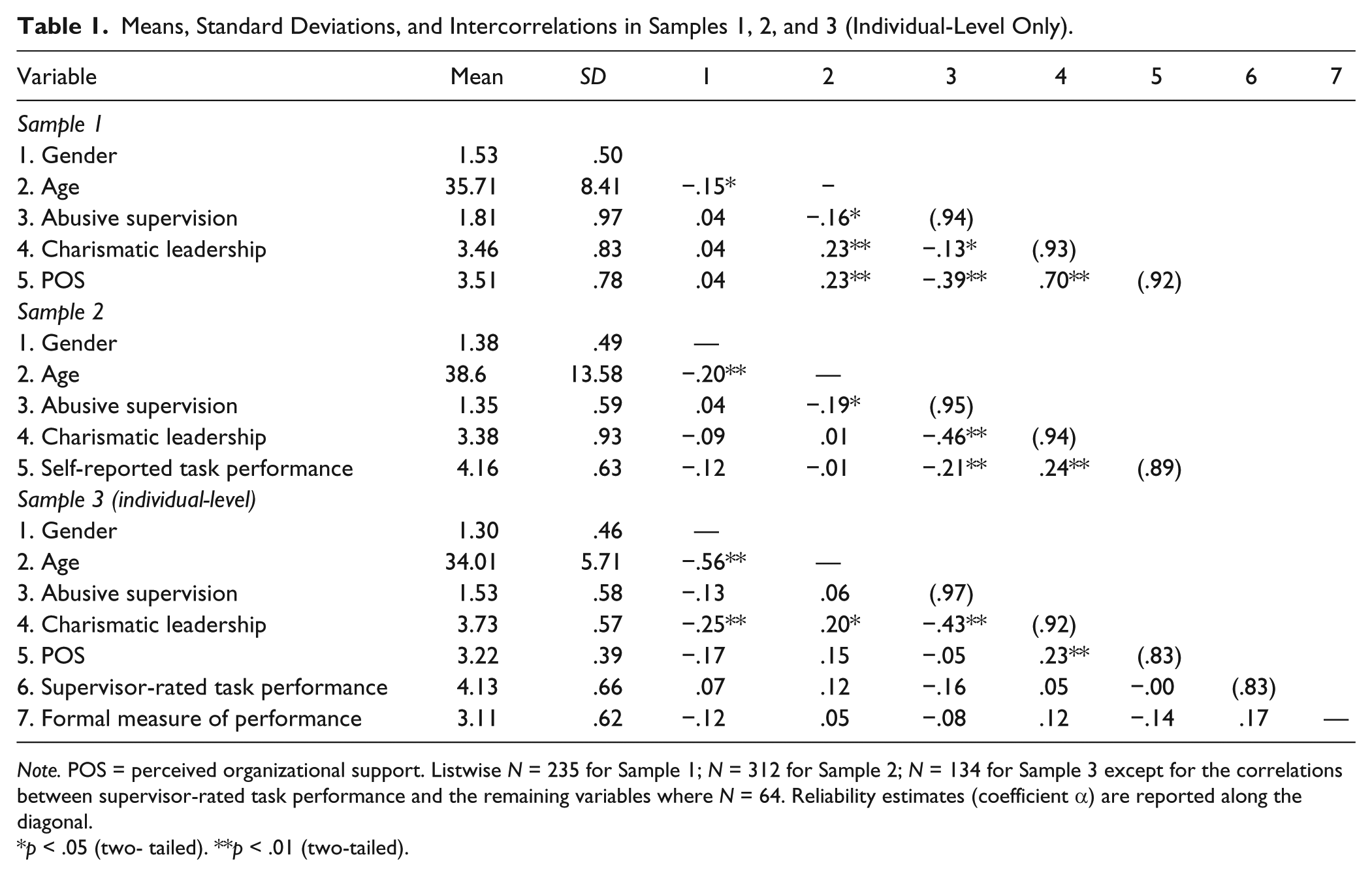
Note. POS = perceived organizational support. Listwise N = 235 for Sample 1; N = 312 for Sample 2; N = 134 for Sample 3 except for the correlations between supervisor-rated task performance and the remaining variables where N = 64. Reliability estimates (coefficient α) are reported along the diagonal.
p < .05 (two- tailed). **p < .01 (two-tailed).
Team-Level Descriptive, Agreement, and Aggregation Statistics and Intercorrelations in Sample 3.
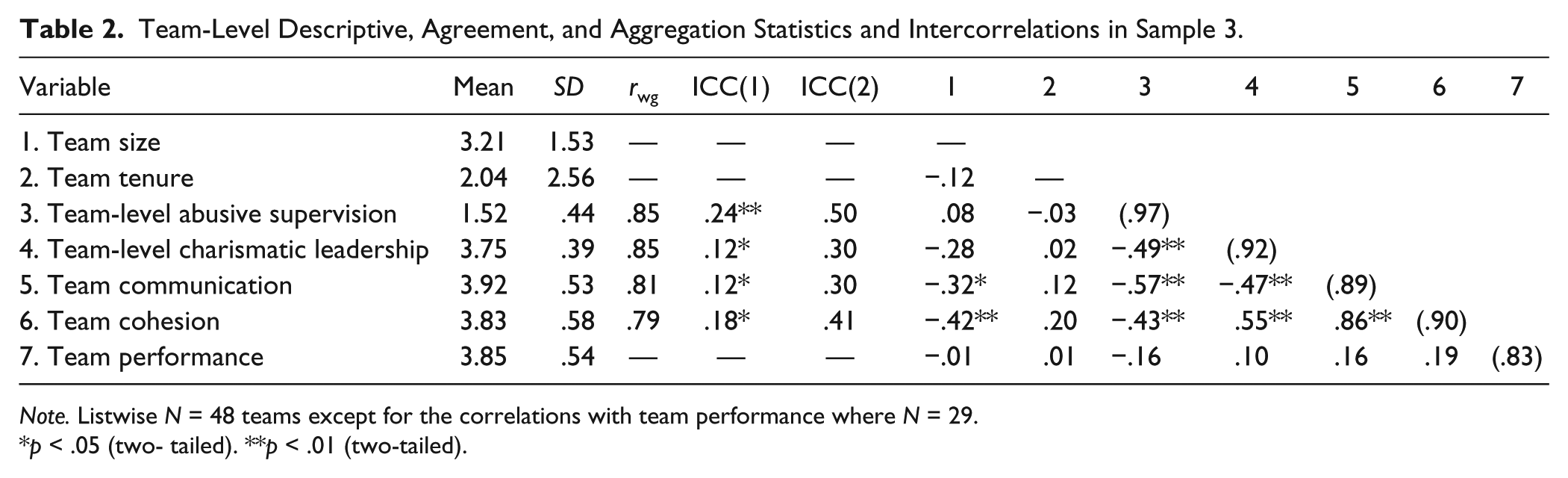
Note. Listwise N = 48 teams except for the correlations with team performance where N = 29.
p < .05 (two- tailed). **p < .01 (two-tailed).
In Sample 2, the model containing charismatic leadership, abusive supervision, and self-reported task performance as three factors fits the data well (χ2[87] = 287.92, p < .01; CFI = .97; SRMR = .05) and shows a better fit than alternative nested models, such as an alternative two-factor model in which charismatic leadership and self-reported task performance are combined into one factor (χ2[89] = 1085.83, p < .01; CFI = .87; SRMR = .16). Last, in Sample 3, the model containing charismatic leadership, abusive supervision, and POS as three factors fits the data well (χ2[101] = 221.92, p < .01; CFI = .96; SRMR = .05) and shows a better fit than alternative nested models, such as a two-factor model in which charismatic leadership and POS are combined into one factor (χ2[103] = 608.13, p < .01; CFI = .83; SRMR = .16). In addition, the CFA results show that at the team level, the model made up of team-level charismatic leadership, team-level abusive supervision, team cohesion, and team commutation adequately fits the data (χ2[84] = 145.79, p < .01; CFI = .94; SRMR = .06). The four-factor model fits with data better than alternative nested models including a three-factor model (Δχ2[3] = 34.01, p < .01) in which team cohesion and team communication are combined into one factor (χ2[87] = 179.80, p < .01; CFI = .91; SRMR = .08).
Hypothesis Testing Results
Table 3 summarizes moderated regression results of testing Hypotheses 1 and 2 in Samples 1 and 2 respectively. Hypothesis 1 predicted that the positive relationship between charismatic leadership and POS would be attenuated by abusive supervision. The product term representing the interaction between charismatic leadership (CL) and abusive supervision (AS) was significantly (β = −.10, p < .05) related to POS (Sample 1). Following Aiken and West’s (1991) suggestions, we mean-centered the predictors (CL and AS) and plotted the interaction at 1 SD below and above the mean of AS. As depicted in Figure 1a, simple slope tests show that the simple slopes at 1 SD below (simple slope = .72, p < .01) and above (simple slope = .54, p < .01) the mean of AS were positive and significant with the latter being less positive than the latter. Thus, results in Sample 1 supported Hypothesis 1.
Moderated Regression Results in Samples 1 and 2.
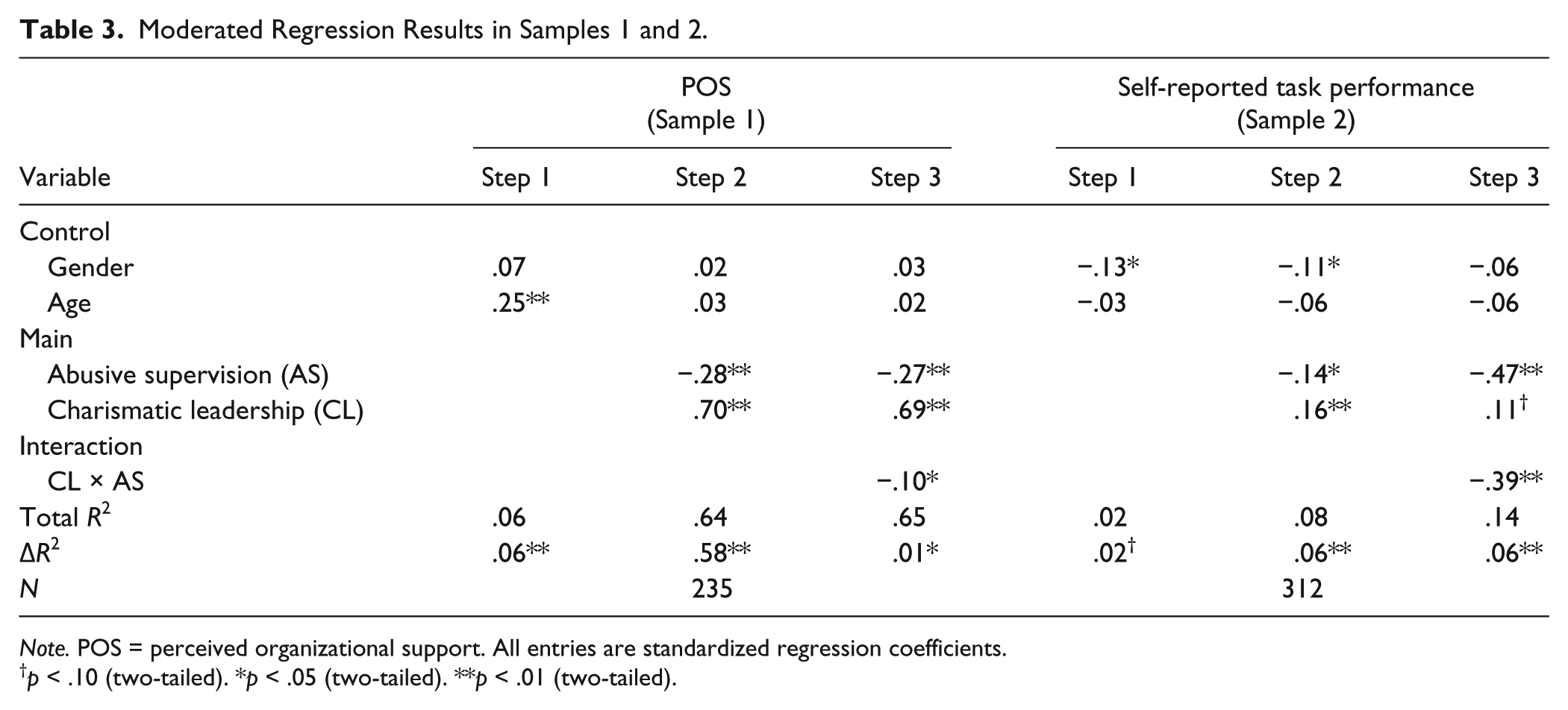
Note. POS = perceived organizational support. All entries are standardized regression coefficients.
p < .10 (two-tailed). *p < .05 (two-tailed). **p < .01 (two-tailed).
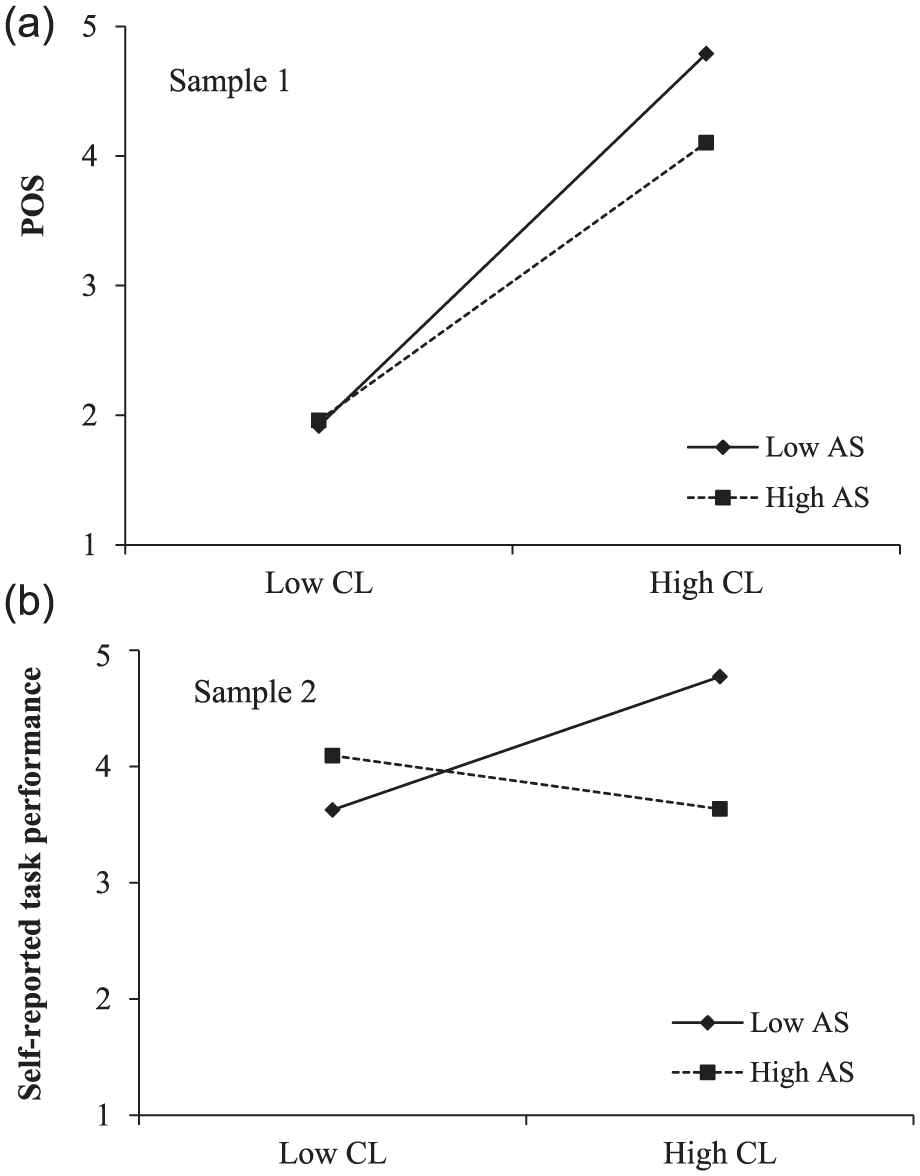
(a) Interaction between charismatic leadership (CL) and abusive supervision (AS) in predicting POS in Sample 1. (b) Interaction between CL and abusive supervision AS in predicting self-reported task performance in Sample 2.
Hypothesis 2 posited that the positive relationship between charismatic leadership and follower task performance would be attenuated by abusive supervision. The product term (CL × AS) was significantly related to self-reported task performance (β = −.39, p < .01) in Sample 2. As Figure 1b illustrates, the simple slope at low levels of abusive supervision (1 SD below the mean of AS) was positive and significant (simple slope = .29, p < .01), whereas the simple slope at high levels of abusive supervision (1 SD below the mean of AS) was nonsignificant. Supporting Hypothesis 2, the results in Sample 2 confirm that the positive relationship between charismatic leadership and self-reported task performance was attenuated by abusive supervision, such that this relationship was no longer significant at high levels of abusive supervision.
Table 4 presents moderated regression results in Sample 3, which were intended to replicate findings in Samples 1 and 2. As Table 4 shows, the product term (CL × AS) was marginally significantly related to POS (β = −.15, p < .10). Figure 2a displays that the simple slope at low levels of abusive supervision was positive and significant (simple slope = .23, p < .01), whereas the simple slope at high levels of abusive supervision was positive but nonsignificant. This pattern of interaction between CL and AS supports Hypothesis 2 and generally replicates findings in Sample 1 with nuances. In addition, the product term (CL × AS) was significantly (β = 19, p < .05) related to followers’ formal performance ratings. As displayed in Figure 2b, charismatic leadership had a marginally positive relationship with followers’ formal performance ratings when abusive supervision was high (simple slope = .23, p < .10) rather than low. Thus, findings in Sample 2 were not replicated in Sample 3.
Individual-Level Moderated Regression Results in Sample 3.
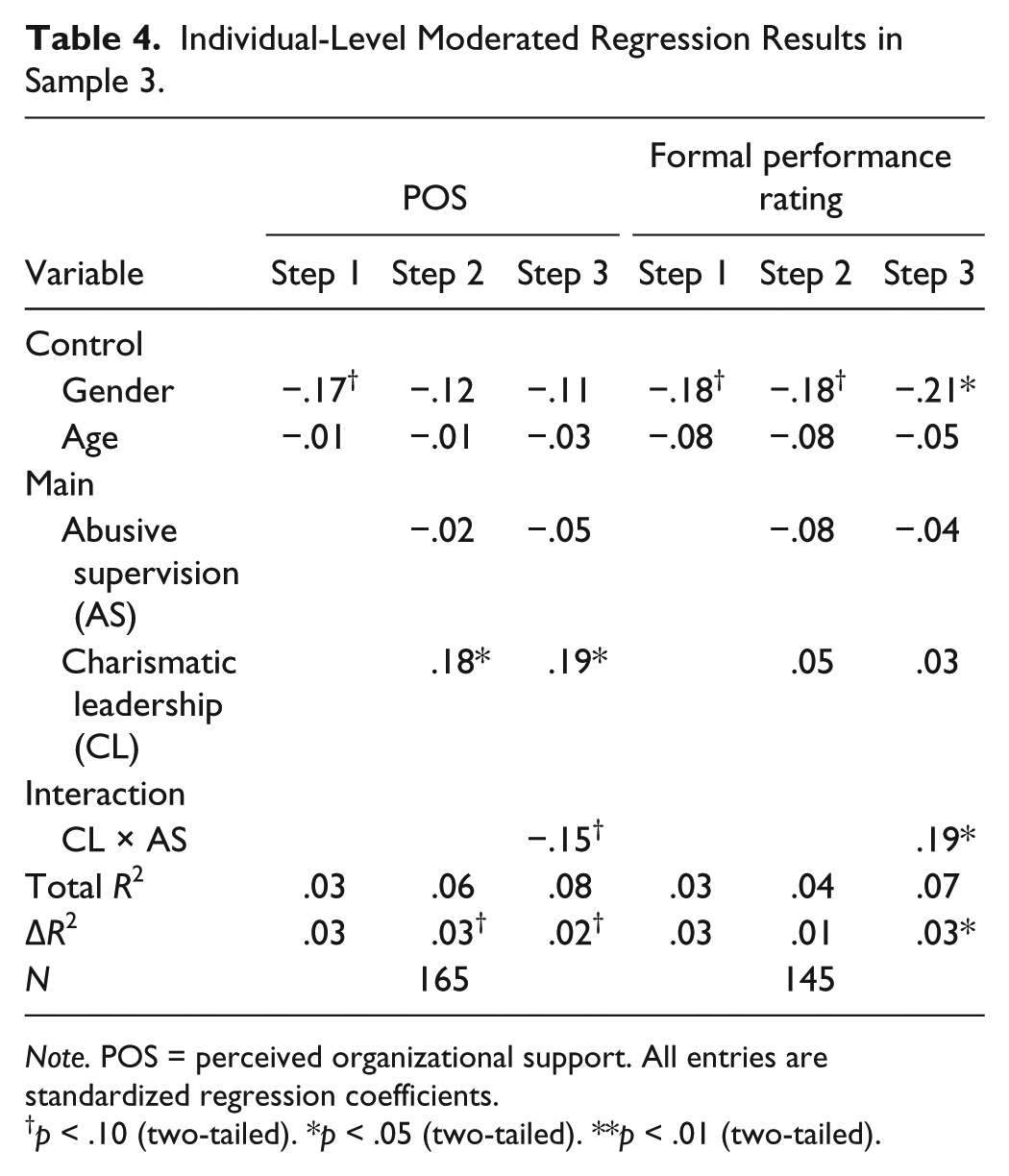
Note. POS = perceived organizational support. All entries are standardized regression coefficients.
p < .10 (two-tailed). *p < .05 (two-tailed). **p < .01 (two-tailed).
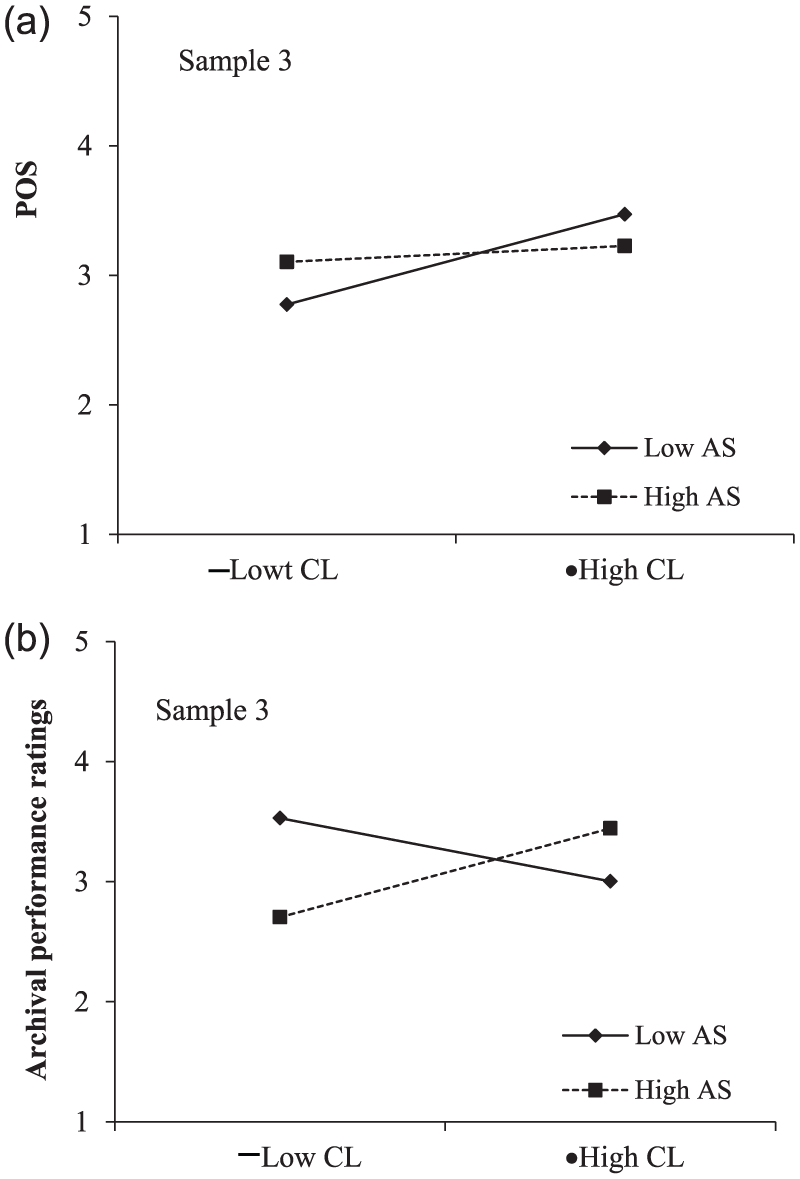
(a) Interaction between charismatic leadership (CL) and abusive supervision (AS) in predicting POS in Sample 3. (b) Interaction between CL and AS in predicting formal archival task performance in Sample 3.
As summarized in Table 5, we also tested Hypothesis 2 using supervisor ratings of followers’ task performance. To account for the nonindependence in supervisor ratings (ICC(1) = .32, or 32% of variance in supervisor ratings were accounted for by followers’ team membership), we tested Hypothesis 2 using hierarchical linear modeling. The product term (CL × AS) was significantly (γ = −.35, p < .05) related to supervisor-rated task performance. However, when the interaction was plotted, the simple slopes at 1 SD below or above the mean of abusive supervision were nonsignificant. The simple slopes at other values within the range of abusive supervision were nonsignificant, either.
Hierarchical Linear Modeling Results in Sample 3.
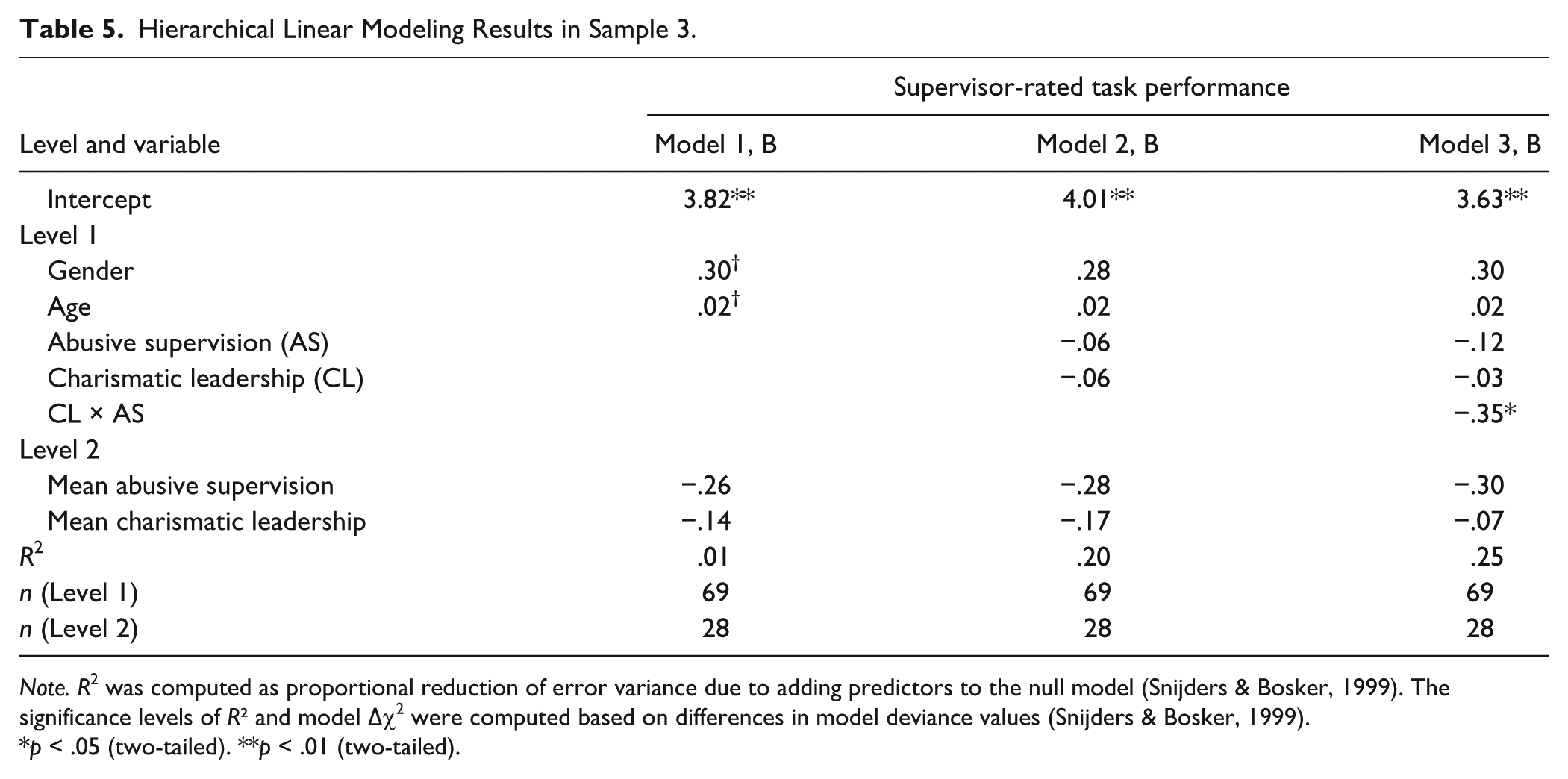
Note. R2 was computed as proportional reduction of error variance due to adding predictors to the null model (Snijders & Bosker, 1999). The significance levels of R² and model Δχ2 were computed based on differences in model deviance values (Snijders & Bosker, 1999).
p < .05 (two-tailed). **p < .01 (two-tailed).
Table 6 presents moderated regression results of testing Hypotheses 3 and 4, which posited that team-level abusive supervision (TAS) would attenuate the positive relationships of team-level charismatic leadership (TCL) with team processes (team cohesion and team communication, Hypothesis 3) and team performance (Hypothesis 4). The product term (TCL × TAS) was significantly related to team cohesion (β = −.27, p < .05) and team communication (β = −.33, p < .05) and marginally significantly related to team performance (β = −.42, p < .10). As displayed at Figure 3a and 3b, team-level charismatic leadership was significantly and positively related to team cohesion (simple slope = .93, p < .01) and team communication (simple slope = .69, p < .01) at low levels of team-level abusive supervision but had nonsignificant relationships with team cohesion and team communication at high levels of team-level abusive supervision. Thus, Hypotheses 3 was supported. As shown in Figure 3c, team-level charismatic leadership was marginally positively related to team performance (simple slope = .98, p < .10) at low levels of team-level abusive supervision but was not significantly related to team performance at high levels of team-level abusive supervision. Thus, Hypothesis 4 was generally supported.
Team-Level Moderated Regression Results in Sample 3.
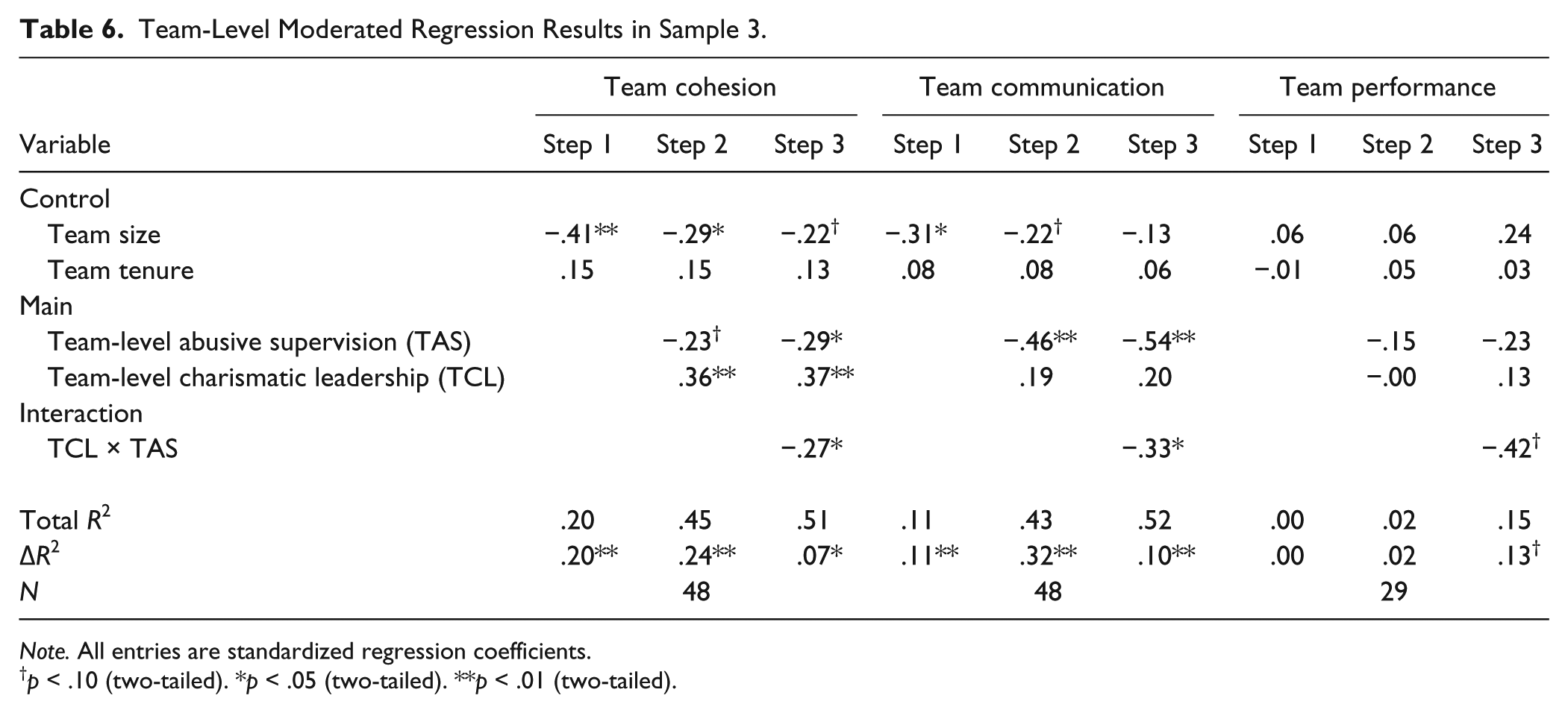
Note. All entries are standardized regression coefficients.
p < .10 (two-tailed). *p < .05 (two-tailed). **p < .01 (two-tailed).
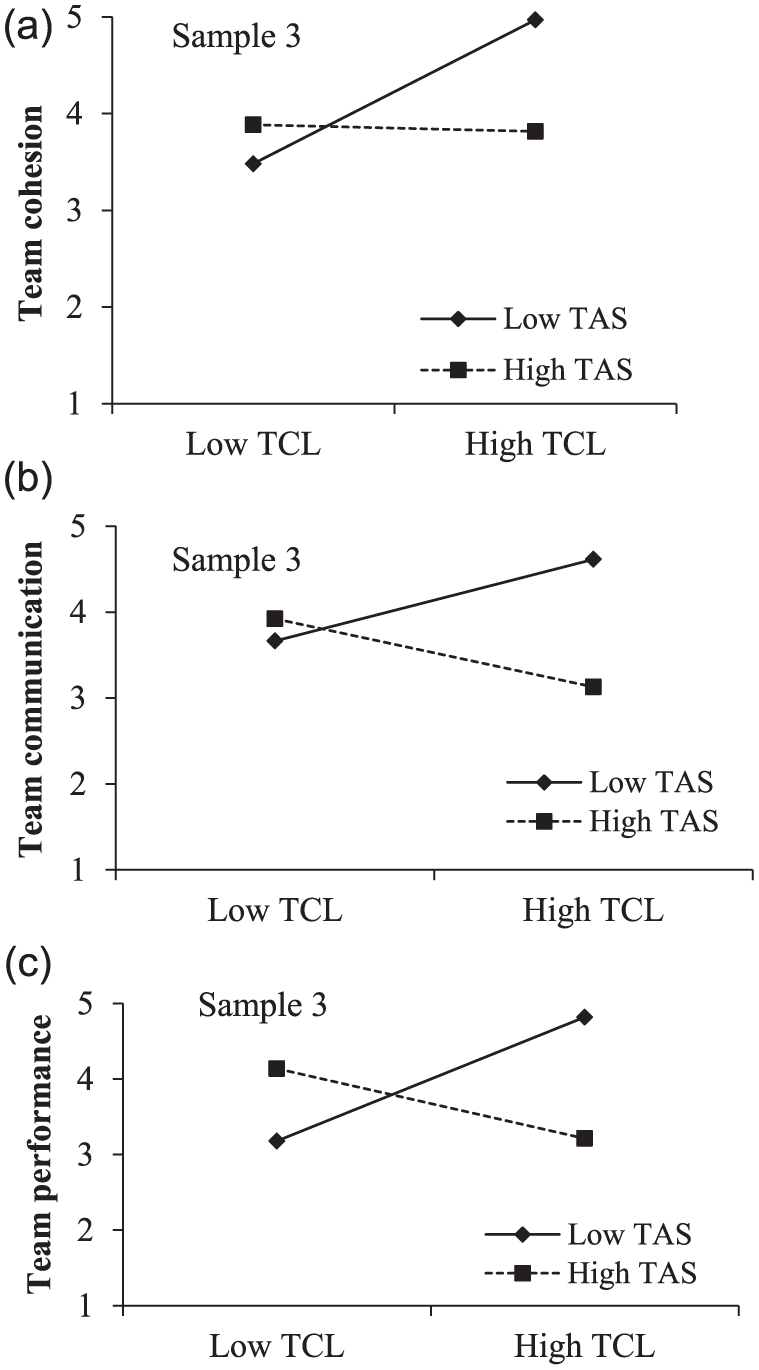
(a) Interaction between team-level charismatic leadership (TCL) and team-level abusive supervision (TAS) in predicting team cohesion in Sample 3. (b) Interaction between TCL and TAS in predicting team communication in Sample 3. (c) Interaction between TCL and TAS in predicting team performance in Sample 3.
Discussion
The present study examined the interactive effects of charismatic leadership and abusive supervision on follower and team outcomes. More specifically, our results suggest that at the individual-level, abusive supervision undermines the positive relationship between charismatic leadership and followers’ POS in both the United States and South Korean samples (Samples 1 and 3). Furthermore, consistent with our predictions and tenets of cognitive dissonance theory (Festinger, 1957), high levels of abusive supervision were found to diminish the positive association of charismatic leadership with follower self-reports of task performance in the U.S. sample (Sample 2). At the team level, the results suggest that the positive relationships between team-level charismatic leadership and team outcomes were attenuated when team-level abusive supervision was high. In general, results of this study were supportive of our proposed hypotheses across three different samples.
That said, we also found that under high levels of abusive supervision, charismatic leadership had a marginally significant positive relationship with an objective measure of goal accomplishment in the South Korean sample. Thus, for a subjective measure of performance, charismatic leadership and abusive supervision interacted as expected; abuse diminished the positive effects of charisma. For an objective assessment of goal accomplishment, however, results of this interaction, though marginal, were inconsistent with what we expected. One possible explanation for this inconsistency is that the objective measure of goal accomplishment captures different aspects of performance than those in the supervisor-rated measure. Indeed, the two measures of performance are not significantly correlated (r = .17, ns), and the objective measure is not significantly correlated with either charismatic leadership or abusive supervision.
Furthermore, we note that the objective measure of performance used in the current study was based on an individual employee’s accomplishment of work goals. Such result-based criteria tend to be narrowly defined (Bommer, Johnson, Rich, Podsakoff, & MacKenzie, 1995) with little information beyond a metric comparing actual versus expected results. According to Campbell, Dunnette, Lawler, and Weick (1970), objective measures such as these often suffer from criterion deficiency or contamination, as they tap only a small portion of the individual’s behavior, relying on variations in performance that are shaped largely by factors outside of an employee’s immediate control. Consequently, objective measures tend to yield, on average, lower criterion-related validities.
At the team-level of analyses, results were also generally supportive. The only marginally significant result is the interaction effect of charismatic leadership and abusive supervision on team performance, a result that is consistent with the general observation that validities of leadership on team-level performance tend to be smaller than more proximal indicators of team process (e.g., cohesion, communication).
Theoretical Implications
Breaking from a dominant research practice of focusing on a single, individual type of leadership, we sought to reconcile two independent schools of thought on leadership by examining the interactive impacts of charismatic and abusive leadership on multilevel outcomes. Our findings on the significant interaction between the two forms of leadership speak to the importance of integrating existing leadership theories. van Knippenberg and Sitkin (2013), in a review of charismatic-transformational leadership research, suggested that an important future research direction is to study the interactive effects of elements in charismatic-transformational leadership (e.g., vision communication) and “elements of leadership that are not part of the charismatic-transformational framework” (p. 47). Responding to this call, we drew upon the charismatic leadership and abusive leadership literatures to simultaneously examine multiple, opposing leadership styles in a single analysis. Our study suggests that the role of leadership in organizations is much more complex and dynamic than commonly examined (Lin et al., 2016; Uhl-Bien, Marion, & McKelvey, 2007). To gain more and deeper knowledge of leadership effects, we believe it is imperative for researchers to study the joint, complementary, or conflicting effects of various forms of leadership.
Our approach also helps - understand the dark side of charisma or pseudo-charismatic leadership by explicitly examining its influence process in relation to abusive supervision. Bass and Steidlmeier (1999) argued that authentic charismatic/transformational and pseudo-charismatic/transformational leadership differ in terms of three pillars: leaders’ characters (e.g., personality, values), ethics behind leaders’ visions, and leaders’ influence processes. Whereas most research in this area has been focused on the first two pillars (e.g., Barling et al., 2008; House & Howell, 1992), there is little work on the influence processes of pseudo-charismatic/transformational leadership.
Knowledge on the influence processes of pseudo-charismatic/transformational leadership would contribute to the external validity of Bass and Steidlmeier’s (1999) theoretical framework and reveal additional consequences of pseudo-charismatic/transformational leadership for followers and teams. This study’s focus on the interaction of charismatic leadership and abusive supervision captures a dynamic influence process through which pseudo-charismatic/transformational leaders may promote a vision but coerce their followers to attain the vision through abusive behaviors. Our work suggests that pseudo-charismatic leadership may be better understood by considering other elements of leadership that are not part of the charismatic-transformational framework (van Knippenberg & Sitkin, 2013), such as abusive leader behaviors.
In addition, we found that charismatic leaders who also score low on abusive supervision have positive influences on followers’ POS across different cultures. This is consistent with the POS literature suggesting that employees hold the organization accountable for the treatment they receive from their supervisors, and that favorable treatment leads to high levels of POS (Eisenberger et al., 2002). However, the results from the U.S. Sample 1 (see Figure 1a) show that although followers perceived their supervisors to be highly abusive, their supervisors’ charismatic leadership was still positively related to their POS. In contrast, in the South Korean sample (Sample 3), the simple slope at high levels of abusive supervision was not significant.
One plausible explanation would be that the U.S. employees might not blame the organization for their supervisor’s abusive behaviors because such behaviors violate role expectations and basic etiquette in social interactions (Coté, 2005; Shoss et al., 2013) and thus should be ascribed to the particular individual, not the organization. In contrast, South Korea has a high power distance culture where social status dominates social interactions and an authority figure is viewed as a personification of the organization (Hofstede, 2001; Hofstede, Hofstede, & Minkov, 2010). Because we did not measure cultural variables in the study, we speculate that employees in South Korea are more likely to associate their supervisors’ abusive behaviors with the organization (Shoss et al., 2013).
Furthermore, it appears that the interactive effects of charismatic leadership and abusive supervision on individual followers’ task performance were not uniform across the samples. In Sample 2, the positive relationship between charismatic leadership and self-reported task performance was significant at low levels of abusive supervision. In Sample 3, however, the relationship between charismatic leadership and followers’ formal performance ratings was marginally positive at high, rather than low, levels of abusive supervision. As noted earlier, we suspect that the inconsistent findings might be due to differences between two types of performance measures. Alternatively, the inconsistent results might be because abused followers tend to believe that their supervisors are dissatisfied with their task performance (Tepper, Moss, & Duffy, 2011; Wang, Harms, & Mackey, 2015). Driven by the perception that their performance levels are low, subordinates may be motivated to improve their performance specifically on aspects that are formally assessed by the organization (or their supervisors). For these followers, their supervisors’ charismatic leadership behaviors can be particularly useful in boosting their self-confidence and self-efficacy. In this case, abusive supervision plays a coercive role in the relationship between charismatic leadership and followers’ formal performance ratings, such that under high levels of abusive supervision, employees are forced to be more receptive to the influence of their supervisors’ charismatic leadership behaviors thereby strengthening the positive relationship between charismatic leadership and followers’ formal performance ratings.
The coercive but instrumental role of abusive supervision may be especially pronounced in countries like South Korea where country-level power distance and collectivism tend to be high, and a paternalistic and authoritarian leadership style is culturally acceptable and common (Hofstede, 2001; Pellegrini & Scandura, 2008). However, given the harmful impact of team-level abusive supervision on the positive relationships of team-level charismatic leadership with team processes and team performance, abusive supervision used by charismatic leaders to push their subordinates to meet performance expectations will do more harm than good.
Finally, our study provides additional evidence that abusive supervision could emerge as a team-level construct affecting team-level outcomes. The findings in these studies suggest that team-level abusive supervision may undermine the positive effects of team-level charismatic leadership on team cohesion, team communication, and team performance. The positive relationships between team-level charismatic leadership team-related outcomes only exist at low levels of team-level abusive supervision. This suggests that team-level abusive supervision could negate the positive effects of team-level charismatic leadership on team processes and team performance. As such, the present study helps extend the abusive supervision literature beyond individual victims’ perspectives to work groups and teams and demonstrates a wider range of damages caused by abusive supervision (Priesemuth et al., 2014).
Practical Implications
This research provides important practical implications for managers and organizations. As shown in popular and successful CEOs who have displayed both positive and negative leadership styles, we hope people will become to appreciate the reality that leaders regularly demonstrate both socially desirable and undesirable behaviors. In particular, as leaders are often expected to handle complicated, various demands of a rapidly changing and highly competitive business environment, they may request their followers to fulfill conflicting objectives as well as displaying opposing leadership styles. The study illuminates not only what might happen when leaders display such behaviors as inspirationally motivating and emphasizing a collective identity but also engage in humiliating followers publicly or improperly blaming followers. The findings of our study suggest that the positive impact of charismatic leadership could be lost in the presence of abusive behaviors toward followers. When charismatic leaders are unable to refrain from engaging in abusive behaviors, their followers will perceive low levels of support from the organization, and team processes and performance will suffer, too. This in turn can cause a significant loss to the organization especially when it is critical for leaders to exert an intended influence on their followers but their influence is compromised. Therefore, leaders need to be mindful about their leadership behaviors, regularly reflect on their actions, and proactively communicate their true intention behind the action, if necessary.
Although high levels of abusive supervision may reinforce the positive relationship between charismatic leadership and followers’ formal performance appraisal, managers are better off not to engage in abusive supervision because it may lead to decreased POS and team outcomes. Therefore, we suggest that managers heed the potential inconsistency of their leadership behaviors. Research on leaders’ prioritization of their competing demands suggests similar prescriptions (e.g., Zohar, 2002; Zohar & Luria, 2005). Our studies also offer useful implications for leadership training and development programs. When designing charismatic leadership-related training programs, organizations may need to bring trainees’ attention to the consequences of abusive behaviors they may consciously or unconsciously engage in toward followers. Providing information about these opposing but closely related leadership behaviors will help achieve the intended goals of leadership training and thus will improve the effectiveness of leadership programs.
Limitations and Future Research Directions
This study has several limitations. First, a cross-sectional research design was used to collect self-report data in Samples 1 and 2. While Sample 3 addressed these issues by using a three-wave study and supervisor-rated and company-provided performance data, the sample size was relatively small, especially for supervisor-rated performance. Thus, interpretation of the causal relationships should be made with caution. Second, data for Sample 3 were collected in South Korea but we did not measure culture-related variables that would have allowed us to compare potential national-level cultural differences between findings from the U.S. data (Samples 1 and 2) and those from the South Korea data. Third, although we drew on cognitive dissonance theory, it was not directly measured in the study. This may be a fruitful area for future research. Finally, we did not make a distinction between personalized and socialized charismatic leadership in the study. Future researchers should examine whether personalized charismatic leadership may interact with abusive supervision to predict more negative outcomes than socialized charismatic leaders or vice versa.
Conclusion
The call for integrating the positive and negative side of leadership has been repeatedly echoed. However, empirical research based on the integrative approach still remains rare in the leadership literature. The current study demonstrates the importance of considering the interactive effects of multiple, divergent leadership styles.
Footnotes
Declaration of Conflicting Interests
The author(s) declared no potential conflicts of interest with respect to the research, authorship, and/or publication of this article.
Funding
The author(s) received no financial support for the research, authorship, and/or publication of this article.