







Abstract
Despite a flourishing literature demonstrating the consequences of implicit leadership theories (ILTs) for workplace phenomena, relatively little is known about the antecedents of ILTs, particularly those that are malleable or can be changed to shape ILTs. In two studies of dual-job holders, which allows for the modeling of between- and within-person predictors, I examined the extent to which workers’ ILTs were stable versus dynamic across work contexts. In line with connectionist perspectives, trait identities, a personal factor, promoted stability in ILTs across situations in both studies, whereas there was some limited evidence that organizational culture, a situational factor, only predicted ILTs within a given job context. Furthermore, the relationship between independent identity and ILTs differed when examining workers’ typical versus ideal leadership conceptualizations. Implications for future research on ILTs are also discussed.
Leadership research is thriving, and scholars have developed a wide range of theoretical perspectives on leadership that enriches our understanding (Dinh et al., 2014). Information-processing perspectives on leadership (i.e., Lord & Emrich, 2000; Lord & Maher, 1991), which draw on advances in cognitive science to better understand the role of leader and follower information processing (i.e., cognitions, schemas, and/or attributions) in leadership processes, have increasingly gained traction. Within this domain, the study of implicit leadership theories (ILTs), in particular, has flourished in the past two decades (Epitropaki, Sy, Martin, Tram-Quom, & Topakas, 2013; Junker & van Dick, 2014; Shondrick & Lord, 2010).
ILTs refer to people’s cognitive structures or prototypes of leader characteristics (Lord, Foti, & De Vader, 1984) and have significant real-world consequences (Epitropaki et al., 2013). Specifically, to handle the demands of informational complexity, people typically rely on their ILTs to guide their sense-making processes. For example, a match between an individual in one’s environment and one’s ILT influences one’s expectations and behaviors; congruence between one’s ILTs and the characteristics of one’s actual leader is positively related to the quality of leader–member exchange (LMX), which is then associated with more positive job attitudes and better performance (e.g., Epitropaki & Martin, 2005; Topakas, 2011). Similarly, a match between followers and leaders on ILTs positively predicts LMX, and there is some limited evidence that LMX then positively affects the followers’ developmental activities (Riggs & Porter, 2017). Finally, ILTs have been shown to guide new leaders’ behaviors; new leaders who believe that leaders ought to be sensitive are more apt to break the cycle of abuse by not emulating prior leader role models who were abusive and successful (Tu, Bono, Shum, & LaMontagne, 2018).
Although evidence is accumulating regarding the important consequences of ILTs, little empirical work exists exploring the antecedents of ILTs (Epitropaki et al., 2013). Furthermore, the limited extant research on antecedents has uncovered mostly dispositional and difficult to alter characteristics (e.g., personal and parental personality traits; Keller, 1999). Thus, the purpose of the present study is to fill these critical gaps in the literature by investigating both personal (i.e., trait identity levels) and situational (i.e., organizational culture) antecedents of ILTs, particularly factors that may be more malleable and could be targeted in future interventions. Additionally, by utilizing samples of dual-job holders in two studies, I assessed the degree to which workers’ ILTs are dynamic or stable across work settings. This innovative design also allows for better estimates of the relative contribution of personal versus situational factors to workers’ ILTs (e.g., Inness, Barling, & Turner, 2005; Inness, Turner, Barling, & Stride, 2010). Deeper insight into the malleable factors affecting individuals’ ILTs will help scholars better understand to what extent ILTs are fixed versus fluid and how to shape these cognitive structures in order to maximize leadership development (e.g., Schyns, Kiefer, Kerschreiter, & Tymon, 2011) and organizational functioning (e.g., Epitropaki et al., 2013).
Dynamism and Stability in ILTs
Drawing on connectionist models of knowledge, Shondrick, Dinh, and Lord (2010) argue that “ILTs are represented by relatively stable patterns of connections in a neural-like network” (p. 964). Inputs or stimuli activate nodes in the network, which then spread to other nodes based on the strength of the connections between nodes, ultimately resulting in different patterns of activation that represent different leadership prototypes. Importantly, Shondrick et al. also posit that these structures are flexible and change dynamically across situations because of the joint influence of different patterns of inputs from the environment and network constraints. Overall, this connectionist framework helps us understand the factors that drive stability (i.e., the connections between nodes are learned over time and are, therefore, relatively stable) as well as change (i.e., changing input patterns based on different situations) in individuals’ ILTs.
Despite this rich conceptual literature, little empirical work has examined the extent to which ILTs are stable versus dynamic either over time or across situations, particularly in field settings. In other words, although connectionist models of knowledge suggest that some degree of stability as well as change in individuals’ ILTs is likely, the degree to which each factor operates in practice is unclear. Epitropaki and Martin (2004) examined the stability of ILTs over time (i.e., 1 year) among two samples of workers and found no evidence of alpha (i.e., change in level), beta (i.e., change in scale point interpretations), or gamma (i.e., change in the definition of the construct) change. However, note that Epitropaki and Martin examined change in ILTs among workers whose employment situation was largely stable across the time span, and therefore, they may not have been able to detect the influence of changing contexts, which prior scholars have argued likely play a critical role in ILT change (Brown & Lord, 2001).
Given limited evidence of ILT change simply due to the passage of time, in this study I employ a rarely utilized—but highly telling—design that better allows for the assessment of potential context effects on ILTs. Specifically, I chose a within-person, between-jobs design using dual-job holders (i.e., individuals who hold paid employment in two separate organizations). This powerful design allows for the examination of both between- and within-subject predictors as well as different possibilities for how context may influence outcomes (e.g., job-specific predictors vs. spillover between jobs). To my knowledge, this design has only been used a couple of times in the literature, likely partly because of the difficulty of recruiting dual-job holders, who are relatively rare in the population; as examples, Inness et al. (2005) examined between-subject (e.g., self-esteem) and within-subject (e.g., abusive supervision) predictors of supervisor-targeted aggression, and Inness et al. (2010) examined the relationship between transformational leadership and employee safety performance between- and within-jobs. Thus, although prior research has used the within-person, between-jobs design to understand the impact of leadership, in the current study, I employ this method to understand whether and how personal factors and context shape leadership prototypes.
Antecedents of ILTs
Personal Antecedents
Prior research has argued that ILTs develop early in life (e.g., Antonakis & Dalgas, 2009; Ayman-Nolley & Ayman, 2005) and are likely shaped by early socialization experiences. In support of this argument, Keller (1999) generally found that ILTs are related to perceptions of parental personality traits, such that one’s ideal leader prototype typically possesses characteristics similar to those of one’s parents, particularly one’s father. Keller also found that one’s ideal leader prototype also has a tendency to mirror one’s own personality traits (e.g., extraverted individuals perceive charisma to be more prototypical of leaders). Thus, prior research has primarily uncovered dispositional and difficult to change antecedents of ILTs.
The idea that the self is implicated in leadership perception and processes is supported by a growing body of research (e.g., Lord & Brown, 2004; van Knippenberg, van Knippenberg, De Cremer, & Hogg, 2004). One’s identity refers to the knowledge or beliefs individuals hold about themselves. A key aspect of identity is identity level or self-construal, how one defines oneself relative to others (Markus & Wurf, 1987). Prior work has found that individuals can define the self along three distinct dimensions: individual (i.e., one’s uniqueness and distinctiveness from others), relational (i.e., one’s dyadic relationships with specific others, e.g., a supervisor or one’s spouse), and collective (i.e., one’s memberships in groups, e.g., work groups or racial/ethnic groups; Brewer & Gardner, 1996). Thus, individuals who define their sense of self differentially generally derive their sense of self-worth via different avenues (e.g., focusing on their own needs and performance, the performance and satisfaction of close others, or the performance and success of groups one is associated with; Jackson & Johnson, 2012).
Leader and follower identities appear to be central to many leadership processes. Follower collective identity mediates many of the relationships between transformational leadership and group outcomes (van Knippenberg et al., 2004), leaders’ trait identity guides leaders use of transformational and abusive leadership behaviors (Johnson, Venus, Lanaj, Mao, & Chang, 2012), and the fit between leaders’ and followers’ trait identities affects the quality of their LMX (Jackson & Johnson, 2012). However, despite mounting evidence regarding the importance of identity for leadership phenomenon, there has been little work linking identity levels with ILTs (for an exception, see Ehrhart, 2012). Furthermore, although there is evidence that identity levels are relatively stable, prior work also indicates that they are also somewhat malleable and can be changed (e.g., Johnson & Saboe, 2011; Johnson, Selenta, & Lord, 2006), making them a promising candidate for intervention to shape workers’ ILTs.
Epitropaki and Martin (2004) demonstrated that ILTs are defined by six factors: sensitivity, intelligence, dedication, dynamism, tyranny, and masculinity. The first four factors further load onto a higher-order prototypical ILT factor, and the latter two factors load onto a higher-order anti-prototypical ILT factor. Individuals with strong trait collective identities tend to derive their sense of self from the groups they are members of and seek to benefit those groups. Individuals with strong trait relational identities tend to derive their sense of identity from their relationships with others and seek to elicit esteem and liking from close others (Johnson et al., 2012). In the workplace, the best way to do so would be to pay attention to the well-being of others within the group or specific others (i.e., sensitivity) and to help the group achieve its valued outcomes or prove oneself to be a valuable social-exchange partner (i.e., intelligence, dedication, and dynamism). In fact, prior research suggests that individuals with stronger interdependent identities tend to perform more organizational citizenship behaviors and are higher in task performance (Johnson & Saboe, 2011). Given that ILTs tend to mirror one’s own personal characteristics (Keller, 1999), I anticipate that individuals higher on trait collective and relational identity will see prototypical leader attributes as more characteristic of leaders.
In contrast, individuals with strong trait independent identities tend to derive their sense of self by setting themselves apart from others and seek to maximize and fulfill their personal goals and desires. This may result in a greater willingness to manipulate and dominate others (i.e., tyranny and masculinity). Substantiating these claims, prior research has found that workers with stronger independent identities are more likely to engage in counterproductive work behaviors (Johnson & Saboe, 2011), and leaders with stronger independent identities are more likely to abuse their followers (Johnson et al., 2012). Given prior research that suggests that people expect leaders to be similar to the self (Keller, 1999), I hypothesize that individuals higher on trait independent identity will see anti-prototypical leader attributes as more characteristic of leaders.
Given the voluminous evidence suggesting that identity plays a key role in leadership processes, in the current study, I examine whether trait identity levels (i.e., independent, relational, and collective) are associated with workers’ ILTs. Moreover, because the self provides a relatively stable interpretive lens via which individuals view the world (Kihlstrom & Klein, 1994), I anticipate that an individual’s trait identity levels should contribute to the consistency and stability of his or her ILTs across work settings.
Situational Antecedents
Prior research has shown that characteristics of the environment can affect individuals’ ILTs (Epitropaki et al., 2013). The majority of this work has focused on national culture, showing that although there are some universally endorsed leader attributes across cultures, there are also some culturally contingent leader attributes (e.g., Gerstner & Day, 1994; House, Hanges, Javidan, Dorfman, & Gupta, 2004). Similarly, some scholars have suggested that organizational characteristics, such as organizational culture, likely also shape the cognitive schemas of workers (e.g., Sy, 2010; Wofford & Goodwin, 1994). However, to my knowledge, this proposition has not been empirically tested. Therefore, in the current study, I explore whether organizational culture affects workers’ ILTs.
Organizational culture refers to the “set of cognitions shared by members of the social unit” (Cooke & Rosseau, 1988, p. 248), and it typically manifests itself in the values and goals, norms, communications, and artifacts of the group. Although early studies of organizational culture often took an ethnographic approach, subsequent work has sought to assess culture quantitatively (Denison, 1996). The Competing Values Framework (Quinn & Rohrbaugh, 1981) specifies that there are two key dimensions that underlie the differences between organizations in their cultures. The first dimension is the extent to which organizations value control and stability versus flexibility and individuality. The second dimension is the extent to which organizations possess an internal versus external focus. Together these two dimensions form four types of organizational culture: clan, adhocracy, hierarchy, and market (see Figure 1). Furthermore, although changing organizational culture can be difficult, it is widely acknowledged as possible (e.g., Cameron & Quinn, 1999). Thus, organizational culture may be a promising way in which organizations can influence and align workers’ and leaders’ ILTs to shape work outcomes.
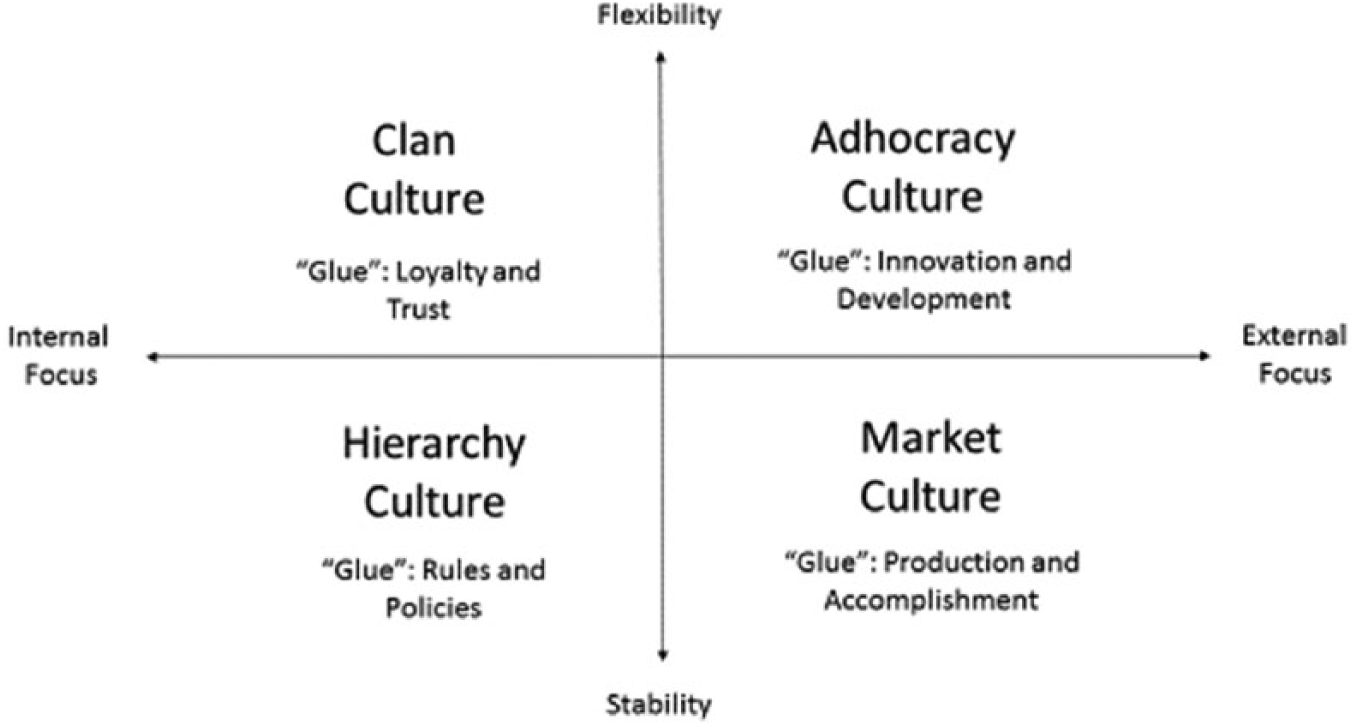
The Competing Values Framework depiction of organizational culture types.
I anticipate that organizational culture will act as a key situational input that shapes workers’ ILTs. Specifically, in clan cultures, where the organization is a warm and inviting place and the importance of morale is highly stressed (Hoojiberg & Petrock, 1993), members should be primed to view the prototypical leader attributes of sensitivity, intelligence, dedication, and dynamism as highly characteristic of leaders in that context. In fact, leaders in clan cultures are often described as mentors and facilitators (Cameron & Quinn, 1999). Note that mentors are typically expected to provide both career and psychosocial functions to protégés (Noe, 1988); therefore, I anticipate that individuals in clan cultures should be more likely to see all four prototypical leader attributes as more characteristic of leaders, not just the sensitivity dimension. In contrast, in market cultures, where the organization is an aggressive place and the importance of results is stressed (Hoojiberg & Petrock, 1993), members should be primed to view the anti-prototypical leader attributes of tyranny and masculinity as more characteristic of leaders in that context. Supporting this assertion, leaders in market cultures are often described as hard drivers or competitors (Cameron & Quinn, 1999). Predictions regarding ILTs within adhocracy and hierarchy cultures are less clear as they each share an element with clan and market cultures; therefore, I do not make any specific predictions regarding those two cultures.
Study 1
In this study, I employed a within-person, between-jobs design using dual-job holders to examine to what extent personal factors (i.e., trait identity levels) and situational factors (i.e., organizational culture) predict workers’ ILTs across job settings. This approach is helpful as it allows for the examination and estimation of change or dynamism across settings without employing a longitudinal design, as temporal issues associated with ILTs have generally been underexplored in the literature (Alipour, Mohammed, & Martinez, 2017) and there is currently little guidance or specificity regarding the appropriate time frame for such studies. Overall, this study provides valuable insights regarding both the antecedents and the stability of ILTs in field settings.
Method
Participants and Procedures
According to the U.S. Bureau of Labor Statistics (2015), approximately 5% of workers in the United States hold two jobs at once. Thus, to obtain a sufficient number of dual-job holders, it was necessary to reach large numbers of potential participants. Participants were recruited with the assistance of Qualtrics Panels. A prescreen question about number of jobs held was included as one of 10 items on a prescreen survey administered to U.S. panelists. 1 Only respondents who indicated that they currently held at least two jobs were invited to participate.
This sample consisted of 162 dual-job holders, none of whom were self-employed in either of their jobs given the study’s focus on leadership perceptions. The majority of the sample were female (71.6%) and White (75.3%). On average, the participants were 39 years of age (SD = 13.36). The participants first responded to trait measures (i.e., identity levels, demographics), followed by questions about each of the two jobs they held in turn (i.e., work hours and wages, organizational culture, and ILTs), starting with the job that they typically worked more hours at each week. On their primary job, on average, the participants worked 35 hours per week (SD = 10.80) for $16.58 per hour (SD = $10.88). For their secondary job, on average, the participants worked 17 hours per week (SD = 9.42) for $13.25 per hour (SD = $8.14). The participants held a variety of jobs (e.g., cashier, administrative assistant, teacher, and manager). 2
Measures
Trait identity
Johnson et al.’s (2006) 15-item measure of trait identity levels, which employs a five-point Likert scale (from strongly disagree to strongly agree), was used to assess independent (5 items, α = .73, “I have a strong need to know how I stand in comparison with my coworkers”), relational (5 items, α = .88, “It is important to me that I uphold my commitments to significant people in my life”), and collective (5 items, α = .84, “Making a lasting contribution to the groups that I belong to, such as my work organization, is very important to me”) identities.
Organizational culture
The participants responded to four questions about the organizational culture of the two organizations they were employed in, separately, using Cameron and Freeman’s (1991) measure. This measure is an earlier form of the Organizational Culture Assessment Instrument (Cameron & Quinn, 1999) and differs from the later measure in that it is shorter (four vs. six items) and does not include items assessing the dimensions of management of employees and criteria of success. Note that prior work has successfully used shorter forms of the measure to assess organizational culture (e.g., Deshpandé, Farley, & Webster, 1993; Naranjo-Valencia, Jimenez-Jimenez, & Sanz-Valle, 2011; Obendhain & Johnson, 2004).
Each of the four organizational culture questions was further broken down into four subfacets and asked respondents to allocate 100 points total per question across the four organizational descriptions based on similarity between their organization’s culture and each of the four exemplar organizations: clan, adhocracy, hierarchy, and market. Each question asked about one aspect of organizational culture (i.e., dominant organizational characteristics, leadership, organizational “glue,” and strategic organizational emphasis), and scores are created by summing across the questions for each exemplar organization and dividing by 4. Thus, the resulting organizational culture scores are ipsative—in line with prior theorizing and research indicating that organizations have finite resources and cannot pursue different strategies for organizational success to the same extent (Cameron, 2008; Sathe, 1983; Schein, 1996)—and reflect how similar the respondent’s organization is to each of the four organizational cultures.
In line with prior theorizing regarding how organizational cultures form, 86.4% of the participants worked in an organization with a dominant culture in their primary job (i.e., clan: 39.3%, adhocracy: 14.3%, hierarchy: 30.7%, market: 15.7%), and 88.3% of the participants worked in an organization with a dominant culture in their secondary job (i.e., clan: 32.1%, adhocracy: 14.3%, hierarchy: 30.0%, market, 23.6%). The limited number of remaining organizations had culture scores that reflected equal similarity to two or more organizational culture types. Given the ipsative nature of the organizational culture scores, in the current study, I categorized each organization based on their dominant culture type: clan, adhocracy, hierarchy, market, or split.
Implicit leadership theories
To assess ILTs, Epitropaki and Martin’s (2004) 21-item measure was employed to assess six dimensions: sensitivity (e.g., “understanding”), intelligence (e.g., “knowledgeable”), dedication (e.g., “motivated”), dynamism (e.g., “energetic”), tyranny (e.g., “domineering”), and masculinity (e.g., “male”). The participants were asked to rate how characteristic each item was of leaders in both the organizations in which they were employed, separately, using a 10-point Likert scale (from not at all characteristic to extremely characteristic). Prior research shows that the first four dimensions hang together to form a prototypical ILT latent factor and the latter two dimensions hang together to form an anti-prototypical ILT latent factor (Epitropaki & Martin, 2004). Thus, in line with prior research (e.g., Christie, Barling, & Turner, 2011; Martin & Epitropaki, 2001; Riggs & Porter, 2017), I created variables representing each of the two higher-order dimensions. Reliabilities for both prototypical (Primary job α = .95 and Secondary job α = .94) and anti-prototypical (Primary job α = .86 and Secondary job α = .88) ILTs were high.
Results
Table 1 reports the means, standard deviations, and correlations for the study variables. Of primary interest, ILTs appear to demonstrate both some moderate degree of consistency as well as some degree of change across job settings for a given worker. The correlation between prototypical ILTs across jobs was r = .45, p < .01, whereas the correlation between anti-prototypical ILTs across jobs was r = .52, p < .01. 3
Correlations for Study 1 and Study 2 Variables.
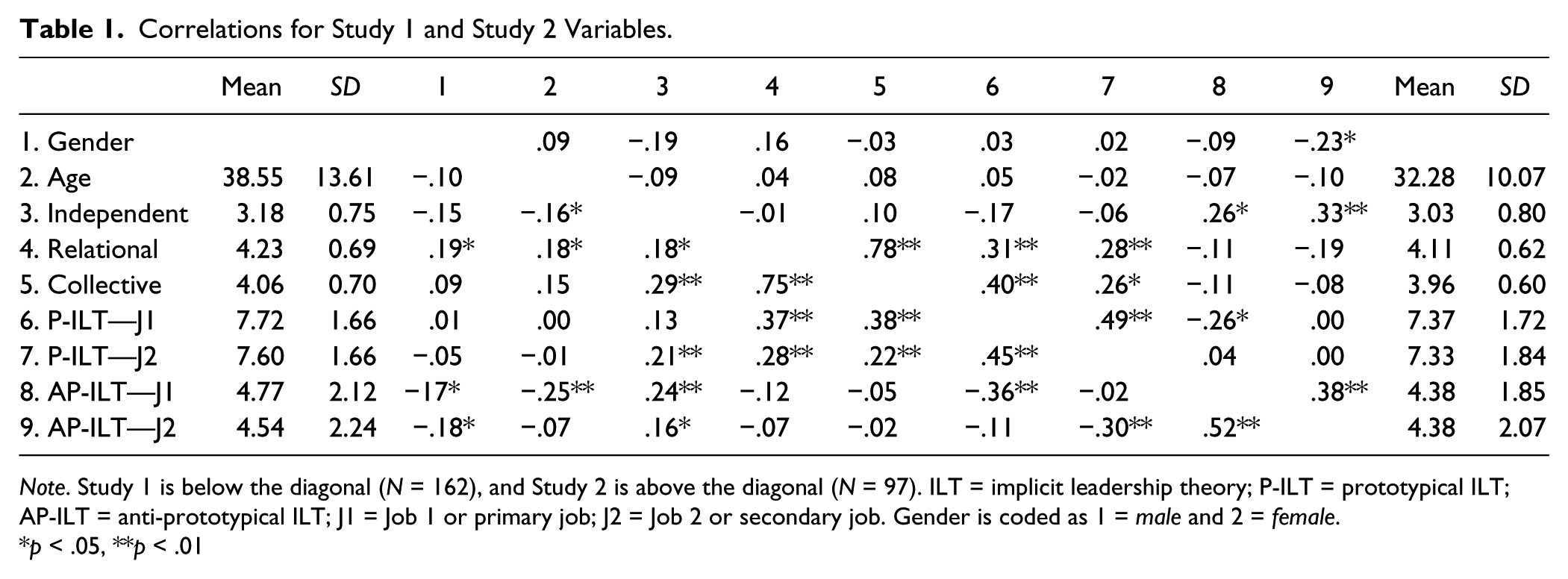
Note. Study 1 is below the diagonal (N = 162), and Study 2 is above the diagonal (N = 97). ILT = implicit leadership theory; P-ILT = prototypical ILT; AP-ILT = anti-prototypical ILT; J1 = Job 1 or primary job; J2 = Job 2 or secondary job. Gender is coded as 1 = male and 2 = female.
*p < .05, **p < .01
Identity and ILTs
Given that identity levels appear to be somewhat correlated, particularly the two interdependent identities (i.e., relational and collective), I examined the unique impact of each type of identity by entering them simultaneously in multiple regression analyses (see Table 2). For the participants’ primary jobs, relational (β = .21, p = .06) and collective (β = .22, p = .058) identities were both marginally associated with higher ratings of prototypical leader traits as characteristic of leaders. For participants’ secondary jobs, relational identity (β = .27, p < .05) was also associated with higher ratings of prototypical leader traits as characteristic of leaders. These results provide partial support for Hypotheses 1 and 2. In contrast, for anti-prototypical ILTs, participants with a stronger independent identity saw these traits as more characteristic of leaders in both their primary (β = .27, p < .01) and their secondary (β = .18, p < .05) job, providing support for Hypothesis 3. Overall, there appears to be a tendency for workers with stronger interdependent identities (i.e., relational and collective) to see prototypical leader traits (i.e., sensitivity, intelligence, dedication, and dynamism) as more characteristic of leaders across settings, whereas workers with stronger independent identities generally saw more anti-prototypical leader traits (i.e., tyranny and masculinity) as more characteristic of leaders across settings.
Trait Identity Predicting Implicit Leadership Theories (ILTs) Across Job Settings in Study 1.
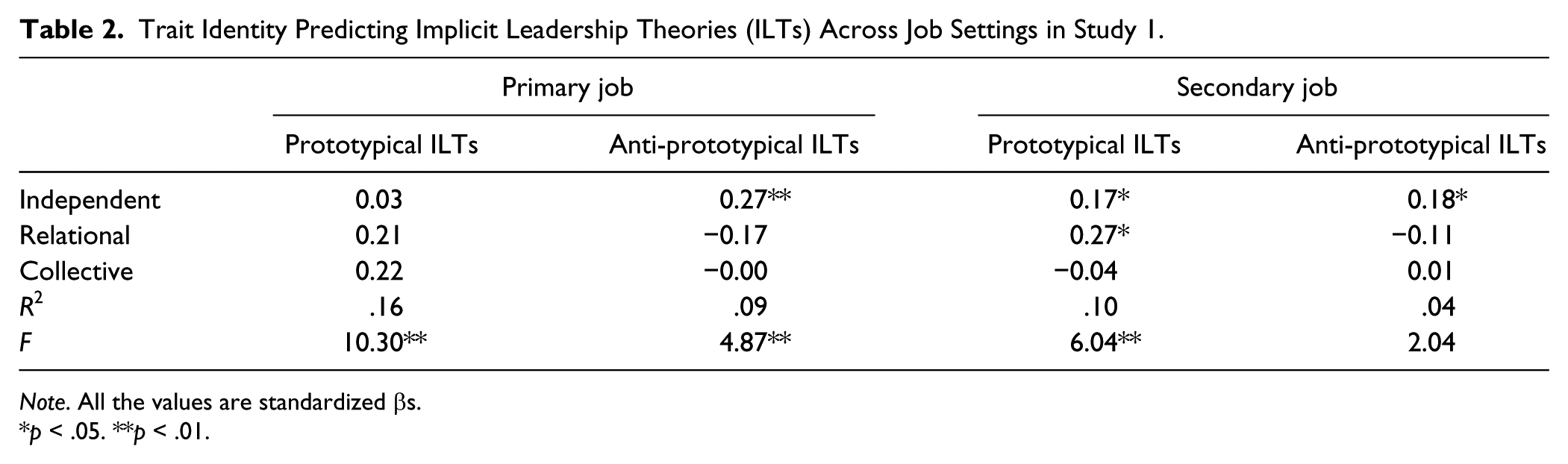
Note. All the values are standardized βs.
p < .05. **p < .01.
Organizational Culture and ILTs
Next, I explored whether organizational culture influences the ILTs of dual-job holders. A multivariate analysis of variance (MANOVA) with organizational cultures in one’s primary and secondary jobs as simultaneous predictors and prototypical and anti-prototypical ILTs for both jobs as dependent variables simultaneously revealed significant effects for organizational culture in one’s primary (F(16, 410) = 2.38, p < .01, Wilk’s Λ = .76, partial η2 = .07) and secondary (F(16, 410) = 2.51, p < .01, Wilk’s Λ = .75, partial η2 = .07) jobs on the dependent variables, but no interactive effect between the organizational cultures across the two jobs (F(64, 527) = 1.06, p > .05, Wilk’s Λ = .62, partial η2 = .11). 4
Follow-up one-way analyses of variance (ANOVAs) with organizational culture in each job separately as the predictor demonstrated that the organizational culture of one’s primary job significantly predicted prototypical (F(4, 157) = 6.69, p < .01) and anti-prototypical (F(4, 157) = 4.89, p < .01) ILTs for that job, but was nonsignificant in predicting prototypical (F(4, 157) = 1.25, p > .05) and anti-prototypical (F(4, 157) = 0.83, p > .05) ILTs for one’s secondary job. A similar of pattern of effects was obtained for the organizational culture of one’s secondary job, which significantly predicted prototypical (F(4, 157) = 6.69, p < .01) and anti-prototypical (F(4, 157) = 3.08, p < .05) ILTs for that job, but did not do so for workers’ ILTs in their primary job (prototypical: F(4, 157) = 1.28, p >.05; anti-prototypical: F(4, 157) = 1.53, p >.05).
Table 3 reports the results of post hoc analyses between organizational culture types and workers’ ILTs with Bonferroni corrections. Across jobs, workers in organizations with a clan culture saw prototypical leader traits as significantly more characteristic of leaders than workers in organizations with a hierarchy or market culture. In their primary job, workers in organizations with a clan culture viewed anti-prototypical leader characteristics as less typical of leaders than workers in organizations with a market culture, whereas in their secondary job, workers in organizations with a clan culture viewed anti-prototypical leader traits as less typical of leaders than workers in organizations with split cultures. These results provide some support for Hypothesis 4.
Differences in Implicit Leadership Theories (ILTs) Across Organizational Culture Types in Study 1 and Study 2.
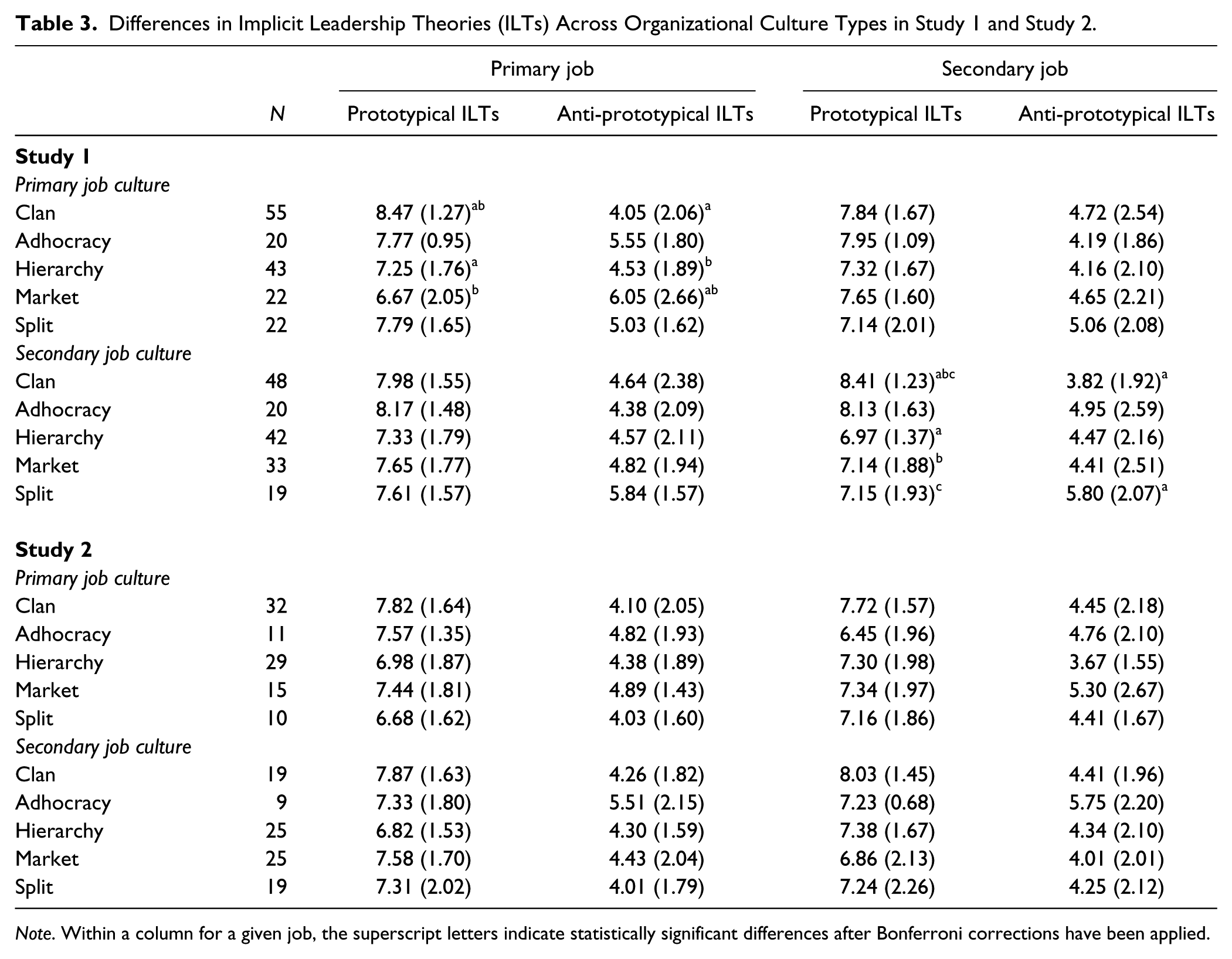
Note. Within a column for a given job, the superscript letters indicate statistically significant differences after Bonferroni corrections have been applied.
Study 2
In Study 1, the participants were asked how characteristic each leadership-related attribute was of leaders generally for each organization in which they were employed. However, scholars increasingly recognize that there are two kinds of leader prototypes, typical and ideal, and the two may not always be isomorphic (Junker & van Dick, 2014). A recent study by Van Quaquebeke, Graf, and Eckloff (2014) found that although typical and ideal ILTs are correlated, follower outcomes were generally more strongly predicted by match with ideal rather than typical ILTs. However, given the limited research on the antecedents of ILTs (Epitropaki et al., 2013), it is currently unclear whether the same pattern of relationships is likely to be found between the proposed antecedents and typical and ideal ILTs. Thus, I sought to replicate and extend Study 1 by examining the antecedents and stability of workers’ typical versus ideal ILTs in a separate sample of dual-job holders.
Method
Participants and Procedures
Participants were recruited from Amazon’s Mechanical Turk (Buhrmeister, Kwang, & Gosling, 2011) and restricted to those based in the United States. Participants were directed to a prescreen survey (which also included filler items), and only those participants who indicated that they worked in two or more jobs and were not self-employed could then proceed to the main study. The only difference between Study 1 and Study 2 in terms of procedures was that Study 2 participants were randomly assigned to respond regarding their view of either “typical” or “ideal” leaders in each organization when responding to the ILT measures, whereas Study 1 participants were asked about leaders in each organization generally.
This sample consisted of 97 dual-job holders; 55% were female, 75% were White, and the average age was 32 years (SD = 10.07). For their primary job, on average, the participants worked 35 hours per week (SD = 13.06) for $22.17 per hour (SD = $31.78). For their secondary job, on average, the participants worked 16.33 hours per week (SD = 8.61) for $16.71 per hour (SD = $26.79). The participants held a wide variety of jobs (e.g., manager, teacher, nurse, and sales).
Measures
The participants completed the same measures of trait identity levels (i.e., independent identity, α = .77; relational identity, α = .85; and collective identity, α = .71; Johnson et al., 2006), organizational culture (Cameron & Freeman, 1991), and ILTs (prototypical ILTs in primary job, α = .93 and secondary job, α = .95; anti-prototypical ILTs in primary job, α = .81 and secondary job, α = .88; Epitropaki & Martin, 2004) as in Study 1. However, for the ILT measures, the participants were asked to rate how characteristic each item was of either the “typical leader” (n = 45) or the “ideal leader” (n = 52) in each organization in which they were employed, separately, depending on the condition they were assigned to using a 10-point Likert scale (from not at all characteristic to extremely characteristic).
Results
As in Study 1, ILTs appear to demonstrate both a moderate degree of consistency as well as some degree of dynamism across job settings (see Table 1). The correlation between prototypical ILTs across jobs was r = .49, p < .01, and the correlation between anti-prototypical ILTs across jobs was r = .38, p < .01. Additionally, correlations between prototypical and anti-prototypical ILTs across jobs did not appear to vary significantly based on whether participants were responding about typical or ideal ILTs (prototypical ILTs: “typical” for primary and secondary jobs, r = .62,p < .001 vs. “ideal” for primary and secondary jobs, r = .42, p < .01, z = 1.32, p > .05; anti-prototypical ILTs: “typical” for primary and secondary jobs, r = .49, p < .001 vs. “ideal” for primary and secondary jobs, r = .23, p > .05, z = 1.44, p > .05).
Identity and ILTs
The results of multiple regression analyses linking trait identity levels with ILTs in Study 2 are reported in Table 4. In contrast to Study 1, there was little evidence in Study 2 that higher standing on the two interdependent identities (i.e., relational and collective) was associated with rating more prototypical leadership traits (e.g., sensitivity, intelligence) as more characteristic of leaders in participants’ primary or secondary jobs, failing to support Hypotheses 1 and 2. However, in line with Study 1, participants higher on independent identity were more likely to rate anti-prototypical leader traits as more characteristic of leaders in both their primary (β = .38, p < .05) and their secondary (β = .35, p < .01) jobs, supporting Hypothesis 3.
Trait Identity Predicting Implicit Leadership Theories (ILTs) Across Job Settings in Study 2.
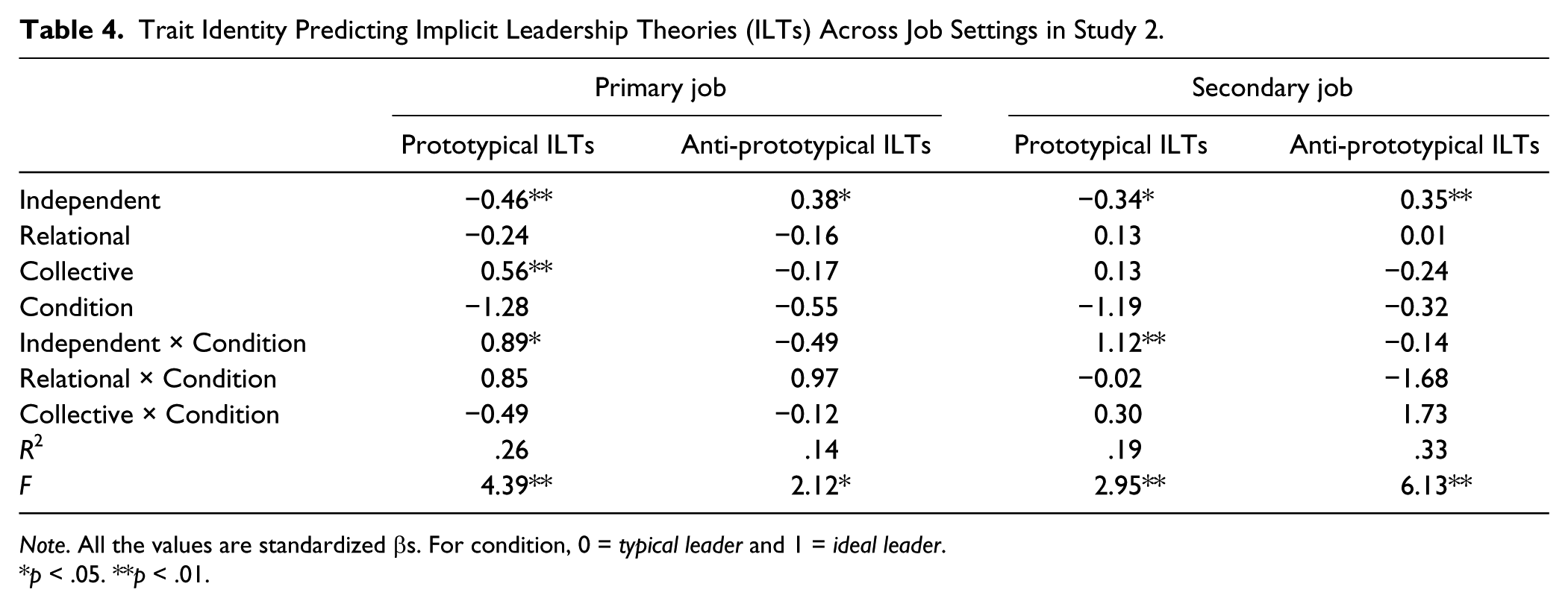
Note. All the values are standardized βs. For condition, 0 = typical leader and 1 = ideal leader.
p < .05. **p < .01.
Although there were no significant identity-by-condition interactions when predicting anti-prototypical ILTs, indicating that those individuals with stronger independent identities were more likely to see both typical and ideal leaders as more tyrannical and masculine, there were significant identity-by-condition interactions when predicting prototypical ILTs (see Table 4). Specifically, those higher on independent identity were less likely to rate prototypical leader traits (e.g., dynamism, dedication) as characteristic of typical leaders in both their primary (r = −.39, p < .001) and their secondary (r = −.39, p < .001) job, whereas independent identity was not significantly related to participants’ ratings of prototypical leader traits as characteristic of ideal leaders in either their primary (r = .01, p > .05) or their secondary (r = .22, p > .05) job. Thus, the lack of a significant relationship between independent identity and prototypical ILTs in Study 1 may have been because the participants were generally thinking of ideal rather than typical leaders. 5
Organizational Culture and ILTs
A MANOVA with organizational culture at one’s primary and secondary jobs and condition as simultaneous predictors and prototypical and anti-prototypical ILTs for both jobs as dependent variables simultaneously revealed nonsignificant effects for organizational culture in one’s primary job (F(16, 163) = 1.07, p > .05, Wilk’s Λ = .74, partial η2 = .07) and secondary job (F(16, 163) = 0.68, p > .01, Wilk’s Λ = .82, partial η2 = .05). However, there was a significant main effect of condition (F(4, 53) = 3.74, p < .05, Wilk’s Λ = .78, partial η2 = .22). There were also no significant interactions between the two organizational cultures (F(60, 209) = 0.82, p > .05, Wilk’s Λ = .44, partial η2 = .19), of condition with either of the organizational cultures (primary job: F(16, 163) = 0.49, p > .05, Wilk’s Λ = .87, partial η2 = .04; secondary job: F(16, 163) = 1.34, p > .05, Wilk’s Λ = .68, partial η2 = .09), or between the three predictors (F(32, 197) = 0.98, p > .05, Wilk’s Λ = .58, partial η2 = .13). These results generally failed to support Hypothesis 4.
Follow-up one-way ANOVAs to unpack the significant effect of condition on each dependent variable separately to better isolate the significant effect demonstrated that condition did not significantly predict the participants’ prototypical ILT ratings for their primary (F(1, 95) = 1.04, p > .05) or secondary (F(1, 95) = 1.37, p > .05) job. However, condition was marginally significant in predicting the participants’ anti-prototypical ILT ratings in their primary job (F(1, 95) = 2.80, p = .097) and significant in predicting the participants’ anti-prototypical ILT ratings in their secondary job (F(1, 95) = 17.67, p < .001). In both cases, the participants rated typical leaders as higher on anti-prototypical leader traits than ideal leaders (primary job: 4.71 vs. 4.09, secondary job: 5.26 vs. 3.62, respectively).
It should be noted that although organizational culture was not statistically significant in predicting ILTs in Study 2, the sample size and cell sizes were quite modest in this sample (n = 10–32 in the primary job and n = 9–25 in the secondary job per organizational culture type; see Table 3). Furthermore, consistent with the Study 1 results, participants working in organizations with a clan culture rated prototypical leader traits as most characteristic of leaders for both primary (mean = 7.82) and secondary (mean = 8.03) jobs, compared with workers in organizations with adhocracy, hierarchy, and market cultures, demonstrating some evidence of convergence across the samples.
General Discussion
Consistent with connectionist perspectives (Lord & Brown, 2004; Shondrick et al., 2010), this article revealed, using two studies of dual-job holders, that ILTs exhibit some degree of consistency as well as dynamism across work contexts. In other words, both person and situation factors appear to be (similarly) important in shaping ILTs. Additionally, this research sheds light on the particular personal and situational factors that contribute to both stability and change in ILTs. Specifically, workers’ ILTs appear to demonstrate stability because of a tendency for ILTs to be similar to the self across contexts, whereas workers’ ILTs exhibit change, in part, because differences in the organizational culture or environment appear to cue and influence ILTs.
Across the two studies, individuals with stronger independent identities saw anti-prototypical leader attributes (i.e., tyranny and masculinity) as more characteristic of leaders generally. This is in line with the prior research finding that those who focus on personal independence and uniqueness from others tend to engage in more counternormative behaviors themselves (i.e., abusive supervision, Johnson et al., 2012; counterproductive work behaviors, Johnson & Saboe, 2011). Furthermore, Study 2 revealed that individuals with stronger independent identities were also more likely to view positive prototypical leader traits (e.g., sensitivity, dedication) as less characteristic of typical leaders, although no less desirable for ideal leaders. Interestingly, recent research found that workplace supervisors who rated anti-prototypical leader traits as more characteristic of leaders tended to have worse relationships with their subordinates (i.e., lower LMX; Riggs & Porter, 2017). Thus, the current work fills in another piece of the puzzle, suggesting that leaders who hold strong independent identities may be most at risk of negative workplace relationships because of their tendency to view anti-prototypical leader attributes as more normative (for both ideal and typical leaders).
In line with prior theorizing regarding the importance of context (Brown & Lord, 2001), these results indicate that ILTs may change across work situations, in part, because of differences in organizational culture. Specifically, individuals working in organizations with a clan culture saw prototypical leader traits as more characteristic of leaders than individuals working in organizations with hierarchy and market cultures, and this finding was consistent across the participants’ primary and secondary jobs. There was also limited evidence that individuals working in organizations with a market culture saw tyranny as more characteristic of leaders than individuals working in organizations with a clan culture. However, it should be acknowledged that statistically significant organizational culture effects were not found in Study 2, likely because of the more modest sample size and the associated loss of statistical power.
One question that may be raised is whether the observed organizational culture effects occurred because culture was influenced by workers’ trait identity levels via attraction–selection–attrition processes (Schneider, 1987), which then shaped the workers’ ILTs. The present pattern of results suggests that to be relatively unlikely as this would suggest that participants with certain identities would be more likely to seek employment in certain types of firms across jobs, making it more likely that organizational cultures should predict workers’ ILTs across jobs, rather than only within each job, as found in the current study. In fact, in Study 1, only 35% of the dual-job holders worked in organizations with the same culture type across their two jobs (and this further drops to approximately 28% when excluding workers in organizations with split cultures). If the distribution of the four culture types is approximately equal in the population, this would be equal to roughly at chance levels (i.e., 25%) that one happens to be employed in two organizations with the same culture type.
Future research interested in changing workers’ ILTs to facilitate key workplace outcomes, such as more positive leader–follower relationships, leadership development, and positive follower job attitudes and behaviors, could potentially intervene by targeting these two somewhat malleable determinants of ILTs. In particular, concerted efforts to change organizational culture may be particularly powerful as this could not only change workers’ ILTs individually but also serves to align ILTs among both leaders and followers within an organization, helping them to see “eye to eye” and establishing important common ground. Given the mounting evidence that ILTs are consequential both in guiding our own actions as well in evaluating the behaviors of others, including leaders, in the workplace, I call for future research that examines how ILTs can be changed and developed.
Limitations and Future Research Directions
Although this study had several strengths, including the use of two unique dual-job holder samples, which allowed for the simultaneous examination of between- versus within-person predictors on ILTs, it is not without limitations. The first limitation is the modest sample size of both studies, particularly in Study 2, which may have contributed to the difficulties in replicating organizational culture effects. As the base rate of dual-job holders is quite low in the population (approximately 5% according to the U.S. Bureau of Labor Statistics, 2015), it was not feasible given the available resources to further increase the sample sizes. Additionally, I note that the current sample sizes are comparable with those of prior research utilizing within-person, between-jobs designs (n = 105, Inness et al., 2005; n = 159, Inness et al., 2010). Future research may be able to use other innovative designs, such as experience sampling studies or longer-term longitudinal studies, to examine change or fluctuation in ILTs over time as well as covariation between ILTs and correlates.
A second limitation is that I assessed only ILTs in this article, but research has shown that people also have cognitive schemas or prototypes of followers, known as implicit followership theories (IFTs; Sy, 2010). Similar to ILTs, IFTs also consist of two higher-order factors, one representing prototypical follower traits (i.e., industry, enthusiasm, and good citizen) and one representing anti-prototypical follower traits (i.e., conformity, insubordination, and incompetence). Given the nascent stage of IFT research, relatively little is known about the antecedents of IFTs (Epitropaki et al., 2013). However, it seems plausible that personal characteristics, such as identity levels, and situational factors, such as organizational culture, may also affect and shape IFTs, particularly given that role identities often entail complementary positions to define responsibilities (i.e., leadership necessitates followers). Thus, I call for future research that examines the common and unique antecedents of workers’ ILTs and IFTs.
A third limitation is the assessment of organizational culture used in the current study. Although I used an assessment of organizational culture that was based on a rich theoretical background and has been empirically validated, some recent research suggests that the nomological network of the Competing Values Framework may deviate from what has been previously theorized (Hartnell, Ou, & Kinicki, 2011). Additionally, there are a number of other organizational culture models and measures in the literature, though I note that many of these would have been too prohibitive in length for use in the current study. For example, Hofstede’s model of organizational culture specifies eight dimensions (Hofstede, Hofstede, & Minkov, 2010). Therefore, it is possible that the current study did not include some dimensions or aspects of organizational culture that affect workers’ ILTs. I encourage future researchers to explore this possibility in greater detail.
A final limitation is that the current study utilized a single-source (i.e., focal participant) and single-method (i.e., cross-sectional survey) design. Thus, the present results may be affected by common-method bias (Podsakoff, MacKenzie, Lee, & Podsakoff, 2003). As one way to guard against this possibility, future research could incorporate multisource data collection into within-person, between-jobs designs. For example, information regarding organizational culture or other job environment variables could be collected from coworkers at each of the participants’ job settings and correlated with the focal participants’ ILTs and IFTs.
Conclusion
Research on ILTs is growing and thriving. Although scholars have made great headway in understanding the consequences and impact of ILTs, how they develop and are affected by factors both distal and proximal as well as how they may be changed is less well understood. The current study provides some evidence that both potentially malleable personal (i.e., trait identities) and situational factors (i.e., organizational culture) play key roles in shaping workers’ ILTs, leading to both consistency and dynamism in these important cognitive structures. However, much more remains to be uncovered, and I encourage future research to continue to explore and discover the critical antecedents of ILTs and IFTs.
Footnotes
Declaration of Conflicting Interests
The author declared no potential conflicts of interest with respect to the research, authorship, and/or publication of this article.
Funding
The author received no financial support for the research, authorship, and/or publication of this article.
