







Abstract
Leaders are important for overcoming silence in organizations, because they can serve as role models and facilitate voice, for example, by being just. However, at times, leaders themselves remain silent. In such instances, trickle-down models of leadership and role-modeling theory suggest that leader silence results in follower silence. Drawing on research on laissez-faire leadership and coping, we challenge these approaches proposing that team members can compensate for their leader’s silence. This compensatory effect, in turn, is proposed to be contingent on followers’ justice perceptions, although in a counterintuitive way: Drawing on the fairness heuristic and collective action research, we propose that perceiving the leader as unjust makes it less likely that followers use their leader as a role model and can motivate followers to overcome fear and resignation, eventually resulting in followers’ speaking up in cases when leaders fail to do so. Results from two studies in organizations support our assumption that jointly considering leader and follower silence can reveal surprising effects and thus inspire new research complementing current approaches to overcome silence and its detrimental effects for organizations and their stakeholders. Additionally, we discuss theoretical and practical implications regarding the role of leaders, followers, and context as antecedents of silence.
Silence in organizations (i.e., the withholding of ideas, views, and concerns regarding work-related issues from others who could affect change; Pinder & Harlos, 2001) impedes individual and collective learning and decision making and can sustain inefficient or even unethical circumstances (Morrison & Milliken, 2000). The two most prominent reasons for silence are fear (e.g., of upsetting others, disturbing the smooth operation of the group) and the expectancy that addressing critical issues is futile (for a review, see Morrison, 2014). Therefore, organizations and researchers expect leaders to encourage and facilitate the expression of work-related ideas and concerns (Detert & Burris, 2007; Saunders, Sheppard, Knight, & Roth, 1992). Leaders are supposed to improve the status quo, thereby functioning as role models (Bandura, 1986; Schaubroeck et al., 2012), and they are expected to establish a climate in which their followers feel comfortable and confident to speak up, for example, by being perceived as just (Takeuchi, Chen, & Cheung, 2012).
Unfortunately, leaders sometimes withhold their views and avoid leadership responsibilities (Bass & Avolio, 1990; Chang, Chou, & Han, 2018; Hinkin & Schriesheim, 2008). Because of their specific role in initiating improvements and preventing their followers from harm, leaders’ silence in the face of critical issues—a behavioral facet of laissez-faire leadership (Judge & Piccolo, 2004; Skogstad, Hetland, Glasø, & Einarsen, 2014)—is potentially problematic for organizations (e.g., Buch, Martinsen, & Kuvaas, 2015; Skogstad, Einarsen, Torsheim, Aasland, & Hetland, 2007). Moreover, when leaders remain silent and passive in the face of, for instance, inefficacy, inertia, or unethical behaviors, followers can see their leader’s silence as exemplary, which can establish silence as the appropriate follower response to critical issues (Bandura, 1986; Harland, Harrison, Jones, & Reiter-Palmon, 2005). While it seems safe for followers to comply with their leader’s silence, such avoidant coping (Roth & Cohen, 1986) might come with a price. Leader silence on critical issues can create a climate of inconsistency, can result in more work for followers who need to make up for inefficient processes, deprives followers of organizational support, and can create toxic workplace environments (Frost, 2004; Kelloway, Sivanathan, Francis, & Barling, 2005; Lutgen-Sandvik & Arsht, 2014). Consequently, followers sometimes have reasons for overcoming fears and feelings of futility and compensate for their leader’s silence, for example, by being the one who breaks the silence in meetings (Cable & Judge, 2003; Carsten & Uhl-Bien, 2013; Deluga, 1990). The current article focuses on conditions under which followers surmount their avoidant coping styles. It thus aims at establishing a basis for understanding when compensatory follower behavior becomes more likely which, eventually, will increase chances to prevent or reduce maladaptive developments that would have endured due to leader silence.
Recent meta-analyses and reviews on silence and voice in organizations suggest that favorable conditions, such as working with a leader who one perceives as just, reduces employees’ uncertainty regarding the efficacy of voice and helps in overcoming silence that is based on fear and resignation (Chamberlin, Newton, & LePine, 2017; Morrison, 2014). This research, however, focused exclusively on followers’ silence (or voice), thereby neglecting how the respective leader behaves (i.e., does or does not address critical issues). This can be problematic, because working for a leader who does not address critical issues but is perceived as just may tempt employees to remain silent as well. As it functions as a social heuristic (van den Bos, 2001), a just role-model thus bears the risk that maladaptive developments go unchecked. Considering this potentially sedating effect of perceived justice, research on collective action (van Stekelenburg & Klandermans, 2013; van Zomeren, Postmes, & Spears, 2008) suggests a potential bright side of injustice, as dark as it otherwise might be (e.g., Pinder & Harlos, 2001). As injustice leads to arousal and approach behaviors, it is a potential motivator for followers to overcome fear and resignation and speak up when their superiors do not (Bal & van den Bos, 2017; Colquitt et al., 2013).
In the current article, we integrate research on coping with laissez-faire leadership, justice, and collective action to increase knowledge on the relationship between leader and follower silence. Applying a multilevel approach that allows for jointly considering leaders’ and followers’ responses to critical issues, we examine two counterintuitive assumptions—a potentially negative relationship between leader and follower silence and the (conditional) silence-reducing effect of leader injustice—in two organizations that went through considerable changes previous to the time of our study, which makes the occurrence of critical issues likely (Fugate, Prussia, & Kinicki, 2012; Kiefer, 2005).
Theoretical Background
Leader Silence and Its Consequences
For leaders, there is a social consensus that they should intervene when they notice critical issues, such as inefficacies or unethical behaviors. Creating an effective work environment and finding ways to increase productivity is a central leadership task (Lord, 1977; Morgeson, DeRue, & Karam, 2010). Leaders are also responsible for protecting their followers from harm, guaranteeing safety and ethical standards, and assigning workload at an appropriate level (Frost, 2004; Hackman & Wageman, 2005). At times, however, leaders fail to meet these expectations, for example, by not confronting followers’ or fellow managers’ shortcomings, not addressing inefficient processes within the team or at the interface to another team, or being reluctant to sanction bullying within their team (e.g., Frischer & Larsson, 2000; Leyman, 1996).
Leader silence when encountering critical issues is one behavioral facet of passive or so-called laissez-faire leadership, as indicated, for example, by respective items used in established questionnaires such as the Multifactor Leadership Questionnaire (MLQ; e.g., “My manager takes no action even when problems become chronic”; Bass & Avolio, 1990). Laissez-faire leadership functions as an umbrella term for a range of leader behaviors including a leader being absent when needed, a leader who avoids decisions or does not intervene in critical situations, a leader who delays decisions and/or fails to provide followers with feedback (Bass & Avolio, 1990; Chang et al., 2018; Hinkin & Schriesheim, 2008; Lewin, Lippitt, & White, 1939). Notably, similar to situations in which leaders commit destructive actions (Einarsen, Aasland, & Skogstad, 2007; Tepper, 2007), laissez-faire leadership can have detrimental effects: A meta-analysis and a large study show links between laissez-faire leadership and role conflict, role ambiguity, conflicts with coworkers, low follower job satisfaction, exposure to bullying, and low follower satisfaction with the leader (Judge & Piccolo, 2004; Skogstad et al., 2007). These effects were explained by the fact that followers of leaders who neglect critical issues are likely to work in ambiguous, nonsupportive, and even toxic environments and/or need to invest scarce resources (e.g., time, energy) to make up for inefficiencies (Frost, 2004; Kelloway et al., 2005; Skogstad et al., 2007).
Followers’ Coping With Leader Silence
Employees do not necessarily respond passively to work-related stressors and demands (Britt, Crane, Hodson, & Adler, 2016; Lazarus, 1991). When examining followers’ responses to forms of leadership that negatively affect followers, prior research distinguished between approach- and avoidance-oriented coping strategies (May, Wesche, Heinitz, & Kerschreiter, 2014; Roth & Cohen, 1986; Yagil, Ben-Zur, & Tamir, 2011). Avoidance behaviors are directed away from the source of stress and include absenteeism, avoiding contact with the leader, and some forms of counterproductive work behavior (Webster, Brough, & Daley, 2016; Yagil et al., 2011). Approach behaviors, in turn, are directed toward the source of stress and include attacking the supervisor or trying to solve the situation by speaking up (Cable & Judge, 2003; Hagedoorn, Buunk, & van de Vliert, 1998).
Followers are proposed to tailor their coping strategies to the context in which they experience demands and stressors, and to consider cues regarding which strategies to use by watching how their manager tries to lead (Bonanno, Pat-Horenczyk, & Noll, 2011; Britt et al., 2016; Cable & Judge, 2003). Active forms of negative leadership such as abusive leadership limit the scope of followers’ responses (e.g., by intimidating or threatening followers), increase the likelihood of avoidance behaviors, and may even pressure followers into silence (Frieder, Hochwarter, & DeOrtentiis, 2015; Morrison, See, & Pan, 2015; Xu, Loi, & Lam, 2015). In contrast, passive forms of negative leadership (e.g., laissez-faire leadership) provide room for followers to wield influence and do not prompt that change is impossible (Hollander & Offerman, 1990; Vanderslice, 1988). By remaining silent and absent in the face of critical issues, leaders create a vacuum that followers can take advantage of by seizing the initiative themselves. Moreover, leaders who remain silent when confronted with critical issues fail to prove that they can protect the group from harm, and thus, lose legitimacy as a leader (Hollander & Julian, 1969; van Vugt, Hogan, & Kaiser, 2008). Lacking legitimacy, in turn, makes it less likely that followers use their leader’s behavior (here: silence) as a model for their own behavior (Suddaby, Bitektine, & Haack, 2017). As a consequence, if followers are less likely to copy their leader’s silence, and if they want to avoid suffering from the negative consequences of the critical issues that their leader neglects, followers need to overcome their fear and resignation, and thus, not remain silent.
Our assumption that followers are less likely to respond to leader silence with avoidance-oriented coping behavior is supported by the few studies that examined followers’ responses to passive or laissez-faire leadership—leadership styles that include leader silence. Using a scenario approach, Deluga (1990) found that—compared with participants who were assigned to be followers of transformational leaders—those who were assigned to laissez-faire leaders were less likely to remain passive (but opted to obtain the support of other people in the organization). Cable and Judge (2003) achieved similar results with a survey study that examined the tactics managers use when they try to influence their own superiors (thus providing a rare example for a study that examines managers in their role as followers). When their supervisor displayed a laissez-faire leadership style, managers used more demanding tactics (e.g., building coalitions, using demands and threats) than when their supervisor displayed transformational leadership. Based on our theoretical arguments and the limited evidence available, we expect:
Perceived (In)justice as a Trigger for Follower Coping
While leader silence and laissez-faire leadership in general create a vacuum that invites followers to take advantage of, it is far from certain that followers use this leeway and compensate for their leader’s silence (Carsten & Uhl-Bien, 2013; Uhl-Bien & Carsten, 2007). Speaking up when one’s leader remains silent requires effort, for instance, for figuring out ways to improve the situation, and one may be asked to implement one’s suggestions, probably on top of one’s regular workload (Bolino & Turnley, 2005; Chiaburu, Marinova, & Van Dyne, 2008). In addition to an increased workload, breaking the silence leads to uncertain outcomes. While copying a leader’s silence can be a relatively safe option (at least with regard to immediate consequences), breaking the silence may annoy superiors or peers who were responsible for, tolerated, or benefited from the status quo (Burris, 2012; Kim, Rosen, & Lee, 2009). The prospect of both positive (i.e., preventing themselves from the negative effects that may follow from the critical issues their leader neglects) and negative consequences (i.e., being confronted with additional workload and facing negative consequences from peers and their leader) raises questions regarding the factors that trigger followers to either remain silent or overcoming their silence in the face of silent leaders.
We propose that followers’ perceptions of leader justice influence this decision. Fairness and justice are central characteristics when followers evaluate their leaders (Gilliland & Day, 1999; Graen & Scandura, 1987), and perceived leader justice is connected to affect-based and cognition-based trust in the leader’s actions which, in turn, affects follower attitudes, motivation, and behavior (Bligh & Kohles, 2013; De Cremer, van Dijke, & Bos, 2006). If leaders are perceived as just, followers can trust that their suggestions are treated appropriately, and that they will not be punished for coming up with reasonable ideas (Lind & Tyler, 1988; van den Bos & Lind, 2002). In line with that reasoning, leader justice has been associated with voice (Chamberlin et al., 2017; Tangirala & Ramanujam, 2008), whereas injustice has been associated with silence (Pinder & Harlos, 2001). This research, however, focused exclusively on the follower side of the leadership equation. The effects of leadership, however, emerge from leaders’ and followers’ contributions to a dynamic and interdependent system (Cable & Judge, 2003; Hollander & Julian, 1969; Salancik & Pfeffer, 1977). We propose that followers’ perceptions of leader (in)justice can have a different effect when they are considered in combination with the leaders’ actions. More specifically, we are interested in the effect of followers’ perceptions of leader (in)justice on follower silence depending on whether leaders tend to remain silent or not.
While we do not question the negative relationship between leader justice and follower silence in general, we propose that perceiving the leader as just may have a downside. As followers tend to trust a just leader, they assume that the leader has a reason for his or her behavior and thus also for his or her remaining silent (Colquitt et al., 2013; Jost & Kay, 2010). Moreover, perceiving the leader as just serves as a heuristic device helping to decide how to react toward events related to the leader (Choi, 2008; van den Bos, 2001). In such a case, followers’ motivation to compensate for their leader’s silence should be low. Perceptions of injustice, in turn, are likely to trigger arousal and negative emotions such as anger which, in turn, activate the approach (rather than the avoidance) behavioral system (see, Carver & Harmon-Jones, 2009; van Zomeren et al., 2008). Arousal and activation of the approach system have been proposed to be basic preconditions for overcoming the state of silence (Grant, 2013; Morrison et al., 2015) and participation in collective action (van Zomeren et al., 2008). Collective action research suggests that, while perceptions of justice can increase a group’s acceptance of even negative situations, injustice is likely to motivate action (Bal & van de Bos, 2017; van Zomeren et al., 2008).
Besides motivating action, injustice perceptions should also affect whether or not a leader is accepted as a role model (Bligh & Kohles, 2013; Colquitt et al., 2013). To be considered role models and thus function as a legitimate source of information about appropriate behavior, leaders need to appear just and credible and treat their followers fairly and considerately (Brown, Trevino, & Harrison, 2005; Suddaby et al., 2017). If they are perceived as just, even laissez-faire leaders may function as role models, and followers use fairness perceptions as social heuristics to interpret leader-related events (van den Bos, 2001). If leaders are perceived as unjust, in turn, they are evaluated less positively, lack legitimacy, and followers are less likely to use their behavior as a reference for their own behavior (Alexander & Ruderman, 1987; Choi, 2008; Graen & Scandura, 1987).
Because of these two effects of perceived leader injustice—the motivating role of perceived leader injustice and the lower tendency among followers to use unjust leaders as role models—we expect:
Method
Samples
In summer 2016, we were part of two consulting projects aiming at helping two organizations, an energy company and a state-level public administration unit, through periods of organizational change. Both organizations went through mergers and restructuring within the last years and during the time of the project. The changes caused a considerable amount of uncertainty among staff at all levels, although employees were told that no layoffs would occur. As prior research showed that restructuring after mergers and outplacement threatens both leaders’ and followers’ status, prior investments, and the value of qualifications (e.g., Fugate et al., 2012; Kiefer, 2005), we posit that these organizations provide appropriate contexts (Johns, 2006) for examining leader silence and potential compensatory behavior by followers.
In Study 1, we examine our basic assumption, namely that leader silence is not necessarily accompanied by follower silence (Hypothesis 1), in a German energy provider that undertook restructuring to keep up with changing demands in the energy sector. The company comprised two large divisions: power supply operations and trade and distribution of electricity, gas, waste water, drinking water, and thermal energy. In both divisions, we surveyed employees with a diverse range of qualifications such as engineers, foreman, consultants, administrative staff, and blue-collar workers. We took arrangements to preserve the anonymity of the respondents (e.g., by reporting only aggregated data to the organization, using identification numbers in the data set). The variables in Study 1 are part of a large employee survey that we conducted in the organization. All 1,070 employees were invited to participate in the voluntary survey and employees could choose to complete the survey either as a paper-and-pencil or an online survey. With 675 employees responding, the overall participation rate was 63%. Of the 675 participants, 554 were included in the study because of their status as followers, whereas 22 did not state their current position (leader or follower/employee), and 99 stated that they were in a leadership position. We excluded cases in a stepwise manner, as some cases fulfilled more than one exclusion criteria: 150 participants did not state their team membership and were therefore excluded. Of the remaining 404 participants, only 356 provided data regarding follower silence. Because of missing leader data, we had to exclude 159 cases. Missing leader data could have been caused by the leader not taking part in the questionnaire at all, not stating the respective team led by him or her, or the leader not answering the items for the computation of the study variables. The specific reason for the missing leader data per team could not be determined in the study. Of the remaining 197 cases, 11 participants did not fill out the demographic data for the control variables. As not all team members and leaders stated their team membership, and due to other missing data, our final sample consisted of 39 leaders and 186 followers for multilevel hypotheses testing. Of the followers, 72 were females and 114 were males. Age was measured in intervals and was distributed as follows: younger than 25 years (n = 14), 26 to 35 years (n = 32), 36 to 45 years (n = 31), 46 to 55 years (n = 71), and older than 55 years (n = 36). Two participants did not report their age. Of the leaders, 9 were females. Age distribution among leaders was 26 to 35 years (n = 2), 36 to 45 years (n = 15), 46 to 55 years (n = 17), and older than 55 years (n = 5).
In Study 2, we aimed at replicating and qualifying the proposed compensatory effect of reduced follower silence in a different setting. The second sample consisted of members of a public administration in which three formally independent divisions at different locations had been merged into a single organization in a federal state in Germany. Although merger had taken place 5 years prior to the study, employee representatives and the leadership of the organization felt that many employees do not identify with the new organization and cooperation across units suffered. We were asked to examine these issues and used the opportunity to replicate and extend Study 1. All the 1,490 organization’s employees were invited to participate in the employee survey. Overall participation rate was 60% with 894 employees responding using either the paper and pencil or the online survey. Of the 894 participants, 94 stated that they were in a leadership position. We excluded cases in a stepwise manner: Of the 800 employees/followers, 98 participants did not state their team membership and were therefore excluded. Of the remaining 702, 195 did not fill out the items on follower silence and/or perceived leader justice. Of the remaining 507 participants, 266 could not be included in the study because the data of the respective leader were missing. Finally, 20 participants were excluded because they did not state the demographics data for the control variables. After eliminating cases with missing values (except for age), the final sample consisted of 43 leaders and 221 followers who provided information about their team membership and could therefore be included in the multilevel analyses. Of the followers, 146 were women. Age distribution among followers was as follows: younger than 25 years (n = 5), 26 to 35 years (n = 38), 36 to 45 years (n = 55), 46 to 55 years (n = 81), and 55 years or older (n = 39). Three followers did not report their age. Of the leaders included in the analyses, 18 were females. Age distribution among leaders was 36 to 45 years (n = 6), 46 to 55 years (n = 21), and older than 55 years (n = 16).
Measures
Leader and Follower Silence was measured with the three-item subscales for fear- and resignation-based silence (i.e., quiescent and acquiescent silence) that are part of the motives for silence at work scale (Knoll & van Dick, 2013). We combined quiescent and acquiescent silence, because these forms of silence are caused by external factors (e.g., organizational climate, leadership) to a larger extent and are thus particularly relevant for our research topic (Kurzon, 2007). Indeed, quiescent and acquiescent silence were highly correlated, with r(225) = .53, p < .01 in Study 1 and r(264) = .67, p < .01 in Study 2. To control for silence forms that are more strongly rooted in individual differences (e.g., prosocial and selfish motivation), we furthermore included the three-item subscales for prosocial and opportunistic silence as control variables. In a brief introduction, participants read that people in organizations sometimes face problematic situations and that they may deal with these situations in different ways: Some may voice their concerns to people who have the chance to change the situation, whereas others remain silent. Following the item root: “I remained silent at work . . .” we asked participants how often they remained silent and what motivated them to do so. Sample items were “. . . because of a fear of negative consequences” (quiescent silence); “. . . because nothing will change, anyway” (acquiescent silence). We assessed silence on a 5-point scale, ranging from 1 (never) to 5 (very often), in Study 1 and, due to requirements of the second survey format, on a 7-point scale, ranging from 1 (never) to 7 (daily), in Study 2. Reliability of the Leader and Follower Silence score was α = .89 in both samples. Because of recent critiques regarding the usage of Cronbach’s alpha as the sole measure of reliability (McNeish, 2017), we also computed the Revelle’s omega total (ωRT), which was .93 in Study 1 and .94 in Study 2, indicating a good reliability of the scale (Revelle, 2016). Regarding control variables, reliability scores were α = .88 and ωRT = .88 for prosocial silence in both studies, and α = .69 and ωRT = .70 in Study 1 and α = .64 and ωRT = .71 in Study 2 for opportunistic silence.
Perceived Leader Justice was measured with two items: “Please assess, how unjust [Item 1] / fair [Item 2] your direct supervisor is” which were derived from an overview on measuring justice and fairness (Colquitt & Rodell, 2015). The Likert-type scale ranged from 1 (to a very large extent) to 5 (to a very small extent). As the scale consisted of two items only, we computed the standardized coefficient alpha, as well as the Spearman–Brown coefficient (Eisinga, de Grotenhuis, & Pelzer, 2013), which indicated acceptable, respectively good reliability (α = .76, ρ = .84) of the scale.
Analysis Strategy
In both studies, follower ratings were nested within teams headed by a single leader. Followers and leaders stated their team affiliation on a voluntary basis, which allowed us to match follower ratings (Level 1) to the respective leader ratings (Level 2). Because of the hierarchical structure of the data and the cross-level nature of the hypotheses, we used mixed models using the nlme package (Pinheiro, Dates, DebRoy, & Sarkar, 2017) in the R environment (R Development Core Team, 2015).
Results
Study 1
Table 1 presents descriptive statistics of the study variables. Intraclass coefficients (ICCs) did not indicate that follower silence was nonindependent within teams, ICC(1) = .04, F(38, 147) = 1.17, p = .20. Teams were moderately distinguishable regarding follower silence, ICC(2) = .15.
Descriptive Statistics Study 1.
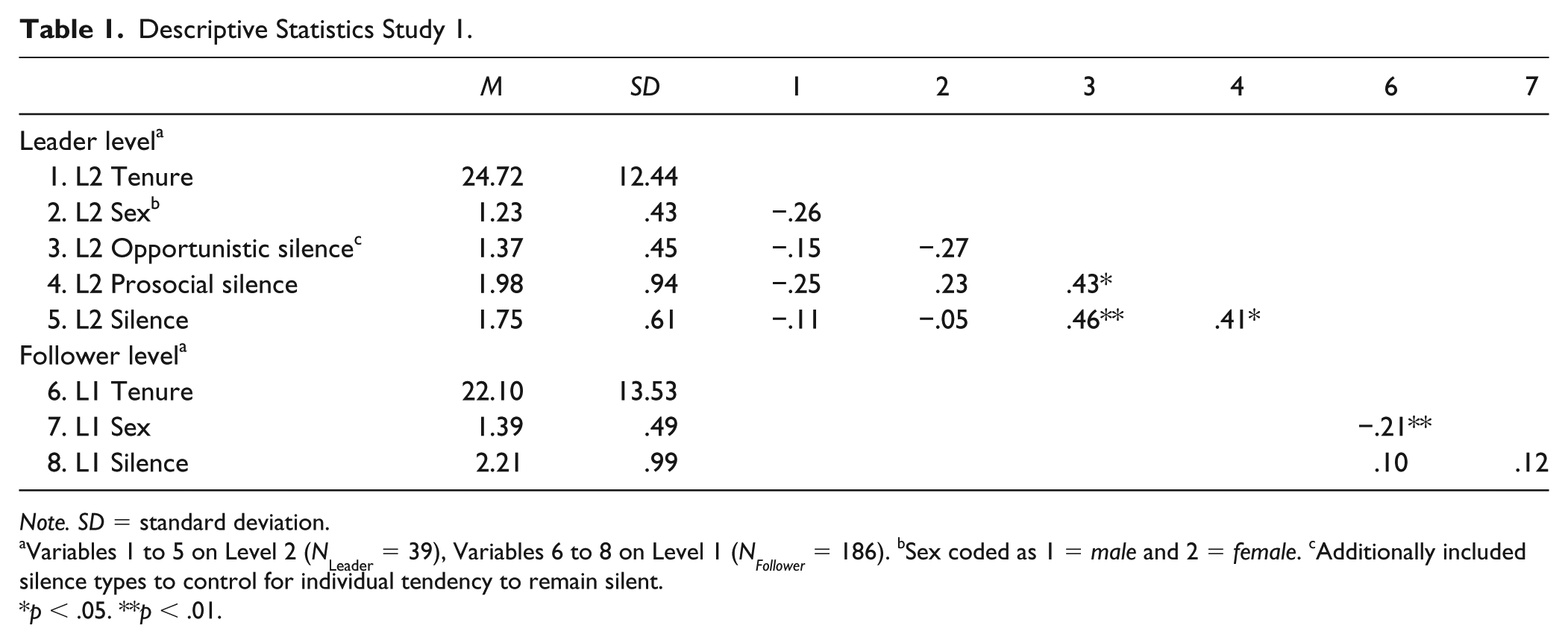
Note. SD = standard deviation.
Variables 1 to 5 on Level 2 (NLeader = 39), Variables 6 to 8 on Level 1 (NFollower = 186). bSex coded as 1 = male and 2 = female. cAdditionally included silence types to control for individual tendency to remain silent.
p < .05. **p < .01.
As there was no key predictor at the follower level (Level 1) in Study 1, we fitted random-intercept models with the standardized predictor and control variables for hypothesis testing. Model 1 included only the control variables and Model 2 included the control variables and leader silence as the main predictor (Table 2). We computed
Study 1 Random Coefficient Models Regressing Level 1 Follower Silence on Standardized Independent and Control Variables.
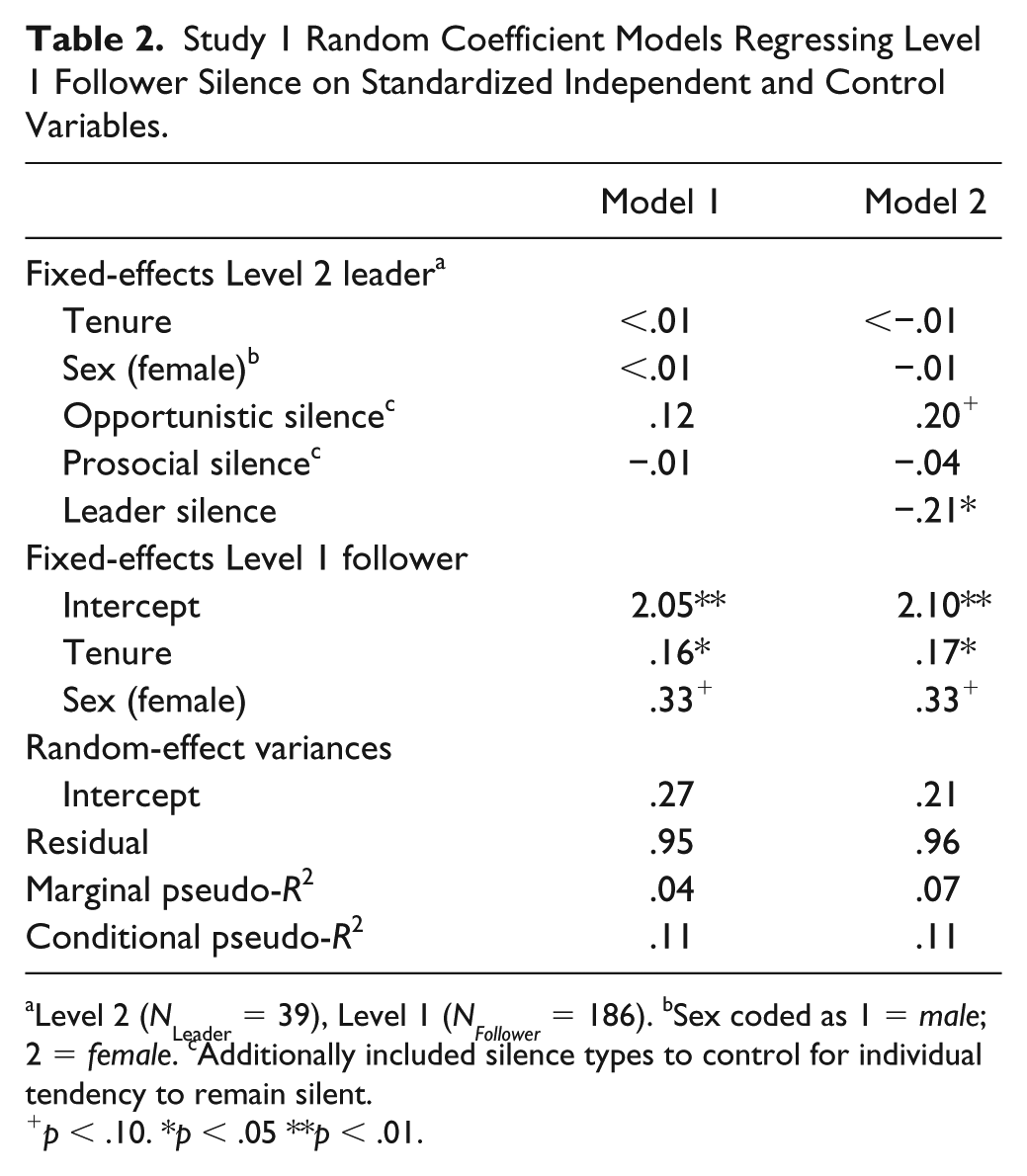
Level 2 (NLeader = 39), Level 1 (NFollower = 186). bSex coded as 1 = male; 2 = female. cAdditionally included silence types to control for individual tendency to remain silent.
p < .10. *p < .05 **p < .01.
Study 2
Study 2 aimed at replicating Study 1 findings and qualifying the results with regard to when followers’ compensatory behavior is particularly likely. Table 3 presents descriptive statistics of the study variables. ICCs did not indicate nonindependence of follower silence within teams, ICC(1) = .05, F(42, 178) = 1.26, p = .15, whereas teams were moderately distinguishable regarding follower silence, ICC(2) = .21.
Descriptive Statistics Study 2.
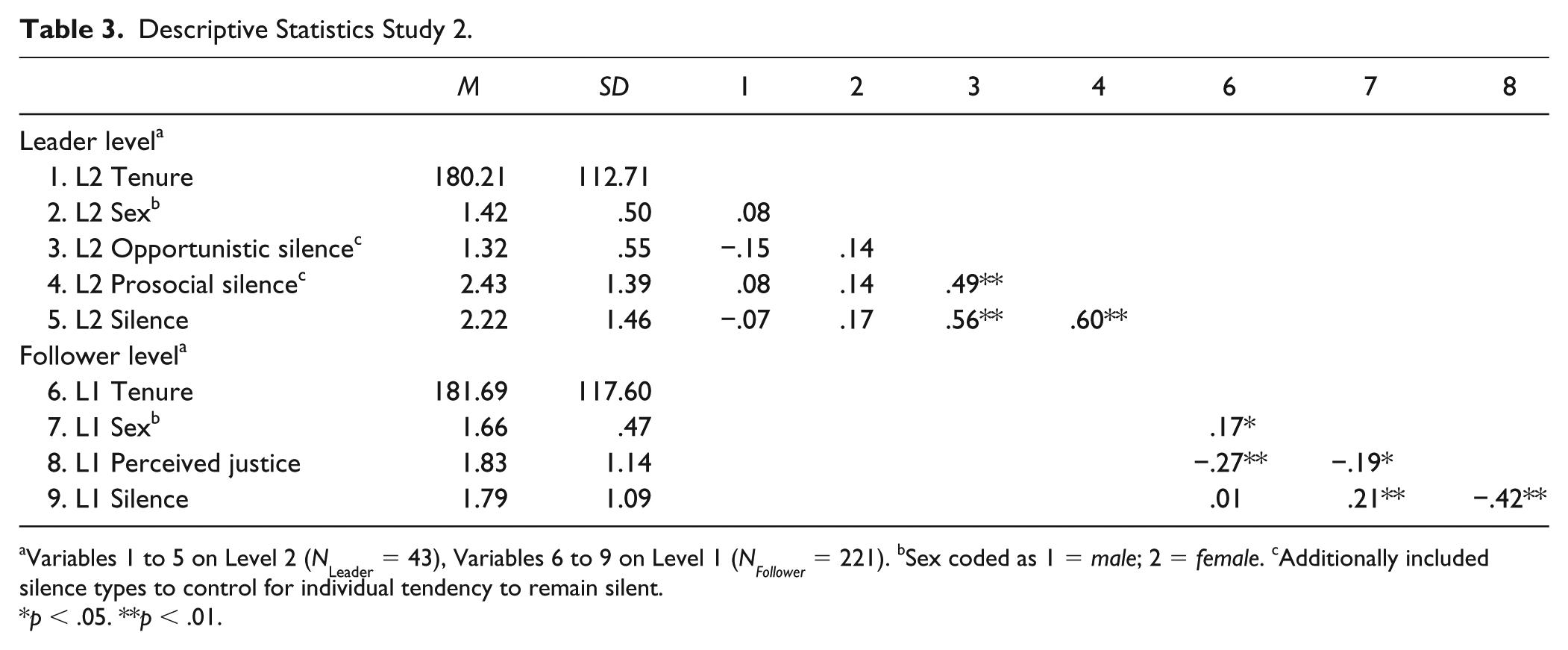
Variables 1 to 5 on Level 2 (NLeader = 43), Variables 6 to 9 on Level 1 (NFollower = 221). bSex coded as 1 = male; 2 = female. cAdditionally included silence types to control for individual tendency to remain silent.
p < .05. **p < .01.
As Study 2, in contrast to Study 1, included a main predictor on the employee level (Level 1) of analysis (perceived justice), we fitted simple models with the Level 1 moderator perceived justice as sole predictor in order to identify the random-effects structure of the baseline model. Comparing the −2 log-likelihood–based model fits showed that a random-intercepts-and-slopes model allowing the relationship between follower–perceived leader justice and follower silence to vary freely between teams fit the data significantly better compared with the random-intercepts model,
Study 2 Random Coefficient Models Regressing Level 1 Follower Silence on Standardized Independent and Control Variables.
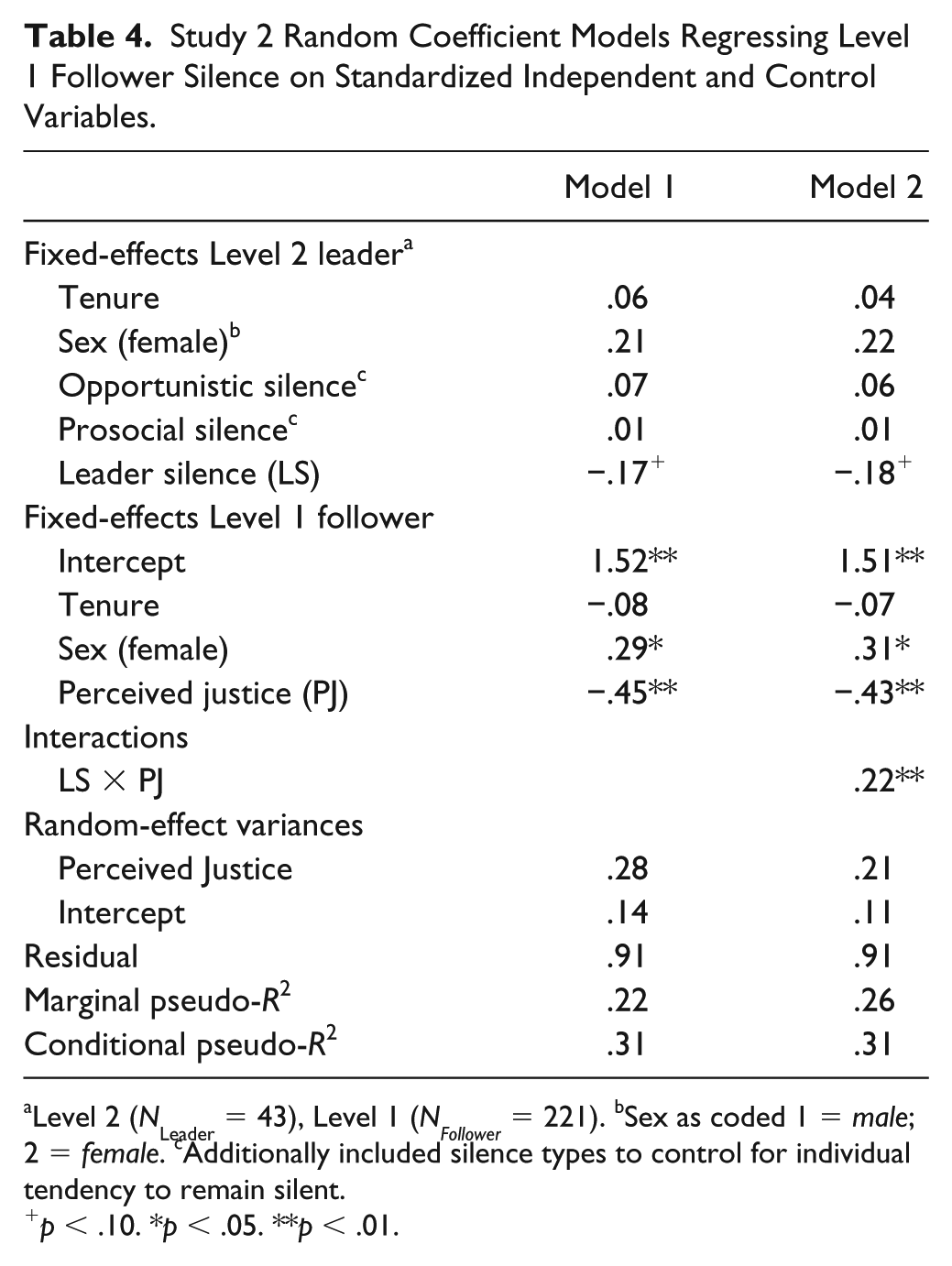
Level 2 (NLeader = 43), Level 1 (NFollower = 221). bSex as coded 1 = male; 2 = female. cAdditionally included silence types to control for individual tendency to remain silent.
p < .10. *p < .05. **p < .01.
Results for Model 1 show that follower–perceived leader justice was negatively related to follower silence supporting prior research that suggests that followers who work for an unfair leader show more silence behaviors (e.g., Pinder & Harlos, 2001). When controlling for the strong effect of follower–perceived leader justice, the relationship between leader silence and follower silence was only marginally significant. Thus, the well-known silence-reducing effect of leader justice seems to be stronger than the compensatory effect. However, when occurring together with leader silence, justice perceptions had a different effect. In line with Hypothesis 2, the interaction between leader silence and perceived leader justice emerged as a significant predictor of follower silence, Β = .22, p < .01. Adding the interaction term to the model increased the marginal pseudo R2 by 4% which can be considered as relevant increase in explained variance in a field study (Champoux & Peters, 1987; Evans, 1985). Again, we computed VIFs to rule out multicollinearity with VIF = 1.86 for the leader silence, VIF = 1.86 for prosocial silence, and VIF = 1.95 for opportunistic silence, which are less than the recommended threshold values (Dorman et al., 2013).
We plotted the interaction for slope analyses (Figure 1) and ran simple slope tests with an online tool for multilevel slope analysis (Preacher, Curran, & Bauer, 2006). Leader silence had a significantly negative impact on follower silence when perceived leader justice was low, −1 SD, z = −3.24, p < .01. When justice was perceived as high, there was no significant effect of leader silence on follower silence, +1 SD, z = .35, p = .72.
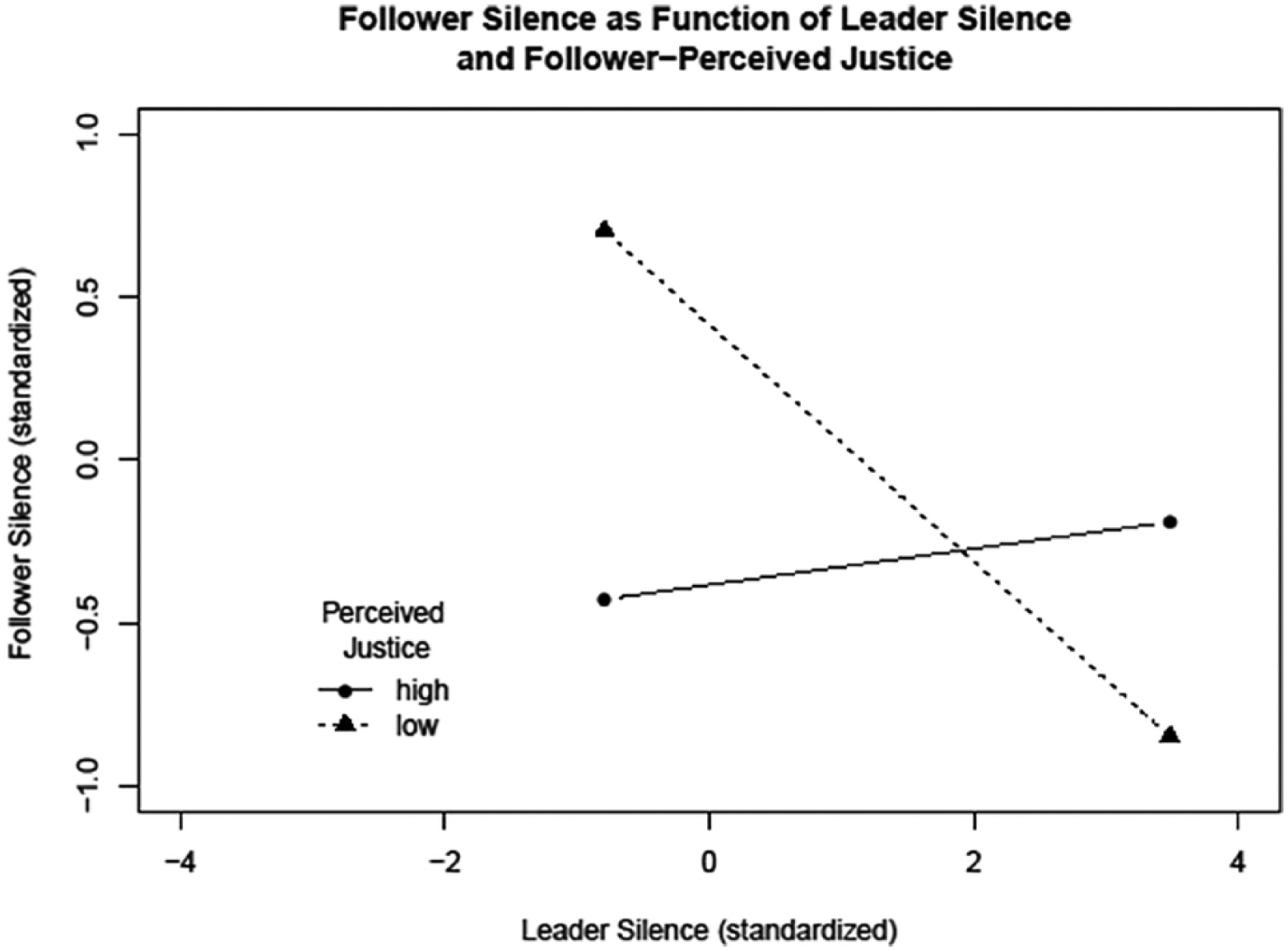
Plot of the interaction between standardized leader silence and follower–perceived leader justice on follower silence.
Discussion
The changing nature of work and organizations can cause a considerable amount of uncertainty for employees at all levels (Griffin, Neal, & Parker, 2007; Okhuysen et al., 2013). An important function of leaders is to support their followers when dealing with change and accompanying hardships. If leaders neglect critical issues, followers have to deal with these issues on their own or suffer the consequences (Hinkin & Schriesheim, 2008; Schweiger & DeNisi, 1991; Skogstad et al., 2007). Our findings suggest that, when leaders do not address critical issues, followers can fill the vacuum by compensating for their leader’s silence. After showing the proposed negative relationship between leader and follower silence (Hypothesis 1) in Study 1, we qualified these findings with respect to perceptions of leader justice in Study 2, thus identifying a condition under which the proposed compensatory effect occurs. While our findings support prior research associating leader injustice with follower silence (Pinder & Harlos, 2001), we found that if leaders are perceived as unjust and do not address critical issues, followers are more likely to overcome their own hesitations to speak up. In line with Hypothesis 2, our findings suggest that when leaders are perceived as unjust, their behavior is less likely to be used by followers as a reference for their own behavior and perceiving their leader as unjust functions as an impetus for followers to compensate for leader silence (Bal & van den Bos, 2017).
Theoretical Implications
Our research provides insights into the less researched field of followers’ responses to one behavioral facet of laissez-faire leadership, particularly, for situations in which leaders do not address critical issues that potentially harm their followers (i.e., leader silence). Our results furthermore suggest that jointly considering leader and follower silence can challenge two basic tenets of silence research, namely, that leader justice necessarily results in less silence and that followers will overcome silence only if context conditions are favorable.
A first implication of our research is that the relationship between laissez-faire leadership and follower behavior is more complex than the relationships between abusive and positive leadership and follower behavior. If confronted with abusive leadership, followers are likely to feel threatened and intimidated which causes them to engage in avoidant behavior, and they are more likely to copy their leader’s behavior (May et al., 2014; Xu et al., 2015). If followers are confronted with positive types of leadership such as transformational or ethical leadership, followers seem to feel safe and potentially encouraged by their leader; they will engage in approach behavior and, as role model theory (Bandura, 1986) suggests, use their leader’s behavior as a reference for their own behavior (Harland et al., 2005; Schaubroeck et al., 2012). In contrast to abusive and positive leadership types, passive or laissez-faire leaders who, as in our example, do not address critical issues, create a vacuum, and thus, opportunities for followers to gain influence, which is particularly relevant when critical issues occur (Hinkin & Schriesheim, 2008; Skogstad et al., 2007). Our finding that followers overcome barriers to speak up (in our case: fear and resignation) shows that—under certain conditions—followers use this leeway. Drawing on this finding, future research could specify which kind of approach behaviors (which include voice but also taking charge or diverse forms of prosocial rule breaking; Morrison, 2006) followers of laissez-faire leaders prefer, and which conditions (besides the condition of injustice that we focused on) make either one particularly likely. Moreover, as we examined just one facet of laissez-faire leadership, future research could include further facets (e.g., neglect of feedback, delayed decision making; Bass & Avolio, 1990) and thereby examine similarities and differences in followers’ coping styles.
Our approach to jointly consider leader and follower silence furthermore shows that some of the conditions under which compensatory follower behavior may manifest will go unnoticed when leaders and followers are examined in isolation. Specifically, our finding that compensatory follower behavior occurred when context conditions were unfavorable (i.e., when leaders were perceived as unjust) supports suggestions that considering context can reveal counterintuitive effects (Johns, 2006). As meta-analyses and reviews (Chamberlin et al., 2017; Morrison, 2014) show, previous approaches to voice and silence are grounded in social exchange theory (Blau, 1964; Rusbult, Farrell, Rogers, & Mainous, 1988) suggesting that employees show voice behavior if the company provides satisfaction of basic needs or balanced cost–reward structures whereas they withhold their views when these preconditions are lacking. In line with nascent theorizing in the field of collective action (Bal & van den Bos, 2017; van Zomeren et al., 2008), our findings suggest that unfavorable circumstances can also motivate followers to overcome fear and passivity. Our findings thus support and extend elaborations of leadership scholars suggesting potentially positive effects of negatively connoted features (see Judge, Piccolo, & Kosalka, 2009), and contradictory effects of positive leader characteristics (in our case: leader justice; see also Bharanitharan, Chen, Bahmannia, & Lowe, 2018; for contradictory effects of humble leadership). Our research also contributes to a broader understanding of difficult workplace conditions which might be more prevalent in today’s work-life than echoed in previous research (Courpasson, 2016; Leana, Mittal, & Stiehl, 2012).
Practical Implications
Our findings suggest at least two implications for practitioners’ attempts to overcome silence in organizations—one referring to leaders, and one referring to followers. With respect to leaders, our findings from Study 2 underscore not only the importance of leaders being perceived as just (Chamberlin et al., 2017; Takeuchi et al., 2012) but also that justice perceptions can mitigate active followership (Bal & van den Bos, 2017; Bligh & Kohles, 2013; Hagedoorn et al., 1998). As visible on the left-hand side of Figure 1, if leaders are perceived as unjust, followers will not follow their example but show a strong tendency to withhold their views. While leader justice was negatively correlated with follower silence in general (see Table 3), in cases when followers need to compensate for leader silence (as seen on the right-hand side of Figure 1), justice seems to have a buffering effect. Although the (nonsignificant) slope for leader justice (see Figure 1) needs to be interpreted with care, the possibility exists that followers who perceive their leader as just might hesitate to speak up when this leader remains silent. We predicted this effect on the basis of fairness heuristics theory (van den Bos, 2001). The pattern of findings implies that, in teams in which leaders are perceived as just, there might be a shortage of activating force that is needed to move followers to cross the tipping point and compensate for their leader’s silence (Bal & van den Bos, 2017).
Second, our findings emphasize how followers influence the results of leadership. Few leaders are made of strengths solely, and leader failure—be it caused by poor character, lack of skills, or a mismatch between leader skill/character and specific context demands—is not an uncommon phenomenon (Kelloway et al., 2005; Schyns, Neves, Wisse, & Knoll, 2018; Uhl-Bien & Carsten, 2007). As leaders are not easily replaceable, practitioners are interested in factors that compensate for ineffective leadership (Howell, Bowen, Dorfman, Kerr, & Podsakoff, 1990). Our findings show that followers compensate for leaders’ reluctance to deal with critical issues, even under unfavorable circumstances. Drawing on collective action research (Bal & van den Bos, 2007), we explained this by the greater approach orientation followers develop while experiencing injustice. As leader injustice cannot be recommended (even if it can have motivating effects), practitioners will look for other ways to increase approach motivation. A proper way might be to combine insights from silence and voice research (e.g., Chamberlin et al., 2017; Knoll, Wegge, Unterrainer, Silva, & Jønsson, 2016) with research on substitutes for leadership (Kerr & Jermier, 1978). The latter provides practicable advice regarding to how individual, task, and organizational features can neutralize leader behaviors or attributes and substitute for lacking leader behavior (Howell et al., 1990; but see Dionne, Yammarino, Howell, & Villa, 2005). Using these strategies might help practitioners even if the moderating and mediating processes between leader and follower silence are not well understood yet—an issue we discuss in the following section.
Limitations and Directions for Future Research
Our research aimed at extending current knowledge by showing that leader silence does not necessarily result in follower silence, and we aimed to provide an example for a condition in which such compensatory behavior is particularly likely to occur. Although the results of our two studies support our reasoning, the nature of our data and the scant knowledge on the phenomenon of leader silence call for a cautious interpretation. Four points seem to be particularly relevant and deem further investigation.
First, we proposed that lower scores in follower silence are a compensation for leader silence. However, it is also possible that followers’ tendency to speak up makes leader voice redundant (Hackman & Wageman, 2005; Kerr & Jermier, 1978). This pattern was particularly likely in organizations with high worker empowerment and/or particularly humble leaders (Bharanitharan et al., 2018; Spreitzer, 1995). Based on our experiences with the public service unit where we conducted Study 2, we doubt that high employee empowerment is an adequate alternative explanation. We would not rule out humble leadership, but this is associated with leader justice, and thus, does not provide the motivating effect of leader injustice that we found. However, based on our cross-sectional design (we examined both parties’ tendency to withhold their views within the same time frame, namely 6 weeks prior to the employee survey), we cannot rule out these possibilities. Longitudinal studies with several measurement points and experiments that allow for clearly identifying the exact time when leaders and followers remained silent could solve this potential ambiguity. These studies could also include further motives for leader and follower silence (see Chang et al., 2018). For example, leader silence that aims at providing followers with room to make their own decisions (and maybe learn from errors) should have different effects than silence that aims at undermining follower development (Covarrubias, 2007; Tannen, 1985).
Second, we provide evidence for just one factor that reduces followers’ tendency to remain silent when they are confronted with leader silence (i.e., followers’ injustice perceptions), and we suggest two processes driving this effect (i.e., followers’ lower tendency to rely on an unjust leader’s role modeling and injustice-induced approach motivation). There might be other processes relevant for followers’ compensating behavior. For instance, conservation of resources theory (Hobfoll, 1989) proposes that followers’ motivation to protect against resource loss motivates them to invest resources (e.g., time and effort). If leaders remain passive in the face of critical issues, followers need to be concerned of resource loss (e.g., because they need to cope with current inefficient processes or bullying, or because further resource loss looms due to a leader that does not take action; Hinkin & Schriesheim, 2008; Skogstad et al., 2007). Similar to our application of research on collective action, conservation of resources theory has received comparably little attention in silence research, yet (for an exception, see Ng & Feldman, 2012). Future research could examine the potential of these and additional processes (e.g., team-level moderators such as cohesion and shared leadership; Kozlowski & Chao, 2012) potentially moderating and mediating the relationship between leader and follower silence.
Third, we focused on dyads of leader and follower silence, because we did not have responses from all team members. Our studies are based on employee surveys which achieved a response rate of slightly more than 60%. Consequently, we cannot assume that the followers ascribed to a specific leader constituted the entire team. Future research needs to complement this approach by examining how followers as a whole team respond to leader silence. These approaches need to consider that team-level follower silence as a response to leader silence could be conceptualized either as a composition or compilation model (Klein & Kozlowski, 2000). In a composition model, we would expect consensus among followers with respect to their response to leader silence. Our research can function as a starting point for studying composition models as all team members may experience arousal, strong emotions, and approach behavioral tendencies when working under an unjust leader—the reasoning that is also inherent in research on collective action (Bal & van den Bos, 2017; van Zomeren et al., 2008). With respect to compilation models of team-level follower silence, our studies are less informative. Compilation models would suggest different responses to leader silence among members of the same team, potentially driven by team members experiencing different levels of motivation when the leader neglects critical issues (e.g., because some of them are more threatened to lose resources than others).
Finally, more research is needed on followers’ ability to estimate leader silence. Because of its covert nature, silence is more difficult to assess than voice (van Dyne, Ang, & Botero, 2003), and thus, followers may have difficulties estimating whether their leader remained silent. That is why we did not rely on followers’ self-reports of perceived leader silence but asked leaders about their responses to critical issues. However, leadership research draws heavily on the assumption that followers can judge leader behavior (Lord & Dinh, 2014) and that their perception of leader behavior (or its absence) affects follower behavior (e.g., Cable & Judge, 2003; Deluga, 1990, for laissez-faire leadership). Future research could combine self- and other ratings of leader silence, may be using recently developed observational methods (Cook & Meyer, 2017; Meinecke, Klonek, & Kauffeld, 2016). This research could apply a design similar to existing experimental research that already showed how an individual’s concealing of information impedes partner- and observer-rated perceptions of this individual and the overall relationship quality (Newheiser & Barretto, 2014). While these effects are rather implicit and based on experiments, research in the leadership domain (e.g., Judge & Piccolo, 2004; Skogstad et al., 2007) also suggests that employees are sensitive when it comes to leaders’ inaction (which includes but is not identical with leader silence).
Conclusion
So far, research on silence in organizations mainly focused on follower silence alone without considering simultaneously whether leaders do or do not address critical issues. Our research suggests that jointly considering leader and follower silence can enrich current approaches in at least two ways. First, we showed that leader silence is not necessarily accompanied by follower silence. Our findings suggest that followers may compensate for leader silence by showing less silence behavior, a finding we predicted based on the negative effects that may follow from leaders neglecting critical issues (Hinkin & Schriesheim, 2008; Skogstad et al., 2007) and the leeway laissez-faire leaders provide (Bass & Avolio, 1990; Lewin et al., 1939). Second, we found support for our assumption that conditions that are generally associated with more silence, in our case, perceived leader injustice, can actually reduce silence—a finding we predicted based on collective action research (Bal & van den Bos, 2017; van Zomeren et al., 2008) and injustice-induced approach motivation (Carver & Harmon-Jones, 2009; Colquitt et al., 2013). Unfavorable conditions can obviously function as a trigger, motivating followers to mobilize the resources needed to speak up when context conditions (here: a laissez-faire leader who does not address critical issues) require them to do so. Thus, jointly considering leader and follower silence can reveal provocative effects, and thus, inspire new research complementing current approaches to overcome silence in organizations and its detrimental effects for organizations and their stakeholders.
Footnotes
Declaration of Conflicting Interests
The author(s) declared no potential conflicts of interest with respect to the research, authorship, and/or publication of this article.
Funding
The author(s) received no financial support for the research, authorship, and/or publication of this article.