







Abstract
This study extends our understanding of humble leadership as an important trust-engendering leadership style that influences employee behaviors. Drawing on social exchange theory, we articulate how humble leaders’ employee-centric behaviors signal trust and facilitate a social exchange relationship between leaders and followers. Specifically, we posit that a leader’s humble leadership behaviors are positively related to employees’ task performance and organizational citizenship behavior via feelings of being trusted by one’s supervisor. We also predict that the interaction between humble leadership and employee job autonomy will influence employees’ appraisal of feeling trusted. We tested our moderated-mediation model using experimental vignette data and three-wave survey data collected from 233 employees and their supervisors working at a large Chinese internet company. Study results support our hypotheses that humble leadership, and its interaction with employee job autonomy, contribute to feeling trusted by their supervisor. Furthermore, we found that humble leadership behavior, via enhanced perceptions of feeling trusted, predicted supervisor-rated employee task performance and organizational citizenship behavior toward the organization. The implications for theory and practice are discussed.
Keywords
A new paradigm of leadership scholarship in the 21st century is focused on leaders’ supportive and nurturing role in helping employees grow and achieve their full potential, while contributing to organizational goals (Daft, 2014). At the heart of this employee-centric approach, humble leadership has recently been spotlighted by leadership scholars and the popular press as an effective and promising modern leadership style (e.g., Cable, 2018; Ou et al., 2014; Owens & Hekman, 2012; Owens & Hekman, 2016). Humble leadership is conceptualized as the leader’s expressed humility (i.e., behavioral humility) in interactions with others that can be readily observed and rated by observers or subordinates as reflecting humility (Owens et al., 2013; Rego et al., 2017). A leader’s expressed humility reflects “(a) a manifested willingness to view oneself accurately, (b) a displayed appreciation of others’ strengths and contributions, and (c) teachability, or open-ness to new ideas and feedback” (Owens et al., 2013, p. 1518).
Extant empirical research has begun to show the various impacts of humble leadership on followers. For example, humble leadership is positively related to increased employee job engagement, job satisfaction and task performance, and lower turnover (Owens et al., 2013). In addition, extant research indicates that humble leadership positively affects employees’ loyalty and commitment (Basford et al., 2014), perceptions of leader–member exchange, entitlement, and deviance behaviors depending on how the humble behavior is attributed (Qin et al., 2020). At the team level, humble leadership has been found to be positively associated with team psychological safety and creativity (Hu et al., 2018). Furthermore, previous research has uncovered how a leader’s expressed humility tempers the harmful impacts of leader narcissism on employee engagement and performance (Owens et al., 2015).
Although much theoretical and empirical research has been conducted in the past 10 years in the area of leaders’ expressed humility, scholars continue to note that “research on leader humility is still in its infancy” (Qin et al., 2020, p. 703). Other scholars lament the limited body of empirical research that studies humble leadership in organizational settings (Ou et al., 2014; Owens et al., 2011), and note the particular scarcity of empirical investigations about leader humility (Oc et al., 2015). Oc et al. (2015, p. 69) even label humility as an “often neglected construct in organizational research.” Indeed, despite widespread speculation that leader humility may affect a range of important employee and organizational outcomes (Morris et al., 2005; Owens et al., 2013; Vera & Rodriguez-Lopez, 2004; Weick, 2001), empirical studies of humility demonstrated by leaders remain rare.
One of the areas that has been left largely unexplored is the identification of psychological processes and boundary conditions by which humble leadership results in these positive outcomes (Carnevale et al., 2019; Hu et al., 2018). Examining mediating mechanisms is critical for the theoretical advancement of the humble leadership literature as it would allow us to uncover the larger nomological network of this leadership style. To do so, our current research seeks to provide theoretical reasoning and empirical insights to illuminate how humble leader behaviors influence employees’ perception of feeling trusted, which in turn is posited to impact in-role and extra-role workplace performance. Trust within leadership contexts is important because, in a vertical dyadic relationship characterized by different degrees of power and authority, supervisory behaviors that signal trust can serve to motivate employee behavioral reciprocity (Miller, 1992). Drawing on social exchange theory, we posit that humble leaders’ behavioral characteristics play a vital role in igniting trust in leader–follower relationships. According to Blau’s seminal work (1964), a social exchange relationship involves one party doing a favor for the other party with the expectation of obtaining unspecified returns in the future. Due to the embedded norm of reciprocity, social exchange relationships “evolve over time into trusting, loyal and mutual commitments” (Cropanzano & Mitchell, 2005, p. 875).
Applying social exchange theory to the humble leadership context, we theorize that humble leaders practice employee-centric behaviors (e.g., viewing oneself accurately, being appreciative of others’ strengths, and teachability) with the expectation of obtaining positive returns (e.g., better task performance and interpersonal helpfulness at work). Leaders’ humble behaviors, such as admitting their professional shortcomings and failings, signal to employees their leaders’ willingness to accept vulnerability toward his or her subordinates, which is a defining characteristic of trust (Mayer et al., 1995). We predict that subordinates of humble leaders will feel trusted by their leader and in turn this felt trust will be expressed in subordinates’ enhanced in-role and extra-role performance behaviors as a result of the norm of reciprocity (Cropanzano & Mitchell, 2005). Indeed, the social psychological literature on feeling trusted has revealed that felt-trust perceptions are associated with non-self-interested behaviors (Kelly, 1979; Rempel et al., 1985), making trust a fitting theoretical mediating mechanism to transmit humble leadership effects on subordinate performance.
Furthermore, a review of the extant literature on humble leadership reveals an incomplete understanding of how the behaviors inherent in humble leadership interact with the context. Specifically, this nascent literature only includes two manuscripts that detail environmental conditions under which humble leadership practices are more or less impactful (see Owens & Hekman, 2012; Qin et al., 2020). The scant focus on contextual moderators is regrettable because leadership is inherently contextually conditional (Bass, 1981; Hill & Hughes, 1974). Indeed, leadership styles or behaviors, including humble leadership conduct, may be effective or fail depending on situational contingencies (Hersey, 1985; Owens & Hekman, 2012). A contextual lens may help us uncover the effectiveness of humble leadership given that this leadership style appears to assume that developmental opportunities to help subordinates grow are generally available and allowed (Owens & Hekman, 2012), even though a lack of discretion in their job roles (e.g., strict work hours, or a proscribed meeting schedule) may prevent employees from taking advantage of such opportunities. Therefore, we seek to investigate the effectiveness of humble leadership practices in a variety of job roles where perceived job autonomy varies. Specifically, we argue that humble leadership will have an interactive effect with employee job autonomy, describing the extent to which an employee has freedom and discretion to structure and control the ways in which they perform their job tasks (Hackman & Oldham, 1976).
Humble leadership theory has revealed that helping subordinates develop and enhance their skills is a fundamental humble leadership practice (Owens et al., 2011). We therefore posit that humble leadership will be more impactful when subordinates are able to capitalize on developmental opportunities by structuring and completing their work tasks autonomously. Investigating a possible boundary condition of humble leadership answers Owens and Hekman’s (2012) call for more research on moderators of humble leadership effects.
This article intends to make several contributions to the extant literature. First, grounded in social exchange theory, our research adds to the research on humble leadership by investigating how and why subordinates of humble leaders perform more effectively by exploring the role of feeling trusted. Second, our investigation of feeling trusted as a mediating mechanism in our model further explores the impact of such trust cognitions as called for by Baer et al. (2015), thus adding to the literature on felt trust. Third, by examining the role of autonomy as a boundary condition for the impact of leaders’ expressed humility, we address the call for acknowledging the broader context in leadership scholarship (Antonakis et al., 2004). Finally, of practical importance, examining a mediating mechanism and a moderating contextual influence may provide organizations with the knowledge to put in place practices that may maximize the benefits of humble leadership in organizational settings.
Taken together, Figure 1 summarizes the theoretical model of the study that we will explain in more detail in the next sections of the article.
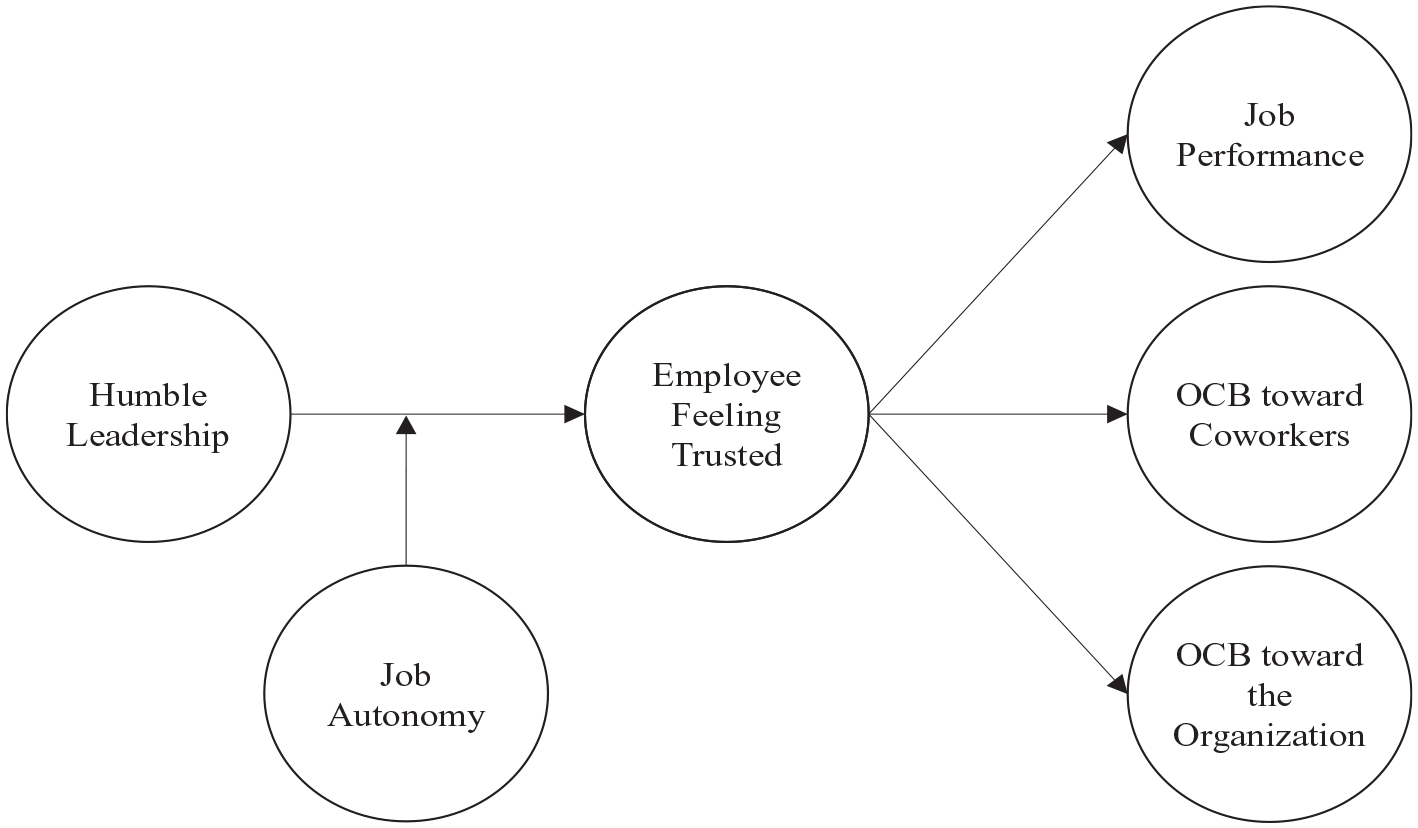
The proposed conceptual model of humble leadership and employee outcomes.
Theory and Hypotheses
Humble Leadership and Feeling Trusted
Following the three-part definition of expressed leader humility (Owens et al., 2013), humble leaders are argued to hold a more accurate, impartial assessment of their own contributions and limitations as members of the organization (Owens & Hekman, 2012). In addition, humble leaders listen to, value, and incorporate followers’ ideas, values, and contributions (Ou et al., 2014; Owens et al., 2013). Finally, humble leaders tend to maintain a high degree of openness in interpersonal interactions with others characterized by a strong motive for learning through and from them (Ou et al., 2018; Owens et al., 2013). Humble leadership may be a promising new leadership style to promote positive employee conduct because leaders who move beyond a state of self-centered perception tend to be equipped with higher levels of empathy, which in turn has been shown to be an essential component of effective leadership in research on employee motivation, emotional intelligence, and servant leadership (Goleman, 2004; Van Dierendonck, 2011). This nascent research stream has, indeed, indicated that humble leadership, characterized by a leader’s more objective self-view, positively influences followers’ work related attitudes and behaviors (see Owens et al., 2013; Owens & Hekman, 2012; Owens et al., 2015; Qin et al., 2020; Rego et al., 2017).
We propose that humble leadership plays a critical role in the process of interpersonal trust development in organizations as it provides a starting point for a social exchange relationship between leaders and followers. According to social exchange theory, the rules of exchange embedded in a social exchange relationship require “a bidirectional transaction—something has to be given and something returned” (Cropanzano & Mitchell, 2005, p. 876). In this study, we pay attention to the bidirectional nature of the social exchange relationship by investigating leaders’ expressed humility, and subordinates’ perceptions of feeling trusted and subsequent performance behaviors. We posit that the leaders’ employee-centric humble behaviors, such as viewing their or others’ strengths and weaknesses accurately and being open to new ideas and feedback from followers, reflect the leaders’ positive expectations of employees’ contributions. We also argue that leaders’ humble appreciation of others’ contributions and ideas becomes a credible signal to subordinates that their leader deems them trustworthy. Trustworthiness is based on the belief that the other party is competent, benevolent, and reliable (Mayer et al., 1995). Indeed, trust in dyadic relationships has been defined as one party’s willingness to be vulnerable to the other party irrespective of the ability to monitor or control the other party (Mayer et al., 1995; Mishra & Mishra, 2012) because of expectations that the other party’s future actions will be beneficial rather than detrimental (Gambetta, 1988). Grounded in attachment theory, recent empirical research shows that leader humility is related to employees feeling trusted which in turn facilitates their risky voice behaviors (Bharanitharan et al., 2019).
A leader’s humble behaviors, such as recognizing and appreciating an employee’s strengths and abilities, seeking their views, requesting input, inviting feedback, and being open to learn from the employee, become useful behavioral cues for the employee that he or she is perceived as trustworthy (e.g., competent, and benevolent) by the leader. Indeed, Ou and colleagues (2014) note that humility allows for the appreciation of other people’s idiosyncratic abilities, and Morris et al. (2005) convey that humility is expressed in other-enhancing behaviors. Owens and Hekman (2016) note that humble leaders appreciate others who have skills in domains where the leader’s abilities may be lacking and Owens et al. (2011) posit that humble people recognize and admire others’ specialized abilities and unique skills as exemplars to learn from.
When a leader demonstrates the fact that he or she does not have all the answers, shows that the employee’s input is important and valued, and places dependency on the employee, such humble behaviors signal trustworthiness toward the employee. Indeed, disclosure of information that makes one vulnerable, honest accounts of abilities and shortcomings, and reliance or dependency on another have been shown to be associated with perceptions of trustworthiness (Levin et al., 2006; Thielmann & Hilbig, 2015). Therefore, we hypothesize that humble leadership behaviors will be positively related to employees’ perceptions of feeling trusted. This leads to our first hypothesis:
The Moderating Effect of Job Autonomy
To date the literature on humble leadership has revealed primarily positive results in terms of predicting organizationally desirable outcomes (Ou et al., 2014; Owens et al., 2013; Owens et al., 2015). However, as with any set of leadership behaviors, a contingency approach will likely be most accurate in describing its effects (e.g., Grant, 2012; Hoch & Kozlowski, 2014). Specifically, it is likely that the impact of humble leadership will be more positive in certain contexts and less so in others. The contextual nature of leadership effectiveness is well recognized in various leadership theories (e.g., Bass, 1981; Hill & Hughes, 1974) and qualitative work on humble leadership behaviors is already beginning to identify some important contingencies that influence its effectiveness, including time pressure, a learning culture, and hierarchical adherence (Owens et al., 2015). Similarly, studies have shown that humility’s effectiveness is impacted by the presence of other leader characteristics such as sincerity (Owens, 2009) or narcissism (Owens et al., 2015). Therefore, a theoretically grounded contingency approach to studying humble leadership seems appropriate and timely.
One recently articulated way by which subordinates may derive positive benefits from the expressed humility of their supervisor is through experimentation, making mistakes, and enacting change at work, which allows them to develop and grow as employees (Owens & Hekman, 2012). A tacit assumption in these findings is the notion that the subordinates of humble leaders would be afforded opportunities to learn, make mistakes, and enact their ideas so that they may take charge of their professional progress and development. Yet, not all employees may enjoy the job autonomy to enact these learning and growth behaviors that allow for such beneficial improvement and development at work. Given the focus on encouraging followers to progress and improve through experimentation, making mistakes, and enacting change, that is central to the humble leadership style (Owens et al., 2011), the level of structural job autonomy seems theoretically relevant as a contingency factor that moderates the influence of humble leadership on followers. For example, if a humble leader attempts to model for a follower a difficult process that requires trial and error and a healthy dose of failure, but the follower is not in a position that provides him or her with sufficient autonomy to experiment with the task implementation, the leader’s humility behaviors could be a potential source of frustration for followers and engender feelings of not being trusted with real change behaviors. Because leaders are likely to be seen as having legitimate power and authority to influence job design and job control systems (Creed & Miles, 1996), the incongruence between leader’s growth-modeling behaviors and non-self-governing job characteristics might make the humble behaviors demonstrated by the leader less effective in generating feelings of being trusted.
Moreover, it is not only the growth-modeling aspect of leader humility that is potentially undermined by a lack of job autonomy, employees may also question the credibility of a humble leader’s consultative and delegating behaviors if these leader behaviors are inconsistent with the level of autonomy they actually experience at work. Our assertion that such inconsistencies between leader behaviors and structural job characteristics may undermine a leader’s effectiveness is consistent with Kramer and Lewicki’s (2010) finding that trust-breakdowns can occur when incongruence is perceived, such as when job expectations do not match job experiences. Indeed, qualitative research by Owens and Hekman (2012) reveals the theme that for humble leaders to have a strong and positive impact on followers, they must be perceived to be sincere. Contextual job realities, as reflected in the extended level of job autonomy, are likely to be perceived by employees as an indicator of the consistency or inconsistency of the leader’s humble behaviors, such that when job autonomy is low, the relationship between humble leader behaviors and feeling trusted is attenuated. In contrast, job autonomy is expected to enhance the effect of humble leadership on feeing trusted given that job realities confirm and match the humble leader’s consultative and delegating behaviors. Thus, we introduce our second hypothesis:
The Mediating Effect of Feeling Trusted and Work Outcomes
The level of trust perceived in interpersonal relationships plays an important role in determining the parties’ future relational decisions and behaviors toward one another (Mayer et al., 1995). When an employee perceives that he or she is viewed as reliable, competent, and benevolent by the leader, the employee will strive to live up to these positive expectations (Livingston, 2003). Humble leadership behaviors, such as appreciating employees’ strengths and contributions, requesting input from employees and attempting to learn from them, likely engender in subordinates’ feelings of being trusted (see Hypothesis 1). In reciprocation, the employees may enhance their work efforts and discretionary helpfulness to deem themselves deserving of the trust afforded to them by their supervisor. Indeed, social exchange theory articulates the norm of reciprocity to be a common behavioral mechanism in interpersonal relationships (Blau, 1964; Gouldner, 1960). The norm of reciprocity is noted to be an essential part of maintaining one’s current close interpersonal ties and is a key means of improving a relationship (Cropanzano & Mitchell, 2005). In the workplace domain, reciprocity resulting from a leader’s employee-centric behaviors become the impetus for citizenship behaviors by those who perceive receiving favors (in this case, employees; Deckop et al., 2003; Organ, 1988). In addition, feeling trusted is associated with non-self-interested behavioral motivation (Rempel et al., 1985), which predicts citizenship behaviors (e.g., interpersonal helpfulness and cooperation) in workplace settings (Lind & Tyler, 1988).
Recent empirical studies have also reported that feeling trusted is positively related to organizational performance at the individual level and the collective level (Lau et al., 2014; Salamon & Robinson, 2008). Specifically, Salamon and Robinson (2008) found that employees’ collective perception of feeling trusted by management is positively associated with the performance criteria of sales volume and customer service performance. In addition, Lau et al. (2014) found that feeling trusted is positively related to school teachers’ task performance and organizational citizenship behavior (OCB) within the school.
As humble leaders accurately assess their shortcomings, appreciate others’ skills and contributions, and demonstrate teachability, it is likely that the subordinate will feel that he or she is trusted (see Hypothesis 1), and in turn it is likely that the subordinate will attempt to reciprocate helpfulness toward the leader because he or she feels indebted to the leader for the trust placed in him or her (Aryee et al., 2002). Enhancing one’s efforts to excel at work tasks, extending efforts above and beyond task obligations, and engaging in OCBs are work-related ways for the employee to reciprocate feeling trusted by his/her humble leader. As a result, feeling trusted by the leader likely spurs the employee’s enhanced task performance and increased citizenship conduct. Since leaders are often viewed as organizational agents (Eisenberg et al., 2002), we argue that benefitting the organization and its members (i.e., coworkers) is a reasonable way of reciprocating feeling trusted by their leader.
Thus, we predict that feeling trusted by their leader will be positively related to task performance, OCB toward coworkers, and OCB toward the organization.
Based on Hypothesis 3, we also propose that job autonomy moderates the hypothesized mediated relationship, such that the indirect effect of humble leadership on job performance (Hypothesis 3a), OCB toward coworkers (Hypothesis 3b), and OCB toward the organization (Hypothesis 3c), through its effect on feeling trusted, tend to be stronger when employees perceive their job autonomy to be higher. Therefore, we posit the following first-stage moderated mediation hypothesis:
Study 1
The initial step in testing our hypothesized research model was to design and conduct a vignette-based experiment (Aguinis & Bradley, 2014) to establish the relationship between humble leadership, autonomy, and feeling trusted. Study 1, therefore, provides an initial test of Hypotheses 1 and 2 in a manner (a randomized experiment) that will allow us to establish the causal nature of the relationship between these three constructs.
Method
Sample and Procedures
We recruited undergraduate business students at a large public university in the northwestern United States to participate in a lab-based experiment. The 269 participants were offered course extra credit for their participation. Because the university has a large international population (and an English-as-a-second-language transition program), we excluded data from participants who indicated that they were uncomfortable reading or writing in the English language (i.e., indicating a 1 or 2 on the questions of “How comfortable are you with reading (writing) in English” using a 5-item rating scale, ranging from 1 = not at all comfortable to 5 = very comfortable). This resulted in the removal of 141 participants, leaving us with a final sample of 128 spread across the four experimental conditions. The average age of the undergraduate student sample was 21.91 (SD = 2.32) and 55% of the sample was male. Almost all had some work experience with the average respondent having 3.39 years of work experience.
The participants took part in a two-by-two randomized experiment where both humble leadership and autonomy were manipulated using vignettes. The experimental manipulation consisted of a web-based survey wherein participants came into a computer lab and were then randomly assigned to one of four experimental conditions: high humble leadership/high autonomy, high humble leadership/low autonomy, low humble leadership/high autonomy, and low humble leadership/low autonomy. After accepting the terms of their participation in the study, students were asked to read a simple vignette describing a workplace scenario. The participants were asked to envision themselves as working in the workplace described in the scenario. The vignette consisted of two paragraphs, one describing the supervisor that they reported to and the other describing the conditions of their job. Items from Owens et al.’s (2013) measure of expressed humility (e.g., viewing oneself accurately, being appreciative of others’ strengths, and teachability) were used to create the information about the supervisor and items from Morgeson and Humphrey (2006) were used to create the paragraph describing high and low job autonomy. As both scales consist of positively worded items, these were adapted to create the high leader humility and high autonomy scenarios.
Measures
After reading one randomly assigned vignette, participants were asked to complete a three-item measure of feeling trusted adapted from Mayer and Davis (1999; α = .72) for use in this study. Participants were also asked to complete the nine-item Owens et al. (2013) measure of humble leadership (α = .99) and the three-item Morgeson and Humphrey (2006) measure of autonomy (α = .97) to allow us to test the effectiveness of the manipulations. In addition, we collected a range of demographic variables from the participants including age, gender identity, race, and English language proficiency.
Results
Manipulation and Realism Checks
We conducted two sets of one-way analysis of variance (ANOVA) for manipulation checks of the humble leadership and autonomy manipulations. Participants who read the vignette describing the supervisor high on humble leadership reported significantly higher ratings on the measure of humble leadership: F(1, 120) = 786.43, p < .001, η2 = .87, (high humble leadership, M = 4.52, SD = 0.61; low humble leadership, M = 1.42, SD = 0.61). Moreover, participants who read the scenario describing the job context with high autonomy reported significantly higher ratings on the measure of autonomy: F(1, 126) = 77.93, p < .001, η2 = .38, (high autonomy, M = 3.80, SD = 1.19; low autonomy, M = 1.91, SD = 1.22). In sum, both manipulations were successful. We also queried participants regarding the mundane realism of the vignettes by asking them whether the described workplace scenario could happen to them in a current or future job, using the response scale of 1 (strongly disagree) to 5 (strongly agree). The mean ratings on this item varied from 3.66 (SD = 1.01) for the low humble leadership/high autonomy condition to 4.18 (SD = 0.81) for the high humble leadership/high autonomy condition. These means indicate that participants found the workplace scenarios to be believable and realistic.
Hypothesis Testing
A 2 × 2 ANOVA on the feeling trusted score revealed a significant main effect of humble leadership on feeling trusted (Hypothesis 1), F(1, 124) = 131.74, p < .001, η2 = .49 (high humble leadership, M = 3.71, SD = 0.80; low humble leadership, M = 2.26, SD = 0.68), indicating that participants considered a humble leader to engender greater felt-trust than a leader lacking in humility. Hypothesis 2 predicted an interaction effect between humble leadership and job autonomy in predicting feeling trusted. The results of the experiment supported this interaction effect, F(1, 124) = 4.55, p < .05, η2 = .02, confirming that the positive relationship between humble leadership and feeling trusted is stronger when job autonomy is high (vs. low). Figure 2 visually depicts the interaction.
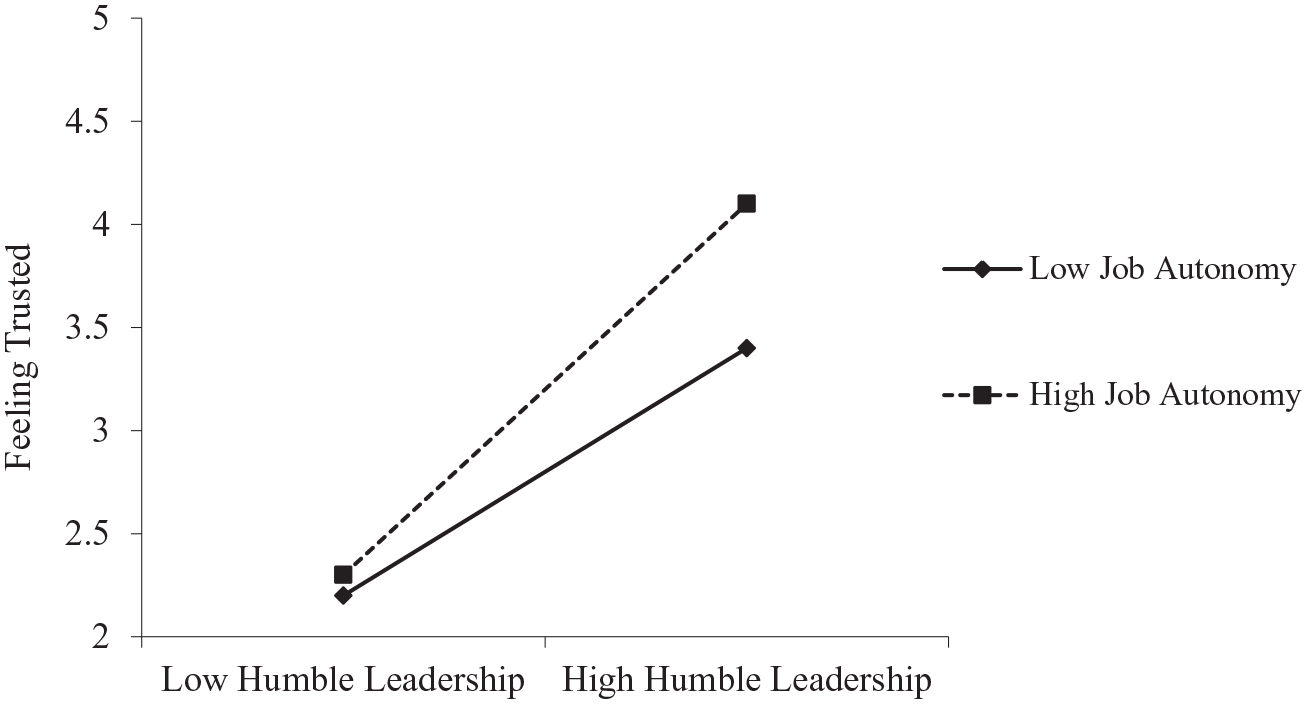
The moderation effect of job autonomy on the relationship between humble leadership and feeling trusted (Study 1).
Study 2
Having established the causal link between humble leadership, autonomy, and feeling trusted and the interaction effect, supporting Hypotheses 1 and 2, we proceeded to test our complete research model in a field study, consisting of a three-wave multisource survey.
Method
Sample and Procedures
We invited 933 employees of a large internet content solutions company in China to participate in this study. The company provides content solutions with regards to classified advertisements to corporate consumer clients seeking to promote their products in relation to the needs of people’s everyday life. It also provides individual clients with a web-based platform where people can buy or sell items or services. The invited participants worked in various job domains such as web design, content editing, data analytics, operations, business development, marketing, human resources, and accounting.
The surveys were administered to the employees in three waves (time points) to create a time lag between survey-taking events to alleviate reverse causality concerns in testing the posited relationships (MacKinnon et al., 2012; Mitchell & James, 2001; Podsakoff et al., 2003). The survey waves were spaced 3 weeks apart to ensure independent responding by the employees. At Time 1, we asked 933 employees to complete a survey questionnaire about their managers’ humble leadership behavior, their perceived job autonomy, and demographic information. However, 558 employees completed the first survey, yielding a response rate of 59.8%. At Time 2 (3 weeks later after Time 1), we asked these 558 respondents to rate their degree of feeling trusted by their supervisor. Indeed, 412 employees participated in the second survey, yielding a response rate of 73.8%. At Time 3 (3 weeks later after Time 2), we invited the 77 managers of those 412 employees who completed both Time 1 and Time 2 surveys to rate their subordinates’ job performance and OCB. However, 233 employee-ratings were collected from 45 participating managers, yielding a response rate of 58.4%. Therefore, our final sample consists of 233 employees and their 45 supervising managers. Indeed, 64 of the 233 employee respondents (27.5%) were female. The average age and organizational tenure were 31.8 and 6.0 years, respectively. All of the employee respondents held college degrees and 46 of them (19.7%) held postgraduate (Masters) degrees.
Translation of questionnaire items
Since all participants were Chinese, the survey questionnaires were provided in Mandarin, Chinese. The questionnaire items were originally created in English with the exception of job performance, and we administered the standard and recommended translation and back-translation procedure (Brislin et al., 1973) to ensure conceptual equivalence and comparability between the English and Chinese questionnaire items.
Measures
Unless specified, we used a 5-point Likert scale ranging from 1 (strongly disagree) to 5 (strongly agree) as anchors to measure our study variables.
Humble leadership (α = .93)
Subordinates were asked to rate their immediate supervisor’s humble leadership behaviors, using the nine-item leader humility scale (Owens et al., 2013). Sample items include “My manager actively seeks feedback, even if it is critical,” and “My manager shows appreciation for the unique contributions of others.”
Job autonomy (α = .92)
Job autonomy was measured using three items adapted from the autonomy dimension of the work design questionnaire (Morgeson & Humphrey, 2006). The items capture job autonomy in three aspects: work scheduling, decision-making, and work methods. Sample items were “The job allows me to make a lot of decisions on my own,” and “The job allows me to decide on my own how to go about doing my work.”
Feeling trusted (α = .90)
Feeling trusted was measured by adapting three items from Mayer and Davis’s (1999) trust scale. We modified the trust scale to capture employees’ beliefs of being trusted by their supervisor. In addition, the referent was modified from “top management” to “my supervisor” to be consistent with our research objectives. Sample items were “My supervisor would let me have control over important issues in this company,” and “I think my supervisor would feel comfortable giving me a critical task or problem to handle.”
Job performance (α = .80)
Job performance was measured by supervisors using Farh et al.’s (2007) three items of the job performance scale originally written in Chinese. Supervisors were asked to assess their subordinates based on (1) quality of work, (2) efficiency of work, and accomplishment of work goals.
Organizational citizenship behavior toward coworkers (α = .91)
Supervisors assessed each subordinate’s OCB toward coworkers using the OCB for individuals developed by Williams and Anderson’s four item (1991) OCB-Interpersonal scale. We modified the referent to “coworkers” specifically to better capture the purpose of this study. Supervisors were asked to indicate how often their immediate subordinates are engaged in these behaviors. Sample items were “This employee willingly gives his/her time to help coworkers who have work-related problems.”
Organizational citizenship behavior toward the organization (α = .72)
OCB toward the organization was assessed using Masterson et al.’s (2000) two items of organization-directed OCB. Supervisors were asked to rate each subordinate’s OCB toward the organization. The items were “This subordinate defends this organization when other employees criticize it,” “This subordinate defends this organization when outsiders criticize it.”
Control variables
Consistent with prior research investigating humble leadership and its influence on employee outcomes (e.g., Owens et al., 2013; 2015), age, gender, and organizational tenure were controlled to minimize the potential confounding effects on the hypothesized relationships.
Analyses
Because the majority of supervisors in our sample rated the work outcomes of multiple employees, there is a possibility of nonindependence of observations. To check if our data were subject to nonindependent observations, we conducted ANOVA using the three employee outcomes as the dependent variables (Zhang & Bartol, 2010). The results from ANOVA revealed that none of these three manager-rated employee outcome variables were subject to level-2 (i.e., manager) effects [i.e., job performance (F = 1.044, p =.409), OCB toward coworkers (F = 1.156, p = .252), and OCB toward the organization (F = 1.436, p = .052). This indicates that there are no differences in manager rating patterns as they relate to differences in employee outcome variables. Therefore, we decided to proceed with our analyses using the regression approach. Prior to testing our hypotheses, we performed confirmatory factor analyses (CFAs) to test the validity of our proposed measurement model, utilizing Mplus 6.1 (Muthén & Muthén, 2010) and the results of the CFA is presented in the result section.
Our conceptual model predicts that employee job autonomy will moderate the mediating relationship between the independent variable and the dependent variables. To test this moderated mediation model (Muller et al., 2005), we conducted a conditional process analysis utilizing the SPSS Process macro (Model 7) suggested by Hayes (2013), which allows for the investigation of Hypotheses 2, 3, and 4. This macro Process procedure performs the bootstrapping procedure (i.e., 5,000 bootstrap estimates) and provides the significance of conditional indirect effects at different values (1 standard deviation [SD] below the mean, the mean, and 1 SD above the mean in job autonomy) of the moderator. Prior to the analyses, all the variables except for the dependent variables were mean-centered to assuage multicollinearity concerns (Aiken & West, 1991).
Results
Table 1 presents means, standard deviations, and intercorrelations among the measures. As shown in Table 1, the correlations among primary study variables were all significant and the directions of these correlations were as hypothesized. None of the control variables, however, were significantly related to any of the primary study variables. Therefore, we proceeded to model testing without including these control variables.
Means, Standard Deviations, and Intercorrelations of Study Variables From Study 2.
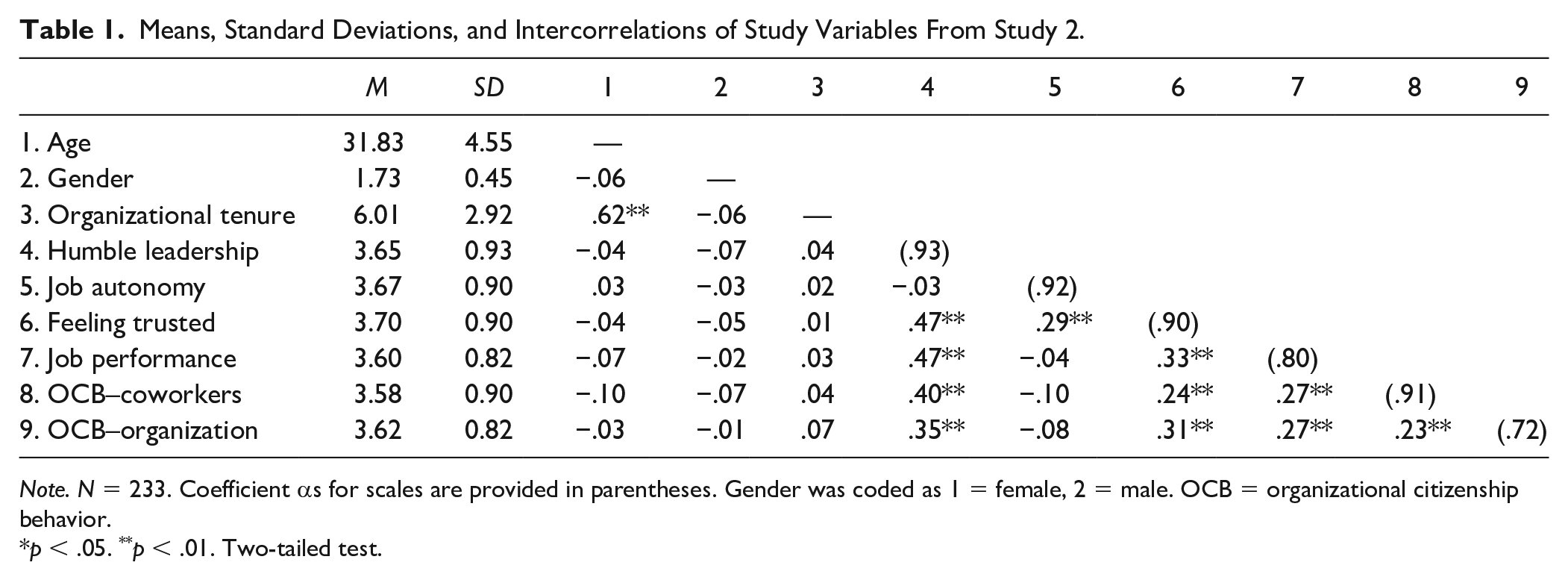
Note. N = 233. Coefficient αs for scales are provided in parentheses. Gender was coded as 1 = female, 2 = male. OCB = organizational citizenship behavior.
p < .05. **p < .01. Two-tailed test.
Measurement Model Testing
The CFA results revealed that our hypothesized six factor model exhibits the most adequate fit to the data among the seven plausible alternative models, χ2(237) = 316.57, χ2/degrees of freedom (df) = 1.34, comparative fit index (CFI) = .98, Tucker–Lewis index (TLI) = .97, root mean square error of approximation (RMSEA) = .04, standardized root mean square residual (SRMR) = .04. As shown in Table 2, the results for comparative analyses among several alternative models indicated that our proposed six-factor baseline model was significantly better than the best competing five-factor model in which we loaded the items of the OCB toward coworker and OCB toward organization scales onto one single latent factor: χ2(242) = 568.29; χ2/df = 2.35; CFI = .91; TLI = .90; RMSEA = .08; SRMR = .10 based on the chi-square difference test, χ2(5) = 251.72. Therefore, we conducted further hypotheses testing, using the proposed six-factor model.
Comparisons of Measurement Models From Study 2.
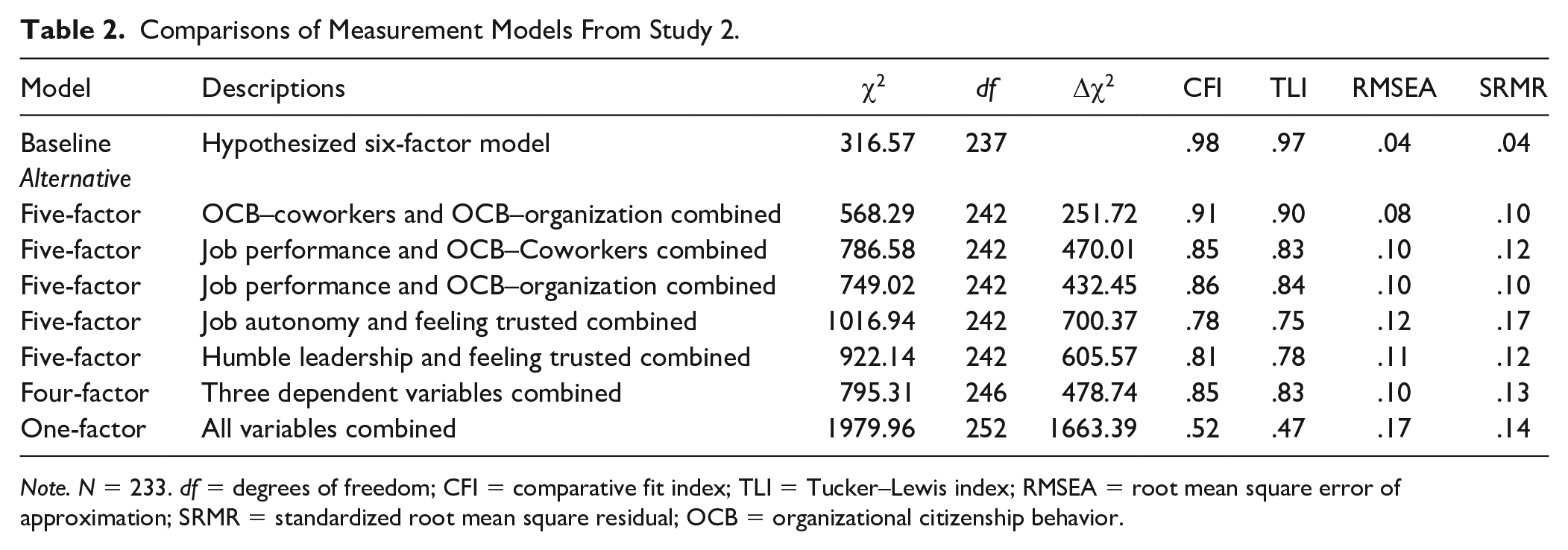
Note. N = 233. df = degrees of freedom; CFI = comparative fit index; TLI = Tucker–Lewis index; RMSEA = root mean square error of approximation; SRMR = standardized root mean square residual; OCB = organizational citizenship behavior.
Hypotheses Testing
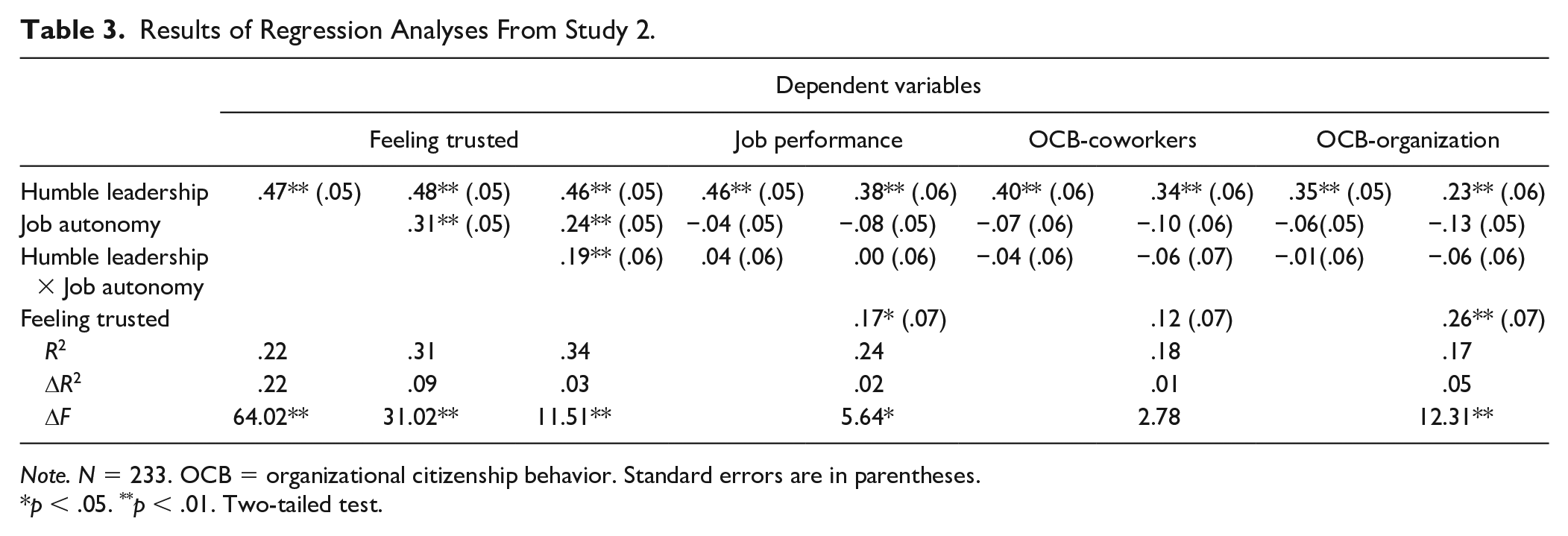
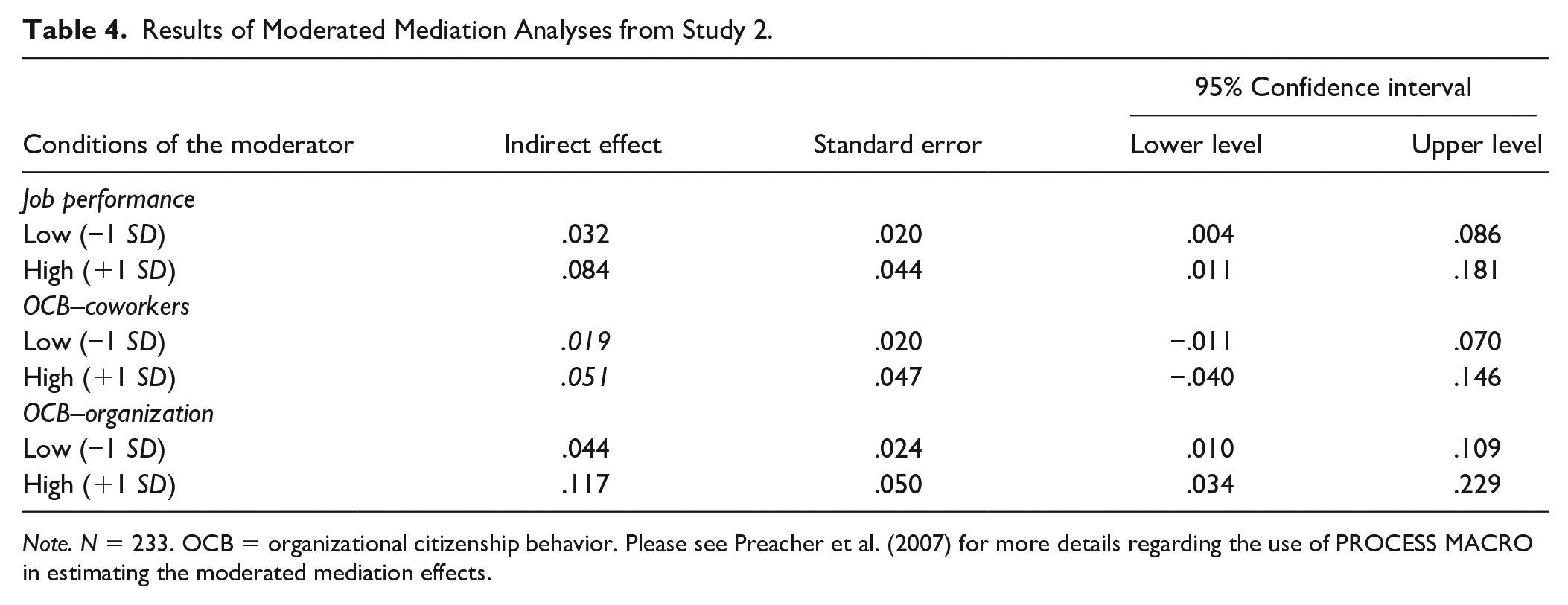
Hypothesis 1 proposed that humble leadership would be positively related to feeling trusted. As shown in Table 3, the regression results show a significant positive relationship between humble leadership and feeling trusted by the supervisor (β = .47, p < .01). Therefore, Hypothesis 1 was supported. Results of moderated mediation analyses from Study 2 are given in Table 4.
Results of Regression Analyses From Study 2.
Note. N = 233. OCB = organizational citizenship behavior. Standard errors are in parentheses.
p < .05. **p < .01. Two-tailed test.
Results of Moderated Mediation Analyses from Study 2.
Note. N = 233. OCB = organizational citizenship behavior. Please see Preacher et al. (2007) for more details regarding the use of PROCESS MACRO in estimating the moderated mediation effects.
Hypothesis 2 posited that the positive relationship between humble leadership and feeling trusted would be moderated by job autonomy, such that this positive relationship would be stronger in the presence of high (vs. low) job autonomy. As shown in Table 3, we found a significant moderation effect of job autonomy on the positive relationship between humble leadership and feeling trusted (β = .19, p < .01). We further plotted this interaction in Figure 3. As shown in the figure, the positive relationship between humble leadership and feeling trusted was stronger when job autonomy was high (vs. low). Results from the simple slope t tests (Aiken & West, 1991) showed that the slopes of the high-autonomy condition (b = .607, t = 7.836, p < .01) and that of the low-autonomy condition (b = .225, t = 2.905, p < .01) were both significant. Therefore, Hypothesis 2 was supported.
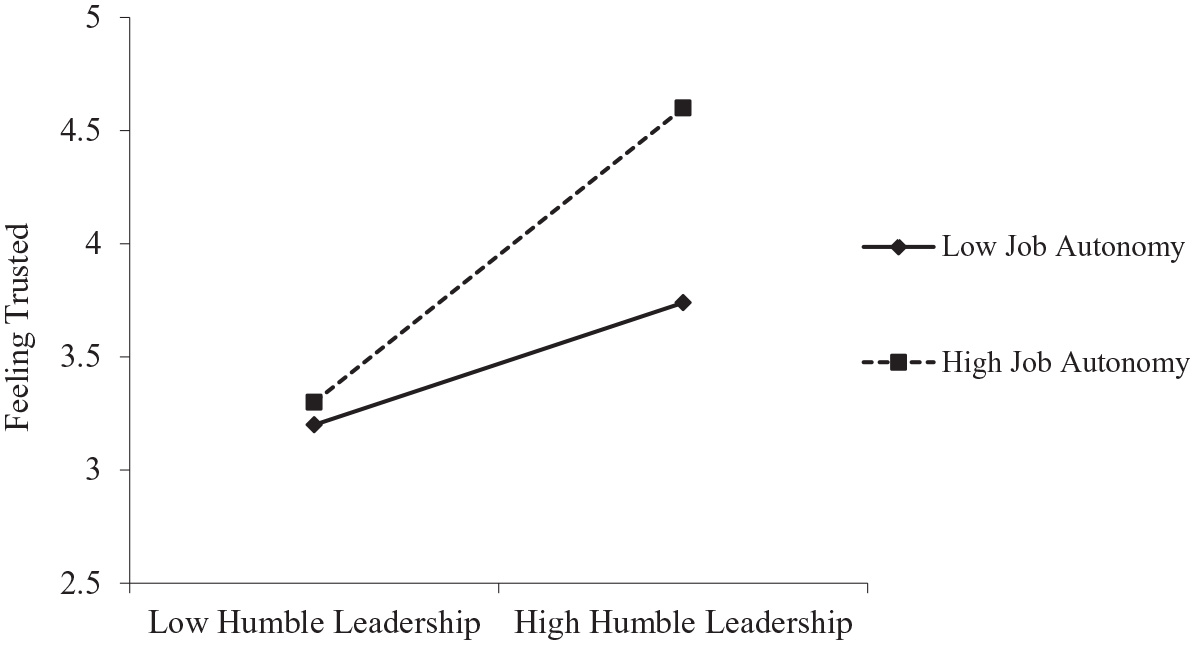
The moderation effect of job autonomy on the relationship between humble leadership and feeling trusted (Study 2)
Hypothesis 3 proposed that feeling trusted would be positively related to: (a) job performance, (b) OCB toward coworkers, and (c) OCB toward the organization. As shown in Table 3, we found that feeling trusted was positively related to job performance (β = .17, p < .05) and OCB toward the organization (β = .26, p < .01). However, there was no significant relationship between feeling trusted and OCB toward coworkers (β = .12, ns). Therefore, Hypothesis 3 was partially supported.
Finally, using a conditional process analysis utilizing an SPSS macro suggested by Hayes (2013), we examined the moderated mediation hypothesis (Hypothesis 4), the conditional indirect effects of humble leadership on our dependent variables (via feeling trusted) at three values of job autonomy: 1 SD below the mean, the mean, and 1 SD above the mean. We bootstrapped 5,000 samples to obtain bias-corrected confidence intervals (CIs) to see the significance of indirect effects (Edwards & Lambert, 2007). The results show that the positive and indirect effect of humble leadership on job performance via feeling trusted was significantly stronger when job autonomy was high (β = .084, 95% CI [.011, .181]) than when it was low (β = .032, 95% CI [.004, .086]). We also found that feeling trusted mediates the relationship between humble leadership and job performance at both levels of job autonomy (high and low). Similarly, the positive and indirect effect of humble leadership on OCB toward the organization via feeling trusted was also significantly stronger when job autonomy was high (β = .117, 95% CI [.034, .229]) than when it was low (β = .044, 95% CI [.010, .109]) but the mediation effect of feeling trusted on the relationship between humble leadership and OCB toward the organization was significant at the both levels of job autonomy. However, such indirect effect on OCB toward coworkers via feeling trusted trust was not significant when job autonomy was both low (β = .019, 95% CI [−.011, .070]) and high (β = .051, 95% CI [−.040, .146]). Therefore, Hypothesis 4 was partially supported. Specifically, job autonomy enhances task performance and OCB toward the organization due to an elevated level of feeling trusted by the supervisor, but job autonomy does not enhance OCB toward coworkers.
Discussion
The purpose of this article was to enhance our understanding of humble leadership in the workplace by investigating feeling trusted as the intervening mediating process in the relationship between humble leadership and employee job performance. In addition, we investigated the moderating influence of the contextual contingency factor of job autonomy on the relationship between humble leadership and feeling trusted.
Our empirical findings supported the posited hypothesis that the expression of humble behaviors by leaders is positively related to employees’ perception of feeling trusted. In addition, our results revealed that job autonomy has an augmenting moderating effect on the relationship between humble leadership and feeling trusted; such that the positive relationship between humble leadership and feeling trusted is stronger when higher levels of job autonomy were reported. Furthermore, our moderated mediation analyses indicated that feeling trusted mediates the interactive relationship between humble leadership and the employee work outcomes of job performance and OCB toward the organization.
However, we found no support for the hypothesized relationship between feeling trusted and OCB toward coworkers. Reflecting on this “missing” or nonsignificant empirical association, we speculate that the broad notion of “congruence” may be one explanatory mechanism for why feeling trusted does not spur helpfulness toward coworkers. Congruence between sources (between the source extending trust and the source receiving reciprocated citizenship conduct) likely needs to be present, such that employees may only seek to benefit those “others” who have shown them beneficial treatment, and not potential third-party beneficiaries. Indeed, when employees extend good will and effort toward their coworkers, the motivation to engage in such interpersonal citizenship conduct may not stem from their personal relationship with their supervisor, or their assessment of feeling trusted by their leader. Instead, interpersonal helpfulness has been shown to be associated with the strength or quality of the interpersonal tie between the “helper” and the person being helped (Settoon & Mossholder, 2002). Moreover, reciprocity is advocated as the notion that “you should give benefits to those who give you benefits” (Gouldner, 1960, p. 170). Therefore, helping other coworkers by engaging in OCB–Interpersonal conduct is not a behavior that one may feel obligated to engage in to reciprocate receiving humble leadership.
Another plausible explanation for this nonsignificant relationship comes from recent trust research by Baer et al. (2015), who found that feeling trusted by one’s supervisor is positively related to employee concerns about workload and keeping up one’s reputation. These authors argue that leaders who trust their employees tend to increasingly delegate decision-making and responsibilities to them (Lawler, 1992; Mishra, 1996). Trusted employees in turn perceive greater workload and enhanced pressure to maintain a trustworthy reputation in their supervisor’s estimation. Thus, it is plausible that the primary concerns for trusted employees involve keeping up with their enlarged workload and to maintain a trust-worthy (capable and benevolent) reputation in the organization, rather than with assisting their coworkers.
Theoretical Implications
This article extends the current understanding of humble leadership processes and interpersonal trust formation by focusing on the fundamental, yet unanswered, question of why employees who report to humble leaders perform more effectively. Our current work makes several contributions to various extant literatures in the organizational sciences. First, these two studies contribute to the leadership perspective which challenges the notion that leaders should be perceived as masculine, authoritarian, and dominant (Koenig et al., 2011; Lord et al., 1986). Alongside recent empirical papers that demonstrate employee-centric leader behaviors as effective methods to motivate employees (e.g., Chen et al., 2015; Mathieu et al., 2015), we demonstrated that humble leaders, who display accurate views of oneself and their subordinates and have an openness to new ideas and feedback from their employees, would motivate employee work performance and extra-role behaviors via feeling trusted.
Perhaps the motivating potential of humble leaders is a function of today’s workforce and we are entering into a new era of subordinate motivation that is spurred by more employee-centric leadership practices. Indeed, recent research has revealed that narcissistic leaders, who do not genuinely have their employees’ best interest at heart, weaken their influence on subordinates (Galvin et al., 2010). Moreover, Weick (2001) noted that effective leadership in the new millennium is characterized more by humble leader behaviors and less by leader hubris to address the level of uncertainty and by transferring decision-making away from “rank” and toward individuals who possess the expertise to handle it. Leaders who admit that there are things that “they don’t know” would end with something learned (Weick, 2001), which is a core tenet of humble leadership practice. The contemporary employee-centric leadership style appears to be a better fit with the realities of the increased globalization that rely on heavy use of technology (Burke & Ng, 2006), higher performance expectations, and needs for innovative and creative competencies and expertise (Burke & Cooper, 2006).
Second, in their review of leadership research in the new millennium, Dinh et al. (2014) note that extant leadership research reveals little about the processes by which leaders make organizations effective. This is certainly true for the humble leadership domain, which despite the recent theoretical and empirical advancements, has not explicated the underlying psychological processes between humble leadership and positive employee performance outcomes. Drawing on social exchange theory, this study explicates humble leadership processes and the subsequent leadership effectiveness, investigating feeling trusted as a mediating mechanism for why employees working with humble leaders show higher levels of job performance. As a result, the present study advances our understanding of the underlying mechanisms of humble leadership effectiveness. In doing so, this study also responds to the call for research on the understudied cognition of feeling trusted by one’s leader (Baer et al., 2015).
Third, our current work contributes to the integration of context in theories and models of leadership effectiveness. While Porter and McLaughlin (2006) note that leadership occurs within a broader social contextual backdrop, the contextual factors surrounding leadership have received little research attention (Antonakis et al., 2004). Indeed, a recent review of the leadership literature in organizational behavior research in the new millennium (Dinh et al., 2014) concludes that the topic of context remains underresearched and poorly understood in leadership paradigms. Modern leadership theories tend to neglect or omit possible contextual influences from their theoretical frameworks and instead regard leadership as a context–neutral phenomenon (Johns, 2006), resulting in the omission of contextual influences from many scholarly leadership models. With regards to the role of context in humble leadership, Owens’s (2009) findings reflect that leaders’ expressed humility must be perceived to be authentic, or its effectiveness will be undermined. Furthermore, Ou et al. (2014) aptly noted that various additional organizational context variables may constrain the effects of humble leadership and that “the contingencies of its influence in organizations represent a promising and important future research direction” (p. 62). We agree with this assertion and sought to illuminate the role of contextual job autonomy, alongside humble leadership, on feeling trusted and performance criteria.
Finally, our current work contributes to literature on the role of cognition in organizations. While fairness perceptions and trusting are frequently studied employee cognitions, the cognitive appraisal of feeling trusted is a newcomer to the organizational cognition domain. Our findings indicate that feeling trusted appears to motivate work effort and influence to which ends employee efforts are directed. Classic work on the norm of reciprocity conveys that one’s efforts or benefits should be extended to helping people who have provided them with benefits (Gouldner, 1960). Our current work conveys that when employees perceive that their supervisor trusts them, their work effort is aimed at reciprocating this trust by helping the organization with extra-role behavior and by enhancing their task performance.
Practical Implications
Of practical importance, leaders’ humble behaviors are well-aligned with employee-centered work practices (e.g., self-managed teams, shared leadership in virtual team settings, and empowerment) common in today’s organizations. Specifically, a leader’s tendency to view himself or herself and employees accurately and openness to learn from subordinates may function as a motivating force for employees in team-based work structures common in most contemporary organizations (Collins, 2006; Morris et al., 2005). As such, the theoretical implications of this article provide practical insights into how organizations and managers may strategically integrate the findings of this study into their organizational and leadership practices.
First, the findings of these two studies suggest that it is important for organizations and managers to understand the fact that employees who feel trusted by their leader are motivated to perform more effectively at work, to engage in work that extends above and beyond their job scope, and to direct their effects to help benefit the organization. Therefore, it is beneficial for companies to make institutional efforts to integrate our findings into leadership training curriculum, which would lead managers to be mindful about the importance and benefits of learning and implementing humble leadership practices in their work settings and in their interactions with their subordinates. Managers who admit personal shortcomings, appreciate their subordinates’ strengths, and seek input and expertise from their subordinates will facilitate employees feeling trusted by their leaders. In order to effectively spur managers’ humble leadership behavior, organizations should expressly articulate how to behave humbly toward their subordinates or to implement staffing practices to recruit and select managers, who successfully practice humble leadership behaviors.
Second, when introducing and encouraging humble leadership behaviors in management practices, organizations should be mindful of the synergy between humble leadership and contextual job autonomy. As our findings indicate, structural organizational support for employees’ job autonomy such that employees enjoy discretion to self-determine work processes (e.g., decision-making, determining task order, work arrangement, scheduling, and coordinating) enhanced the positive effect of humble behaviors on the trust-engendering process. Therefore, organizations should make institutional efforts to allow more autonomous job design to trigger a synergetic effect with humble leadership.
Finally, our research findings revealed that while feeling trusted as invoked by humble leadership and job autonomy is positively associated with task performance and helpfulness toward the organization, it is not associated with helpfulness toward coworkers. Therefore, organizations and managers who desire interpersonal helpfulness at work might also experiment with humble coworker behaviors to perhaps stimulate interpersonal helpfulness in the form of interdependence and interpersonal support, backup-behavior, or assistance among peers.
Limitations and Suggestions for Future Research
We would also like to highlight the limitations of this article. First, our field data may suffer from reverse causality, such that higher employee performance levels and exhibited citizenship conduct, as noted by supervisors, would inspire supervisors to behave more humbly toward them by soliciting input, delegating, and admitting shortcomings. While we certainly think that higher performance and workplace helpfulness would incite leaders to treat their employees more humbly, effectively creating a perpetually maintained balance of higher performance criteria and higher levels of humility, we do not think that the relationship needs to start with employee performance. Instead, our findings conveyed that humble leadership, autonomy and their interaction exert their effects via feeling trusted, and theory has supported why humble leadership, job autonomy and their interaction would invoke this cognition. Reversing the unfolding order of our model would not be able to explain how feeling trusted might be informed by higher performance or helpful conduct.
Second, in our work, we theorize job autonomy to be a meaningful job characteristic to influence feeling trusted, yet, our current study does not investigate other theoretical job characteristics (e.g., job variety, identity, significance, and feedback) that were suggested as useful job factors to enhance employee intrinsic motivation (Hackman & Oldham, 1976). We chose to study job autonomy as part of our model because the level of job autonomy would indicate being trusted in terms of competence, integrity, and benevolence (Mayer et al., 1995). Yet, while our findings convey that being allowed more job autonomy related to work processes is a valid indicator for employees to gauge feeling trusted, investigating the other potentially important job characteristics might provide further insight into feeling trusted by their supervisor. Therefore, future research may benefit from studying whether being extended job variety or being assigned highly significant tasks might further signal that one’s supervisor deems the employee trustworthy.
Footnotes
Declaration of Conflicting Interests
The author(s) declared no potential conflicts of interest with respect to the research, authorship, and/or publication of this article.
Funding
The author(s) received no financial support for the research, authorship, and/or publication of this article.
