







Abstract
In this article, we propose a strategic view of leadership development, by defining a Leadership Service Academy (LSA) construct. The LSA represents a strategic approach that enables an organization and its leaders to institutionalize its own theory of leadership, narrative, models, learning methodologies, practices, and evaluation methods for determining the impact of investing in developing leadership. The LSA construct represents a shift in strategic thinking that involves moving beyond focusing on individual leader development training programs used for satisfying current role-requirements or tactical succession planning, to adopting a systemic view of leadership development aligned with the organization's strategic objectives, mission, values, and culture. Most leadership development research has focused on examining the efficacy of training methodologies linked to individual leadership models and modalities and has produced promising results. However, the narrow focus on individual leadership development has excluded the full spectrum of leadership development interventions from being explored and analyzed. Our primary goal here is to explore a comprehensive strategy for building a sustainable, multi-level leadership development system firmly anchored in both science and practice.
Introduction
Building a Strategic Framework to Advance Leadership Development
Most of the research and practice associated with leadership development has focused on how planned interventions and unplanned events contribute to leader development—largely focusing on the individual targeted to lead others. A recent example of focusing on individual-level leadership development was reported in one of the most comprehensive meta-analyses of the leadership development literature by Lacerenza et al. (2017). These authors concluded that “data from 335 independent samples suggest that leadership training is substantially more effective than previously thought, leading to improvements in reactions (0.63), learning (0.73), transfer (0.82), and results (0.72), the strength of these effects differs based on various design, delivery, and implementation characteristics (p. 1686).” Building on this conclusion, our interest here is to focus on examining the various design, delivery and implementation characteristics that require further exploration, while also going beyond just individual leadership development, based on Day's (2000) definition, that addressed systematic programs designed to evaluate enhancements in individual leader knowledge, skills, ability, behavior, and other components.
Our principal goal is to expand upon Avolio's (2007) call for more integrative theory building in the leadership and development literature, which he concluded lacked a coherent framework for organizing this literature, as well as offering future pathways for examining leadership development research. For example, there has been relatively little research developed and tested, that has focused on examining how small to larger collectives versus focusing on the individual, engage in leadership development processes.
In sum, the arc of the leadership development literature has clearly failed to bend towards examining how leadership development is promoted or inhibited by followers, peers, teams, culture, organizations, and leaders in organizations, as well as the leadership experienced day in and day out, in the broader context of one's community, culture, and society. Most leadership research has limited its focus to examining individual leadership development interventions missing an opportunity to explore, experiment with and evaluate a much broader range of interventions that go beyond focusing just on the individual leader (Day, 2000; Drath et al., 2008; Van Velsor et al., 2010).
Challenging What Constitutes Leadership Development and Proposing Next Steps
We can start with a very common statement made by both leadership development practitioners, and many academics teaching leadership in higher education, referred to as the 70–20-10 “rule of thumb” for leader development (very commonly recognized, but not empirically validated; Clardy, 2018). This so-called rule suggests that leaders develop based on obtaining 70% of their knowledge from experiences, 20% from interacting with others, and 10% from formal instruction. This type of “received wisdom” may be misguided, since we have little proof that it has ever been tested nor validated. It seems fair to say, there are far more declarations pertaining to the efficacy of leadership development interventions than the evidence supporting them. More importantly, having evidence should not be sought to simply affirm declarations that leadership training interventions work. Rather, it is equally important to show what doesn’t work, so that investments in improving leadership development interventions can be done more accurately.
We also found very little empirical research on how individuals or collectives, e.g., dyads, teams, and larger units, develop the affective or motivational capabilities, that promote effective leadership. Rather, most of the existing research has focused on how these affective and motivational capabilities influence individual leadership development (e.g., Atwater, Dionne, Avolio, Camobreco, & Lau, 1998; May & Kahnweiler, 2000), but not on how they are each developed in individuals, groups, or larger units.
Taking stock of the current state of the leadership development literature, we should celebrate the work that has been done, that has shown, even with very short-duration intervention programs, that ones that are planned and rigorous can have a positive and significant impact on leadership development and performance. For example, from the Lacerenza et al. (2017, p. 1700) extensive meta-analysis of leadership development literature, the authors concluded that, “overall, our findings are more optimistic about the effectiveness of leadership training than popular press articles that suggest most leadership training programs are minimally effective (Nelson, 2016) and that leadership cannot be taught because managers are created, leaders are born (Morgan, 2015)”.
We now call for leadership research to move above the individual level of analysis in determining the effectiveness of leadership development interventions. For example, in an article by Leroy et al., (2022) published in this journal, the authors researched common declarations associated with most business school missions around the globe regarding their development of future leaders (Day & Dragoni, 2015; Reyes, et al. 2019). They reported that “a content analysis of twenty-first century mission statements of top business schools indicates that the majority sees leader development as critical (Kniffin et al. 2020),” (p. 6), and that these business schools serve a critical role in developing the next formation of organizational and societal leaders. Yet, Reyes et al. (2019) concluded from their analysis of these higher educational leadership development efforts that, “in practice, LD programs generally use approaches that are convenient and inexpensive rather than rooted in science” (p. 10).
Leroy et al., (2022) expanded this research by conducting a more comprehensive analysis of 60 business schools around the globe, concluding that evidence-based leadership development is not widely accepted nor produced by these schools. Indeed, there was very little evidence that demonstrated there was even a collective consensus associated with what constitutes effective leadership development, as one should expect from professional schools. There was also little understanding of what constitutes evidence-based leadership development. When directly addressing this lack of consensus, the authors concluded, “at the highest level of analysis, we identified the lack of a clear identity of being an EBLD, individually held and collectively endorsed, as an important roadblock to improving evidence-based leader development in business schools” (p.18).
We intend to begin addressing this roadblock by escalating the level of analysis to a focus on strategic leadership development by framing these efforts using a construct we refer to as a Leadership Service Academy (LSA). In this paper, we will operationally define what an LSA should include and how it could impact individual and collective leadership development. We purposely use the term the LSA construct, to signal here, that the LSA cannot be fully observed, but it can be operationally defined like any other construct, such as leadership, culture, psychological safety, and values.
We begin this discussion, by relying upon some well-established individual-level learning theories that have been applied to guiding individual leadership development research. However, we are unsure these theories can fully account for the full dynamics involved in relational or collective leadership development, but believe they are a good starting point to launch our discussion. For example, Nahrgang et al. (2009) examined the development of 330 leader-follower dyads in MBA teams, which operated together over 8 weeks. Their findings showed that leaders and followers form initial perceptions of relationship quality based on different personality characteristics, but over time, both leaders and followers adjust their perceptions of the leader–follower relationship based on the performance of their dyadic partner, offering some initial insights into what constitutes collective leadership development.
Studies of relational and collective leadership development mark an important shift in focus regarding how individual leadership development accrues, by placing more attention on examining the social context, to determine how embedded leadership development processes evolve. Results from this work may point to the importance of building a culture that supports learning and development beyond just concentrating on individual development, to include the development of dyads and larger collectives, and the context in which each is embedded.
Shifting this level of analysis to the dyadic or collective level could be informed by developmental theories, such as the one developed by Dweck (2017), which focused on linking individual needs and goals with a unified theory of motivation, personality, and development. Dweck's theory was built on a common set of principles and mechanisms to help understand human development and growth, and not necessarily just at the individual level. In her theory, she examined how the need for acceptance, predictability, and competence, form the basis for an individual's need for trust, control, self-esteem, and self-coherence. We suggest that these basic mechanisms are equally applicable to understanding the needs underlying a collective's mutual trust, control, esteem, and coherence.
Expanding on the collective social context and its relevance to leadership development, planned and/or serendipitous developmental experiences can both reinforce and extend the lessons learned from prior experiences, while forming the building blocks for a positive leadership development trajectory in individuals and groups (DeRue & Workman, 2011). Yet, there is very little attention paid to developing a theoretical or empirical basis for understanding how these sequences of experiences impact either individual or collective leadership development. For the most part, research on experience-based leadership development has concentrated on the developmental value of a single unique job or career experience (see Bunker & Webb, 1992; DeRue & Wellman, 2009; Dragoni et al., 2009; McCall, 1998), while leaving the optimal sequencing of development experiences to remain a mystery.
In a seminal article focused on examining what constitutes organizational learning, de Geus (1988, p. 71) claimed that the “…only enduring source of competitive advantage is an organization's relative ability to learn faster than its competition.” The reference to ‘the organization's relative ability’, suggests that a shift to the collective level might now be warranted in terms of examining how strategic leadership development systems can be built, tested, revised, evaluated, and continue to unfold over time as the system contributes to or detracts from leadership development in an organization.
Building an LSA
We will first examine a few familiar strategic frameworks for leadership development that have been commonly used within organizations to contrast why the proposed LSA framework is a different approach to fostering collective leadership development. The first framework has been described as a “Corporate University” (CU) model. The CU model centers on building an internal training strategy frequently leader led, which directs the organization's training approach to be focused on current and emerging workforce-related needs, onboarding, as well as developing employees identified as high potentials. These CUs often emphasize the organization's brand, culture, and service to the organization and/or in some cases community, which is then integrated with the overall focus on the employees’ full leadership development. Yet, many of these corporate universities have been closed due to their costs, the lack of any evidence of their impact or return on investment, and for being too insular to adapt to a rapidly changing external world.
A second popular model for organizational leadership development doesn’t usually occur within the organization. This approach can best be described as an outsourced leader executive education program. These programs are typically housed within university professional schools or consulting firms, and focus on developing knowledge, skills, abilities, and behaviors, that are identified as required competencies for leaders. These executive leadership development programs focus on developing skills within an individual leader based on the assumption that participants will transfer what is learned in these programs back into their current and future leadership roles within their organization. However, this type of transfer process is often compromised due to the program being loosely tied to the participant's organizational needs, along with there being no investment into validating the merits of the program nor determining the readiness of both participants and their organizational leaders to effectively apply what has been learned (Avolio & Hannah, 2008). Overall, these programs tend to be more in service of the individual leader versus their organization and in neither case are they properly validated.
Using the LSA construct, we model how individual leaders, and their organizations, serve each other's leadership development, by being intentionally designed for individual leader development, which aligns participants in support of their organizational strategy, culture, strategic priorities, and mission. To explore what constitutes an LSA, try to imagine a successful bio-tech start-up executive team, pitching to investors their company's growth goals. Their pitch includes mapping, testing, and validating a range of new discoveries of promising immune therapies. In their pitch to investors, the CEO also offers a vision for developing the next generation of bio-tech leaders and organizational culture, not only for their own organization, but also for leaders across the bio-tech industry.
To accomplish their organization's objectives, the CEO and the top management team believe that a significant accelerator for advancing the science and practice of immune therapy is to have in place an optimal leadership culture, along with the best development system that enhances the requisite workforce capabilities needed to address known and unknown challenges facing the bio-tech industry in the near to distant future. The CEO and the executive team have concluded that if the quality of their leadership development system accounts for just 10% of the variance in their organization's performance, it warrants investing in its strategic development, like any other “tangible” resource that would contribute to their organization's future success. Adopting this viewpoint, places the development of an LSA construct and system squarely on what constitutes the return on developmental investment for the organization.
Just using best practices from other industries on how to develop leadership, relying upon university programs, consultancies, replicating military academies, or relying on whether leaders played sports in high school or college to learn their leadership “practice”, will fall short of supporting the type of innovative models and methods that could position this bio-tech organization to successfully drive the next generation of discoveries associated with transformative immune system therapies. Now applying Dweck's individual developmental theory to the organizational level, the basic needs of predictability, acceptance, and competence apply equally well to examining the development of all leaders both individually and collectively. For example, the need for trusting others within this bio-tech organization and in its collaborations with other organizations to optimize their respective missions can contribute to a collective effort that could accelerate the development of transformative immune therapies. We then should ask the following question: Why can’t the same type of breakthrough innovative thinking, theory, models, and methods that fuel this bio-tech's scientific discoveries, be integrated with the science and practice of how its organization's leaders are transformed and developed?
In the example above, by collectively developing current and future leaders for the bio-tech industry, it is more likely that many more collaborative discoveries will emerge within and between bio-tech organizations, where leaders learn how to lead both within their respective organizations—vertically and horizontally, as well as across organizations. We can then imagine a bio-tech organization and industry, focused on building its LSA construct, where the best faculty from universities, government scientists, and the private sector, learn a common framework, language and profession that could serve to guide and accelerate their individual and collective leadership development. This LSA construct could then grow towards developing leaders within a single organization and equally important across the boundaries of other organizations that are needed to accelerate these immune therapy discoveries, e.g., deep data scientists from more traditional hi-tech firms, which could then involve peers developing peers supported by instructional faculty, coaches, mentors, and facilitators.
What we have now proposed is not unlike what other service academies have done, such as the United States Military Academy at West Point founded March 16th, 1802, or the United States Naval Academy launched on October 10th, 1845, or the British Royal Military Academy operating since 1741, and the Singapore Armed Forces Training Institute established on February 14, 1964. Each of these academies has evolved, to not only be seen as developing the future leaders of their armed services, but also those individuals, who leave the service to go to industry, government, education, and other institutions that support the growth and development of societies. A large part of this proposed work involves learning to lead across boundaries, while being challenged by peers, proximal and distal leaders in their service, including in the LSA's foundation for supporting research and validation on what works and doesn’t work. The military service academies, their leadership development construct, and focus do not necessarily optimize the development of their leadership, but over the years have built a much more open and strategic focus than corporate university-oriented leadership development efforts.
There has been a well-recognized need identified among numerous militaries throughout history to invest in developing their leaders, although oftentimes focused on the technological aspects, going as far back to the Italian Military Academy established in Turin on 1 January 1678, as well as the military academy launched in England by King Henry IV in La Fleche in 1604. Certainly, reaching back further to Socrates and the Greeks, and even further into early tribal cultures, we also find evidence of the importance of developing leaders. For example, Socrates quizzed a man who had attended a military school in Greece, because he felt that its graduates were limited in their development to mastering simple military drills, remarking that this approach fell short of developing students to be effective planners and managers (Preston, 1980).
Defining Leadership and the LSA
Leadership is defined as a social influence process that impacts the thoughts, feelings, actions, and performance of individuals or groups (Yukl, 2020). We view leadership development as a concerted effort to enhance the social influence process to improve leaders, leadership, and their performance. We suggest that the LSA provides an organizing construct and developmental framework that services both individual leaders and teams, as well as organizational-level development by utilizing mechanisms and processes for advancing both the science and practice of leadership development. Leadership development can then be embedded within a structure where models, concepts, ideas, practices, processes, questions, challenges, performance standards, culture, and engagements are discovered, shared, tested, revised, taught, practiced, evaluated, and maintained, with the overarching goal to improve the full potential of the organization and indeed a profession.
Through developing, owning, and institutionalizing the LSA, an organization not only establishes a repeatable and reliable practice for developing their leaders, but it also serves to develop and reinforce a shared mental model or representation about how leadership will be defined, utilized, changed, transformed, and advanced in line with advances in the mission and culture of the organization, industry, and/or profession. This representation is again, exactly in line with Dweck's theory of development, where she argues that once an individual's needs for acceptance, predictability and competence are satisfied, they reinforce an individual's trust, control, self-esteem, and self-coherence, which then builds the basis for a new representation of their world view and identity, which constitutes the individual's growth and development. We suggest that in theory, there is a very similar and albeit more complex process that also explains team and/or organizational growth and the formation of a new collective identity in terms of its development.
The LSA Mission Clarified
To foster and accelerate the development of individual and collective needs driving leadership, ownership, and competencies in individuals, teams, and larger units in support of an organization's, industry's and/or profession's sustainable development, growth, and success, while serving to validate and substantiate the return on investments.
The LSA's Strategic Goals
We have alluded to the “Service” in the LSA, which represents how academies function in service to both individual leadership development, as well as the organization, industry, and profession's growth and development. As noted, existing models of leadership development are more focused on either the individual (e.g., executive education) or the organization, while the LSA seeks to integrate servicing both. This service focus is comprised of several essential dimensions, such as serving the current and future needs of generations of leaders, employees, customers, and all key stakeholders in their growth and development, while establishing the high road for moral/ethical decision-making and practices. The LSA is rooted in the promotion of the advancement of science and best practices being synergistic and in balance, as well as providing a curriculum and rubric on how to best accelerate and measure leadership development. The LSA's strategic goals and priorities then align with the strategic priorities and mission of the organization and/or industry, as well as adjusting over time, as the context, organization and its developmental focus evolves.
The LSA should incorporate the strategic priorities of the organization and then translate them into more specific goals, that are measurable and can be used to determine the Return on Development Investment (R.O.D.I.) in the LSA (Avolio et al., 2010). The LSA's leadership would then be responsible for producing a report on its goals, initiatives, investments, costs, and impact, which would then be placed in the LSA's Performance Dashboard. Using this approach, the LSA demonstrates the value it places on being transparent about the changes being pursued, and with the implementation of rigorous metrics and standards to define the Academy's success. Ultimately, the LSA should be a legitimate business unit like any other unit within an organization that has to justify its existence in terms of its return on investment.
Models of Leadership and Performance
We know that positive models of leadership, come in many different forms ranging from authentic to participative to being humble or transformative, and therefore can impact a broad range of individual and collective performance outcomes (Bass & Bass, 2008; Yukl, 2013). As noted by Yukl (2012, p. 66), “leaders can improve the performance of a team or organization by influencing the processes that determine performance.” By selecting and developing superior talent for its workforce, organizations can provide a premium that contributes to higher levels of productivity, whereby higher performers are 400% more productive than those who are average (O’Boyle & Aguinis, 2012).
Implementing a high-performance leadership development system with high performers should also offer a premium return on the investment in development. Also, having a plan and executing it to develop an already talented workforce can substantially contribute to building a coherent collective identity and brand for an organization, as well as a more integrated organizational identity, which can attract new talent to the organization (Greyser & Urde, 2019). Indeed, Cascio (2019) concludes that training is so instrumental to an organization's success that it has already become a central attribute associated with an organization's brand.
Yet, how effective are organizations in developing interventions that can sustain the impact of leadership development? Lazzara et al. (2021, p.3) introduced the concept they called training sustainment, which refers to, “the long-term retention and proficient use of trained knowledge, skills and abilities on the job”, maintained over longer periods of time. The maintenance of any developmental intervention and its impact has been shown to be enhanced by the “doses” an individual receives through the intervention (Lazzara et al., 2021; Nunez et al., 2013).
Prior research shows that the transfer of what has been learned to the organization, is dependent on the degree to which the organizational culture and context are ready to support what has been learned. Successful leadership development sustainment requires that the individual, team, and organization change and support continued development. We view the LSA as representing a key strategic lever that can be used to foster leadership development by embedding rigorous leadership development practices within the organizational system, while adopting a more generative approach, that serves both the individual leader and the organization, with the goal of promoting training sustainment.
Lazzara et al. (2021) identified some of the best practices that can foster such leadership development sustainment and what has been learned thus far. We’ve pulled from those recommendations those that support developing and deploying an LSA in one's organization in Figure 1 including:
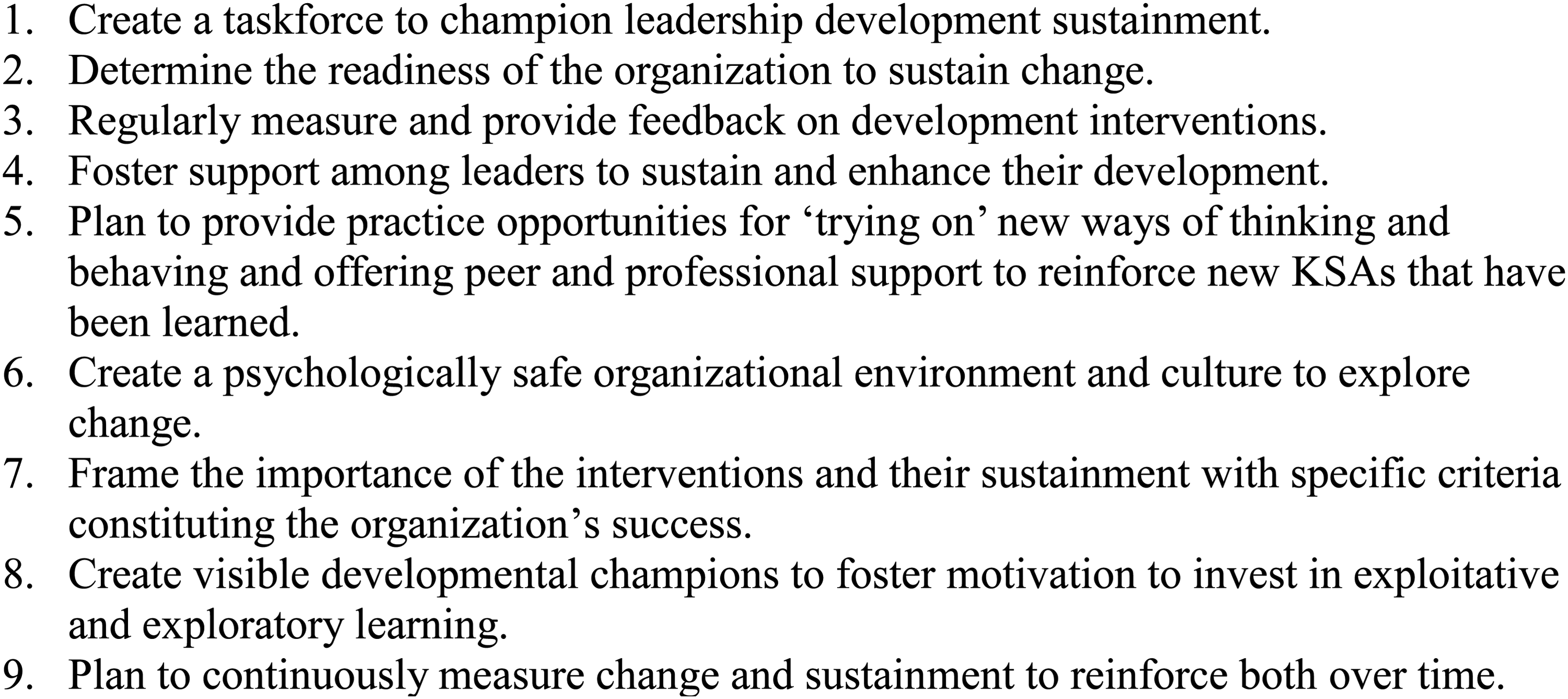
Recommendations for best-practices from Lazzara et al. (2021).
Creating the LSA's Core Value(s) System
To be fully effective, an LSA needs to be guided not just by a mission and strategy, but also by core values that connect the LSA to the larger organization, profession, and/or industry mission or purpose. We propose that any LSA's core values should be centered around the concept of psychological ownership. Ownership in this case means having the responsibility for stepping up and providing the necessary input, capabilities, motivation, and intentions to help all organizational members and stakeholders achieve their full potential, based on the instantiation of an optimal leadership and organizational development system. Individual leaders as well as LSA developers and sponsors would share the collective ownership for the development, success, and growth of the LSA. Furthermore, this ownership would then become a core component of what constitutes the organization, profession and/or industry's collective leadership identity (Guarana & Avolio, 2022; DeRue & Ashford, 2010).
Leadership identity represents the way you’ve socially constructed your view of what constitutes leadership in an organization, culture, and/or society. To claim this identity, as well as to be granted that identity by others, forms the basis for your leadership narrative and organization (Zheng, Meister & Caza, 2021). How individuals claim and grant leadership then becomes a function of the leadership narrative associated with an organization, profession and/or industry, which can be intentionally and strategically reinforced by the LSA. Specifically, the role representations associated with leadership become part of each leader's identity when those roles are internalized and instantiated. Over time, the leader's identity can be reinforced by the sense-making process associated with specific leadership representations or what are called leadership prototypes (see Lord & Hall, 2005) supported by the LSA, as well as changed and transformed as needed over time.
“Leader identity work is consequently the process by which individuals attempt to create, develop, and maintain their own coherent notions of who they are as leaders amid the social forces around them” (Zheng et al., 2021, p. 5). It is through this narrative creation process of new representations and storytelling in the organization, that individuals construct how they fit within an organization and subsequently identify their standards for performing (Ibarra & Barbulescu, 2010; Shamir & Eilam, 2005). Leader identity work also allows leaders to engage and alter their self-views on who they are becoming as a leader, as the organization changes and transforms. What leaders engage in and do, also serves to reinforce the narrative they maintain in terms of their leader identities and/or how they will change them, as they seek to try on different representations of their possible selves/concepts associated with changes occurring in the organization both internally and externally (Ibarra, 1999; Zheng et al., 2021). The collective leadership identity can then be formed and built into the LSA mission, values, and strategic focus.
Building on this core tenant of ownership as a foundational value for the LSA, each LSA can be linked to a different or larger set of core values that represent and address the needs of the organization and industry. These core values would then reflect and support the organization's mission and should inform how people engage with each other and their LSA. While it may be tempting to create a lengthy list of values that meet these criteria, we suggest striving for a short and limited set of concisely described core values that are foundational to driving the LSA's growth, evolution, and development, starting with one core organizing value, that contributes to the foundation for methodically building a robust strategic leadership development system in the form of an LSA. The sample of core values is a starting point for your discussion on creating a value-based LSA. For example:
We continually inquire, experiment, and challenge ourselves to try new and unique ideas and approaches to evolve and transform. We remain vulnerable and open to being challenged to build deeper levels of trust. We seek to build a transparent, inclusive, and equitable environment in which all can flourish.
A Broader Developmental Philosophy for the Foundation of an LSA
Moshman (2003) defined development in two ways. First, development constitutes an instrumental change in individuals, such as associated with various models of leadership whereby the leader initiates structure, clarifies expectations, and sets goals, while providing contingent rewards for the completion of those goals.
With the second form of development, Moshman (2003) describes a qualitative or more fundamental change in how individuals view and then represent themselves to others, as they attempt to influence, and then change their perspectives and capacity in how they “choose” to influence their own growth and the development of others. This second form of development is more commonly associated with intra-individual transformative change. This type of transformative change is linked to the development of a leader's self-views/representations, cognitions, emotions, knowledge, and attributions (Day & Sin, 2011; Dragoni et al., 2014; Lester et al., 2011; Lord & Hall, 2005).
The strategic focus of the LSA is based on developmental theory regarding how leaders learn and grow both individually and collectively. Leadership development then entails what is learned that makes one a more efficacious leader (Hannah et al., 2008; Duan et al., 2022). However, this form of instrumental learning is only one aspect of leadership growth and development. Learning new skills and abilities provides leaders with the expanded capabilities to perform in new and more complex ways, while being more efficacious based on social learning theory (Hannah et al., 2008). However, what is learned from experiences is not just new capabilities, but also potentially involves a transformation in how one thinks about themselves and their leadership development. This distinction between acquiring new skills and knowledge and a transformation in thinking is referred to as constituting both horizontal and vertical leadership development, respectively (Cook-Greuter, 2004).
The LSA framework needs to advance both horizontal and vertical leadership development of all leaders and through their leadership growth, all employees within the organization, as well as their stakeholders. Consequently, one ultimate goal for the LSA is to achieve each individual's and organization's full potential, however defined for the organization, industry, and profession. To achieve this goal, the LSA framework, structure, and activities can be intentionally designed to balance both horizontal and vertical development, to foster deeper individual and collective learning, that promotes a transformation in representations of leaders, and their organization, profession and/or industry that are hopefully at least in alignment with where each is heading to adapt to the changes unfolding in their evolving social context.
Most prior research on leadership training and development has focused on what Petrie (2014) pragmatically referred to as horizontal leader development (also see Collins & Holton, 2004; Day & Dragoni, 2015.) Change described as horizontal development involves acquiring knowledge and skills that result in leaders doing things incrementally different, demonstrating specific changes in leadership behavior aligned with the organization's culture, values, professional standards, and ethos. All of these are important foundational elements of leadership training and form the basis for high-quality relationships in organizations. These interventions involve the learner refining and deepening their existing areas of knowledge, skills, and abilities, which entails learning what falls outside of their current domain of knowledge, skills, and abilities (Greco et al., 2019). Exploratory learning facilitates the learning required for leaders to adapt, change, and transform to address new and evolving challenges.
Deeper learning that is exploratory and transformative constitutes ‘vertical development’ and involves engaging in a qualitative shift in the meaning people associate with their identity, values and how they judge themselves and others. This vertical shift in development occurs as an individual increases how they represent the challenges and opportunities they face, along with their level of ‘self-complexity’, as their transformation in thinking unfolds. For example, an increase in leader self-complexity occurs when someone, who is in an individual contributor/followership role is promoted to a level of leadership that is fundamentally different than the knowledge, skills, and experiences they’ve accumulated. This requires the individual to the first question and develop a deeper understanding of how they can best influence others to complete their work, even if the leader is better equipped to complete the tasks on their own. This type of vertical development involves a change in the leader's theory representing themselves and their personal narrative, shifting to one where they are developing others to come up with and implementing solutions to workplace challenges. The significant reorientation involved in vertical leadership development engages intrapersonal change versus horizontal development, where the individual changes their thinking regarding their core self-definition of what constitutes the leader's self or collective-identity construal, resulting in them synthesizing diverse points of view and attributions about leadership into a more coherent implicit model, theory, and narrative, constituting their model and methods for optimally leading others (Dragoni, et al., 2014; Lord & Hall, 2005).
Vertical leadership development transforms the thinking and behavior of leaders, followers, and ultimately the context, climate, and culture in which they interact as it shifts and changes. Mezirow (2000) refers to this type of development, as being based on transformative learning. Transformative learning occurs when an individual alters their taken-for-granted frames of reference (frequently referred to as meaning-making perspectives, habits of the mind, mind-sets, etc.) about how they can best influence others to achieve the leader's goals and objectives. Vertical development results in a change in the leader's locus of leadership, in terms of where leadership originates from and is sourced, e.g., shifting from being sourced from the individual to a shared leadership focus, where it is then sourced from multiple individuals in a team of peers. This collective form of leadership construal can then be transmitted through the leaders’ behaviors to others in terms of both ‘content’ and ‘style’ via, for example, peers coaching peers, etc. (Hernandez et al., 2011).
In sum, horizontal leadership development does not require “deep learning” nor does one have to experience or endure states of disorientation to foster an individual's transformation in the representation of their leadership identity, narrative, and actual practice/actions. Whereas deep learning can only occur where there is a state of disorientation, which then motivates an individual to consider how they should shift their mental models from not being aware of how they think, feel, and behave towards others, to understanding the key factors that fundamentally drive the leadership they transmit.
In terms of life-span adult development, Kegan (1998) describes more transformative levels of human development as representing an individual that is ‘in over their head’. What Kegan meant is that on the front end of development, the individual doesn’t fully understand or even recognize the need for change. The disorientation in the individual resides in what they don’t know or what he called “subject” or subjective to them, in that the individual is yet unaware of the need to change. Once the individual does become aware of the need for change, the “subject” and focus of change shifts to “object,” where the individual can now analyze more systematically the need for change, with a greater degree of clarity and insight concerning how best to achieve their full potential.
The concepts of subject and object can also be applied to understanding when groups, organizations, professions, and indeed the designers of LSAs don’t understand that they must change and adapt—because its subject for them, in terms of knowing the direction and goals needing to be changed, which then becomes object. Deep learning can and should occur when someone with a majority identity (e.g., white, male, straight), does not understand the privileges associated with their status, nor the blind spots they have with respect to the lived experience of others, in historically marginalized identity groups, and how that all contributes to biases or discrimination.
Deep learning can be triggered by consequential experiences or jolts, such as receiving feedback from respected sources, instruction, observation, challenging events, and reflection. For example, the deep learning that occurs when the individual realizes they are creating a lot of uncertainty when engaging others, whereby they don’t properly regulate their emotions, which makes them more threatening, resulting in others being hesitant to question the way they think and behave. This sort of reaction can then spiral into a lower level of individual and collective psychological safety that inhibits the leader's and follower's full engagement with one another. Once the individual realizes the unpredictability in their emotional regulation triggers lower levels of psychological safety among others –oftentimes based on self and other feedback—it becomes object. At this point, the individual can then develop a strategy for regulating their emotions in a way that makes them more predictable, moving their emotional regulation from being subject to object where greater clarity resides.
In the example above regarding one's privilege, the jolt may come from hearing stories from colleagues and members of their community, who have not experienced the same privilege and who have had a very different lived experience. One example includes learning about the fear a person of color has in the United States of being pulled over when driving, for no apparent reason except due to the color of their skin. This type of jolt either individually or at a societal level can lead to vertical development with the effects of racism moving from subject to object.
To further clarify the distinction between these different types of learning we offer a representation of this shift from vertical to horizontal leadership development and its impact on individuals and the organization below in Figure 2.
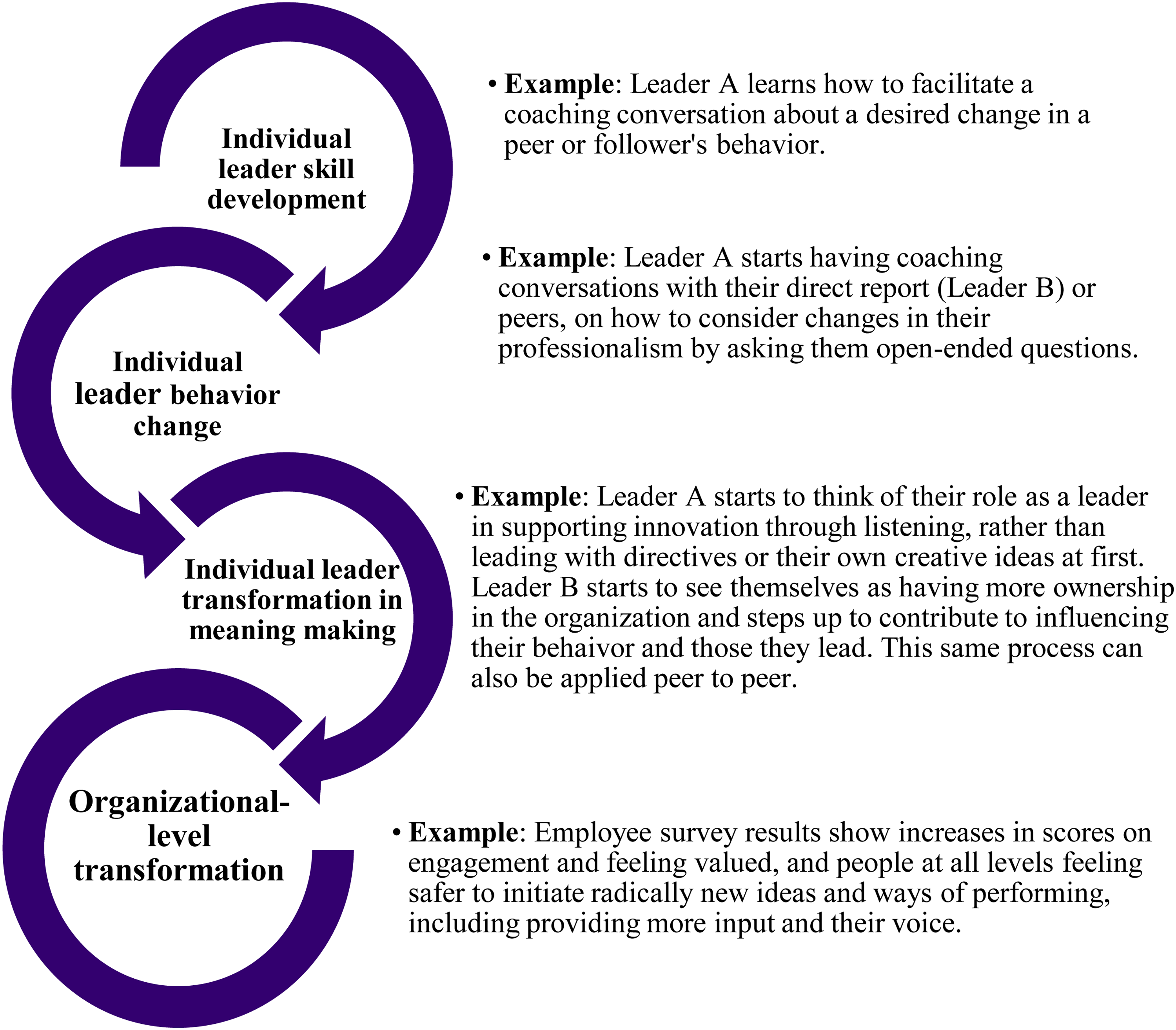
Evolution of vertical learning and development.
Returning to the earlier comment made by Socrates, the development of a leader cannot just focus on “drilling” into individuals the set routines for how one leads. Deeper and transformative levels of development must include challenging how leaders construe their own theories of leadership, so they can address blind spots or what is ‘subject’, investing time and energy into fostering their leadership development. At this point, the leader's level of self-complexity regarding their own theory, representation or narrative of leadership has vertically developed when measured with valid change metrics.
The formation process associated with this type of development in leaders should be a prerequisite for any generative LSA, in that as the context changes in which leadership is enacted, so too will the demands placed on leaders, shifting development from a horizontal to vertical leadership development focus. This is one big reason why we advocate that organizations develop an LSA, which should have the resources to foster both horizontal and vertical aspects of leadership development. Our recommendation suggests that organizations, professions, and their industries need to go beyond the simplistic notion that a specific training program or certification will develop the next generation of leaders to consider a more comprehensive and integrative strategy that represents building a sustainable institution to achieve the full potential of your organization's leadership development system, where certification could be an important service provided by the LSA.
An LSA Structure and Methodology
In defining an LSA, we noted above the academy is a construct. A construct is something that is unobservable, but once operationally defined, such as candor, transparency, comradery, awe, inclusion, trust, and vulnerability, it helps to clarify what the concept means, how to represent it and invest in its creation, while then determining and measuring the impact it can have on an individual's thinking, motivation, behavior, and performance. Many such constructs have stimulated debate since the dawning of humankind, such as ethics, ownership, power, ethos, justice, and charismatic leadership. This necessitates that any construct be clearly defined to be better understood, interpreted, learned, displayed, measured, evaluated, and debated to improve or disprove its worth and its validity for predicting some outcome.
In the case of building an LSA, along with its associated construct, we also seek to identify the mechanisms that an organization's leadership can use to onboard and support new employees, to clearly portray what differentiates the organization from every other organization in terms of how it views and enacts the appropriate trajectory for optimizing leadership development. This includes mechanisms that promote both horizontal and vertical leadership development, along with creating safe opportunities for jolts in service of horizontal to deeper learning, and practice opportunities embedded in the organizational context. We assume that with the implementation of the LSA, this construct can be operationalized, defined, practiced, evaluated, researched, adapted, and eventually institutionalized in what each employee and leader will willingly take ownership of in the organization, profession, or industry because it is a central part of their collective identity. We then can ask, ‘What will that LSA then represent and mean to the future growth of this organization, profession, and its industry?
Building the LSA's Foundation and Guiding Principles
Like any other professional science and practice, the approach to leadership development must be guided by well-established theories, models, frameworks, methods, and measures, which have been tested and validated. This requires that any developmental intervention and its design, should be based on understanding what has been demonstrated to be effective in not just horizontal leadership/incremental development, but also development that entails transforming individuals, teams, and organizations to achieve vertical leadership development.
To build and resource an LSA, academics will need to collaborate with industry and organizational leaders, as well as other outside experts in promoting both the science and practice of leadership, to identify the unique needs of the organization, profession, and/or industry, and then to adapt and customize those interventions to meet those needs. This approach will provide a more solid basis for identifying and agreeing to common strategic initiatives for each proposed activity, which is meaningful and can be used for evaluating the impact of our development interventions over time (Avolio & Chan, 2008).
These beginnings and subsequent initial steps are depicted in Figure 3, which forms the basis for developing one's LSA.
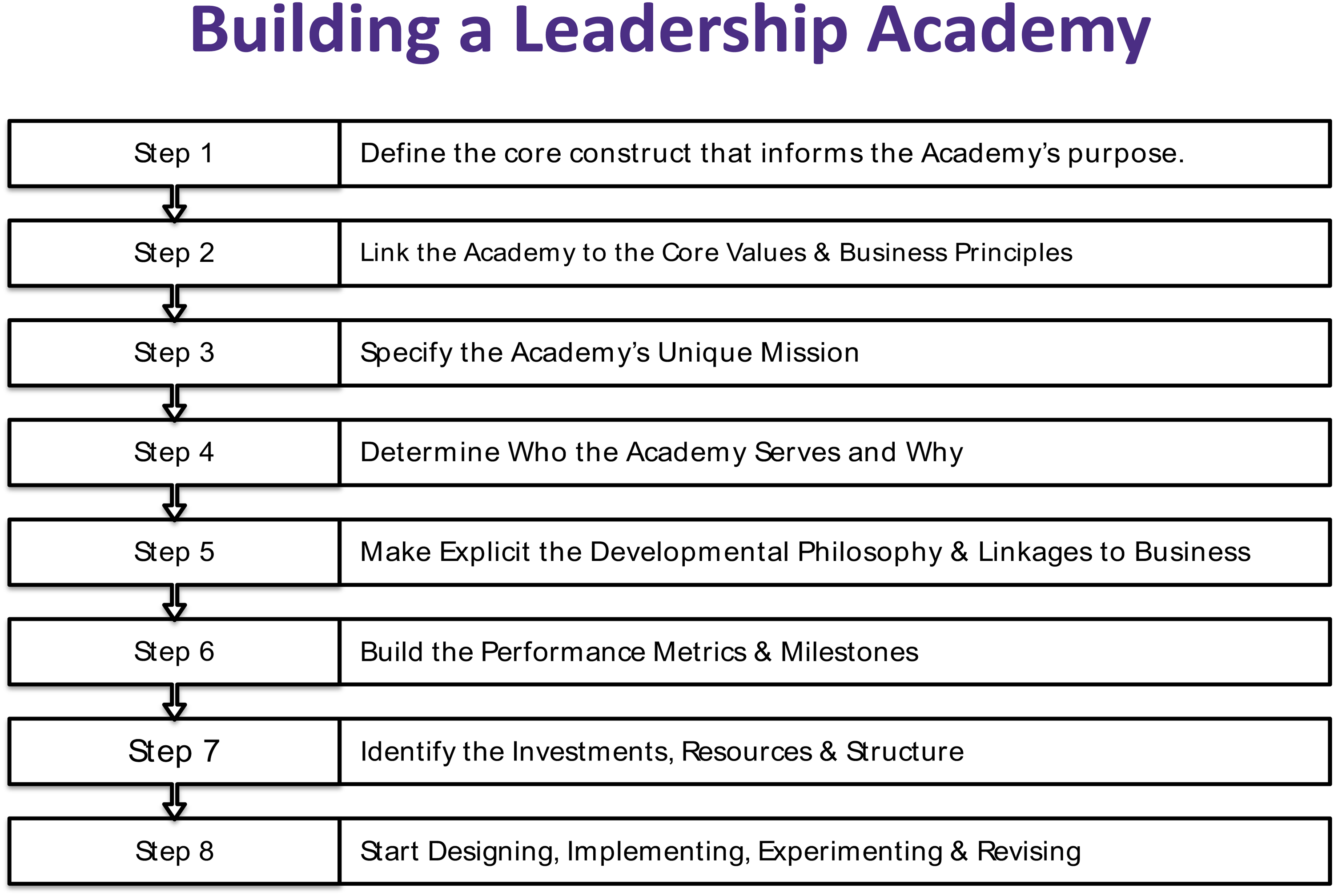
Leadership Service Academy (LSA) design criteria to horizontally and vertically transform leaders & organizations.
A vibrant and successful LSA evolves and grows over time by modeling the importance of fostering individual, group, and organizational generativity, as the needs and challenges facing leaders and their organization/industry are anticipated and shift. The LSA must represent an open system, where inputs from leaders, employees, domain experts, other learning institutions/organizations, customers, stakeholders, and an executive council and advisory board, contribute to the LSA's horizontal and vertical development. This is why one might develop an LSA for an industry or a consortium of organizations, in that an organization's need for change and transformation is oftentimes a function of the transformations impacting the industry or related industries, rather than just within the organization itself, arguing for a more collective strategy for building an LSA, which can still serve the unique needs of an organization.
Earlier, our example of a bio-tech start-up was chosen specifically because this industry is undergoing dramatic and global transformations due in part, to the recent COVID-19 pandemic, but also due to rapid advances in scientific discoveries, new technologies and ongoing changes in the global evolution the human species faces, such as new and more complex viruses, which are rapidly adapting to the world's earlier strategies for combatting them.
The LSA can serve as a repository for documenting real cases, challenges, experiments, strategic initiatives, stories, research projects, and best practices, as well as for sharing this information and knowledge broadly and deeply within the organization and industry. The LSA can and should direct some of its own research, working with other partner organizations and other researchers to determine the efficacy and the impact of leadership development interventions designed, developed, and cooperatively implemented. The LSA should set a high standard for including rigor in the work it does within its organization, profession, and industry. It must serve as an exemplar that helps to guide the current and future development of leaders and leadership in any organization and industry.
Demonstrating how an LSA Evolves
Creating a LSA Manifesto: Assume your organizational leaders have built a manifesto that clearly states what constitutes caring, ownership or achieving everyone's full potential in your organization, as well as for all stakeholders and customers, and communities in which you operate and serve. Consider that academy programs, cases, articles, podcasts, discussion boards, training materials, and assessments promote the enactment of how caring is promoted.
Building a Charter: Addressing How a LSA Functions: The LSA focus is based on the interactions of its instructors, members, board of science and practice advisors, stakeholders, executive council of advisors, and customers, which help to shape and then produce the models and methods to develop in each new employee a greater understanding of the following statement: As an employee, owning caring in everything you do across every day you work, in every task and in every interaction.
How can this be accomplished? The LSA could work with many organizations to determine the balance of self-paced and synchronous horizontal and vertical learning development sessions, while also experimenting with each determining whether synchronous sessions are best in-person, mixed hybrid or virtual. The Academy could then provide information, content, and materials in many different formats, some still yet imagined, while considering the maximum opportunity for accessibility, access, and inclusion for all participants. Other functional characteristics of the LSA could include:
Led by Whom?
Self-guided learning.
Peer to peer coaching.
Internal leader instructors.
External expert instructors.
Vertical and diagonal mentoring and coaching.
Professional individual and peer coaching.
Senior leaders and board members affiliated with the organization and industry.
Artificial intelligence (AI)-generated interactions and machine learning methods.
Instructed Through What and by Whom
From Experienced to New Leaders, Peers, and an Inside/Outside Instructor
Testimonials
Speeches
Facilitation
Coaching
Real Challenge Cases
Storytelling
Simulations
Lectures
Problem-solving Challenges
Exercises
Role playing
Gaming and Gamulation(s)
Visitation, Shadowing & Observation
Readings
Blogs
Videos
Leadership Challenge Hackathons
Social forums
Reflections and Practice
Interactions with AI
Neuroscience applications that provide feedback on cognitive processing
Other: Only limited by your imagination and what is needed to be learned
In the next section, we provide a generic blueprint that can help guide both horizontal and vertical leadership development with application of this blueprint to any organization, profession and/or industry. This LD blueprint helps to frame our discussion regarding both individual and organizational strategic leadership development within an LSA.
Building a Strategic Blueprint for Ongoing Leadership Development
The LSA develops and provides a blueprint for leaders to anticipate the knowledge, skills and abilities that will be necessary for them to learn both vertically and horizontally, as they continue to develop and progress as leaders within an organization's leadership development pipeline. As leaders move from entry level to more advanced leadership roles within their organization or industry, so too would they progress through relevant levels of the LSA, with the skills needing to be developed, the challenges presented, and the concepts introduced over time, which can become increasingly more complex, along with the level of commitment expected at that level of leadership.
The entry-level in LSA can be designed for emerging leaders and first-time people managers, largely based on the individual's self-leadership development, including how to be an effective follower, peer, and leader (Avolio, 2017). This first level of development focuses on building the readiness of participants to engage in influencing themselves and others, including being self-aware about how they come across to others, what their ideal philosophy and model of influencing others represents, the narrative they want to create for others to follow them and the basic and foundational elements of what constitutes their identity, character, and ethical/moral base (Avolio & Hannah, 2008).
Following this foundational first level, the next level is designed for the advanced development of leaders motivated to commit to intensive horizontal and vertical development experiences that span a longer period of time—long enough to have the necessary impact. At this level, the guiding questions include: “How do you choose to purposively engage with others?”; “How do you show up and exchange with others ideas, recognition or other resources?’; ‘What is your purpose and key directives?”; “How do you go about engaging others and fostering future engagements’; What do you do to provide feedback and support?”; ‘What do you expect from those you lead in terms of providing feedback to you and support’; and how do you create a safe climate in which to do so?’ The learning experiences at this level builds on the skills developed in the foundational level and will increase in complexity challenging leaders to deepen their ability to give and receive feedback, engage with a more diverse range of perspectives and to begin fostering more positive work climates, such as those characterized by inclusion and psychological safety.
At the next level of leadership development, there is more of a focus on vertical development. This takes place in terms of continuing to invest in your own leadership and the leadership of others, as well as determining how to address and adjudicate difficult situations and decisions, promoting a sufficient degree of tension and disorientation to foster transformative vertical development. One of the end goals at this level, is to build a sufficient level of goodwill to drive the needed change and transformation in yourself, and those you influence in your organization and its industry.
At the fourth level of development, individuals focus on inspiring future possibilities not yet conceived of or tried, while also being a role model to reflect on your own ways of thinking, emoting, and doing, and what you then expect from others. Here you can focus on how you distribute leadership to others, to develop a sufficient cadre of leaders to populate leadership positions at all organizational, professional, and industry levels, such that you support and help steward the future of leadership, the organization, and in its industry. At the most senior levels in the LSA, the design is for leaders willing to make longer commitments to advancing their strategic leadership development, who are positioned to build on their foundational skills of leading in smaller to mid-size groups moving, to do indirectly with larger groups, where they engage in the strategic leadership of organizations. The end point is where the leader is a steward for how the future will unfold in this LSA, resulting in the leader(s) leaving a legacy of horizontal and vertical leadership development (Avey et al., 2009; Guarana & Avolio, 2022).
Leadership Developmental Intervention Characteristics
The duration of developmental interventions/training will depend on the complexity of learning to master the requirements for a learner's certification at all LSA and blueprint levels based on good science and practice. These will include:
Intervention length will vary depending on whether the focus is just on horizontal vs. vertical development. Interventions will be designed and spaced from initial orientation to materials, models, principles, and concepts to more complex learning with practice, feedback, support, and assessment of progress for those learning constructs that are more complex and require more time to develop. Interventions will be designed to be both relevant to the organization and rigorous in terms of expected impact and return on investment. Interventions can range from 1-on-1 to 100 or 1,000 participants and higher depending on the micro, meso- and macro area of focus for development. Interventions are based on life-span adult learning models such as Kegan's where there is a clear line of sight between what needs to be learned and how it matters to leading in your organization. Interventions can be virtual, hybrid, self-directed, peer-to-peer supported, instructor or coach led, and any combination.
The LSA Structure and Core Team
Core Team Serving the Academy: The council or board of executive advisors would be comprised of organizational and industry leaders, researchers, and developers. Over time, alumni of the LSA, would become advisory board members, peer coaches, facilitators, owners, and champions of building and implementing real case challenges applicable to your organization and industry, instructional designers that can guide the creation and building of the LSA. Respected leaders would serve as mentors and coaches for the next generation of emerging and established leaders. In addition, other LSA staff would include:
Technical support staff. Evaluation team. Facilitators. Professional coaches. An Academy Board comprised of leaders, students, and developers.
Key LSA Stakeholders
Different from many idiosyncratic leadership development programs, which focus more on individual leaders as the target of the program's impact, the LSA model emphasizes integrating the dynamic system within which all leaders operate in an organization, industry and/or profession. In doing so, the LSA model considers both individual leader development and the full ecosystem within which all leaders are growing, developing, transforming, and expected to perform. The LSA would emphasize the role of key stakeholders and champions in helping to shape the strategy and focus of the LSA, while stewarding the program and leaders involved into addressing future challenges, connecting to organizational initiatives that are then aligned with the organization's strategy (Avolio, 2007; Avolio & Chan, 2008)
In addition to nominating leaders for inclusion in the LSA, senior and executive leaders are invited to take an active role in the LSA by being engaged in a variety of different roles, such as joining the Executive Council or Board of Advisors, providing sponsorship for Academy participants, and serving as coaches and mentors for leaders as they attend Academy programs. Using this more integrative leadership development system strategy, supports the growth of the LSA into the fabric and mission of the organization, profession, or industry, while also promoting more meaningful connections between the core content of the programs and leaders’ day-to-day work demands. Our proposed strategy provides a more supportive context for individual leaders at all levels, their teams and the LSA to thrive all summarized below in Figure 4 below.
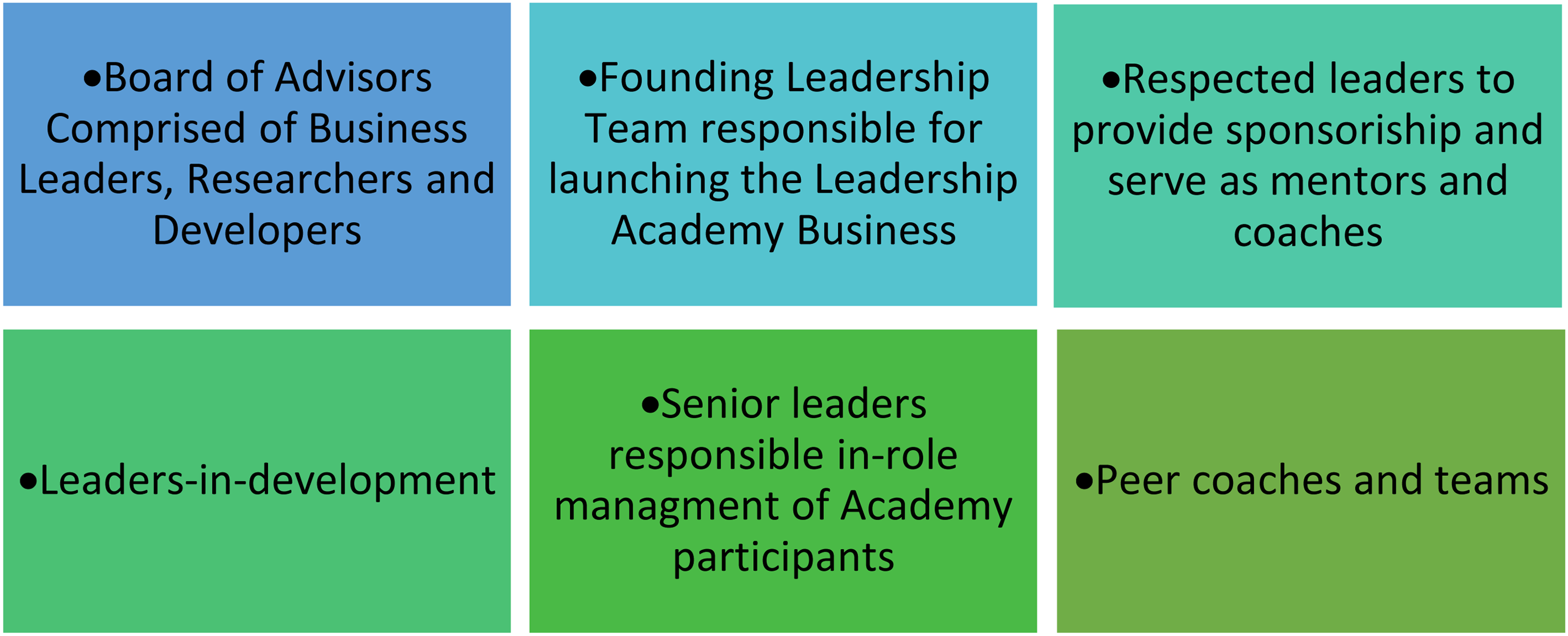
Leadership Service Academy (LSA) leader roles.
Each LSA would transparently share its outcomes by developing a learning and development performance dashboard for the LSA incorporating metrics below. Figure 5 elements. The dashboard not only keeps track of progress, but it is also essential to determining the R.O.D.I.. As noted in Figures 5 and 6, the LSA would incorporate a broad range of targeted performance outcomes that would be assessed at multiple levels of analysis.
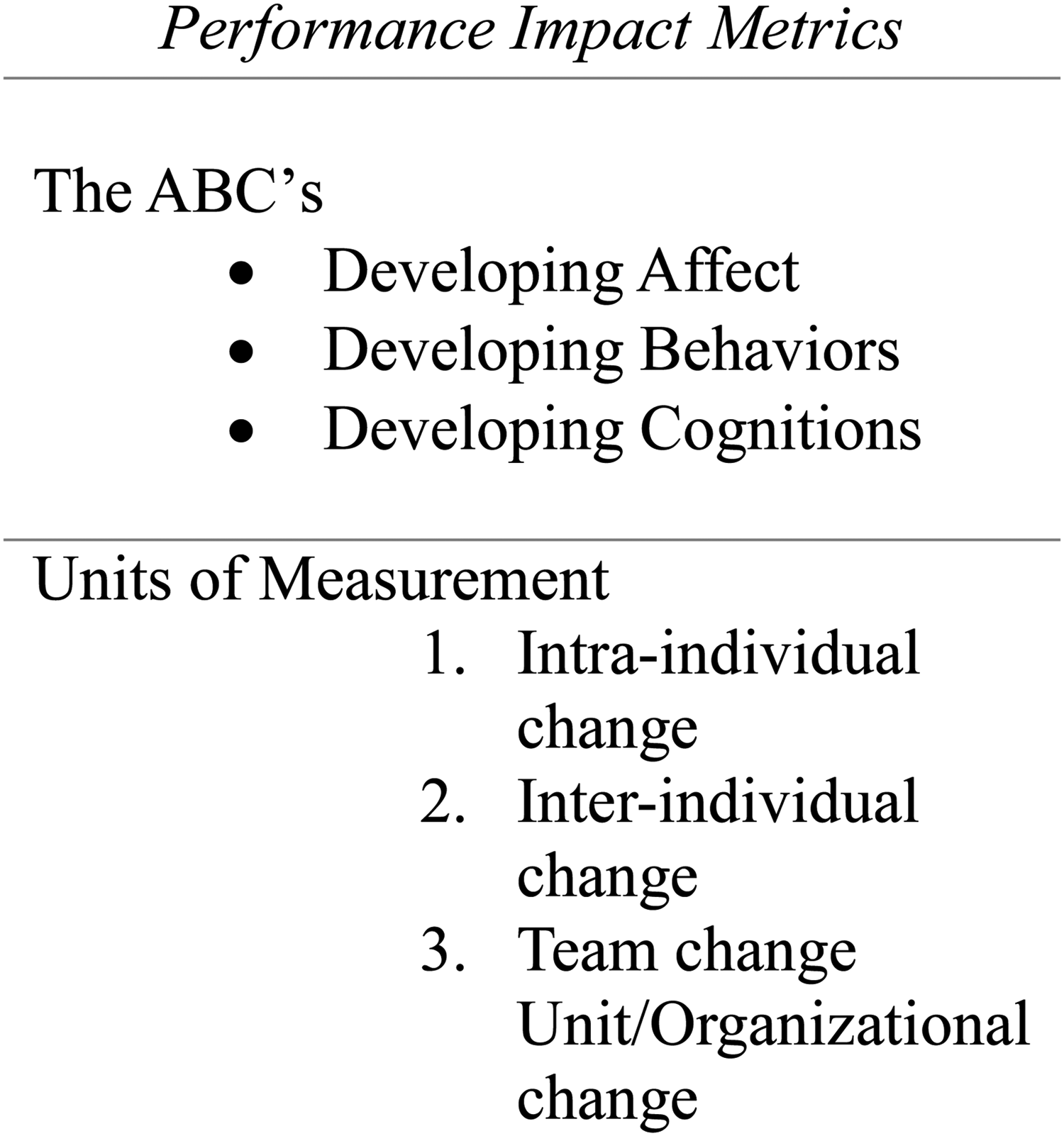
Academy performance dashboard.
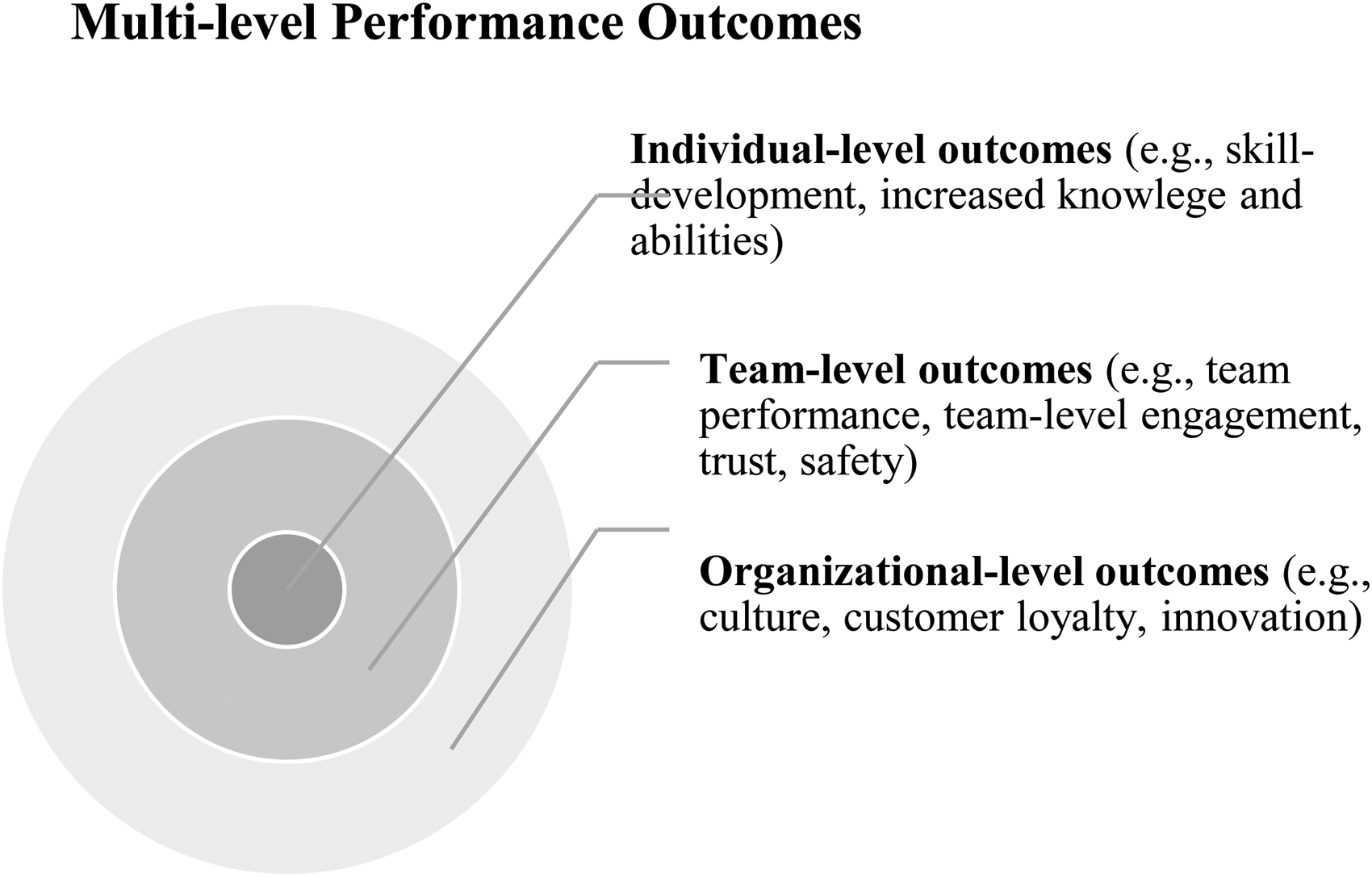
Multi-level performance outcomes.
In Figure 7 below, we focus on differentiating outcomes that would be considered proximal to the development of individuals or groups and those more distal in terms of horizontal and vertical leadership development. As we have noted earlier, horizontal leadership development would typically occur over shorter periods of time relative to vertical leadership development, which is more fundamental and transformative. The amount of time it takes to measure the effects of leadership development and indeed the LSA itself, is a critical task for leaders of the LSA to take ownership for, as well as developing a process for updating these processes and criteria for success, as the individual and LSA needs evolve. This is not something that the field of leadership development nor learning has fully developed, so some experimentation will be required to improve over time the accuracy of measurements.
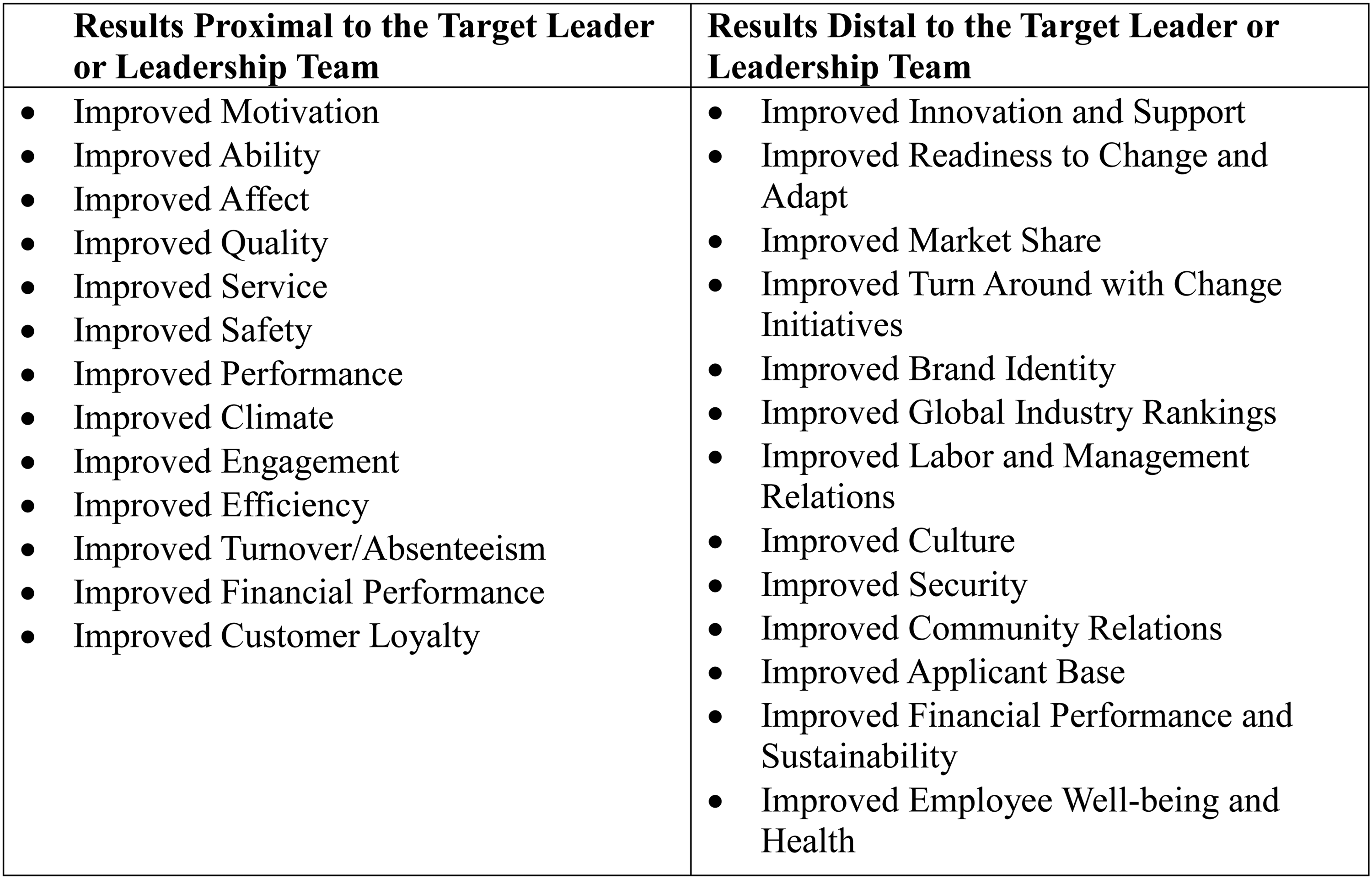
Measuring proximal and distal outcomes to the target leader/team's vertical and horizontal development.
Multi-Level Measurement of Performance Impact Metrics
Aligned with the philosophical approach of the LSA, we reaffirm that our view of leadership development is not just an individual level focus, but rather a focus on individual, team, and organizational, professional and industry-level performance outcomes/change/transformation. The LSA outcomes would then be measured at the individual leader performance, team, and organizational levels, and over time, even professional or industry system levels. In doing so, we are more likely to demonstrate a return on investments at all levels, including the impact on organizational initiatives and strategic goal achievements, as well as the transmission of leadership development practices throughout the organization and diffused within the profession and industry.
A Starting Point for a Proposed Intervention Evaluation Strategy
In addition to rigorous measurement and demonstration of RODI throughout the LSA, and particularly during the pilot phase of a new Academy, data should be collected to help understand not only the results of the intervention(s), but how specific programmatic activities, experiments, delivery methods, course content, have each materially contributed to these outcomes. Additionally, there is a need to collect from participants using a variety of methods, e.g., survey, gaming, etc., rigorous feedback on course instructors, facilitators, mentors, and coaches so that we can monitor the consistency and effectiveness of program delivery and then provide developmental support for the team implementing the LSA.
Evaluation is a vital component not only to one's commitment to continued improvement of the range of interventions comprising the LSA, but to measuring satisfaction, engagement, progress, and ultimately performance effectiveness and impact of the LSA on the organization, profession and/or industry. Rigorous evaluation combined with a thorough review of the results, provides support that an LSA is continuously changing and evolving, while supporting data-driven decisions that enhances the participant experience and academy's effectiveness.
Leadership Development Certifications: The LSA can also define certification requirements for all levels of leadership and development. Every developmental intervention will have the following key components:
Assessments of developmental readiness Learning and performance goals Performance milestones/metrics Mastery indices Validation of requirements for achieving certification Continuing education and recertification
The Business of Being an LSA—Metrics and Impact
We can now envision the LSA operating like any business in terms of the resources needed to be successful, with processes that produce the desired outcomes and ways to measure how well all aspects of the business operates day-to-day, month- to-month and year-to-year. In terms of the LSA performance metrics for any type of organization, we would advocate the following, as just some examples to be used to measure performance impact:
PVA: The R.O.D.I.. This is based on the investments made by the organization in human resources to run the LSA, the technology and operations used, facilities, materials, and the time employees invest in their learning and development that may compromise the total time they have for the work they are charged to do in the organization. It is then essential to determine what is the return on these investments in terms of moving an organization towards its full potential having defined specific criteria and measurement/methods. ROA: LPA:
Conclusion
The LSA is a complex construct that will change and transform over time as different organizations, professions, and industries engage in its development. Inherent in the design of an LSA is that it is organic, generative, and should evolve and change as the needs and strategic priorities of an organization changes or the social context/environment of an industry evolves.
Perhaps one of the main messages that should be taken away from this article, is that the time is propitious to focus on leadership development in a much more strategic way, where an organization, industry or profession becomes equally responsible for its success. If one surveys the leadership field over the last 100 years, it becomes very clear, that theorists, researchers, and practitioners have applied their work in leadership to its development, at all levels of organizations and with respect to focusing on individuals in every function from military to human services, healthcare, manufacturing, education, high-technology, services, transportation, construction and yes even biotechnology! This body of work points to a growing interest in pursuing a more strategic approach to examining leadership development at levels, in all units, and with all individuals. With this strategic focus in mind, we offer the LSA construct to help trigger the next generation of conversations about strategic leadership development and to expand our horizons into what constitutes both vertical and horizontal leadership development.
Footnotes
Declaration of Conflicting Interests
The author(s) declared no potential conflicts of interest with respect to the research, authorship, and/or publication of this article.
Funding
The author(s) received no financial support for the research, authorship, and/or publication of this article.