







Abstract
Exploitative leadership is a form of destructive leadership behavior that has adverse effects on the overall organization. This study aimed to explore the mechanisms underlying the association between exploitative leadership and employees’ unethical behavior. Drawing on ego depletion theory, we proposed a theoretical model wherein exploitative leadership increases employees’ unethical behavior through ego depletion, with microbreaks acting as a contextual condition. Using a multi-wave diary study across ten consecutive workdays from 115 employees, we found that exploitative leadership was positively associated with employees’ unethical behavior and that ego depletion mediated this relationship. Moreover, microbreaks buffer the positive relationship between exploitative leadership and ego depletion as well as the indirect effect of exploitative leadership on employees’ unethical behavior through ego depletion. We discussed the theoretical and practical implications and proposed future research directions.
Introduction
Unethical behavior has been exposed in domestic and foreign organizations, such as U.S. Enron financial scandal, vaccine fraud, Sanlu formula incident. Recent data indicate that unethical behavior in organizations remains a significant issue. For instance, the 2022 Global Business Ethics Survey by the Ethics & Compliance Initiative found that 49% of employees observed misconduct in their workplace, including conflicts of interest, abusive behavior, and violations of company policies. Additionally, the 2023 report from the Association of Certified Fraud Examiners highlighted that 45% of fraud cases were detected, underscoring the prevalence of unethical actions like asset misappropriation, corruption, and financial statement fraud. Unethical behavior refers to action that is in breach of accepted moral code (Treviño et al., 2006), and causes various negative outcomes, including decreased job satisfaction, reduced organizational commitment, increased turnover intention, and damaged organizational reputation (Gino et al., 2011; Rui & Xinqi, 2020; Veetikazhi et al., 2022). As a result, employee unethical behavior has been widely concerned by the business community and academia. In the past fewer years, research has shown that destructive leadership has been proved to play an important role in employee unethical behavior, such as abusive behavior, supervisor undermining and hubristic leadership (Duffy et al., 2002; Sadler-Smith et al., 2018; Thau et al., 2009; Wang et al., 2012), but leader self-interest, as one important element of destruction, remains unexplored. Schmid et al. (2019) first introduced the concept of exploitative leadership to capture the self-interest of leaders. Since their work, much research has established the detrimental effects of exploitative leadership on followers, including reduced job satisfaction, organizational commitment, and increased workplace deviance and turnover intention (Lyu et al., 2022; Schmid et al., 2019). Exploitative leadership, which is essentially self-interested at the expense of others (Schmid et al., 2019), violates ethical norms and can lead to serious ethical issues in the workplace. Therefore, it is of great significance to explore the relationship between exploitative leadership and employee's unethical behavior.
To date, a dominant perspective to understand exploitative leadership focused on conservation of resources (COR) theory (Guo et al., 2021), fairness heuristic theory theory (Wang et al., 2023) and social exchange theory (SET) (Abdulmuhsin et al., 2021). Researchers have contended that exploitative leaders overburden subordinates, give unrealistic deadlines and exploit them, leading employees to experience a sense of emotional exhaustion (Guo et al., 2021), injustice (Mikula et al., 1990), and impaired leader–member social exchange (Pircher Verdorfer et al., 2019), leading to subsequent behavioral outcomes, such as innovative behavior (Wang et al., 2021), workplace deviance (Lyu et al., 2022), and service performance (Wu et al., 2021). A neglected possibility in the extant exploitative leadership literature is that the sense of exploited can evoke the exhaustion of employees’ self-regulatory resources to influence employees’ ethical behavior. Ego depletion theory offers a different lens by focusing on the cognitive and emotional toll of continuous self-regulation, leading to increased susceptibility to unethical behavior (Baumeister et al., 1998). Therefore, we adopt the ego depletion theory as our overarching theoretical framework to illustrate the impact of exploitative leadership on employees’ unethical behavior.
According to ego depletion theory, individuals possess a finite pool of resources that can be depleted through continuous exertion of self-regulatory (Baumeister et al., 1998; Muraven & Baumeister, 2000). When employees are subjected to exploitative leadership, they must continuously regulate their negative emotions and suppress impulses, leading to resource depletion. This depletion impairs their ability to adhere to ethical standards and increases the likelihood of engaging in unethical behavior. In this vein, employees exploited by supervisors may lead to depletion of self-regulatory resources and then may lack the necessary energy to refrain from engaging in unethical acts (Gino et al., 2011). Therefore, we propose that ego depletion, a state in which the self does not have sufficient self-regulatory resources (Baumeister & Vohs, 2007), may be a key mediating mechanism.
Furthermore, ego depletion theory argues that depleted resources can be replenished after sufficient rest (Muraven & Baumeister, 2000). Microbreaks refer to voluntary, short, and informal breaks that can help individuals recover diminished self-regulatory resources (Kim et al., 2018), typically lasting from 30 s to 10 min. The key characteristics of microbreaks include brief duration, the intentional decision by the employee to take a short break rather than being passively interrupted, and the type of activities involved, which can range from stretching, gazing out the window, drinking water, to deep breathing. The primary purpose of a microbreak is to provide a quick mental and physical recovery, thereby improving work performance and overall well-being. When exploited employees engage in micro-break activities, they can replenish depleted resource and have sufficient resources to regulate self-emotions, which effectively weakens their ego depletion and subsequent unethical behaviors, and vice versa. As such, we believe that employees’ micro-break is a key boundary condition for the depletion under supervisor exploitation.
In conclusion, this study aims to investigate the mechanism by which exploitative leadership influences unethical behavior in employees. Specifically, based on ego depletion theory, we conduct a diary survey to examine the mediating role of ego depletion in the relationship between exploitative leadership and unethical behavior. Further, we draw from ego depletion theory to explore whether the effect of exploitative leadership on ego depletion and the indirect effect of exploitative leadership on unethical behavior through ego depletion are influenced by microbreaks.
The execution of this study offers several contributions to the extant literature. First, this study investigates the impact of exploitative leadership on employees’ unethical behavior, which enhances the research on the consequences of exploitative leadership and further extends the current knowledge regarding the antecedents of unethical behavior among employees. Second, we advance the knowledge about exploitative leadership on employees’ unethical behavior by explicitly testing the mediating role of ego depletion between the two, it theoretically clarifies the underlying mechanisms. Third, by exploring the moderating role of micro-breaks, the study highlights the importance of micro-breaks in mitigating the effect of exploitative leadership on unethical employee behavior. In doing so, we can better understand the positive impact of micro-breaks and advocate for organizations to support employee engage in micro-breaks.
Literature Review and Hypotheses
Exploitative Leadership
Exploitative leadership is characterized as excessively selfish leadership that prioritizes pursuing self-benefits at the expense of employees’ interests, as evidenced by five dimensions: genuine egoistic behaviors, taking credit, exerting pressure, manipulating, and undermining development (Schmid et al., 2018; Schmid et al., 2019). Genuine egoistic behavior refers to the prioritization of a leader's self-interest over the interests of their employees, treating employees as mere tools to achieve their own goals. Taking credit denotes the act of leaders utilizing employees’ accomplishments to advance their own interests. Exerting pressure entails a leader assigning an excessive workload to employees for their own goals. Manipulating involves leaders deceiving their followers and playing others off against each other for personal gain. Finally, undermining development refers to the practice of leaders assigning unchallenging tasks to followers, impeding their career growth and advancement (Guo et al., 2021; Schmid et al., 2019; Ye et al., 2022).
Exploitative Leadership and Unethical Behavior of Employees
Unethical behavior is defined as actions that violate societal norms and are deemed morally or legally unacceptable to the larger community (Gino et al., 2011; Jones, 1991; Paterson & Huang, 2018). In the workplace, unethical behavior can encompass activities such as unauthorized information disclosure, exchanging gifts or favors for preferential treatment, and stealing company supplies (Akaah, 1996). While prior studies have shown that negative leadership styles can foster unethical behavior among employees, limited research specifically explores the impact of exploitative leadership on such behaviors. We seek to examine the antecedents of unethical behavior from the perspective of exploitative leadership.
According to ego depletion theory, exploitative leaders create a negative work environment that drains employees’ self-regulatory resources through constant exploitation in pursuit of their own interests. As these resources become depleted, employees are less able to maintain control over their actions, which increases the likelihood of engaging in unethical behavior. Therefore, we propose that exploitative leadership has a positive impact on employee unethical behavior. On one hand, employees who are exploited by leaders must constantly engage in self-regulation to manage their emotions, cope with the negative treatment, suppress negative impulses, and conform to their leaders’ expectations. This constant need for self-regulation depletes their limited self-regulatory resources. As their self-regulatory capacity diminishes, employees become less able to resist unethical temptations and more likely to engage in unethical behavior. On the other hand, employees may prioritize immediate relief from stress over long-term ethical considerations, further increasing the likelihood of unethical behavior. For example, they might cut corners, falsify reports, or engage in other forms of misconduct to cope with the excessive demands placed upon them (Schmeichel et al., 2003). Furthermore, exploitative leaders may manipulate employees and create conflicts among them to serve their own interests, resulting in a decrease in trust and collaboration within the team. Employees remain on high alert, doubting the goodwill of their colleagues (Wang et al., 2021), which further depletes their psychological energy. As these resources become drained, the ability to self-regulate is impaired, and employees will be more likely to engage in unethical behavior (Tepper et al., 2017; Zhang et al., 2020). Based on the above analysis, our study proposes the following hypothesis:
The Mediating Role of ego Depletion
Ego depletion is a state in which an individual's self-regulatory resources are diminished, reducing their capacity to exercise control over thoughts, emotions, and behaviors as they typically would under normal conditions (Baumeister et al., 1998). According to ego depletion theory, self-regulatory resources are limited and can be exhausted through continuous demands, such as managing emotions, persisting in challenging tasks, or adhering to external pressures (Baumeister et al., 1998). When these resources are depleted, individuals may struggle to control their actions effectively in subsequent situations (Muraven & Baumeister, 2000). In the context of exploitative leadership, this theory suggests that employees may experience ego depletion due to the ongoing effort required to handle negative treatment and excessive demands, making it more difficult for them to maintain normative behaviors.
To be specific, exploitative leaders assign excessive work tasks to followers, which means employees experience heavy workloads and have to take a long time to concentrate on work (Schmid et al., 2019). Accordingly, employees must expend considerable self-regulatory resources to meet the high standards set by leaders, further depleting their self-regulatory capacity. This ongoing consumption of resources leaves employees in a state of ego depletion (Baumeister et al., 1998; Joosten et al., 2014). Additionally, exploitative leaders often take credit for their followers’ achievements, prioritizing their own self-interest over that of their employees. As a result, subordinates must suppress their self-interest, and these self-imposed restrictions on personal development further drain their regulatory resources, exacerbating their feelings of depletion. For instance, some studies provided evidence that exploitative leadership leads to resource depletion and burnout (Livne-Ofer et al., 2019; Schmid et al., 2019; Ye et al., 2022).
Furthermore, we speculate that individuals whose self-regulatory resources are depleted are more likely to act unethically because they lack the resources necessary to identify ethical issues (Gino et al., 2011). Ethical behavior requires significant cognitive resources and attention (Dilchert et al., 2007). When individuals experience high levels of ego depletion, their cognitive and regulatory resources are significantly diminished. Since ethical behavior relies on the same resources that are taxed by self-regulatory depletion (Bazerman et al., 2011; Usoof-Thowfeek et al., 2011), it is less likely that depleted individuals will have the strength to resist ethical temptations. Indeed, substantial evidence indicates that depletion induces unethical behavior (Baumeister & Vohs, 2007; Christian & Ellis, 2011; Yam et al., 2014). Research showed resource depletion makes it difficult for employees to refrain from acting aggressively and unethically (Gino et al., 2011; Lin et al., 2016). For example, Welsh and Ordonez (2014) found that people are more prone to act unethically when they feel depleted of resources.
In summary, employees exploited by supervisors may feel depleted due to limited self-regulatory resources, in turn, depletion makes it more difficult for employees to refrain from unethical acts.
The Moderating Influence of Employees’ Microbreaks
Ego depletion theory argues that depleted resources are commonly replenished after adequate rest (Muraven & Baumeister, 2000; Tyler & Burns, 2008). Microbreaks are voluntary, short, informal respite activities that employees use as energy management strategies to sustain their physical and psychological resources throughout the workday, typically lasting from a few seconds to several minutes (Kim et al., 2018; Nie et al., 2021). They include relaxation, nutrition intake, social and cognitive activities, all intended to help employees manage energy and restore depleted resources (Kim et al., 2017; Nie et al., 2021). In line with this, we argue that microbreaks enable employees to replenish exhausted resources and moderate the relationship between exploitative leadership and ego depletion.
Microbreaks considered core recovery experiences can restore depleted resources (Kim et al., 2018; Sonnentag & Fritz, 2007). When employees are exposed to leaders’ manipulation and undermining, individuals high in microbreaks are likely to acquire sufficient resources or energy to suppress emotion or self-regulate and then experience less resource depletion. In addition, when employees take some self-initiated respite activities, they are more likely to disengage from the supervisor's exploitation just in time of need, thus making them less stressful and buffering the influences of exploitative leadership on ego depletion. Therefore, microbreaks can weaken the depletion of employees’ self-regulation resources. Indeed, empirical results suggest that microbreaks counter the depleting effects of work stress (Kim et al., 2017; Wang et al., 2022). It is possible, then, that employees with high microbreaks may be less susceptible to the negative effects of leaders’ exploitation; thus, microbreaks might buffer the influences of exploitative leadership on ego depletion. In contrast, if employees continue to exert self-regulatory without respite activities, they cannot recover from work, and their self-regulatory will be severely impaired (Muraven & Baumeister, 2000; Muraven et al., 1998). Given that exploitative leadership creates a bad environment where employees consume their limited self-regulatory resources, employees with lower levels of microbreaks cannot replenish resources that compensate for depleting situations, thus experiencing stronger ego depletion. Based on the above arguments, we propose the following hypothesis:
Integrating Hypothesis 3 with Hypothesis 2, we further argue that microbreak activities are ways of recovering resources that moderate the indirect effect of exploitative leadership on employees’ unethical behavior through ego depletion. Considering that the relationship between exploitative leadership and ego depletion is stronger when microbreak activities are low, we reason that the indirect relationship between exploitative leadership and unethical behavior via ego depletion is similarly stronger when microbreak activities are low and vice versa.
Hypothesis 4. Employees’ microbreak activities moderate the positive indirect effect of exploitative leadership on the unethical behavior of employees via the ego depletion of employees such that the indirect effect is stronger (weaker) when microbreak activities are low (high).
Our theoretical model is presented in Figure 1.
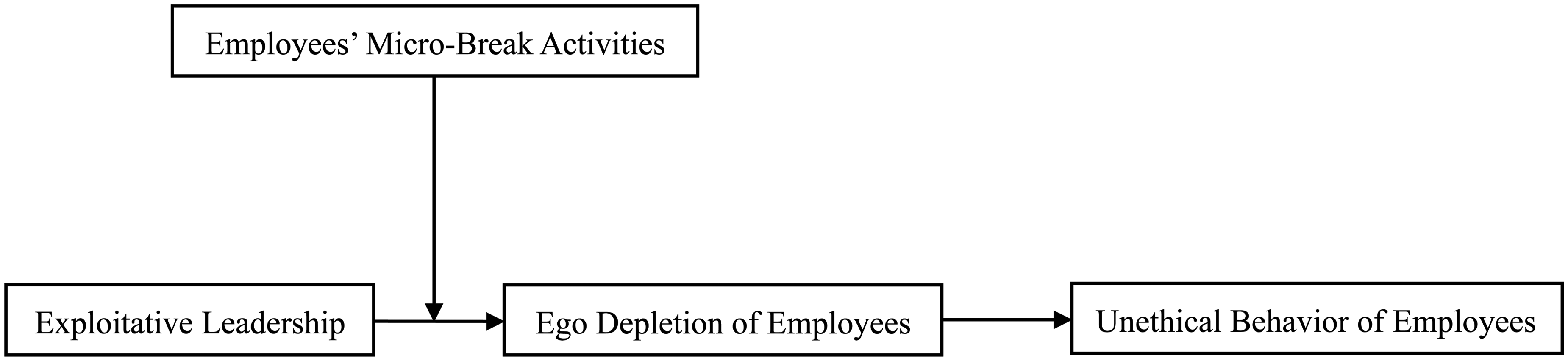
General theoretical model.
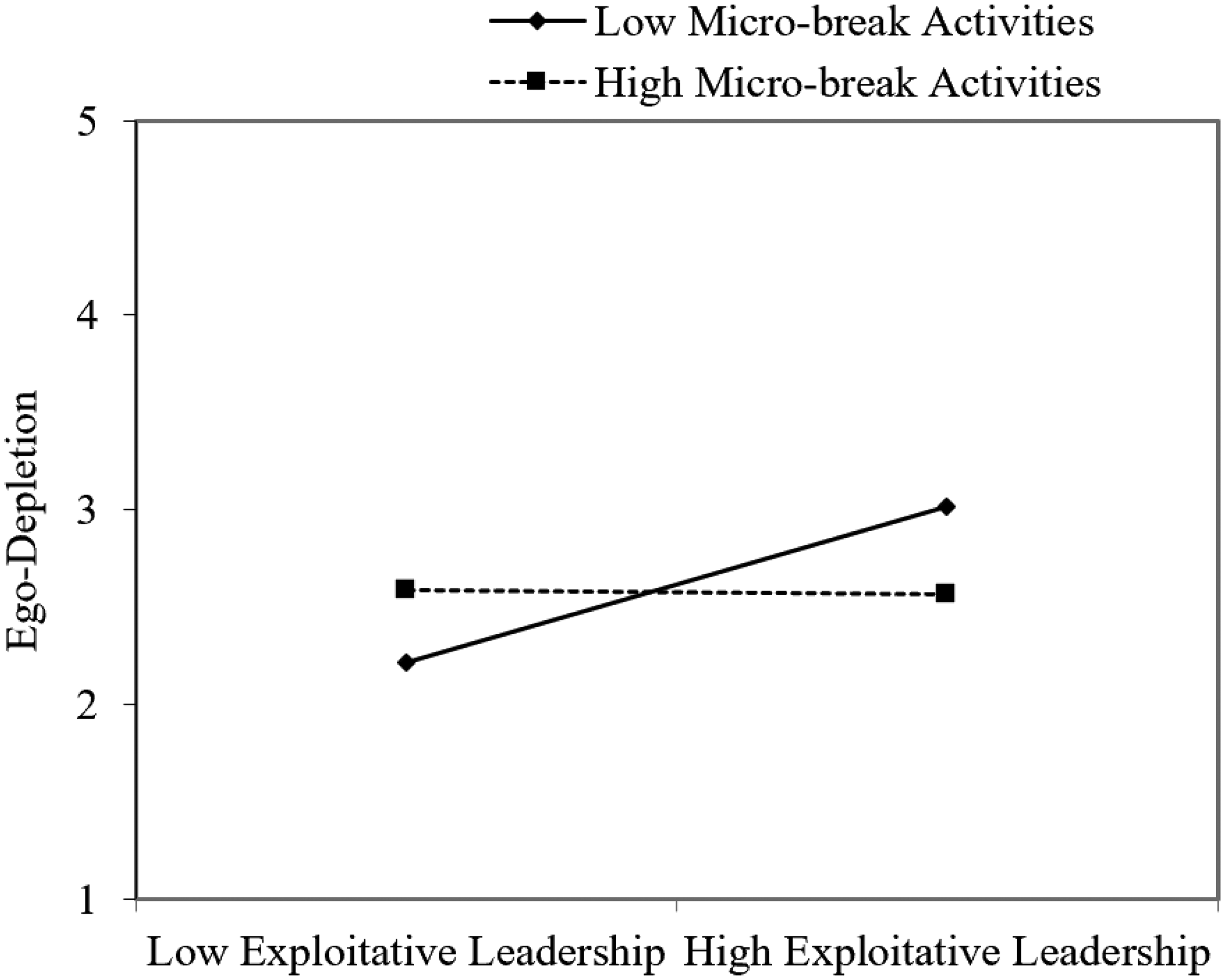
Moderating effect of microbeaks on the relationship between exploitative leadership and ego depletion.
Method
Sample and Procedure
For both theoretical and empirical reasons, we utilized a multiday diary design. Theoretically, ego depletion theory focuses on self-regulatory resources, which could ebb and flow within individuals (Baumeister et al., 2007; Muraven & Baumeister, 2000). Furthermore, our focus in this research is on the proximal consequences of exploitative leadership, which necessitates a daily diary design. Our methodology is therefore appropriate, given the theoretical lens we use and the nature of the focal phenomena in our model. It is also appropriate from an empirical standpoint because supervisory behaviors vary daily (Qin et al., 2018).
We followed the convenience sampling method to recruit participants for our study. Specifically, based on our social network, we obtained approval for collecting data from a large state-owned organization in China. With the support of the human resources department, we sent an electronic advertisement to recruit participants for our study to all the employees in the organization. The advertisement provided a brief introduction of the research purpose, method, and rewards. Employees who were willing to participate in our study were directed to join an online WeChat group. Based on this online group, we were able to keep in touch with all the participants and send surveys to them. Specifically, we assured participants that their responses would remain confidential and anonymous, with their personal data not being shared with employers and used only for academic research purposes. Each participant was awarded 5 RMB (approximately $0.75 USD) for each completed daily survey. Participants who completed all stages of the survey (a total of ten consecutive workdays) received a total of 50 RMB (approximately $7.50 USD) as a reward.
At the initial stage, we recruited 135 full-time employees from that organization. Before the start of the survey, we built an online WeChat group that included all the voluntary participants, which allowed us to contact the participants and send them online surveys. The employees completed a one-time baseline survey in which they reported their demographic data (i.e., age, gender, education). Daily data collection began one week after the baseline survey. Employees had to complete the daily survey on ten consecutive workdays. The daily survey was sent near the end of the day before employees left the workplace and consisted of three different parts. In the first part, employees were asked to rate daily exploitative leadership as well as their daily microbreaks during the workday. In the second part, they reported their daily ego depletion. In the third part, they reported their unethical behavior.
One hundred twenty (88.89%) employees participated in the daily survey; however, some employees failed to complete the whole survey due to business trips or personal factors. To ensure the validity of the data, we followed the suggestion of Bhave & Lefter (2018) to include the participants who provided data for more than half the days (i.e., five days). Finally, we obtained 1107 daily observations from 115 employees for use in our analyses, a response rate of 82.00% across participants and time periods. The average age of the respondents in our sample was 40.09 years (range = 21–61, SD = 10.56). Of the participants, 45.2% were male, and 54.8% were female. Regarding education, 35.7% of the sample had a college degree, 58.3% had a bachelor's degree, 5.2% had a master's degree and 0.9% had a doctoral degree.
Measures
Exploitative Leadership
Exploitative leadership was measured using Schmid et al. (2019) five items. A sample item is “Takes it for granted that my work can be used for his or her personal benefit” (α = 0.965).
Ego Depletion
We measured ego depletion with a five-item scale developed by Lanaj et al. (2014). A sample item is “I feel drained.” (α = 0.946).
Unethical Behavior of Employees
We measured ego depletion with a five-item scale developed by Paterson and Huang (2019). A sample item is “I pass blame for errors to an innocent coworker” (α = 0.876).
Microbreaks
Microbreaks were measured using the nine-item scale developed by Kim et al. (2018). The participants rated how often they engaged in these microbreak activities during the workday on a 5-point scale (1 = never to 5 = very frequently). A sample item is “Stretching, walking around the office, or relaxing briefly” (α = 0.913).
Control Variables
We controlled for age, education, gender, and tenure for two main reasons. First, prior studies on employees’ ego depletion and unethical behavior of employees have included such variables as controls (Ahmad et al., 2021; Cao et al., 2023). Second, these characteristics were empirically found to be associated with employees’ unethical behavior (Berry et al., 2007; Kish-Gephart et al., 2010).
Analytic Approach
In a diary field study, day-level data are nested within persons. Therefore, we employed a multilevel path analysis model in Mplus 7.4 to test our hypotheses. Our within-individual variables (exploitative leadership, unethical behavior, ego depletion, microbreaks) were modeled at level 1 using random slopes. The between-individual variables (control variables) were modeled at level 2. As recommended by Enders and Tofighi (2007), we centered all predictors measured at level 1 around the individual means (group-mean centering), and all level 2 predictors were grand-mean centered.
Testing the mediating effect. Following recent research, we centered the person means of the predictor and mediator variables to capture the within-person indirect effects (Preacher et al., 2010). We applied a hierarchical data analysis strategy by subsequently adding complexity; we estimated the impact of the control variables and exploitative leadership and then added ego depletion. Considering the multilevel structure of our data, we used Mplus 7.4 to run the Monte Carlo simulation to estimate indirect effects.
The moderation hypotheses were tested by modeling microbreaks as having a moderating effect on ego depletion and as influencing the strength of the indirect relationship between exploitative leadership and unethical behavior. A random slope indicated that the relationship between exploitative leadership and ego depletion differed for different levels of microbreaks, demonstrating possible moderation of these relationships.
Results
Preliminary Analysis
Before testing our hypotheses, we investigated the within- and between-person variation in our variables by running the null model. The results identified a considerable proportion of the total variance in exploitative leadership (34.37%), ego depletion (48.23%), unethical behavior (44.57%), and microbreaks (34.48%) as within-person.
We conducted multilevel confirmatory factor analyses (CFAs) to distinguish between the following four key variables: exploitative leadership, ego depletion, unethical behavior, and microbreaks. As presented in Table 1, the four-factor models (χ2 = 1467.853, df = 492, CFI = .902, RMSEA = .042, SRMR = .048) fit the data well and had a better fit than any of the competing models (Δχ2s ≥ 1272.177, Δdfs ≥ 6, ps < .001), thus supporting the discriminant validity of our focal variables.
Results of the Confirmatory Factor Analyses.
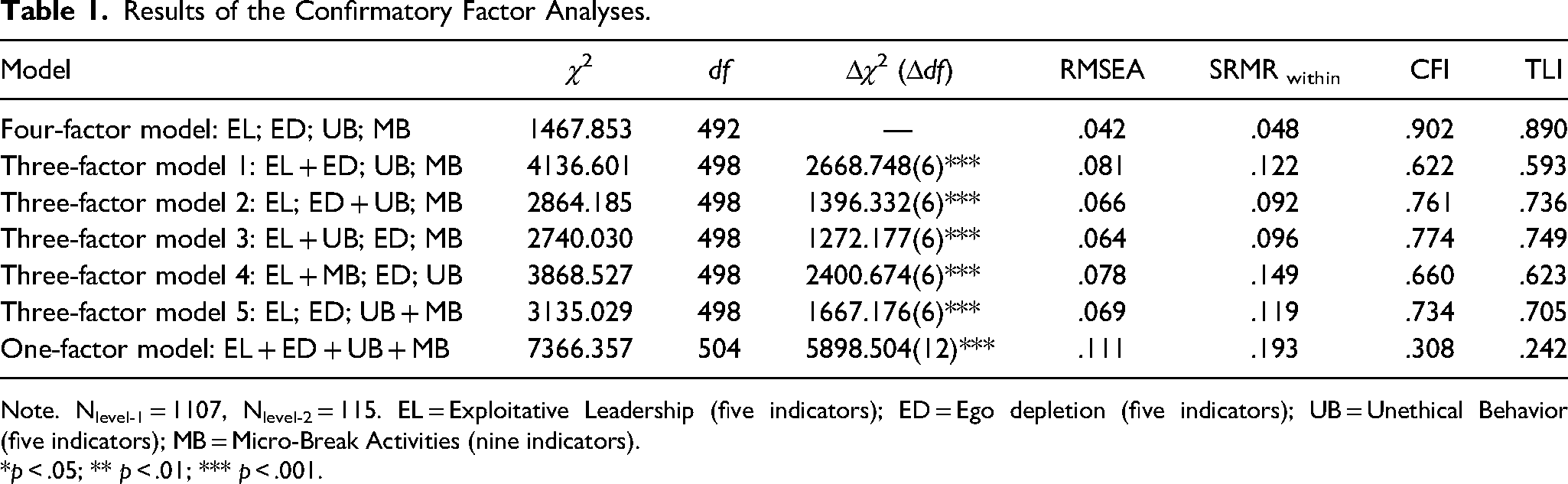
Note. Nlevel-1 = 1107, Nlevel-2 = 115. EL = Exploitative Leadership (five indicators); ED = Ego depletion (five indicators); UB = Unethical Behavior (five indicators); MB = Micro-Break Activities (nine indicators).
*p < .05; ** p < .01; *** p < .001.
The descriptive statistics and intercorrelations among the focal variables are presented in Table 2. Exploitative leadership was positively related to ego depletion of employees (r = .061, p < .001) and unethical behavior of employees (r = .061, p < .001). Ego depletion of employees was also positively related to unethical behavior of employees (r = .073, p < .001).
Means, Standard Deviations, and Correlations Between Study Variables.
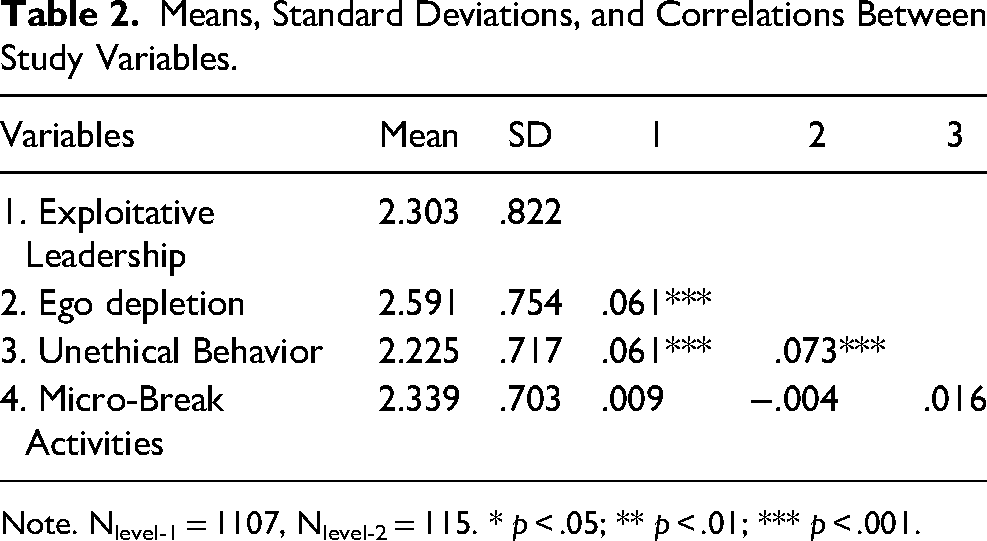
Note. Nlevel-1 = 1107, Nlevel-2 = 115. * p < .05; ** p < .01; *** p < .001.
Hypothesis Testing
Table 3 presents the results of the multilevel modeling. As shown in Table 3, exploitative leadership was positively related to the unethical behavior of employees (b = .261, p < .001; Model 3). Hence, Hypothesis 1 was supported.
Results of Multilevel Modeling.
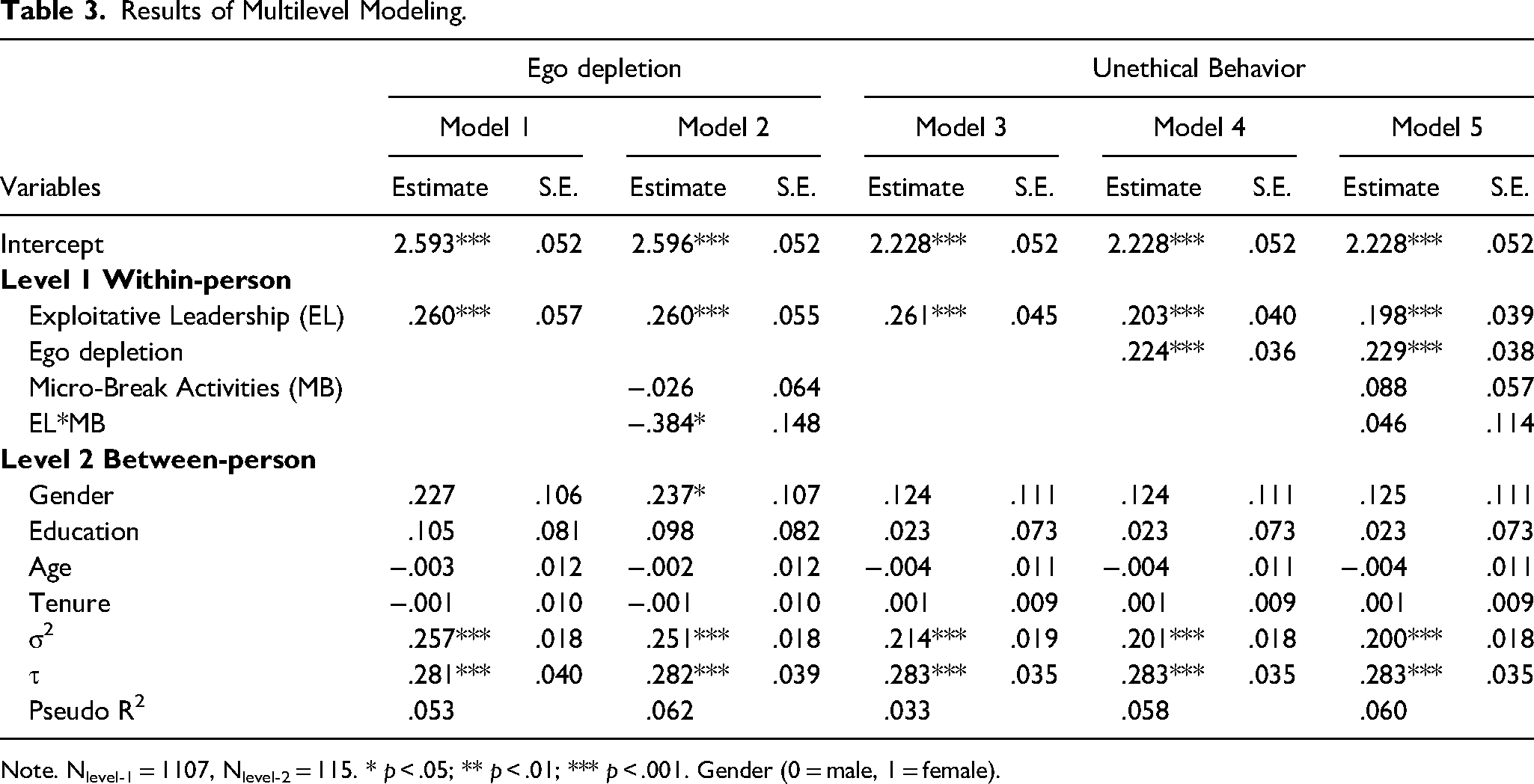
Note. Nlevel-1 = 1107, Nlevel-2 = 115. * p < .05; ** p < .01; *** p < .001. Gender (0 = male, 1 = female).
Moderated Mediation Results Across Levels.
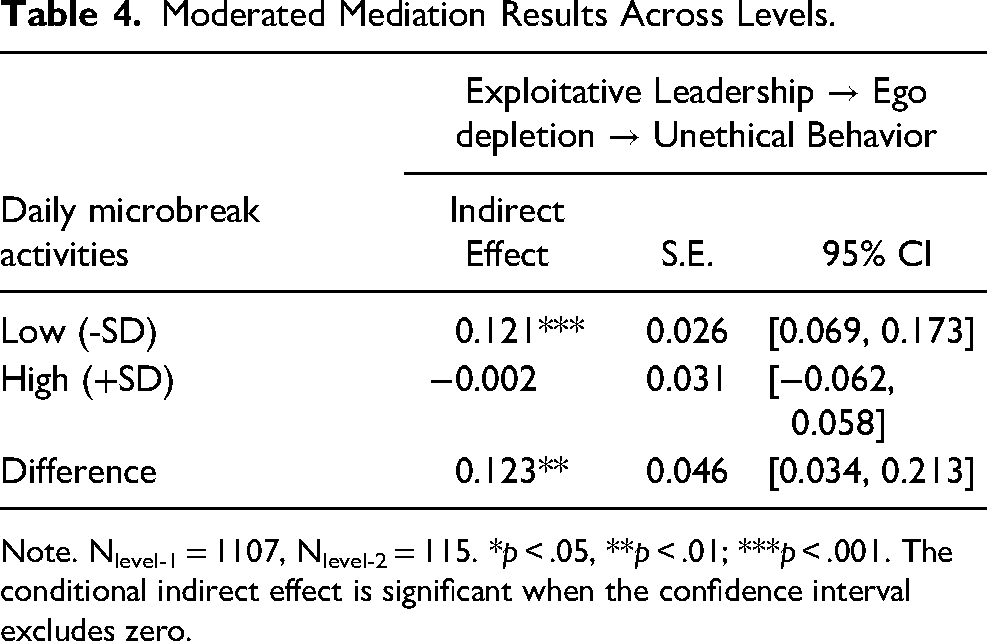
Note. Nlevel-1 = 1107, Nlevel-2 = 115. *p < .05, **p < .01; ***p < .001. The conditional indirect effect is significant when the confidence interval excludes zero.
As shown in Table 3, exploitative leadership was positively related to the ego depletion of employees (b = .260, p < .001; Model 1). Ego depletion of employees was positively related to unethical behavior of employees (b = .224, p < .001; Model 4). Hence, Hypothesis 2 and Hypothesis 3 were supported. Furthermore, the indirect effect of exploitative leadership on unethical behavior of employees via ego depletion of employees was .058, with a 95% Monte Carlo confidence interval (CI) from .025 to .092. As the CI did not include zero, Hypothesis 4 was supported.
Table 3 presents the results from the path analysis that estimated all path coefficients simultaneously. We tested a moderation effect of microbreaks on the within-person relationship between exploitative leadership and the ego depletion of employees. The results in Table 3 show that microbreaks were negatively associated with the random slope between exploitative leadership and ego depletion of employees (γ = −.384, p = .010; Model 2).
As Figure 2 shows, when exploitative leadership increased, ego depletion of employees increased more for employees who had low levels of microbreak activities. Following the suggestion of Preacher et al. (2006), we conducted simple slope analyses in multilevel modeling to identify the nature of the interaction effects. The positive within-person link between exploitative leadership and ego depletion of employees was stronger for employees with low levels of microbreak activities (b = .530, SE = .099, p < .001) and weaker for those with high levels of microbreak activities (b = −.009, SE = .135, ns). The difference between these two moderation effects was significant (△=.539, 95% CI = [.130, .948]), supporting the hypothesized moderation effect. Thus, H5 was supported.
Finally, we tested whether the estimated indirect effects of exploitative leadership on the unethical behavior of employees via the ego depletion of employees differed at higher (+1 SD) and lower (−1 SD) levels of microbreaks. As shown in Table 4, exploitative leadership had a significant indirect effect of .121 (p < .001) under low levels of microbreaks and a nonsignificant indirect effect of −.002 (p = .944) under high levels of microbreak activities. Moreover, the indirect effects were significantly different between the two conditions, i.e., .123 (95% CI = [.034, .213]). Therefore, microbreaks significantly moderated the indirect relationship between exploitative leadership and unethical behavior of employees via ego depletion of employees. Thus, H6 was supported.
Supplementary Analysis
We also conducted lagged analyses to explore the temporal sequence and potential causality between the variables in our daily diary data. Unfortunately, the results from these analyses did not yield significant findings. Specifically, exploitative leadership (b = .021, p = .607), ego depletion of employees (b = .019, p = .563) did not show a significant positive relationship with unethical behavior of employees. It's possible that other intervening variables or contextual factors not captured in our current model could be influencing these relationships. At this point, our study primarily focuses on examining the immediate relationships between variables through cross-sectional data.
Discussion
The aim of the present research was to investigate the effects of exploitative leadership on employees’ ego depletion and unethical behavior. In the diary study, our findings indicate that exploitative leadership can induce employees’ ego depletion, which in turn could increase employees’ unethical behavior. Moreover, to further enhance our understanding of this relationship, we also focused on microbreaks as a possible boundary condition. Our results indicate that employees with more microbreaks refrain from engaging in unethical behavior, while for employees who are taking fewer microbreaks, the relationship between exploitative leadership and employees’ unethical behavior occurs via ego depletion.
Theoretical Implications
This study tested the role of ego depletion in the translation of exploitative leadership into employees’ unethical behavior. Although it has been suggested that exploitative leadership negatively affects employees’ mood, work attitude and work behavior (Guo et al., 2021), it was not previously known whether exploitative leadership could lead to unethical behavior of employees. The underlying ego depletion mechanism explaining the link between exploitative leadership behavior and employees’ unethical behavior was also previously untested. To address this issue, this study empirically revealed the mediating role of ego depletion in the relationship between exploitative leadership and employees’ unethical behavior. In doing so, this study enriches our knowledge of employees’ ego depletion caused by exploitative leadership and its implications for employees’ unethical behavior, thus serving as a complement to prior findings.
This study identified employees’ microbreaks as a moderator of the relationship among exploitative leadership, employees’ ego depletion, and employees’ unethical behavior, which reveals under what circumstances exploitative leadership leads to more or less employees’ ego depletion and unethical behavior. Drawing on ego depletion theory, we contended that in the presence of an exploitative leader, employees who always engage in microbreaks could weaken the negative effect of exploitative leadership on the ego depletion and unethical behavior of employees. Based on these findings, this study provides a more contingent perspective on the implications of exploitative leadership.
Our study also contributed to the research on microbreaks in the workplace. Prior research has focused on the moderating effect of microbreaks on work demand and negative affect (Kim et al., 2017). Building upon prior findings, our studies show that microbreak activities also alter one's responses to leadership behaviors and influence the degree of employees’ ego depletion caused by exploitative leadership behaviors. In addition, the findings on the moderating role of microbreaks on the impact of exploitative leadership on employee outcomes speak to substitutes for the exploitative leadership literature (Lyu et al., 2022; Schmid et al., 2019). That is, as an energy management strategy of subordinates, microbreak activities make exploitative leadership less influential in inducing employees’ unethical behavior via ego depletion.
Managerial and Organizational Implications
Our research also provides several important managerial implications. First, we propose several suggestions for the management of unethical behavior. Organizations need to be aware that exploitative leadership can lead to the depletion of employees’ self-regulatory resources, and unethical behavior may be the result of employees’ ego depletion. Thus, organizations need to strive to prevent or curb the development of exploitative leadership within the organization to effectively manage employees’ unethical behavior. Moreover, organizations should empathically understand why employees have the need to engage in unethical behavior and help employees use alternative approaches (rather than unethical behavior) to satisfy such needs.
Furthermore, our findings show that employees’ microbreaks attenuate the relationships between exploitative leadership and employees’ ego depletion and subsequent unethical behavior. In line with ego depletion theory arguments (Baumeister et al., 1998; Muraven & Baumeister, 2000), employees’ microbreaks can effectively weaken the impact of exploitative leadership on employees’ ego depletion and subsequent unethical behavior. Hence, we recommend the importance of encouraging employees to take microbreaks. In doing so, the degree of employees’ ego depletion caused by exploitative leadership will decrease, thereby reducing unethical behavior among employees. In such a condition, unethical behavior among employees can be addressed to a certain extent.
Limitations and Future Research Directions
Although the current research has a variety of strengths, some limitations and directions for future research are worth noting. First, the data in our study were collected once daily, which can provide evidence of only the correlational relationship between our focal variables but cannot be used to infer causality. Given this limitation, we encourage future research to explore the causal relationships through experimental methods or a daily multi-wave design. Furthermore, future research could consider incorporating a more extensive lagged effects analysis to deepen our understanding further. This will potentially allow for a more detailed examination of how effects unfold over time and contribute to the development of more robust theoretical models in this area.
Second, we recognize that ego depletion theory has faced significant scrutiny, particularly regarding the clarity of its constructs and the replicability of some of the foundational experiments. To address these challenges, we propose that future research should not only aim to refine the conceptual definitions within ego depletion theory but also explore its application in exploitative leadership contexts. For instance, a closer look at how ego depletion functions under exploitative leadership might help clarify whether microbreaks can serve as a practical intervention to mitigate its effects on unethical behavior. Additionally, future studies could enhance methodological rigor by exploring alternative measures of ego depletion and employing longitudinal or experimental designs. This approach could provide stronger evidence for the buffering effect of microbreaks and contribute to a more robust understanding of ego depletion in organizational settings.
Third, this study draws on only the ego depletion model to examine the mediating role of ego depletion in the relationship between exploitative leadership and employees’ unethical behavior, overlooking alternative mechanisms. Justice theory focuses on perceived fairness and suggests that employees may engage in unethical behavior as a form of retaliation to restore perceived equity when they feel wronged by their leaders (Mackey et al., 2017). Employees subjected to exploitative leadership may experience moral disengagement as they attempt to cope with the unfair treatment and justify their own unethical behaviors as a response. Future research could attempt to explore other significant mechanisms that may account for the implications of exploitative leadership, such as moral disengagement, and further consider measuring these constructs alongside ego depletion to investigate their relative contributions and interactions.
Last, this study examined only the moderating role of employees’ energy management strategies (microbreaks) in the relationship among exploitative leadership, employees’ ego depletion, and employees’ unethical behavior, neglecting how employees’ personal characteristics shape the implications of exploitative leadership. For example, our results indeed show that women reported higher levels of ego depletion than men (b = .237, p < .05; Model 2). Thus, gender may influence how employees experience ego depletion under exploitative leaders. Future studies could investigate whether gender-specific patterns in microbreaks utilization or duration might influence resilience to ego depletion and, consequently, unethical behavior under exploitative leadership. Moreover, in high power distance cultures, employees are more likely to accept and respect authority and hierarchical differences. Previous research by Lian et al. (2012) found that high power distance can buffer the negative effects of abusive supervision by fostering greater acceptance of such treatment, thereby reducing its impact on outcomes like job satisfaction and commitment. Similarly, employees in high power distance cultures may experience less ego depletion when subjected to exploitative leadership, as their acceptance of hierarchical differences may help mitigate the immediate emotional toll of exploitative behaviors. Therefore, future research could examine power distance as a moderating variable to provide a more nuanced understanding of how cultural values shape employees’ responses to exploitative leadership.
Conclusion
This study finds that ego depletion plays a significant mediating role in the relationship between exploitative leadership and unethical behavior, while microbreaks can effectively buffer this effect. The findings offer new insights for management practices, particularly in utilizing microbreaks to reduce the risk of unethical behavior caused by exploitative leadership.
Footnotes
Acknowledgments
This work was supported by the National Social Science Foundation of China [grant numbers 72302116].
Declaration of Conflicting Interests
The authors declared no potential conflicts of interest with respect to the research, authorship, and/or publication of this article.
Funding
The authors disclosed receipt of the following financial support for the research, authorship, and/or publication of this article: This work was supported by the National Natural Science Foundation of China, (grant number 72302116).
