






Abstract
Employees’ community citizenship behaviour is a significant factor in shaping an organisation's socially responsible image. However, existing theoretical accounts could be further strengthened by identifying effective mechanisms and strategies to improve community citizenship behaviour among employees. Employing social learning theory, this research examines the relationship of servant leadership with employees’ community citizenship behaviour potentially induced through their public service motivation and the moderating role of leader-follower value congruence. Hypotheses were tested in a sample of 497 employees working in 103 teams across 36 hotels at popular tourist destinations in China, using multilevel structural equation modelling to analyse data collected across three waves. Findings show that public service motivation mediates the positive relationship between servant leadership and community citizenship behaviour within the sampled setting, and that leader-follower value congruence enhances the impact of servant leadership on employees’ public service motivation and the resulting community citizenship behaviour. Theoretical insights and practical implications are provided for managers in service-intensive settings similar to this study's context.
Keywords
Introduction
Organisations are increasingly expected to generate value not only for internal stakeholders, but also for the communities in which they operate (Lemoine et al., 2021). One employee-centred expression of this broader social responsibility is community citizenship behaviour (CCB), defined here as discretionary behaviour directed toward supporting community well-being beyond formal job requirements (Eva et al., 2020). Although such behaviour can strengthen an organisation's social legitimacy and community relationships, there is further room to strengthen theoretical clarity on how leadership shapes employees’ willingness to engage in these extra-organisational, community-directed acts.
This issue is theoretically important because leadership research has explained citizenship behaviour far more extensively within organisational boundaries than beyond them. In particular, while servant leadership has been linked consistently to follower development, prosociality, and citizenship-related outcomes (Eva et al., 2019; Hoch et al., 2018; Lee et al., 2020), we still know less about how a leader's other-oriented inspiration extends outward into employees’ discretionary contributions to the broader community. The unresolved question is not simply whether leadership matters for CCB, but how and under what conditions leader influence crosses the organisational boundary into community-directed behaviour.
Drawing on social learning theory (Bandura, 1977), we propose that servant leaders’ modelling of other-oriented behaviour fosters employees’ public service motivation (PSM). PSM then increases the likelihood of community citizenship behaviour (CCB), particularly when leader-follower value congruence (LFVC) is high, thereby enhancing the internalisation of leader-modelled values. Shared values increase the credibility and internalisation of leader-modelled cues (Cheng et al., 2019; Edwards & Cable, 2009).
Employees’ CCB embraces voluntary extra-role actions aimed at promoting community well-being and supporting organisational CSR goals (Fatima et al., 2023). From volunteering at neighbourhood shelters to advocating for firm-led sustainability programmes, CCB transcends formal job requirements and signals an individual's intrinsic commitment to social good (Eva et al., 2020). Empirical evidence suggests that robust CCB accelerates CSR implementation, improves corporate reputation, and forges durable community partnerships (Fatima et al., 2023).
Prior research (Lemoine et al., 2024) already provides some evidence that servant leadership is positively associated with community-directed citizenship behaviour Notably, Liden et al. (2008) and Fatima et al. (2023) examined the servant leadership-CCB relationship and reported supportive findings. The present study does not claim to be the first to show that servant leadership relates to CCB. Rather, it addresses a different, more precise theoretical problem: explaining the mechanism by which servant leadership relates to CCB and identifying the conditions under which that mechanism is more likely to operate.
Specifically, the literature provides less than sufficient integration of a multilevel translation of servant leadership into employees’ community-directed behaviour through a motivational pathway, or when that pathway is strengthened by leader-follower value alignment. Employees observe, internalise, and emulate the values of role models. When leaders demonstrate appreciation for service to others, employees perceive such behaviours as desirable, fostering an internal motivation to act similarly. We argue that public service motivation (PSM) constitutes the core psychological mechanism that translates servant leaders’ modelling into community citizenship behaviour (CCB). PSM captures an individual's intrinsic orientation toward serving the public and advancing collective well-being (Perry & Hondeghem, 2008). Prior research has identified PSM as a mediator between leadership and employees’ organisational behaviours (Hameduddin & Engbers, 2022); however, its role in explaining how servant leadership fosters community-directed prosocial behaviours beyond organisational boundaries has yet to be articulated. Leader-follower value congruence (LFVC) moderates the relationship between servant leadership and PSM, strengthening the effect when values are aligned (Cheng et al., 2019). When employees perceive congruence between their values and those of their servant leaders, they are more likely to internalise prosocial cues, sustain motivation to serve, and translate values into CCB. In contrast, misaligned values may weaken this process, reducing the efficacy of servant leadership in inspiring community-oriented action.
Despite a growing body of research connecting servant leadership to prosocial outcomes (Fatima et al., 2023; Lemoine et al., 2024), less is known about the mechanisms through which leaders inspire followers to act beyond organisational boundaries in ways that benefit their wider communities. This outward-facing form of citizenship, community citizenship behaviour (CCB), represents a theoretically distinct phenomenon from internal organisational citizenship (Liden et al., 2008). Addressing this phenomenon requires integrating motivational (PSM) and value-congruence (LFVC) mechanisms to uncover the processes and boundary conditions through which servant leadership translates into community-level citizenship. Building on this gap, we next propose mechanisms and moderators that may explain how leadership translates into community-directed behaviour.
While research links servant leadership (SL) to prosocial behaviours, prior work has offered limited insight into how SL may extend to community-directed citizenship (CCB) and under what conditions (Wu et al., 2022). Here, we examine these mechanisms within a service-intensive context, integrating social learning with motivational and value-alignment perspectives. In so doing, we attempt to strengthen the structured theoretical account by integrating social learning with motivational and value-alignment logics. We test this model using three-wave, time-lagged data from employees working in hotel teams in China. Although the empirical setting is hospitality, the model may also be applicable to other service-intensive contexts in which leader modelling, team interaction, and community interface are especially visible.
This study makes three incremental contributions to the leadership literature. First, it extends research on servant leadership by examining a community-directed, extra-organisational outcome rather than the more commonly studied in-role or intra-organisational outcomes (Eva et al., 2019; Hoch et al., 2018). Second, it explains this relationship by identifying PSM as the motivational pathway through which servant leadership relates to employees’ CCB (Hameduddin & Engbers, 2022; Perry et al., 2010). Third, it shows that this pathway is stronger when LFVC is higher, thereby identifying an important boundary condition for translating leader-modelled values into community-directed behaviour (Cheng et al., 2019; Edwards & Cable, 2009).
By illuminating the relational and motivational pathways through which servant leadership can inspire community citizenship, our study contributes to leadership scholarship on extra-organisational prosocial behaviour. It offers actionable insights for managers in service-intensive settings. We begin by reviewing the servant leadership and CCB literatures, develop hypotheses, describe our methods and multilevel SEM analyses, present results, and conclude with theoretical and practical implications. The theoretical model of this research is presented in Figure 1.
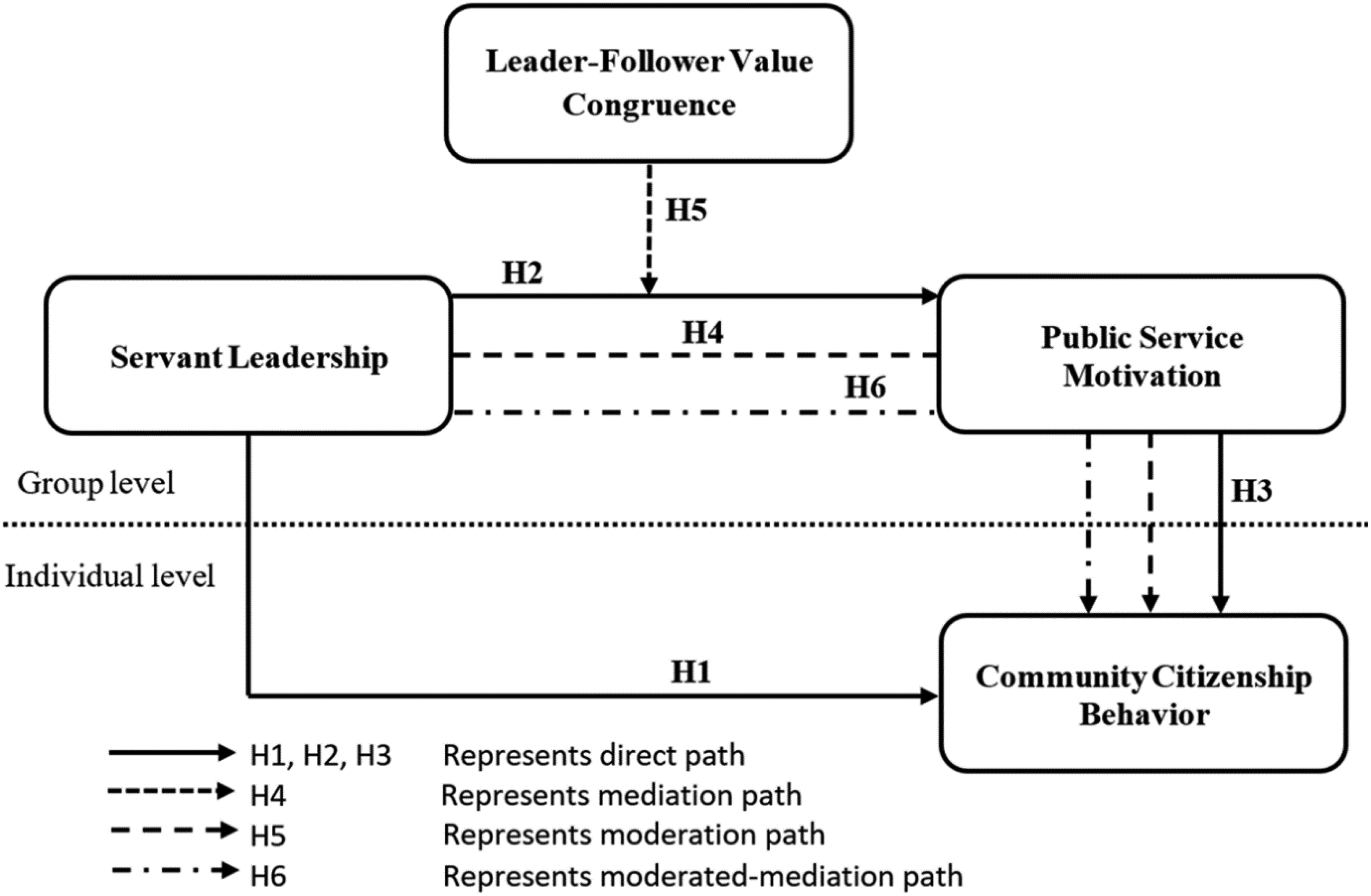
Structural model.
Theoretical Underpinnings and Hypotheses
The central theoretical problem addressed in this study is how leader influence extends beyond the organisation into employees’ discretionary contributions to the broader community. A strong theoretical account requires specifying the focal phenomenon, clarifying the explanatory mechanism, and identifying the conditions under which that mechanism is more or less likely to operate (Ashkanasy, 2016; Bacharach, 1989; Sutton & Staw, 1995). Guided by this logic, we develop a multilevel explanation in which servant leadership functions as the upstream socialising context, PSM operates as the motivational mechanism, and LFVC conditions the extent to which leader-modelled values are internalised and translated into CCB.
As a whole, this framing builds on prior servant leadership research rather than positioning the study as a simple gap-filling exercise. Servant leadership has been consistently associated with prosocial and citizenship-related outcomes, yet prior work has focused more on outcomes within organisational boundaries (Eva et al., 2019; Hoch et al., 2018; Lee et al., 2020; Lemoine et al., 2024). At the same time, research on CCB has recognised the importance of community-directed citizenship, yet has not fully explained how leader inspiration generates this behaviour through a theoretically specified process (Eva et al., 2020; Fatima et al., 2023). We therefore focus on explaining how servant leadership relates to CCB and when that relationship should be stronger.
Servant Leadership and Employees’ Community Citizenship Behaviour
Employees’ CCB refers to discretionary behaviour directed toward promoting the well-being of the broader community rather than directly benefiting the organisation or its immediate members (Eva et al., 2020; Van Dyne et al., 1994). In the present study, CCB is treated as a unidimensional construct reflecting employees’ voluntary community-directed contribution. This treatment aligns with the operationalisation used in the study and maintains the construct's conceptualisation consistent with its empirical modelling. Although community-directed citizenship may take different behavioural forms, our interest here is in the overall extent to which employees engage in discretionary acts that support community welfare.
Over the past two decades, servant leadership research has progressed from defining leader attributes (Greenleaf, 1970; Liden et al., 2008) to identifying its broader social and moral consequences (Eva et al., 2019). Recent studies have extended servant leadership beyond internal organisational outcomes, suggesting its potential to foster community-oriented prosocial behaviours among followers (Fatima et al., 2023; Yoshida et al., 2014). However, existing work remains fragmented in explaining how and why servant leaders instil collective pro-sociality that transcends organisational boundaries.
Servant leadership is most consistently defined as a leadership approach that prioritises the growth and well-being of followers while extending concern to multiple stakeholders (Lemoine et al., 2024) including the broader community (Greenleaf, 1970; Liden et al., 2008). In contrast to other leadership models, the hallmark of servant leadership is followers first, leaders second, a stance operationalised through specific behaviours such as empowering and developing followers, demonstrating ethical guidance, and creating value for the community (Liden et al., 2008). These defining characteristics form the conceptual anchor for this study. By consistently emphasising follower development and community-oriented concern, servant leaders cultivate values and role expectations that extend beyond organisational performance toward community contribution (Ehrhart, 2004; Graham, 1991).
Citizenship behaviours have been extensively studied within organisational boundaries; their extension to community-directed domains has received less systematic attention (Wu et al., 2022). Leadership has long been recognised as a powerful antecedent of citizenship behaviours at work, yet fostering prosocial engagement beyond the workplace may require a leadership approach that explicitly emphasises multiple stakeholders, including the broader society (Eva et al., 2020). Servant leadership, more than other value-based leadership styles, embodies this multi-stakeholder orientation (Lemoine et al., 2024). Systematic reviews consistently highlight SL's incremental predictive power for prosocial outcomes relative to transformational or ethical leadership (Hoch et al., 2018; Lee et al., 2020). However, empirical scholarship has paid less systematic attention to how servant leadership shapes employees’ CCB as a community-directed outcome.
Building on social learning theory (Bandura, 1977), we argue that servant leaders model altruistic, service-oriented behaviours that employees emulate not only toward coworkers but also toward external community stakeholders. Complementing this social learning perspective, public service motivation (PSM) captures an internalised drive to serve the collective good (Perry & Wise, 1990), providing the motivational channel through which servant leadership translates into community citizenship behaviour (CCB). Moreover, leader-follower value congruence (LFVC) operates as a boundary-enhancing mechanism that strengthens this modelling process by aligning leaders’ and followers’ moral schemas (Edwards & Cable, 2009). Integrating these perspectives enables a more comprehensive account of how servant leadership fosters outward-oriented citizenship behaviours, thus enriching both servant leadership and CCB literatures with a multilevel theoretical model grounded in established motivational and value-based mechanisms.
According to SLT, individuals learn appropriate behaviours by observing and modelling the actions of credible and admired role models. Leaders, by virtue of their status, visibility, and symbolic authority, are particularly influential models for employees (Cheng et al., 2019). When leaders consistently enact behaviours that prioritise ethical responsibility, community concern, and follower development, employees observe and internalise these values. Servant leaders thus create a normative environment in which community service is not peripheral but central to the meaning of work. Through vicarious learning and value alignment, employees are motivated to extend these behaviours into the community domain, thereby enacting CCB.
This theorised relationship between SL and CCB is further reinforced by their shared altruistic orientation. Both constructs are rooted in prioritising the welfare of others and transcending self-interest for the collective good (Luu Trong, 2018). Greenleaf's (1970) original vision of servant leadership explicitly emphasised building community and promoting social responsibility as integral to the servant-leader ethos. Subsequent refinements have affirmed community value creation as a core dimension of servant leadership (Liden et al., 2008). Thus, when leaders model behaviours consistent with this ethos, employees are likely to emulate them by engaging in CCB, whether through direct volunteerism, encouraging peers, or advocating for community engagement at the organisational level (Greenleaf, 1970; van Dierendonck & Patterson, 2014).
Servant leaders, by demonstrating community-oriented values and embedding them into daily interactions, are uniquely positioned to inspire employees to extend their service mindset beyond customers and organisations to the communities they represent. Servant leadership offers both the conceptual grounding and the behavioural modelling necessary to stimulate employees’ CCB. By applying SLT, we argue that the specific defining aspects of SL, follower development, ethical guidance, and community focus, constitute the mechanisms through which employees learn to prioritise and enact prosocial contributions to the broader community.
The Mediating Effect of Employees’ Public Service Motivation
A central concern in servant leadership research is clarifying how servant leaders instil prosocial orientations in their followers (Faraz et al., 2021; Lee et al., 2020). While extant scholarship has identified relational mechanisms such as trust, empowerment, or justice, less attention has been devoted to followers’ motivational foundations that sustain behaviours extending beyond organisational boundaries. This omission is particularly salient for CCB, which, unlike organisational citizenship behaviour, primarily benefits the external community and often lacks formal recognition or reward from the organisation (Rodell et al., 2016). To explain how servant leaders inspire such outward-facing discretionary effort, we focus on PSM as a mediating mechanism.
PSM refers to an enduring, other-oriented motivation that drives individuals to contribute to society's welfare and act in the service of the public good (Perry, 1996). Its core components, commitment to the public interest, compassion, self-sacrifice, and civic duty, capture an intrinsic willingness to place communal needs above personal gain (Perry et al., 2010; Ritz et al., 2020). Importantly, PSM is distinct from general altruism or prosocial motivation because it reflects an explicitly societal orientation: a drive to create public value even when such actions are not materially rewarded (Schott et al., 2019). This makes PSM an especially relevant explanatory bridge between servant leadership and CCB, both of which are anchored in “others-first” values. PSM comprises four components: commitment to the public interest and civic duty, altruism, compassion, and attraction toward policy-making (Perry, 1996). Self-sacrifice is the primary component of different definitions of PSM, which advocates that PSM is deeply grounded in an individual's intention to engage in the service of the broader community (Perry et al., 2010). It has also been found to be positively related to ethical responsibilities deep-rooted in virtuous deeds (Gnankob et al., 2022). Equally, servant leaders are well known for their self-sacrifice, compassion, ethical orientation, altruism, and community stewardship (Sendjaya et al., 2008). Servant leadership encompasses several positive characteristics, including altruism, compassionate love, ethical and honest considerations, self-sacrifice, and a genuine concern for the followers (van Dierendonck & Patterson, 2014). These attributes align closely with the essential components of PSM, particularly compassion towards the public, dedication to the community's interest, and a willingness to make sacrifices for the greater good.
While PSM is commonly treated as an individual disposition, it may also emerge at the team level when members share repeated exposure to the same servant leader, receive similar normative cues about serving others, interact frequently, and collectively interpret what kinds of motives and behaviours are legitimate within the team (Bandura, 1977; Chan, 1998). Team-level PSM, therefore, should not be viewed as identical to individual PSM, but as a higher-level representation of the same public-regarding motivational domain, capturing the extent to which service to broader society becomes collectively salient among team members (Perry et al., 2010). This is consistent with our model because servant leadership is theorised as a shared team-influence that, through repeated modelling of community concern and follower-oriented values, cultivates a common motivational climate; accordingly, PSM is positioned as a Level-2 mediator through which team-level servant leadership translates into individual employees’ community citizenship behaviour (van Dierendonck & Patterson, 2014).
SLT (Bandura, 1977) provides the explanatory foundation for this process. Servant leaders function as salient role models whose consistent demonstration of community-oriented values and ethical concern provides vicarious cues for followers (Walumbwa et al., 2010). Through observational learning, employees internalise these values, gradually adopting PSM as part of their own motivational system. In addition, servant leaders reinforce prosocial efforts by acknowledging or symbolically rewarding community-focused acts, which strengthens followers’ belief in the importance of serving society. This motivational transfer is particularly powerful in service-intensive industries where employees often confront opportunities to engage with the community directly.
Empirical evidence reveals that servant leadership inculcates PSM among employees. For instance, Gnankob et al. (2022) identified a positive association between servant leadership and employees’ PSM. PSM and CCB share a common foundation in prosocial values, reflecting individuals’ altruistic tendencies and commitment to community well-being (Perry et al., 2010). Employees driven by altruistic motives tend to engage in activities beyond their prescribed roles. Research also offers evidence that PSM promotes positive citizenship behaviour beyond the confines of the organisation (Liu & Perry, 2016; Wright et al., 2013). Besides, literature also lent credence to the underlying role of PSM in the relationship of servant leadership with knowledge sharing (Tuan, 2016), job performance (Schwarz et al., 2016), innovative behaviour (Nguyen et al., 2023), and organisational citizenship behaviour (Gnankob et al., 2022). We specify a cross-level indirect effect (Preacher et al., 2010) of SL to CCB through PSM.
Although PSM is often conceptualised at the individual level, there is a sound basis for examining it as a shared team context when employees are exposed to a common leader, similar work routines, and repeated normative cues regarding service to others. In such settings, leader behaviour can shape not only individual motives but also a collectively shared sense that serving broader societal interests is valued and expected within the team. Consistent with direct-consensus approaches to composition, we therefore conceptualise team-level PSM as an emergent motivational climate reflecting shared public-regarding orientation among team members (Chan, 1998; Walumbwa et al., 2010).
The Moderating Effect of Leader-Follower Value Congruence
SLT (Bandura, 1977) emphasises that individuals acquire and internalise behaviours, attitudes, and values by observing credible role models. Yet, SLT also recognises that this observational learning process is not uniform; it is shaped by contextual moderators that can either amplify or attenuate its outcomes. In organisational contexts, these moderators extend beyond the attributes of leaders and followers to include the broader environment in which leader-follower interactions are embedded. Within the social learning process, individuals learn behaviours and skills and internalise their role models’ values and beliefs. Notably, the harmony of the observers’ and role models’ values may play a pivotal role in shaping their social learning. LFVC is defined as the perceived resemblance between a leader's and a follower's values (Edwards & Cable, 2009). LFVC can enrich employees’ motivation and commitment. When employees perceive their servant leaders share similar values, they are more likely to be motivated to follow their lead and become committed to serving others. Besides, LFVC fosters trust and open communication where employees trust their leaders, seek feedback, and engage in dialogue, critical elements of social learning.
While examining the boundary conditions of servant leadership, scholarship focused on either the leader's or follower's personality traits rather than exploring their congruence. Consistent with this argument, Cheng et al. (2019) recommended exploring LFVC to enhance the comprehension of their interconnected relationships. The high level of values congruence between employees and their servant leaders can play a pivotal role in fostering the development of the follower's PSM through role modelling. Accordingly, the employees can quickly adapt to the other-oriented behaviours demonstrated by their servant leader. This adaptability, in turn, aids the employees in developing a confident belief in their CCB performance. From another perspective, value congruence is a critical criterion for evaluating the leader's ethical behaviour and guiding the employees’ actions and reactions after observing the leader's conduct. Under high-value congruence, employees would be more inclined to positively view the leader's behaviours and pay closer attention to mimicking them. This would probably be due to the increased trust that comes with a higher level of LFVC, leading to a more effective role of leadership in strengthening employees’ attitudes and behaviours.
Recent empirical research supports these contentions, where LFVC has been examined as a boundary condition on the relationship between leadership styles and employees’ behavioural outcomes. For instance, studies by Ahmed et al. (2023) and Cheng et al. (2019) found that LFVC moderated the responsible leadership's direct and indirect association with employees’ unethical pro-organisational behaviour. Similarly, in their research, Lee et al. (2017) identified LFVC as a moderator of the direct and indirect relationship between ethical leadership and employees’ moral voice. Advancing these arguments, it is posited that a high alignment between the values of leaders and followers augments the positive impact of servant leadership on employees’ PSM. Consequently, this heightened alignment accentuates the indirect effect of servant leadership on employee CCB via PSM.
Materials and Methods
Research Context, Sampling Frame, and Participants
Hospitality provides an appropriate empirical context because hotel employees work in service-intensive teams, interact closely with a common supervisor, and operate at the interface between the organisation and the local community. These features make the context suitable for examining how team-level leadership relates to employees’ community-directed discretionary behaviour. Given its service-intensive and community-facing nature, such organisations depend heavily on employees who not only serve guests but also act as ambassadors of social responsibility (Asghar et al., 2023; Fatima et al., 2023; Schwarz et al., 2016). At the same time, the theoretical model is not limited to hospitality and may be relevant to other service-intensive settings characterised by visible leader modelling and frequent stakeholder contact.
The sampling frame was developed during the China Tourism and Culture Week in Beijing, where the researchers identified potential three-star and above hotels. Focusing on this category of hotels was deliberate and theoretically justified. Hotels at this level are formally recognised for operational sophistication and are more likely to have institutionalised CSR initiatives, such as environmental programmes, community outreach, and employee welfare schemes. They also maintain formalised leadership structures and employ a relatively larger and more diverse workforce compared to lower-rated establishments, conditions that are necessary for studying leadership-follower dynamics. Further, prior research has emphasised that three-star and above hotels offer an optimal balance between organisational complexity and accessibility for empirical research, making them a compelling choice (Asghar et al., 2023).
A purposive yet structured approach was adopted to minimise sample bias. Using a convenience-based initial contact strategy, executives of 50 hotels were approached, 10 each from five major tourism hubs: Beijing, Shanghai, Guangzhou, Wuhan, and Xinjiang. These regions were selected to ensure both geographical and cultural diversity, thereby enhancing the generalisability of findings. The research team provided detailed information on the study's purpose, scope, and assurances of confidentiality and anonymity to participating executives. Of the 50 hotels contacted, 36 provided complete participation across the full data collection process and were retained in the final analytic sample.
At the team level, human resource departments were requested to provide complete rosters of all eligible work teams. To avoid manager-driven selection bias, line managers were not permitted to nominate teams. Instead, after receiving the full rosters, the research team randomly selected teams from the eligible pool using a random-number procedure in Excel. Team eligibility required that: (a) the team originally comprised at least three members reporting to a single direct supervisor, and (b) team members had worked under that supervisor for at least 12 months. These criteria ensured sufficient shared exposure to the same leader and work routines for team-level constructs to emerge meaningfully. All employees within each selected team were invited to participate. The final analytic sample consisted of 497 employees nested within 103 teams from 36 hotels.
Data Collection Procedure
Consistent with concerns regarding common method bias in cross-sectional research designs, we employed a time-lagged data collection strategy (Podsakoff et al., 2012). Data were collected across three waves, each separated by a two-week interval, to minimise the likelihood of same-source and same-time response bias.
At the start of the study, employees were informed of the study's objectives, assured that their participation was voluntary, and guaranteed confidentiality. They were explicitly told that responses would be used only for academic research and reported in aggregate form. To facilitate comprehension, the questionnaire provided clear definitions of the key constructs, such as servant leadership (SL), public service motivation (PSM), and community citizenship behaviour (CCB), alongside examples to ensure consistent interpretation across participants. Surveys were distributed electronically via email and WeChat, widely used communication tools in Chinese organisations, allowing participants to complete the questionnaire at a time convenient to their work schedules.
In Wave 1, employees reported demographic information and their perceptions of supervisors’ servant leadership. A total of 759 employees across 155 distinct teams were invited, resulting in 624 valid responses from 129 teams. In Wave 2, conducted two weeks later, employees who had responded in Wave 1 were recontacted using the same communication channels. To enhance response rates, reminder messages were sent 3 and 5 days after the initial invitation. In this wave, participants reported on the mediating and moderating variables, namely public service motivation and leader-follower value congruence (LFVC). This wave yielded 563 usable responses across 115 teams. In Wave 3, conducted two weeks after Wave 2, respondents from Wave 2 were contacted again, using identical procedures and confidentiality assurances. In this final stage, respondents provided information about their community citizenship behaviour. Wave 3 concluded with 497 usable responses nested in 103 teams.
To match responses across waves while maintaining confidentiality, each participant generated a unique identification code derived from a combination of stable personal cues known only to the respondent. The code was entered at each wave and used solely for matching purposes. Neither supervisors nor hotel management had access to these identifiers, and the research team used them only to link responses longitudinally before removing the matching file from the analytical dataset.
To maintain engagement across all three waves, respondents received a small incentive after each completed questionnaire, specifically an electronic gift voucher worth RMB 30 from an international coffee chain in China. The study was conducted under the approval of the corresponding university's institutional ethics committee, and participation remained entirely voluntary.
Data Screening and Final Sample
The minimum team-size criterion of three members was applied at the original team-selection stage using intact team rosters. Owing to attrition across the three survey waves, twelve of the originally eligible teams contributed only two final-wave respondents. These teams were retained in the main analyses because the underlying work units satisfied the original eligibility requirement and continued to represent intact teams under a common supervisor. As an additional robustness check, we re-estimated the models after excluding all teams with only two final-wave respondents. The substantive pattern of findings remained unchanged, suggesting that the reported results were not driven by small final team sizes.
The overall final response rate was 65.5% (497/759). At the team level, response rate was defined as the number of Wave 3 respondents in a team divided by the number of Wave 1 invitees in that team. The mean team-level response rate was 74% (SD = 9%), ranging from 62% to 95%. To ensure that aggregation decisions were not unduly influenced by low-response teams, we also re-estimated the multilevel models using only teams with response rates of at least 70% and at least 80%. In both cases, the pattern and statistical inferences of the hypothesised relationships were unchanged.
To assess the possibility of attrition bias, we compared retained respondents in the final matched sample with those who dropped out after Wave 1 or Wave 2 on the available demographic variables and on Wave 1 servant leadership ratings. These comparisons revealed no substantive differences, indicating that attrition was unlikely to have biased the final sample in a systematic way. Among the final respondents, 252 were female, 239 were male, and six preferred not to disclose their sex. In terms of age, 228 were between 18 and 25 years, 177 between 26 and 35, 57 between 36 and 45, 22 between 46 and 55, and 13 were above 55 years. Regarding educational background, 192 had high school or lower qualifications, 236 held a bachelor's degree or equivalent qualification, and 69 possessed a master's degree or higher. On average, respondents had worked under their current supervisors for 2.7 years (SD = 1.2).
Measures
All measures were adapted from studies with established reliability and validity. The survey was originally prepared in English and then translated into Chinese using a back-translation procedure (Brislin, 1986). Specifically, a native scholar translated the instrument into Chinese, after which a bilingual academic back-translated the Chinese version into English. Any discrepancies were reconciled through discussion with two additional bilingual associate professors. Unless otherwise noted, all items were rated on a five-point Likert scale ranging from 1 = strongly disagree to 5 = strongly agree. Because our theorised process is cross-level, we articulate the composition assumptions that license inferences from leader behaviours to individual outcomes. We adopt a referent-shift logic in which team members evaluate servant leadership at the unit or leader level, forming a shared perception that functions as a Level-2 predictor, while public service motivation is modelled at Level 2 as a shared team motivational climate, and employees’ community citizenship behaviour remains at Level 1. This approach follows Chan's (1998) framework for clarifying functional relationships across levels and supports our 2-1 and 2-2-1 hypothesising. Our hypotheses, therefore, separate leader-level influences from follower-level enactments and anticipate the multilevel mediation tests that follow.
Servant leadership: Servant leadership was reported by employees using the seven-item global servant leadership scale developed by Liden et al. (2015). A sample item is: “My leader emphasises the importance of giving back to the community.” Internal consistency was satisfactory (α = .89).
Public service motivation: Employees rated their public service motivation using a five-item global measure drawn from the original PSM scale introduced by Perry (1996) and widely used in subsequent research (Wright et al., 2013). A sample item is: “Making a difference in society means more to me than personal achievements.” Although measured at the individual level, PSM was conceptualised as a shared team property reflecting the collective orientation of the team towards serving broader societal interests. This treatment is consistent with multilevel work, suggesting that prosocial and service-oriented motives can emerge as shared motivational climates when employees are exposed to a common leader, shared norms, and recurrent service situations. Internal consistency for the PSM scale was acceptable (α = .84).
Leader-follower value congruence: Leader-follower value congruence was measured using an adapted version of Cable and DeRue's (2002) subjective fit scale. We employed a referent shift from organisation to supervisor so that the items captured the perceived similarity between employees’ values and those of their direct supervisor, for example: “My values are similar to my supervisor's values.” Items explicitly referring to organisational culture were removed to align the scale more closely with dyadic leader-follower alignment. Because all members within a team worked under the same immediate supervisor and shared repeated exposure to that supervisor's expressed priorities and conduct, LFVC was treated as a shared team-level perception once within-team agreement was established empirically. The adapted three-item scale showed excellent internal consistency (α = .92).
Community citizenship behaviour: Employees rated their community citizenship behaviour using the seven-item measure developed by Liden et al. (2008). A sample item is: “I am involved in community service and volunteer activities outside of work.” Internal consistency was acceptable (α = .84). In line with the present theorising and measurement model, CCB was treated as a unidimensional construct.
Control variables: To obtain a parsimonious estimate of the hypothesised effects, we controlled for employees’ sex, age, tenure under the current supervisor, educational attainment, and team size (Tuan, 2016). These controls were included because age and tenure may relate to community ties and exposure to leader modelling, education may reflect civic efficacy and broader social awareness, sex may relate to prosocial role expectations, and team size may influence the visibility and coordination of discretionary community-directed behaviour. Sex was coded 1 = male, 2 = female, with the few non-disclosure cases retained as missing on that variable. Age was measured in ordered categories corresponding to the brackets reported in the sample description. Education was coded in ascending order from 1 = high school or below to 3 = master's degree or above. Tenure under the current supervisor was measured in years. Team size referred to the number of employees in the final analytic team at Wave 3.
To ensure that there was no contamination between servant leadership and community citizenship behaviour, both of which were drawn from prior work by Liden and colleagues, we compared a two-factor measurement model distinguishing SL and CCB with a one-factor model loading all relevant items onto a single factor. The two-factor model fit the data substantially better than the one-factor alternative, supporting the empirical distinctiveness of the two constructs (SRMR = .045 vs .096).
Aggregation and Measurement Assessment
In full-service hotels, work is organised in intact teams, such as front office, food and beverage outlets, and housekeeping, with shared goals, high task interdependence, coordinated routines, and a common immediate supervisor. This structure provides the social exposure necessary for team-shared perceptions of leadership, value alignment, and team motivational climate to form. Accordingly, and following Chan's (1998) typology, we adopted a direct-consensus composition model for team-level servant leadership, public service motivation, and leader-follower value congruence. Aggregation was justified both conceptually and empirically. Conceptually, these constructs reflect shared perceptions formed through common exposure to the same leader and climate.
Empirically, we evaluated within-team agreement and between-team reliability using rwg, ICC(1), and ICC(2) (James et al., 1993). We next examined the psychometric properties of the focal constructs. Composite reliability (CR) ranged from .839 to .912, and average variance extracted (AVE) ranged from .513 to .602, indicating satisfactory reliability and convergent validity. Discriminant validity was assessed using the Fornell-Larcker criterion (Fornell and Larcker, 1981), and in each case the square root of the AVE exceeded the correlations with the other constructs.
To assess the distinctiveness of the main variables, we conducted confirmatory factor analysis in Mplus 8.0. The hypothesised four-factor model comprising SL, PSM, LFVC, and CCB showed good fit to the data, χ2(700) = 1437.10, χ2/df = 2.05, TLI = .972, CFI = .984, RMSEA = .045, SRMR = .041, and fit the data better than the alternative three-factor, two-factor, and one-factor models. These results support the distinctiveness of the focal constructs.
Data Analysis Strategy
Data were analysed in Mplus 8.0 using multilevel structural equation modelling (MSEM). After finalising the matched three-wave dataset, the analysis proceeded in several stages. First, we examined descriptive statistics and zero-order correlations for all study variables. Second, we evaluated the appropriateness of aggregating servant leadership, public service motivation, and leader-follower value congruence to the team level using rwg, ICC(1), and ICC(2). Third, we assessed the measurement model, including reliability, convergent validity, discriminant validity, and the fit of the hypothesised factor structure relative to alternative models. Fourth, we estimated the structural model to test the hypothesised direct, mediating, moderating, and conditional indirect effects. In these analyses, SL, PSM, and LFVC were specified at Level 2, whereas CCB was specified at Level 1. All Level-2 predictors were grand-mean centred prior to estimation, and the interaction term for SL × LFVC was created from the centred team-level variables. The structural models included the control variables described above. Missing data within the retained matched sample were handled using full information maximum likelihood, which is appropriate under the assumption that data are missing at random. Fifth, following Preacher et al. (2010), indirect effects were evaluated using Monte Carlo confidence intervals based on 20,000 draws, with 95% confidence intervals reported throughout. The moderated mediation hypothesis was tested by estimating the conditional indirect effect of servant leadership on employees’ CCB through PSM at low, mean, and high levels of LFVC, defined as one standard deviation below the mean, at the mean, and one standard deviation above the mean and examined the index of moderated mediation as a formal test of whether the indirect effect varied significantly across levels of LFVC. Finally, to assess the possibility of common method variance, we implemented the unmeasured latent methods factor approach in Mplus 8.0 following Podsakoff et al. (2012). Comparing models with and without the method factor indicated that no single latent factor dominated the covariation among indicators, suggesting that common method variance was not a pervasive threat to the reported relationships.
Results
Descriptive Statistics and Preliminary Evidence
Table 1 reports the means, standard deviations, and zero-order correlations for all study variables. At the employee level, community citizenship behaviour (CCB) had a mean of 4.52 (SD = 0.51). At the team level, the mean values were 4.26 (SD = 0.42) for servant leadership (SL), 4.39 (SD = 0.54) for public service motivation (PSM), and 4.22 (SD = 0.63) for leader-follower value congruence (LFVC). The focal variables were related in the expected direction. In particular, employee CCB was positively associated with team-level SL (r = .253), team-level PSM (r = .215), and team-level LFVC (r = .153). In addition, SL was positively associated with PSM (r = .401), providing preliminary support for the proposed model.
Descriptive Statistics and Correlation Coefficient.
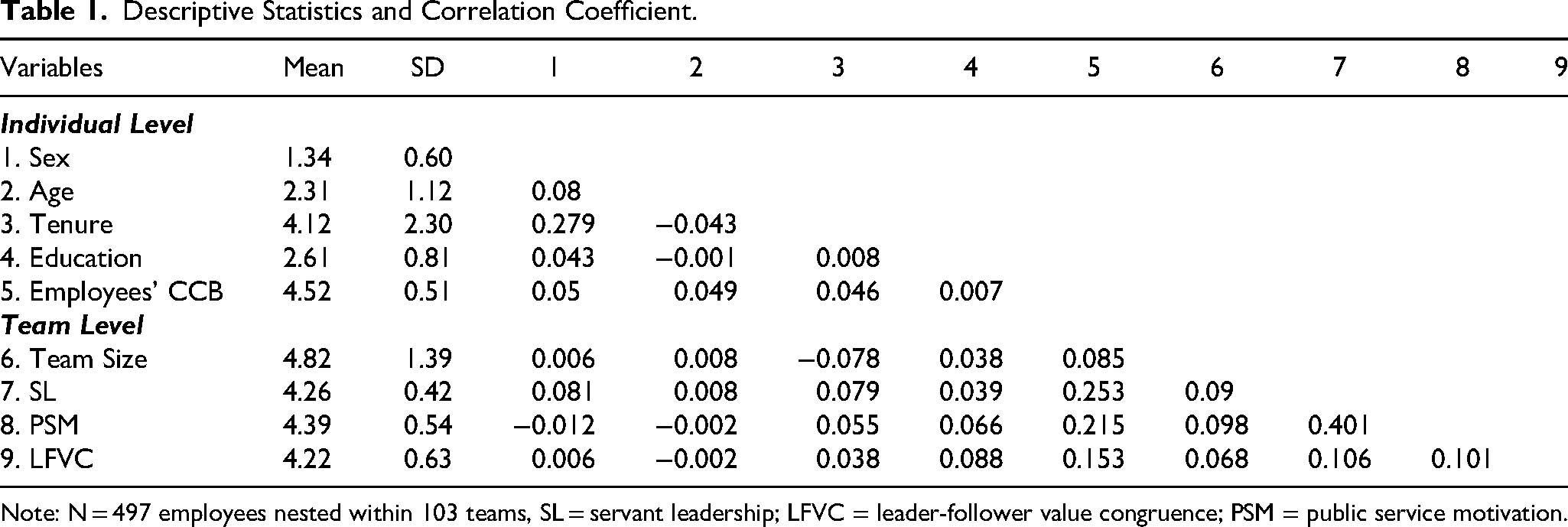
Note: N = 497 employees nested within 103 teams, SL = servant leadership; LFVC = leader-follower value congruence; PSM = public service motivation.
Aggregation and Team-Level Justification
Because the theorised model treats SL, PSM, and LFVC as team-level constructs, we first examined whether aggregation from individual responses to the team level was justified. In full-service hotels, work is organised in intact teams, such as front office, food and beverage outlets, and housekeeping, with shared goals, coordinated routines, high task interdependence, and a common immediate supervisor. This structure provides the social conditions necessary for shared perceptions of leadership, motivational climate, and value alignment to emerge. Following Chan's (1998) typology, we adopted a direct-consensus composition model for team-level SL, PSM, and LFVC. The overall final response rate was 65.5% (497/759). Team-level response rate was defined as the number of Wave 3 respondents in a team divided by the number of Wave 1 invitees in that team. The mean team-level response rate was 74% (SD = 9%), with a range from 62% to 95%. All teams, therefore, met or exceeded the 60% threshold commonly used to support team-level aggregation. To ensure that the results were not driven by lower-response teams, we re-estimated the multilevel models using only teams with response rates of at least 70% (83 teams, 403 employees) and at least 80% (51 teams, 247 employees). In both cases, the substantive pattern of findings remained unchanged, and the point estimates remained within the original 95% confidence intervals.
In terms of aggregation statistics for each team-level construct, within-team agreement and between-team reliability were acceptable for all three variables. For SL, rwg = .73, ICC(1) = .16, and ICC(2) = .72. For LFVC, the corresponding values were .76, .12, and .75, respectively. For PSM, the values were .79, .10, and .72. Thus, adequate within-team consensus and sufficient reliability of team means, thereby supporting the aggregation of SL, LFVC, and PSM to the team level. Given this multilevel structure, we estimated a two-level structural equation model with team-level predictors and employee-level outcomes. We also assessed the possibility of common method variance using the unmeasured latent method factor approach in Mplus 8.0 following Podsakoff et al. (2012). The inclusion of the method factor did not materially alter the substantive pattern of results, suggesting that common method variance was not a pervasive threat to the observed relationships.
Measurement Model Assessment
Before testing the structural model, we evaluated the reliability and validity of the focal constructs. As shown in Table 2, all constructs demonstrated satisfactory psychometric properties. Composite reliability values ranged from .839 to .912, and average variance extracted (AVE) values ranged from .513 to .602, indicating acceptable internal consistency and convergent validity. In addition, the square root of the AVE for each construct exceeded its correlations with the other constructs, supporting discriminant validity in accordance with the Fornell-Larcker criterion.
Reliability, Convergent, and Discriminant Validity.
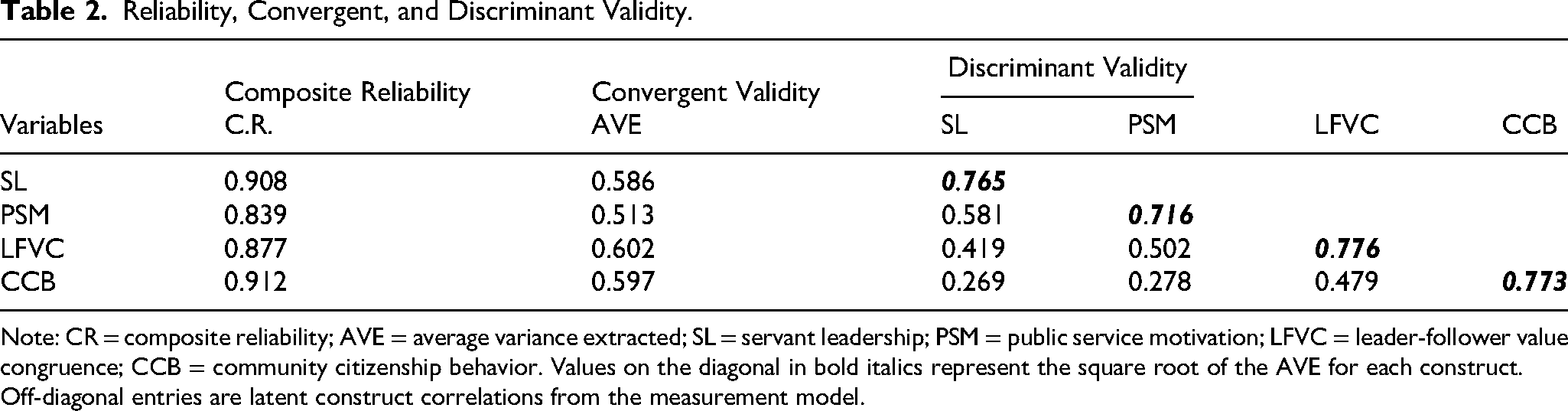
Note: CR = composite reliability; AVE = average variance extracted; SL = servant leadership; PSM = public service motivation; LFVC = leader-follower value congruence; CCB = community citizenship behavior. Values on the diagonal in bold italics represent the square root of the AVE for each construct. Off-diagonal entries are latent construct correlations from the measurement model.
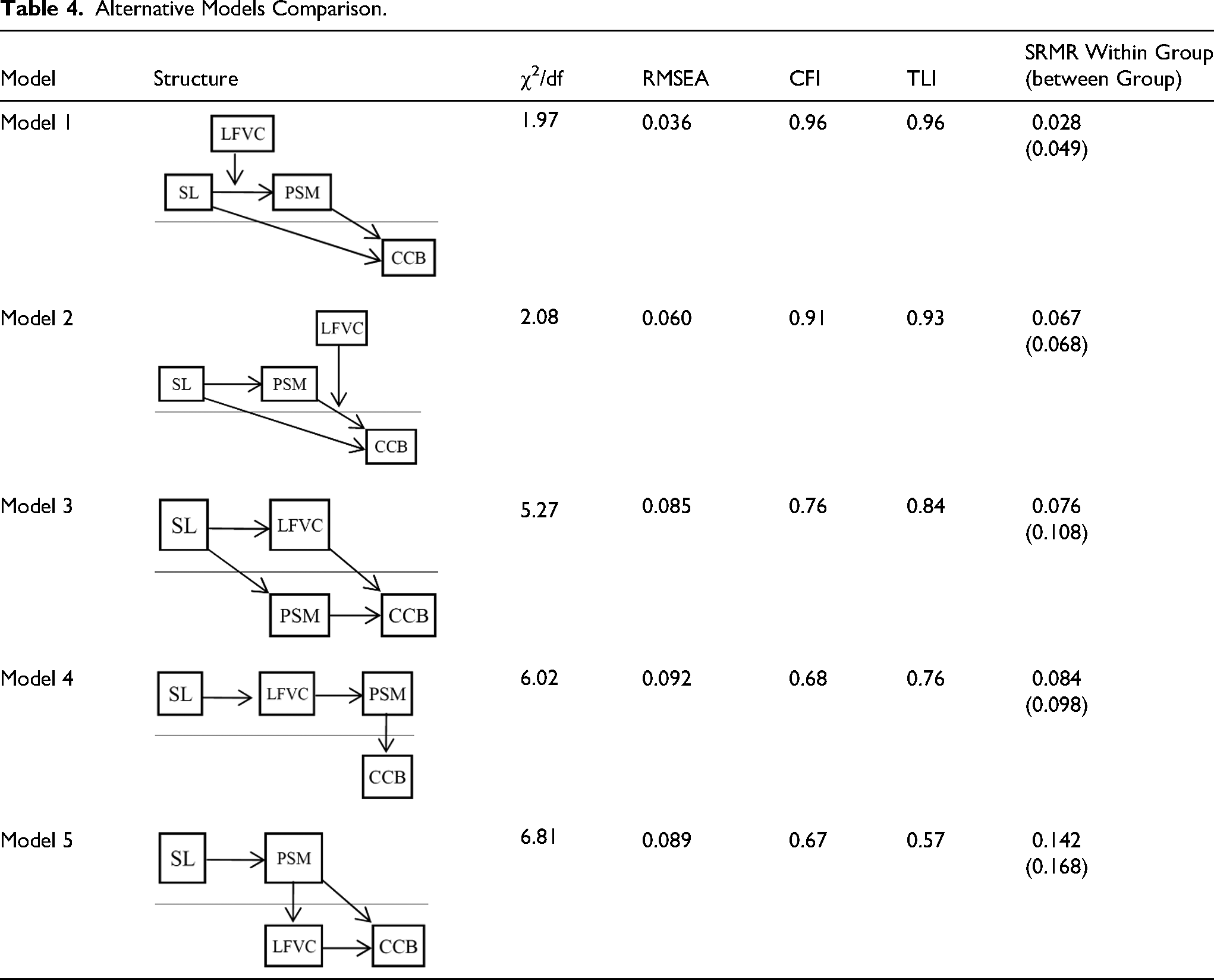
We next examined the distinctiveness of the focal variables through confirmatory factor analysis (see Table 3). The hypothesised four-factor model comprising SL, PSM, LFVC, and CCB fit the data well, χ2(700) = 1437.10, χ2/df = 2.05, TLI = .972, CFI = .984, RMSEA = .045, SRMR = .041. This model fit the data better than the alternative three-factor, two-factor, and one-factor models, all of which produced materially poorer fit indices. Thus, the results support the empirical distinctiveness of the four focal constructs. Moreover, alternative models comparison (Table 4) indicates the hypothsized model fits better.
Confirmatory Factor Analysis and Model-fit Indices.
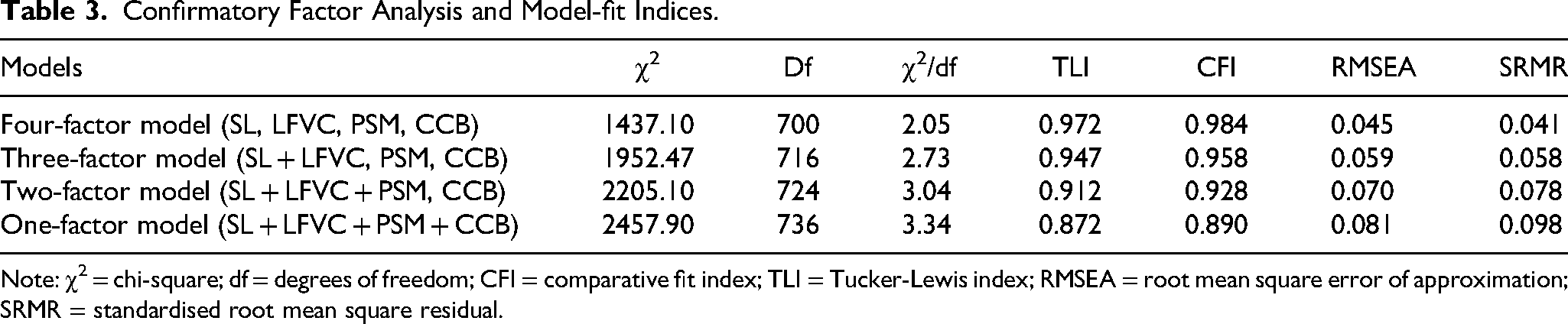
Note: χ2 = chi-square; df = degrees of freedom; CFI = comparative fit index; TLI = Tucker-Lewis index; RMSEA = root mean square error of approximation; SRMR = standardised root mean square residual.
Alternative Models Comparison.
Structural Model and Hypothesis Tests
All structural analyses were estimated using the final sample, controlling for sex, age, education, tenure under the current supervisor, and team size.
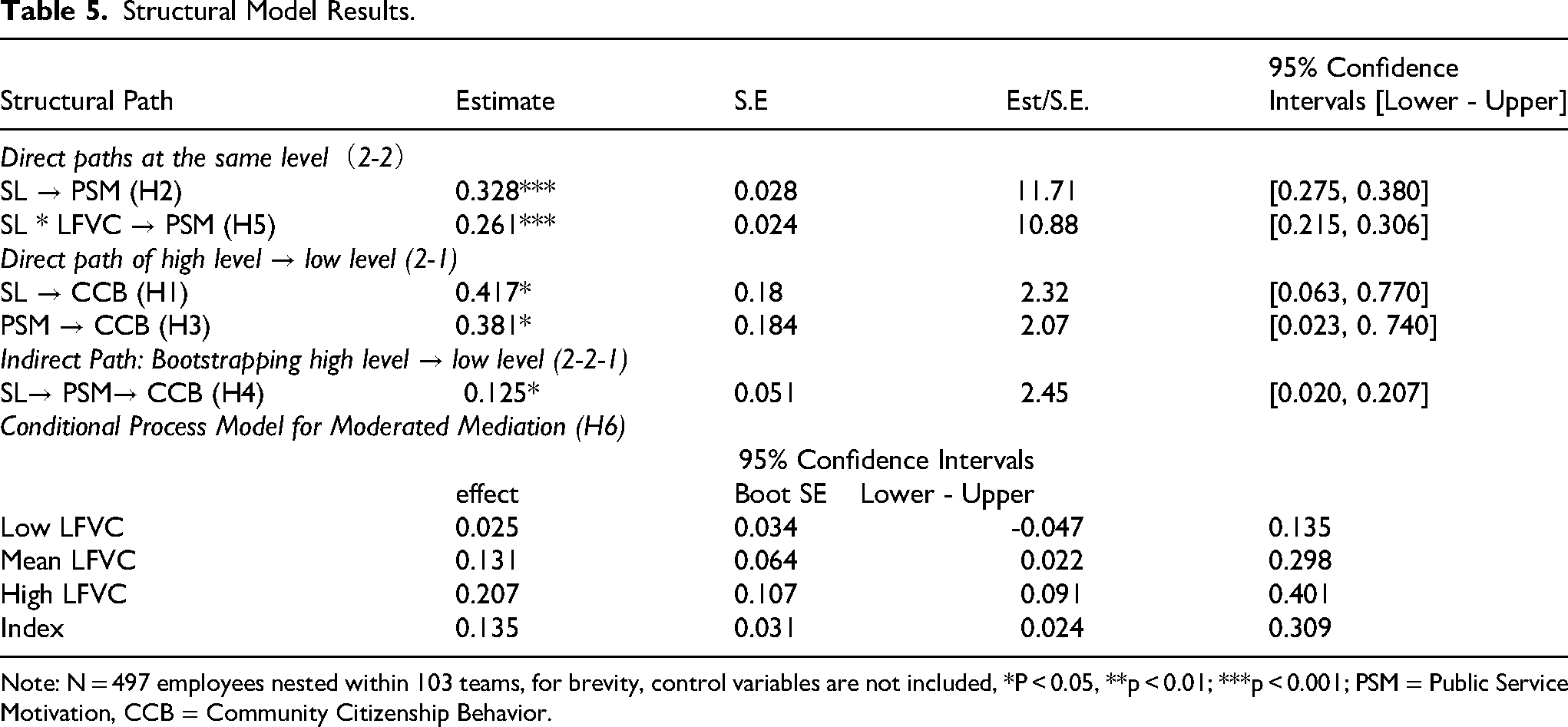
Direct effects: Hypothesis 1 predicted that team-level servant leadership would be positively related to employee CCB. SL positively predicted CCB, b = 0.417, SE = 0.180, z = 2.32, 95% CI [0.063, 0.770]. Thus, H1 was supported. Hypothesis 2 predicted that team-level servant leadership would be positively related to team-level public service motivation. Consistent with this expectation, SL had a significant positive association with PSM, b = 0.328, SE = 0.028, z = 11.71, 95% CI [0.275, 0.380]. Thus, H2 was supported. Hypothesis 3 predicted that team-level public service motivation would be positively related to employee CCB. The results supported this prediction, with PSM showing a positive effect on CCB, b = 0.381, SE = 0.184, z = 2.07, 95% CI [0.023, 0.740]. Thus, H3 was supported.
Indirect effect: Hypothesis 4 proposed that PSM would mediate the relationship between SL and employee CCB. The indirect effect of SL on CCB through PSM was positive and statistically significant, indirect effect = 0.125, SE = 0.051, z = 2.45, 95% CI [0.020, 0.207]. Because the confidence interval did not include zero, the mediating effect was supported. Thus, H4 was supported.
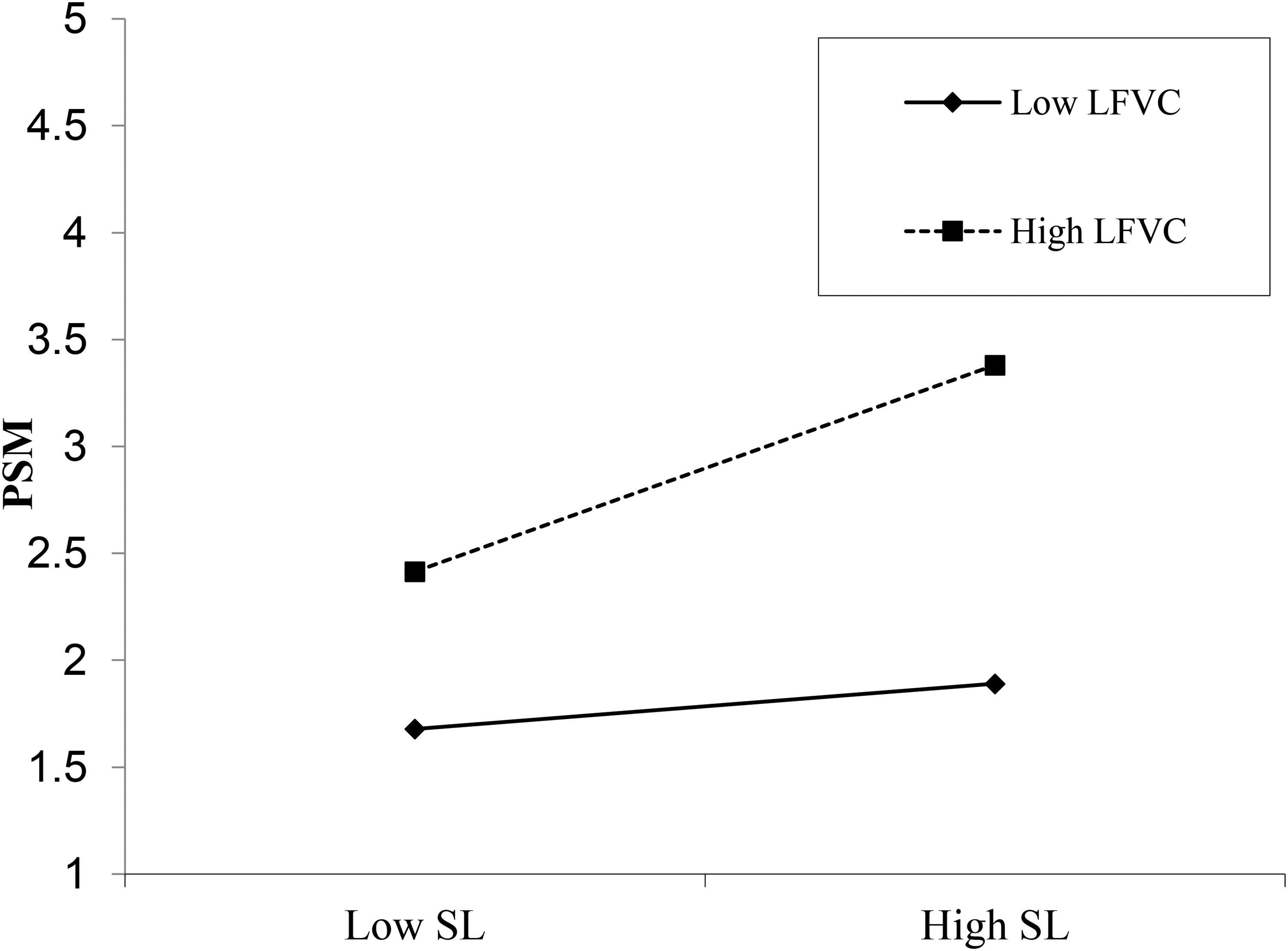
Moderation effect: Hypothesis 5 proposed that LFVC would moderate the relationship between SL and PSM, such that the positive association would be stronger when LFVC was higher. The interaction between SL and LFVC was positive and statistically significant, b = 0.261, SE = 0.024, z = 10.88, 95% CI [0.215, 0.306], indicating that servant leadership is positively associated with PSM at higher levels of LFVC, while the effect is weaker and non-significant at lower LFVC. H5 is thus partially supported (Figure 2).
Moderation.
Conditional Indirect Effect and Moderated Mediation
Hypothesis 6 predicted that the indirect effect of SL on employee CCB via PSM would vary as a function of LFVC and would be stronger at higher levels of LFVC. To test this conditional process model, we estimated the indirect effect at three values of LFVC: one standard deviation below the mean, at the mean, and one standard deviation above the mean. As shown in Table 5, the indirect effect was not significant when LFVC was low, effect = 0.025, Boot SE = 0.034, 95% CI [-0.047, 0.135], because the confidence interval included zero. At the mean level of LFVC, however, the indirect effect was positive and significant, effect = 0.131, Boot SE = 0.064, 95% CI [0.022, 0.298]. The indirect effect became stronger at high LFVC, effect = 0.207, Boot SE = 0.107, 95% CI [0.091, 0.401]. This pattern indicates that the indirect effect of servant leadership on community citizenship behaviour through public service motivation strengthens as leader-follower value congruence increases. The index of moderated mediation was also positive and statistically significant, index = 0.135, Boot SE = 0.031, 95% CI [0.024, 0.309], providing formal support for the conditional indirect effect. Accordingly, H6 was supported.
Structural Model Results.
Note: N = 497 employees nested within 103 teams, for brevity, control variables are not included, *P < 0.05, **p < 0.01; ***p < 0.001; PSM = Public Service Motivation, CCB = Community Citizenship Behavior.
Discussion
This study employed the context of social learning theory (SLT; Bandura, 1977) to explore the association of servant leadership (SL) with cultivating employees’ community citizenship behaviour (CCB) via employees’ public service motivation (PSM), with leader-follower value congruence (LFVC) as a moderating factor. Results indicate that all hypothesised relationships are supported, with the exception of H5, which is only partially supported. Although our data come from hospitality, the mechanism linking team-level SL, PSM, and employee CCB may be relevant to other high-interdependence, team-based service settings where leaders’ modelling and community interactions are salient. Future research should empirically test this generalisation. Boundary conditions include low interdependence, fluid membership, or rotating supervision, which impede shared perceptions and can weaken the pathway. Practically, managers in other service-intensive organisations can adapt the sequence by assessing value congruence, making role modelling observable, and reducing friction for community-facing action, calibrated to local norms.
Theoretical Implications
This study clarifies how servant leadership inspires CCB through motivational (PSM) and relational (LFVC) pathways, refining social learning theory in the context of community-directed behaviour. Though servant leadership has been shown to nurture servanthood among followers (Hunter et al., 2013; Wu et al., 2022), this dual-mechanism approach clarifies the theoretical logic underlying outward-oriented citizenship behaviours. Although our multi-wave, multi-wave design enhances validity, and we recognise it does not constitute a full multi-source model; thus, we cautiously interpret our methodological contribution as demonstrating incremental progress rather than a paradigm shift.
Drawing on SLT, our mechanism specification integrates four subprocesses and shows why servant leaders are unusually potent socialising agents of community stewardship. Close, individualised relationships heighten attention to leaders’ other-regarding cues (Faraz et al., 2023). Leaders’ consistent emphasis on caring for the community strengthens retention by rendering those values cognitively accessible and normatively salient (Liden et al., 2008). Overt, repeated enactment of community stewardship furnishes models for reproduction, clear exemplars employees can emulate in situ. Finally, leaders’ visible concern for followers and investment in their growth enhances motivation to internalise and enact those values (van Dierendonck & Patterson, 2014). These subprocesses collectively explain how team-level SL diffuses other-regarding priorities that are legible, memorable, doable, and worth doing, highlighting the mechanism through which leadership translates into community-directed action.
CCB is modelled as a downstream outcome rather than as a definitional component of leadership. By modelling SL as an antecedent and employees’ CCB as an outcome, the study separates leader behaviour from follower community-directed action at the level of theorising and hypothesis testing. This distinction helps clarify the nomological role of CCB as an employee behaviour that may be related to leadership while remaining analytically distinct from leadership itself. Specifying PSM as the mediator identifies what is learned: a public-facing motive rather than generic pro-sociality. In aligning servant leadership's other-oriented modelling with PSM's altruistic core (Graham, 1991; Perry et al., 2010), we explain why employees cross the organisational boundary to contribute to community stakeholders. In this study, we model PSM at the team level as a shared motivational context that emerges through common exposure to the same leader and work environment. This treatment follows a direct-consensus composition logic (Chan, 1998) and is intended to capture the extent to which public-regarding motivation becomes collectively salient within the team rather than remaining solely an individual disposition. These insights provide a deeper theoretical understanding of how motivation is internalised collectively, advancing both servant leadership and PSM literatures.
The interaction between SL and LFVC on PSM exhibits a clear substitution-complementarity pattern. High LFVC reduces dissonance, heightens the credibility of modelled values, and facilitates their internalisation, thereby strengthening the SL → PSM link and, in turn, the indirect effect on CCB; low LFVC attenuates these learning processes. The simple means show the lowest PSM when both SL and LFVC are low. This is consistent with a misfit account: when leaders model little other-regarding behaviour, and followers perceive value incongruence, the dyadic climate lacks trust and shared priorities, conditions under which social-learning internalisation is unlikely. Notably, our conditional indirect effects formalise this pattern: as LFVC rises, the SL → PSM → CCB pathway strengthens, whereas under low LFVC, the pathway attenuates. These results demonstrate that the reach of servant leadership into community outcomes is contingent on value alignment, refining theoretical perspectives on the contextual and relational factors that shape leadership effectiveness.
Our cross-level theorising adds precision to debates on levels and operationalisation. Modelling servant leadership at the team level while theorising CCB at the individual level reduces construct-outcome conflation and foregrounds the collective motivational channel through which leadership operates. It also extends value-alignment scholarship from attitudinal similarity to a mechanistic account of how alignment conditions the internalisation of leader-modelled, public-regarding motives into outward-facing citizenship. This cross-level perspective clarifies how team-level leadership produces collective motivational contexts, linking leader modelling, follower internalisation, and community-oriented action in a coherent theoretical framework.
Collectively, these theoretical implications move the discourse from asking whether servant leadership promotes prosociality to understanding how, for whom, and under what conditions team-level leadership produces community-directed citizenship. By integrating SLT subprocesses, motivational and relational pathways, and cross-level operationalisation, the study provides a cohesive theoretical framework that explains the mechanisms, moderators, and emergent team-level processes underlying CCB, offering both clarity and guidance for future theory development in leadership research.
Practical Implications
Our findings translate into actionable guidance for leaders seeking authentic, durable community impact. Because servant leadership (SL) operates through social learning, leaders model other-regarding values that followers notice, internalise, and enact. Organisations should invest in practice-based leadership development that makes this modelling visible in day-to-day operations. In hotels, this means managers narrate the “why” behind community-facing choices during pre-shift huddles (e.g., explaining how small acts, refilling a guest's reusable bottle, guiding visitors toward public transit, advance the property's shared commitment to community stewardship); supervisors then reinforce those cues by recognising staff who initiate community-benefiting actions and by connecting those actions to shared stakeholder commitments.
Recognising and rewarding employees who actively engage in community initiatives can help reinforce these desired behaviours, motivating others to follow suit. Formal programmes should not be generic: modules should explicitly cultivate SL capabilities, ethical conduct, empathy, self-sacrifice, and a multi-stakeholder orientation, and include shadowing and reflective debriefs so leaders learn to publicly model the values they aim to diffuse. The goal is not a campaign veneer, but a routine in which leaders’ everyday conduct renders community stewardship normal, legible, and imitable.
Talent systems should be tuned to PSM as the engine that carries leaders’ models into employees’ CCB. Selection can incorporate structured, values-based interviews (e.g., past behaviour prompts about service to the community), realistic previews of the property's community commitments, and reference checks that probe sustained prosocial engagement. Onboarding should clarify how the property partners with local organisations, food banks, shoreline conservancies, neighbourhood schools, and give new hires low-friction entry points (e.g., micro-volunteering during paid lulls, sign-up rosters posted with schedules). For development, short reflective exercises, “how did today's service incident affect the community?”, keep the PSM mechanism salient while avoiding any sense of coercion. These designs align with the motivational pathway our model identifies and make community contribution easy, expected, and voluntary.
A central managerial lever is diagnosing and managing LFVC. Leaders should begin with brief, periodic pulse checks of perceived value alignment at the team level; the results determine how to intervene. Where LFVC is low, value alignment requires parallel attention to leadership training. Properties can rebalance selection and placement (e.g., assigning supervisors with strong community-stewardship reputations to high-contact units), redesign onboarding to include values-clarification storytelling and guest-shadowing that surfaces assumptions about “service to community,” and adjust “choice architecture” so community-facing actions are easy (pre-approved micro-grants for team-led projects; streamlined approvals for volunteering during soft occupancy). Where LFVC is high, the priority is amplification: leaders translate shared values into visible routines (a weekly “community lens” review of guest feedback; after-action reflections when staff assist local events), while the organisation supplies instrumental supports (small budgets and release time for team-initiated projects; partnerships with neighbourhood NGOs that match the hotel's service footprint).
Governance and measurement should reinforce team-level learning rather than individual quotas. Properties can track simple indicators, team participation rates, the continuity and reciprocity of community partnerships, guest-reported community touchpoints, and recognise teams (not only individuals) whose practices sustain external citizenship. Recognition might include story features in internal comms, preferred access to development opportunities, or hosting privileges for partnered community events. Safeguards preserve authenticity: avoid coercive targets; ensure equitable access so opportunities do not privilege day shifts or public-facing roles; and watch workload spillovers during lean staffing. Framed this way, CCB remains a values-consistent option rather than a performance requirement, key to maintaining prosocial engagement over time.
In sum, these implications move beyond “do more servant leadership” to specify where to intervene (values alignment), how to activate the mechanism (public modelling that elevates PSM), and how to sustain it (team-level supports and safeguards). They translate our moderated-mediation into concrete levers managers can actuate to extend leadership's influence beyond the property to the community
Limitations and Future Research
Similar to other scholarship in the management field, we acknowledge the limitations of this research. First, the cross-sectional nature of the research constrains strong causal inference. Although we introduced temporal separation in the data collection process to reduce this concern, future research should employ longitudinal designs to better capture the temporal dynamics linking servant leadership, PSM, LFVC, and CCB.
Second, although the temporal separation of measures helps mitigate common method concerns, the focal constructs relied primarily on employee-reported data. Future research could strengthen confidence in the findings by incorporating multi-source data, including supervisor ratings, peer assessments, or behavioural indicators of community-oriented engagement.
Third, the study was conducted within a specific industrial and cultural context, which necessarily places limits on the generalisability of the findings. While the underlying theoretical logic may travel beyond hospitality, replication across other sectors, institutional settings, and national contexts is needed to establish the robustness and boundary conditions of the proposed model.
Fourth, this study theorised and tested PSM as the central explanatory mechanism through which servant leadership shapes CCB. However, other mediating processes may also be relevant. Future research could examine alternative mechanisms, such as prosocial motivation, moral identity, felt responsibility for constructive change, or broader community-oriented identification.
Fifth, our focus was on the consequences rather than the antecedents of servant leadership. This leaves open important questions regarding the conditions under which servant leadership emerges and is sustained within organisations. Future studies could usefully examine the role of leadership development, organisational culture, selection systems, and socially responsible human resource management practices in cultivating servant leadership.
Sixth, although LFVC was modelled as a theoretically relevant boundary condition, other contextual and individual contingencies may also shape the extent to which servant leadership translates into community-directed behaviour. Future research could therefore examine moderators such as cultural norms, job embeddedness, personality traits, religiosity, social status, and team interdependence to develop a more fine-grained understanding of when and for whom these effects are most likely to occur. Lastly, it must be acknowledged that the CCB measure has historical proximity to servant leadership scholarship, even though your item-level analyses support empirical distinctiveness.
Conclusion
This study addresses a central leadership question: how does a leader's influence extend beyond the organisation into employees’ discretionary contributions to the broader community? Drawing on social learning theory, we argued and found that servant leadership relates positively to employees’ community citizenship behaviour through PSM, and that this pathway is stronger when leader-follower value congruence is higher. By shifting attention from whether servant leadership matters to how and under what conditions it matters for community-directed behaviour, the study contributes a more precise explanation of extra-organisational prosocial influence. Although tested in hospitality, the model has relevance for leadership research more broadly because it highlights how leader-modelled values can travel through shared motivation and value alignment into behaviour that benefits stakeholders beyond the firm.
Footnotes

Ethics and Informed Consent
The researchers clarified the academic nature of the study and obtained approval from relevant authorities in organizations to proceed with data collection. The questionnaires included a clear statement assuring participants of complete anonymity and confidentiality, explaining they had the right to withdraw anytime during the study and that proceeding to fill in the questionnaire shall deem their informed consent. The study was non-invasive, did not involve any intervention or manipulation of the human subjects, and participants were not vulnerable to physical or psychological harm. Responses were accessible by researchers only.
Funding
The authors disclosed receipt of the following financial support for the research, authorship, and/or publication of this article: Partially supported by Research Enhancement Fund (REF-25-01-001), Xian Jiaotong-Liverpool University.
Declaration of Conflicting Interests
The authors declared no potential conflicts of interest with respect to the research, authorship, and/or publication of this article.
Data Availability
This research data is available from the corresponding author upon request.