







Abstract
We propose a novel design for high-power laser source generation using a Gaussian pulse propagating within an embedded optical device system. The system consists of a non-linear microring resonator and an add-drop filter. In principle, a Gaussian laser pulse with a specified center wavelength ranging from 0.40 to 1.50 µm is fed into the designed system. By using suitable ring parameters, the required output at the specific center wavelength and power can be obtained by controlling the coupling coefficients of the add-drop filter. The power outputs for different center wavelengths were generated, for instance, 0.8, 1.3, 1.5 µm, which can be used to form suitable operating wavelengths for various applications, such as laser guns, swords and medical tools’.
1. Introduction
Recently, it was pointed out that the time has come for the generation of science fiction weapon known as a death ray to become a realistic tool. 1 The weapon can be used for many applications, for instance, nuclear weapons or missile defenses, laser guns and medical tools. In this work, we will show some interesting results obtained by using a laser within a tiny device. An optical soliton can be recognized as a powerful light source for high-powered lasers. However, a pumping system is required before the soliton can being generated. For simplicity, a Gaussian soliton is recommended to form the soliton instead of pumping the soliton. One interesting aspect of the Gaussian soliton is that the non-dispersive soliton can be realized by using a 1.30 µm light source. Many research works have reported on the use of a Gaussian pulse.1–6 Recently, the interesting aspect of light pulse propagating within a non-linear microring device has been reported, 7 in which the transfer function of the output at resonant condition is derived and studied. It was found that the broad spectrum of the light pulse can be transformed into discrete pulses. An optical soliton is used to enlarge the optical bandwidth when propagating within the non-linear microring resonator.8,9 The superposition of self-phase modulation (SPM) soliton pulses, either bright or dark 10 solitons, can generate a large output power. Hasegawa 11 has described many application works on soliton applications in optical fibers. Many of the soliton-related concepts in fiber optics are discussed by Agrawal. 12 It is necessary to solve and address the problems of soliton–soliton interactions, 13 collision, 14 rectification 15 and dispersion management. 16 . In this work we are looking for a common laser source that can be used to generate the broad spectrum of lasers, in particular with the broad center wavelengths within the range from 0.40 to 1.50 µm. By using suitable microring parameters, most of the results have shown that the optical signals, that is, Gaussian pulse, can be amplified within the non-linear ring resonator system. The flat laser output can be generated with sufficient high power, which is available for applications such as laser guns and laser cutting devices. In addition, the compact device can be constructed by small embedded devices, which is useful in practical applications.
2. High-power laser generation
Light from a monochromatic light source is launched into a non-linear microring resonator. The combination of terms in attenuation (α) and phase (φ0) constants results in the temporal coherence degradation. Hence, the time-dependent input light field (Ein), without the pumping term, can be expressed as

Here L is the propagation distance (waveguide length).
We assume that the non-linearity of the optical ring resonator is of the non-linear Kerr type. The refractive index is given by

Here
When a Gaussian pulse is input and allowed to propagate within a fiber ring resonator, a resonant output is formed. Thus, the normalized output of the light field is the ratio between the output and input fields (
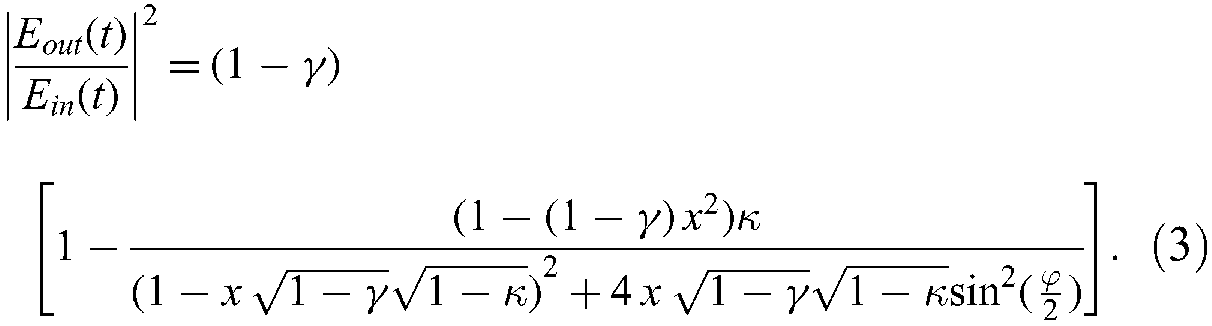
Equation (3) describes a ring resonator with a property equivalent to that of a Fabry–Perot cavity, with an input and output mirror of field reflectivity, (1−
The input optical field, as shown in Equation (1), that is a Gaussian pulse, is input into a non-linear microring resonator. By using the appropriate parameters, the chaotic signal is obtained by using Equation (3). To retrieve the signals from the chaotic noise, we propose the use of the add-drop device with the appropriate parameters. The optical outputs of the add-drop filter are given by Equations (4) and (5):
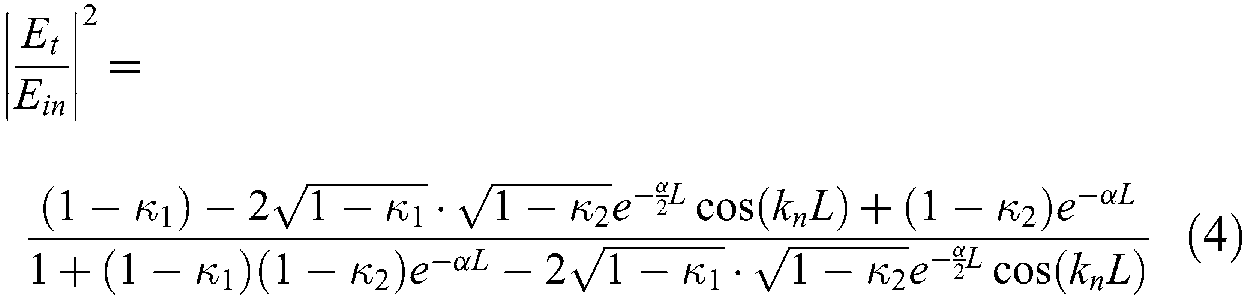
and
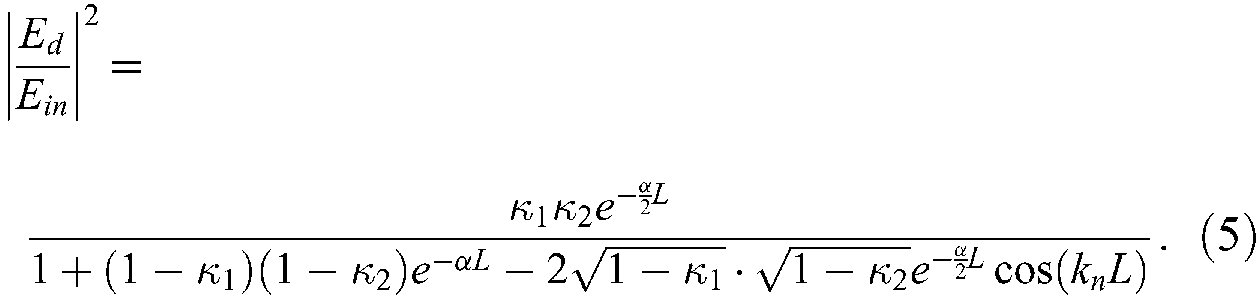
Here Et and Ed represent the optical fields of the throughput and drop ports, respectively. The transmitted output can be controlled and obtained by choosing the suitable coupling ratio of the ring resonator, which is well derived and described by Yupapin and Suwancharoen.
7
Here
In simulation, the light pulse is sliced into a discrete signal and amplified within the first ring, where more signal amplification can be obtained by using the smaller ring device (second ring), as shown in Figure 1. Finally, the required signals can be obtained via a drop port of the add-drop filter. In operation, an optical field in the form of a Gaussian pulse from a laser source at the specified center wavelength is input into the system. The Gaussian pulse with center wavelength (λ0) at 0.40 µm, pulse width (Full Width at Half Maximum, FWHM) of 20 ns and peak power at 2 W is input into the system, as shown in Figure 2(a). The large bandwidth signals can be seen within the first microring device, as shown in Figure 2(b). The suitable ring parameters are used, for instance, ring radii R1 = 16.0 µm, R2 = 5.0 µm and Rd = 25.0 µm. In order to make the system associate with the practical device, 17 the selected parameters of the system are fixed to n0 = 3.34 (InGaAsP/InP), Aeff = 0.50 µm2 and 0.25 µm2 for a microring and add-drop ring resonator, respectively, with α = 0.5 dB mm−1 and γ = 0.1. In this investigation, the coupling coefficient (‘κ’) of the microring resonator is varied from 0.55 to 0.90. The non-linear refractive index of the microring used is n2 = 2.2 × 10⁻¹⁷ m2/W. In this case, the attenuation of light propagates within the system (i.e. wave guided) used is 0.5 dB mm−1. After light is input into the system, the Gaussian pulse is sliced into a smaller signal spreading over the spectrum due to the non-linear effects, 5 which is shown in Figure 2(a). The large bandwidth signal is generated within the first ring device. In applications, the specific input or output wavelengths can be used and generated. For instance, the different center wavelengths of the input pulse vary from 0.40 to 1.5 µm, as shown in Figures 2–7, where the suitable parameters are used and shown in the figures.
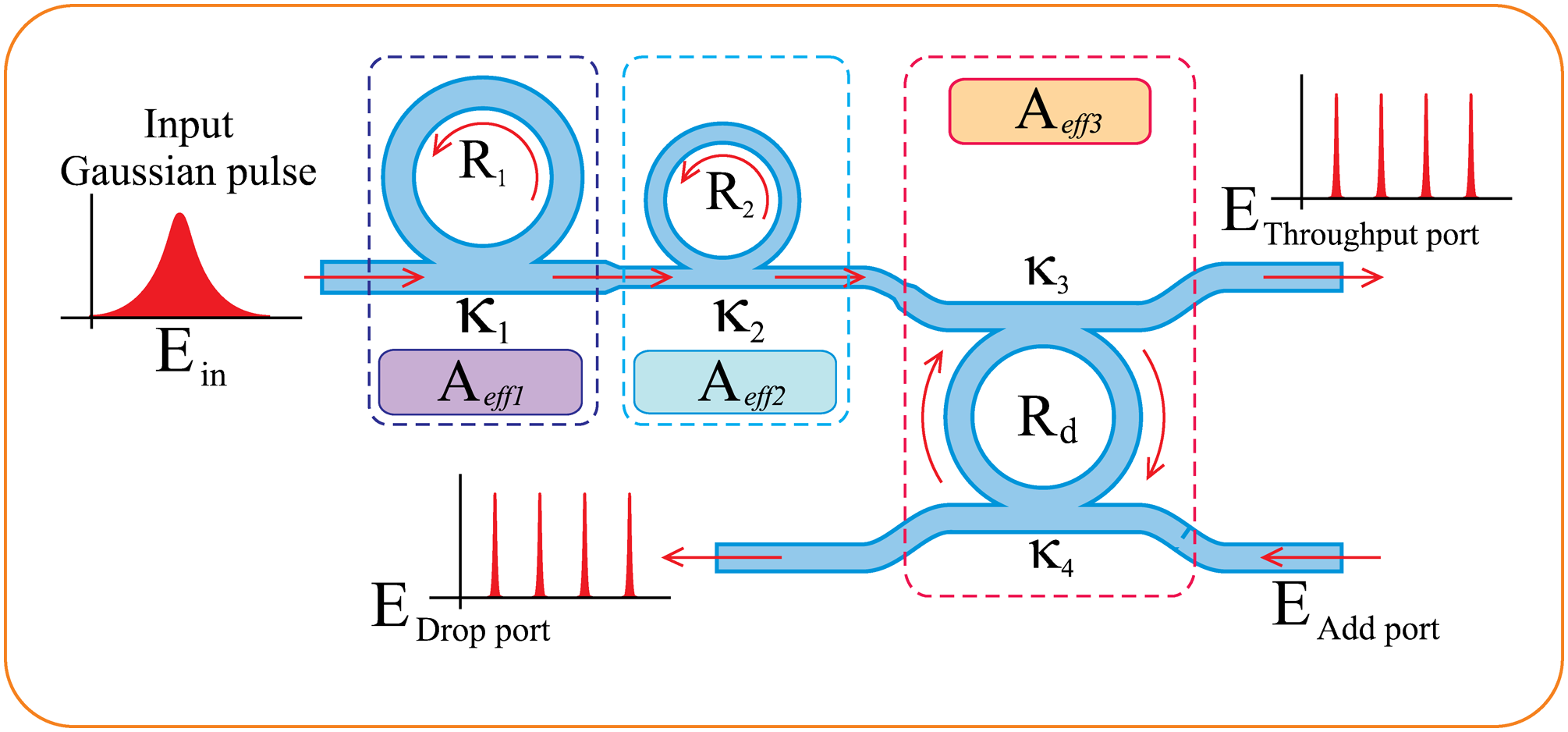
A schematic of a Gaussian soliton generation system for laser guns and laser tools, where Rs is ring radii, κs is coupling coefficients, Rd is an add-drop ring radius and Aeffs is effective areas.
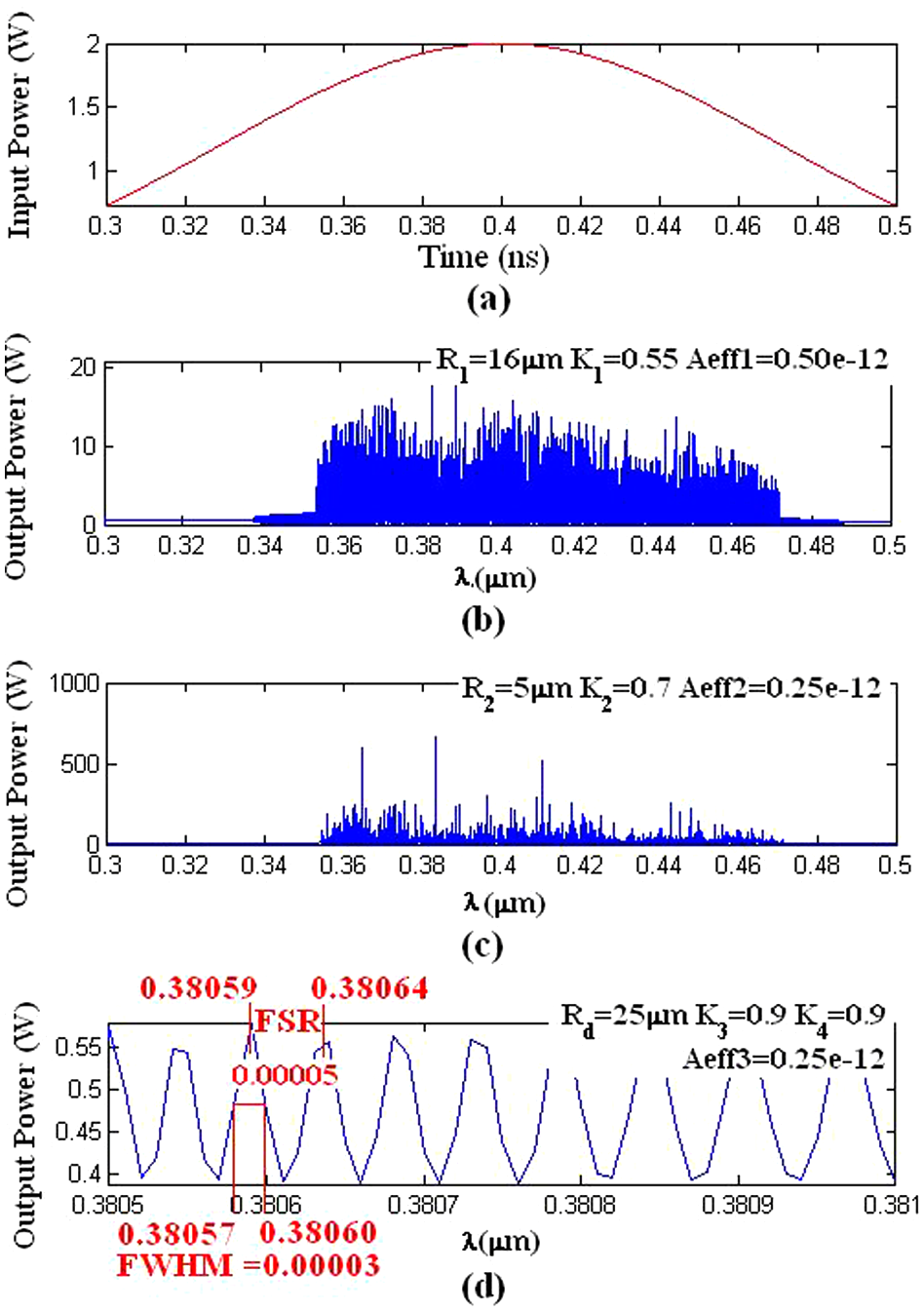
Result of the spatial pulses with center wavelength at 0.40 µm, where (a) shows the Gaussian pulse, (b) shows the large bandwidth signals, (c) shows the large amplified signals and (d) shows the filtering and amplifying signals from the drop port.
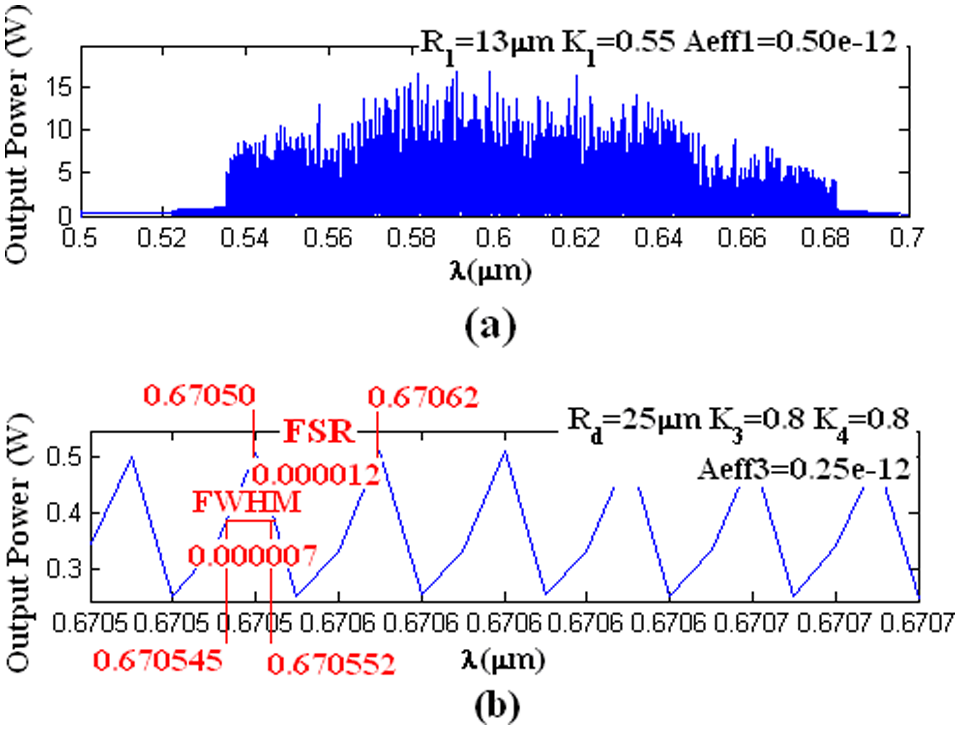
Result of the spatial pulses with center wavelength at 0.60 µm, where (a) shows the large bandwidth signals and (b) shows the filtering and amplifying signals from the drop port.
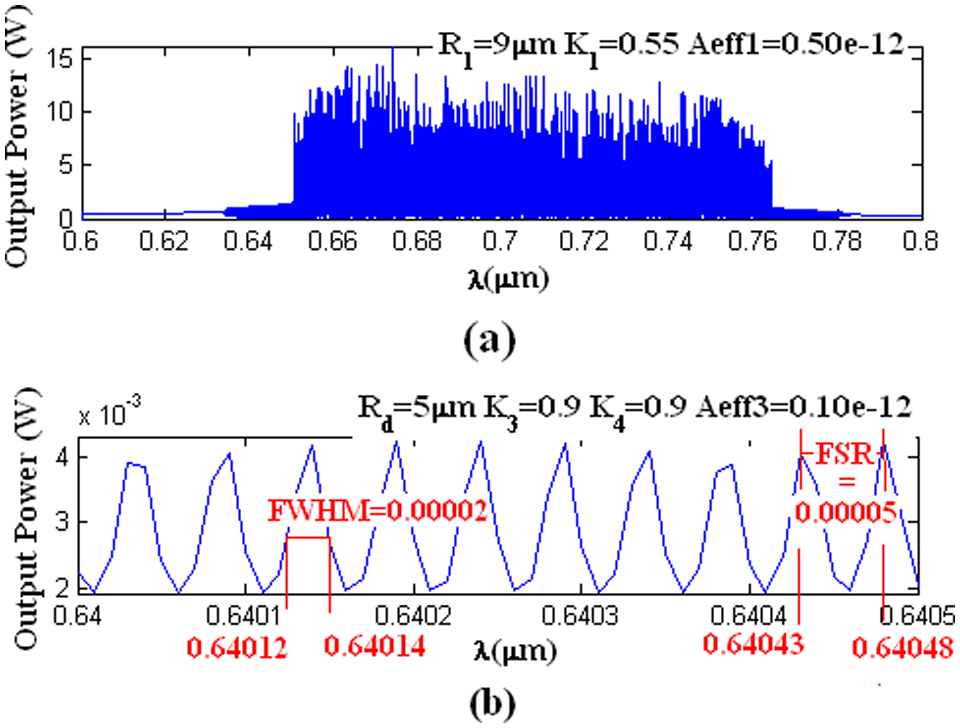
Result of the spatial pulses with center wavelength at 0.70 µm, where (a) shows the large bandwidth signals and (b) shows the filtering and amplifying signals from the drop port.
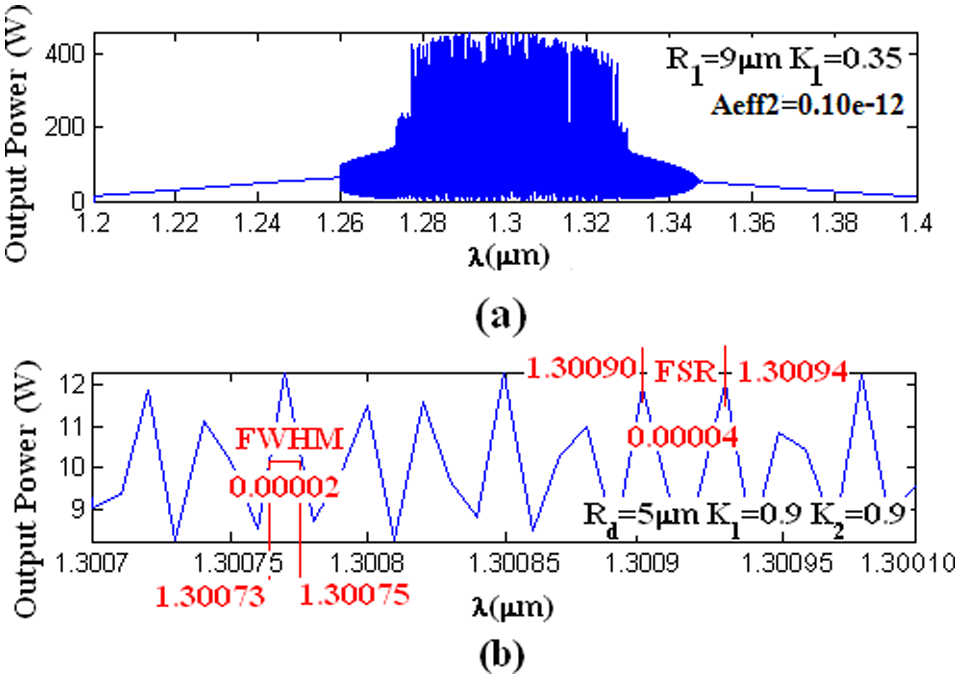
Result of the spatial pulses with center wavelength at 1.30 µm, where (a) shows the large bandwidth signals and (b) shows the filtering and amplifying signals from the drop port.
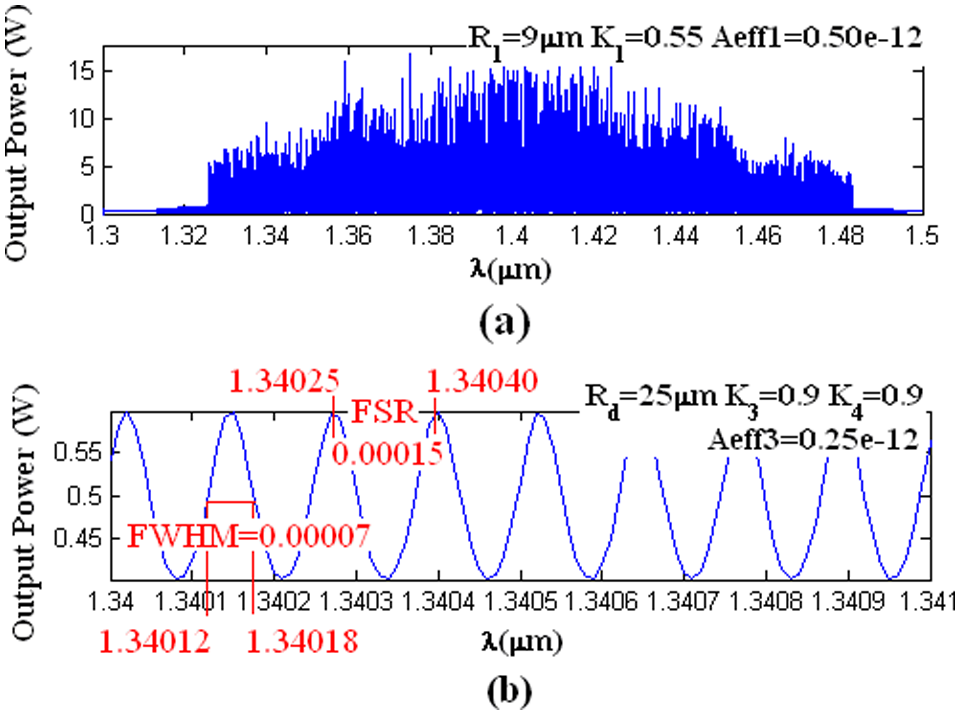
Result of the spatial pulses with center wavelength at 1.40 µm, where (a) shows the large bandwidth signals and (b) shows the filtering and amplifying signals from the drop port.
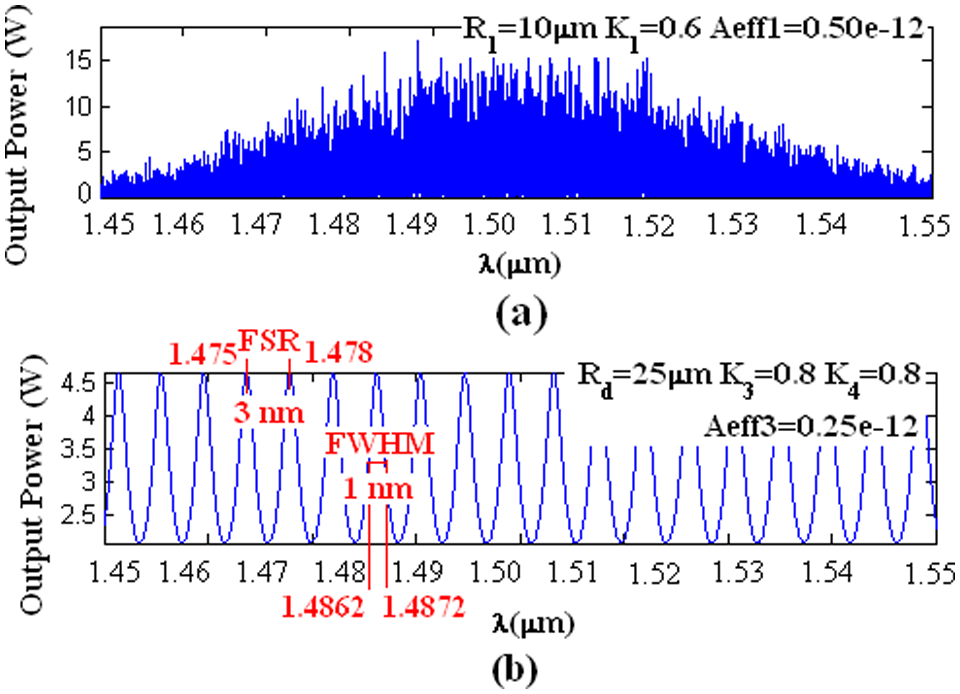
Results of the spatial pulses with center wavelength at 1.50 µm, where (a) shows the large bandwidth signals and (b) shows the filtering and amplifying signals from the drop port.
3. Laser gun mechanism
The results obtained have shown that a wide range of laser sources can be generated, while the generation of a high-power light source can also be achieved. By using the results obtained from Section 2, the laser tools system can be designed as shown in Figure 8. In principle, for safety reasons, the controlled unit is very important in this design. Therefore, each part of the system is carefully described. After the input Gaussian pulse is amplified and reaches the specified value, the optical energy will be stored in ring resonator R3, which has been designed and well described by Yupapin and Pornsuwancharoen. 18 The controlled parameters are the coupling coefficients (κ31, κ3 and κ32) that are chosen for controlling the output energy. In applications, the number of light sources generated and stored within the embedded system, can be used for the different requirements.
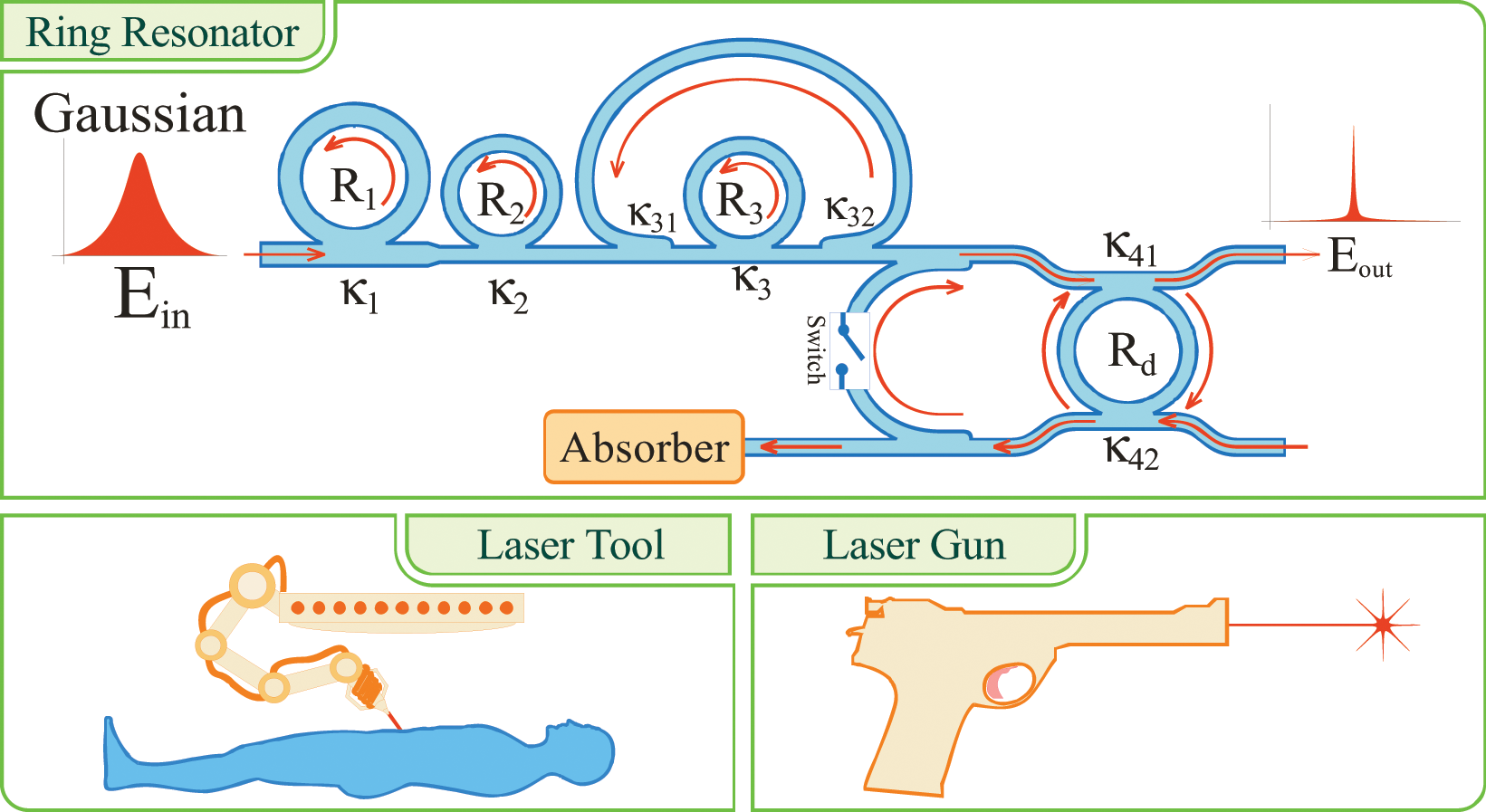
Laser tool mechanism diagram, where Rs is the ring radii, κs is the coupling coefficients, Rd is an add-drop ring radius and Aeffs is the effective areas.
For safety reasons, the coupling coefficients κ41and κ42 are designed for low-output energy. The laser energy can be increased by controlling the optical switch. The absorber is operated when the switch is in the open status, that is mode, thus providing low-output energy. The semi-automatic running mode can be arranged by keeping the optical switch in the operating position. Otherwise, it will be the manual operation status as shown in Figure 8. The various applications, such as medical and kitchen tools, laser guns and laser swords, can be operated by choosing the suitable laser center wavelength, output energy and beam size.
4. Conclusion
We have shown that multi-wavelength laser sources can be generated by using a Gaussian pulse propagating within the microring resonator system, for medical tool applications with wavelength centers ranging from 0.40 to 1.50 µm. In applications, by using a wider range of ring parameters, the spectral range of the output can be covered for a wider range instead of a fraction of nm. The large increase in peak power is seen when light propagates from the large to small effective core area. The output power ranges from a few watts to kilowatts and can be designed to meet the different applications requirements. The advantage of the proposed system is that the communication laser (a basic commercial laser), a laser diode, can be pumped and the output power increased by using a non-linear optical device. We found that when the input source used was 1.3 µm, the Gaussian soliton behavior is seen as shown in Figure 5(a), which is available for our applications. However, this is a simulation work, in which the cooling part will be required to absorb the heat dissipation within the system.
Footnotes
Funding
This research received no specific grant from any funding agency in the public, commercial or not-for-profit sectors.