






Abstract
In this paper we present a model for expressing attacks on control protocols that involve the exchange of messages. Attacks are modeled using the notion of an attacker who can block and/or fabricate messages. These two attack mechanisms cover a variety of scenarios ranging from power grid failures to cyber attacks on oil pipelines. The model provides a method to syntactically express communication systems and attacks, which supports the development of attack and defense strategies. For demonstration purposes, an attack instance is modeled that shows how a targeted messaging attack can result in the rupture of a gas pipeline.
1 Introduction
The electric power grid, oil and gas pipelines, railways and other critical infrastructures are viable military targets. Attacks on these systems disrupt communications, hinder logistical support, create confusion, and achieve psychological effects. The majority of systems that comprise critical infrastructures rely on control protocols to command, direct and monitor operations. Inherent vulnerabilities in these protocols enable an attacker to exploit message transactions in order to manipulate control system operations. As demonstrated by the recent Stuxnet virus, non-kinetic means have the ability to achieve direct kinetic effects. Indeed, manipulation of operations can result in devastating consequences.
This research presents a model for expressing attacks on control protocols that involve the exchange of messages. Attacks are modeled using the notion of an adversary who can block and/or fabricate messages. These two attack mechanisms cover a variety of scenarios ranging from power grid failures to cyber attacks on oil pipelines.
The model, which is defined using a process calculus, helps conceptualize attacks in one control protocol and translate them to similar attacks in another protocol. It also assists in targeting specific control protocol and system implementations. In particular, the model helps identify the information requirements, articulate possible outcomes and examine the feasibility of attacks based on the available information. The comprehensive understanding of attacks can facilitate risk analysis and risk management, the implementation of defensive postures, and the design of robust protocols.
2 Discussion of related work
The majority of attack models for computer systems are founded on the notion of an attack tree. 1 The root node of an attack tree denotes the goal of the attacker. The steps for completing the attack are decomposed using parent–child relations such that a path from a leaf node to the root node expresses one instance of the attack. The possible attacks correspond to the different branches of the attack tree. Attack trees have been shown to capture a variety of computer system attack scenarios.2,3
Attack tree models are attractive because of their simplicity and ease of analysis. However, certain ambiguities and the lack of expressiveness of attack tree models hinder quantitative reasoning and comparison. Precise analysis is difficult because an attack tree node represents both the current system state and the specific attack action. 4 Also, attack trees are susceptible to state explosion, they do not represent the temporal aspects of dependent attacks, and lack the ability to generalize beyond the modeled scenario. 5
An alternative model to attack trees 5 views attacks as a series of capabilities instead of a sequence of events. It provides constructs for defining intrusion signatures and automating the discovery of attacks. Other researchers have proposed taxonomies for classifying attacks, 6 ontology-based models, 7 and attack models using simulations of cyber attacks. 8 These models describe complex scenarios involving multiple attacks; however, they lack formalisms for analyzing causality and sequential events. Analysis focuses on generalized structures associated with an adversary’s perceived actions. The methodology has some advantages for defining signatures of attacks for intrusion detection. However, the ability to define system specific scenarios and conceptualize variants of attacks is limited.
Little, if any, research has specifically focused on modeling attacks on control system protocols. Current work has tended to focus on modeling intrusion and anomaly signatures, identifying attributes for system resilience and evaluating system vulnerabilities for risk analysis. The US Department of Energy, 9 National Institute of Standards and Technology, 10 and other entities 11 have developed models for predicting, reacting to, and understanding failures in control systems. Several failure analysis models 12 demonstrate the conditions that can lead to failures in control systems. Our model does not directly focus on failure analysis. However, a failure analysis model can be used to determine the conditions under which physical damage can occur. The conditions can then be analyzed using our model to determine how a control protocol may be attacked to cause physical damage.
Byres et al. 13 used attack trees to identify vulnerabilities inherent in the specification and typical deployment of the Modbus control protocol. Similarly, other works14,15 have presented taxonomies of vulnerabilities that are specific to Modbus and DNP3. Their research is intended primarily to identify generalized attack scenarios.
Cheung et al. 16 described a language for modeling attacks on process control systems. Because control systems are relatively static, models can be constructed to characterize the expected system behavior. Traffic that does not conform to normal traffic patterns is identified as a potential attack. The concept focuses on a purely defensive posture that assumes attackers will not use legitimate traffic in an attack. Our model is attack-centered and incorporates the use of legitimate messages in attack scenarios. Moreover, our model expresses temporal aspects and causal effects while lending itself to formal analysis.
Other models leverage finite state machines and automata theory. Ye et al. 17 and Carlson et al. 18 presented models using Markov chains to represent a profile of computer-event transitions. Activities are observed to profile normal traffic through sequential ordering of events. Similarly, several finite state machine models based on Petri nets19,4,20 have been used to express common computer attacks. Petri nets use graphs and set theory to model concurrency, synchronization, resource allocation, and randomness. Petri net models explicitly specify consequences of attack states and provide a means for formal analysis. However, Petri nets leverage a purely concurrent construct that randomly transitions to different states. 21 Although the non-determinism is adequate for analyzing the safeness of a system, it introduces complexity when defining specific attack sequences. In addition, Petri nets are limited by an inability to use one instance to model similar attacks.
3 Modeling control systems
Control systems use central monitoring stations, typically with a human–machine interface for an operator in the loop, to control and monitor remote processes. Remote terminal units (RTUs) or programmable logic controllers (PLCs) are field devices that communicate with the monitoring stations and convert digital messaging into physical actions such as opening and closing valves and breakers, collecting data from sensor systems, and monitoring the local environment for alarm conditions.
Control systems use a request–response communication paradigm for message transmission between a master control device and edge field devices. 22 The control device sends request messages to outlying edge devices to gather monitoring data or to specify control actions. The edge devices collect discrete and analog sensor data and maintain actuator settings specified by the control device. Response messages are generated by edge devices after direct requests from the control device. In addition, when alarm conditions are detected the edge device may notify the control device.
A control system architecture comprises control devices, edge devices and communication links. Note that communication links may include myriad devices (e.g. gateways, repeaters, and modems). For purposes of this discussion, communication links refers to the infrastructure that facilitates message exchange between control and edge devices.
The control system architecture is specified in the model with control devices/edge devices
4 Process calculus representation
This section introduces a simple, yet expressive, process calculus for modeling communication paradigms in control systems.
Process calculi are a diverse family of mathematical formalisms for describing and analyzing properties of concurrent computations. 23 Process calculi provide a tool for the high-level description of process interaction, communication, and synchronization. System attributes are observed and manipulated to permit formal reasoning about process behavior and system characteristics.24,25 The control system processes that enable data exchange and concurrent interaction are readily modeled using a process calculus. The ability to express hierarchical communications, logical sequences of events, concurrency, and system-wide situational awareness enable the modeling of control system message transactions that the formalisms described in Section 2 do not afford.
4.1 Basic concepts
In a process calculus, primitive constructs are used to build equations that define system behavior. Table 1 lists the primitive constructs used in this research, which are based on Milner’s work on communication and concurrency 24 .
Primitive process calculus constructs.
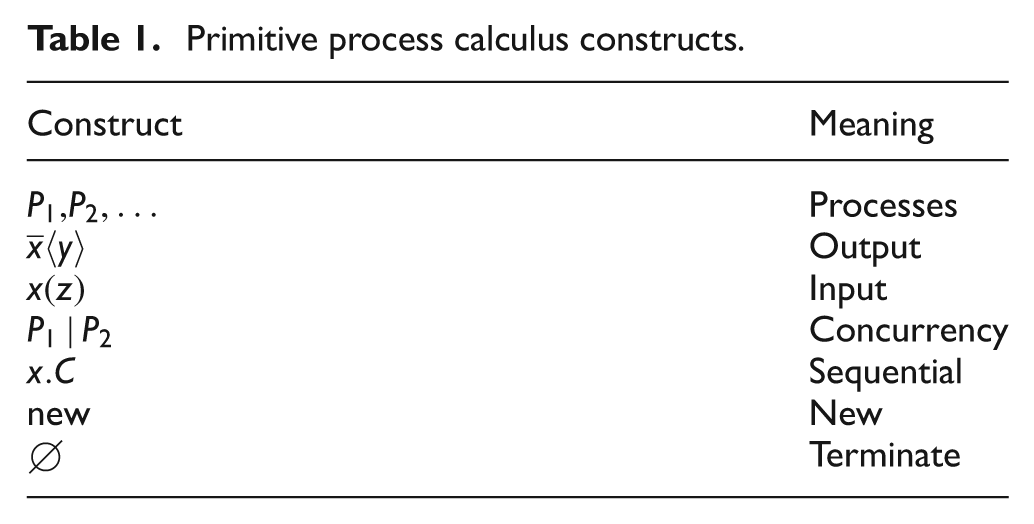
A process is an autonomous entity that uses channels to communicate and interact with other processes. Communication is specified as the directed flow of messages.
The output construct
Concurrency, specified as
The sequential construct allows interactions to be ordered temporally. In general, the sequential construct is associated with the output and input constructs to model a process sending a message or a process expecting a message. The output prefixing
The new construct specifies the instantiation of new system attributes. For example, a process invoked to facilitate a message exchange may be declared as
4.2 Message transactions
A communication paradigm
The communication channels for message flow and synchronization are derived from the functional control system architecture. The symbol
Control systems employ three types of message transactions: (i) request-only; (ii) unsolicited-reply; and (iii) request-reply. The request-only message transaction consists of a control device sending a request message to an edge device. A typical example is a broadcast sent from a control device that does not solicit a response message from receiving edge devices. The request-only message transaction is expressed as
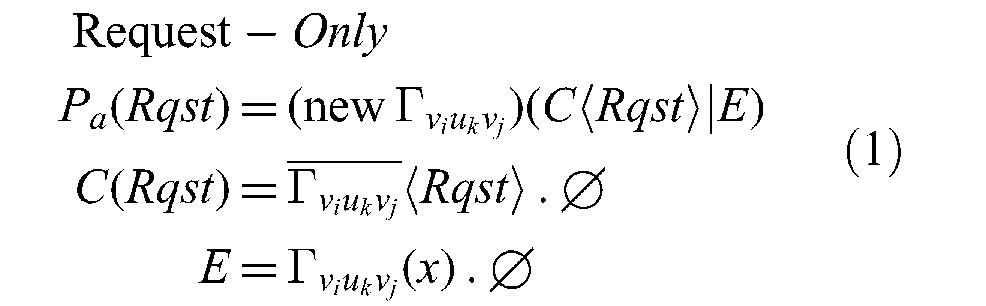
Note that
In Equation (1), the process
The unsolicited-reply message transaction consists of an edge device sending a reply message to a control device. This message transaction is used primarily to alert control devices to alarm conditions. The unsolicited-reply message transaction is expressed as
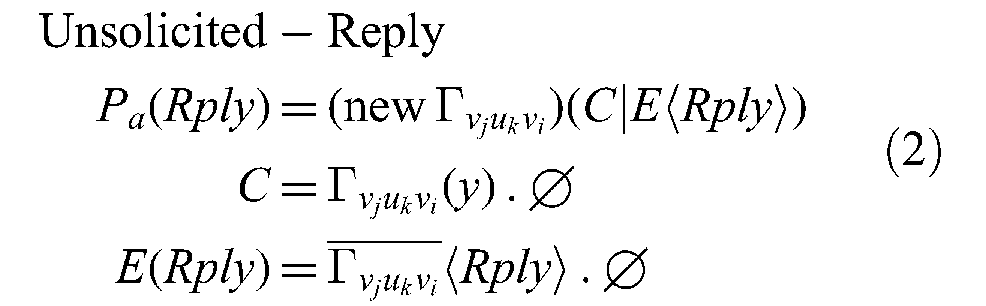
The unsolicited-reply message transaction is similar in execution to the request-only message transaction. The primary difference is that a message is sent from the edge device process
The request-reply message transaction consists of a control device sending a request message to an edge device, prompting the edge device to send a reply message to the control device in response. The request-reply message transaction constitutes the majority of communications in control systems. Typically, control systems employ these message transactions for round-robin polling. The request-reply message transaction is expressed as
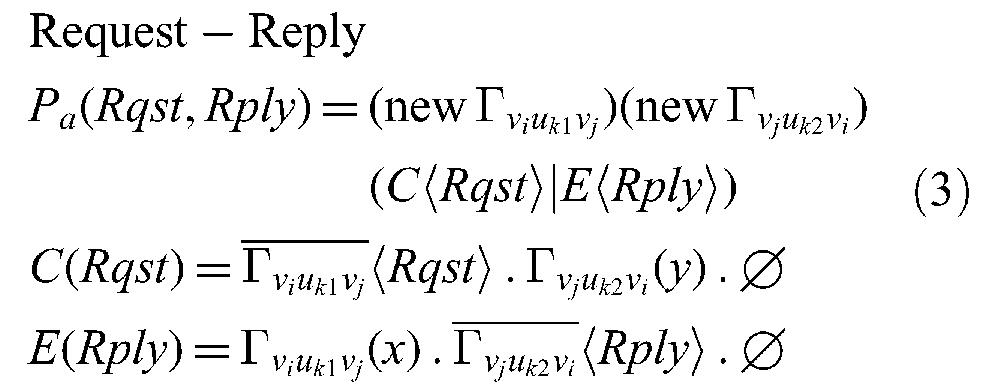
The request-reply message transaction involves two-way synchronization between a control device and an edge device. Two message channels
4.3 Control protocol classification
Communication paradigms are categorized according to the types of message transactions they incorporate. The Venn diagram in Figure 1 shows the seven communication paradigms. Class 1 incorporates request-only, unsolicited-reply, and request-reply message transactions. Class 5 incorporates request-reply message transactions.
For example, the DNP3 protocol used in the electric power grid belongs to Class 1. On the other hand, Modbus incorporates request-only and request-reply message transactions and belongs to Class 2.

Communication paradigms.
For descriptive purposes, the seven communication paradigms are labeled as follows:
Class 1 – Unrestricted Paradigm;
Class 2 – Request Paradigm;
Class 3 – Notify Paradigm;
Class 4 – Asynchronous Paradigm;
Class 5 – Synchronous Paradigm;
Class 6 – Nagging Paradigm;
Class 7 – Chatterbox Paradigm.
The unrestricted paradigm expresses a range of functional operations as it incorporates all three types of message transactions. The request and notify paradigms are slightly more restrictive; both offer one-way message transactions as well as request-reply message transactions. The more restrictive asynchronous paradigm only supports one-way message transactions from control devices to edge devices or from edge devices to control devices. The synchronous paradigm only supports two-way synchronized message transactions between control devices and edge devices.
The nagging and chatterbox paradigms are an interesting set of degenerate paradigms. The paradigms are strictly one way and have limited utility in normal operations. However, an adversary may attempt to transition a control protocol to a degenerate paradigm. Interestingly, the communication paradigm determines the susceptibility of a control system to messaging attacks.
4.4 Modeling communication paradigms
This section describes the formalisms associated with modeling communication paradigms.
The following equations define the seven communication paradigms:







Note that the subscript identifies the specific paradigm.
A communication paradigm may invoke the message transactions that are specified in the corresponding equation. For example, the unrestricted paradigm defined by Equation (4) incorporates the request-only, unsolicited-reply, and request-reply message transactions.
Note that
Equations (1)–(3) define the syntax for valid message transactions in a control system. If a process is initiated but is unable to proceed and terminate (e.g. sequencing to wait for an input message from another process that does not exist), the corresponding message transaction results in a state of deadlock.
Note that message transactions are modeled as independent, unique instances. Consider a broadcast message sent from control device
5 Modeling attacks on control systems
Process calculi provide a means for studying complex, concurrent systems. Equational reasoning allows the verification of correctness and safe operations of a system (e.g. determining whether a system can reach a deadlock state). 27 The analysis, however, primarily focuses on implementation behavior with respect to system design; the possibility of an adversary intentionally altering system processes is not considered.
This section introduces the notion of an adversary whose goal is to use messaging attacks to achieve a desired effect. An adversary has three entry points or avenues for launching attacks: (i) control device(s); (ii) edge device(s); and (iii) communication link(s). Control device compromise provides access between functional control system operations and the human controller. Edge device compromise provides access between the physical operations and the control system. Gaining access to the control system through a communication link provides specific man-in-the-middle access.
Depending on the level of access, an adversary may block and/or fabricate messages from the compromised device or link. The primitive operations of block and fabricate enable an adversary to launch a variety of attacks.
5.1 Extending the process calculus
The process calculus defines the valid message transactions for a control system. As such, the adversary’s actions must coincide with message transactions for an attack to be successful.
Consider the following POLL message transaction with respect to the compromise of an edge device
POLL:
for
end for
The message transaction supports
To extend the process calculus equations to specify adversary actions, the variable
As a result of the block operator, the intended recipient
Note that in an attack process that spoofs the message source,
Attack processes are inserted into message transactions in conjunction with control device processes (
Consider the previous POLL message transaction. An attack process that spoofs a message from
POLL:
for
end for
Note that per Definition 5.2, the attack process message transaction is only valid if a message channel exists from
An alternative attack process includes compromise of control device
POLL:
for
end for
This specification represents a denial-of-service attack on the system.
5.2 Attack considerations
As mentioned previously, the communication paradigm determines the susceptibility of a control system to messaging attacks. For analysis, this enables an adversary to abstract physical system attributes and characteristics in order to define generic attacks.
As an example, consider an adversary that desires to attack a specific system. The adversary first determines the communication paradigm (e.g. synchronous paradigm). The adversary may then apply messaging attacks that have been pre-defined via the process calculus for that paradigm. In essence, attack templates can be created that conform to system classes, much like a weapons cache. Indeed, as demonstrated in the next section, the ability to create a physical effect on an oil pipeline can be decomposed to abstract messaging attacks that are defined through the process calculus.
6 Modeling an attack on an oil pipeline
This section describes and models a pipeline rupture incident that occurred at Fork Shoals, South Carolina on 26 June 1996. The rupture released 957,600 gallons of fuel oil and caused damage estimated at US$20.5 million. According to the National Transportation Safety Board (NTSB) Pipeline Accident Report, 28 the incident occurred as a result of failures in system components and improper operator actions. However, as we show in this section, the same results can be produced by a targeted cyber attack. For brevity, only the critical events that led to the pipeline rupture are discussed.
6.1 Pipeline rupture incident
The Fork Shoals pipeline transports fuel oil from Atlanta, GA, to Greensboro, NC. Figure 2 shows the pipeline section of interest, which contains four pump stations (

Pipeline layout.
The pipeline rupture was due to two primary factors: (i) increase in pressure flow beyond the maximum allowable pipeline pressure, and (ii) failure of operator to realize and correct the conditions before structural failure occurred. The control failures that resulted in the pressure increase occurred in the following chronological order:
Meanwhile, the pipeline operator at Control Center
6.2 Oil pipeline system specification
The oil pipeline is modeled using the unrestricted paradigm with request-only, unsolicited-reply, and request-reply message transactions. Figure 3 presents the process calculus specification of the oil pipeline system.

Process calculus specification of the oil pipeline system.
The conditions denote events that invoke system functions. The ConditionA event invokes POLL to facilitate normal round-robin communication; once initiated, the polling continues until it is specifically stopped. Likewise, the ConditionB event is invoked to send request-only messages from the control device
POLL incorporates a request-reply message transaction between two system devices. Each iteration of the for loop in POLL instantiates a new process
Finally, the implications of message payloads are abstracted to focus the analysis on control message interactions. For example, process
6.3 Cyber attack on the oil pipeline
This section uses cyber attacks to recreate the control system failures that led to the pipeline rupture. The notion of an adversary using messaging attacks to create the control failures is now introduced in the model. The attack described below involves compromising the Control Device

Introduction of attack processes in the oil pipeline system.
The events Attack1a, Attack1b, and Attack1c invoke the functions that implement the adversary’s actions in Control Failure 1. Similarly, Attack2, Attack3, and Attack4 correspond to Control Failure 2, Control Failure 3, and Control Failure 4, respectively. Note that Attack4 is performed continuously to block alerts generated during the ongoing polling cycle. The other attack events are inserted into the polling cycle and executed once.
Figure 5 details three of the specific attack processes. Note the insertion of the attack process

Attack processes for oil pipeline rupture incident.
For brevity, the for loop is considered unrolled for Attack1a and Attack2. That is, the Attack1a event is only executed for
In the Attack1a event,
The Attack2 event blocks a message from the Control Center
The Attack4 event modifies the round-robin polling cycle in order to mask any alerts on the system. For each pump station, the
In the attack events, the ability to block a message is dependent on the message channel containing the compromised control device
7 Discussion
In this section we discuss attributes of the model and the applicability to defining attack and defense strategies.
The model provides the ability to define attacks for control protocols despite differences in the implementation details (e.g. message format and payload characteristics). The specific protocol can be abstracted to focus on desired effects and attack strategies. After the attack processes are defined and the attack strategy is determined, the appropriate message format and payloads for the targeted protocol can be specified.
Consider a control protocol that belongs to the synchronous paradigm and an attack that closes a control valve and prevents the update. The attack involves fabricating a
For example, consider Modbus and Fisher ROC implementations that belong to the request paradigm. In the Modbus protocol, assume an attack process fabricates a
The model provides a powerful mechanism for conceptualizing attacks in one control protocol and translating them to similar attacks in another protocol. The operation associated with rupturing a pipeline is very similar to an operation that turns off a section of the electric power grid or shuts down telephone service. The physical attributes (pumping stations, generators, and service switching/transfer points) and protocols (Modbus, DNP3, and SS7) for pipelines, power grids, and telecommunications infrastructures are different, but the underlying attack processes and sequences of attacks are practically identical.
For example, the masking operation on the Fork Shoals polling mechanism is applicable to numerous protocols in the oil and gas sector (e.g. Modbus and Fisher ROC) and to protocols in other sectors such as the electric power grid (DNP3) and manufacturing (Profibus). The actions require blocking
Similarly, attacks specified using the model can be categorized according to the communication paradigms. Attacks that contain attack processes for request-reply and request-only message transactions are effective for control protocols belonging to the asynchronous paradigm; attacks containing attack processes for request-reply message transactions are effective for control protocols that belong to the synchronous paradigm. Categorizing attacks in such a manner provides an easy way to determine whether an attack can be successful for a given protocol. It also provides the ability to retrofit attacks to other protocols that belong to the same communication paradigm.
An attack process is applicable to any communication paradigm that incorporates the message transaction containing the attack process. For example, an attack process for a request-reply message transaction is applicable to the unrestricted, request, notify, and synchronous paradigms. The applicability across communication paradigms helps determine the necessary modifications (i.e. addition or subtraction of attack processes) when translating an attack to a different paradigm.
Attacks devised for the unrestricted paradigm (e.g. DNP3) disregard attack processes for request-only and unsolicited-reply message transactions when translating to the synchronous paradigm. Alternatively, attacks devised for the synchronous paradigm must account for request-only and unsolicited-reply message transactions when translating them to the unrestricted paradigm.
8 Conclusions
The model presented in this research provides a mechanism for expressing attacks on control protocols. The model helps provide a comprehensive understanding of attacks that target control systems, which supports the development of attack and defense strategies.
The model defines system characteristics and message transactions using a process calculus. The formalisms associated with the process calculus provides an abstraction method for determining the attack and defense categories via the messaging paradigms. The model offers a powerful mechanism for conceptualizing attacks in one control protocol and translating them to similar attacks in another protocol. In fact, the model is capable of expressing attacks in diverse protocols that involve the exchange of messages.
In addition to conceptualizing common attacks and attack strategies for different protocols, the formal model assists in targeting specific protocol and system implementations. In particular, the model helps identify the intelligence requirements, articulate possible outcomes, and examine the feasibility of attacks based on the available information. Novel features of the model include the ability to analyze the complexity of attacks, demonstrate common vulnerabilities in control protocols, and classify attacks.
Future work involves attack automation and protocol simulation and verification. Efforts in this area support risk analysis, risk management, and the design of robust control protocols.
Footnotes
Disclaimer
Note that the views expressed in this article are those of the authors and do not reflect the official policy or position of the United States Air Force, Department of Defense, or the US Government.
Funding
This research received no specific grant from any funding agency in the public, commercial, or not-for-profit sectors.