







Abstract
Quantum Key Distribution (QKD) is an innovative technology which exploits the laws of quantum physics to generate and distribute shared secret key for use in cryptographic devices. Quantum Key Distribution offers the advantage of ‘unconditionally secure’ key generation with the unique ability to detect eavesdropping on the key distribution channel and shows promise for high-security applications such as those found in banking, government, and military environments. However, Quantum Key Distribution is a nascent technology where realized systems suffer from implementation non-idealities, which may significantly impact system performance and security. In this article, we discuss the modeling of a decoy state enabled Quantum Key Distribution system built to study the impact of these practical limitations. Specifically, we present a thorough background on the decoy state protocol, detailed discussion of the modeled decoy state enabled Quantum Key Distribution system, and evidence for component and sub-system verification, as well as, multiple examples of system-level validation. Additionally, we bring attention to practical considerations associated with implementing the decoy state protocol security condition gained from these research activities.
Keywords
1. Introduction
Quantum Key Distribution (QKD) is the most mature application of the quantum information field and is heralded as a revolutionary technology offering the means for two physically separated parties to generate ‘unconditionally secure’ 1 cryptographic key. Employing the laws of quantum physics, QKD systems can detect eavesdropping during the key generation process where unauthorized observation of quantum communication necessarily induces measurable errors. This work builds upon previous work,1,2,3 with additional details regarding the modeling and simulation of a decoy state enabled QKD system. For detailed treatments and comprehensive reviews of QKD please see Gisin et al., 4 Scarani, 5 Loepp and Wooters 6 and Nielsen and Chuang. 7
QKD technology is emerging as an important development in the military and national defense cybersecurity solution space with research occurring in the United States Navy, 8 Army, 9 and Air Force. 10 Increasingly practical systems have been realized in numerous experiments and have recently become available from commercial vendors such as ID Quantique (Switzerland), 11 SeQureNet (France), 12 Quintessence Labs (Australia), 13 MagiQ Technologies (USA), 14 and Quantum Communication Technology Co., Ltd. (China). 15 However, QKD is a nascent technology where real-world systems are constructed from non-ideal components, which may significantly impact system performance and security. As with any new technological development, and especially security technologies, one must carefully evaluate its use holistically. In the case of QKD systems, its overall security posture relies not only upon its theoretical security proofs but upon how well they are realized (i.e., designed, implemented, and operated), which few have addressed.
In this article, we provide a review of the decoy state protocol and describe our decoy state enabled QKD system model built to study practical system implementation issues. Furthermore, we provide results supporting component and sub-system verification, as well as, system-level validation against eight experimental systems. Through these exercises we gain confidence in the subject model, as well as, additional insight into design, implementation, and operational considerations for the decoy state protocol security condition.
A comprehensive discussion of the decoy state protocol is provided in Section 2, which includes a discussion of multi-photon vulnerabilities associated with practical QKD realizations. The modeled decoy state enabled QKD system is described in Section 3, with emphasis on the end-to-end quantum communications. A discussion of component and sub-system verification, along with system-level validation activities and their results are provided in Section 4. Practical implementation considerations for the decoy state security condition are introduced in Section 5. Conclusions and future works are offered in Section 6.
2. QKD systems and the decoy state protocol
2.1. QKD Background
The genesis of QKD technology can be traced back to Stephen Wiesner, who first developed the idea of fraud-proof quantum money in the late 1960s. 16 In 1984, Charles Bennett and Gilles Brassard operationalized this concept when they proposed the first QKD protocol (i.e., BB84) where single photons, representing quantum bits (qubits), are used to securely generate shared cryptographic key. 17 Figure 1 illustrates a QKD system configured to generate shared secret key K for use in external encryptors to protect sensitive data, voice, or video communications. The architecture consists of a sender ‘Alice’, a receiver ‘Bob’, a quantum channel (i.e., an otherwise unused ‘dark’ optical fiber), and a classical channel (i.e., a conventional networked connection). Alice and Bob each consist of a central processing unit (CPU) configured to control QKD processes, a network interface configured to control communications on the classical channel, and a quantum module configured to control communications on the quantum channel. QKD systems can be paired with traditional symmetric encryption algorithms (e.g., DES, 3DES, or AES) where the QKD-generated key is used to increase the security posture of encrypted communications through frequent re-keying. Alternatively, the QKD-generated key can be used in conjunction with the One-Time-Pad (OTP) encryption algorithm to provide unbreakable communications.18,19
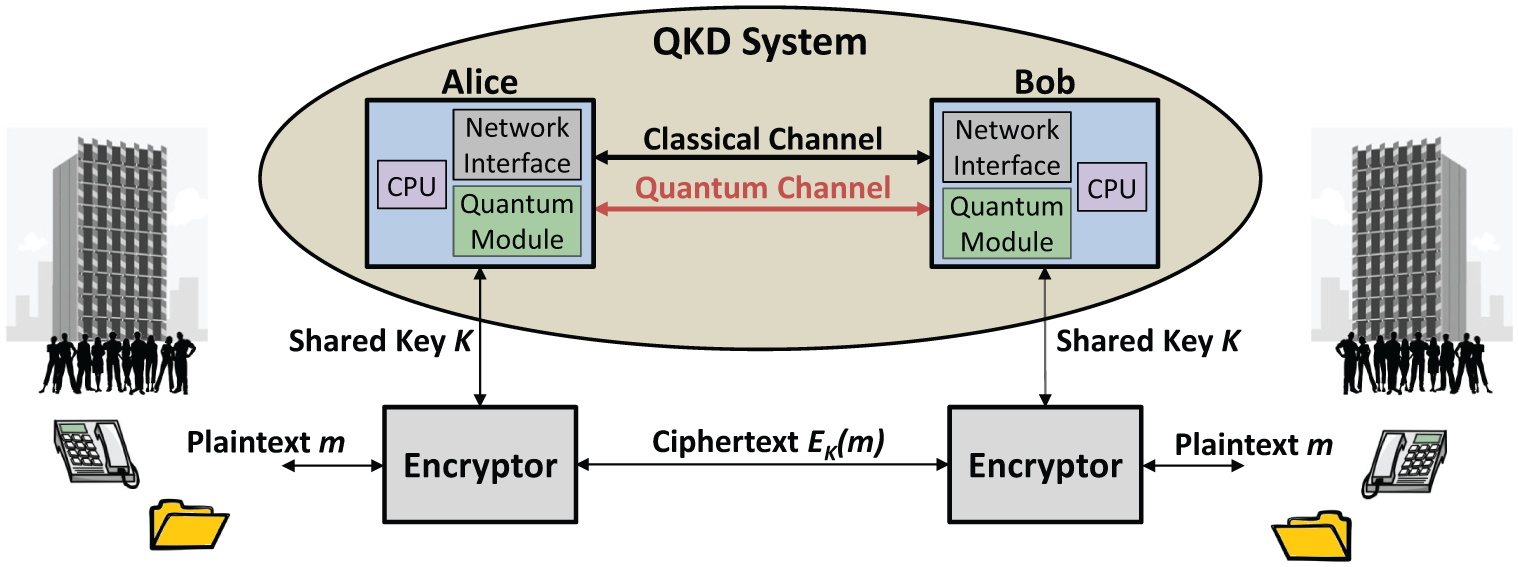
QKD system context diagram. QKD: Quantum Key Distribution.
2.2 The first QKD protocol: BB84
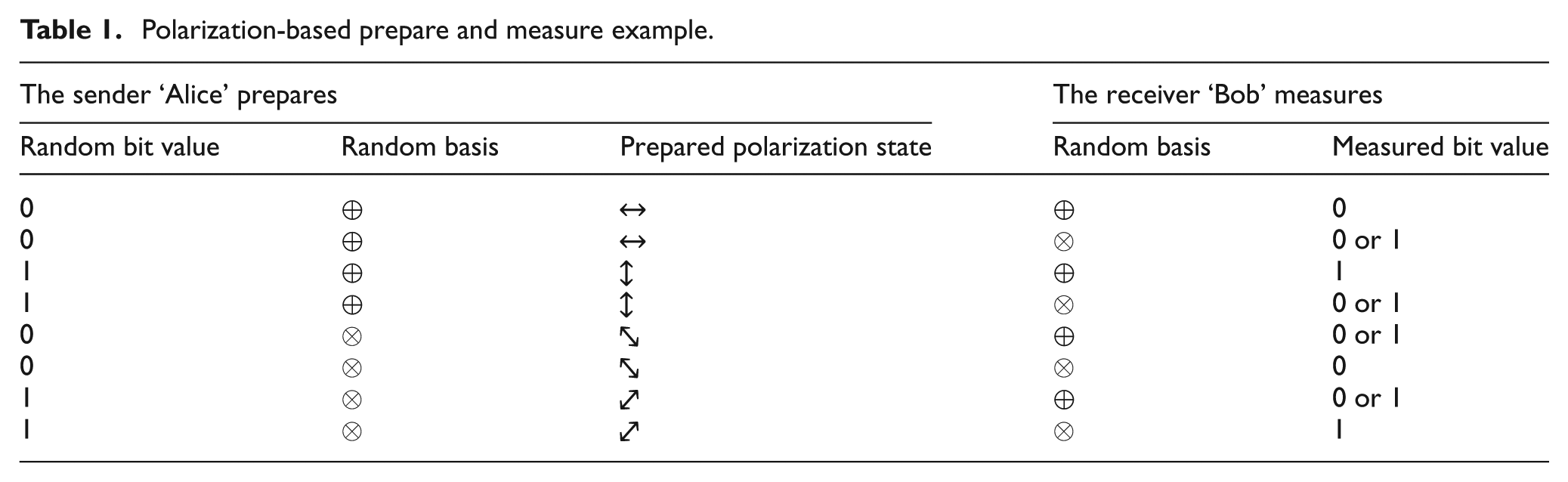
BB84 is a polarization-based prepare and measure QKD protocol, where four polarization states ↔, ↕, ⤡, and ⤢ are used to encode qubits as depicted in Table 1. 17 Alice prepares qubits according to a randomly selected bit value (i.e., ‘0’ or ‘1’) and a randomly selected basis (i.e., rectilinear ‘ ⊕ ’ for the orthogonal polarization pair ↔, ↕ or diagonal ‘ ⊗ ’ for the orthogonal polarization pair ⤡, ⤢). For example, when the bit value ‘0’ and the basis ‘ ⊕ ’ is selected, the qubit is prepared in the horizontal orientation state ↔. Likewise, when the bit value ‘1’ and the basis ‘ ⊗ ’ is selected, the qubit is prepared in the diagonal state ⤢. In this manner, Alice randomly prepares qubits through polarization modulation and sends them to Bob where he randomly selects a basis ( ⊕ or ⊗) to measure each qubit. When Alice’s prepared and Bob’s measured bases agree, the qubit is correctly read with a high probability. Otherwise a random result occurs as depicted in the last column of Table 1 with a 0 or 1. The preparation, transmission, and measurement of qubits between Alice and Bob is known as ‘quantum exchange’ and inherently quantum in nature, whereas the remainder of the BB84 protocol (sifting, error reconciliation, and privacy amplification) is entirely classical.
Polarization-based prepare and measure example.
During sifting, error reconciliation, and privacy amplification Alice and Bob use classical information theory techniques and communicate over the classical channel. For sifting, Bob announces the measurement bases he used to Alice, and she responds indicating where the prepared and measured bases agreed (note only the bases are revealed and not the encoded bit values). Due to the random nature of Bob’s measurement basis selection, approximately 50% of the detected qubits are mismatched (i.e., erroneous) and sifted out (i.e., removed) of the secret key. Error reconciliation algorithms perform bi-directional error correction of the shared sifted keys to correct for quantum communication errors, while privacy amplification compensates for information leaked on the classical channel during error correction by producing a smaller, more secure key. Details of these processes can be found in Gisin et al. 4 and Scarani et al. 5
2.3 Multi-photon vulnerabilities in realized QKD systems
The security of QKD is based on ‘quantum uncertainty’ inherent in the BB84 protocol, where interference on the quantum channel necessarily increases the Quantum Bit Error Rate (QBER).4,5 If an eavesdropper, commonly referred to as ‘Eve,’ attempts to listen on the quantum channel, she introduces additional errors and increases the QBER as captured in formal security proofs.20,21 Since the source of quantum bit errors cannot be known, all errors are attributed to Eve; thus the QBER must be closely monitored. Owing to device imperfections and transmission errors, operational QBERs are typically 3-5% with practical security thresholds <12%. 5 If the QBER threshold is exceeded, the key generation process is generally aborted, as it is assumed an adversary is interfering with the quantum key exchange. 5
The unique nature of QKD theory makes it well-suited for high-security applications such as military, banking, and government environments, where information protection is of primary concern. However, practical design and implementation limitations can quickly undermine pristine theoretical security proofs.
22
For example, BB84 security proofs assume (and attempt to compensate for) perfect on-demand single photon sources in Alice, yet practical on-demand single photon sources are not currently available nor are they expected in the near-term.
22
Therefore, most prepare and measure architectures attenuate a classical laser pulse down from millions of photons to a Mean Photon Number (MPN) of 0.1 according to QKD security practices.
4
These sub-quantum pulses are referred to as ‘weak coherent pulses’ and represented probabilistically using a Poisson distribution,
A low MPN results in poor quantum throughput and thus low key generation rates. However, a low MPN is desirable to reduce the likelihood of multi-photon pulses, each of which exposes information about the distributed cryptographic key to a listening adversary. This multi-photon security vulnerability has been subject of a number of attacks against the quantum channel. More specifically, the Photon Number Splitting (PNS) attack was conceived to gain maximum information from this vulnerability without detection.23–26 The decoy state protocol was introduced to mitigate this attack and has since become widely implemented in several high performance QKD experiments . 27
2.4 The decoy state protocol
The decoy state protocol represents a significant advancement in QKD technology, as the protocol is relatively cheap and easy to implement, while simultaneously increasing quantum throughput and security on the quantum channel. The decoy state protocol was introduced in 2003
27
and quickly improved in an initial series of works28–31,38 and later.32–37,39,40,41. Decoy state enabled QKD systems utilize the conventional signal state plus dedicated security states (decoy and vacuum) as described in Table 2. In this three state configuration, the signal state, represented as a ‘ μ,’ facilitates higher key distribution rates and greater operational distances through an increased MPN (i.e., an MPN of 0.6 is greater than the traditionally used 0.1), while the decoy state, represented as a ‘ ν,’ is used to increase the likelihood of detecting an attack using differential statistical analysis. Utilizing different MPNs for the signal and decoy states, allows the QKD system to detect photon number specific interference, such as the PNS attack (described in Section 5). The vacuum state, represented as a ‘
Example decoy state protocol configuration.
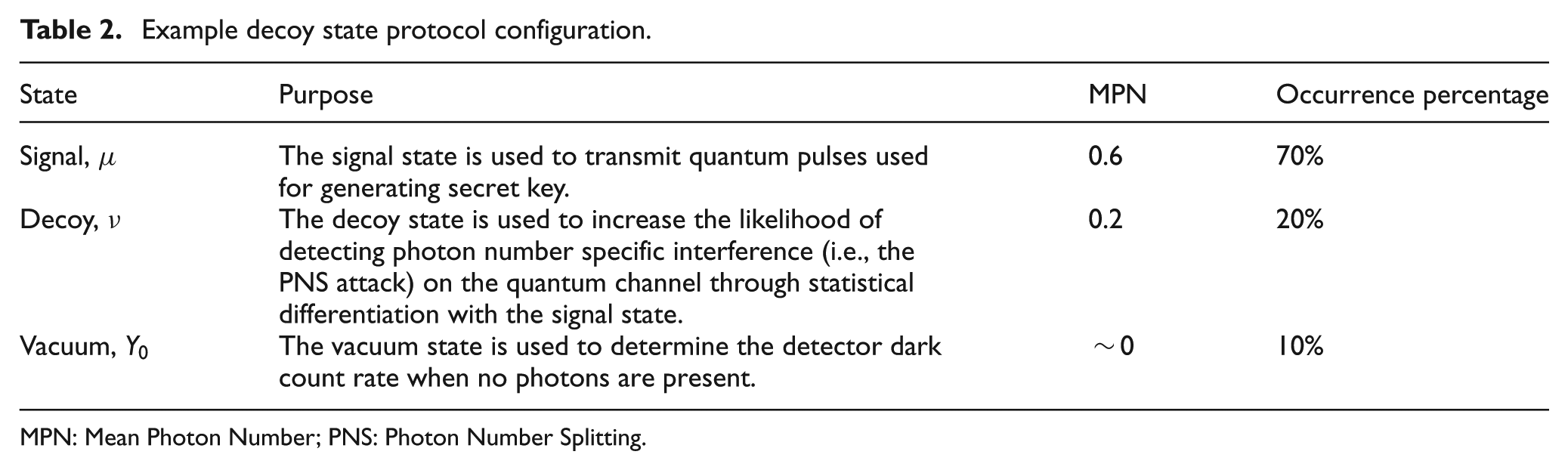
MPN: Mean Photon Number; PNS: Photon Number Splitting.
An outline of the decoy state protocol is described in Table 328,30 (note we’ve decomposed the decoy state protocol into multiple steps for clarity; it may be described differently, especially with respect to its implementation). The first step in the protocol is known as quantum exchange, where signal, decoy, and vacuum states are randomly transmitted across the quantum channel according to their unique MPN and occurrence percentage. Each pulse must have identical characteristics (e.g., wavelength, duration, etc.) other than the MPN, such that Eve cannot distinguish a decoy state from a signal or vacuum state.
Decoy state protocol.
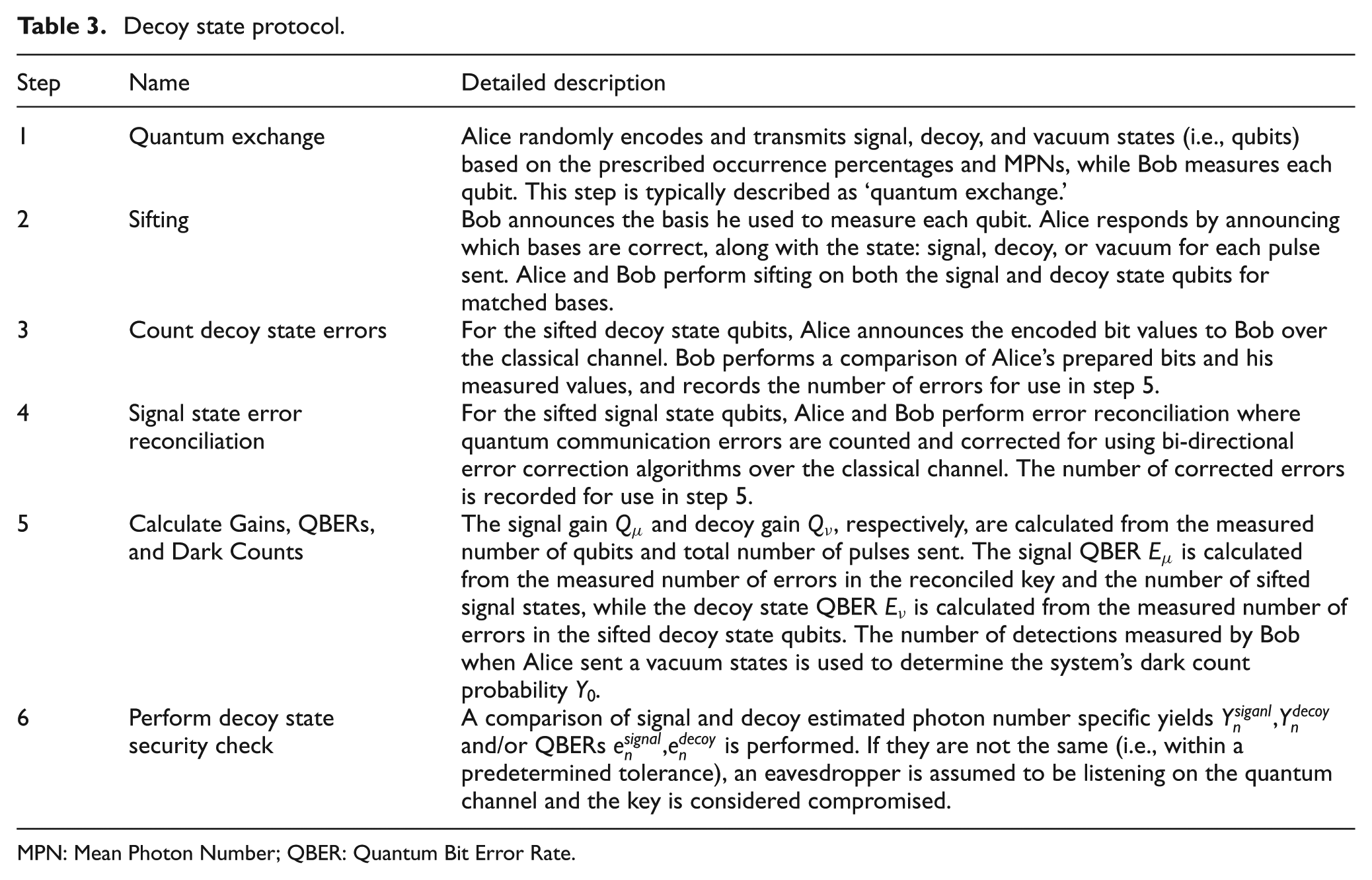
MPN: Mean Photon Number; QBER: Quantum Bit Error Rate.
After quantum exchange, Alice and Bob perform sifting where they announce the bases used to prepare and measure qubits along with each qubit’s state (signal, decoy, or vacuum). For the signal and decoy states, non-matching bases are sifted from the raw secret key, where the correctly matched signal states contribute to a sifted secret key and the decoy states are used for security analysis. Sifting is not necessary on vacuum states, since every detection is a dark count regardless of the basis.
Steps 3 and 4 are responsible for identifying, counting, and correcting errors in the signal and decoy state transmission. Counting of decoy state errors is accomplished by publically announcing and comparing the prepared and measured bit values, while error reconciliation techniques such as winnow, cascade, or low density parity check are used to perform bi-directional error correction of Alice’s and Bob’s sifted signal qubits without revealing specific bit values.4,5
In step 5, a number of decoy state protocol unique calculations are made from performance measurements: the signal gain
2.5. Secret key rate
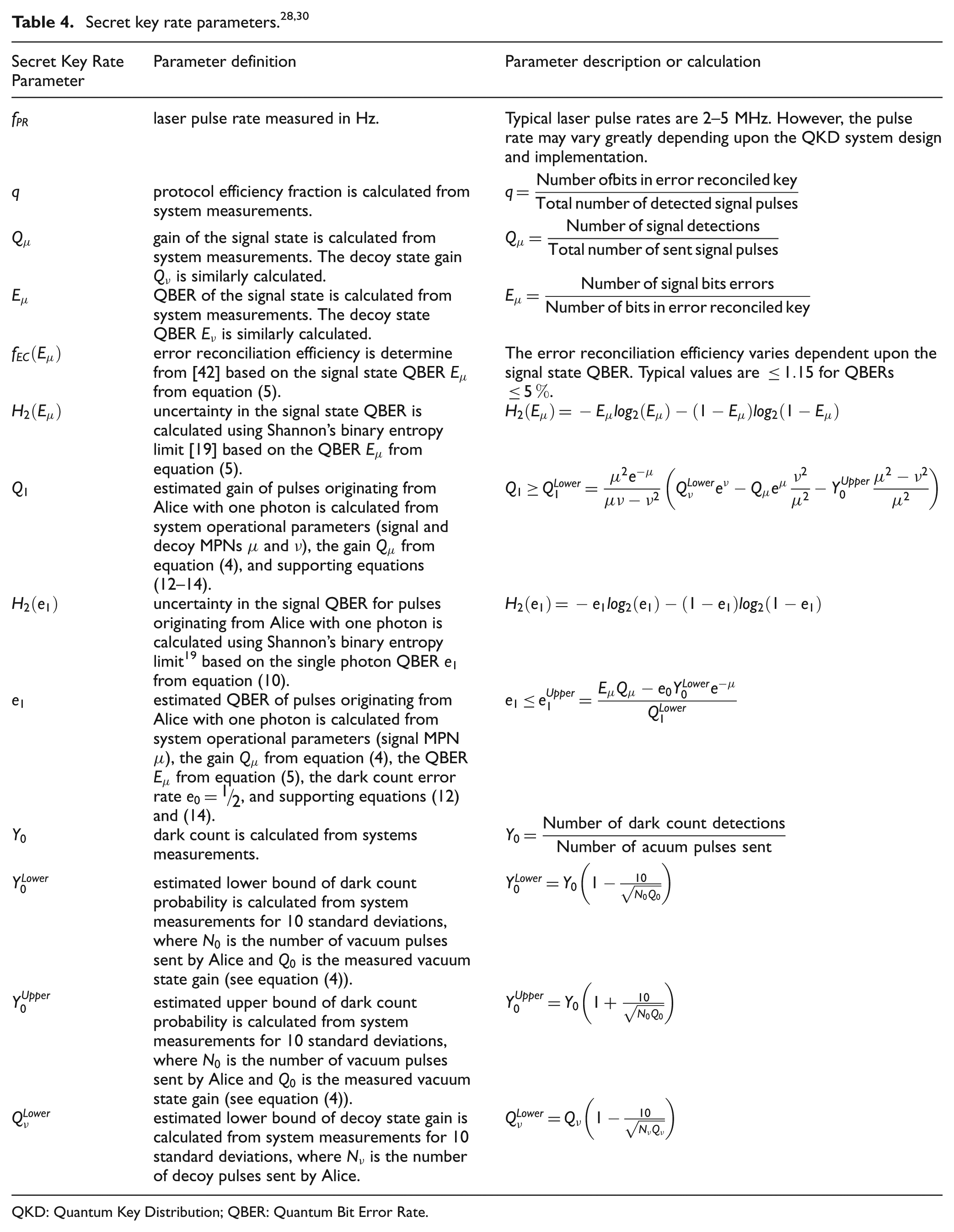
QKD systems are designed to securely distribute cryptographic key; however, due to higher MPNs (and therefore more multi-photon pulses) associated with the decoy state protocol, it is important to limit the secret key rate to pulses originating from Alice with a single photon. This relationship is captured in the secret key rate.21,28,30

where the parameters are described in Table 4.28,30 Of note, much of the initial decoy state research focused on increasing the secure key rate by providing improved bounds for the single photon gain
QKD: Quantum Key Distribution; QBER: Quantum Bit Error Rate.
3. The decoy state enabled QKD system model
In this section we describe the decoy state enabled QKD model built to study system performance and security. 1 The model was constructed in a QKD modeling framework using the OMNeT++ Discrete Event Simulation (DES) environment with an extended library of optical components. 3 This framework enables models to be built in a modular fashion, supporting multiple levels of abstraction to more efficiently answer performance and security questions. The library consists of 17 optical components modeled in an event-driven paradigm with supporting control logic modeled in a process-based paradigm, see the Appendix of Mailloux et al. 3 for details. Each component is configured with 12–15 (and up to 27) configurable parameters.
The focus of this research effort pertains to accurately modeling interactions between system-level behaviors and quantum phenomenon in an end-to-end decoy state quantum communication path. Thus the model is described in three distinct parts: (a) the sender, Alice’s quantum module; (b) the quantum channel; and (c) the receiver, Bob’s quantum module. Modeling assumptions are described below, where appropriate.
3.1. Alice’s quantum module
Figure 2 provides a depiction of Alice’s quantum module (introduced in Figure 1) designed to generate sub-quantum pulses as described in Section 2.2. Alice’s quantum module is designed to generate weak coherent optical pulses at a specified pulse rate, which have the desired MPN and polarization, in a reproducible manner. For example, Alice generates classical laser pulses, randomly selects an encoding basis and bit value, prepares the desired polarization state (↔, ↕, ⤡, or ⤢), and attenuates the pulse’s energy down to the specified MPN.
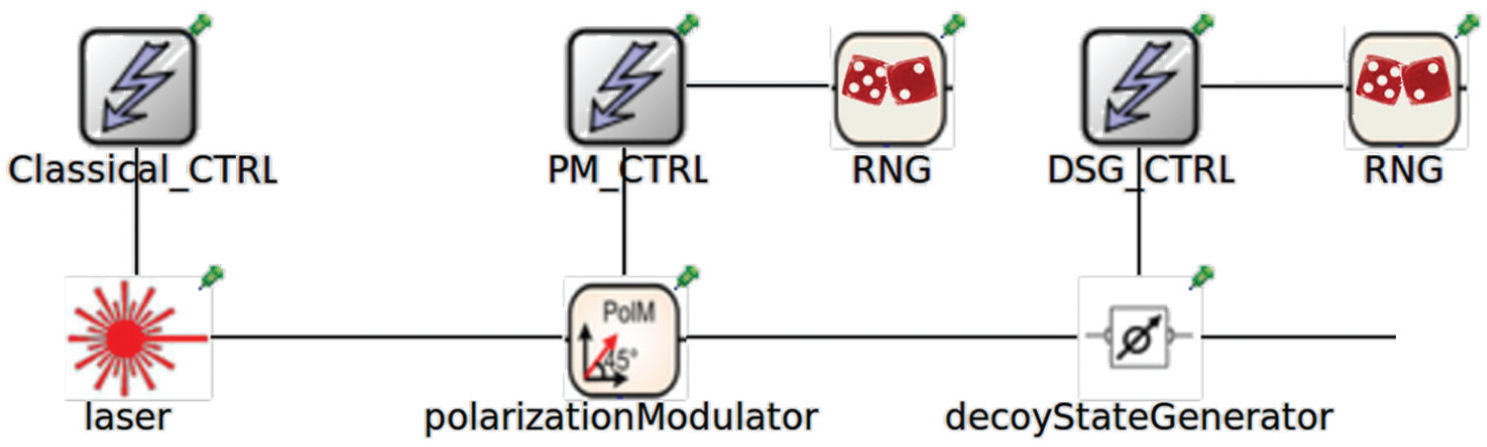
Modeled Alice quantum module. RNG: Random Number Generators.
The module is shown with a classical laser source, a Polarization Modulator (PM), a Decoy State Generator (DSG), two Random Number Generators (RNG), and respective controllers (CTRL). This representation is a simplification of Alice’s quantum module where additional control and timing synchronization components are not of interest in the simulation study and are therefore assumed to operate properly and not shown in the module diagrams. The laser controller is configured to generate classical pulses by triggering the laser to fire in response to an electrical trigger pulse (e.g., 2 Mhz). The laser’s pulse rate is configurable to match any system of interest or experiment with alternative configurations. The laser is designed to generate optical pulses representative of the ID300 commercial laser, including pulse shape, amplitude, duration, and wavelength11,43 (detailed discussion of the laser pulse is provided in Mailloux et al. 44 ). Additionally, variations in the laser pulse can be turned on or off when so desired. The laser generates classical energy light pulses, where the PM prepares (or encodes) each optical pulse according to the random bit and basis provided by the RNG. The modeled RNG can be configured to provide pseudo random numbers through conventional RNG algorithms or quantum random numbers through a dedicated hardware interface. 11
The DSG controller randomly selects the state type (i.e., signal, decoy, or vacuum) according to each state’s occurrence percentage and the second RNG. The controller adjusts the DSG to reduce the classical pulse energy down to the specified signal, decoy, and vacuum MPNs as illustrated in Table 2. This behavior is representative of an electronic variable optical attenuator configured to apply 0–30 dB depending on the desired MPN. For example, if the desired state is a signal pulse with an MPN of 0.6, the DSG will apply ~6 dB. For a decoy state of 0.2 MPN, the DSG will apply ~10 dB, and ~30 dB for the vacuum state.
3.2. Quantum channel
The quantum channel is representative of Single Mode Fiber (SMF) where both the length and loss can be easily adjusted. Channel loss is specified per km (e.g., 0.20 dB per km) where the total loss due to fiber length and connectors is expressed as a single value. Alternatively, the loss can be expressed as an efficiency or percentage. For example, losses for a 50 km SMF-28 fiber are
3.3. Bob’s quantum module
Figure 3 is a depiction of Bob’s quantum module (introduced in Figure 1) shown with a beamsplitter (BS), a half wave plate, two polarizing beamsplitters (PBS1 and PBS2), four Single Photon Detectors (SPDs), and one controller. Pulses entering Bob are randomly split by the BS (i.e., a 50/50 BS) and transmitted to PBS2 towards the horizontal/vertical SPDs or reflect towards the half wave plate, PBS1, and the diagonal/antidiagonal SPDs. This configuration is commonly referred to as a ‘passive basis selection,’ where Bob’s random basis selection intrinsically occurs at the 50/50 BS. This configuration is generally considered advantageous as it does not require additional RNGs in Bob.
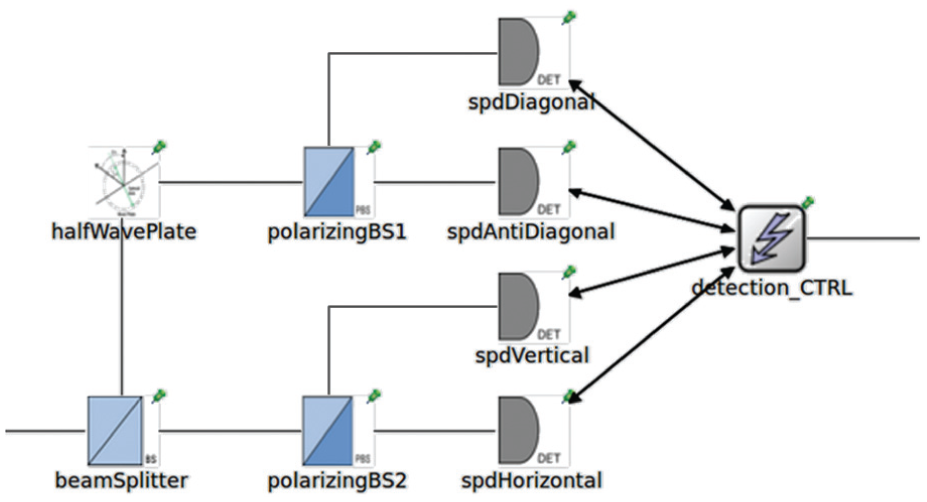
Modeled Bob quantum module.
The PBSs are modeled similarly to the BS; however, they are designed to transform pulses into known orthogonal polarization states (i.e., the horizontal or vertical state) from any input state. More specifically, pulses transmitted by the BS to PBS2, are split into the horizontal state ↔ or vertical state ↕ and sent to their respective SPDs. With respect to pulses reflected by the BS towards PBS1, they receive a
In the modeled architecture, the SPDs are responsible for probabilistically determining the detection of weak coherent pulses; thus simulating the uncertainty inherent in quantum phenomenon.45,46 Specifically, for each pulse arriving at an SPD a probabilistic determination is made for how many photons arrived according to its MPN and the Poisson distribution. 4 Note: after propagating through the quantum channel and Bob’s architecture the pulse’s MPN is significantly lower than when it left Alice (e.g., a signal state MPN of 0.65 propagating though 50 km of fiber with 0.20 dB loss per km, and a passive basis selection architecture with 3 dB loss will have an MPN of ~0.0325). This probabilistic design mimics the desired behavior of single photon generation and detection in the modeled architecture. 47
The detection CTRL is configured to precisely ‘gate’ the SPDs to reduce noise (i.e., dark counts and after pulsing) while detecting single photon pulses. This means the SPDs change from a classical detection state to a heightened ‘Geiger’ state configured to detect the arrival of single photons. Typical gating periods are on the order of nanoseconds (i.e., 10-9 sec) controlled by the detection controller and assumed to be ideal in this model. Bob’s SPDs take into account detector efficiency (e.g., 10%), dark count probability per gate interval (e.g., 10-6), detector dead time interval (e.g., 10-5 sec), after pulsing probability (e.g., 10-3 with the proper dead time interval), and expected photon arrival times (e.g., 10-12 sec). Modeling and simulating these parameters provides a baseline for studying the performance and security of realized decoy state QKD systems.
3.4 Decoy state protocol logic
The decoy state protocol as outlined in Table 3 is implemented through the described physical model and control logic within Alice and Bob. In our model, Alice is implemented as the protocol master and Bob as the slave; however, these roles can change depending on how the desired functionality is modeled. In some cases it may be more advantageous to have Bob, as the receiver, control processes or sub-processes to reduce the number of classical communications (and thus reduce the amount of leaked information).
To perform quantum exchange (step 1 of Table 3), Alice and Bob use a flexible data frame structure defined as a classical timing and polarization control reference pulse followed by a configurable number of weak coherent pulses (e.g., 100 or 1000) with adjustable spacing between both frames and pulses. Alice randomly distributes signal, decoy, and vacuum pulses within each frame according to their occurrence percentages and records the frame number, bit position, prepared basis, encoded bit value, and state (signal, decoy, or vacuum) for each pulse generated. Likewise, upon detection Bob stores the frame number, bit position, measurement basis, and detected value. Quantum exchange ends when Bob reaches the specified number of total detections (signal, decoy, and vacuum).
Steps 2–6 of Table 3 are not quantum in nature and occur over the classical channel using abstracted message traffic passed between Alice and Bob including large memory arrays to quickly and easily facilitate information exchange for the remaining classical steps. During sifting (step 2), Bob publicly announces the basis in which he detected each qubit to Alice, and she responds by announcing which bases are correct and identifies the signal, decoy and vacuum states. Alice and Bob perform sifting on both the signal and decoy state detections to identify when they have matching prepare and measure bases. For each decoy state pulse, Alice also announces the encoded bit value to Bob. The announced decoy state bases and bit values are used to calculate the number of errors in the decoy state transmission (Step 3). Additionally, Alice calculates the dark count rate
Next, Alice and Bob begin error reconciliation (step 4) of the sifted key to correct for quantum communication errors. They first sacrifice an adjustable percentage of the signal state bits (e.g., 25%) to estimate the error rate. This means, Alice randomly chooses the specified percentage of post-sifted signal bits and sends them (frame number, bit number, and value) to Bob. He calculates the estimated error rate and sends it back to Alice. If the estimated error rate is higher than a user defined threshold (e.g., 12%), the protocol is aborted; this is done to conserve processor resources. If the estimated error rate is below the threshold, the QKD system performs error reconciliation. The simulation framework provides the ability to use conventional error reconciliation algorithms such as winnow, cascade, and low density parity check where the algorithm’s efficiency is based on the estimated error rate3. For example, the error rate can be used to determine block correction sizes and influences the number of communications necessary for error reconciliation. Since these algorithms are resource intensive, and not of interest to our simulation study, we implemented a ‘perfect’ error reconciliation algorithm that quickly counts and corrects errors without unnecessary complexity. We anticipate using the perfect error reconciliation most often because of its speed advantage while running large simulation trails. During perfect error reconciliation, Alice sends her key to Bob who determines the number of errors in his key and returns the results back to Alice.
In step 5, the decoy state protocol specific measurements (i.e., the gains
4. Verification and validation of the decoy state enabled QKD system model
In this section we describe our Verification & Validation (V&V) approach and provide results for component, sub-system, and system-level test activities. Our V&V work is primarily based on the approaches and specific activities discussed in Sargent, 48 Smith et al. 49 and Roza et al. 50 In general, we confirm the model was built correctly against expected analytical results, and validate performance against multiple experimental systems. More specifically, component verification is conducted against commercial specifications, where modeled behaviors and operational parameters are evaluated for each component by assessing its transformation of optical pulses. Sub-system verification is conducted using analytical means to test the integration of multiple components by assessing their combined transformations against expected pulse MPNs and polarization orientation. Since the modeled QKD system and its verification is primarily concerned with the transformation of optical pulses, we provide an abbreviated description of the optical pulse model for the reader before we proceed with our detailed discussion of V&V activities. Details of the optical pulse model can be found in Mailloux et al., 44 whereas a detailed description of the modeling framework used to develop the decoy state enabled QKD system model can be found in Mailloux et. al. 3
4.1. Optical pulse model
Figure 4 displays a textural representation of the modeled optical pulse output generated by Alice, where she creates pulses according to a type (i.e., signal, decoy, or vacuum), and prescribed MPN, occurrence percentage, and polarization encoding. Each pulse is given a unique identifier such that it can be traced throughout the entire simulation, which is particularly useful for verification and analysis activities. The pulse model is abstracted from a classical electromagnetic wave representation

where a time-dependent power envelope
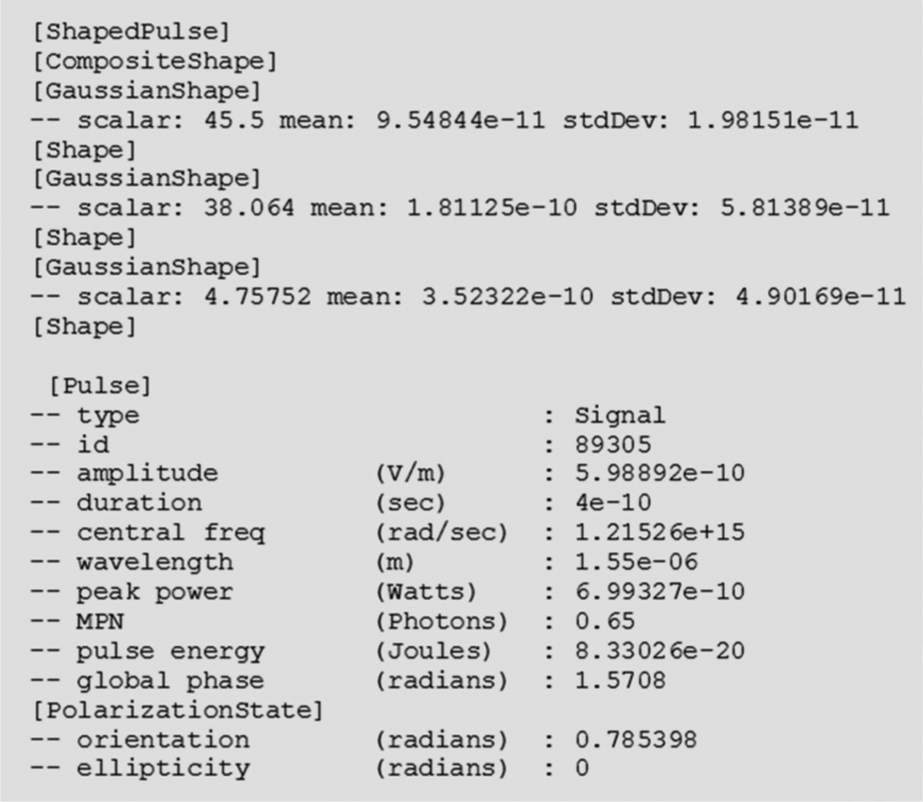
Modeled optical pulse.
4.2. Component verification
Component verification was conducted for each of the modeled optical components (laser, polarization modulator, electronic variable optical attenuator, fixed optical attenuator, fiber channel, beamsplitter, polarizing beamsplitter, half wave plate, and other components not shown such as a bandpass filter, circulator, in-line polarizer, isolator, optical switch 1×2, polarization controller, and wave division multiplexer). We used analytical means to verify the component models according to theory combined with commercial specifications and measured data. Specifically, the modeled components were implemented in C++ and verified using Python. This testing approach is intended to provide a flexible capability for verification of optical components, where new or modified components can be easily added and tested.
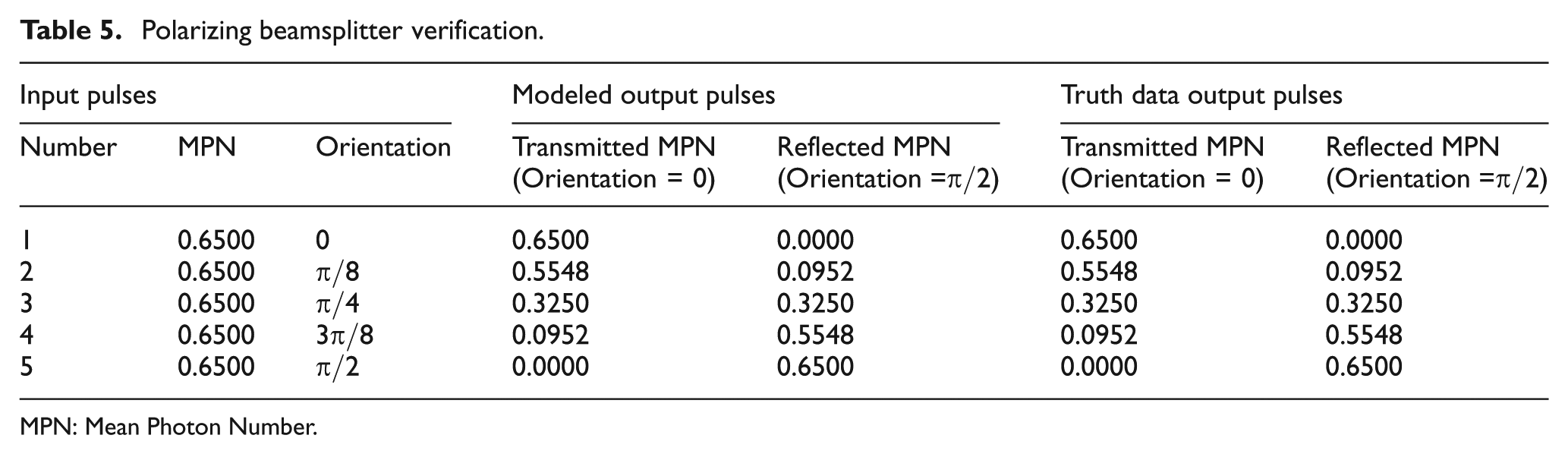
Testing focused on verifying the primary behaviors of each modeled component by ensuring the expected pulse transformations occur correctly. This was accomplished by comparing each model’s results (i.e., the pulse’s shape, amplitude, duration, central frequency, global phase, orientation, and ellipticity) to independent reference calculations over their specified operational ranges. An example of this testing methodology is provided in Table 5, where five input pulses with varying orientations (0,
Polarizing beamsplitter verification.
MPN: Mean Photon Number.
4.3. Sub-system verification
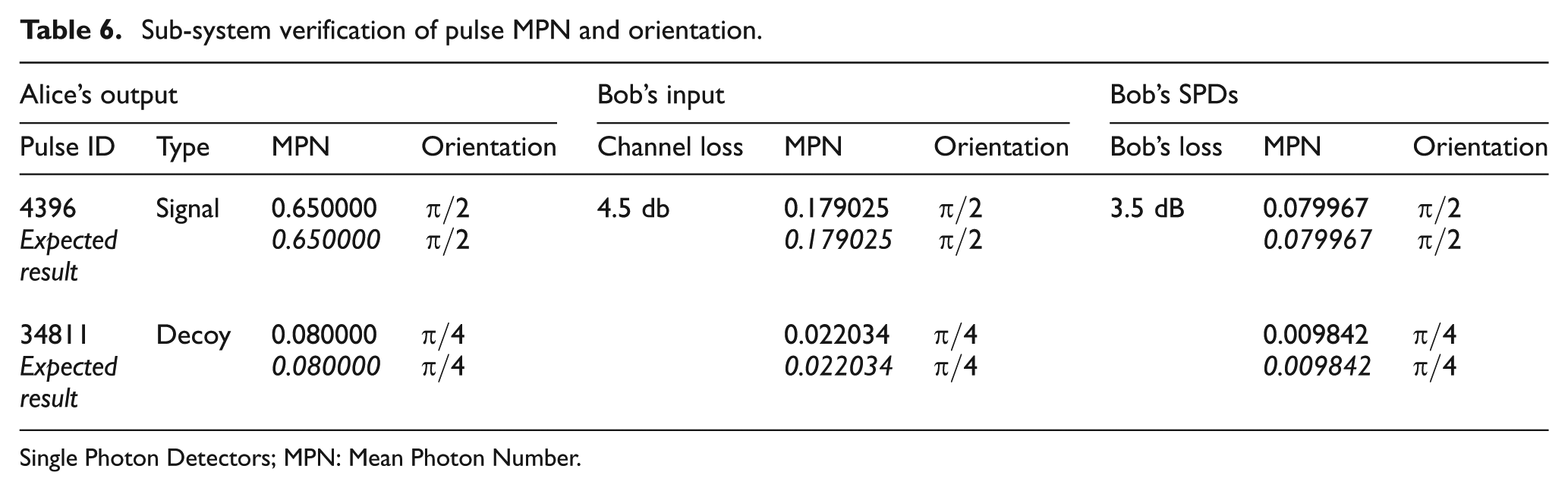
Sub-system verification was conducted using the experimental configuration as reported in Chen et al., where the USTC-Xinglin QKD architecture employed a signal MPN of 0.65, a decoy MPN of 0.08, a measured channel loss of 4.5 dB, and a reported 3.5 dB loss in Bob. 51 From the sub-system perspective there are three points of interest in the communication system: (a) Alice’s output; (b) Bob’s input; and (c) Bob’s SPDs. For each point, we used analytical means to verify the state of the optical pulse for the expected and modeled MPNs and polarization orientation. Table 6 depicts the sub-system verification results where two pulses, a signal and a decoy, are tracked throughout the simulation using its unique identifier.
Sub-system verification of pulse MPN and orientation.
Single Photon Detectors; MPN: Mean Photon Number.
Each pulses’ MPN was verified against analytical calculations proving the modeled components were integrated properly. Verifying these three points ensures our optical pulse is propagating correctly through the end-to-end quantum path in preparation for system-level validation. Finally, we verified the expected signal, decoy, and vacuum occurrence percentages at Alice’s output with an average of 74.99978%, 12.50350%, and 12.49672% for 120 trials of 28,000 detections.
4.4. System validation
We conducted validation against similar systems, providing valid ranges of operation for our decoy state QKD model. Specifically, we chose five systems representative of a short operational distance (i.e., 20 km)32,51–54 and three of a longer distance (i.e., 60 km).33,55,56 The details reported in these articles, including architectural design, configuration parameters, and performance results lend themselves to a thorough validation effort. Operational parameters and results from each of the eight systems are presented in Table 7, along with results from representative models. Each of the simulated models include system implementations details such as signal and decoy MPNs, occurrence percentages, channel losses, receiver losses, detector efficiency, and detector dark count. The simulation results are reported for 60 trials of 50,000 detections each for a total of nearly 100,000,000 pulses sent per experimental treatment to provide statistically significant comparisons to the reported signal and decoy state gains and QBERs.
Validation results.
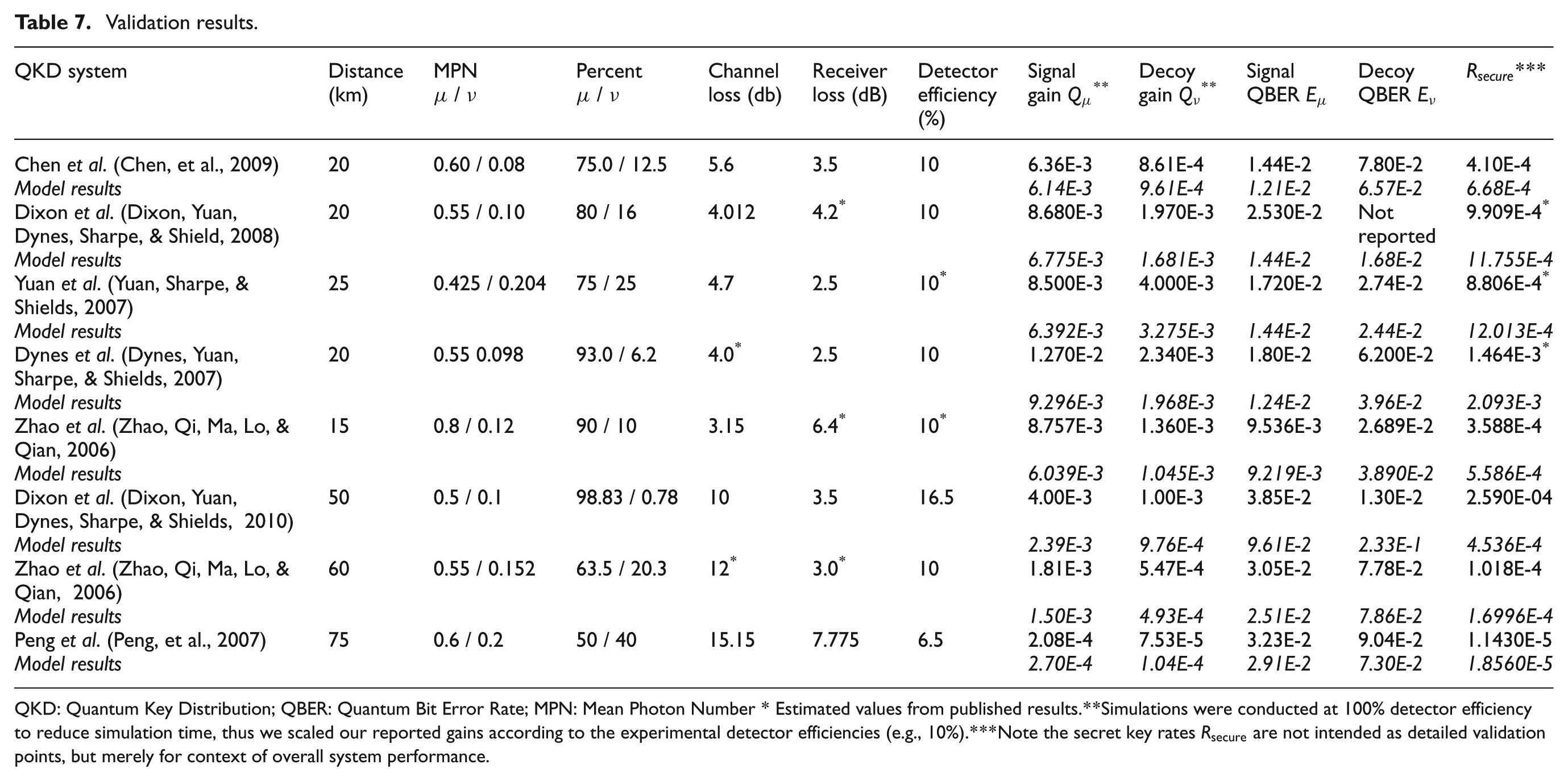
QKD: Quantum Key Distribution; QBER: Quantum Bit Error Rate; MPN: Mean Photon Number * Estimated values from published results. ** Simulations were conducted at 100% detector efficiency to reduce simulation time, thus we scaled our reported gains according to the experimental detector efficiencies (e.g., 10%). *** Note the secret key rates Rsecure are not intended as detailed validation points, but merely for context of overall system performance.
Each QKD system is entirely unique, where the reported results are dependent upon dozens of operational and implementation details including calibration of the optical channel, programming of device controllers, various device imperfections, and the changing operational environment. Therefore, in these validation activities, we do not attempt to precisely match the reported performance but rather we attempt to replicate their results with a reasonable level of accuracy to justify the use of our model. That is, we prove sufficient accuracy for the intended purpose of studying the decoy state protocol. Specifically, by modeling the operational configuration parameters of Table 7, as well as the reported dark count and after pulse probabilities, we achieve simulation results within the same order of magnitude as the reported experimental system gains
By modeling and simulating architectural details such as reported propagation distances, losses, MPNs, occurrence percentages, and detector efficiencies we have ensured our model is consistent with decoy state enabled QKD systems for operational distances of 20 km and 60 km. Our verification activities ensured the model was built correctly, while our validation activities provide objective evidence that we built the correct model. These V&V activities provide analytical and experimental evidences for the accurate modeling of decoy state QKD systems to support further research and performance analysis.
5. Considerations for the decoy state protocol security condition
While the V&V activities described herein were primarily focused on ensuring the correctness of modeled behaviors, they also provide insight into practical considerations for implementing the decoy state protocol security condition which have not been explicitly addressed in other literature. In this section, we first introduce the security condition and then discuss practical implementation issues and initial findings from modeling, verifying, and validating these behaviors.
5.1 The decoy state protocol security condition
Recall, the decoy state protocol security condition was introduced to detect differences between the decoy and signal state statistics caused by the PNS attack, where the general premise is simply that channel losses and induced errors should remain constant over a given quantum channel. Formally, the decoy state protocol security condition is described as28,30


where the photon number dependent yield
The security condition asserts the yields
5.2 Implementing the decoy state security condition
In practical QKD implementations, the photon number dependent yields
5.3 Estimating photon number dependent yields
The photon number depended yield

where

where

The overall quantum communication system efficiency η is the product of the quantum channel efficiency

The protocol efficiency
The systems quantum efficiency η can be measured using device specific calibration activities or calculated as described in equation (21). As described by Lo et al. the quantum efficiency must be known in order to execute the decoy state security condition to detect PNS attacks [28], where the efficiency η along with the measured gains

where μ is the signal state MPN and
5.4 Estimating photon number dependent QBERs
The photon number dependent QBER

where

The end-to-end efficiency η, the decoy state gain
5.5 Security condition example
Assuming an eavesdropper is not going to knowingly introduce errors, Eve’s detectability is primarily dependent upon the system’s ability to detect changes in the yields
Example photon dependent yields.
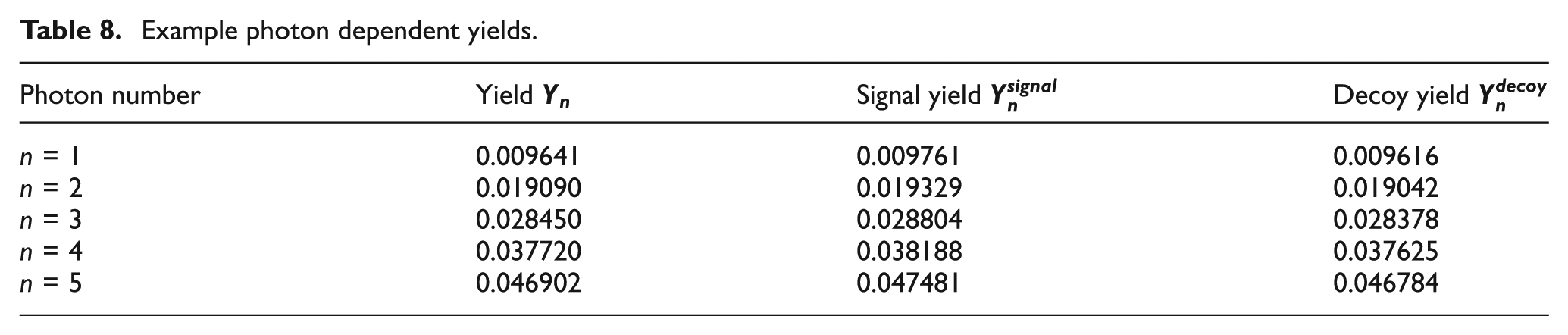
As the reader can ascertain, the photon specific yields are similar but not the same in all cases. We now turn our attention to understanding these differences in the form of implementation considerations and allowable tolerances.
5.6 Security condition considerations
In order to effectively implement the decoy state protocol, there are a number of design, implementation, and operational considerations to consider, including signal and decoy MPNs, occurrence percentages, propagation distances, total losses, desired detection sensitivity, the number of signal, decoy, and vacuum detections, and their resultant confidence intervals, amongst others. Therefore, when attempting to execute the decoy state protocol security condition, there needs to be additional consideration for implementation non-idealities and operational tolerances such that the security condition becomes


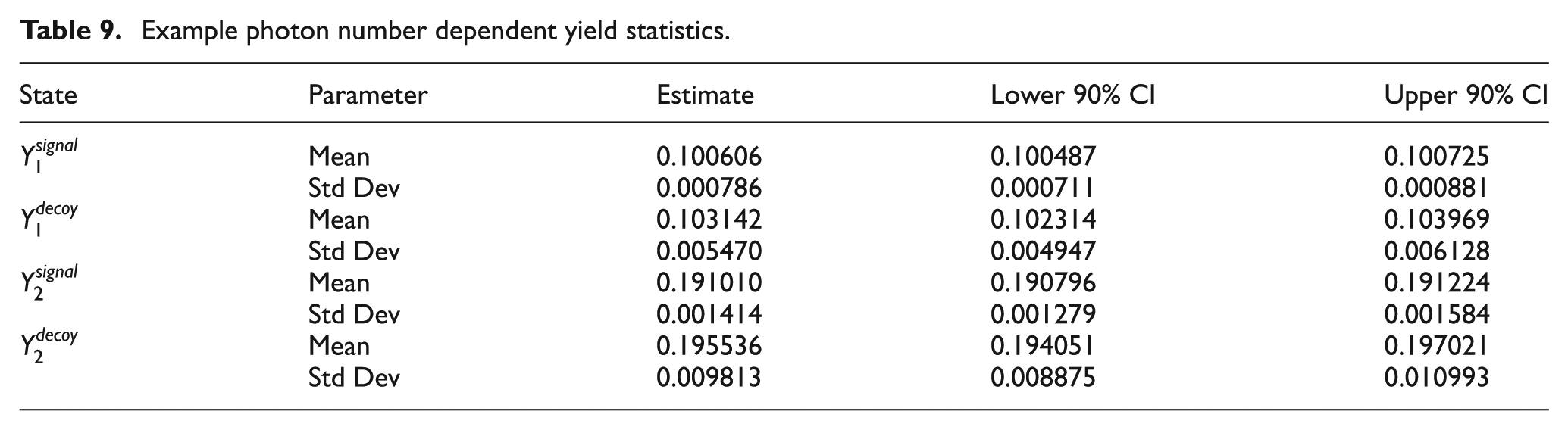
where Δ describes the expected variation in system operation. For example, in 120 trials designed to collect qubits for error reconciliation blocks of 10,000 bits (i.e., ~28,000 detections when accounting for 75% signal state and 50% sifting), we observed variations in both the signal and decoy photon dependent yields as depicted in Figure 5 and reported in Table 9. This is primarily due to expected probabilistic behavior in the number of detections and total number of pulses sent in each trial. In both
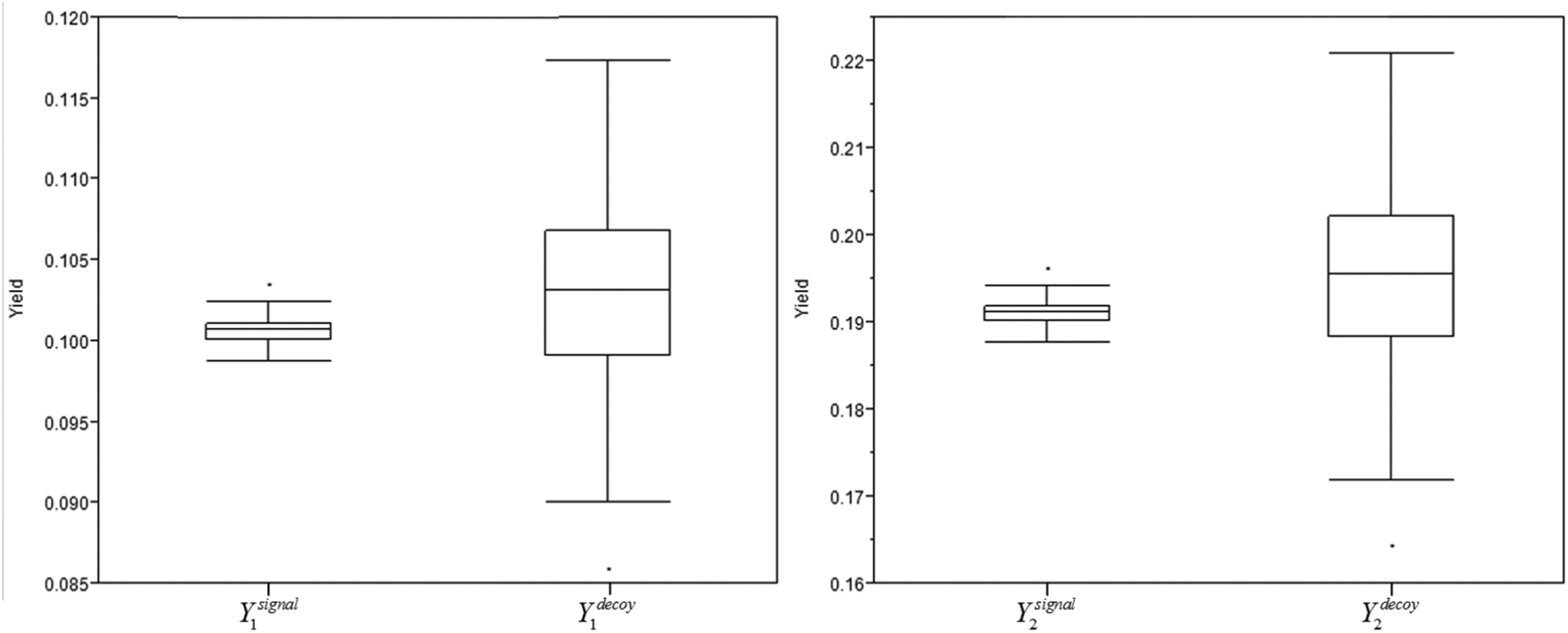
Example photon dependent yields for n = 1 (left) and n = 2 (right). Note scales are different.
Example photon number dependent yield statistics.
5.7 Implementation considerations
When considering implementation of the decoy state protocol, one should first consider that decoy states have been primarily used to increase secret key rates and not necessarily for the ability to detect PNS attacks; there has been little formal consideration of the effectiveness of the decoy state security condition in detecting eavesdroppers in the published literature. Therefore, we provide an enumerated list of practical implementation considerations and operational configuration issues which merit further examination:
Accuracy in signal and decoy state MPNs
Difference between signal and decoy state MPNs
Ratio of signal, decoy, and vacuum occurrence percentages
The impact of losses through the end-to-end quantum path
Induced errors between Alice and Bob, including reference alignment, timing synchronization, and bias in photon detection
Statistical confidence of decoy state security related parameters
Monitoring of alternate decoy state security measurable parameters such as the ratio between
Trade space definition between system performance (i.e., secret key rate) and security posture (i.e., detectability of an eavesdropper)
Lastly, we suggest conventional security practices such as operating from a known secure state and continuous monitoring be integrated into QKD system design and operation. For example, an independent characterization of channel losses, Bob’s internal losses, detector efficiency, and protocol efficiency can be used as an additional security check for validating and ensuring expected yields
6. Conclusions
This paper provides a detailed discussion of a modeled decoy state enabled QKD system. We demonstrated component and sub-system verification activities, as well as, system-level validation proving the model’s correctness and applicability for further performance and security analysis. Lastly, based on our work modeling of a decoy state enabled QKD system, we bring attention to practical considerations for executing the decoy state protocol security condition, including design considerations and allowable tolerances.
Future work includes studying the decoy state enabled QKD system’s ability to detect photon number specific attacks, accomplishing sensitivity analysis of operational parameters, conducting system-level performance characterization with respect to decoy state protocol security condition, and defining the security-performance trade space.
Footnotes
Disclaimer
The views expressed in this paper are those of the authors and do not reflect the official policy or position of the United States Air Force, the Department of Defense, or the U.S. Government.
Declaration of Conflicting Interest
The authors declare that there is no conflict of interest.
Funding
This work was supported by the Laboratory for Telecommunication Sciences [grant number 5743400-304-6448].