







Abstract
Modeling and simulation efforts depend upon accurate input to create viable representations and useful output information. When modeling human behavior, the challenge is often rationalizing sometimes irrational decisions. An existing cognitive model, prospect theory, has provided decades of research and insight into how relativistic differences and decision framing can significantly impact the decision-making process. If applied to security modeling and simulation, these findings can help predict differences in human behavior, which often differs significantly with regard to optimal decision-making or resource allocation strategies. The discussion presented here begins with some basic background for prospect theory and several existing attempts to incorporate these principles into modeling and simulation efforts thus far. Next, a detailed discussion is provided regarding how security and adversarial personnel factor into various prospect theory roles and classifications. Perhaps counter-intuitively, prospect theory would describe security personnel as engaging in risk-seeking behavior, suicidal adversaries as engaging in risk-averse behavior, and non-suicidal adversaries as being more susceptible to decision frames and relativistic differences. The discussion further describes how and why each of these assignments are made as well as implications for future modeling and simulation efforts.
1. Introduction
Security screenings always benefit from being ahead of the adversary because checkpoints can be better prepared to counter threats. To that end, recent “big” data platforms have created new possibilities in preparing our defenses by outthinking adversaries through modeling and simulation (M&S). Sometimes this approach involves collecting billions of examples for search behaviors and decisions through simulated security screenings.1-3 Alternatively, this approach can involve using well-established cognitive theory and principles to anticipate adversarial initiatives while there is still time to thwart them. 4 The latter example then builds these cognitive principles into models that predict how an adversary will approach the given situation. Although there are many cognitive findings on which to build models, cognitive science regarding decision-making—especially risky decisions, where there is an element of uncertainty with gains and losses—represents perhaps the most fruitful area for further exploration.
The decision-making literature has key roots in the mid-1900s, where behavioral scientists tried to assess how and why people made certain decisions. A common assumption was that people would always act rationally and pick options that gave them the best results. 5 However, decision-making is not always based upon logic and rationality. One seminal study 6 demonstrated the importance of decision framing in influencing behavior—that is, how the question was posed mattered almost as much as the possible options. In the original investigation, participants had to choose one of two treatment options that would affect 600 people. Treatment A guaranteed saving 200 lives, whereas Treatment B had a 1/3 chance of saving all 600 and a 2/3 possibility of saving no-one. The decision frame is positive because the options describe people who will live. The negative framing spun the decision by keeping the same odds while emphasizing the downside. Specifically, Treatment A guaranteed that 400 people would die, whereas Treatment B gave the same percentage odds with the descriptions that no one would die or everyone would die. A simple twist of language also twisted the results. Approximately 75% of participants picked Treatment A with the positive decision frame, whereas approximately 75% picked Treatment B with the negative decision frame.
Decision frames ultimately represented a key shift in decision-making studies. The assumption of human rationality gave way to another, more encompassing idea. Essentially, humans are quite capable of making irrational choices, yet even that irrationality is based upon repeatable and predictable—albeit irrational—logic. Decision frames and prospect theory changed how behavioral scientists approached their studies, and evidence collected from more than three decades of studies can now be used to inform another critical area: security modeling and simulation. The following discussion will begin with an overview of prospect theory as it has developed over the past several decades. Next, we will describe some previous M&S efforts that incorporated prospect theory in some way. Finally, we will provide a detailed discussion about how prospect theory applies to security M&S for both security and adversarial personnel, including differences between decisions of suicidal and non-suicidal adversaries. The goal of this discussion is to provide defense personnel with a better understanding of prospect theory and human decision-making processes so that future security M&S efforts can build upon the theoretical and empirical successes achieved thus far.
2. Prospect theory overview
Prospect theory is an account of how people make decisions when faced with uncertain outcomes. Its main advantage is that it provides insight into why people often make decisions that deviate from the optimal choice. Essentially, the theory proposes that there are two stages involved in each decision. First, there is an editing stage in which the choices under scrutiny are simplified. This approach may involve discarding extremely unlikely events (or treating extremely likely events as certain), or removing any elements that multiple events have in common to focus on the differences between them. In the second stage, the options are evaluated according to the subjective value assigned to each outcome, and the choice is made. 7 The assignment of probability and value placed on each outcome are what give prospect theory its explanatory power, particularly with respect to when people are likely to make choices that are suboptimal.
There are two assumptions made in prospect theory that explain why people deviate from the most rational choice. First, people do not view probabilities in a linear fashion. An event that has a probability of 0.90 is weighted to occur somewhat less than 90% of the time. As shown in Figure 1, the weighted probability of an event, denoted π(p), is a non-linear curve, whereas the actual probability (p) is linear. Figure 1 presents an idealized version of the weighted probability of an event, but its form is based on empirical evidence. For example, one study 8 presented a series of risky and safe gambles that have the same expected value (e.g., 10% chance to win $150 plus 1% chance to win $300 or 12% chance to win $150) to examine how people weigh probabilities along the curve. Their results fit the probability weighting curve described elsewhere in the literature and depicted in Figure 1, which also illustrates the tendency to underweight outcomes that have a high probability and overweight outcomes that have a low probability. The subjective perception of probability behaves differently at the ends of the spectrum than in the middle, which may also influence decision-making. A change in likelihood from 1.00 to 0.99 is viewed as much more drastic than a change from 0.54 to 0.53. For example, given the opportunity to win $1000, the first change would be far more disheartening than the latter. This mismatch between perception and actual change is important because, according to prospect theory, values are attached to changes in condition rather than final states. 7 This can be likened to sensory perception—someone is more likely to notice a three degree increase in the temperature of a very cold room versus the same change in a comfortably warm room.
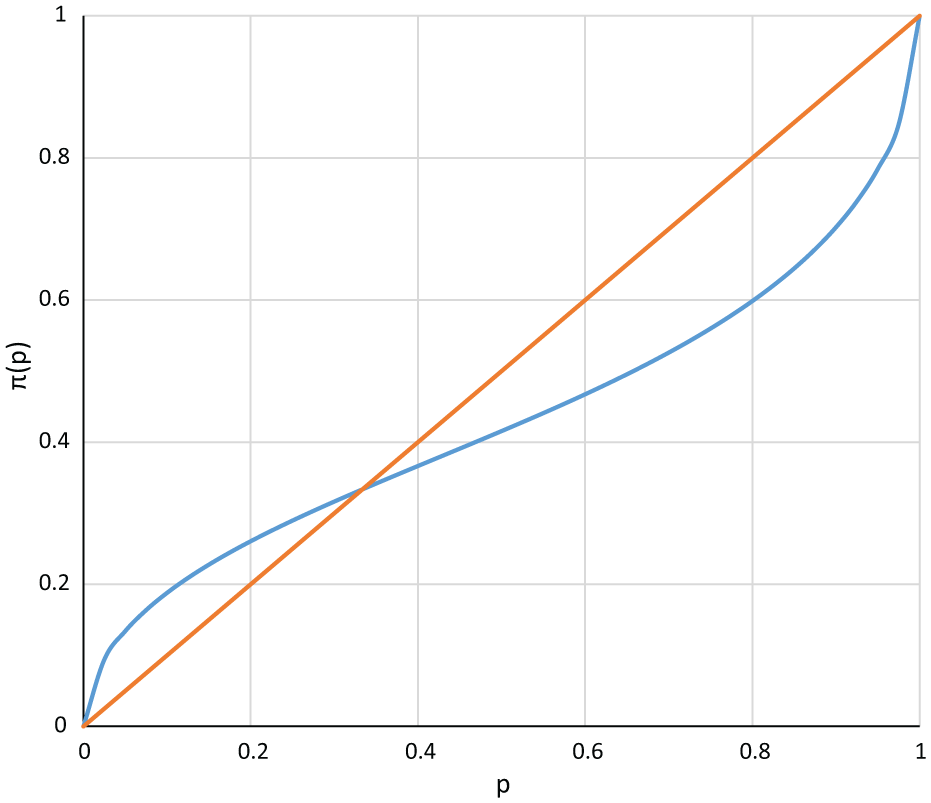
A graph of the subjective probability of an event (blue line) versus actual probability (orange line). (Color online only.)
The second assumption regards the value assigned to each different outcome. Figure 2 shows an example of the value function, which is a non-linear curve that changes based on an indifference point. Above this point, the curve is convex and rises slowly, while below it is concave with a sharper drop. This reflects the fact that people are more sensitive to losses than gains. In other words, a loss of $100 will cause more pain than a gain of $100 will give pleasure. The difference in sensitivity combined with the subjective perception of probability leads people to be generally risk-averse in positive domains and risk-seeking in negative domains. For the purposes of this discussion, we will define risk-aversion as a tendency to choose a surer option over one that is less certain but could result in a better outcome. Risk-seeking is the opposite—choosing the riskier option with more potential for gain/loss over a more certain option with less gain/more loss.
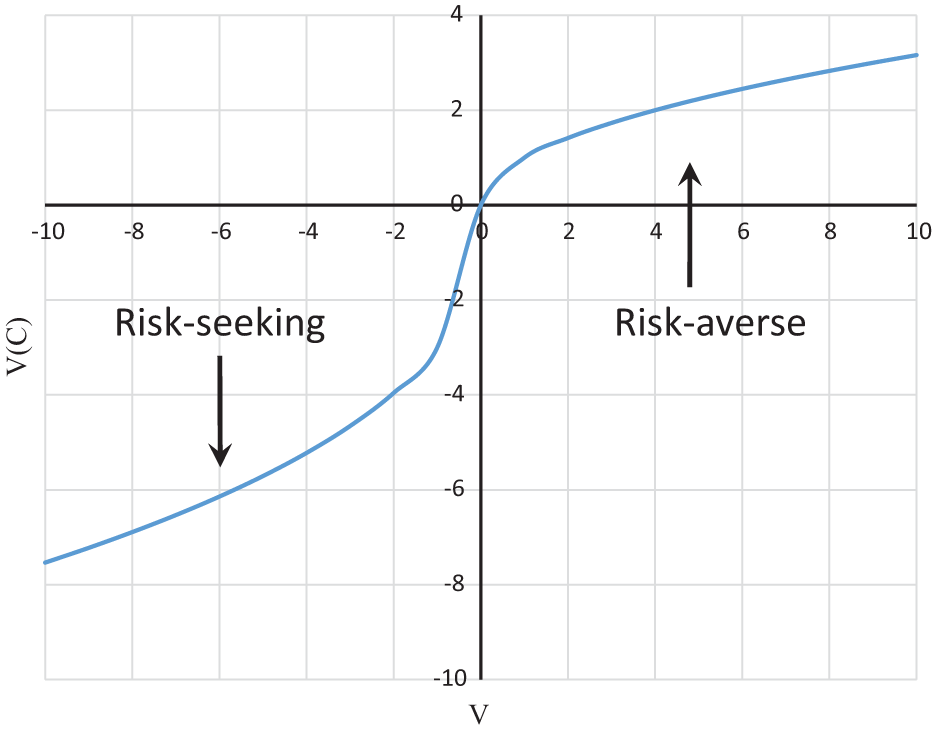
A value function depicting the value assigned to an outcome (V(C)) versus the actual outcome (C). Risk-averse behavior is denoted in a scenario framed through terms of gains, whereas risk-seeking behavior is denoted in a scenario framed through terms of losses.
The shape of the value function in Figure 2 reflects that people tend to be risk-averse when faced with gains, whereas they are risk-seeking when faced with losses. These tendencies were demonstrated by Kahneman & Tversky. 7 When given the option to choose between a certain gain of $3000 or a gain of $4000 with 0.80 probability (0.20 probability of no gain at all), most people (80%) chose the certain gain (Figure 3). According to a purely rational decision making technique, this behavior does not reflect the optimal choice because it has a lower expected value (i.e., 4000 * 0.80 = 3200, and 3200 > 3000). However, the opposite result was found when this same choice was framed as a potential loss (i.e., certain loss of $3000, or 0.80 probability of losing $4000 with 0.20 probability of no loss). Now 92% of the respondents opted to risk incurring the larger loss than accept the definite smaller loss. In other words, the 20% probability of avoiding the loss altogether caused people to be more willing to accept the risk of the larger loss. Note that these decisions tend to occur for the relatively high or low probabilities. There is a possibility that if the probabilities were much lower, the option might be discarded as an impossibility in the editing step. In the middle of the probability range, decisions are more likely to be optimal. When given the same problem as above, but with the probability of each outcome multiplied by 0.25 (i.e., $4000 with 0.20 probability vs. $3000 with 0.25 probability), more people (65%) chose the optimal option.
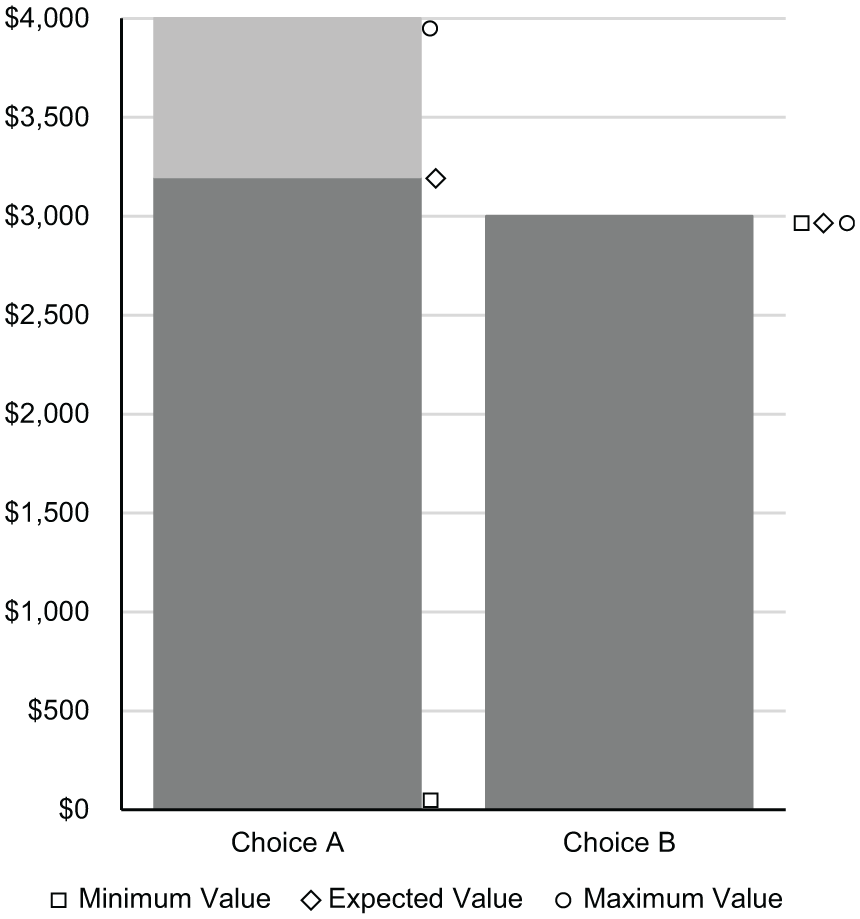
An illustration of an example choice from Kahneman & Tversky (1979). When the choice is framed in terms of gains, people opt for Choice B which has the lower expected value (smaller gain). When framed in terms of losses, people opt for Choice A which has the greater expected value (larger loss).
Another important aspect of prospect theory is the role of uncertainty. Many examples discussed thus far present decisions in terms of probability, where mathematical value could be assigned to the likelihood of different events and the expected utility of various outcomes. However, many decisions do not present this information in such a concrete way. Decisions can involve a high level of uncertainty or lack of concrete information about the values or probabilities involved when determining an outcome, and choice under uncertainty differs in some ways from choice under risk. 9 Several such differences include that subjective judgments of probability do not conform to probability theory, 10 and individuals prefer some types of uncertainty such as uncertain events in their area of expertise versus uncertainty in chance scenarios. 11
The key point is that different types of uncertainty, or uncertainty in different domains, have different impacts on decision-making. It is also worth noting that uncertainty and probability are related, but not equivalent terms. A probabilistic outcome with well-defined chances (e.g., 15% chance to succeed, 85% chance to fail) is still an uncertain outcome, although uncertainty could also refer to the described chances as well (e.g., there is somewhere between a 10% and 20% chance of success). That is, all probabilistic outcomes are uncertain, but uncertainty can apply to more than just probabilities. The difference underscores the need to identify uncertainty due to lack of knowledge and uncertainty due to variability when making a risk assessment. 12 Prospect theory depends heavily on the principle of uncertainty because it often involves a decision made when weighing the options between uncertain choices. For more applied uses, and especially for modeling or simulations, uncertainty should be treated differently based on the population making decisions and the task involved.
These examples apply fairly directly to financial or lottery-like decisions, where gains or losses can be assigned objective monetary values and probabilities can be concretely and accurately assigned. A significant challenge arises when these prospect theory tenets are used to model adversarial decision-making. As will be discussed later, there may be cases in which none of the assumptions of rationality-based models hold or cases in which the subjective assignment becomes almost too uncertain to be usable. However, there have been several previous attempts to model adversarial decision-making using various approaches, including prospect theory. We now turn our attention to these attempts and address some of their limitations.
3. Modeling adversarial decision making
Modeling and simulation provides a way to test theoretical ideas and develop practical applications that more hands-on techniques cannot match. Modern systems have further enhanced these capabilities as once-complicated challenges such as system interoperability are becoming ever more manageable with well-established standards such as high-level architecture (HLA) serving as excellent models for current and future use. 13 For security-specific uses, there is the challenge of integrating discrete and continuous modeling as defense simulations may involve either a limited number of options or an infinite number of options depending on the scale and considerations included. 14 The opportunity to assess many variables and raw processing power thus make modeling and simulation techniques a viable method to develop new protocols for security by modeling how an adversary makes decisions. After all, the decisions about where to attack—and even the first decision to attack—can be interpreted in terms of choices that involve risk and uncertainty.
Defense-related models of choice are often tested using simulations of Stackelberg security games. In these games, a defender has a certain number of targets to protect and a limited number of resources to cover the targets.15-17 For example, the defender might have ten targets and can deploy resources to successfully protect six of them. The attacker is then provided information about each target—the probability that it is defended, the reward for a successful attack, and the penalty for an unsuccessful attack. Note that in these games, the defender always chooses a strategy before an attack is made. This approach is similar to a real-life scenario in which an attacker might observe a defender’s behavior (e.g., patrol routes) before choosing when and where to attack. Moreover, these designs have already been translated from simulations to real-world applications. An applied solver for Stackelberg games called ARMOR (Assistant for Randomizing Monitoring over Routes) has been implemented at Los Angeles International Airport to randomize checkpoint locations and patrol routes, 18 and another, PAWS (Protection Assistant for Wildlife Security), is used to schedule anti-poaching patrols in Uganda, which demonstrates the practical value of these models.
When adversarial behavior is modeled using prospect theory and security resources are deployed based on the model, the outcome (defined as defender expected utility) is better than when a purely rational opponent is assumed both in simulation 19 and with human opponents. 20 This evidence shows that even though people make irrational decisions, the associated unpredictability can be modeled and defenses successfully implemented to account for it. Other models have found more success in maximizing defender expected utility 19 by incorporating additional assumptions regarding behavior (e.g., different variables to represent heterogeneous attackers). These studies have allowed the attacker multiple rounds, so that he or she can learn more about the defender’s strategy and adjust accordingly. This change produced a derived probability curve that was the opposite of Kahneman & Tversky, in which small probabilities are underweighted and larger probabilities are overweighted. 20 This finding demonstrates that people were more likely to attack targets with medium or low coverage probabilities than those with high probabilities. This reversal of probability weighting—and associated reversal of the decision frame—is a key point to which we will return shortly.
There are limitations to applying prospect theory, or other theories of decision-making, to predictions of attacker behavior. Models that build on prospect theory can show incremental gains in defender utility, but this change comes as a result of adding even more assumptions. With the increased number of assumptions, there is an increased opportunity for mistakes to be made, particularly when attempting to apply such a model to a real-world scenario. Any model will quickly become unwieldy if it attempts to account for every possibility. Another concern is that overfitting predictors will result in a model that performs extremely well for a particular scenario but does not generalize to other situations. For example, Zhang, Sinha, & Tambe 21 used real-world crime data to learn several models of criminal behavior. The models that had fewer parameters (thus avoiding overfitting the data) performed best. Ultimately, there will be things that either cannot be estimated about the attacker’s decision-making process or will be left out of the model entirely. Thus, models with additional parameters increase complexity but may not show an associated increase in usefulness.
Another limitation of these simulations is that they assume the defender will apply the optimal strategy for given a set of assumptions about attacker behavior. For this reason, although these models suggest the best way to defend in a Stackelberg game, they may not capture actual defender behavior. Presumably both attacker and defender are equally subject to the distortions of perceived probability and value described by prospect theory. Different targets will be valued differently based on their monetary, strategic, or symbolic value. Furthermore, these values will almost certainly be different for the attacker and the defender. In fact, there may be cases in which the value of a target cannot be reliably estimated from the defender’s perspective (e.g., those with extremely high symbolic but relatively low monetary or strategic value). This subjectivity complicates the assessment of outcome value because there are factors that influence the attacker’s decision that cannot be quantified or of which the defender is unaware. Although every assumption made about attacker behavior can be accounted for in a simulation, not every key piece of information can be known—and therefore modeled—in the real world. This limitation means that both security and adversarial decisions need to be considered from each perspective to gain the most complete picture of what will influence decision-making.
4. Prospect theory in security and adversarial decision-making
Thus far, the discussion has covered how prospect theory and decision framing can explain why humans may engage in seemingly irrational decision-making behaviors. The oversimplified summary is that decisions are dramatically impacted by relativistic differences and how the question is posed. For security-based decisions, these key tenets indicate that M&S for prospect theory must take into account the viewpoint when crafting sufficiently accurate models. The remainder of the discussion will now specifically separate security and adversarial personnel to evaluate how prospect theory applies to each position in the decision-making process.
An advantage here is that homeland security decisions generally have some stability in how they are framed. Specifically, homeland security decisions are frequently framed in terms of the lives lost rather than the lives saved—such as how September 11th is always posed in terms of the nearly 3000 lives lost rather than the number of individuals who escaped the various locations without life-ending injury. Military security decisions may differ as they can focus on the remaining resources following an attack that then need to be re-deployed throughout the base. However, a homeland security decision is almost always posed in terms of lives lost or resources lost rather than lives or resources saved.
Uncertainty also plays an interesting role when trying to model adversarial decision-making. From the security side, it is likely that the people making security decisions are experts in their domains, and experts are more comfortable dealing with uncertainty or ambiguity when the choices are within their domain of expertise. 11 This comfort could impact the willingness of security personnel to engage in a risky decision. From the adversarial side, a wide range of adversaries could prompt a wide range of options, although the critical concern to consider involves whether the adversary is willing to accept uncertainty and how they might react to uncertainty in their decisions. The most straightforward interpretation then is that the relative expertise of the adversary (e.g., disorganized terrorist versus an adversary from a well-trained organization) will have an impact on the decisions made by the individual adversary and the factors to consider when trying to predict their behavior.
The practical application for modeling and simulation is how best to use the information described thus far when determining the various behaviors people are inclined to undertake in certain situations. Specifically, dividing personnel into risk-seeking or risk-averse classifications is a more complicated and counter-intuitive delineation than it seems. The counter-intuitive conclusions are that security personnel are risk-seeking, suicidal terrorists are risk-averse, and non-suicidal terrorists are more vulnerable to framing effects.
Security personnel—defensive decisions. Prospect theory is fairly straightforward when applied to decision-making of security personnel. This directness is due to the ease with translating values or priorities to various defensive positions. Essentially, prospect theory builds upon relativistic differences in decision-making, which in turn depends on the ability to establish baseline estimates or some similar reference point for comparison. For example, a person may drive across town to save $5 on a $10 purchase, but may not drive across town to save $5 on a $105 purchase. The behavioral differences here entirely depend upon establishing concrete value as the decision-making process may not be the same if the options are posed as saving $5 on a “cheap” versus “expensive” item. Security personnel can likewise assign more realistic and concrete value to various aspects of a defense scenario. This value assignment could derive from knowing traffic flows through various checkpoints, the value of equipment, or a determination regarding how much losing particular personnel or equipment in various locations would compromise the overall functionality of a security checkpoint. All these possibilities are known quantities (or should be known variables) to the security personnel assigning defensive resources.
Another consideration is whether security personnel engage in risk-averse or risk-seeking behavior. According to prospect theory tenets, security personnel will engage in risk-seeking—not risk-aversive—behavior because their decisions are framed in terms of losses. Compare a security-based decision to the classic Tversky & Kahneman 6 decision: Option A will guarantee that 400 people will die, whereas Option B has a 33% chance that no one will die and a 66% chance that everyone will die. Supposed medical treatments are replaced here with the result of an adversarial assault upon a particular target which results in the loss of human life. The decision frame is based on loss of life, or negative/loss-oriented for security personnel, which prospect theory and decision framing evidence indicate are likely to prompt risk-seeking behavior and cause security personnel to choose Option B. Intuition would suggest that security personnel are risk-averse—minimize threats, maximize safety, and so forth. However, prospect theory does establish some decision-making scenarios where security personnel would engage in risk-seeking behavior due to the decision being framed in terms of losses.
A final point worth noting is that the eventual behavioral decisions are discrete possibilities, where everyone chooses Option A or everyone chooses Option B. The behavioral evidence suggests that human decision-making will shift from 75% for Option A to 75% for Option B depending on how the decision is framed. This issue establishes the potential variance in human behavior; even when accounting for these variables, three people will still choose Option A and one person will still choose Option B (or vice versa). M&S efforts need to incorporate this variance to ensure that the models incorporate the inevitable variability in human decision-making. The end result would be similar to a confidence interval in statistics, which depicts the greatest likelihood of outcomes with a certain level of assurance.
Adversarial personnel—hostile decisions. Prospect theory becomes more complicated when trying to evaluate its principles from an adversarial viewpoint. The foremost challenge arises from not being able to accurately assign value to targets. Specifically, how would a terrorist organization assign value to a military target versus a political target versus another civilian target with perceived political value? One way to overcome this challenge is to assign specific adversaries within the challenge to limit possible scope. For example, the Islamic State of Syria and the Levant (ISIS or ISIL) might assign differential priorities to targets than a radicalized pro-life group within the United States—one might choose to bomb a military checkpoint, whereas the other might choose to bomb an abortion clinic. Target selection, or the process by which an individual chooses a target to attack, is a critical concern of adversarial decision-making, and the scope of possible targets is too difficult to assign without first limiting security scenarios to specific possibilities. This issue seems obvious for security decisions and satisfices the editing stage of prospect theory, yet the problem subsists when considering the second, assigned value stage even within a scenario. For example, take a narrower scenario such as airport security screening. How does an adversary assign value to sneaking a bomb onto a plane versus bombing the Starbucks outside the checkpoint versus attacking the checkpoint itself? Each location represents a possible target to which it is difficult to assign a relative value from the adversarial perspective.
Still, some further parameters can limit the scope and assist with the security M&S when applying prospect theory. The most important parameter is whether the adversary is suicidal or non-suicidal as the distinction significantly alters prospect theory descriptions about their behavior. Perhaps the single most counter-intuitive point regarding adversarial decision-making and prospect theory is this one: suicidal adversaries are risk-averse, according to prospect theory. The claim seems ridiculous on the face of it, although it begins to make sense when placed into the proper context. First, suicidal adversaries would not view their own loss of life as a potential loss. Death becomes a sunk cost22-24 simply upon choice to engage in the attack. In other words, the adversary does not include the loss of his or her life as a negative outcome in the decision making process; rather, the loss of life is assumed to inevitable and does not cause them to act in a way that might prevent it. This shifts the adversary’s decision frame from one in which a great cost (death) might be incurred to one in which only the potential for gain exists. For the purposes of classic relativistic decisions, driving across town to save $5 is not the same limiting factor when you have already driven across town and are looking at two options on the shelf.
Next, consider again the classic Tversky & Kahneman 6 decision frame of guaranteed loss of life with Option A and percentage chances with Option B. Loss of life is not a “loss” from the adversarial viewpoint—it is a gain. They intend to kill people, and the more they kill, the higher their gain. So, even though Option A is phrased as “400 will die,” the decision frame becomes positive, and individuals presented with a positive decision frame will engage in risk-averse behavior. Realistic comparisons would involve a suicidal terrorist advancing as deep into the target as possible before detonating an improvised explosive device. So long as the potential to advance undiscovered remains, the adversary will continue to move deeper into the security environment. Once the decision becomes a comparison of guaranteed objectives (cf. Option A) or a percentage that might yield zero objectives (cf. Option B), the adversary is likely to engage in risk-averse behavior and choose the guaranteed option. Thus, the counter-intuitive claim of prospect theory is that suicidal adversaries will engage in risk-averse decision-making behaviors.
The more complicated classification comes with non-suicidal adversaries. Similar to the suicidal adversaries, every loss of civilian life could be posed as a “gain” to them. However, personal loss of life is no longer a sunk cost, and these individuals will go to extreme lengths through rehearsal or similar efforts to escape unscathed. This difference means that suicidal adversaries are almost assuredly presented with a scenario of gains, whereas the loss potential for non-suicidal adversaries—including mission failure, capture by authorities, or loss of personal life—is much higher and must be incorporated into framing the overall scenario in terms of gains or losses. Again the problem comes back to how value is assigned to these principles. Non-suicidal adversaries may seek to make a political statement and thereby be recognized after the fact for any actions, or these individuals may attempt to escape wholly unidentified to continue their efforts. Still, too great a loss for too small a gain could cause the overall scenario to shift the framing in terms of losses.
The M&S challenge comes in assigning value to these different potential losses. The key takeaway is that non-suicidal adversaries are likely vulnerable to decision framing and relativistic effects more than security personnel or suicidal adversaries. Additional factors provide increased opportunity for relativistic differences to nudge behavioral decisions one way or another, and it becomes more difficult to robustly classify these actors as either risk-seeking or risk-averse. Decision frames may not be as simple as how many will die in the attack because these framing effects will also need to incorporate the potential loss to the individual. For example, the classic Option A becomes either 200 will live (and you will leave clues to your identity behind) or 400 will die (and the homeland security will begin pursuing you). The possibilities appear to be an excellent source for future research into decision-making processes, specifically for security decisions, which in turn will enhance M&S efforts. Still, the logical conclusion does appear to be that non-suicidal adversaries will be more susceptible to framing effects and relativistic differences than security personnel or suicidal adversaries.
5. Tactical versus strategic: Placing prospect theory discussed here into the larger context
This paper has largely focused upon a discussion about how prospect theory might operate at the tactical level. That is, how an adversary may select a target for a particular attack. This approach makes sense in context because the goal involved applying prospect theory to the tactics and decisions of an individual decision-maker. However, there are broader applications of the theory that can help place this work within the larger context of uses for prospect theory. The most notable difference involves decision-making by an organization at the strategic level rather than by the individual decision-maker at a more tactical or operational level.
One notable author in particular25-28 provides an overview of how prospect theory can inform behavior that takes place at much larger scales with many more parties involved rather than simply attacker and defender. Specifically, prospect theory has been applied to politics as it operates at the national level in election politics. For example, when choosing whether to elect new leadership, the general behavior of the masses conforms to prospect theory.29,30 The choice presented to voters can be framed in terms of losses and gains. If the economy is good, people engage in risk-avoidance by voting for the incumbent. If the economy is bad, they are more likely to engage in risk-seeking behavior by voting for the challenger whose policies may be less familiar or unproven. Similar factors impact whether a political actor chooses to pursue a riskier reform policy rather than a simpler or safer policy. 31 So, when considering elections, prospect theory could be applied either to the decisions made to cast a vote for a politician or to the decisions made by politicians about which policies to pursue.
Prospect theory can also be applied to international relations as well as national level politics. In general, countries are more willing to go to war when they stand to lose territory (or damage their reputation or lose credibility) than they are to go to war to gain new territory 28 —even the national decision to start a war can be impacted based on whether the choice is framed in terms of gains or losses. An interesting issue, especially as it pertains to the current discussion about adversarial decision-making, is whether international-level decisions will be impacted by the same suicidal or non-suicidal methods as the tactical-level decisions. For example, could a terrorist organization that uses suicidal methods be considered risk averse in their decision-making? Much as with the tactical-level decision, an organizational willing to sacrifice its members seems willing to do anything to achieve a goal. The biggest issue comes in what would be deemed a sunk cost much as it did with the individual. If the organization guaranteed to lose a member no matter how the operation turns out, the loss of life is once again considered a sunk cost and not incorporated as a perceived or potential loss when weighing overall gains and losses. The framing would then be what is gained by striking at a target with a suicidal attack, which would still be framing the decision in terms of gains and the decision-makers would be classified as risk-averse. So, even at a strategic level, an organization willing to use suicidal tactics could be framed as risk-averse in their decision-making—that is, only willing to take on those methods when framed in terms of guaranteed or highly probable gains.
There is also the issue involving how decision-making might differ at the strategic level versus the tactical level. At either level, the decision is still made either by an individual or a collection of individuals, although the type and relative influence of various factors will likely change based on whether the decision is strategic in nature or tactical in nature. Consider the differences in target selection at either the strategic or tactical level. A strategic decision will involve which parties to engage as allies and which to engage as enemies, whereas a tactical decision would involve identifying particular targets for an attack. The scope and scale of the attack differ, obviously, but does the application of prospect theory differ? Relativistic differences will still matter on both scales. An attack may be presented as having a 50% versus 51% chance of success or a 99% versus 100% chance of success, and behavior will likely be equally influenced whether the cost is 5 lives or 5 divisions. Bias to risk-aversive or bias to risk-seeking remains the same because the decision is rooted in a difference of framing as gains or losses, not rooted in scale. Whether presented as 2 of 6 will live or 2,000,000 of 6,000,000 will live, the framing is the important element—not the actual scale. Political leaders do seem to behavior differently when bargaining over gains versus losses, 26 but those differences align with prospect theory based on whether the bargain is framed as a gain or loss. The true difference in how prospect theory applies to strategic versus tactical decisions is simply in the scale of the consequences and not in any change to the decision-making process. There will certainly be more factors involved at the strategic level and the decision will be more complicated. However, the principles of prospect theory will apply no matter what the scale.
6. Conclusions
Ultimately, any M&S efforts are trying to predict human behavior so that security personnel can remain ahead of potential adversaries. The complex and often nerve-wracking challenge is to try rationalize human behavior that is prone to irrational decision-making. Computer models can perfectly predict optimal strategies to maximize defense under prearranged conditions, yet security and adversary decisions in the real-world are based on human logic, and therefore not subject to follow optimal decision-making processes. Prospect theory is one applied cognitive model that can be adapted to M&S efforts in an attempt to rationalize the irrational—thereby providing more complete and accurate indicators of adversarial decision-making. It is also important to consider that the discussion provided here is based upon prospect theory as it is generally described or evaluated. The descriptions here are logical and follow from existing evidence, although security-specific scenarios could result in larger departures in human behavioral predictions relative to other prospect theory results. Further empirical analysis is necessary and highly valuable in elucidating how prospect theory applies to human behavioral evidence among security and adversarial personnel in controlled experiments.
From the discussion here, there are several important takeaways. Foremost, several M&S efforts have already tried to incorporate prospect theory into security scenarios. The success has been fluctuating, although a better understanding of the various roles could improve these success rates. Second, the different roles are counter-intuitive. Security scenarios are often framed in a stable way—in terms of lives lost, and so models can be designed off the relatively stable conclusions that security personnel will engage in risk-seeking behavior and suicidal adversaries will engage in risk-averse behavior. Non-suicidal adversaries present a more complicated challenge, and they are more likely vulnerable to decision frames and relativistic differences than the other actors in these scenarios. Finally, and perhaps most importantly, prospect theory is an attempt to rationalize the irrational. Its greatest value in M&S is to account for the inevitable variability in decision-making. Truly incorporating prospect theory will likely give a range of values or probabilities, although its inclusion has immense potential in making M&S outputs more similar to actual human behavior as opposed to optimal, computer-based outcomes.
Our discussion here also highlights the need for several areas of future research. The most obvious consideration involves the test of risk-aversive versus more situationally-dependent decision-making from suicidal and non-suicidal adversaries, respectively. We believe that the logic here presents a consistent case and reasonable conclusion, yet one tenet of prospect theory is that decision-making does not always adhere to rationality. Until there is empirical evidence to support these ideas, they remain only logically consistent and subject to the types of shortcomings that led to the development of prospect theory in the first place. The risk-seeking nature of security personnel is another counter-intuitive element that requires closer scrutiny. Specifically, the potential consequences are usually framed in terms of losses, but would security personnel behave in a risk-aversive manner if the decision were framed in terms of gains? Finally, the issue of tactical-level versus strategic-level decision-making and the role of prospect theory are based upon assumptions. These assumptions may be reasonable and there may be existing evidence to support these ideas, but they are nevertheless assumptions. A carefully controlled, empirical study is needed to ensure that these assumptions are supported with more concrete evidence. All of these opportunities could enhance modeling and simulation for security scenarios, and incorporating more elements of prospect theory could be another approach to improve models of irrational decision-making.
Footnotes
Acknowledgements
The authors would like to thank the reviewers for preliminary feedback and review of this manuscript.
Authors’ note
The views expressed in this article are those of the authors and do not necessarily reflect the official policy or position of the Department of the Navy, Department of Defense, nor the U.S. Government. The authors are military service members (or employees of the U.S. government). This work was prepared as part of their official duties. Title 17 U.S.C. §105 provides that ‘Copyright protection under this title is not available for any work of the United States Government.’ Title 17 U.S.C. §101 defines a U.S. Government work as a work prepared by a military service member or employee of the U.S. Government as part of that person’s official duties.
Funding
This research received no specific grant from any funding agency in the public, commercial, or not-for-profit sectors.
