







Abstract
The radar equation is the fundamental mathematical model of the basic function of a radar system. Moreover, there are many versions of the radar equation, which correspond to particular radar operations, like low pulse repetition frequency (PRF), high PRF, or surveillance mode. In many cases, all these expressions of the radar equation exist in their combined forms, giving little information to the actual physics and signal geometry between the radar and the target involved in the process. In this case study, we divide the radar equation into its major steps and present a descriptive mathematical modelling of the radar and other related equations utilizing the free space loss and target gain concepts to simulate the effect of a white noise jammer on an adversary radar. We believe that this work will be particularly beneficial to instructors of radar courses and to radar simulation engineers because of its analytical block approach to the main equations related to the fields of radar and electronic warfare. Finally, this work falls under the field of predictive dynamics for radar systems using mathematical modelling techniques.
Keywords
1. Introduction
Usually, the radar equation is presented in the literature in its combined form. The disadvantage of this depiction is that there is much physics in the process that remains hidden. Furthermore, in the afore-mentioned combined form, the signal geometry of the scene between the radar and the target is not shown in all its important stages. Of course the analytical form of the radar equation, with all its various steps, exists in almost all books on radar engineering.1–8
Our contribution in this case study is that we manipulate the mathematical formula of the radar equation to come up with a term called gain of the target, which of course includes the radar cross section σ. The advantage of using this target gain term is that it tries to explain the target's reflectivity by treating the target as an antenna gain. Of course, this value can be negative or positive in decibel notation according to the reflectivity type of target involved.
In section 2, we employ the telecommunications equation in order to set up the foundations of the numerical analysis for the radar and electronic equations in the remaining sections.
Exactly with this equation we can proceed to derive the radar equation in section 3. Also, here we coin the aforementioned target gain parameter.
In section 4 we use the noise of the system and communications channel in order to bring out the important concept of signal-to-noise ratio (SNR).
In section 5 we make the parameter values of the generic telecommunications equation more specific in order to explain the radar warning receiver (RWR) equation, and in section 6 we use the same methodology in order to set up the jammer equation and the important electronic warfare term of jammer-to-signal ratio (JSR).
Finally, the decibel notation is mentioned throughout this work because it makes the task of radar calculations and simulations extremely easy in comparison with real numbers.
2. Employing the Telecommunications Equation
The Friis Transmission Equation describes the budget link between a transmitter and a receiver. We will employ this concept in order to derive the mathematical models for telecommunications, radar, and electronic warfare fields.
First we begin with the power that is created by the emitter of a telecommunications subsystem.
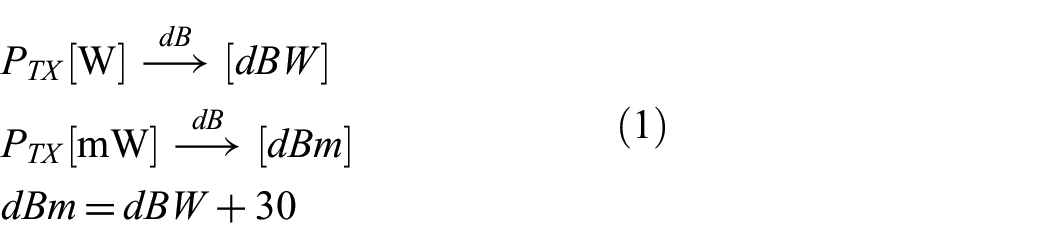
where:
Now this power is translated to electromagnetic waves by the antenna subsystem.
When the radiation is perfectly uniform in a three-dimensional space, it is called isotropic.

In the case of more directive antennas, the gain can be expressed by considering the solid angle of their radiation.
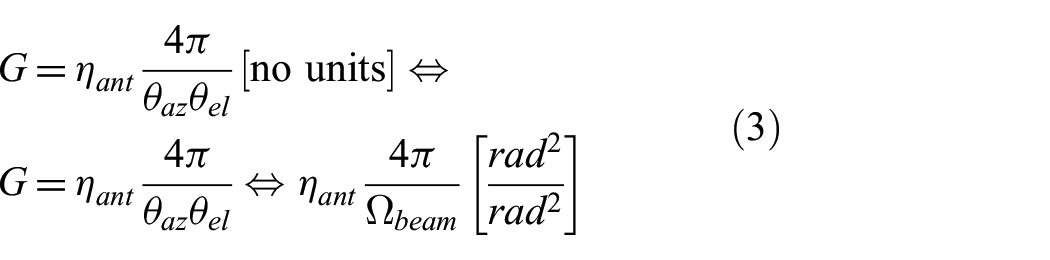
where:
Now the effective isotropic radiated power (EIRP), which is the combination of the emitter transmission power and the gain of the antenna, is the final power emitted by the communications system.

where:
This power is divided by the surface of a sphere, because of the spherical nature of electromagnetic waves.

where:
R is the distance between the transmitter and the receiver
Now the amount of energy that the receiver’s antenna can process is dependent upon the antenna effective area

where:
The antenna’s effective area is dependent upon the gain of the antenna multiplied by a frequency and geometrical factor. Moreover, this formula is derived by equating the blackbody spectral radiance of the radio waves to the Johnson-Nyquist noise power of the antenna resistance, which leads to Equation (7)

Informationally, we can also express the reception of an antenna in terms of a solid angle Ω.

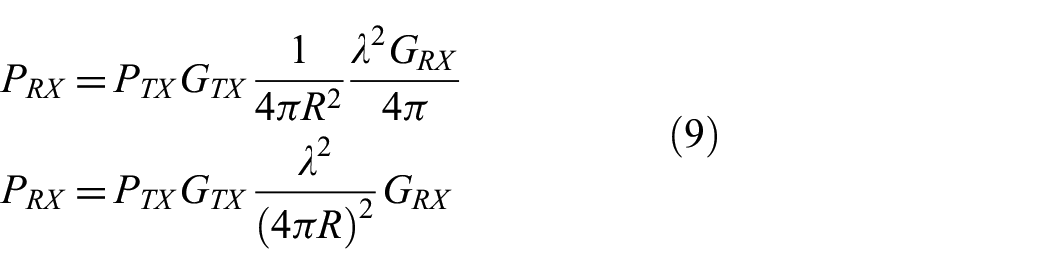
The above information helps to bring the telecommunications equation to a more geometrically oriented form
Using the factor L which is the free space loss from the Friis equation several telecommunications links can be modelled in an effective manner using this convenient loss parameter, as shown in Figure 1.

where :
L is the free space loss from the Friis equation
Simulator graphical results.
Moreover, the free space loss is further calculated, by using the dB notation, with the following forms, which either include the wavelength or the frequency of the telecommunications system.
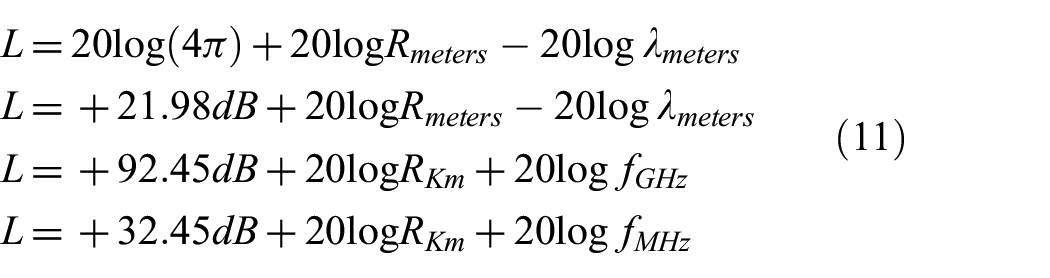
Further on, we arrive at the final form of the telecommunications equation, in real numbers, which shows that the received power is the product of the transmitted power, the transmitter antenna’s gain, the free space loss, and the receiver antenna’s gain.

Now expressing Equation (12) in decibel units, multiplication becomes addition and division becomes subtraction producing the final form of the telecommunications equation in dB units.

Of course, all the above math agrees with the Friis equation, which is as follows:


3. Switching to the Radar Equation
The telecommunications equation for the one-way path can be altered to represent the radar equation, which includes two-way paths.
Using Equation (5), we add the rest of the radar path and come up with a power term instead of a power density term. Analytically the next step is the illumination of the target by the radar transmitter antenna, which is backscattered by the target’s radar cross section

The energy that is returned by the target to the radar is again distributed in the surface of a sphere.

The final step is the target’s returned energy that meets the radar’s reception antenna effective area.
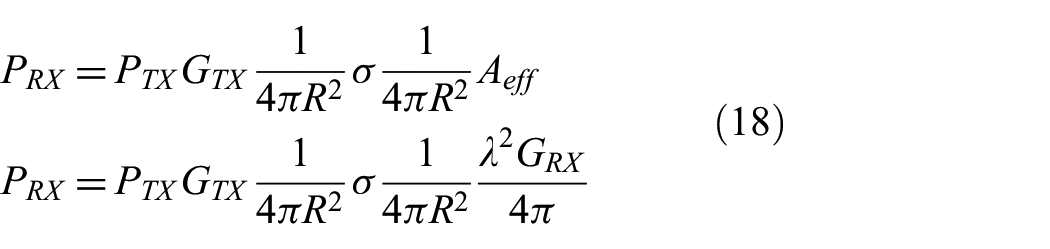
Now by employing some mathematics we will express the radar equation:

By inserting the necessary factors that will create the return free space loss, we have
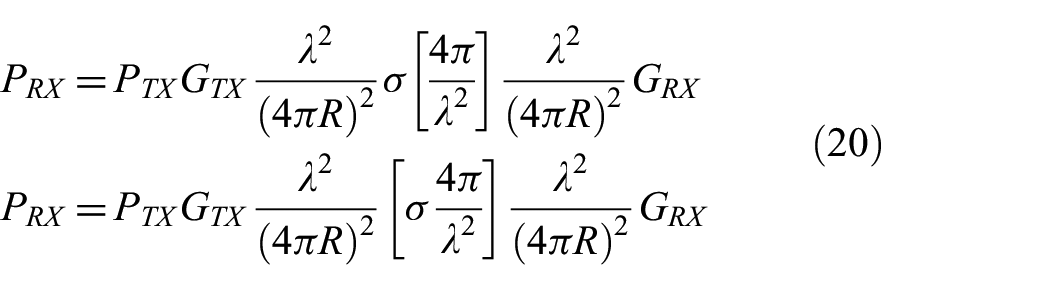
At this point, we have coined the parameter that represents the gain of the target

Further on we treat the target as an antenna gain, which is dimensionless, that radiates backscattered energy to the radar, like an antenna in a steradian.
An explanation comes handy from Richards, 7 which states that the radar cross section can be derived to be dimensionless and Sullivan, 8 which explains the radar cross section theory, as in Equation (22).

Therefore,

This notation may be proven useful in modelling longer wavelength radar links, which do not travel in a straight line but use multiple hops, as a single dimensionless parameter.
Now the radar equation becomes:

Of course, when the above equation is collapsed it is the same as the usual radar equation that is found in all literature

The next step is to express Equation (24) from real numbers notation to decibel values.

4. Thermal Noise, Channel Noise, and SNR
There are three major factors that degrade the received signal: thermal noise, receiver noise factor and the channel’s additive white noise.
4.1. Thermal Noise
In any temperature above absolute zero (-273.15C or 0 Kelvin) the friction of the atoms in the electronics of the receiver will produce white noise or Johnson Noise, in dB.

When we add the losses from the receiver's amplifiers or circuits, which are represented by the receiver’s Noise Factor NFwe come up with:

4.2. Channel Noise
We simulate the channel’s additive white noise by introducing the MOD factor. An explanation is that the sensitivity of the receiver is worsened by channel’s noise. Moreover, the channels noise is considered to be white noise, therefore very similar to the thermal noise in the receiver.
In other words the modulation used needs to achieve a higher SNR for successful demodulation. This approach agrees with the fact that channel’s noise can be seen as degrading the sensitivity of the receiver.
Therefore the total noise that sets the minimum discernible signal of the receiver is as follows:

4.3. Signal-to-Noise Ratio
An important metric that exhibits the quality of signal reception is the SNR, which is as follows:

The SNR metric is particularly important in radar since it is directly connected with the probability of detection and probability of false alarm concepts.
5. Making Variations: RWR Equation
A RWS is a system that detects the radio emissions of radar systems and issues a warning when such signals might be a threat to the carrying platform.
The mathematical modelling of an RWR can be now made very simple by using the afore-mentioned methodology using the decibel notation.

where:
We could attempt the same SNR analysis for the RWR, where the noise of radar receiver is given by the usual noise mathematical formula.

Further on, we could define the SNR of the RWR as:

Usually, we measure the performance of the RWR by considering only its sensitivity
Of course, more complex simulation of advanced RWRs that try to detect low probability waveform is outside the scope of the current case study.
6. More variations: Jammer Equation and JSR
Another transformation of the telecommunications equation allows for the mathematical modelling of a jammer to a radar system.
6.1. Jamming-to-Signal Ratio
The effect that a conventional jammer has on a radar is the increase of the white noise in the receiver, thus degrading the SNR. In this manner, the detection probability of a target is also degraded and the jammer has achieved its purpose. The jammer equation, with all units in dB is shown below:

where:
J is the jammer power that meets the radar receiver’s antenna
The term
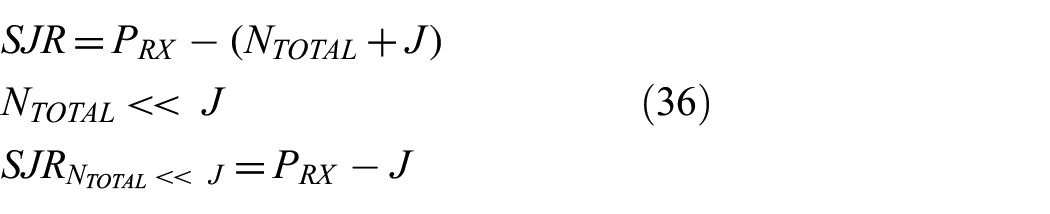
On another note, because the overall white noise of the radar receiver is quite small compared with the white noise created by the jammer, it is usually omitted. Here the term JSR was coined by the electronic warfare community to demonstrate the effectiveness of the jammer’s effect, which is (in dB)

Of course, in order to calculate the new SNR at the radar after the jamming effect, the conjugate concept of the JSR, which is the signal-to-jammer ratio (SJR), is utilized.
Therefore the new SNR of the radar, after the jammer’s effect, is (in dB)
7. SJR and JSR Simulation
In decoy mode, an electronic attack jammer must acquire the operational characteristics of the adversary radar so it can inject false targets. On the other hand, there is no need to acquire the adversary radar’s operating details when the jamming function is using white noise. In other words, the major effort of a white noise jammer is the degradation of the adversary radar’s SNR.
For example let us simulate, using MathcadTM, the invasion of a typical fighter or radar cross section of 3 m2, a stealthier target like a ballistic missile or a B-2 with σ = 1 m2 and a much stealthier target like an F-35, which is claimed to be at σ = 0.005 m2, starting at 250 km to selected ranges up to 10 km away from an early warning radar, like the AESA AN/FPS-117. 9 This type of early earning radar operates at 24.6 kW peak power and 1.3 GHz operating frequency. Its radar’s antenna is set to provide +40.59 dBi at azimuth of 0.18 degrees and full elevation of 20 degrees (fan shaped), and the bandwidth is set to 100 MHz to provide for pulse compression issues. Moreover, an additional noise from the radar’s amplifiers (noise factor equals 5 dB was added, and a typical further atmospheric noise (MOD = 10 dB) was used.
As far as the jammer is concerned, we could set the jammer emitter power to 6800 W, like the AN/ALQ-99E, its antenna gain to +22.63 dBi and its jamming bandwidth to 1 GHz.
Then, as shown in Table 1, we took a sample of results from the simulator which corresponds to ranges of interest for air-defence reasons.
Comparison of SNR and respective SJR for three types of targets.
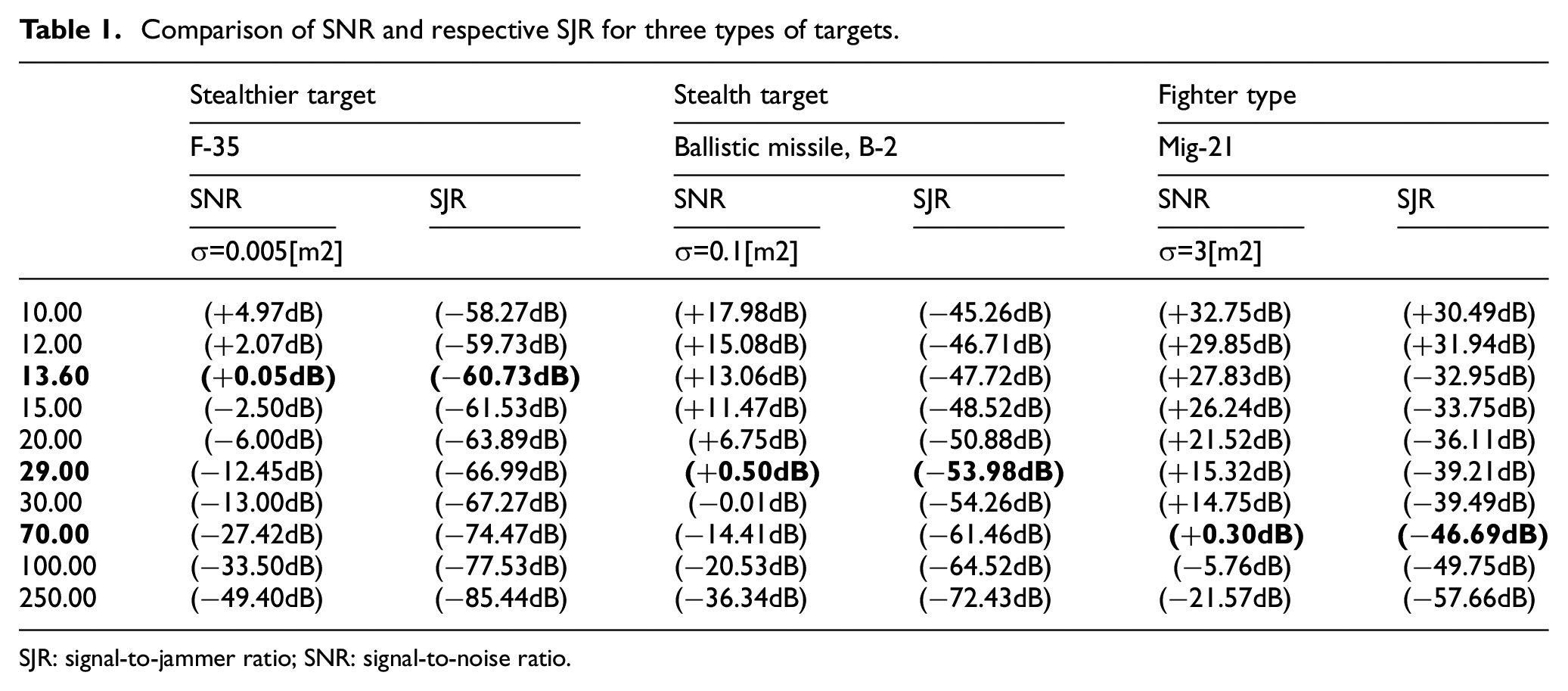
SJR: signal-to-jammer ratio; SNR: signal-to-noise ratio.
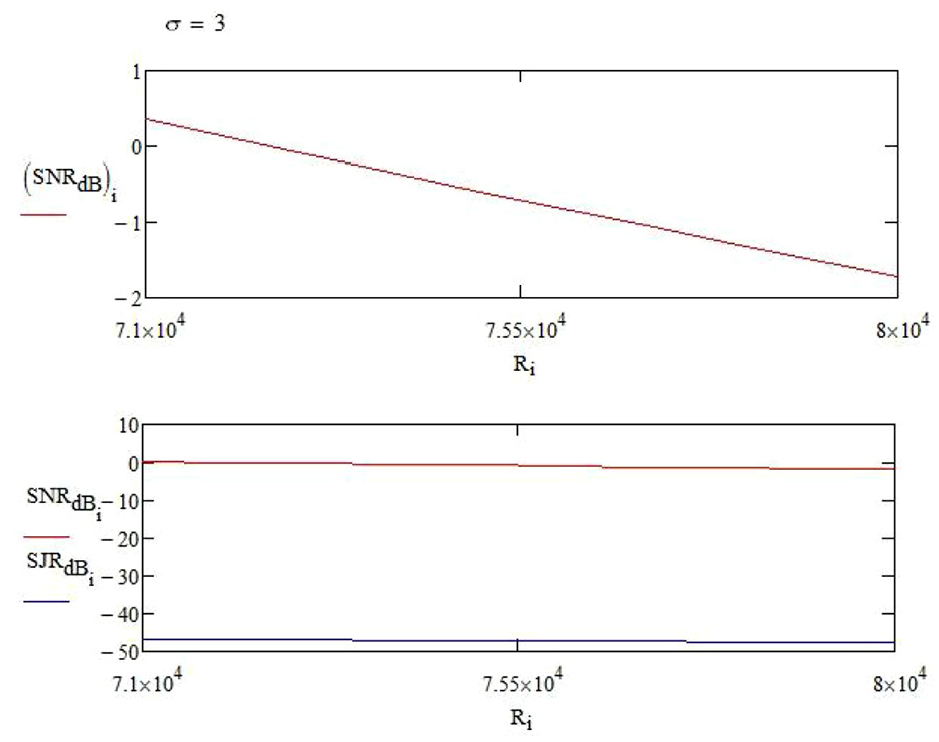
Additionally, the simulator provides a graphical representation of the results, as can be seen in Figure 1 which represents such a sample.
From the results of Figure 2, we can see that without the jammer a target will eventually be seen by the radar, but with the jammer the target will be seen much later by the radar after it passes the burnthrough range. Moreover, the modular layout of the simulator is shown in Figure 2.
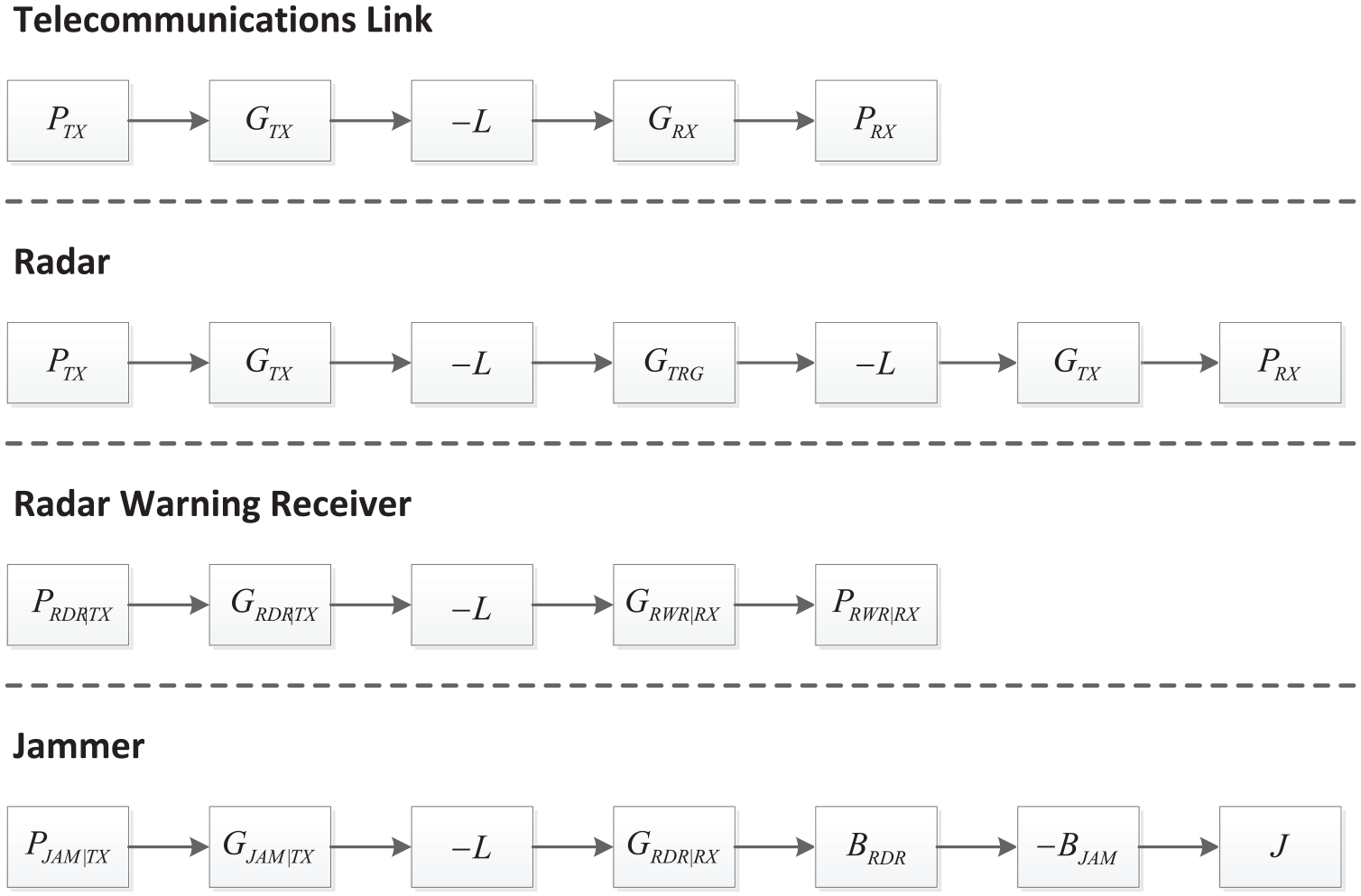
Modular mathematical modelling of several telecommunications links using the free space loss block.
8. Discussion
This paper is an exercise in electronic warfare; it tries to predict the effect of a white noise jammer to a radar system and therefore, in the radar science, falls under the category of predictive dynamics.
As W.F. Bahret stated in an interview for the ‘Cold War Technology History Project’ (2006), 10 there are three ways to calculate a radar discipline, in the interview’s case the radar echo, in our paper’s case the performance of a white noise jammer. One way is to measure the actual machine, and the third is to use scale models or of course actual real setups. But these methods require that somebody took the risk of creating something first, which costs time and funding that bears a probability that it may not work well at the end.
Bahret's way, which this paper adheres to, is the second option, mathematical techniques, i.e., ‘techniques that permit you to design something and predict the outcome’.10, page 6 Moreover, mathematical techniques which take the form of predictive dynamics, is a practice very heavily used in the radar discipline because of all the probabilities of intercept, detection, and false alarm that are involved, together with a considerable amount of partial information that exists between a radar and a target.
Therefore, we back up our claims using the predictive dynamics of mathematical modelling and techniques that are appropriate for the radar and electronic warfare fields.
Analytically, we started with the telecommunications equation as a foundation stone in order to derive the radar equation. In this process, the useful concept of
Furthermore the well-established concept of SNR for radar detection was shown particularly in its decibel form, which provides for easier computations.
Then we conveniently altered the value of the parameters in the telecommunications equation in order to come up with the simulation of a RWR and a Jammer. Moreover, the electronic warfare concepts of JSR and SJR were depicted.
Further additions to the above equations that describe any kind of losses, like antenna polarization mismatches and radar antenna impedance mismatches, were intentionally omitted in this case study for clarity of results.
9. Conclusion
In this work, we arrived at the radar equation by using the telecommunications equation. Moreover, we discussed the target gain
