






Abstract
Protagonists in strategic interactions face uncertainty about their own and their adversaries’ intentions and capabilities, and about the general situation. Uncertainty is often represented probabilistically. However, probability distributions are often unknown due to complexity, limited knowledge or dynamic change. We employ info-gap theory to model and manage uncertainty non-probabilistically. We consider asymmetric uncertainty: both protagonists face significant uncertainty, but one faces much more than the other. Different degrees of uncertainty can motivate different behavior. We explore two responses to uncertainty. Robust satisficing ameliorates pernicious uncertainty to obtain essential outcomes. Opportune windfalling exploits propitious uncertainty to obtain wonderful outcomes. We explore these strategies both quantitatively and qualitatively. We prove two propositions: Protagonists facing greater uncertainty have worse robustness for achieving critical outcomes (Proposition 1) but have better opportuneness for achieving windfall outcomes (Proposition 2). We apply these ideas quantitatively to a generic example, and qualitatively to the Cuban Missile Crisis and to the Japanese attack on Pearl Harbor.
Keywords
1. Introduction
A strategic interaction between two protagonists, with conflicting interests, is an interaction that impacts the understandings of risks and opportunities, leading to the formulation, alteration or adoption of general, far-reaching plans of action. A strategic interaction occurs through the exchange of information between the parties that causes new understandings. In contrast, a tactical interaction occurs by direct contact, causing a new situation on the ground: exchange of hot words, blows or bullets.
Strategic interactions can lead to tactical interactions: understandings of risks or opportunities often lead to actions on the tactical level. For instance, Russian strategic understanding of NATO’s encroachment on Russia’s geographical domain of interests was one factor motivating Russia’s attack on Ukraine in 2022. Likewise, tactical interactions can alter strategic understandings, resulting in new plans. For instance, the bullets that killed Archduke Franz Ferdinand and his wife in 1914 contributed to understandings by world leaders that resulted in World War I. Strategic interactions occur in the realm of leaders and high-level decision-makers, while tactical interactions involve operators in the field. We focus on strategic interactions.
Uncertainty is prevalent in strategic interactions in military and defense affairs; the modeling and management of uncertainty is important for realistic modeling and simulation in these domains. Uncertainty in strategic interactions arises especially around the capabilities and intentions of the adversary. In addition, asymmetric interactions are common in military affairs, for instance, between a state and a non-state actor, or between democratic and autocratic states with greatly different degrees of informational openness. This paper demonstrates the methodology for implementing info-gap decision theory in modeling and managing asymmetric uncertainty and strategic interactions, and explains the practical implications of the analysis.
Uncertainty is usually multifaceted in strategic interactions. Understandings by one party to an interaction focus on the intentions, plans, capabilities and uncertainties of the other party, as well as on their own plans, abilities and uncertainties, and on the context in general. For instance, Atkinson et al. 1 argue that rivalries between states persist due to one side’s uncertainty—modeled probabilistically—about the resolve of their protagonist. These understandings are based on information, prior understanding and past experience, all of which can be incomplete, contradictory or simply wrong. Each party acknowledges some extent of uncertainty in its understanding of the situation. We focus on asymmetry in these recognized uncertainties: one side faces and acknowledges greater uncertainty than the other side.
Uncertainty is often represented probabilistically. However, in new and innovative situations, one may not know relevant probabilities. Knight 2 distinguished between “risk” for which probabilities are known, and “true uncertainty” for which probabilities are unknown. Knight stressed that true uncertainty arises in economic contexts from innovation or other dynamic changes. Knightian true uncertainty arises in strategic interactions when intentions, plans or capabilities of one protagonist are unknown or imperfectly known to the other protagonist. This can occur for several reasons: limited information, situational complexity and dynamic change.
For instance, when Japan attacked Pearl Harbor on 7 December 1941, the Americans did not know if this was intended to establish an outer border of Japan’s Greater East Asia Co-Prosperity Sphere, was intended to support the German war effort in Europe, or was intended as the beginning of a total war with the United States, or perhaps something else. Similarly, when the Arab coalition attacked Israel on 6 October 1973, the Israelis did not know if the coalition intended to reconquer limited sections of land, or intended the thorough and final destruction of the State of Israel, or maybe something else. Probability distributions are inaccessible here, and realistic likelihoods are unknowable, in part because the full space of possible events is unknown. These are examples of non-probabilistic Knightian true uncertainty.
Non-probabilistic uncertainty is important in many strategic interactions. We use info-gap decision theory to model and manage this uncertainty.
It is important to distinguish between uncertainty and ignorance. A protagonist may be ignorant of new technology developed by the adversary. The protagonist is not uncertain about this unknown technology; the protagonist simply has no knowledge of its existence. In contrast, the protagonist may be uncertain about new technologies available to the adversary, but that is different from ignorance of a specific new adversarial capability. Stated differently, awareness of the possibility of ignorance gives rise to uncertainty, but this uncertainty is not itself ignorance.
Section 2 discusses responses to asymmetric uncertainty in a wide range of disciplines, primarily (though not exclusively) in the realm of national security. Section 3 provides a first look at concepts that are developed systematically later in the paper. Section 4 develops a quantitative characterization of strategic interaction under asymmetric non-probabilistic uncertainty based on info-gap decision theory. This section provides a precise and thorough explanation of the methodology of info-gap theory and presents a quantitative example. Two propositions are proven in an online appendix (file: asym-unco25proofs.pdf). We begin with a quantitative study because it facilitates a concise graphical manifestation of the responses to asymmetric uncertainty. We then proceed to qualitative analysis. Section 5 discusses the evolution of strategic interactions, and sections 6 and 7 present examples based on the Cuban Missile Crisis and on the Japanese attack on Pearl Harbor in World War II. Section 8 presents a concluding discussion. In short, this paper demonstrates a comprehensive methodology for modeling and managing non-probabilistic uncertainty in strategic interactions between protagonists.
2. Responses to asymmetric uncertainty
Asymmetric uncertainty between protagonists in a conflict arises in many areas of national security and elsewhere. We review some of that literature. Some of the analyses we discuss are purely qualitative, while some employ quantitative treatments of uncertainty. In the latter case, uncertainty is usually modeled probabilistically.
2.1. Deterrence
Many scholars have recognized that uncertainty is an important factor in understanding deterrence between nations.
Betts 3 discusses NATO strategies for deterrence of a Soviet attack on Western Europe. He explains that “asymmetries between attacker and defender in political constraints and leverage over the conditions of engagement” enhance the uncertainties facing NATO governments (p. 154). These substantive asymmetries may translate into asymmetric uncertainty between the protagonists, although Betts does not discuss asymmetric uncertainty explicitly. Betts asserts that “Defense planners cannot control the uncertainties of future scenarios” (p. 165), due in part to “the unpredictable effects of new technology” (p. 169). Betts concludes that “uncertainty is more conducive to partially nuclear than to purely conventional deterrence” by NATO (p. 179). While uncertainties are central to Betts’ analysis of deterrence, he does not discuss asymmetry in the uncertainties that may hold between NATO and Soviet planners.
Altfeld 4 criticizes the use of uncertainty as a strategy for deterring Soviet attack on the United States. He argues that Soviet uncertainty about US retaliatory capability may deter risk-averse leaders, but not more risk-prone leaders. Altfeld writes that “uncertainty may deter but it also may not, depending on the character of the leaders making the choice” (p. 17). Altfeld does not discuss the implications of asymmetry in uncertainty between the United States and the Soviet Union. While Altfeld recognizes that probabilities may be unknown, he assumes that the protagonists must estimate these probabilities.
Nicholson 5 discusses deterrence between two states with a multi-step rational-actor game-theoretic formulation based on the prisoners’ dilemma. He provides a probabilistic interpretation of discounting over time in international relations. He concludes that deterrence is more likely, and cooperation more prevalent, when the states can move quickly between alternative strategies and when mutual uncertainty is low. High uncertainty or a delayed transition between strategies diminishes deterrence.
Kilgour and Zagare 6 develop a quantitative probabilistic game-theoretic model for describing bilateral deterrence between nations when each side is uncertain about the preferences of the adversary. They identify conditions on the credibility of each agent in which “deterrence can emerge in an uncertain world.”
Baker et al. 7 argue that “uncertain sanctions [in civil and criminal law] may be preferable on efficiency grounds because they achieve more deterrence than certain sanctions of the same expected value.” (p. 445). A potential offender’s uncertainty about the severity of punishment deters criminal behavior more than certainty. While commission of crime and enforcement of the law is an interaction between two parties—offenders and the state—the different uncertainty of each party about the other is not discussed.
Similarly, DeAngelo and Charness 8 argue, based on laboratory experiments, that “uncertainty about the enforcement regime yields a significant reduction in violations committed” (p. 73).
Chilton and Weaver 9 discuss the use of “deliberate ambiguity” about the US response to an attack by the Soviet Union as a strategic device in the Cold War. The United States and the USSR had similar uncertainties and, more importantly, viewed those uncertainties with similar risk aversion in assessing deterrence. Symmetry in uncertainty and in the “propensity to take risks” is inherent here. In contrast, the United States and a terrorist group view uncertainties differently. Explicitly, the terrorists are more “risk-acceptant” than the United States, and the terrorists may view uncertain capabilities of the United States as an opportunity to be exploited, rather than as a source of deterrence.
Ben-Haim 10 discusses a state’s decision to either initiate war or not to initiate, when facing deep uncertainty about the situation, the adversary’s capabilities, potential outcomes and more. Uncertainty is modeled with info-gap decision theory, 11 which is non-probabilistic, and employs the info-gap methodology of robust satisficing: maximizing robustness against uncertainty while satisfying critical requirements. The analysis is qualitative because much of the relevant understanding eludes quantitative representation. It is demonstrated that a putatively less desirable option may be preferred due to its greater robustness against uncertainty. This reflects the potential for a reversal of preference between the putatively optimal alternative and a putatively sub-optimal alternative that has greater robustness to uncertainty. The analysis supports decision-making by a state and thus does not consider asymmetric uncertainties of the state and its adversary.
Kaplow 12 discusses the impact of asymmetric uncertainty on state compliance with international security agreements such as the nuclear nonproliferation regime. States are willing to comply provided that other states comply as well. Each state knows whether it complies or not, but faces uncertainty about the compliance of other states. This asymmetric uncertainty diminishes or grows over time, impacting the willingness for compliance.
Mazarr et al.
13
discuss strategic competition between the United States and other major powers, especially China and Russia. They write (p. 3) that “The primary risk in defense policy” arises because: military competitions tend to shift with inflection points in how wars are fought, as well as the operational concepts and supporting technologies associated with those changes. Emerging technologies…create the potential for just such an inflection point over the next decade—and U.S. rivals are working to take advantage of the change to undermine the effectiveness of traditional U.S. military concepts of operations.
A “priority area” is to “Avoid vulnerability to novel packages of technologies and operational concepts used to generate decisive military effects” (p. 3). New and emerging technologies are uncertain, and that uncertainty is asymmetric when an adversary conceals their innovations.
2.2. War
Asymmetric uncertainty occurred between the British and the Germans in World War II. Handel 14 explains that British scientific intelligence about German offensive capabilities provided the British with “early warning of the development of many new and even revolutionary German weapons, while the Germans could seldom respond in kind.” This enabled the British to take preventive or counteractive actions against German capabilities. The Germans discounted British military capability and thus made little effort to learn about that capability. As a result, there was a great disparity between what the Germans knew about the British and the actual British capability. Had the Germans attempted preventive or counteractive measures against British innovations, the Germans would have faced great uncertainty. British uncertainty about the Germans was substantially less than German uncertainty about the British.
Punla-Green et al. 15 study an interdiction problem in which the evader travels from a source node to a sink node by the shortest path. The interdictor maximizes this shortest path by interdicting arcs in the network. The evader knows the nominal (estimated) values of all the relevant parameters of the system and ignores uncertainty in these values, while the interdictor recognizes the uncertainty in these estimates, creating asymmetric uncertainty between the protagonists.
Hwang and Ma 16 study the detection of camouflaged objects in a military context using artificial intelligence [AI]. Camouflage is intended to enhance the uncertainty in the detection or identification of the object. Uncertainty in detection and identification arises in applying AI in the military domain due to a lack of military-specific data sets for training the AI algorithms. This uncertainty is inherently asymmetric between the camouflager and the adversary due to their different knowledge.
Kenkel and Schram 17 discuss the impact of “Incomplete or asymmetric information” on the choices of protagonists in international crises. They emphasize that “states in crises possess a diverse range of coercive intermediate policy options besides war and peace” including “sanctions or tariffs,”“support to an adversary’s enemies,”“cyberattacks,”“drone strikes” or “low-level conflict” (p. 194). A state that assesses its war-making capability as exceeding that of its adversary may nonetheless choose an alternative coercive policy. We note that different levels of uncertainty may accompany a state’s assessment of its capabilities for the various options, thus influencing the state’s choice.
Fearon 18 studies the question of how a state leader can make a threat of force credible, when presumably the leader would prefer to refrain from military action. The primary response is by making threats that entail costly signals. Fearon’s analysis is based on a Bayesian assessment of the decision process in which relevant probabilities and probability distributions are known for both the challenger and the defender.
Slantchev
19
studies the question of how wars end, focusing on the role of protagonists’ expectations about the likelihood of victory or defeat. War is viewed as a “stochastic process of attrition modeled as “a homogeneous Markov chain” (p. 623). Considering two protagonists, the probability that “Player 1” wins is
Fey and Ramsay 20 explore the “mutual optimism” hypothesis that wars occur when both protagonists believe they can gain by war. Their critique of this hypothesis arises from an analysis of the uncertainty that surrounds war. Their analysis employs a probability distribution on states of the world, upon which protagonists base their decisions. They do not posit asymmetry of information, although each side may have “private information.”
2.3. Terrorism
Asymmetric uncertainty can arise when an established actor, like a nation-state, is confronted by a new actor, such as a new terrorist organization. The terrorists may be quite familiar with the state, while the state has little or no familiarity with the terrorist organization. The asymmetry of uncertainty can also arise from differences in the collection, analysis and dissemination of knowledge and understanding within a state’s large bureaucracy, as distinct from a small and centralized terrorist organization.
Various state institutions are responsible for protecting citizens and infrastructure against terrorist attacks. These institutions may face deep and highly asymmetric uncertainty about the identity of terrorist operatives as well as terrorist intentions, plans, capabilities and vulnerabilities. For instance, Jakovlev et al. 21 discuss the deep uncertainties in detecting hidden radioactive materials in stacked containers on ships or in storage areas, the intended use of which is unknown. These uncertainties arise from diverse possible origins of the material (p. 45), from variable sensor reliability (p. 46), or from the impact of data from different sources (p. 52). As another example, Benjamin and Simon 22 express uncertainty about how US military action in Iraq, and specifically strikes intended to kill Zarqawi, would impact jihadist action. Likewise, Zarqawi’s jihadist organization was uncertain about US capabilities and vulnerabilities, and also uncertain about reactions in various Iraqi populations to terrorist action against the Americans. Clarke 23 stresses that the challenge facing US action against Islamic terror “is a battle not only of bombs and bullets, but chiefly of ideas” between the West and much of Muslim society that, at least initially, did not identify with jihadist action. Likewise, English 24 stresses “the profound uncertainty of terrorism achieving its central goals.” Even understanding those goals is a major source of uncertainty for both sides, as Hayden 25 explains in describing conversations with international anti-terrorism partners in many countries. Understanding, on both sides of the terrorism divide, is impacted by cultural conceptions and biases, thus augmenting uncertainty differently on both sides.
2.4. Cyber security
Cybersecurity refers to protection against digital attacks on critical national infrastructure, corporate organizational resources and private interests such as personal security and privacy, as explained by Dunn Cavelty and Wenger.26,27 Uncertainty abounds in the cyber domain due to rapid technological development, great diversity of potential targets and their respective vulnerabilities, and institutional dispersion of responsibility for cyber security between governments, corporations and private individuals as discussed by Bob and Evyatar. 28 Deterrence of potential cyber attackers is one form of security. However, a strong asymmetry of uncertainty may exist between defender and attacker. The attacker knows who is being attacked and can know existing security tools. The target, however, may know little about the attacker, their goals and capabilities. 29
Albanese et al. 30 discuss a probabilistic “moving target defense” strategy against malicious botnets. They explain that cyber attacks are typically preceded by a reconnaissance phase in which the adversary collects information about the target. The defensive strategy advocated by the authors is to continuously modify the configuration of the system and the network, thereby creating “asymmetric uncertainty, providing the defender with a tactical advantage over the attacker” (p. 92). Each side has knowledge about the other side, but each side’s uncertainty is no less important. The asymmetric uncertainty that the authors emphasize is that the defender augments the attacker’s uncertainty as a defensive mechanism. Further development of this issue appears in the work by Albanese et al., 31 Jajodia et al., 32 Albanese et al. 33 and Connell et al. 34
Ding et al. 35 consider the strategic interaction, in a communication channel, between an attacker and a defender using a probabilistic Markov chain approach. The attacker attempts to corrupt the communication by jamming the channel. The defender attempts to prevent this by adjusting the “transmission power” and the “real-time information,” creating “asymmetric uncertainty to mislead the attacker and thus mitigate attacks” (p. 1). The defender employs this “deception trick to manipulate the attacker’s belief” (p. 10).
Similarly, Chen et al. 36 study defense against attacks in cyberspace using a probabilistic Markov chain analysis. They create diverse functional equivalents of the defended target by sensing the attacker and then altering the defended target. This creates asymmetric uncertainty to favor the defender.
2.5. Economics and management
Asymmetric uncertainty arises in economic interactions. Li et al. 37 study the pricing strategy of a monopolist who sells substitutable products. Consumers face probabilistic uncertainties about these products, while the seller does not. The authors explore the question of whether the seller should reduce this asymmetric uncertainty—and if so, by how much and for which products—to maximize the revenue.
Maskin 38 studies the use of enhanced production capacity by an incumbent firm to deter the entry of competitors. He argues that uncertainty in demand and costs requires the incumbent to install greater production capacity than without uncertainty. This uncertainty thus acts to deter the incumbent from enhancing production. Enhanced production deters competitors, but uncertainty deters enhanced production by the incumbent.
Mazarr et al. 13 discuss uncertainty in economic statistics such as gross domestic product and its rate of change when using data from an authoritarian regime such as China. “Some observers believe that official [Chinese] statistics for both are substantially overstated.” (p. 5) Here is the potential for an asymmetric uncertainty because US statistics on these issues are not subject to deliberate manipulation.
Asymmetric uncertainties can arise in the management and use of civilian infrastructure systems: roads and highways, electric power production and supply, water purification and supply, waste management, telecommunication, Internet systems, educational institutions and more. Rangrazjeddi et al. 39 stress that these infrastructure systems are highly interconnected in many ways: telecommunication depends on electricity supply, waste management depends on roads and highways, schools depend on water supply, and so on. Furthermore, distinct actors influence the operation of these infrastructures, including utility operators, political leaders, state and local governments, public interest groups and more. These groups have different interests and face different uncertainties of different degrees of severity. Utility operators may be uncertain about future demand for their product or future supply of essential components to their operations. Political leaders may be uncertain about political implications and public understandings of various production technologies. Public interest groups may be uncertain about infrastructure impacts on the environment, and so on. In short, asymmetric uncertainties abound.
3. Two quantitative results: A first look
Protagonists in a conflict can respond in various ways to asymmetric uncertainty in strategic interaction. In this paper, we explore two complementary aspects of the response to asymmetric uncertainty in situations where probability distributions are inaccessible. Our analysis is based on two decision functions developed in info-gap decision theory: 11 robustness against pernicious uncertainty and opportuneness from propitious uncertainty. These functions underlie two quantitative propositions on the implications of asymmetric uncertainty for understandings (including plans and decisions) by protagonists in strategic interactions. The two propositions underlie our understanding of the strategic interaction between parties with asymmetric uncertainty and conflicting interests. The concepts are briefly and intuitively described in this section and are then formulated rigorously in the next section.
Consider an agent who faces great uncertainty about the adversary and about the situation in general, and believes that their adversary faces more moderate uncertainty. This agent may abandon the attempt to guarantee critical goals as unrealistic (Proposition 1) and yet may believe that the achievement of a wonderful windfall is possible (Proposition 2). There is no contradiction between these two seemingly conflicting approaches. These approaches arise from responding to different aspects of uncertainty. The attempt to guarantee critical goals is a response to pernicious uncertainty, while the attempt to facilitate windfall is a response to propitious uncertainty. Uncertainty is a vast and diverse realm, not a single homogeneous entity. Furthermore, this agent may anticipate that their adversary will focus on confidently achieving their critical goals (converse of Proposition 1) and would not venture into risky attempts for a wonderful windfall (converse of Proposition 2).
Similarly, consider an agent who faces moderate uncertainty about their adversary and about the situation in general, and believes that their adversary faces great uncertainty. This agent may feel confident in achieving critical goals (converse of Proposition 1) and see the aspiration for a wonderful windfall as risky (converse of Proposition 2). Furthermore, this agent may anticipate that their adversary will not focus on achieving critical goals for which they can have little confidence (Proposition 1) and could venture into attempts for windfall that their adversary would consider to be feasible (Proposition 2).
The reasoning in the last two paragraphs suggests a cognitive match between the adversaries: each side correctly anticipates the preferred strategy of their adversary. However, we will see that cognitive mismatch between adversaries occurs when one or both sides incorrectly anticipate their adversary’s strategy. We will explore the implications of both possibilities.
4. Robustness and opportuneness with asymmetric uncertainty
Uncertainty entails the potential for pernicious failure, and also the potential for propitious windfall. The response to uncertainty is far from unique, and different actors may respond differently. When two interacting protagonists confront substantially different levels of uncertainty, they may respond differently, impacting their interaction. A protagonist facing great uncertainty may recognize that adequate outcomes are not confidently attainable, but may seek to exploit the propitious uncertainty in attempting to obtain an unanticipated but wonderful outcome. In contrast, a protagonist facing more moderate uncertainty may feel that the responsible reaction is to protect against pernicious uncertainty in achieving critical goals. The info-gap robustness function assists in managing the pernicious side of uncertainty, and the info-gap opportuneness function assists in managing the propitious side. We employ these functions in analyzing the strategic interaction of protagonists with asymmetric uncertainty about each other and about the situation in general. We are considering situations where probabilities are unknown, and the protagonists face non-probabilistic Knightian true uncertainty. In this section, we formulate and discuss these functions and present two propositions and a numerical example.
4.1. Formulation of robustness and opportuneness functions
We consider the strategic interaction between two protagonists whom we refer to as Blue and Green. Their understandings of the situation are denoted generically
Each side can articulate its understanding, but each side also recognizes that its understanding may be wrong. That is, each side has a current best estimate of its knowledge and insight into the situation, but each side also recognizes that that knowledge may err. Blue’s best understanding is denoted
Each side has its own understanding and is uncertain about the accuracy of that understanding. The understandings are subtle and complicated, addressing a diverse array of knowledge, including the capabilities and intentions of each side. This knowledge may involve numerical assessments, functional relations and subjective assessments. Probability distributions are lacking because of the Knightian nature of the uncertainties, as discussed earlier. Non-probabilistic info-gap models of uncertainty quantify each side’s uncertainty about its understanding. 11 Blue is highly uncertain about its understanding, while Green faces more modest (but still significant) uncertainty about its understanding. This expresses the asymmetric uncertainty to be quantified subsequently.
We represent this uncertainty with info-gap models.
11
An info-gap model of uncertainty,
The nesting axiom asserts that the uncertainty sets

This axiom endows
Let

That is, the uncertainty set contains only the estimated value when the horizon of uncertainty is zero.
Each side quantifies its uncertainty about its understanding with an info-gap model,
The elements of
Likewise, the center point of
The structures of these info-gap models may differ, one from the other, and their elements (values of
The outcome of the interaction between Blue and Green bears a significant impact on both sides. Each side can assess the outcome quantitatively in terms of duration, cost in human lives or cost in financial or material resources. These assessments may be different for each side, but the subject of the assessment, for example, duration or cost, is the same. In this study, the outcome is a real scalar value whose assessment is based on models or simulations of the relevant issue. For any given realization of Blue’s understanding,
Blue’s robustness to its uncertainty about its understanding is the greatest horizon of uncertainty,

“Reading” this equation from left to right: the robustness,
Likewise, Green’s robustness to its uncertainty is the greatest horizon of uncertainty,

Equation (4) shows that Green’s robustness function,
The inner extrema in Equations (3) and (4) express an important difference between the Blue and Green robustness functions, reflecting the conflictual nature of the interaction. Blue desires a small outcome, so its robustness evaluates bad outcomes by exploring the maximum outcome as a function of the horizon of uncertainty. Green, in contrast, desires a large outcome, so its robustness evaluates bad outcomes by exploring the minimum outcome as a function of the horizon of uncertainty.
There is a fundamental epistemic and methodological distinction between info-gap robust satisficing, Equations (3) and (4), and Wald’s 40 maximin. Wald’s approach presumes knowledge of a worst case and then chooses a decision to minimize the impact of that worst case. Info-gap robust satisficing presumes that a worst case is not known: that the horizon of uncertainty is unbounded. One then satisfices the outcome and maximizes the robustness against uncertainty. This is a fundamentally different strategy from maximin and is particularly suited to practical decision-making in many fields confronting deep uncertainty, including military affairs. The info-gap approach provides an implementable methodology for dealing with non-probabilistic Knightian uncertainty in which realistic worst cases are unknown.
Opportuneness is the complement of robustness. Opportuneness attempts to exploit favorable uncertainty, unlike robustness, which protects against pernicious uncertainty.
Blue desires a small value for the outcome function, and a very small value would be wonderful. Blue’s opportuneness from its uncertainty (about its understanding) is the lowest horizon of uncertainty,

Analogously, Green desires a large value for the outcome function, and a very large value would be wonderful. Green’s opportuneness from its uncertainty is the lowest horizon of uncertainty,

Comparing the robustness functions in Equations (3) and (4) with the opportuneness functions in Equations (5) and (6), we see an inversion of the optimization operators: Each max in a robustness function becomes a min in the corresponding opportuneness function, and each min becomes a max. The robustness function evaluates the maximum uncertainty up to which a requirement is guaranteed; hence, the outer maxima in Equations (3) and (4). The opportuneness function evaluates the minimum uncertainty at which a wonderful outcome is possible; hence, the outer minima in Equations (5) and (6). The inner optimizations express worst cases in Equations (3) and (4) and express best cases in Equations (5) and (6).
We again note the fundamental epistemic and methodological distinction between info-gap opportune windfalling and Wald’s 40 maximin. Wald’s approach presumes knowledge of a worst case and then chooses a decision to minimize the impact of that worst case. Info-gap opportune windfalling presumes that a best case is not known: that the horizon of uncertainty is unbounded. One then windfalls the outcome and optimizes the opportuneness from uncertainty. This is a fundamentally different strategy from maximin.
4.2. Interpretation of robustness and opportuneness functions
Schematic robustness and opportuneness curves for Blue and Green are shown in Figure 1. The robustness curves (solid lines) show the two universal properties of all robustness curves: zeroing and trade-off.
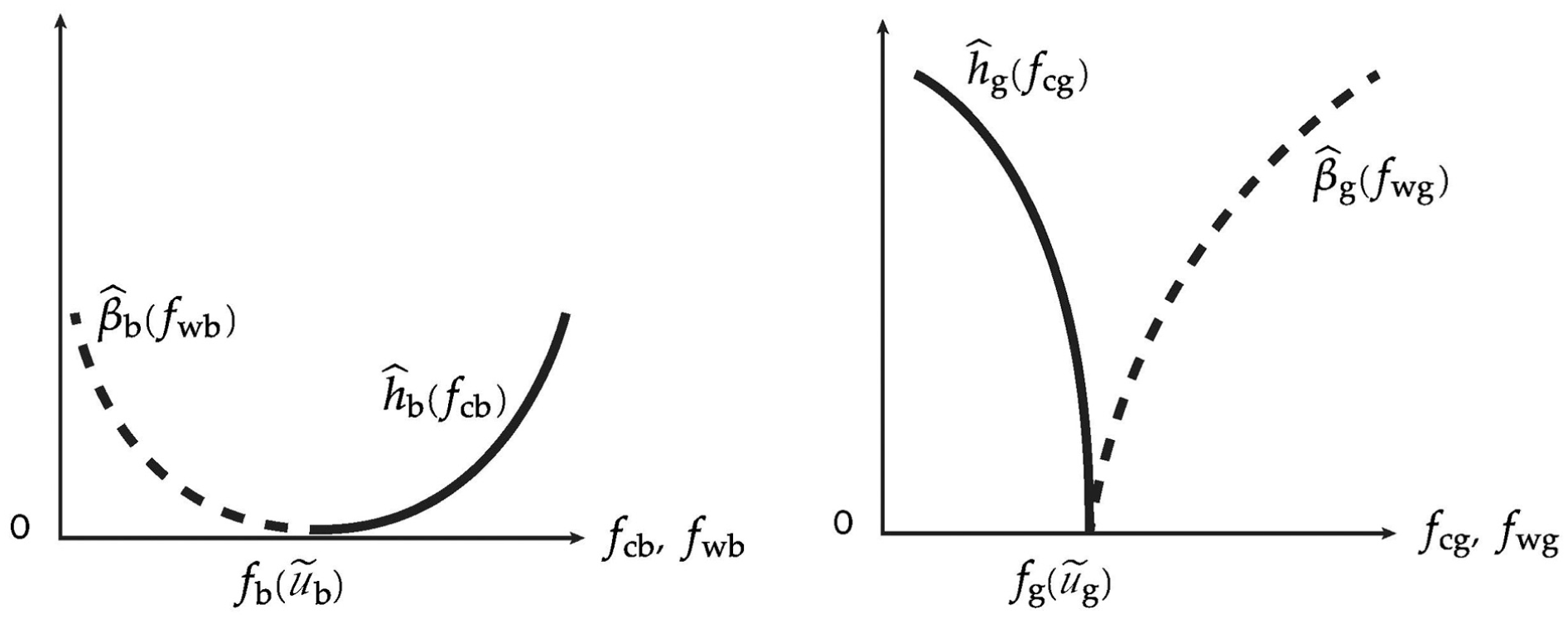
Schematic robustness curves (solid) and opportuneness curves (dashed) for Blue (left) and Green (right).
Zeroing of the robustness curve asserts that the robustness is zero if the critical value,
Trade-off of the robustness curve asserts that the robustness improves as the required outcome becomes less demanding or less desirable: robustness trades off against performance. This is manifested in the positive slope of Blue’s robustness curve in Figure 1 (left). Blue’s robustness,
The dashed opportuneness curves in Figure 1 also show zeroing and trade-off properties whose meanings are complementary to robustness zeroing and trade-off.
Zeroing of the opportuneness curve asserts that no uncertainty is required to enable the predicted outcome: in the absence of uncertainty, the outcome will precisely equal the predicted value.
Trade-off of the opportuneness curve asserts that greater uncertainty is required to enable more wonderful outcomes. The negative slope of
4.3. Asymmetric uncertainty
Asymmetric uncertainty between protagonists—when it exists—is manifested in two ways. First, the asymmetry appears as differences between the protagonists’ info-gap models, expressing different knowledge and different levels of uncertainty about the protagonists’ understandings. In particular, asymmetric uncertainty is significant when one protagonist faces much greater uncertainty than the other. Second, the asymmetry is manifested in the different values of the outcome function when evaluating maximal and minimal responses as a function of the horizon of uncertainty. Consequently, asymmetric uncertainty results in different relations between the robustness and opportuneness functions of the protagonists, as illustrated schematically in Figure 1.
Comparing the Blue and Green robustness curves,
In contrast, comparing the Blue and Green opportuneness curves,
The following two propositions generalize this complementarity between robustness and opportuneness when considering asymmetric uncertainty.
We quantify the concept of asymmetric pernicious uncertainty with the inequality in Equation (7), based on the robustness functions of Equations (3) and (4) and combining the outcome functions and both info-gap models of uncertainty. Recall that Blue requires a small outcome, so large outcomes are contrary to Blue’s interest. The quantity on the left-hand side of Equation (7) is the magnitude of the maximum deviation above Blue’s anticipated outcome, at the horizon of uncertainty

In an analogous fashion, we quantify the concept of asymmetric propitious uncertainty with the inequality in Equation (8), based on the opportuneness functions of Equations (5) and (6) and combining the outcome functions and both info-gap models of uncertainty. Recall that Blue aspires to a very small outcome, so a tiny outcome would be a wonderful windfall for Blue. The quantity on the left-hand side of Equation (8) is the magnitude of the maximum deviation below Blue’s anticipated outcome, at the horizon of uncertainty

4.4. Analytical results
For notational convenience, define
Given:
Info-gap models for the uncertainty of Blue and Green,
Robustness functions for Blue and Green,
Then: Blue faces greater uncertainty than Green, as defined in Equation (7), if and only if Blue is less robust than Green. Specifically:

if and only if

Proposition 1 can also be understood as asserting that lower uncertainty is equivalent to higher robustness.
Given:
Info-gap models for the uncertainty of Blue and Green,
Opportuneness functions for Blue and Green,
Then: Blue faces greater uncertainty than Green, as defined in Equation (8), if and only if Blue is more opportune than Green. Specifically:

if and only if:

Proposition 2 can also be understood as asserting that lower uncertainty is equivalent to worse opportuneness.
We note, from Propositions 1 and 2, that uncertainty has opposite impacts on robustness and opportuneness.
Propositions 1 and 2 may seem, at first sight, to be similar to Proposition 1 in Ben-Haim. 41 There is, however, a significant and substantial difference. The first proposition in Ben-Haim 41 considers “Two states of knowledge, or two contexts of a decision.” That paper assumes nesting of the info-gap model in these two different states, for each protagonist. That paper then asserts that each protagonist’s robustness function is ranked in those two states. In contrast, the current paper assumes ranking of the upper (or lower) range of the outcome of one protagonist on its info-gap model, against the lower (or upper) range of the outcome for the other protagonist on its info-gap model, Equations (7) and (8). These rankings of extreme values on the two different info-gap models do not imply nesting of each protagonist’s info-gap model, nor the converse. The present Propositions 1 and 2 then assert the ranking of one protagonist’s robustness or opportuneness over the robustness or opportuneness of the other protagonist. In addition, it is the robustness and opportuneness functions of the two protagonists that are ranked, rather than ranking each protagonist’s robustness in two different states. In short, the current results differ substantively from those in Ben-Haim. 41
4.5. Simple quantitative example of robustness and opportuneness
We now present a simple numerical example of the robustness functions for Blue and Green,
4.5.1. Formulation of the robustness functions
Blue’s estimate of the number of missiles that Green can launch daily is

This info-gap model is an unbounded family of nested sets of possible values of
Blue is concerned about the extent of economic damage to Blue’s interests that can be caused by Green each day, denoted

where

Employing Equations (13)–(15) in the definition of Blue’s robustness function in Equation (3), one readily finds the following expression for Blue’s robustness to Blue’s uncertainty about Green’s capability:

or zero if this is negative. The robustness of the estimated damage is zero, that is,
We now define and derive Green’s robustness function. Green’s estimate of the number of missiles that Green can fire each day is

This info-gap model is an unbounded family of nested sets of possible values of
Green is also interested in the extent of damage to Blue’s economic interests that can be caused by Green each day, denoted

where

Employing Equations (17)–(19) in the definition of Green’s robustness function in Equation (4), one readily finds the following expression for Green’s robustness:

or zero if this is negative. The robustness of the estimated damage is zero, that is,
4.5.2. Formulation of the opportuneness functions
Blue’s critical requirement, Equation (15), is that the extent of economic damage to Blue’s interests each day not exceed the critical value


or zero if this is negative. No uncertainty is required to enable the estimated damage, so
We now define and derive Green’s opportuneness function. Green’s critical requirement, Equation (19), is that the extent of economic damage to Blue each day be no less than the critical value

Using the info-gap model in Equation (17), the extent of damage in Equation (18) and the definition of the opportuneness function in Equation (5), one readily obtains the following expression for Green’s opportuneness function:

or zero if this is negative. No uncertainty is required to enable the estimated damage, so
4.5.3. Numerical implementation
We now numerically evaluate and discuss the implications of the robustness and opportuneness functions in Equations (16), (20), (22) and (24). The parameters take the following values:
Consider first the robustness curve for Blue,
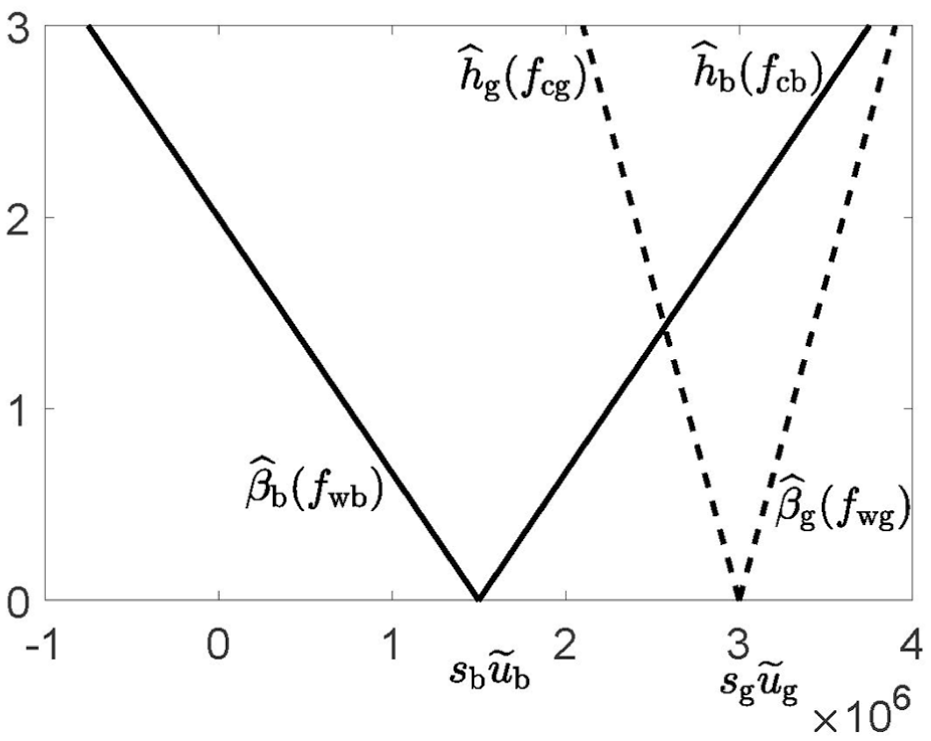
Robustness and opportuneness curves for Blue (solid) and Green (dash). The horizontal axis is
Compare this with the robustness curve for Green,
The Blue and Green robustness curves have opposite slopes because Blue prefers low economic damage (to itself) while Green prefers greater damage (to Blue). The opposite slopes of the Blue and Green robustness curves express the conflict between these parties: Blue requires low damage, while Green requires serious damage.
The slope of a robustness curve expresses the cost of robustness: how much the outcome must be worsened to obtain a positive increment of robustness. The Blue and Green slopes are
Now consider the opportunity curves in Figure 2 for Blue and Green,
Finally, consider the numerical values spanned by the robustness and opportuneness curves in Figure 2. Numerical robustness and opportuneness values are calibrated by referring to the info-gap models in Equations (13) and (17) for Blue and Green, respectively.
A robustness of 3 means that the corresponding Blue or Green requirement is guaranteed provided that the uncertain quantity errs no more than 3 times the corresponding error estimate,
For instance, Blue’s robustness curve,
5. Evolution of strategic interaction: Qualitative analysis
We are considering the strategic interaction between two protagonists who both face non-probabilistic uncertainty about the other protagonist and the general situation, but one protagonist’s uncertainty is significantly greater than the other’s. Proposition 1 asserts that lower uncertainty is equivalent to higher robustness. That is, the protagonist who faces lower uncertainty has greater robustness than its adversary for confidently achieving specified critical goals. Proposition 2 asserts that greater uncertainty is equivalent to better opportuneness. In other words, the protagonist who faces greater uncertainty has greater opportunity than its adversary for enabling unanticipated, wonderful windfall outcomes.
We have proven these propositions with the rigor of quantitative mathematical analysis, but also with mathematics’ lack of qualitative semantic subtlety. We now discuss two implications of these results in a more general qualitative context. We will identify two possible evolutions of the strategic interaction. As before, we refer to the protagonists as Blue and Green, where Blue faces great uncertainty, while Green faces more moderate uncertainty. We will consider two examples.
As discussed in Section 3 and subsequently, uncertainty can be viewed as either pernicious (entailing the potential for unacceptable outcomes) or propitious (entailing the potential for better-than-anticipated wonderful outcomes). One possible response to pernicious uncertainty is to robustly satisfice the achievement of an essential or critical outcome. One possible response to propitious uncertainty is to exploit an unanticipated opportunity for a wonderful windfall outcome. There are many possible strategies in addition to robust satisficing and opportune windfalling. For instance, Blue could attempt to acquire information that would reduce Blue’s uncertainty. Blue could attempt to enhance Green’s uncertainty. Green could also try to reduce its uncertainty. Green could try to reduce Blue’s uncertainty to impede Blue’s opportune windfalling.
Recall that Blue and Green have conflicting interests about the outcome of their strategic interaction. Blue faces great uncertainty, while Green faces more moderate (but not negligible) uncertainty. We focus on the following strategies for Blue and Green.
Blue:
1B. Robust satisficing for an adequate outcome. 2B. Opportune windfalling for a wonderful outcome (motivated by proposition 2).
Green:
1G. Robust satisficing for an adequate outcome (motivated by proposition 1). 2G. Opportune windfall for a wonderful outcome.
There is no immediate or obvious resolution of this inherently conflictual interaction: what is adequate or wonderful for Blue is undesirable or terrible for Green, and vice versa. We can, however, recognize two alternative states of understanding by the protagonists.
Green is aware of Blue’s great uncertainty, so Green might anticipate that Blue will attempt to exploit this uncertainty by opportune windfalling (2B). Similarly, Blue is aware of Green’s more moderate uncertainty, so Blue might anticipate that Green will attempt to manage this uncertainty by robust satisficing (1G). Thus, if Blue adopts 2B and Green adopts 1G, this could be called a cognitive match between Blue and Green.
Any of the other three possible combinations of strategies (1B&1G, 1B&2G or 2B&2G) would constitute a cognitive mismatch between Blue and Green.
We now develop a generic framework for the concepts of cognitive match and cognitive mismatch. We will demonstrate how these concepts can be operationalized in the specific examples of Sections 6 and 7.
We now consider two possible evolutions of the strategic interaction between Blue and Green.
The first possible evolution of the strategic interaction, based on a cognitive match between Blue and Green, leads to subsequent convergent strategic interaction and diminishing asymmetry of uncertainty, both resulting from diminishing uncertainty of both parties. The reasoning is as follows. Recall that the term “understanding” refers broadly to assessments, plans, capabilities and context.
1. Blue faces great uncertainty and believes that Green faces only moderate uncertainty. Moderate uncertainty implies the potential for high robustness for achieving critical goals (Proposition 1). Consequently, Blue expects that Green will formulate its strategy by robust satisficing.
2. Green faces only moderate uncertainty and believes that Blue faces great uncertainty. Great uncertainty implies the potential for facilitating better-than-anticipated outcomes (Proposition 2). Consequently, Green expects that Blue will formulate its strategy by opportune windfalling.
3. Indeed, Blue attempts opportune windfalling because Blue faces great and enticing uncertainty. Green attempts robust satisficing because Green is confident in achieving critical goals under moderate uncertainty.
4. Items 1–2 constitute asymmetric uncertainty between Blue and Green. Item 3 constitutes a cognitive match between Blue and Green.
How does this cognitively-matched strategic interaction evolve, where “strategic interaction” refers to the developing understandings of risks and opportunities leading to plans and actions?
5. As the strategic interaction evolves, each protagonist observes the other’s actions, thus reducing each protagonist’s uncertainty about the other’s current and future understandings and about the general situation.
6. As Blue’s uncertainty diminishes, Blue will be inclined to move from opportune windfalling to robust satisficing (Proposition 1).
7. As Green’s moderate uncertainty is further diminished, Green will remain with robust satisficing (Proposition 1).
8. Understandings evolve, further reducing each protagonist’s uncertainty, until a stable situation emerges. This could be called convergent strategic interaction, resulting in diminishing asymmetry of uncertainty caused by diminishing uncertainty of both parties. This convergence does not imply agreement between Blue and Green; their dispute remains until a solution is found. However, the fog around that dispute has diminished.
The second possible evolution of the strategic interaction, based on cognitive mismatch between Blue and Green, leads to subsequent divergent strategic interaction and diminishing asymmetry of uncertainty, both resulting from increasing uncertainty of both parties. The reasoning is as follows.
1. Blue faces great uncertainty and believes that Green faces only moderate uncertainty. Moderate uncertainty implies high robustness for achieving critical goals (Proposition 1). Consequently, Blue expects that Green will formulate its strategy by robust satisficing.
2. Green faces moderate uncertainty and believes that Blue faces great uncertainty. High uncertainty implies great potential for facilitating better-than-anticipated outcomes (Proposition 2). Consequently, Green expects that Blue will formulate its strategy by opportune windfalling.
3. Either Blue does not adopt the anticipated strategy of opportune windfalling, or Green does not adopt the anticipated strategy of robust satisficing, or both.
4. Items 1–2 constitute asymmetric uncertainty between Blue and Green. Item 3 constitutes a cognitive mismatch between Blue and Green.
How does this cognitively mis-matched strategic interaction evolve, where “strategic interaction” refers to the developing understandings of risks and opportunities leading to plans and actions?
5. As the strategic interaction evolves, each protagonist observes the other’s actions. Those actions do not conform to the protagonist’s anticipation, so each protagonist’s uncertainty increases.
6. The protagonists may switch strategies from time to time, thus further increasing uncertainty for both protagonists with associated decreasing asymmetry of uncertainty. This could be called divergent strategic interaction. The dispute between Blue and Green remains, and a resolution becomes more elusive as the fog around the dispute grows.
In both scenarios, the asymmetry of uncertainty decreases over time. In the first scenario, the uncertainty of each protagonist decreases over time, while in the second scenario, both protagonists’ uncertainty increases over time, in both cases resulting in reduced asymmetry of uncertainty. Either convergent or divergent strategic interaction is possible. Furthermore, neither scenario needs to proceed in its entire course; events can evolve first in one scenario and then move to the other, as we will see in the Cuban Missile Crisis.
6. The Cuban Missile Crisis
The Cuban Missile Crisis started when the United States discovered Soviet bombers and Soviet nuclear ballistic missiles in Cuba in the autumn of 1962. This Soviet action resulted from an agreement between Soviet Premier Nikita Khrushchev and Cuban Premier Fidel Castro to deter any future invasion following the US Bay of Pigs invasion in April 1961.
In discussing the Cuban Missile Crisis, Allison and Zelikow 42 discuss three models for describing decision-making by leaders.
The “Rational Actor Model” presumes that national decisions can be understood as though made by a single entity that identifies “optimal choices in narrowly constrained, neatly defined situations. In these situations, rationality refers to an essentially Hobbesian notion of consistent, value-maximizing reckoning or adaptation within specified constraints.” (Allison and Zelikow,42(p. 17), italics in the original)
Allison and Zelikow recognize the descriptive utility of the Rational Actor Model but argue that it “must be balanced by the appreciation that (1) [governmental] monoliths are black boxes…and (2) large acts result from innumerable and often conflicting smaller actions by individuals at various levels of organizations in the service of a variety of only partially compatible conceptions of national goals, organizational goals, and political objectives.” (p. 5) Following Allison and Zelikow, the present paper argues that understanding the Cuban missile crisis requires attention to uncertainty in understandings, by which we mean uncertainty in assessments, plans, and capabilities of each protagonist, as well as uncertainty in understanding the general context in which these other elements reside.
The “Organizational Behavior Model” emphasizes the distinctive logic, capacities, culture, and procedures of the large organizations that constitute a government.” (Allison and Zelikow,42(p. 5)) For instance, “the causes of inadequate camouflage [of Soviet emplacements]…[are] rooted not in incompetence or a clever policy design but instead in established routines designed for settings in which camouflage had never been required” (p. 381).
The “Governmental Politics Model” focuses on the politics of a government. According to this model, events in foreign affairs are characterized neither as unitary choice nor as organizational outputs. Rather, what happens is understood as a resultant of bargaining games among players in the national government.” (Allison and Zelikow,42(p. 6)) This model reveals Khrushchev’s “appreciation of the situation to have been cloudy at best, his judgments bereft of any attribute of high-quality deliberations. Relying on haphazard and often incorrect information” (p. 382).
Allison and Zelikow 42 also comment that policy makers “must make decisions based on partly read, partially digested, uncertain information” (p. 44) on “real-world issues where information is incomplete” (p. 45).
One can tentatively understand the evolution of the Cuban Missile Crisis between the United States and the Soviet Union in the context of the following two models of the evolution of strategic interaction. Both of these models build on the uncertainty of understandings that Allison and Zelikow emphasize. The situation is complex, dynamic, and the range of possibilities is poorly understood, so probability distributions are unavailable. The missile crisis began with substantial asymmetry of uncertainty and a distinct cognitive mismatch between the United States and the USSR. The following four items correspond to the similarly numbered items in the cognitive mismatch list in Section 5.
1. The United States faces great uncertainty about the intentions underlying the USSR’s decision to place offensive capabilities in Cuba. The United States likewise believes that the USSR faces more moderate uncertainty about how the United States will respond to what the United States perceives as a strategic offensive action.
2. The USSR faces lower uncertainty about the US understanding and recognizes that the USSR’s action would induce great uncertainty in the US leadership.
3. The United States may have initially contemplated exploiting the uncertainty about Soviet intentions with a vast and overwhelming attack that could potentially lead to unanticipated favorable outcomes, such as the replacement of Castro’s regime. However, the Soviets did not actually develop a strategically sound offensive threat; limited air power and a small number of missiles were deployed against the vast offensive and defensive capabilities of the United States. Thus, the United States did not employ an opportune windfalling strategy.
4. This constitutes the asymmetric uncertainty and the cognitive mismatch between the USSR and the United States.
From this point, the crisis proceeded with a distinct cognitive match between the United States and the USSR. The following three items correspond to the similarly numbered items in the cognitive match list in Section 5.
6. The United States recognized the strategic limitation of the Soviet action and did not observe further strengthening of the Soviet presence in Cuba. The United States became more confident that a nuclear attack was not pending: United States uncertainty diminished.
7. Likewise, Soviet uncertainty about US action diminished as the United States implemented a blockade but did not indicate clear preparations for invasion.
8. The diminishing uncertainty of both sides resulted in reduced asymmetry of uncertainty. Both sides reverted to reliably protecting critical interests. The dispute remained over the Soviet placement of offensive capability, and more generally about the status of the communist regime in Cuba. However, a stable situation evolved, agreement was reached (removal of Soviet missiles from Cuba and removal of US missiles from Turkey), and a cognitive match between the protagonists emerged.
7. Pearl Harbor: The strategic interaction
The Japanese attack on Pearl Harbor on 7 December 1941 caused damage or destruction to eight US battleships. This was a tactical operation, but it had a far wider strategic message. This can be understood by describing the attack with the first five stages of a cognitive match with asymmetric uncertainty between Japan (Blue) and the United States (Green).
The military leadership of Japan planned the attack on Pearl Harbor (and on other US and British possessions) as part of the establishment of the Greater East Asia Co-Prosperity Sphere, as discussed by Wohlstetter43(pp. 325, 346). This regional Japanese ambition was by no means secret, and Japan felt that the United States would be only moderately uncertain about how Japan would act to realize this ambition. However, Japanese leadership was very uncertain about how the United States would respond to Japanese aggression. Possibilities ranged from US efforts to contain Japanese expansion (which could even align with Japanese regional intentions) to all-out and sustained war, which would lead to Japanese defeat because of the far greater production capabilities of the United States, as explained by Wohlstetter43(pp. 350–351) (Item 1 in the cognitive match scenario).
By autumn 1941, the US Navy and Army leadership were anticipating war with Japan 44 despite ongoing negotiations on the future of the Pacific Ocean region. However, there was moderate US uncertainty about when, where, and under what pretext Japan would initiate war. The United States also anticipated that Japan faced great uncertainty about how the United States (and Britain) would respond should Japan initiate war, recognizing the far greater industrial war potential of the United States, balanced against the remoteness of Hawaii from the US mainland (Item 2 in the cognitive match scenario).
Indeed, Japan pursued the surprising and risky attack on Pearl Harbor, while the United States maintained a standard defensive posture (Item 3 in the cognitive match scenario).
One sees the asymmetric uncertainty between Japan and the United States before Pearl Harbor, and the cognitive match in their understandings (Item 4 in the cognitive match scenario).
Both sides’ uncertainty is reduced immediately after the attack: the United States learns the location and nature of the multiple Japanese attacks, and Japan witnesses President Roosevelt’s request, in his address to Congress on 8 December 1941, that Congress declare war on Japan (Item 5 in the cognitive match scenario).
8. Concluding discussion
Strategic interactions between protagonists with conflicting interests may be strongly influenced by uncertainties facing each side. These uncertainties cannot be quantified with probability distributions because they result from complexity and limited knowledge about the realm of possibilities. We studied the implications of asymmetric uncertainty: one protagonist faces great uncertainty about the situation, while the other protagonist faces more moderate but still significant uncertainty.
Uncertainty can induce many diverse responses by decision-makers. We explored two alternative responses to non-probabilistic uncertainty. Robust satisficing is a methodology that responds to the pernicious potential of uncertainty and attempts to assure the achievement of a critical or essential outcome. Opportune windfalling is a methodology that responds to the propitious potential of uncertainty, and attempts to facilitate the achievement of a better-than-anticipated wonderful outcome.
We have presented two mathematical propositions: The protagonist facing greater uncertainty has worse robustness for achieving a critical outcome (Proposition 1), but has better opportuneness for achieving a windfall outcome (Proposition 2). This protagonist may lack confidence in achieving a critical outcome (if the robustness to uncertainty is low), but may recognize the potential for a windfall (if the opportuneness from uncertainty is favorable). Conversely, the protagonist facing more moderate uncertainty may be confident in achieving a critical outcome (if the robustness to uncertainty is high), but may not see great opportunity for a windfall (if the opportuneness from uncertainty is unfavorable).
The mathematical analysis of robust and opportune responses to uncertainty reveals three generic properties. First, predicted outcomes have zero robustness to uncertainty in the knowledge upon which the predictions are based. Thus, predicted outcomes are not a reliable basis for assessment. Second, the robustness improves as the required outcome becomes more modest: robustness trades off against the outcome requirement. Hence, reliable sub-optimal requirements can be identified. Third, the opportuneness improves as the windfall aspiration becomes more modest: opportuneness trades off against the outcome aspiration. Hence, plausible windfall aspirations can be identified. A simple numerical example of the quantitative robustness and opportuneness functions was presented, and the interpretation of these functions was discussed.
Mathematical analysis reveals generic structural properties but is ill-suited for the semantic subtlety required in analyzing realistic situations. In preparation for qualitative analysis of strategic interaction under asymmetric uncertainty, we identified two epistemic conditions. A cognitive match occurs when each protagonist correctly assesses its adversary’s uncertainty and its adversary’s choice between robust satisficing and opportune windfalling. A cognitive mismatch occurs otherwise. We then outlined generic stages in the evolution of strategic interaction with either a cognitive match or a cognitive mismatch between the protagonists. We demonstrated that this analysis can describe the Cuban Missile Crisis of 1962 and the Japanese attack on Pearl Harbor in World War II.
Finally, we note that different types of knowledge and understanding underlie quantitative or qualitative analysis. Practical application thus depends on first deciding which type of analysis is appropriate: quantitative or qualitative. The different results of this paper can then be appropriately applied.
Footnotes
Funding
The author received no financial support for the research, authorship and/or publication of this article.
Declaration of conflicting interests
The author declared no potential conflicts of interest with respect to the research, authorship and/or publication of this article.
Author biography
 . He has been a visiting scholar in many countries and has lectured at universities, technological and medical research institutions, public utilities and central banks. He has published more than 100 articles and six books. He is a professor emeritus of mechanical engineering at the Technion—Israel Institute of Technology and held the Yitzhak Moda’i Chair in Technology and Economics during 2001–2021.