






Abstract
Although hypertension and alcohol dependence have been linked by epidemiological surveys and clinical observations, their interactive effects on brain function have rarely been tested. The present study involved the recording of P300 event related potentials (ERP) from 106 middle-aged African-American adults assigned to one of four groups: normotensive/nondependent (n = 56), hypertensive/nondependent (n = 11), normotensive/dependent (n = 27), and hypertensive/dependent (n = 12). The numbers of Nicotine Dependence, Major Depressive Disorder, and Conduct Disorder symptoms were specified as covariates within a 2 by 2 factorial design. ERPs were recorded during separate visual and auditory oddball tasks.
The major result was a synergistic effect of hypertension and alcohol dependence on auditory P300 latency: the combination of both factors was associated with greater slowing than the sum of their independent effects. Future studies should continue to examine the potential synergistic effects of alcohol dependence and hypertension with a view toward identifying and reducing neurophysiological decrements and stroke risk among middle-aged patients.
INTRODUCTION
Hypertension is a risk factor for stroke 1 and is associated with abnormal MRI findings, especially white matter hyperintensities and silent infarcts. 2,3 The literature describing its effects on brain function is more limited. 4 Most studies have focused on subjects older than 55 years and have not examined the interaction of hypertension with other vascular disease risk factors, such as alcohol dependence 5 and smoking. 6,7 Furthermore, the extant studies have employed traditional neuropsychological tests, e.g., from the Halstead-Reitan or Luria-Nebraska batteries, which are not optimally sensitive to the effects of early or subtle brain damage. The present study is among the first to test the interactive effects of hypertension and alcohol dependence on brain function while simultaneously controlling the effects of smoking and relevant comorbid psychiatric disorders.
Although studies examining the interactive effects of hypertension and alcohol dependence are sparse, a large number of studies have examined these disorders individually. For example, Cicconetti and colleagues 8 –11 applied the sensitive technology of event related potentials (ERP) to assessing the effects of hypertension in elderly patients. In a report published in 2000, 8 they documented slowing of the auditory ERP in 20 elderly patients afflicted with mild hypertension versus 10 normotensive controls. Subsequent reports by the same investigators suggest that other measures of vascular disease risk, e.g., blood pressure variability, are not associated with a greater or more reliable neurophysiological decrement than is average blood pressure. 9 –11
Aberrant ERP component amplitudes and latencies have been extensively documented among alcohol dependent patients. 12 One persistent observation is a decrement in the amplitude of the P300 event-related potential. Abnormalities of P300 latency have also been reported in alcohol-dependent populations, 13 –15 albeit not as frequently. P300 abnormalities in substance-dependent patients are not exclusively a consequence of substance dependence; they may also result from disorders, viz., Antisocial Personality Disorder 16 and depression, 17 which frequently predate or promote substance dependence. Accordingly it is critical to control for these other disorders and/or to examine their effects explicitly in any study of substance-dependent patients.
In this preliminary study, the amplitude and latency of the P300 ERP were examined in a sample of 106 African-American participants categorized by the presence/absence of a clinical diagnosis of hypertension and the presence/absence of a DSM-IV diagnosis of alcohol dependence. The numbers of Tobacco Dependence, Major Depressive Disorder, and Conduct Disorder symptoms were entered as covariates. P300 ERPs were recorded during separate visual and auditory oddball tasks.
METHOD
Participants
One-hundred-six African-American participants were recruited from alcohol treatment facilities as well as the community for a study focusing on the genetics of alcohol dependence. All signed an informed consent document approved by the local Institutional Review Board. Alcohol-dependent and non-dependent probands were included as well as family members. For the purpose of the present analyses, the sample was restricted to persons aged 18–60 yrs. On average, participants were 36.1 (SD 9.5) years of age, and 30.2% were female. Individuals with a history of cancer, diabetes, head injury, loss of consciousness > 20 minutes, neurosurgery, HIV/AIDS, seizures, or neurological or renal disease were excluded. The Semi-Structured Assessment for the Genetics of Alcoholism (SSAGA) 18 was used to screen and exclude individuals with additional psychiatric diagnoses (e.g., schizophrenia, bipolar disorder) expected to interfere with cognitive function.
The SSAGA was also used to assign participants to study groups. Assignment to alcohol-dependent and non-dependent groups was based upon the presence versus absence of a DSM-IV lifetime diagnosis of alcohol dependence. Another question on the SSAGA asked if the participant had ever been told by a physician that he/she was hypertensive. The assignment of participants to hypertensive and normotensive groups was based upon the response to this question. Other questions were used to gather information regarding use of antihypertensive and other medications. Only 2 of the 23 hypertensive participants were receiving antihypertension medications at the time of testing. Participants were assigned to one of four groups: normotensive/nondependent (NN; n = 56), hypertensive/nondependent (HN; n = 11), normotensive/dependent (ND; n = 27), or hypertensive/dependent (HD; n = 12).
Procedure
Data were recorded in the Electrophysiology Laboratory at the Howard University Collaborative Alcohol Research Center, Washington, DC. Participants were required to abstain from using alcohol prior to the laboratory session. Recent alcohol abstinence was verified via an Intoximeters, Inc. (St. Louis, MO) breathalyzer. Nicotine and caffeine consumption were not restricted on the day of testing.
Participants were escorted to an acoustically shielded booth equipped with a computer monitor. Stimuli were presented on the monitor, and behavioral measures were collected using push-button response pads. ERP activity was recorded throughout the tasks using an electrode cap (Electro-cap International, Inc., Eaton, OH) with 61 inset tin electrodes. A reference electrode was attached to the tip of the nose. Vertical and horizontal eye movements were also monitored. Inter-electrode impedance was maintained below 10,000 Ohms.
Electroencephalographic activity was amplified at a gain of 10K and filtered (bandpass = 0.02–30 Hz). The analogue signals were digitized at a rate of 256 Hz per channel. Epochs 200 ms preceding and 800 ms following stimulus onset were extracted. If the absolute voltage of the eye movement channel did not exceed ± 75 μV, then the epoch was retained for analysis. A minimum of 20 artifact-free epochs, with correct manual responses, were averaged to create an ERP. Visual P300 was defined as the largest positive peak between 250 ms to 700 ms following the target stimulus. Auditory P300 was defined using a window of 250 ms to 600 ms.
P300 ERPs were recorded during separate visual and auditory oddball tasks. The visual task consisted of three types of stimuli (target, non-target and novel), presented on a computer screen in an interleaved series (ISI = 1.6 sec, stimulus duration = 60 ms). The target stimulus was the letter “X”; the non-target stimuli were comprised of squares, and the novel stimuli were colored geometric figures that changed with each trial. Target and novel stimuli each comprised 12.5% of the total number of trials. Participants were instructed to press a response key each time the target stimulus appeared.
The auditory task consisted of rare 1600 Hz tones and frequent 600 Hz tones interleaved in a series (80 db SPL, ISI = 1.5 sec, stimulus duration = 60 ms) and presented via Neuroscan Inc. (Herndon, VA) earpiece headphones. The rare stimuli comprised 12.5% of the total. Participants were instructed to press a response key upon detecting the rare tone.
Data Reduction and Analysis
P300 amplitudes and latencies were measured within the target stimulus ERP at 6 scalp locations (Fz, F3, F4, Pz, P3, P4) for each task. Behavioral data were also obtained for each task. Hit rates were subjected to an arc-sine transformation to normalize their distributions. Reaction times were converted to their natural log equivalents before analysis.
Visual and auditory P300 amplitudes and latencies were analyzed within separate 4-factor repeated measures ANCOVAs with Alcohol Dependence (positive vs. negative) and Hypertension (positive vs. negative) as grouping factors, and frontal vs. parietal as well as lateral (right hemisphere vs. left hemisphere vs. midline) electrode locations as repeated measures factors. The numbers of DSM-IV Tobacco Dependence, Major Depressive Disorder, and Conduct Disorder symptoms were entered as covariates. Task performance data were analyzed via 2-factor ANCOVAs.
RESULTS
Background Characteristics
The four groups of participants were compared via separate one-way ANOVAs of continuous measures. Pearson's Chi-Square Test was used to evaluate group equivalence on categorical variables.
As Table 1 shows, the four groups were statistically equivalent on age and gender composition. In comparison to the two non-dependent groups, the two alcohol dependent groups endorsed more of the DSM-IV criteria for Tobacco Dependence [F(3, 102) = 13.6, p < 0.001], Major Depressive Disorder-Criterion A [F(3, 102) = 7.8, p < 0.001], and Conduct Disorder [F(3, 102) = 8.8, p < 0.001]. The normotensive, alcohol-dependent group completed fewer years of education [F(3, 102) = 5.1, p < 0.004] than the other groups. The results of Tukey post hoc tests confirmed these interpretations.
Background characteristics *
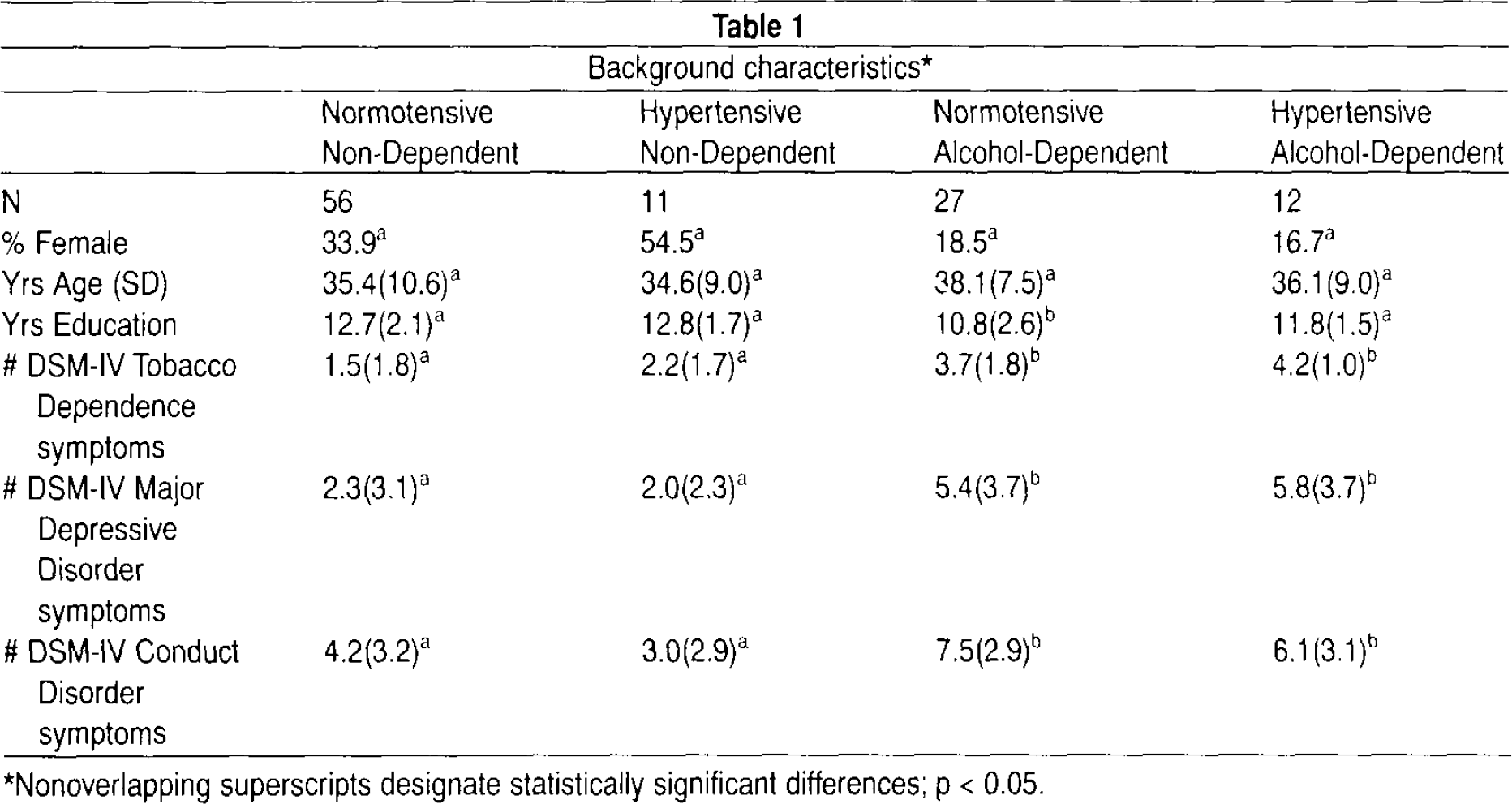
Nonoverlapping superscripts designate statistically significant differences; p < 0.05.
Task Performance
No significant effects of Alcohol Dependence, Hypertension or their interaction were found in analyses of hit rate and reaction time.
P300 Analyses
Analyses of P300 amplitude revealed significant and expected effects of electrode location. For both auditory [F(1,99) = 11.5, p < 0.001] and visual [F(1,99) = 11.8, p < 0.001] tasks, P300 amplitude was larger at parietal versus frontal locations. P300 amplitude was also larger at the midline location in comparison to right and left hemisphere locations during auditory [F(2, 198) = 13.4, p < 0.001] and visual [F(2, 198) = 11.9, p < 0.001] tasks. P300 amplitude was unaffected by other variables or interactions.
Analyses of P300 latency did not yield significant main effects of electrode location. Yet, several interactions between electrode location and the grouping variables were significant. For the visual task, the interaction of lateral position and Alcohol Dependence was significant [F(2, 198) = 3.4, p < 0.5]. Tukey post hoc tests revealed significant slowing of P300 latency associated with Alcohol Dependence at midline and left hemisphere locations only. The average latencies (± 1 SE) for the non-dependent and dependent groups at the midline were 458 ± 17 ms and 488 ± 20 ms, respectively. At left hemisphere locations, the respective averages were 457 ± 16 ms and 489 ± 19 ms.
P300 latency during the auditory task varied as a result of the simple presence (464 ± 19 ms) versus absence (367 ± 16 ms) of Alcohol Dependence [F(1,99) = 13.0, p < 0.001]. It also varied as a function of the complex 3-way interaction of Alcohol Dependence, Hypertension, and lateral electrode position [F(2, 198) = 4.2, p < 0.02]. Tukey post hoc tests revealed a significant delay in P300 latency among subjects with histories of both hypertension and alcohol dependence in comparison to subjects with histories of hypertension only and those with no history of hypertension or alcohol dependence. The group difference was largest at left hemisphere electrode sites (Figure 1).
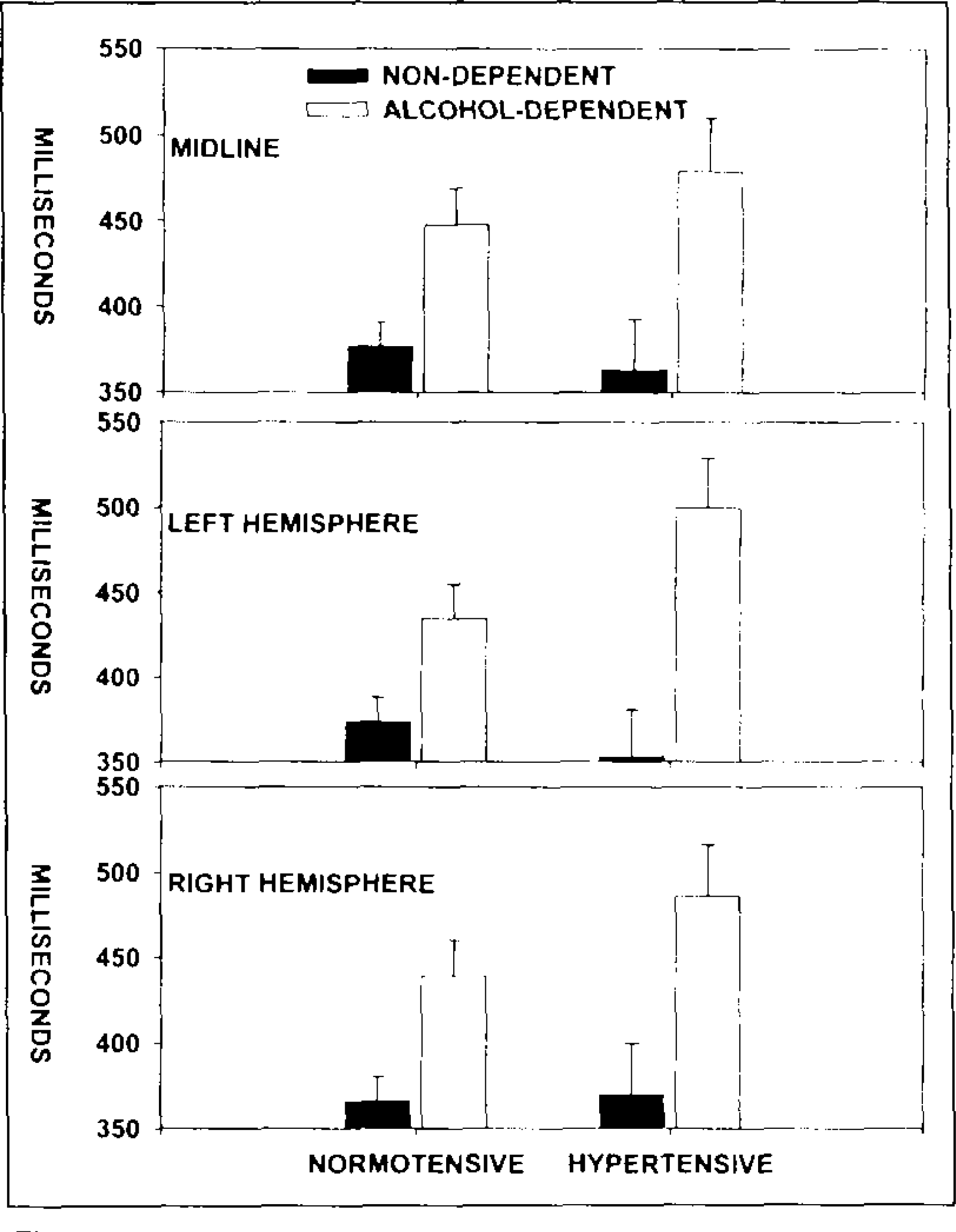
Covariate-adjusted mean (+1 SE) P300 Latency as a Function of Group and Lateral Electrode Position. Auditory Oddball Task.
DISCUSSION
In recent years, there has been substantial interest in the purported ability of beverage alcohol to protect the cerebrovasculature from atherosclerosis as well as acute stroke. In a seminal study reported by Stampfer and colleagues, 19 the alcohol consumption levels of 87,526 female nurses were surveyed. The nurses were followed over a subsequent 5-year period to detect incident cases of stroke. Analyses demonstrated a decreased relative risk (odds ratio = 0.3) of ischemic stroke, but not hemorrhagic stroke, among nurses consuming 5–14 g of alcohol per day. Similar findings have been reported from studies that included men (e.g., Iso et al. 20 ).
The effects of heavy alcohol use on stroke risk are more complex than those of moderate alcohol use. For example, a recent meta-analysis 5 of 35 observational studies revealed that alcohol consumption levels greater than 60 g per day enhanced the risk for any stroke in general and hemorrhagic stroke in particular. Thus, the purported neuroprotection offered by beverage alcohol is dose-dependent and does not generalize across all types of stroke. The present results demonstrate that heavy alcohol use is also not neuroprotective when the dependent measure is brain function, as estimated by the P300 ERP. In fact, when heavy use co-occurs with essential hypertension, the delay in auditory P300 latency is greater than would be expected from a simple addition of their independent effects.
A question could be posed regarding why auditory P300 latency proved especially sensitive to the interaction. Several answers are possible. The most obvious answer is statistical. The auditory P300 typically has a more pronounced peak than the broad visual P300 and can therefore be measured with greater precision and reliability.
Other answers may relate to the mechanisms underlying the effects of alcohol dependence and hypertension. For example, both disorders have been more reliably linked to white than gray matter pathology. 2,21 –23 ERP latencies are arguably more sensitive to white matter involvement than are ERP amplitudes. A future study should obtain structural magnetic resonance images, angiograms, and auditory and visual ERPs in the same patients for the purpose of clarifying the mechanisms that contribute to the synergistic effects of alcohol dependence and hypertension.
The present analyses revealed no overall effect of hypertension on P300. Its effects were only apparent via a synergistic interaction with alcohol dependence. Negligible effects of hypertension might not be surprising, for the participants in this study were middle-aged and had therefore not experienced years of atherosclerosis and abnormal vascular pressure. Indeed, most MRI studies of hypertension do not reveal detectable abnormalities until patients have lived with the disease for several decades. Yet, it is remarkable that the present study could demonstrate an adverse effect of hypertension in middle-aged adults, albeit through its interaction with another risk factor.
The present analyses also revealed robust effects of alcohol dependence on P300 latency. This finding replicates findings reported by other groups. 13 –15,24 The absence of a significant change in auditory or visual P300 amplitude associated with alcohol dependence is difficult to explain in the context of other studies that have detected such changes 12,25 . One explanation may be our unique approach of employing depression, smoking, and conduct problems as covariates. These factors have independently been associated with P300 amplitude reductions and, in the opinion of some investigators, may entirely explain the purported effects of alcohol dependence. 17
The present results should be considered preliminary, and a number of limitations should be noted. First, the present report describes data from a larger study, which was not originally intended as a study of hypertension. Being told by a physician that one has hypertension is a mediocre substitute for the superior diagnostic alternative that involves ambulatory blood pressure monitoring and considerable expense. The present results should be replicated within a future study that employs ambulatory monitoring. Second, the present design does not include MRI data, which could be used for clarifying the mechanisms mediating the interaction. At the present time, we cannot discern whether the effect is neural, vascular, or both. Finally, the sample size is admittedly small. The smallest cell in the design included 11 individuals. A larger sample is needed to determine the reliability of the interaction.
Footnotes
ACKNOWLEDGMENTS
This project was supported, in part, by Public Health Service grants U10AA08401, U10AA08402, U10AA08403, RO1AA12553, U2411888, M01RR10284, P50AA03510, and T32AA07290. Data were collected at the Howard University Collaborative Alcohol Research Center, Washington, D.C.