







Abstract
Two institutions of relatively small size play a major role in documenting women's history in Egypt: the Rare Books and Special Collections Library (RBSCL) of the American University in Cairo (AUC) and the Women and Memory Forum (WMF), a feminist research center in Cairo. This article presents case studies of these institutions’ efforts. The AUC RBSCL's collections are described, including those of leading 20th-century feminist leaders Huda Sharaawi (1879-1947), Doria Shafik (1908-1975), and Aziza Hussein (1919-2015), as are oral history initiatives related to women's history. The article also discusses programs and collections of the WMF, including private papers collections such as that of activist Wedad Mitri (1927-2007), and its Archive of Women's Oral History, which documents women's lives in Egypt and beyond. The initiatives in Egypt of the RBSCL and the WMF indicate how institutions can employ archival collecting, oral history, and outreach-like exhibitions to document and highlight women's historical contributions.
Egyptian women in popular imagination are typically limited to ancient figures such as Hatshepsut and Cleopatra. But the past century of Egyptian history has been marked by women who shaped their society in important ways. The lives of many of them are documented at the American University in Cairo (AUC) in its Rare Books and Special Collections Library (RBSCL) and at the Women and Memory Forum (WMF). The AUC's RBSCL has for several decades documented Egypt and women's roles in the country through primary source collections, and the WMF is the only feminist research center in Egypt dedicated to historical documentation work (other feminist nongovernmental organizations [NGOs], such as the New Women Foundation and Nazra for Feminist Studies, carry out research related to women in contemporary Egypt in connection with their activist programs).
The following pages offer case studies on how these two institutions have built collections related to women in Egypt. For each, background on their history and mission is provided with a description of their initiatives in building collections, including archival personal papers collections, oral histories, and additional resources. Major archival collection holdings for prominent women are described in terms of how they were acquired, their contents, and the promise they hold for research; similar coverage is offered for oral histories as well. By way of conclusion, this article closes with a discussion of ways that the WMF and the AUC's RBSCL are well suited to document women in Egypt and make their history known.
Women's History Collections at the AUC's RBSCL
Dating from 1919, the AUC was founded with a mission of bringing an English-language American liberal arts model of higher education to Egypt. The AUC is located in a decade-old campus in Cairo's suburbs after being for 90 years downtown at Cairo's Tahrir Square (where its old campus still functions for events and continuing education programs). Today, the AUC's nearly 5,500 undergraduates take classes in 36 major programs, and the university enrolls 1,000 graduate students and more than 10,000 continuing education students.
From early in its history, the university strove to play a role in the cultural life of the country through an active program of lectures and performances, and its libraries since the 1950s sought to document Egypt's heritage. In that decade, the AUC acquired the library and photographs of Islamic monuments in Egypt and the region assembled by Sir K. A. C. Creswell (1879-1974), a British subject and one of the foremost scholars of Islamic art and architecture. Creswell's collection and other library holdings, such as rare books and maps, were brought together to form the RBSCL in 1992.
By the 1990s, the RBSCL (in addition to maintaining the university's own archives) came to acquire collections of personal papers from prominent figures such as architect Hassan Fathy (1900-1989), photographer Van-Leo (b. Levon Boyadjian, 1921-2002), and leading artists, journalists, and others who made a major impact on Egyptian culture and society. The AUC, like the WMF (as described below), is somewhat unusual as a repository for archival collections of national scope, as most collecting in Egypt is done by large state-affiliated institutions, such as Bibliotheca in Alexandria and the Egyptian National Library and Archives. 1
For many years, the RBSCL possessed a hidden treasure: the papers of Huda Sharaawi (1879-1947). Widely hailed as the founder of the feminist movement in Egypt, Sharaawi had entered the popular imagination in 1923 with her public gesture of removing the face veil that elite women in society typically wore at the time. As the preeminent Egyptian feminist of the early 20th century, she founded the Egyptian Feminist Union and other organizations dedicated to improving the situation of women in Egypt and participated in many international feminist conferences. 2
In the 1980s, the AUC library's head of reference received the donation of Sharaawi's papers (Figure 1) from Hawa Idris (1909-1988), her niece and head of the Huda Sharaawi Association (the renamed Egyptian Feminist Union). The AUC's association with Huda Sharaawi had existed prior to the donation of her papers, however. From the stage of AUC's Ewart Hall auditorium (a major venue for speakers in the 1920s and 1930s and today on issues such as politics and public health), she had lectured on at least half a dozen occasions about women's rights and family planning. Despite this connection and the value of the collection, resources were unavailable to make it accessible, and it remained uncataloged and unused for a long time.
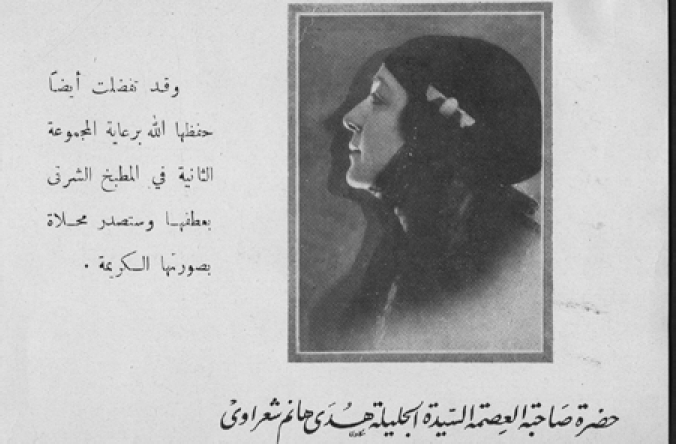
Card with printed greeting from and portrait of Huda Sharaawi.
It was about two decades after its acquisition that the Sharaawi Collection came to the attention of Archives staff at the AUC's RBSCL. By 2006, processing of the collection was under way beyond the basic archival treatment the collection had received to that point. The work intensified in 2011 when an AUC Arabic-language graduate student fluent in French was hired for several months to arrange and describe the collection. While not an especially large collection (it now numbers 25 archival boxes, about six linear feet of material), it had been a complex set of materials to use and required much attention to make it accessible for users.
This was done by arranging the material into various series: for her writings and those of others, conferences and organizations in and outside Egypt, and her correspondents, including friends and family, public figures, and colleagues in the feminist movement. Most of the material is in Arabic or French, the languages Sharaawi most typically used and, to a lesser extent, Turkish (in Arabic script) and English with some correspondence in other languages. To enhance accessibility, English-language summaries were made for all documents, and descriptions of folder contents (such as the title of a publication or name of an organization) were presented in the original language along with a transliteration of Arabic in the Roman alphabet and a translation in English.
The Sharaawi Collection is one of the most extensively used at the RBSCL. As a resource on feminism in Egypt and internationally, it has great value, reflecting goals, activities, and interactions among members of the movement in the 1920s, 1930s, and 1940s through conference materials and Sharaawi's correspondence with counterparts (many prominent) abroad, such as Germaine Malaterre-Selli-er (1889-1967), Carrie Chapman-Catt (1859-1947), and Margery Corbett-Ash-by (1882-1981), and in Egypt, such as Doria Shafik (1908-1975) (discussed below). The collection is also sought out for the breadth of topics covered, reflecting Sharaawi's wide-ranging contributions to Egyptian society in other areas, such as her nationalist opposition to British occupation of Egypt, which figures in many of her writings and letters to political leaders. Other areas of interest to her, such as philanthropy and the arts, offer important insights into Egyptian society as well. The RBSCL staff, when instructing students on the use of archival materials, often demonstrate the varied possibilities for research within archival collections by using the Sharaawi papers as an example.
The mantle of leadership in advocating for the rights of women in mid-20th-century Egypt was taken on by Doria Shafik (1908-1975). Coming from a Nile Delta city, Shafik attended university at the Sorbonne in Paris, from where she received a doctorate, writing two theses, including one on the rights of women in Islam. She returned to Egypt in 1940 and five years later took over the editorship of La Femme Nouvelle, a periodical geared toward the nations French-speaking elite, and launched the Arabic Bint al-Nil (Daughter of the Nile) magazine, aimed at optimizing women's involvement in Egyptian society.
Shafik's advocacy for women's political rights in Egypt included organizing feminist groups’ invasion of the parliament in 1952, founding the Bint al-Nil political party the following year, and in 1954 undertaking a hunger strike to protest the absence of women from the committee drafting a national constitution. Shafik's actions brought her international acclaim and invitations to speak abroad, and the 1956 constitution granted Egyptian women the right to vote, albeit with a literacy test. After another hunger strike in 1957 against the authoritarianism of President Gamal Abdel Nasser's (1918-1970) regime, Shafik was restricted to house arrest, and her magazines were suppressed, and she spent the rest of her life in seclusion, writing and in the company of her family until her death in 1975.
Doria Shafik had been a name long associated with the AUC, as her two daughters served on the faculty and in leadership roles at the university. Shafik also received a new degree of recognition with the 1996 publication of Doria Shafik, Egyptian Feminist: A Woman Apart by a prominent professor of anthropology at the AUC, Cynthia Nelson (1933-2006), who researched her life, assembling material such as news clippings and interviews with those associated with her over the years. With the addition of Nelsons papers to other faculty collections in the AUC s University Archives after her death in 2006, documentation on Doria Shafik became available for research at the AUC. 3
In 2012, the RBSCL staff approached Shafik's daughters to help fulfill a researcher's request, and this contact ultimately resulted in the donation of Shafik's personal papers to the Archives. The donated material reflects various aspects of Shafik's life, containing her diaries, drafts of magazine editorials, and other writings. 4 The Shafik papers are complemented at the AUC by holdings of Bint al-Nil magazine and her portrait (Figure 2) by leading studio photographer Van-Leo (whose collection is addressed below), which has become one of her most iconic depictions.
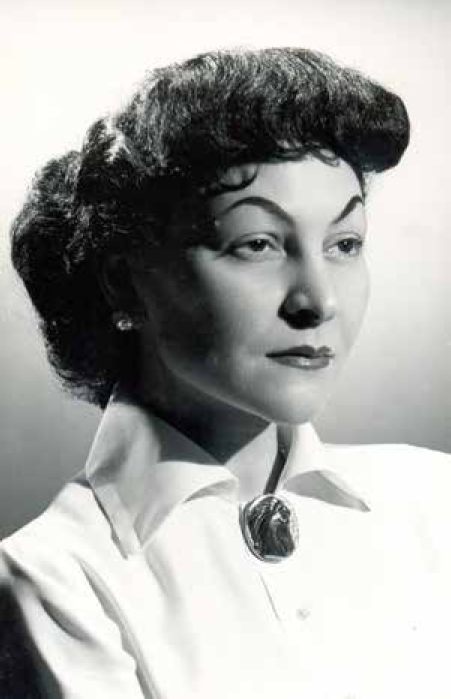
Portrait of Doria Shafik by Van-Leo (b. Levon Boy-adjian). Van-Leo and Angelo Boyadjian Photograph Collection.
The AUC's alumni body has included numerous individuals who have shaped Egyptian society, not least in the area of women's advancement, and the AUC's RBSCL has benefited, as a number of graduates have made donations of their personal archives. One notable donor is Aziza Hussein (1919-2015) of the AUC's class of 1942. Like Shafik the child of a Nile Delta family, Hussein's father was a prominent gynecologist with liberal views on the importance of women's education and rights in marriage. Hussein's life was one dedicated to community and public service, which, as part of a Cairo women's club, she launched in setting up a village nursery in 1955 along with associated family planning programs. She began her role on the international stage in the late 1950s while in the United States, where her husband was Egyptian ambassador to Washington in the 1950s.
Hussein's collection in the Archives is considerable in size (almost 70 boxes and more than 30 linear feet) and contains papers she presented at and material related to her involvement in numerous national and international conferences on women's issues, most notably the 1994 UN Conference on Population and Development in Cairo. Her involvement with family planning organizations and other civil society groups in Egypt and beyond is also documented, as is the international recognition she received, evidenced by numerous awards. 5
Aziza Hussein had competition for the title of most accomplished daughter in the family; her sister anthropologist Laila Shoukry El Hamamsy (1925-2009) went on to a long career as director of the AUC's Social Research Center. Her professional accomplishments are documented in the AUC University Archives as well as the work of the center in studying and advancing conditions for women in Egypt. Records in the University Archives demonstrate its wide-ranging activities, starting most prominently with the 1960s Nubia Ethnographic Study (Figure 3) and associated projects that studied the displacement of inhabitants of southern Egypt due to the building of the Aswan High Dam, documenting women's roles in the social structure there. 6 Later, the center's focus shifted to population studies and family planning work, both examining factors affecting women's lives and playing an important role in addressing Egypt's burgeoning population. 7 Besides holding the archives of the center, the Archives at the AUC also collects publications of a variety of NGOs, many of which address women's issues as an aspect of their mission.
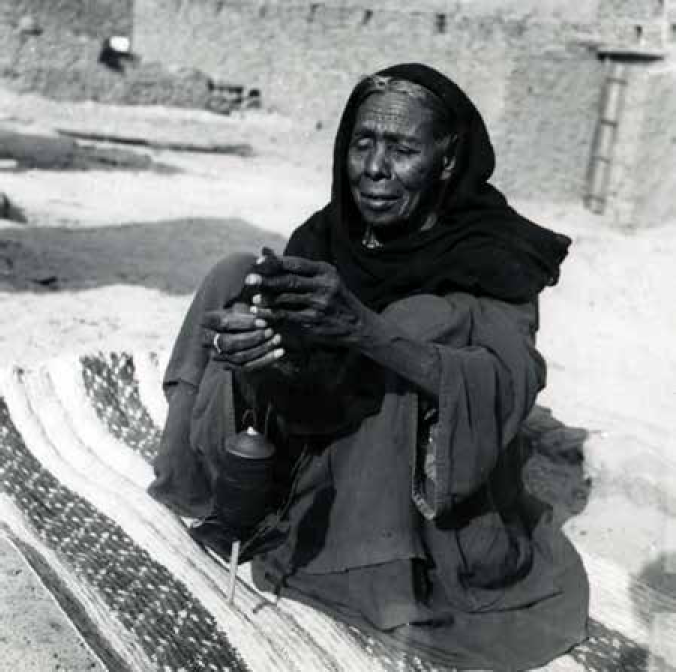
Photograph of Nubian woman by Abdel Fattah Eid, AUC Social Research Center's Nubia Research Projects Collection, early 1960s.
The contributions of women to the arts in Egypt is another focus of collections in the RBSCL. These include collections of individual artists, such as painter, sculptor, and photographer Margot Veillon (1907-2003), who spent most of her life in Egypt. While her works span a range of styles, media, and subjects, the women of Egypt (and countries in the region she visited) were commonly depicted in her compositions. 8 The role of women in Egyptian cinema is revealed in collections of promotional material and photographic stills for movies from the 1920s to the 1980s, and mid-20fh-century actresses, musicians, and dancers feature prominently in the work of photographer Van-Leo, whose corpus the Archives holds. 9
Oral history initiatives that the RBSCL have represented another important avenue for documenting women's lives. Interviews with AUC alumni, faculty, and staff are revealing of the role of women at the university; their testimonies extend beyond campus in covering family life, women's education and employment, and other topics. Interviews conducted with donors such as Aziza Hussein, as well as other advocates for women in Egypt, such as NGO leader Marie Assad (1922-2018), complement documents in the archives, and newer generations of socially and politically engaged women (many of them AUC faculty or students) have their voices heard as part of the University on the Square: Documenting Egypt's 21st Century Revolution project. Newer efforts, such as oral histories with members of ethnic or minority religious communities or with villagers in southern Egypt as part of the Qurna Hillside Oral History project, reflect the diversity of women's lives in Egypt. 10
Women's History Collections at the WMF
The WMF is a feminist research center based in Cairo, Egypt, founded in 1995 by a group of women academics, activists, and scholars. Located in the residential neighborhood of Mohandiseen, Giza, near central Cairo, the WMF is currently the only institution of its kind in Egypt dedicated to documenting women's role in the nation's history. Since its establishment, the WMF has been committed to the production of alternative cultural and historical knowledge about women in Egypt and across the Arab region and making it available to researchers and academics as well as activists and gender equality advocates. For more than two decades, the WMF has been carrying out research, documentation, training, and outreach programs, most centered on the organization's collections and archives, which are gathered into two groupings: the Women and Memory Library and Documentation Center (WMLDC) and the Archive of Women's Oral History.
The collections maintained by the WMF can be described as feminist archives because they are housed and managed by a feminist organization aiming at supporting feminist scholarship and movements in Egypt. As noted by Kate Eichhorn, community-based organizing has been closely connected to feminists documenting and archiving women's lives. 11 Most important, the theory and practice behind WMF collections are grounded in feminist theoretical traditions and research methodologies. Key elements to feminist research include a primary focus on women's voices and lived experiences, valuing reflexivity as a process to examine researchers’ personal biases in conducting research and introducing theoretical perspectives that can be instrumental in addressing gender inequality. 12 Another element is a concern with power issues between the researched and the researcher. 13 Guided by feminist research frameworks, the WMF aims at integrating a feminist approach to the practice of collecting and archiving in Egypt.
The WMF's WMLDC is a specialized resource center for women and gender studies in Egypt and the Arab region, with priority given to Arabic-language materials. It comprises of both a physical library located at the WMF venue in Cairo and a digital library that is accessible via the WMF's website and the Egyptian Universities Library Consortium portal. 14 While the WMLDC was officially launched in 2010, WMF members have been acquiring collections about women in Egypt since 1995.
The official launching of the WMLDC as a specialized resource center manifested an evolution in the organization's understanding and attitudes toward building and managing collections. In addition to collecting materials as a by-product of conducting research in women's studies in Egypt, WMF members decided to adopt a more systematic approach to collecting materials, especially grey literature and private collections. Beyond redefining the scope of collecting, this also meant allocating more organizational resources to building and managing these collections. Currently, the WMLDC team is composed of a library manager, a librarian, and an assistant librarian who work closely with the WMF research team on acquiring new materials and producing books and exhibition projects and are supported by the organization's administrative unit.
A major focus for the WMF has been the acquisition of private collections relevant to women and gender studies. The WMLDC houses several papers collections, encompassing formats such as photographs, notes, conference papers, prints, photographs, and postcards belonging to women who have played important roles in Egypt's public life. These include women such as Kawkab Hifni Nassef (1905-1999), one of Egypt's first physicians; pioneering social worker and activist Lili Doss (1917-2015); and political activist and journalist Genevieve Sidarous (1925-2016).
One of the most notable private papers collections maintained by the WMF is that of unionist and political activist Wedad Mitri (1927-2007) (Figure 4). Born in Cairo, at the age of 24 she became the first woman to be elected to the Student Union at Cairo University. During the 1950s, she worked as a teacher in public schools outside Cairo, where she encouraged students to engage with pressing social and political issues though school journalism. When briefly imprisoned in 1959 for her political views, she set up literacy classes for women serving life sentences. A meticulous and prolific documentarian, she kept detailed records of her public activism, her career as an educator, and her travels. She also collected posters and newspaper clippings on the activities of social and women's movements in Egypt.
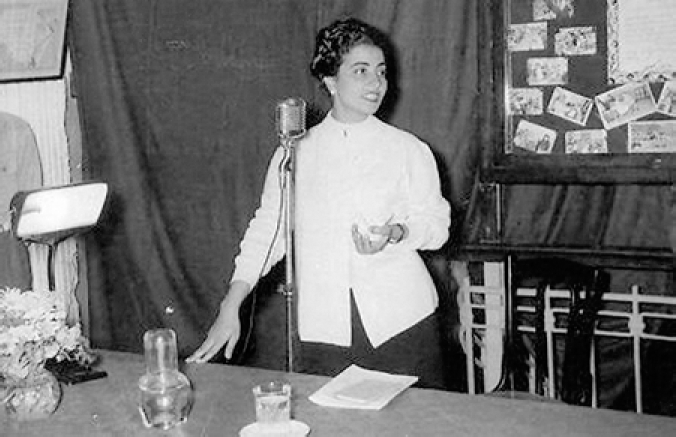
Photograph of Wedad Mitri lecturing at Shibin El-Kom School, Egypt, photographer unknown. Wedad Mitri Collection, 1957.
Before passing away, Mitri entrusted the WMF with her collection, the first private papers collection to be housed at the WMF. In addition to books and periodicals, the collection contains her diaries, autobiographical notes, her personal photographs, photographs of others she knew and worked with, her university and honorary certificates, albums of stamps she collected, letters, postcards, conference proceedings, and press releases. The collection also includes objects such as her eyeglasses, a pen on which her initials were engraved, and her gramophone discs. An oral recording of her life story is also housed at the Archive of Women's Oral History (see below).
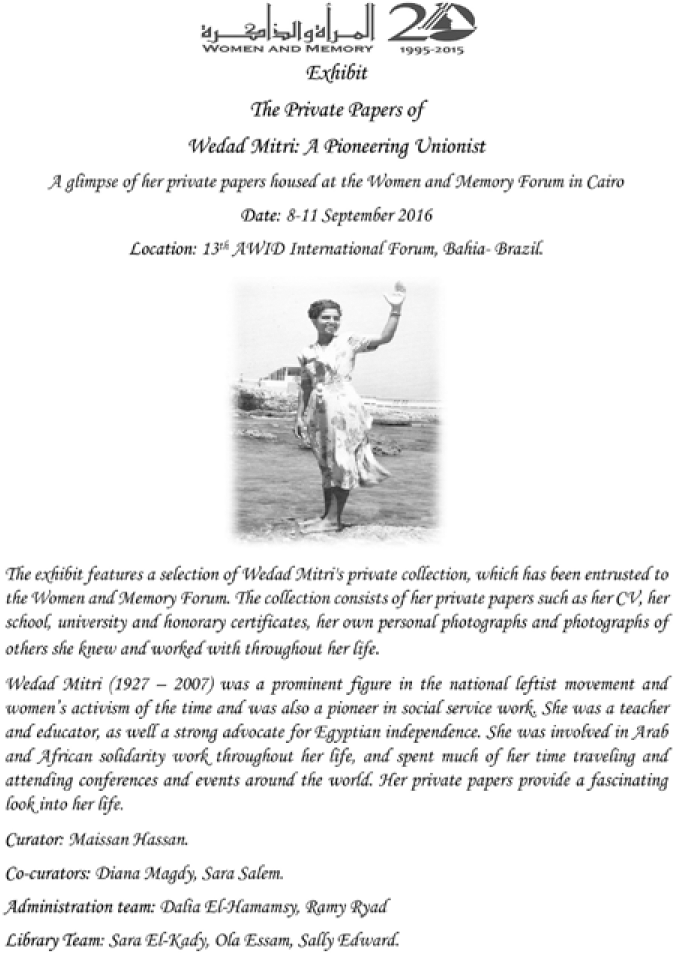
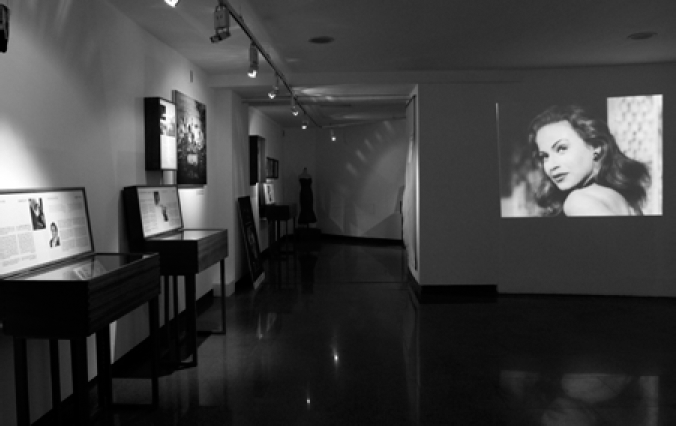
Since it was acquired in 2007, this collection became an inspiring and valuable source for several WMF projects. In September 2015, the WMF held its first exhibition, titled Wedad Mitri (1927-2007): A Pioneering Unionist: A Glimpse of Her Private Papers Housed at the Women and Memory Forum in Cairo, at an exhibition venue in the Cairo Opera House. 15 The exhibition was later held at the Za-malek Library in Cairo in October 2015, the AUC's RBSCL in March 2016, and the Association for Women's Rights in Development-AWID Forum in Brazil (Figure 5) in September 2016. Parts of the collection were also featured in the exhibition “Doing Well, Don't Worry”: Short Tales of Women's Work and Mobility (Figure 6), held at the AUC in May 2017, and at Exode Gallery in Beirut in December 2017. This exhibition was organized by the WMF in collaboration with several regional and international partners, including the AUC.
WMF exhibition at the AWID Forum in Brazil, September 2016.
WMF “Doing Well, Don't Worry”: Short Tales of Women's Work and Mobility exhibition at the AUC Falaki Gallery, Egypt, May 2017.
In addition to papers collections, the WMLDC's special collections also include published materials. Besides books, there is a collection of grey literature produced in and about the Arab region. Guided by the Luxembourg definition 16 of grey literature, the WMF defines these as publications and materials of limited circulation that are not readily available via conventional and commercial venues. Such materials available at the WMF include mostly reports, brochures, posters, press releases, and leaflets that were produced, both digitally and on paper, by NGOs working on gender issues in Egypt and the Arab region. Thanks to WMF s wide networks within the civil society and women's movements in Egypt, WMF members were able to identify and acquire relevant, often overlooked, materials.
Rare publications are also collected by the WMF, in particular cultural and women's journals published between the late 19th and the mid-20th century, most of them very difficult to locate. Examples of rare journals housed at the WMF are Al-Fatat (1892-1893), Anis Al-Jalis (1898-1907), Al-Jins Al-Latif (1908-1925), Fatat El-Sharq (1909-1939), Al-Hisan (1925-?), Omahat Al-Mostaqabal (1930-1932), L'Égyptienne (1937-1940), and Bent El-Nil (1945-1957).
Another focus of the WMF's documentation efforts has been the Archive of Women's Oral History, containing more than 200 oral history interviews with (primarily) Egyptian women who played significant roles in Egypt's public life in the 20th and early 21st centuries. Since the late 1960s, feminists have found oral history to be a particularly useful methodology to help them explore women's various experiences, 17 and the WMF is one of the first women's groups in Egypt to use oral history in their research and advocacy activities. 18 A catalog of the archive containing short biographies of women narrators and interviews abstracts is available online via the WMF's website. 19 Interview transcripts are accessible to read at the WMF's library, with decisions regarding accessibility to transcripts made in collaboration with the narrators.
Interviews within the WMF's oral history archive fall into several categories. The Pioneering Women Collection contains 102 oral narratives of life stories of women who had prominent roles in Egypt's public life, many of the interviews conducted with women over the age of 70 at the time of recording. These interviews were recorded between 1998 and 2005. Most of the conducted interviews are on cassette tapes, as digital sound tracks were not widely available in Egypt at the time, but these were later digitized and transcribed. 20
Another collection is the Women in Public Sphere Post 2011 Collection, containing 100 narratives of women active in the political sphere during and after the 2011 revolution in Egypt. Most of the interviews in this collection were conducted between March 2011 and June 2016. In order to address rapid political changes in Egypt after 2011, the interviews’ lines of inquiry have been revised several times. All the interviews were digitally recorded, transcribed, and edited. 21 Two smaller collections are the Women and Egyptian Parliament Collection and the Tunisian Women Activists Collection. These two collections reflect the WMF's most recent efforts in collecting oral histories. The Tunisian Women Activists Collection is the product of a pilot phase for a new regional archive that would include oral histories of women from across the Arab region.
While working in a challenging NGO environment in Egypt, the scarcity of resources cannot be simply ignored. The WMF has been mobilizing resources in order to be able to maintain and expand its collections. Currently, the WMF's collections of photographs, visual materials, and oral histories are growing. In addition, the WMF is expanding its collections of objects with the aim of holding on-site and digital exhibitions about the history of women in Egypt and across the Arab region.
Conclusion
The WMF and the AUC's RBSCT might appear to share little in common, the former a dedicated, independent feminist research center with an activist bent and the latter a unit of a larger educational institution with a broad collecting focus. But they do share a number of commonalities that have made them well placed to build women's history collections. As nongovernmental institutions, they are well suited to documenting the lives of women who made a stand for women's rights, often in opposition to government authorities or prevailing cultural norms; state institutions would not represent a suitable fit as repositories. Both the WMF and the AUC possess a network of connections with individuals supportive of and knowledgeable about the cause of women in Egypt, whether these be feminist activists or academic scholars. These allies have been crucial for acquiring collections and pursuing oral histories for the WMF and the AUC.
As entities, both are well positioned to tell the story of women in Egypt using the collections they have built through collaborations such as ones they have already pursued (including with each other through the WMF's Wedad Mitri exhibition hosted at the library and their publication of the memoirs of Hawa Idris drawing on materials in the Huda Sharaawi collection). At the AUC, students represent a natural base of users for projects that teaching faculty incorporate into their courses. In addition, the library has a track record of serving researchers and users, such as exhibition curators, and with its base of other collections has complementary resources to support research by scholars in Egypt and from abroad. The WMF's expansive vision and mission offers it varied opportunities to bring its resources to light. In these ways, the AUC's library and the WMF share the capacity to document women's lives in Egypt and tell their story far and wide.
Footnotes
Acknowledgments
This article would not have been possible without the efforts of librarians at the AUC, Archives staff, work-study students, and others who were instrumental in the acquisition, processing, and description of women's history collections at the AUC's RBSCL. Special thanks go to Archives staff member Nada Yassin for providing information and images from the collections. Many thanks to the dedicated team of the WMF. Special thanks to all the women and their families who entrusted the WMF with their oral histories and collections.
1.
Stephen Urgola and Carolyn Runyon, “Participatory Archives: Building on Traditions of Collaboration, Openness, and Accessibility at the American University in Cairo” in Bridging Worlds: Emerging Models and Practices of U.S. Academic Libraries around the Globe, ed. Raymond Pun, Scott Collard, and Justin Parrott, 93-94 (Chicago: Association of College and Research Libraries, 2016).
2.
Huda Sharaawi Papers and Egyptian Feminist Union Records, Archives, Rare Books and Special Collections Library, American University in Cairo.
3.
Cynthia Nelson Papers, Archives, Rare Books and Special Collections Library, American University in Cairo.
4.
Doria Shafik Papers and Photograph Collection, Archives, Rare Books and Special Collections Library American University in Cairo.
5.
Aziza Hussein and Ahmed Hussein Papers, Archives, Rare Books and Special Collections Library, American University in Cairo.
6.
American University in Cairo Social Research Center Nubia Research Projects Collection, Archives, Rare Books and Special Collections Library, American University in Cairo.
7.
American University in Cairo Social Research Center Project Files, Archives, Rare Books and Special Collections Library, American University in Cairo.
8.
Margot Veillon Papers, Archives, Rare Books and Special Collections Library, American University in Cairo.
9.
Van-Leo and Angelo Boyadjian Photograph Collection, Archives, Rare Books and Special Collections Library, American University in Cairo.

11.
Kate Eichhorn, “D.I.Y. Collectors, Archiving Scholars, and Activist Librarians: Legitimizing Feminist Knowledge and Cultural Production since 1990,” Women's Studies 39, no. 6 (2010): 622-646.
12.
Sharlene Nagy Hesse-Biber, “A Re-Invitation to Feminist Research,” in Feminist Research in Theory and Practice: A Primer, 2nd ed., 1-13 (Los Angeles: Sage, 2013).
13.
Sharlene Nagy Hesse-Biber, “Feminist Approaches to In-Depth Interviewing,” in Feminist Research in Theory and Practice, 182-232.
14.
“The Women and Memory Forum,” Egyptian Universities Library Consortium, http://srvl.eulc.edu.eg/eulc_v5/libraries/Start.aspx?fn=DrawInterFace&ScopeID=1.105 (accessed April 12, 2018).
15.
17.
Robert Perks and Alistair Thomson, “Critical Developments: An Introduction,” in The Oral History Reader, ed. Robert Perks and Alistair Thomson, 1-8 (New York: Routledge, 1998).
18.
On the WMF's feminist oral history methodology, see Hoda Elsadda, ed., Tawthiq siyar wa tajarub al-nisaa’ min manthur al-nawo'dalil irshadi (A manual for documenting women's narratives and experiences from a gender-sensitive perspective) (Cairo: Women and Memory Forum, 2016).
20.
A selection of narratives from the Pioneering Women Collection was published in Amal Abou Elfadl, ed., Aswat wa-Asdaa’ (Voices and echoes) (Cairo: Women and Memory Forum, 2007).
21.
On the WMF's Women in Public Sphere Post 2011 Collection, see Hoda Elsadda, “An Archive of Hope: Translating Memories of Revolution,” in Translating Dissent: Voices from and with the Egyptian Revolution, ed. Mona Baker, 148-160 (New York: Routledge, 2016), and Maissan Hassan and Diana Magdy “Narrating Gender in Egypt's Public Sphere: The Archive of Women's Oral History,” in Oral History in Times of Change: Gender Documentation and the Making of Archives. Special Issue of Cairo Papers, guest edited by Hoda Elsadda and Hanan Sabea, 35:1 (2018), 134-144.