







Abstract
Historic house curators have great responsibility and discretion to create what is perceived as an authentic interior. The curator creates the authentic environment based on a variety of factors including research, messaging, and the creation of a visitor experience. However, there are also choices to be made in conserving artifacts as their appearance affects perceptions of authenticity. This article discusses some case studies in which museum staff wrestled with conservation of original objects, trying to find the right balance between constructing the authentic image, maintaining the integrity of the artifact, supporting the message and meaning of the site, and providing a compelling visitor experience.
Keywords
How many times have visitors walked into an historic house asking straight away: “what’s original here?” Faces fall when fewer furnishings are revealed to be original than they hoped. While the building itself may be the most important authentic artifact historic house curators deal with, the furnishings within are integral in creating the authentic interior, imparting meaning and message, and give life to people long gone. Additionally, the conservation of original furnishings affects the appearance of these furnishings, shaping perceptions of authenticity in the historic interior. If restored to a moment in time, the pieces bolster the style and status congruent with the rest of the authentic interior. The appearance of furnishings left unrestored, worn, or dirty can support a message of neglect, abandonment, or hardship. Rejecting the use of original artifacts for replicas (exact copies) suggests a visitor experience in which the newness of furnishings supports an immersive, usable environment. This article discusses a few case studies in which curators made decisions on the conservation of artifacts to bolster the authenticity of the installation.
The ghost town of Bodie, California, is considered by many to be the most authentic ghost town in the United States.
1
The site encompasses dozens of historic buildings and is filled with objects left behind as it was abandoned. Dust that settled on furnishings remains just as it has fallen, and it appears as if no one has touched a thing in decades. Its authenticity hinges on the formally adopted policy of arrested decay: Dirt and dust accumulate rapidly in the wind-blown desert climate of Bodie, and the Park’s policy of arrested decay currently mandates that neither the artifacts nor the dust on top be disturbed, leaving the impression that they are “napped by generations of dust” . . . it is “natural–like it was left.”
2
Bodie’s management has embraced a non-treatment policy, established to bolster an experience that is “dripping authenticity” 3 and is “a magical, historical, mesmerizing place.” 4 This policy creates what visitors perceive to be a remarkably real—“fascinating . . . and evocative”—place in which guests can imagine, and perhaps mythologize, a way of life long gone.
It was not enough to just leave the items in place as they were last used; management dictates they must remain undusted, unrepaired, unmoved by staff because treatment suggests “fake.” Ironic, of course, because Bodie’s inhabitants surely maintained their buildings and dusted their goods (even if it was a losing battle in the windswept landscape). What kind of “authentic” is this? Is it an admission that curators muck up what is supposed to be authentic? Yes probably; curators know how much they can manipulate the historic interior through choices, treatments, and interpretation. The artifice of leaving it untouched creates the authentic although it is hardly so.
Ongoing discussions about replacing, repairing, or leaving alone the original but badly soiled wallpapers and furnishings have occurred for years between staff and board at The Evergreens, one of two houses that comprise The Emily Dickinson Museum (Amherst, MA). The Evergreens was built near the Dickinsons’ family home, The Homestead, in 1856 for the poet Emily Dickinson’s (1830–1886) brother William and his new wife, Susan. William became a successful attorney and politician, and he and Susan raised three children in The Evergreens. Bright and social, his wife Susan worked hard to make her home a stylish family home at which she entertained. Susan redecorated the house c. 1880 with new wallpaper and furnishings.
Despite outward appearances, William and Susan had a troubled marriage. William conducted a lengthy affair with a local poet and editor, Mabel Loomis Todd, creating tension in the household. To add to the gloom, Susan and William’s young son Gilbert passed away in 1883 at age 8, with the poet Emily dying a few years later. Further complications arose when William’s mistress, Mabel, edited the first book of Emily’s poems; the family accused Mabel of altering a number of Emily’s poems. Rancor about the poetry, humiliation regarding the long-standing affair, mourning a child’s death, and bitter lawsuits between Mabel and family members over property issues made The Evergreens a melancholic home.
Susan’s 1880 renovation of The Evergreens remains virtually unchanged to this day. Young Gilbert’s bedroom was never touched again and appears as it did at his death. Parlor, dining room, and sitting room upholstery and rugs are worn but they are original to the house, as is the wallpaper. The late nineteenth-century wallpaper is relentless—big patterns, bold colors on every wall—but they are badly soiled. Emily Dickinson Museum’s Executive Director Jane Wald describes them as water-stained, brittle, faded, torn, and in some places damaged because of the plaster behind. 5
What would Susan Dickinson think of this presentation of her house? Surely, it does not reflect the fashionable interior she carefully cultivated (see Figures 1 and 2). While they may be off-putting for some visitors, others are insistent that the wallpaper chosen and hung by the family—and not reproduced—is an important touchstone to the authentic household.
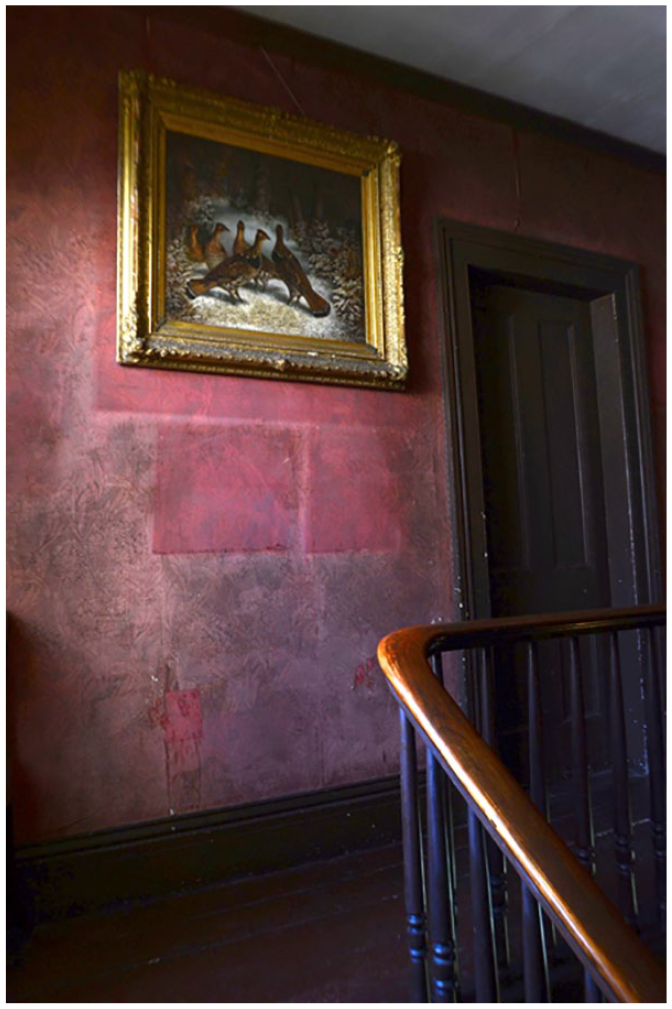
Original hall and stair wallpaper, c. 1880 (The Evergreens, Emily Dickinson Museum).
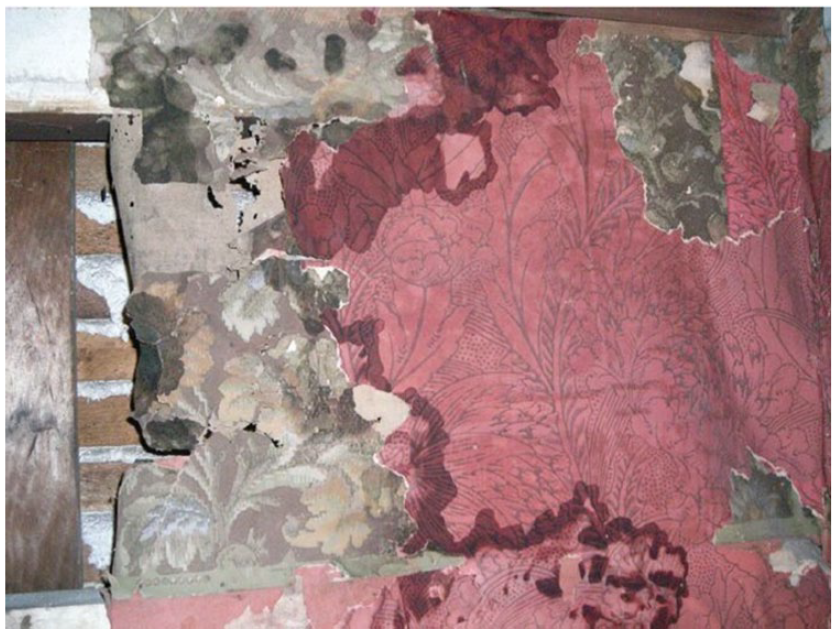
Detail, soiled wallpaper, c. 1880 (The Evergreens, Emily Dickinson Museum).
The board and staff have decided to keep the wallpaper exactly as it is. Director Wald explains that the original wallpapers are a remarkable touchstone to the family. The board and staff feel it is better to maintain its integrity as an original artifact rather than risk washing away the patina of age and authenticity. These are the very papers the family hung, cleaned, and repaired over 140 years—who could replace them? Additionally, the board and staff believe the wallpapers encourage visitors to use their imaginations in order to see the authentic interior in their minds’ eyes. Wald argues that museums do not always have to paint the picture for visitors of a moment in time with exacting furnishings—let visitors do some of this imagining. Who knows? Maybe the authentic interior, in the visitors’ eyes, is more authentic than what we might create for them. Finally, and perhaps most compelling, Wald believes the soiled wallpapers, fraying carpets, and fading upholstery evoke a disquieting environment, creating an effective backdrop for interpreting this family’s disagreements and disappointments. A pristine interior with perfect, fresh paper would belie an unhappy household. This household, with its tragedies and complex, contentious relationships, ultimately affected Emily Dickinson’s poetry itself, is an important part of the poet’s story. 6
In 2011, the Emily Dickinson Museum staff asked over five hundred visitors about their satisfaction with the interpretation and physical environment of the two Dickinson Houses. Twenty-eight percent responded that The Homestead—where the poet lived—exceeded their expectations while sixty-six percent stating it met their expectations. However, the Evergreens—William and Susan’s home with its fading furnishings—provided a more satisfactory visitor experience, with fifty-two percent of the respondents noting that The Evergreens exceeded their expectations. Many agreed that the museum should not change out the original wallpapers and appreciated their authenticity. 7
Immersive environments utilize replicas of original artifacts in creating a usable, authentic appearing interior. This was the case with the c. 1880 J. R. Jones General Store, from rural Waterford, Michigan, when it reinterpreted and reinstalled in 1992. Moved to Henry Ford’s outdoor museum, Greenfield Village, about 1929, it sat on the Village Green gathering dust, with the collar and cuff boxes, union suits, women’s gaiters, patent medicines, dishes baking in the sun and deteriorating in old pasteboard boxes (see Figure 3).
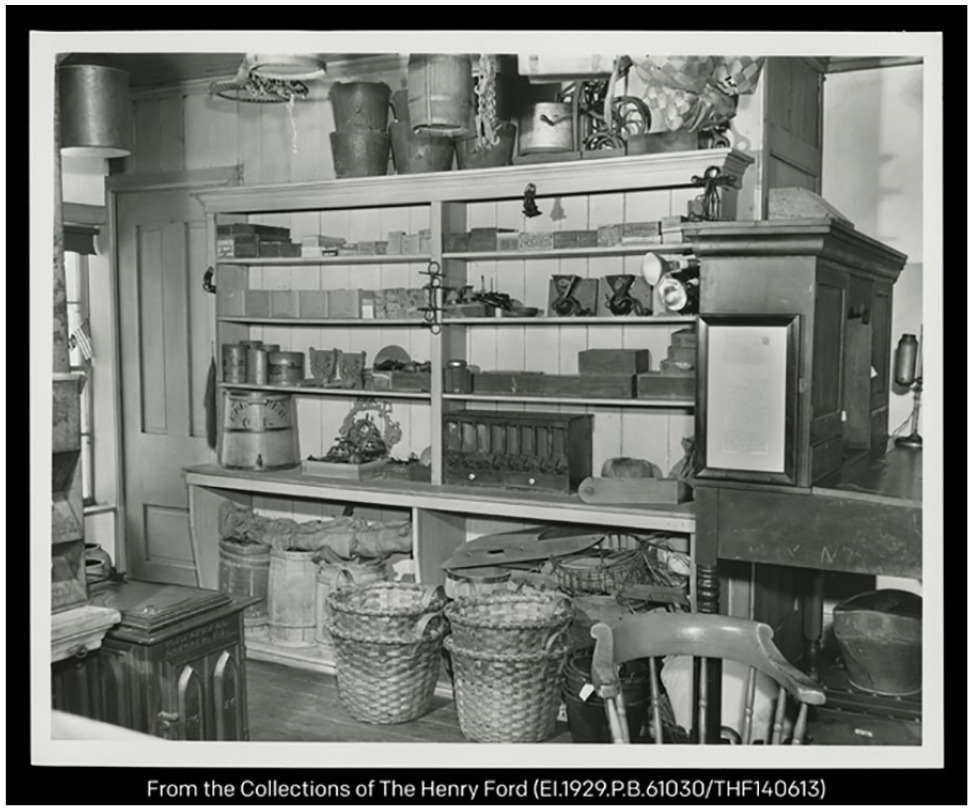
Photo of General Store, 1972 (Greenfield Village, Dearborn, MI).
The old store exhibit included a crazy cacophony of stock from several different general stores in New York state. Before the reinterpretation, it was a fusty if endearing store stocked with new old stock from 1830 to 1910, including “Coshineal” [sic] bug bodies used for scarlet dye in an old glass canning jar with a hand-scrawled label, scratchy c. 1900 woolen union suits with silk breast gussets and seeping pre–Civil War patent medicines with wood-block printed labels. While items in sturdy wood and of metal were in good shape, the store did not always have items in quantity. Fragile textiles and paper items hardly looked like “new” old stock—it just looked shabby. Curator Donna Braden, who led this reinterpretation project, had a challenge ahead of her: was it feasible to use the new old stock that looked tired and faded? What would we do to obtain items in quantity? What might be the year of reinstallation—1830? 1900?
Before deciding what was on the shelves, Braden, a visitor studies expert, developed visitor outcomes for the site. These would guide decisions regarding the construction of authenticity using original store objects. Her team decided that the visitors should: become impressed by the quantity, variety, and far-reaching origins of products; become curious about the products and how they fit into people’s daily lives; learn respect for the risks and decision-making options of sellers and buyers at this time; and feel a kinship with the original customers to this store, realizing that the process of making decisions about purchases is similar in many respects to the ways in which we make decisions. 8 While the products’ variety, quantity, and origins were important to interpret, the artifacts were a means to an end—understanding the lives and issues of the customers who chose these items for purchase in the 1880s (deemed the period of significance).
Braden’s team determined these outcomes would be best accomplished through the creation of an immersive and authentic 1880 store environment. Braden wanted to construct an authentic experience and stated she never thought about creating an authentic installation. She believes that the building itself—remarkably original and evocative—set the stage for the suspension of disbelief and lent the installation the aura of authenticity from the start. 9 Thus, the c. 1880 store must be stocked with fresh and seemingly new items and all from the same period. Other pieces were reproduced that were appropriate to the era and this store. Original artifacts that were in good condition remained; however, those that appeared shabby or soiled were simply not usable in this installation.
I was part of the reinstallation team; I was to wrangle the fabrics, ribbons, and clothing accessories for the installation. I was initially a proponent of using original store stock in the store. This was where they belonged—if not here, where should they be? It seemed nuts to return original store stock back to storage when they belonged here. I felt sure that the conservators could clean up and repair the fragile boxes and could carefully wash the soiled union suits, gloves, and textiles for reinstallation. I was privately concerned that new items could never rival the remarkable look of the originals—where could we find exquisite silk ribbons? Endless calicoes? and How might we duplicate the smell of the dust of ages on these pieces?
Staff conservators disagreed with me. They believed that shabby boxes and clothing, although original to the building, would never seem bright enough to create an authentic environment. And so, the original items were removed from the store, replicated, and returned to storage. Braden’s careful research guided selection and reproduction. To my surprise, I was able to find exquisite ribbons and calicoes in quantity that virtually replicated what we put back in storage. The end result is a visitor experience as authentic as anything in the Village: immersive, colorful, and evocative. One last note: while everyone admires this installation, the authentic smells of the old store—a combination of old leather, musty fabrics, and seeping patent medicine packages—could not be duplicated, to my dismay. I may be the only one who mourns these smells, but to me, it is a reminder that all senses are called upon to conjure that authentic interior (see Figure 4).
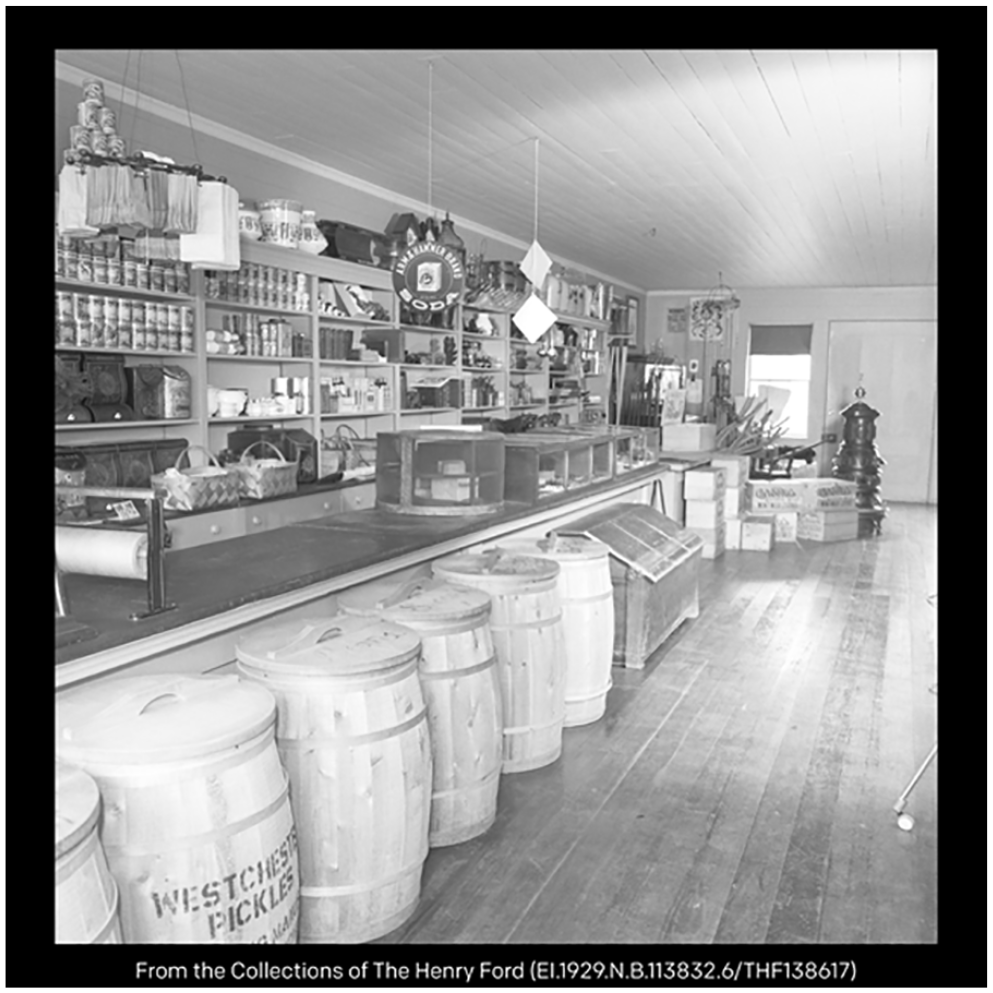
Photo of reinstalled General Store, 1998 (Greenfield Village, Dearborn, MI).
When asked, interpretation staff in the General Store share which artifacts are reproductions and which are new old stock, and why the replacements were made. Braden says this bothers them not at all. In fact, in 2008, Susie Wilkening and Erica Donnis surveyed 5,000 outdoor museumgoers about their expectations of seeing replicas in place of historical artifacts. Respondents suggested accurate replication of artifacts that are not passed off as originals can create an authentic experience. To visitors, authenticity means “being willing to say: ‘this isn’t what they had, but this is what is available today that is the most similar,’ and ‘this is why it is different, and why we can’t get the original.’” 10
Art and anthropology museums increasingly embrace digitally created replicas which are key in providing thrilling new visitor experiences. The combination of the original setting with a precise replica simulates “authenticity.” Perigord Facsimile Studio produced what they call a “complete replica” of the original cave at Lascaux, too fragile for foot traffic but of high interest. 11 The Studio settled the replica (called Lascaux IV) into the foot of Lascaux Cave, so it is experienced in the appropriate landscape. Lascaux IV is precise down to three millimeters thanks to 3D digital scanning of the actual cave, with “every nook and cranny recreated using polysterine and resin, and the latest fiberglass techniques…”, creating a breathtaking historic environment. 12
Similarly, Factum Arte, a digital mediation studio that works with artists and museums, “operates with a distinct disregard for the artificial boundaries discipline, materials and techniques.”
13
Its facsimile of Veronese’s painting Wedding at Cana fills the empty wall in Andrea Palladio’s refectory where the painting once hung (the original is in Louvre). There is no delineation between real and simulated here—the lines are blurred. The combination of an extraordinary accurate reproduction in the original location is such that nobody questions that the heavily restored painting in the Louvre is more original than the facsimile now on the island of San Giorgio. But many have claimed that the experience of seeing a facsimile of such accuracy in its intended environment is more authentic.
14
Context is everything here. Just as the J. R. Jones Store building itself is a perfect backdrop for the replicas as well as the originals, the refectory space and the natural landscape at Lascaux and the associated replicas create the authentic experience and, in some senses, may be more authentic than the real thing.
In sum, curators have heady responsibilities in re-creating what visitors perceive to be an authentic historic house. They research their historic sites, determine the time period to be interpreted, and then construct that authentic interior in part through treatment and presentation of furnishings. Curators must determine the physical treatment of those artifacts in support of the authentic appearance and the site’s message. It is not just what artifacts we have; it is what we do with them—how we physically treat them to inspire, enthrall, or provoke—that matters as well.
Footnotes
Acknowledgements
I wish to express my gratitude to Clara Deck, Senior Objects Conservator at The Henry Ford (Dearborn, MI); Donna Braden, Chief Curator, also at The Henry Ford; Jane Wald, Executive Director of the Emily Dickinson Museum (Amherst, MA); and Dr. William S. Pretzer, Senior Curator at the National Museum of African American History and Culture (Washington, D.C.) for interviews on projects related to this topic.
Declaration of Conflicting Interests
The author(s) declared no potential conflicts of interest with respect to the research, authorship, and/or publication of this article.
Funding
The author(s) received no financial support for the research, authorship, and/or publication of this article.
1.
Dennis Drabelle, “The Weird and Wonderful California,” Washington Post, June 20, 1993,  .
.
2.
Dydia DeLyser, “Authenticity on the Ground: Engaging the Past in a California Ghost Town,” Association of American Geographers 89, no. 4 (December 1999): 615–6, .
4.
8.
Donna R. Braden, “The Process and the Product: Transforming the General Store in Greenfield Village,” History News 50, no. 3 (Summer 1995): 22, .
10.
Susie Wilkening and Erica Donnis, “Authenticity? It Means Everything,” History News 63, no. 4 (Autumn 2008): 19, .