







Abstract
Many historic house museums are a hotchpotch of architectural styles, furnishing, and fittings, reflecting the tastes and financial situations of generations of owners, and therefore rarely entirely “genuine” or complete. A few examples have been “frozen” at a point in time and remain an unchanging representation of the lives of the last owners, while others are carefully constructed art installations or pieces of theater. And yet, over centuries, museums have cultivated an aura of authenticity which leads visitors to assume that what we show them is “the real thing,” even if the evidence in front of them suggests the opposite. This case study explores two questions: by allowing historic house visitors to believe that what they are seeing is original (when it is not), are we jeopardizing a relationship based on trust? And conversely, will revealing the truth destroy the aura of realism that attracts our audiences in the first place?
Introduction
In today’s “post-truth” world of fake news and manipulated facts, museums are more trusted than most other public institutions, including government and the media. 1 Truth and authenticity are often connected and sometimes mistaken for each other. This is the story of a historic house project that reveals how fluid and contentious these terms can be when applied to the creation of a visitor experience.
From 2012 to 2014, I was Learning Services Manager at Sheffield Industrial Museums Trust (SIMT). My role included joint responsibility for interpretation with the Collection Services Manager. Our remit covered three sites: Kelham Island Museum, Shepherd Wheel, and Abbeydale Industrial Hamlet. 2
Abbeydale is a unique relic: an early example of an industrial complex, with a crucible furnace and water-powered machinery for making agricultural edge tools, such as sickles and scythes. In addition to workshops, warehousing, and offices, the Hamlet also provided some living accommodation for the workforce. The Manager’s House and Worker’s Cottage have been part of the Abbeydale visitor attraction since it first opened as a museum in 1970.
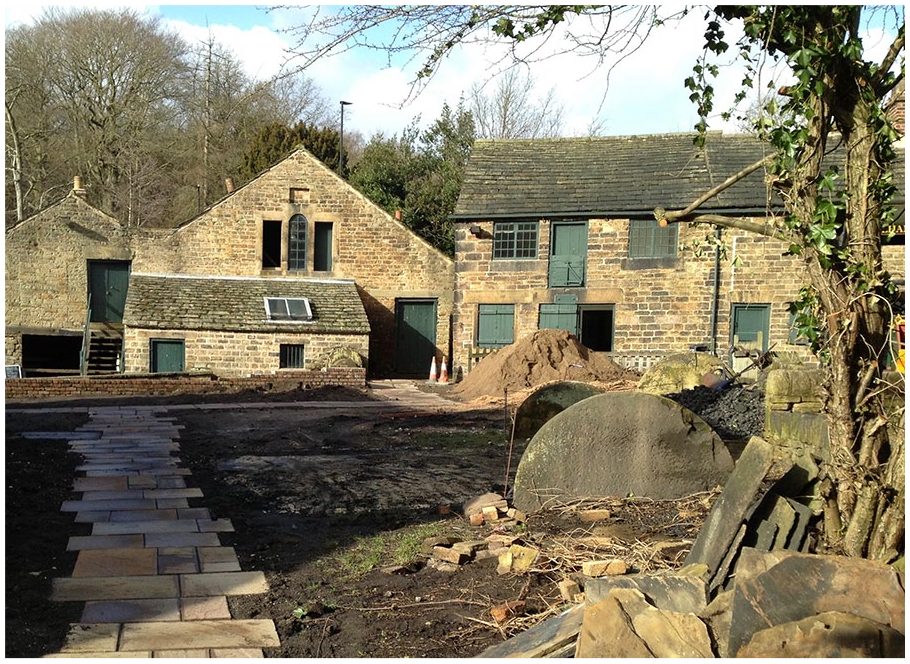
Abbeydale Industrial Hamlet image ©Pete Brown.
When I started my new job, the two homes were displayed with period furniture and fittings appropriate to the social standing of their nineteenth-century tenants: the cottages (built between 1786 and 1793) as an 1840s forge master’s home and the 1838 Manager’s House in late nineteenth-century style. As in many historic houses, there were barriers to prevent unauthorized access to the rooms, which led me to believe—as other visitors did—that the interiors were Abbeydale originals and that I was enjoying a genuine glimpse into the past.
The Trust had just been granted Heritage Lottery Fund (HLF) support for a new learning center and upgrade of the site as a whole, which provided the opportunity (and the wherewithal) for a re-think of the Hamlet’s interpretation. We began exploring ideas and I soon discovered that all was not as it seemed.
Abbeydale was closed down in 1849 (apart from a brief period when the furnace was re-lit during the Second World War, to boost steel production) and the site lay unused until 1935, when it was bought by the Alderman Graves Trust and donated to the City of Sheffield. At some time between this transfer and Abbeydale’s transformation into a museum, the Manager’s House and Worker’s Cottage had both been stripped of their contents. The room settings that museum visitors viewed were constructed by staff, who had trawled antique dealers and secondhand shops for suitable items and appealed for donations from local people.
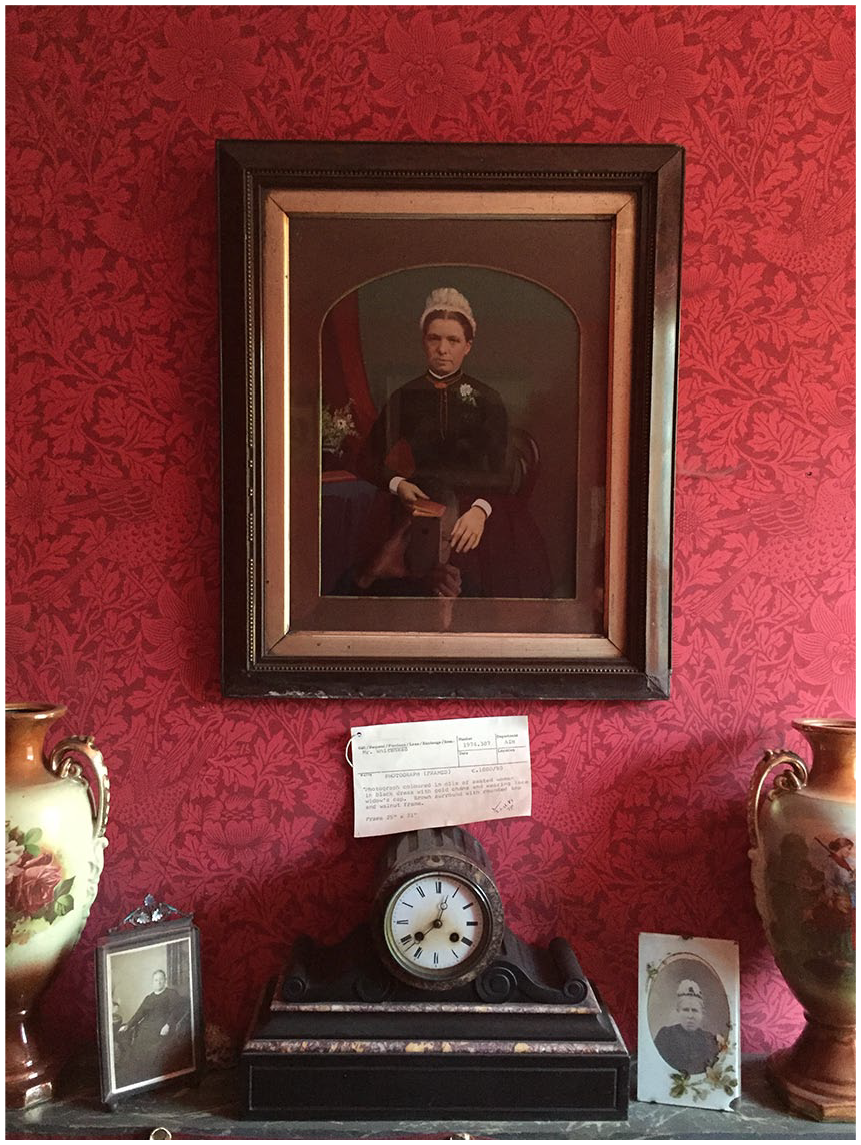
Abbeydale Manger’s House parlor setting image ©Pete Brown.
This knowledge threw up an interesting dilemma: should we maintain the illusion or burst the bubble? The question was hotly debated among the staff, with passionate advocates on both sides.
Considering Authenticity
Susan Pearce, Professor Emeritus at the University of Leicester and editor of the Collecting Cultures series, in the volume On Collecting, offers a useful definition of authenticity (and its opposite) in the context of collectable objects, among which I would include historic houses: The word ‘authentic,’ over which much ink has been spilt in the recent past, carries with it not only the notion of ‘real’ in the forensic sense, but also a feeling of ‘genuine’ in the emotional sense, of sincerity, honesty and truthfulness after its own kind. It absorbs ideas like true-bred and consistent: with authentic things you see what you get without double-dealing or unpleasant surprises. Authenticity in material goods is the moral equivalent of a lifelong friendship between two people, the essence of honourable dealing. Non-authentic or spurious is the opposite of these things. Its morals are those of the bazaar, where the buyer bewares. Its glamour is sickly and its appeal curious, in the newer rather than the older sense of the word.
3
Pearce’s definition asserts that authenticity is more than simply verifiable provenance: it also has an intangible quality that relates to trust, between seller or exhibitor and buyer or visitor.
Many historic house museums protect the room settings with ropes or other barriers, and fix signs to furniture reminding visitors that they can look, but not touch. These measures add credence to the authenticity of the interiors and remind us that we are lucky to be allowed this encounter with history (even if we have paid admission of £8.25 including GiftAid).
There are a few examples, such as the National Trust’s Mr Straw’s House in Workshop, Nottinghamshire, that have been frozen at a point in time and remain an unchanging representation of the lives of the last owners. The website invites the visitor to “step back in time to the 1920s” and claims “Treasured possessions and ordinary domestic items can still be seen exactly where their owners left them.” 4
There are others, such as the Dennis Severs’ House, in London, which are carefully constructed art installations or pieces of theater. Most historic houses hover somewhere in between. Interestingly, the Dennis Severs’ House is described in its publicity ambiguously as both as “a time capsule” and “a meticulously crafted 18th century world.” 5
The fantasy of time travel is just as appealing today as it was in 1895 when H. G. Wells published his novella, and historic house museums, with their other-worldly atmosphere, have the power to carry our imaginations off into the past. The immersive nature of these domestic showcases encourages us to daydream different lives as Lady of the Manor or spit boy. On special occasions, historic houses are populated by costumed characters, fires are lit, and drop scones cooked on the range. These sights, sounds, and smells enhance the illusion and convince us to suspend disbelief for the duration of our visit.
So what does authentic mean in these different contexts? Can people have an authentic experience communing with Dennis Severs’ artwork or exploring Abbeydale’s substitute collection of Victorian furniture and objects?
Although dictionary definitions of authenticity refer to accuracy and authoritative confirmation, I wonder whether a sense of authenticity can also be engendered by the integrity of the interaction. An eye-witness such as a D-Day veteran sharing memories of the beach landings in 1944 may well pass on a number of inaccuracies—it was a long time ago, after all—but there is no doubt that his story is authentic by Pearce’s definition, as is the experience of hearing him tell it.
Making the Case
I was confident that coming clean about the provenance of the house contents would lead to a more equitable and thought-provoking experience for visitors, while maintaining the period atmosphere that people enjoyed, but first I had to convince colleagues and, most importantly, my line-manager, the CEO of the Trust.
The strongest arguments for a different approach were supported by conservation and access. I am sure that the rooms once appeared fresh and lived in, but after 40 years of minimal intervention they were looking shabby and abandoned. So, the houses no longer fulfilled their original brief—no self-respecting manager’s household staff or worker’s wife would have allowed their home to get into such a dilapidated state.
The fact that the contents were well-documented through bills of sale and donation forms provided us with an interesting new layer to add to the story of the site, and hardly any of the objects had been accessioned, which meant we could open up access without worrying too much about wear and tear.
Times also change, and the preservation of the illusion seemed less acceptable in the 2010s than allowing visitors to continue believing that the interiors were original, in the same way that we no longer blend in repairs to conceal conservation work to buildings.
The project team debated whether the proposal was a bit self-indulgently “post-modern.” Why did it matter that people believed the interiors of the Manager’s House and the Worker’s Cottage were genuine relics of Abbeydale? If they were enjoying the experience, why would we rock the boat and seek to disabuse them of the notion? What right did we have to experiment with their expectations?
The main objection from the visitor services perspective was that if we removed the barriers there were too few staff on site to ensure that visitors did not break or steal things. My view, shared by the Collection Services Manager, was that it was worth the risk in order to improve access and give people an opportunity to explore unhindered. And if any of the contents were stolen, we could always buy the equivalent for a few pounds at one of the many secondhand shops in the area.
Some colleagues argued that revealing the truth about the interiors would “spoil the magic,” like a conjurer explaining a trick, but I know from experience as a character interpreter in historic houses that audiences can easily reconcile the knowledge that the person in front of them is a twenty-first century man dressed as a Tudor cook, with the belief that somehow he is channeling the sixteenth century. Everybody knows where they stand, the rules of the game are clear, and people are welcome to opt in or out. Historic house visitors are perfectly capable of imaginative time travel while simultaneously understanding the mechanics of museum practice.
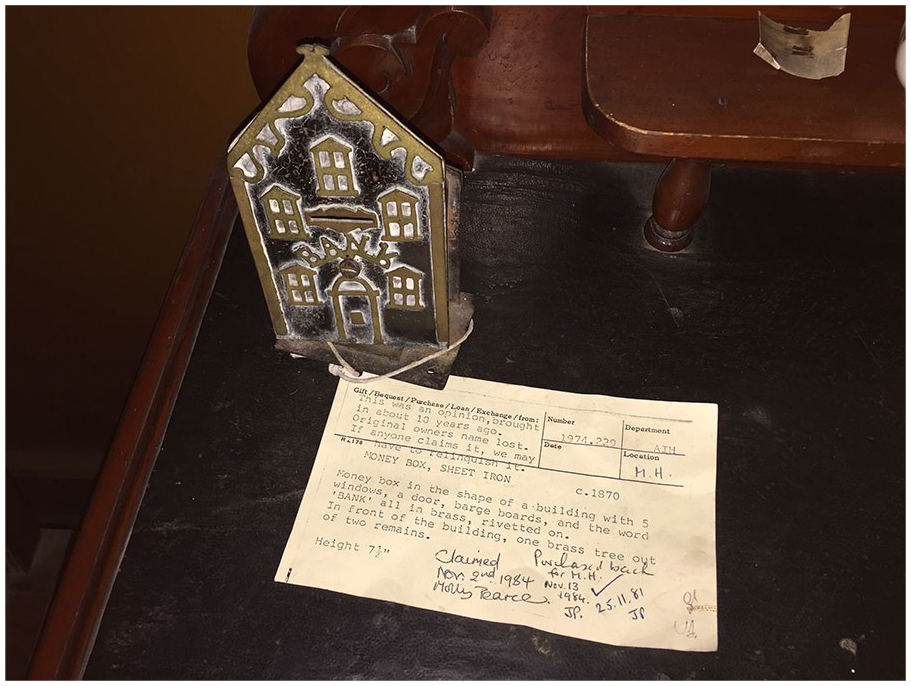
Abbeydale Worker’s Cottage label image ©Pete Brown.
All these concerns deserved to be listened to and considered, because I think they mostly arose from a genuine love for the place. We took time to consult and discuss the issues, but in the end, it was my responsibility, along with the Collection Services Manager, to make a decision, and we decided to burst the bubble.
Putting Theory into Practice
The HLF project interpretation funding did not stretch to redecorating and re-dressing the houses—the budget also had to pay for new signage and wayfinding; a new interactive space: The Works; new information panels for each workshop; a smartphone app providing a digital tour, and a new welcome gallery in one of the old workshops giving visitors an introduction to the site and its history—so the plan was limited to a thorough clean and risk assessment of all the contents; creation of welcome panels; production of object labels for selected items in each house revealing their provenance (simply enlarged copies of the documentation made into giant luggage labels); and of course removal of the wooden barriers preventing people from entering the rooms. To stimulate people’s curiosity, we opened some drawers revealing the contents and also added signs to chairs in each house inviting visitors to sit down if they needed a rest. Staff and volunteers were primed to provide information and encourage visitors to explore.
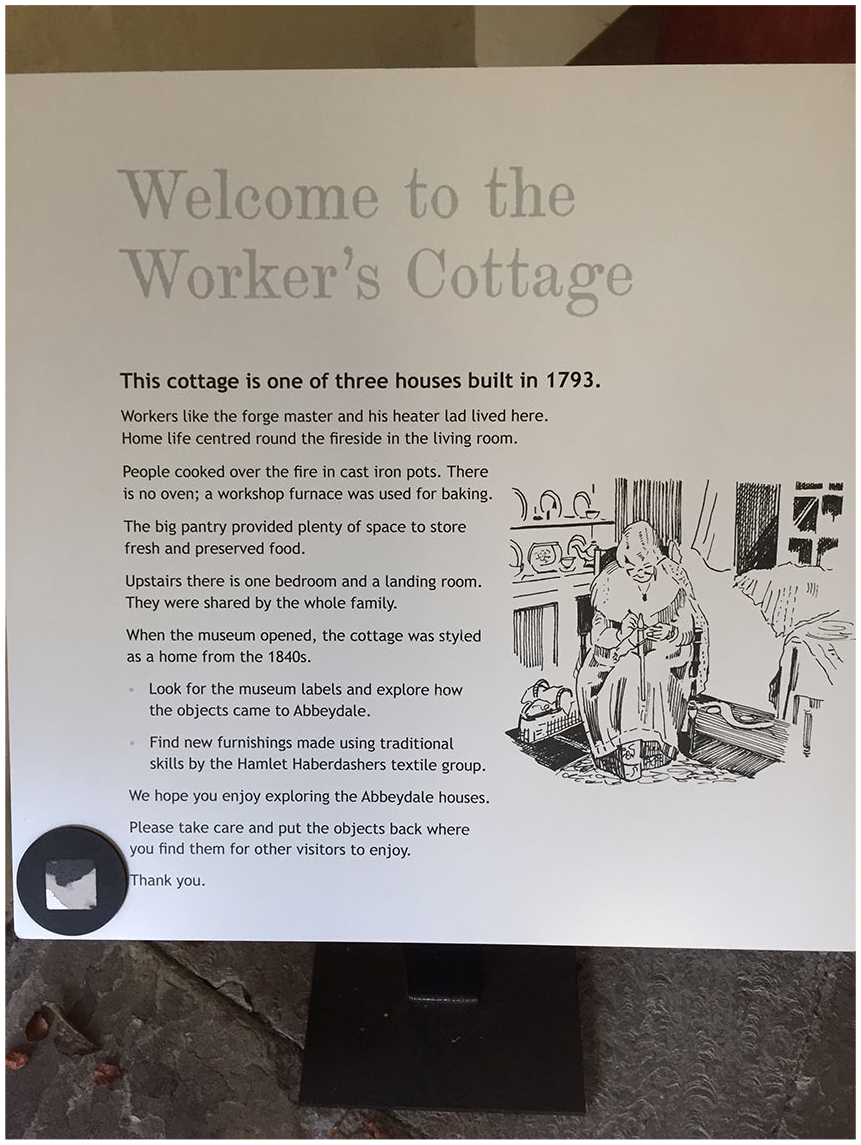
Abbeydale Worker’s Cottage welcome panel ©Pete Brown.
As is often the case, the cleaning process exposed the damaging effects of time and the elements on the interiors, particularly the soft furnishings, which were faded and threadbare. By coincidence, I had been approached by a local branch of the Workers’ Educational Association (WEA) asking whether we might have a room where their sewing class could meet. I was always looking for ways to align the museum’s objectives with other agencies and groups, so it struck me straight away that this could work for both of us.
I took course leader Shirley on a tour of the site, and she was entranced by the Manager’s House: “the sense of walking back in time,” as she described it. Her enthusiasm was undimmed when I explained that the interiors were not original—in fact, she was intrigued to learn how the museum had created the settings.
I explained that we wanted to refresh and brighten up the rooms in an appropriate style, and we struck a deal: Abbeydale would provide a room rent free and Shirley’s group, as part of their sewing course, would research and produce soft furnishings in keeping with the period and status of the houses.
Very soon, new quilts, cushion covers, curtains, and rag rugs began to brighten up both buildings. A set of peg dolls even appeared in the baby’s crib. I asked the group if they could add labels to their pieces, to explain to visitors how and when they had been made. This prompted them to come up with a name—The Hamlet Haberdashers—and to design their own logo, which they added to each item they made.
The Haberdashers enjoyed the work so much that when the course ended, they asked if they could carry on meeting at the Hamlet. They have become a permanent part of the Abbeydale community and have since produced some large-scale textile artworks for the new learning center. People who are sharp-eyed and tuned in may notice some stern-faced, black and white portraits of the Haberdashers in Victorian frames—a playful tribute to the enhancement these volunteers have made to the visitor experience.
Conclusion
In recent years, many historic houses have moved toward a more “constructivist” approach to learning programs and activities: what Graham Black calls “the Idealist Alternative.” 6 The concept of constructivism in education goes back to the 1920s, when psychologist Jean Piaget posited that knowledge is formulated in the mind of the learner rather than existing independently of it. Learners are viewed as active participants rather than empty heads waiting to be stuffed with information. In a historic house that embraces constructivism, the curatorial voice of authority becomes one of many, and visitors are encouraged to share their knowledge and ideas.
On the face of it, constructivism would seem to demand a lot of visitors who are used to being presented with “the facts,” but many proponents of constructivism, such as George Hein, 7 believe that the process is inevitable: that visitors will make sense of our exhibitions and displays in their own way regardless of whether we seek to direct them, so we might as well make it easier for them.
If the making of meaning is the active engagement between the house as it is presented and the visitor’s prior knowledge, preconceptions, and prejudices, the museum cannot control that process, it can only guide. New visitors to Abbeydale might still overlook or ignore the object labels and information panels and leave with the conviction that they have witnessed an authentic snapshot of the lives of the actual people who inhabited the houses in the 19th century, but I was comfortable with that because it would be their choice rather than a kind of confidence trick played by default.
A sign that the open approach was working as intended, for one person at least, came when I was on my way across the yard to the Manager’s House some time after the barriers had been removed. As I approached, I could hear a piano, badly in need of tuning, being played: a visitor had felt comfortable enough to sit down at the keys and perform in the parlor in true Victorian style.
In 2019, five years after I left SIMT, the barriers are still down and the interiors have not been destroyed by clumsy or light-fingered visitors. Granted, some objects have been broken and a few have vanished, but a degree of damage and disappearance was a risk that the Collection Services Manager and I felt was acceptable.
Not long ago, I visited the Elizabeth Gaskell’s House in Manchester 8 and was delighted to find that the trustees had taken an approach similar to our transformation at Abbeydale, albeit with a substantially bigger budget!
“This beautifully restored home has spectacular period rooms” puffs the Gaskell website, but there is more to the story than that. It adds the following: Our aim is for visitors to have the experience of visiting 84 Plymouth Grove as it was in the 1860s, a welcoming family home. Elizabeth’s letters and our own research have enabled us to present the rooms as we think they were. Please feel free to “be at home” in the rooms, talk, linger and enjoy the experience.
84 Plymouth Grove is a near miraculous survivor of nineteenth-century Italianate domestic architecture in an area of Manchester that has undergone almost complete demolition and rebuilding. In 2004, the University, which had owned the building since 1969, bequeathed it to Manchester Historic Buildings Trust (MHBT) and ten years later, at a cost of £2.5 million, the leaking, rotten shell was restored and the ground floor rooms returned to something like their former selves.
The contents of Elizabeth Gaskell’s house had been sold many years earlier, which, as at Abbeydale, left the MHBT with a blank canvas. From Elizabeth’s correspondence and other research, they were able to source the right furnishings and fittings to give visitors a sense of what the Gaskell’s family home was like in the mid-1800s.
There are no barriers and visitors are encouraged to sit at the writing desk, browse the bookshelves, lounge on the chaise-longue, and even play the piano. Knowledgeable and friendly volunteers are on hand to explain the rationale and reminisce about Elizabeth, her work and life at number 84.
Visitors are told that this is not really Elizabeth Gaskell’s house as she knew it, but that does not prevent them from imagining that the family are just out of earshot, about to re-enter the rooms and welcome their guests. It is a clever conceit, and it is an honest one.
The visit to Elizabeth Gaskell’s House reinforced the conviction I had formed at Abbeydale: if replacement furniture and fittings are properly researched and appropriately sourced or manufactured, revealing those items as substitutes need not detract from an authentic historic house experience.
Footnotes
Declaration of Conflicting Interests
The author(s) declared no potential conflicts of interest with respect to the research, authorship, and/or publication of this article.
Funding
The author(s) received no financial support for the research, authorship, and/or publication of this article.
