






Abstract
The origin of the Museum of Vancouver in British Columbia, Canada, dates to the late nineteenth century—only a few years after the city was formally incorporated. Initially intended to showcase curios and items of interest, among the early donations were objects from various Mesoamerican cultures. Over the years the Mesoamerican archaeology collection grew not from a deliberate collecting strategy, but from chance donations by residents of the city. Not long after the re-focus to a civic museum the collection ceased to grow, and today the collection is consigned to the museum’s storage area. Despite not being of immediate relevance to the museum’s mission, the history of the collection reveals a fascinating insight into the lives of past Vancouver residents and demonstrates the utility of investigating the provenance of previously little-known collections.
The Museum of Vancouver (MOV), located in the lower mainland of British Columbia (B.C.), is a civic museum with collections and exhibitions that tell the city’s story (Figure 1). It is the oldest museum in Vancouver, having grown out of an effort to accumulate interesting and curious objects from around the world beginning in the late nineteenth century. The MOV houses approximately 70,000 objects from different places, times, and cultures, and is thus unique in its ability to reflect Vancouver, its history, and its relationship with other parts of the world. 1
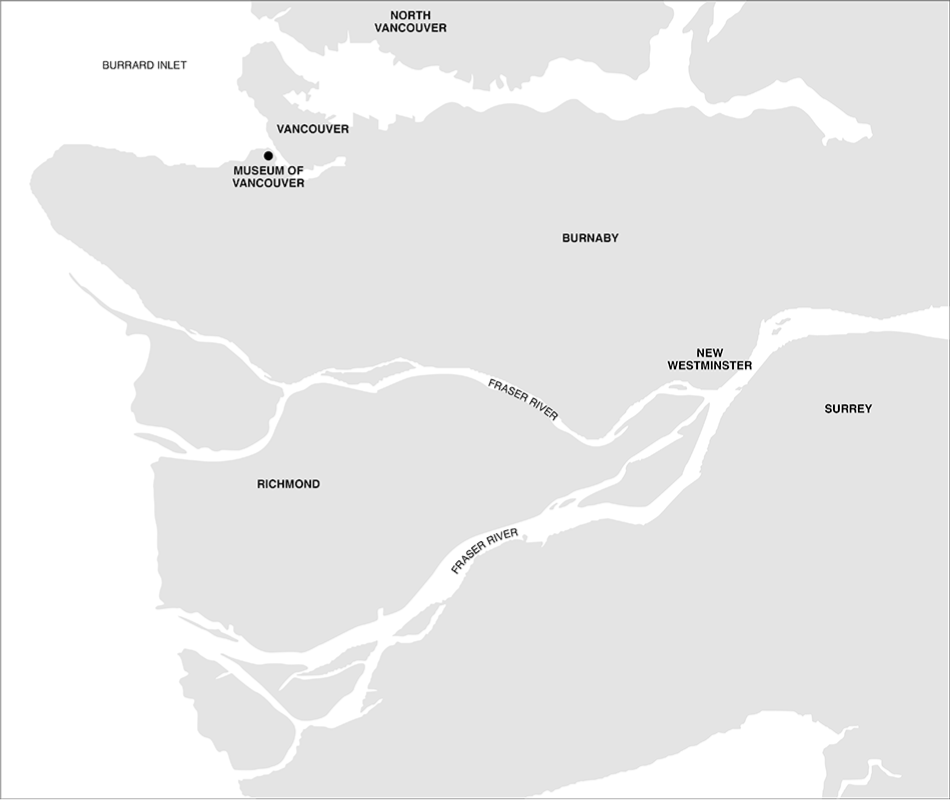
Location of the Museum of Vancouver in the lower mainland of B.C. Map by John Short.
Museums such as the MOV, who possess cultural heritage from many world cultures, have an obligation to address their colonial histories and past acquisition methods. 2 The retention of cultural heritage by museums has long been a contentious issue, and the continued presence of heritage in the exhibit cases and storage areas of museums calls for increased efforts toward transparency and rationalization of custodial practices. Canada has traditionally adopted an inward-looking perspective toward heritage, limiting the recognition of indigeneity to those within the country. 3 Shifting the perspective toward global recognition indicates that the cultural heritage of all people is significant, and emphasizes that an understanding of how heritage has been systematically taken away from indigenous people inside and outside of Canada is necessary.
Heritage held in Canadian museums from regions such as Latin America is important to call attention to because not only has this region of the world long suffered from the looting of antiquities and destruction of archaeological sites, but because Canada has a dedicated yearly celebration of Latin American heritage. 4 As a recognizable part of Latin America’s heritage, objects from Mesoamerica represent the cultural importance of this region where people of many different ethnicities, language groups, and identities have lived for thousands of years. This article focuses on the MOV’s Mesoamerican archaeology collection, located in the museum’s storage area. 5 The collection was assembled by at least fourteen different individuals over an eighty-nine year period, and, apart from one Honduran object and one object possibly from Costa Rica, the items in the collection originated in Mexico (these countries are part of the region that Kirchhoff (1943) identified as “Mesoamerica”). While there were shared cultural traits throughout the region prior to Spanish contact, differences led to the emergence of distinct cultures including the Aztec, Maya, Olmec, and Zapotec.
The growth of the collection is significant considering that it began earlier than many well-known Mesoamerican collections in places such as the United States (Coe 1993; Yates 2019, 191). This article focuses not on the objects themselves, but the people who collected and later donated or sold these objects to the museum. As Sellen (2015) has explained, “past and present lives. . .[are] woven around, and inseparable from, the biographies of. . .ancient archaeological objects.” The information presented in this study is based on archival and historical research, demonstrating that even with limited information it is possible to begin to reconstruct the history of collections and contribute to the important field of provenance studies (Milosch and Pearce 2019). Written in the time of reduced access to museums and their collections, a result of the COVID-19 pandemic, this paper hopes to demonstrate the contribution that “hands-off” object research can have in revealing the history and past acquisition practices of museums—something that is necessary to address for museums to be recognized as relevant for all contemporary communities. In this particular case, we can begin to address how objects from Mesoamerica ended up in a civic museum in Canada, what connection they have to the city and its residents (both past and present), and how understanding their history might help shape their future.
History of the MOV
The growth of the City of Vancouver stems from its history of non-indigenous settlement, heightened by the Gold Rush of 1858 and the extension of the Canadian Pacific Railway to the west coast in the 1880s (Belshaw 2016; MacDonald 1975, 52). The policy of forceful removal of Coast Salish people, including Musqueam, Squamish, and Tsleil-Waututh, to small parcels within their traditional lands enabled newcomers to marginalize Indigenous populations and seize control of the region (Ware 1975). Colonial development followed and incorporation of the city came in 1886. The chosen name of the city reflected the explorations of the region by British naval officer Captain George Vancouver, similar to the British reference chosen for the province by Queen Victoria (Akrigg and Akrigg 1997, 278, 281; Harris 1997, 80).
The origins of the MOV can be traced back to just three years after the city’s incorporation, when a group of residents began “an art association with the idea of subsequently enlarging its scope to include historical and scientific objects and curios as a basis for a museum.” 6 The idea is credited to Mrs. H. A. Mellon, following a suggestion by her cousin two years earlier, recommending the establishment of a society connected with the history of B.C. 7 Mrs. Mellon was described as “an ardent collector” and her husband, Captain Henry Augustus Mellon, having worked in the Royal Navy, was said to have “travelled much and picked up many curiosities” (Bursill and Forest 1908). The association held their first exhibition a year after they founded and two years later they published a proposal “to form Historical and Scientific departments,” suggesting that “were these departments established there is no doubt that donations from private citizens would pour in, and the nucleus of a museum be established.” 8 Records show that the association subsequently organized lectures, concerts, and dances to raise funds for their cause. 9 They failed to continue momentum however, suggesting their failure was in part due to the heavy concentration on art, and the exclusion of women from leadership positions (Hunt 1987, 44). 10
On 17 April 1894, the Art, Historical and Scientific Association (AHSA) of Vancouver was established to reinvigorate and eventually replace the Art Association. 11 Hunt (1987, 40–41) suggests their intent was to bring European, and specifically British, inspired civilization and refinement to Vancouver and cultivate a learned and sophisticated society. Their objectives were varied and ambitious, including establishing an art gallery, museum, and library. The nucleus of the museum was said to be a number of antiquities “collected by Mr. Dean.” 12 Dean, of Victoria, was collecting for the Chicago World Fair and members of the AHSA raised funds for him to acquire duplicates for their own collection (The Art, Historical and Scientific Association 1926, 4). 13 Other objects of interest to their cause had been collected by members over the years, and the resulting collection “of pictures and curios” were exhibited in November 1894. 14
The AHSA continued to grow and from 1898 onwards City Council made yearly grants toward their “maintenance.” 15 Hunt (1987, 49) argues the association were “forced to begin soliciting” such grants because “the city was far too young to have produced its own class of wealthy industrial philanthropists.” Soon after, the AHSA began petitioning the city for premises to enable them to move the collection from their “shack,” and in 1901 secured the forthcoming library as a new location for their collection (built with funds donated by Andrew Carnegie, famous steel manufacturer). 16
In 1903 an agreement was made between the association and City Council, whereby the AHSA would retain ownership of the collection but council members would have a voice in its management when it transferred to the new premises. 17 This decision was based on the fact “collections had become so extensive and of such value” that handing it over to the city would allow it to be properly housed and preserved (The Art, Historical and Scientific Association 1915, 3). It also ensured that City Council financed the museum (ibid 1926, 6). When the new Carnegie building, housing the AHSA collection on its top floor and the library on the two lower floors, officially opened on 19 April 1905 the museum continued to be property of the association but also became a department of the city and over time became known as the “City Museum.” 18 The space quickly became incompatible with the growing collection, and it seems even the Carnegie basement became overcrowded (Matthews 2011 [1933], 357).
To advertise their collection, activities, and advocate for new space, the association began a series of publications to allow them to formally communicate with its members about its history, collection, activities, and future vision (Arts, Historical and Scientific Association 1910; Bursill and Forest 1908). 19 These publications demonstrate an eclectic and varied collection including minerals, fossils, ethnography, curios, weapons, zoology, flora, coins, literature, and paintings (The Art, Historical and Scientific Association 1915). In 1916, along with other cultural organizations in the city, the AHSA became part of the Vancouver Institute at the University of British Columbia and its public lecture program (which continues to operate today [Hunt 1987, 43]).
With an ever-expanding collection came a continued fight for improved space to exhibit within the city (see Figure 2 for an example of the crowded display cases). Promotional newspaper articles became commonplace, reporting tens of thousands of visitors per year, and local news coverage of the need for a new location appeared repeatedly. At the onset of the Second World War, parts of the collection were removed from display and stored in an underground city vault for safety—yet attendance at the museum boomed. 20 The AHSA continued to push for a new museum to be built as part of a post-war project, but even by the time of their golden jubilee they were still fighting to secure new premises. That same year, the city claimed they would consider a new museum “when civic finances permit.” 21 The museum were left behind in the Carnegie building when the library vacated it in 1958 and, despite having access to the leftover areas, “leaking ceilings and falling plaster” spurred on the fight for a new space. 22 Reports of the museum’s deteriorating condition became so well known that visitors specifically requested to see the falling plaster! 23 The staircase in the building was also identified as a hindrance and described as an “insurmountable obstacle to many visitors who are far past their prime” (The Art, Historical and Scientific Association 1944, 18).
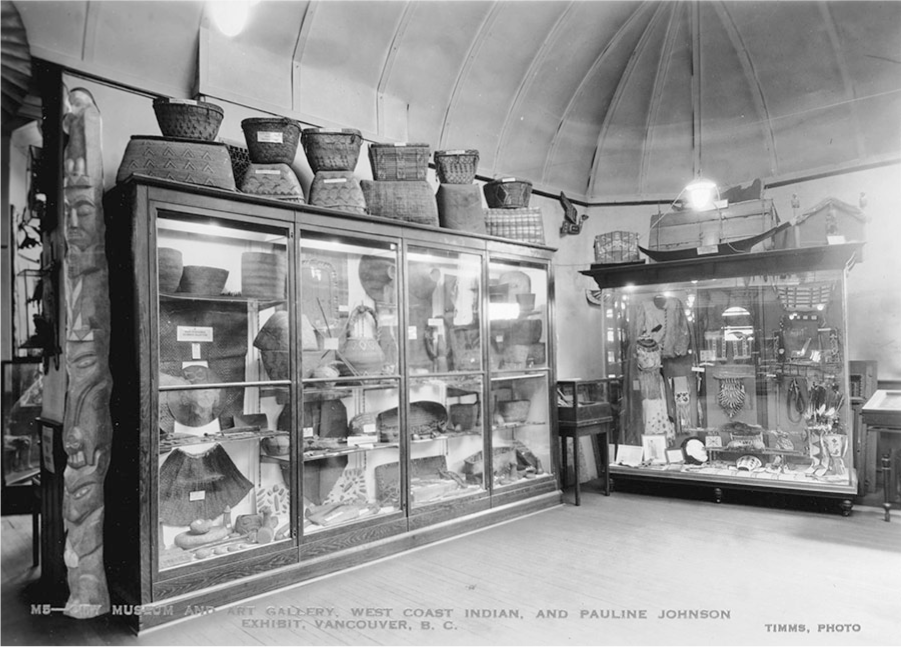
The City Museum’s “West Coast Indian, and Pauline Johnson exhibit” in 1932. City of Vancouver Archives Vancouver Museum Fonds AM336-S3-2-CVA 677-711.9, Box 199-A-05.
In 1959 the city appointed a museum board to operate all civic museums and its members overtook operation of the City Museum. 24 The board pressed for a museum bylaw in 1964, with a budget of $2 million to build a new space, but it was rejected and plans swiftly changed for a new museum as part of the 1967 Canadian Centennial. 25 A proposal to create a new museum at a former RCAF site in the city—albeit as a package deal including a new art gallery, casino, restaurant, and planetarium—was put forward in May 1965. 26 Protestors almost derailed the project but the following month the city announced that it would build the new museum as Vancouver’s centennial project. 27 Initial plans exceeded size and cost expectations, and eventually a plan for a combined museum and planetarium was approved—with all other additions such as the art gallery shelved. 28 Due to delays in approval, the city did not complete the $3.5 million project on time but finally opened the Centennial Museum and H.R. MacMillan Planetarium in October 1968 (Figure 3). 29 The museum was renamed the Vancouver Museum in 1981 because the board of trustees felt “the word Centennial has lost its original relevance” and the museum needed a stronger and simpler identification. 30 Almost three decades later, in 2008, the museum announced that its new vision was to focus on the City of Vancouver and the following year it changed its name to the Museum of Vancouver. 31 Its current mission is “to achieve a deeper understanding of Vancouver through stories, objects and shared experiences.”
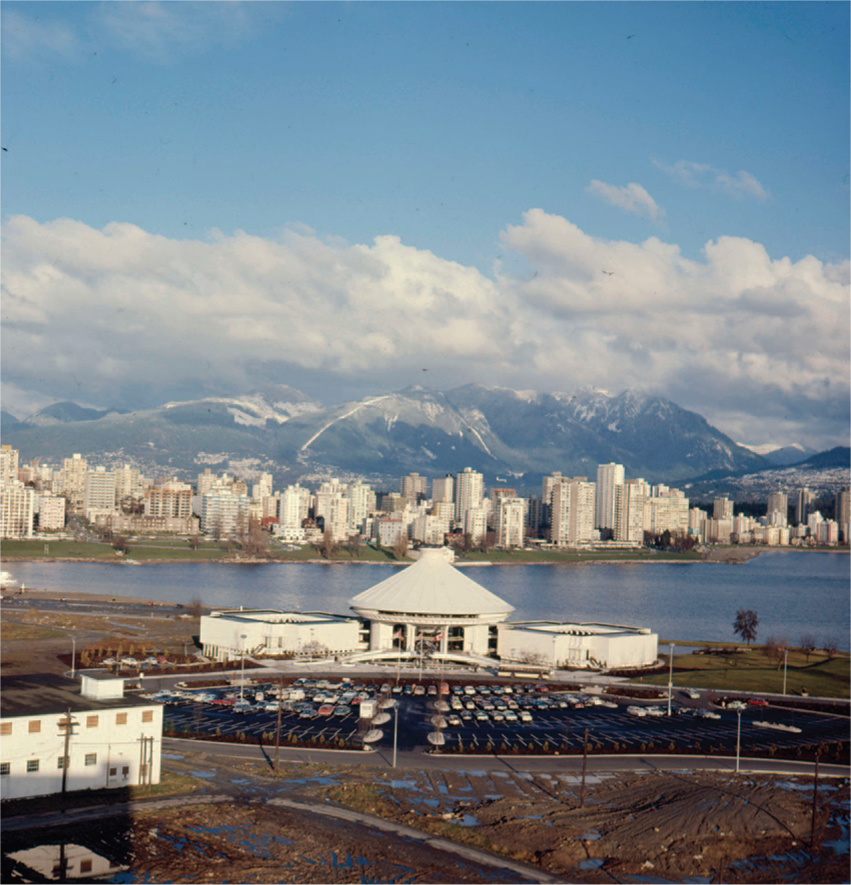
Centennial Museum and H.R. MacMillan Planetarium, showing Burrard Inlet and downtown Vancouver behind. City of Vancouver Archives, AM1435-: CVA 1435-51. Photograph by Westcoast Transmission Company, exact date unknown but thought to be from the 1970s.
The Mesoamerican Archaeology Collection at the MOV
The AHSA “believed it was their duty to save, for British Columbians, as many ‘antiques’ as they could by attracting voluntary donations from willing local citizens” (Hunt 1987, 45). When the museum formally opened at the Carnegie building it was described as having “many exceedingly interesting curiosities from many parts of British Columbia and from out-of-the-way portions of the world.” 32 Soon after, and no doubt regarded as favourable additions to expand its global nature, objects from Mexico began to be incorporated into the collection.
Several centuries earlier, when colonization of Mexico and its Central American neighbors began, so did the exodus of Mesoamerican cultural heritage to Europe and the United States, as conquistadors, clergymen, and explorers sent objects home in an effort to showcase marvels of the New World. While this paper does not speak to the ethical nor legal aspects of the MOV’s Mesoamerican collection, it is important to note there are several national and international legislative instruments in place to protect the cultural heritage of Mexico, Costa Rica, and Honduras—dating back as early as the nineteenth century. 33 These instruments were drafted in an age when public fascination with the Mesoamerican region was increasing, in part due to popular publications such as the famed travels by John Lloyd Stephens and Frederick Catherwood (Stephens 1841), which stimulated the collection of heritage from this region.
Of the seventy Mexican objects in the collection (see Table 1), forty-seven are listed as originating in San Juan Teotihuacan, a town in the larger archaeological zone of the site of Teotihuacan (roughly 45 km northeast of Mexico City). The site was the largest and most densely occupied city in ancient Mesoamerica at its time (it flourished from about 100 BC and lasted until roughly AD 650). Its population was 100,000 or more and interest in the site has an almost uninterrupted history from ancient times to today (Nichols 2016). Cowgill (2015, 14) describes Teotihuacan as “the least lost prehistoric city in the world” because of the immense size of its structures. This is likely why the site name was translated as “temple of gods” in colonial times (Nuttall 1926, 62). The Pyramid of the Sun is the largest building at the site, standing 75 m tall on a 350 m2 terrace, and is one of the unique monuments that makes it worthy of UNESCO World Heritage Status. 34 The structure was first excavated in 1905 by Leopoldo Batres (1889), who had carried out prior excavations elsewhere at the site. Of the forty-seven objects said to be from San Juan Teotihuacan, ten are specifically associated with the Sun Pyramid and their donor (see below) inscribed the name of the structure on their reverse. Teotihuacan’s monumental size and designation as a World Heritage site not only makes it an important site for the Mexican nation and Mexican identity, it also attracts millions of visitors each year (Bueno 2010, 54; Newell 2008).
List of Objects in the Mesoamerican Archaeology Collection at the MOV, Organized by Date of Acquisition.
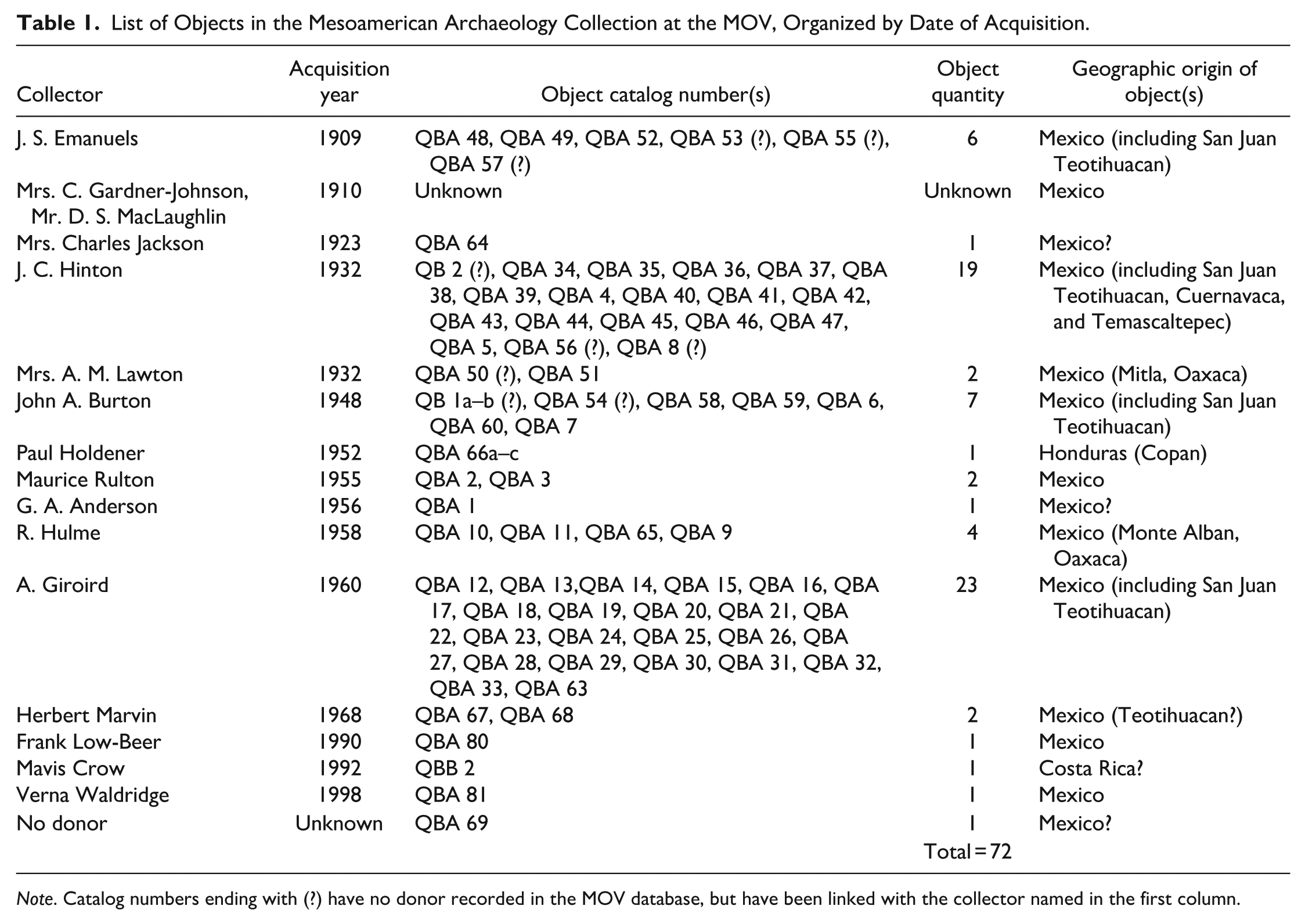
Note. Catalog numbers ending with (?) have no donor recorded in the MOV database, but have been linked with the collector named in the first column.
Acquisitions of Mexican material by the AHSA as far back as 1909 is incredibly interesting because, as previously discussed, many other Mesoamerican collections did not develop until later in the twentieth century. The early collectors donating Mesoamerican material to the AHSA were likely influenced by the writings of people such the aforementioned Stephens (1841) and the incipient field of Pre-Columbian art, stimulated by avant-garde artists such as Braque, Matisse, and Picasso, who recognized aesthetic qualities in so-called “primitive” antiquities (Baudez 2002). Mesoamerican material entering the AHSA at the turn of the twentieth century is equally impressive considering that the tourist industry in Mexico did not formally develop until the 1920s (Berger 2006). However, as Sellen (2015, 28) has explained, the earlier Porfiriato period of General Porfirio Díaz in Mexico (1876–1911) spurred interest in, and exploration of, the country’s archaeological sites and the sale of antiquities to foreign collectors followed suit. Bueno (2010) documents the ‘birth’ of Teotihuacan as Mexico’s first official archaeological site, which Porfirio ordered to be rebuilt from ruins for the country’s centennial in 1910. Visitors to Mexico City, and nearby Teotihuacan, were few and far between prior to the completion of the international highway in 1939 (Berger 2006, 103) but tourism subsequently grew significantly and by 1946 Mexico was said to be “one of the premiere playgrounds for American tourists” (ibid, 5).
The archaeological site of Teotihuacan was promoted as a worthwhile excursion for such tourists, and even archaeologists like Batres promoted the site as a tourist destination (Berger 2006, 96, 102; Díaz-Andreu 2013, 229). Of the forty-seven objects in the MOV collection reportedly from Teotihuacan, the majority are figurines or figurine fragments. Considering that figurines were manufactured at Teotihuacan “during all eras of occupation, and are found almost without exception in all areas of the site” (Goldsmith 2002), this is unsurprising. Furthermore, eight of the forty-seven objects are thought to be replicas and this is also anticipated considering that fakes and reproductions were being sold to tourists at Teotihuacan in the late nineteenth century (Kaplan 1992, 105), if not earlier. The Mexican state later encouraged the reproduction of antiquities for the tourist market to “halt the trade in fakes and actual antiquities” (Díaz-Andreu 2013, 230).
The Mesoamerican archaeology collection is currently housed in the MOV’s storage area, away from public view (as Robin [2019, 41] has found for most Latin American collections in Canada), yet access to the objects is available through the museum’s online collection. The last exhibition to include objects from the Mesoamerican collection appears to have been in 2006, which is unsurprising considering the museum’s mandate. 35 Interestingly, the museum was scheduled to present the travelling exhibition “Cenote of Sacrifice: Maya Treasures from the Sacred Well at Chichen Itza” in 1986 but due to financial reasons the booking was cancelled. 36 Apart from this one example, the museum does not appear to have considered presenting any other exhibitions related to Mesoamerican cultures. 37
The rest of this paper will discuss the individuals associated with the collection, organized chronologically by date of acquisition. 38 Two of these individuals (see discussion of Frank Low-Beer and Mavis Crow below) also donated objects to neighbouring museums, but the majority of individuals appear to have limited their donations to the MOV. 39 As will become clear, the story that can be told about each donor is highly variable and relates to Achim’s (2017, 8) statement that “tracking the trajectories of people and things presents us with a messy and entangled story that is not the broad and sweeping story we might want.” The lack of documentation about some donors is due to minimal or missing information in the museum source files, and the inability to find additional information about donors in local archives or from local historic newspapers. Regardless, what emerges below is a fascinating example of the utility of provenance research for museum collections—particularly those that are relegated to storage shelves and largely become unused through time, as has been the case with the Mesoamerican archaeology collection at the MOV.
S. J. Emanuels
When the AHSA published their catalog in 1915 they listed “Aztec Household Gods” in the Ethnology category, located in case 41. The first donor of Mexican material was S. J. Emanuels, who is recorded as donating six “household god, Aztec” in 1909 in the MOV accession records. However, the museum’s catalog lists only three objects as being donated by Emanuels and another three as possibly donated by him (see Table 1), revealing that somewhere between 4 percent and 8 percent of the collection’s final size was established through this inaugural donation. The six objects are all fairly small ceramic items including figurine heads, applique feet from the base of ceramic vessels, and one female figure.
Research reveals there was an S. J. Emanuels present in the city by 1889, who appeared to have a range of occupations including auctioneer, appraiser, insurance agent, and realtor. 40 The following year the Vancouver City Electoral District (1890) published their voters’ list and there is a Samuel John Emanuels, Insurance Agent, listed. British Columbia Legislative Assembly (1890) Records show he was a member of the Vancouver Pioneers’ Association, which had been founded in 1893 initially as a social organization for those who arrived in the city before the Great Fire of 1886 (Smith 2014) but later included residents of the city before 1892. 41 In 1915 Emanuels was appointed as the Brazilian vice-counsul for British Columbia, and a subsequent news article stated that his parentage was Brazilian. 42 That same article explained that after arriving in Vancouver he spent four years traveling in Mexico and Central America. This is likely to have been from 1900 to 1904, based on the disappearance of Emanuels’ auction notices and the absence of his name from local news during this time, followed by news in 1905 that he was in the city after having lived in Mexico. 43
News articles from the 1890s report that Emanuels was involved with various associations such as St. John’s Ambulance Corps and the Christ Church Young Men’s Society—the latter also one in which Captain Mellon was involved. Articles from the same time also report that Mellon and Emanuels attended the same local events. Thus, it is highly likely Emanuels was aware of the AHSA because of his relationship with Mellon, and because he appeared to be an active member of associations in Vancouver at the time. It is possible that during his travels in Mexico, Emanuels collected items with the intent to donate them to the AHSA on his return. This may have been to help increase the quantity of the AHSA collection, its geographic scope, or both. Emanuels passed away in 1929 at the age of seventy-nine and his obituary stated that he was born in London, settled in Saskatchewan in 1883, and came to Vancouver in 1888. 44
Mrs. C. Gardner-Johnson, Mr. D. S. MacLaughlin
In August 1910 the Vancouver Daily World reported that “Mrs. A. Bethune, Mrs. C. Gardner-Johnson, and Mr. D. S. MacLaughlin have each presented interesting specimens of work by Mexicans.” 45 Interestingly, another local newspaper published announcements five months earlier reporting “Mr. and Mrs. C. Gardner Johnson. . .have been on a holiday trip to Mexico for the past two or three months,” thus indicating that their donation may have resulted from their earlier travels. 46 While there are no MOV database records that show these individuals as donors of Mesoamerican material, it is possible that the collection continued to grow a year after the initial donation of Mexican objects by Emanuels.
The MOV database records show that Mr and Mrs. A. Bethune donated one historic item from China and several ethnological items to the museum, including objects from Nicaragua, the Bahamas, Peru, and Mexico. Alexander Bethune became the twelfth Mayor of Vancouver in 1907 and served until 1908. 47 While the Bethune donation was clearly ethnological items from Mexico, the MOV records do not show archaeological or ethnographic items associated with Gardner-Johnson or MacLaughlin (see Table 1). 48 Potentially, some of the items in the Mesoamerican archaeology collection without a secure donor association could have been donated by these individuals. There are no records available for MacLaughlin in the B.C. digital archives, nor from newspaper articles of the time.
Fortunately, records for the Gardner-Johnson (sometimes spelled Gardiner-Johnson) family are abundant because they were prominent in early Vancouver due to their shipping business, which earned Charles Gardner-Johnson the title “father of Vancouver’s shipping industry” (Smith 2014, 217). Charles was originally from Scotland and arrived with his wife Minnie (née Boultbee) in Vancouver in 1886, later opening the first shipping and insurance agency in the city. 49 Like Emanuels, Charles was also a member of the Vancouver Pioneer Association and is known for his experience surviving the Great Fire, recalling that in trying to escape it “our clothes commenced to burn and our handkerchiefs dried like chips.” 50 He died in 1926 at the age of sixty-nine and two years later his wife was named a life member of the museum association, in recognition of the “substantial” donations she made. 51 Minnie died at the age of ninety-two in 1953 and her estate was said to total $113,000 (in excess of $1 million in 2020). 52
Mrs. Charles Jackson
It was more than a decade after the initial Mexican material entered the AHSA collection that the next recorded donation occurred (see Table 1). The paper records in the MOV source files reveal that from 1922 to 1924 Mrs. Charles Jackson, of Harrison Lake, B.C., donated thirty-one objects to the museum. Notable items, highlighting the varied nature of the AHSA collecting strategy of the time, include a “young crocodile” and a Kwakwaka’wakw canoe. Another item was a zoomorphic bird vessel, which the MOV database notes as being acquired in 1923 and is perhaps from Mexico. However, the acquisition sheet in the museum source files lists a donation of a “jug. Mexican” in 1922. No other items in the 1923 donation list match the description of the sole Mesoamerican donation from Jackson, so it is probable that the acquisition year in the database is slightly incorrect.
“Notes on Indian Canoe,” published in The Totem Poles in Stanley Park by the AHSA (Goodfellow 1923), which details information about the canoe donated to the museum by Jackson, does not provide any information other than her residence near the Harrison River (roughly 80 miles east of Vancouver). Research of the Harrison area revealed that after Mr. Jackson passed away, the executor of his will sold a 160-acre parcel of land to the Pretty family (who were involved in the lumber industry). The family allowed Mrs. Jackson to live on the land for as long as she wanted and Betty-Anne Faulker, whose parents purchased the land in 1924, believes Mrs. Jackson likely stayed on the land for a year or two after the sale and then moved to Vancouver. 53 Today, the land encompasses a golf course and bed and breakfast known as Rowena’s Inn on the River—originally the Pretty family home. 54 Just as Mrs. Jackson remained on the land after the sale, Betty-Anne sold the land in 2016 but continues to reside in her family home—reportedly built on the same spot where Mrs. Jackson originally lived. 55
Sleigh’s (1990) research on the history of the Harrison region reveals that Mrs. Jackson’s maiden name was Lucretia Martin and she was the daughter of Joseph Martin, who owned a sawmill and hundreds of acres of land in the region. Joseph was from Milton, Ontario, but reportedly spent some time gold mining in Australia—where his daughter was born (Sleigh 1990, 85). After he died in 1900, his sons moved back to Milton but Lucretia stayed on the family property with her husband (Sleigh 1990, 88). She passed away in 1933 at the age of seventy and was buried beside her husband in Agassiz, in the Harrison region. 56
J. C. Hinton
Almost another decade passed before the next donation of Mexican material entered the collection in 1932, but it was the most sizeable donation yet—constituting a little more than a quarter of the collection’s final size (see Table 1). The acquisition sheet for J. C. Hinton’s donation to the museum simply lists “heads, pottery, Teotihuacan” and “molds, pottery, fragments.” Notes on the sheet in pencil, added at some unknown later date, list all the items associated with Hinton in Table 1 except for QB 2 and QBA 8. The notes also have two additional items listed, QBA 48 and QBA 49, with two question marks after each. Clearly at some point after these notes were written, the two aforementioned items were instead associated to S. J. Emanuels.
In addition to the acquisition sheet, the MOV source files contain a handwritten note with rough illustrations of three of the items donated by Hinton. The note reads that they were “Presented to City by J. C. Hinton,” and also lists the “Sun Pyramid in Teotihuacan,” “Dist of Temascaltepec State of Mexico,” and “Cuernavaca State of Morelos Mexico” (Figure 4). One of these items (QBA 40) has “Sun Pyramid Mexico J. C. Hinton” written in ink on its non-applique side (Figure 4). Three other items (QBA 35, QBA 36, QBA 39) have the same text on their reverse but the writing has largely worn off. A fourth (QBA 47) simply has “J. C. Hinton” on its reverse.
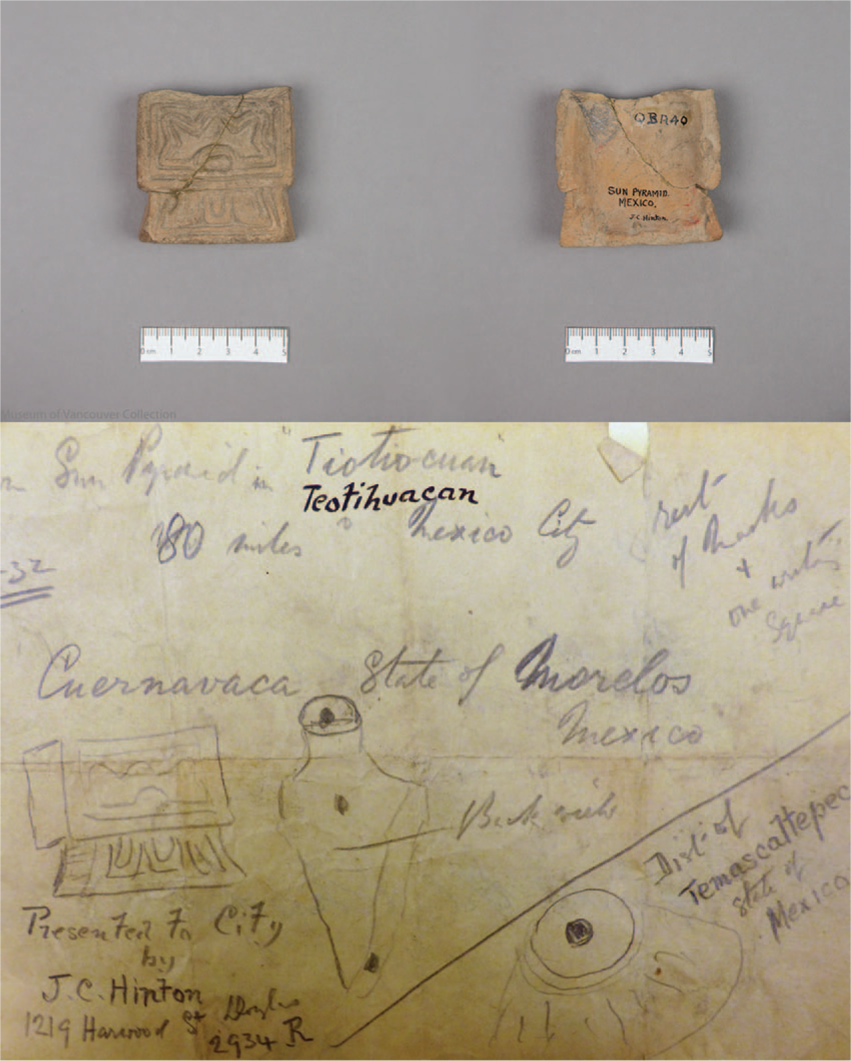
Object QBA 40 front (left) and back (right), with illustration of artefact at leftmost of note in MOV source files for J.C. Hinton (below).
Evidence of a “J. C. Hinton” in Vancouver at the time of the donation is limited to a High School pass list of 1931, which lists a “J. C. Hinton” among those advancing to Grade 10 (usually equivalent to the ages of 14–16).
57
James C. Hinton, son of a well-known botanist (who was born in London but lived and worked in Mexico), was sent to study in Vancouver at the age of fourteen (Hinton and Turner 2007). James was born in Mexico City, not far from the site of Teotihuacan, and after his mother passed away when he was four years old his father moved him and his two brothers to Cuernavaca (Hinton and Turner 2007). It is very likely that the “J. C. Hinton” in the MOV records is the same James Hinton who studied in Vancouver as a teenager. George Hinton is in agreement that his father donated these items: “If the donations were made by J. C. Hinton and there is a link to Temascaltepec and Cuernavaca, then it must have been my father. His father, George Boole Hinton, was superintendent in the Lane Rincón Mine in Temascaltepec for years before he quit to dedicate himself to botanical explorations. My father lived in Cuernavaca for 30 years before retiring to his ranch in the highlands of Nuevo León, where he dedicated himself to writing and botanical explorations. My father was always interested in collecting things, from beetles, arrowheads, plants to archaeological artifacts.”
58
The writing that George refers to includes James’ extensive publication record of short stories and novels, including Juan Caraveo (2004). 59 James passed away in 2006 at the age of ninety.
Mrs A. M. Lawton
In the same year as Hinton’s donation, two additional items (small jade beads) entered the collection (see Table 1). Unfortunately, it is unclear whether the donor associated with the items in the MOV database was the true donor because the acquisition sheet in the MOV source files does not indicate the items among those donated by Mrs. A. M. Lawton. The catalog numbers for these two items were added in pencil at a later date—both preceded with question marks—to the list of several items donated by Lawton in 1932. The acquisition sheet indicates that Lawton was a resident of Seattle, not Vancouver. Unfortunately, there is no clear trace of Lawton in either Seattle or Vancouver newspapers from the time. Nor is there a death certificate from Washington state or B.C. for Mrs. Lawton or her husband, hindering any further searches by name. 60
John A. Burton
Sixteen years passed before further donations from Mexico were made to the museum, but the seven objects acquired from John A. Burton in 1948 (see Table 1) allowed the collection to increase its representation of Mexican material (Burton’s donation contributed a little under 10 percent of the collection’s final size). The acquisition sheet in the MOV source files indicates that Burton donated a “set of replicas of Aztec images from San Juan Testihuacan” (likely a spelling error of Teotihuacan). This set are the five items without corresponding question marks associated with Burton in Table 1. Two of these items (QBA 59, QBA 60) have “John A. Burton 9-2-48” written in ink on their reverse. The two items with question marks have both been identified as replicas, which is likely why they are also associated with Burton. Information for a John A. Burton from the B.C. digital archives could not be located but the 1948 City Directory listed “John A. Burton, assistant UBC.” The absence of an address on the MOV acquisition sheet hindered verification of this individual as the donor, but based on absence of other individuals with the same name in the Directory it is possible this was indeed the donor.
Since the Directory indicated that Burton worked for the University of British Columbia (UBC), a search of UBC materials from the time was undertaken. A 1944 edition of the student newspaper, the Ubyssey, 61 listed a “John Burton, Mech. 44” as an Assistant Editor and a 1953 edition of the Alumni Chronicle included a reference to Mr & Mrs. John A. Burton (nee Phyllis Ney). 62 Newspaper records reveal that John Albert Burton and Phyllis Ney married in Ontario in 1949, that both the bride and groom were graduates of UBC and former Vancouverites, and that they were to settle in New Hampshire after the wedding. 63
Paul Holdener
The next donation by Paul Holdener, four years later, consisted of only a single object but it was significant because it diversified the Mesoamerican collection outside of Mexico for the first time (see Table 1). The acquisition sheet in the MOV source files reads “mold, Mayan. Ruinas de Copan. Honduras.” Copan is an ancient Maya site located in western Honduras and became well-known in the mid-nineteenth century, due to the travel memoirs of Stephens (1841). Like Teotihuacan, Copan is a UNESCO World Heritage Site. 64 Additional documents in the MOV source files list a 1964 donation of a concave plaster cast made by the donor representing a “Mayan goddess.” It is probable that Holdener produced this cast using the very mold that he donated in 1952. Genealogical records reveal that the donor’s full name was Paul Hans Holdener and he passed away in 1993 at the age of eighty-seven. Originally born in Switzerland, his occupation in Vancouver was “printing.” The only local newspaper articles discussing a “Paul Holdener” relate to a 1929 report about “a Swiss” who faced a charge of “attempting to obtain $2 by false pretences.” 65 The charges were later dismissed in court.
Maurice Rulton
Three years later, in 1955, the museum purchased a “collection of Indian artifacts” from Mrs L. Rulton in honor of her husband Maurice, for the sum of $25. 66 The collection, which contained two stone points from Mexico (see Table 1), was put on display in the museum and a letter from Mrs. Rulton’s daughter explained that “if my father was alive today we know that nothing would have pleased him more than to have his collection put in a museum.” 67 Genealogical records reveal that Laura and Maurice Rulton were both born in England. Maurice died in 1942 at the age of sixty-two, and Laura passed away twenty years later at the age of seventy-six. Newspaper records indicate that Maurice was a cook at B.C. logging camps, while the 1941 City Directory lists him as a baker. 68
The items donated by Laura Rulton in honor of her husband included more than 120 stone tool “points”—many from B.C. and the United States, various minerals, and a variety of other items including a Japanese ivory dagger. Several of the items in the collection, including both of those from Mexico, have the donor’s name or initials inscribed on them. Interestingly, the two Mexican stone points have Rulton’s initials, followed by “Mexico” and then designated “Aztec” (QBA 2) and “Mayan” (QBA 3).
G. A. Anderson
One year later, the collection grew by a single item—a replica Aztec “Sun Calendar”—donated by G. A. Anderson (see Table 1). Anderson’s folder in the MOV source files point to an interesting, yet mysterious, history behind his donation. Records show that Anderson obtained the item from local boys who “came upon it accidently while playing around in an old abandoned house.” 69 Thomas Ainsworth, the museum’s curator at the time, received this information after requesting that Anderson try to find out more information about the item from the boys. 70 Seemingly unaware of its fairly recent manufacture, Ainsworth proceeded to contact the Director of the National Institute of Anthropology and History in Mexico City to ask for information about the object’s age, origin, and function. 71 The Director of Prehispanic Monuments at the museum in Mexico City replied soon after, explaining that the item was a reproduction of the famous Sun Calendar—the original of which was in Mexico’s National Anthropology Museum—and that many such reproductions of this artefact are made that “no tiene más valor que como una simple curiosidad” (it has no more value than a simple curiosity). 72 Lacking a full name in the MOV records, and an address that does not appear to exist anymore, it was not possible to locate any further information about the donor.
R. Hulme
Two years later, in 1958, four objects from Monte Alban in Oaxaca were gifted to the museum by R. Hulme (see Table 1). The documentation in the MOV source files indicate that the initial “R” was for “Reg.” The 1958 City Directory lists a “Regd retired r” at the donor’s address; “Regd.” is used in the Directory as an abbreviation for Reginald and “r” for someone that rents or resides at an address, rather than being the homeowner. A death certificate exists for a Reginald Hulme, who passed away in 1975 at the age of ninety-one, listed at a different address to the Reginald in the 1958 Directory (which makes sense since accommodation can easily change over a twenty year period). The certificate also indicates that Reginald was born in Cornwall, England, was single, but his parents and occupation are not listed. The informant on the certificate was from the Department of Veteran Affairs, indicating that Reginald was a Veteran himself. Local newspaper articles of the time list a “Reg. Hulme” as an executive member of the Canadian Legion, so it is probable that the donor was a military veteran. 73
A. Giroird
Two years following Reg Hulme’s donation, the most sizeable donation to the museum thus far took place: twenty-three objects from Mexico, constituting 32 percent of the collection’s final size (see Table 1). Unfortunately, there are no records for the “A. Giroird” who donated these objects in the City Directories from the time of the donation, nor the year prior or subsequent to the donation. There are also no individuals of a slightly different surname with an “A” as the initial for the first name. Additionally, an individual of an entirely different name is listed as living at the address listed on the MOV paperwork for Giroird. The inability to locate evidence about this donor is very unfortunate considering the substantial size of the donation, mostly ceramic figurines from Teotihuacan. The only information about the donor’s identity from the MOV source files is the use of the title “Mr.”, indicating he was male.
Herbert Marvin
Eight years later, the following donation of two objects by Herbert Marvin was considerably smaller than Giroid’s (see Table 1). The MOV archival file for Marvin is largely limited to confirmation of the two items he donated in 1968, one of which (QBA 68) is said to be from an “excavation at Mexico City.” that same year. Genealogical records for Herbert Arne Marvin, who died in 1986 at the age of seventy-seven, reveal that he was born in Saskatchewan and his occupation was a ceramic tile contractor. The City Directory from the year of his donation also lists him as a tile setter. Local newspaper reports about Marvin could not be located, and the absence of a wife on his death certificate hindered further avenues to discover information about this donor.
Frank Low-Beer
Two years later, in 1990, a single donation to the Mesoamerican collection by Frank Low-Beer began a trajectory of single object donations to the collection that would continue over the next eight years. Frank donated a collection of artifacts to the museum “to be known as Edith Low-Beer collection” in honor of his mother, who passed away at the age of eighty-three in 1988. According to the acquisition report in the MOV source files, the collection consisted of 107 items from places such as China, Japan, South East Asia, and Asia Minor. Within the collection was one item from Mexico, described as a “figure fragment, culture: Maya” (see Table 1).
Edith Low-Beer was born in Brno, Czechoslovakia, and came with her husband Max and two children to Canada as political refugees in the late 1930s. 74 Frank’s sister Margaret explained that her family were “textile-industrialists” and when Germany invaded Austria in 1938 her mother took her and her brother to England, where her father was working. 75 The following year, her father applied for the family to immigrate to Canada and initially they arrived in the east but subsequently travelled by train across the country and arrived in Vancouver in 1940. In the family’s native Brno (in today’s Czech Republic), the Löw-Beer Villa—part of the Museum of the Brno Region—tells the story of her father’s family home. 76 The Löw-Beer family were involved in the wool trade, sugar industry, and distilling and are considered to have been “amongst the most important textile companies in the Habsburg Empire” as well as a leading Jewish family “in the development, business and civic life and culture of Brno.” 77
Edith chaired the Civic Arts Committee of the Community Arts Council at the time of the Centennial Museum, and her son Frank was later president of the committee. 78 Frank was a lawyer and in 1974 the Liberal nominee for the Vancouver-Quadra seat in the federal election, though he did not win the seat (he came close to securing another nomination in 1977). 79 The online catalog for the Museum of Anthropology in Vancouver indicates that Frank donated thirty objects, among them items from China, Japan, Korea, Vietnam, and possibly England, in November 1990. According to a 2005 newspaper article, after his death in 1999 his children donated items from his estate, including items from Edith’s collection, to the Art Gallery of Greater Victoria. 80 The gallery’s online collection reveals more than fifteen objects were donated in Frank’s name, while forty objects were donated in his mother’s name, almost exclusively consisting of items from Asia.
Mavis Crow
The next donation to the Mesoamerican archaeology collection came two years later in May 1992 when the museum accepted a collection of ethnological and archaeological material, and a collection of books from Mrs. Crow. 81 Within this donation was one item from Costa Rica (see Table 1), purchased in 1988 from Portobello Antiques in Vancouver (no longer in operation). For only the second time in the collection’s history (since Holdener’s donation forty years prior), it was once again culturally diversified and now representative of a third country in addition to Mexico and Honduras. The original receipt for the donation, part of the paperwork in the MOV source files, describes the item as a “Zoomorphic double jaguar effigy vessel, 500-1000 A.D.” The receipt also shows a 40 percent discount from the original price, which indicates that Crow was perhaps a valued or repeat customer at the store. Genealogical records reveal that the donor’s full name was Cora Mavis Aileen McRae Crow and she passed away at the age of seventy, just three months after her donation to the museum. She was born in Saskatchewan and for most of her life did clerical office work.
Local newspaper reports about Crow are limited and do not provide any further information about the donor but the online catalog for the Art Gallery of Greater Victoria (AGGV) indicates that, like Frank Low-Beer, Mavis Crow donated to the gallery’s collection. 82 Stephen Topfer, manager of collections and exhibits at the AGGV, disclosed that Crow’s donation to the gallery was received in 1993 by a company handling her estate. 83 He suggested that her donations to the MOV and AGGV may have been connected, because at the time the curators of Asian art at both institutions were married. It is possible that at the time, the AAGV collection lacked representation from the region of the world that Crow’s donation represented, so some of the items were suggested for the AAGV instead of the MOV.
Verna Waldridge
The final recorded donor of the MOV Mesoamerican archaeology collection was Verna Waldrige, who gave a single Maya ceramic vessel to the museum in 1998. Unfortunately, the museum do not have any records pertaining to this donation. The City of Vancouver Archives have City Directories available to consult up to 1996—two years prior to Waldridge’s donation—and there is a “Verna retd” listed under the surname Waldridge. A 2006 obituary for a Verna Waldridge lists a different address to that in the 1996 directory, but it is of course possible that same individual moved residence within the space of a decade. 84 The obituary explains that Verna was from a pioneer New Westminster family, and she and her husband Rae operated a manufacturing business in Vancouver. 85 She passed away at the age of 96 and a death certificate for a Rae Waldrige (listing a Verna Douglas as his wife), who manufactured wooden wares, shows that he passed away in 1961 at the age of 60. Apart from an obituary, local newspaper reports about Waldridge could not be located.
Conclusion
Over the course of almost ninety years, at least fourteen different individuals donated or sold Mesoamerican material to the MOV. The majority of these individuals were male, but in five cases the museum acquired items directly from females (and in one instance on behalf of a female). Apart from one Seattle-based individual, all others were Vancouver residents of a varied heritage (where known); three were born in Canada, three in England, one in Czechoslovakia, one in Switzerland, and one in Mexico. Apart from the direct link to Mexico via birthplace, one other individual had a clearly recorded link to Mexico via short-term residence (Emanuels) and two other possible donors were also recorded as having travelled to Mexico (Gardner-Johnson and MacLaughlin). Though it is unclear how each individual acquired Mesoamerican objects, and when, it is telling that the majority of Mexican items are said to be from a well-known archaeological site in Mexico, popular with tourists, and the donation from Honduras also originates from a popular tourist destination. Interestingly, the sole object from Costa Rica was not acquired in the source country but was purchased from an antique store in Vancouver.
Ultimately, this research sheds a light on the collecting practices of Vancouverites interested in Mesoamerican heritage and reveals how items from Mexico and other Central American countries became part of a local museum collection. This is important because it is inherently difficult, and sometimes impossible, to trace the trajectories of objects from source countries to market countries. 86 Although only a few strands of evidence exist, it is clear that there were at least two avenues into the homes of Vancouver residents: acquisition direct from Mexico via travel/residency, and purchase from an antiquities dealer. While the exact journey of the objects is unclear, the study does reveal a previously unknown narrative about the people behind the collection and joins together more than two dozen individuals of different age, ancestry, gender, occupation, and status in a shared effort to acquire Mesoamerican heritage. The nature of the collection, constituting objects that are small and portable, also connects the donors’ taste for cultural heritage to items that can easily and conveniently be removed from Latin America (as compared to large sculpture, which necessitates different transport networks and is more costly to acquire). Ultimately, this research demonstrates that acquisition of heritage is something of interest to a wide variety of people, and that personal collecting practices are part of a larger, collective, effort to contribute to and develop museum collections.
It is hoped that this research will stimulate more investigations into the history behind collections, particularly those that are not seen as immediately relevant to a museum’s mandate. Scholars involved in the study of heritage have a responsibility to piece back together objects’ often fragmented or lost histories, and continue to increase transparency regarding the nature of acquisition of all objects in a museum collection—especially in light of the heightened awareness and conversations surrounding heritage in overseas (colonial/ market) countries. 87 Whether the objects in the Mesoamerican collection will remain in the MOV, be transferred to another institution, or returned to their countries of origin, the history of the collection itself tells a story about the collection of Latin American heritage in Canada. This is particularly important for diversifying the traditional inward-focused perspective on heritage in Canada, and symbolizing the need to recognize global cultural heritage.
Footnotes
Acknowledgements
I am grateful to Sharon Fortney and Wendy Nichols from the Museum of Vancouver, and Kira Baker from the City of Vancouver Archives, for their assistance. Gemma Biglowe provided database and research support, funded by Langara College’s Research and Scholarly Activity Fund, and Cassandra Bill reviewed a manuscript draft and provided very useful comments and suggestions. Finally, Betty-Anne Faulkner kindly shared her family history with me and gave me a tour of the land where Mrs. Charles Jackson once lived.
Declaration of Conflicting Interests
The author declared no potential conflicts of interest with respect to the research, authorship, and/or publication of this article.
Funding
The author received no financial support for the research, authorship, and/or publication of this article.
