







Abstract
Since 1976 more than 25,000 Arctic sediment samples have been processed for their palynological, nannofossil, or microfossil content at the Geological Survey of Greenland (GGU) and the Geological Survey of Denmark (DGU); both institutes are now merged into the Geological Survey of Denmark and Greenland (GEUS). The samples represent nearly all ages from the Neoproterozoic to the Neogene, though dominated by the Mesozoic. A large proportion of the samples were processed for palynomorphs. Up to ten slides have been produced for each palynological sample and usually one slide is produced for each nannofossil and microfossil sample, making the GEUS collection one of the largest Arctic slide collections with more than 200,000 slides. All type specimens and some specimens illustrated in publications listed here have been assigned MGUH numbers (Museum Geologica Universitas Hafniensis) and are housed in the type collection of the Geological Museum of the University of Copenhagen, now part of the Natural History Museum of Denmark.
Introduction
The GEUS Palynology, Nannofossil, and Microfossil Slide Collection has existed for almost fifty years ago and is continuously added to following each new field/drilling campaign. It represents more than 25,000 Arctic sediment samples from more than 500 outcrop and borehole sections from the Canadian Arctic Archipelago, onshore West Greenland (Nuussuaq Basin), onshore East Greenland (southern East, central East, North-East) onshore North Greenland, offshore East Greenland, Spitsbergen, and offshore sediment samples from exploration wells in the Labrador–Baffin Seaway, Vøring Basin and Barents Sea (offshore Norway), and dredges and boreholes from Danmarkshavn Basin (Figure 1).
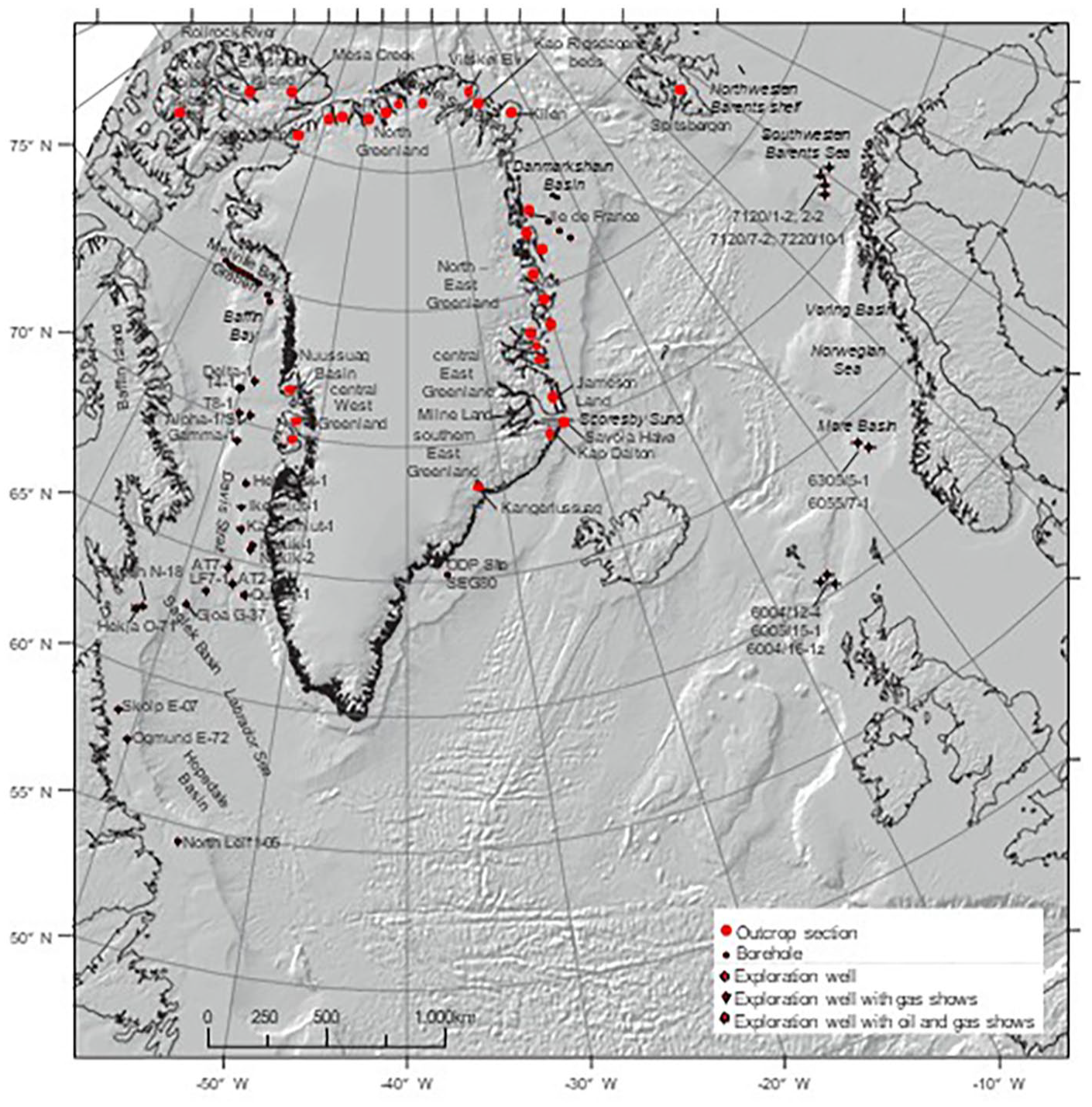
Location map of the sample sites represented by the GEUS Palynology, Nannofossil, and Microfossil Arctic Slide Collection. Modified from Nøhr-Hansen, Piasecki, and Alsen (2020).
Research into microscopic fossils from in and around Greenland hardly existed before 1975. However, oil exploration in the North Sea and the successful application of biostratigraphy based on microscopic fossils in drilled successions raised interest for research. This was reflected in the National Research Foundation grants awards in the 1970s and managed by Professor Tove Birkelund, of the Geological Institute, University of Copenhagen. These research grants were focused on dinoflagellate cyst (dinocyst) stratigraphy in Cretaceous–Tertiary successions of West Greenland and Jurassic successions in East Greenland, both areas expected to be of interest for future hydrocarbon exploration.
It was also in the first half of the 1970s that the head of the Petroleum Geology Department of the Geological Survey of Greenland (GGU) Gilroy Henderson created two new job positions (in micropaleontology and palynology) and organized the appropriate laboratory facilities and technical assistance for the research with the purpose of facilitating the exploration of the offshore West Greenland (1976–1977).
The two research groups and their laboratory facilities were merged at GGU in 1979 when the National Research Foundation grants expired and as the petroleum exploration offshore West Greenland declined, the staff was reduced to a palynologist, a micropaleontologist, and a laboratory technician. However, the focus of the department changed toward research projects in the 1980 to 1990s and up to five palynologists and one micropaleontologist worked on Arctic projects at GGU partly based on research grants. The research focused on large sedimentary basins of Greenland from the Wandel Sea Basin in North Greenland to East and West Greenland.
In 1995 GGU and DGU (Geological Survey of Denmark) merged into a national geological survey, GEUS, along with their paleontologists, technicians, and laboratory facilities, forming the Stratigraphy Department at GEUS. The main focus of the former DGU staff was mainly outside the Arctic region and mostly continued to be so. However, the work in the Arctic continued and expanded over the years to include the Faeroe Islands, and Canadian and Norwegian Arctic regions in cooperation with scientists of those countries.
The political situation in Denmark in 2022 has become less favorable for research associated with hydrocarbon exploration and combined with the retirement of experienced staff, Arctic palynology and micropaleontology scientific research seems likely to decrease in near future.
General Description
The importance of the GEUS Palynology, Nannofossil, and Microfossil Slide Collection is not only based on its comprehensiveness, but also on the numerous scientific works carried out with their data that have been published in international papers and in-house reports.
The collection is fundamental for establishing new species, paleoenvironmental studies, biostratigraphic dating, and detailed biozonations, essential for local and regional stratigraphic correlation schemes.
The 102 scientific articles that have been published based on this collection are cited below, grouped into geographic areas and are listed chronostratigraphically, from the oldest to the youngest. More than 15,600 samples are represented by these 102 articles. The approximate number of samples that form the background for each of the 102 articles is listed in brackets. Articles without an indication of number of samples are based on samples already described in a previously published article. Thirty-five of the publications contain illustrations of specimens with an MGUH or MMH number, and thirteen of these contain descriptions and illustrations of holotypes.
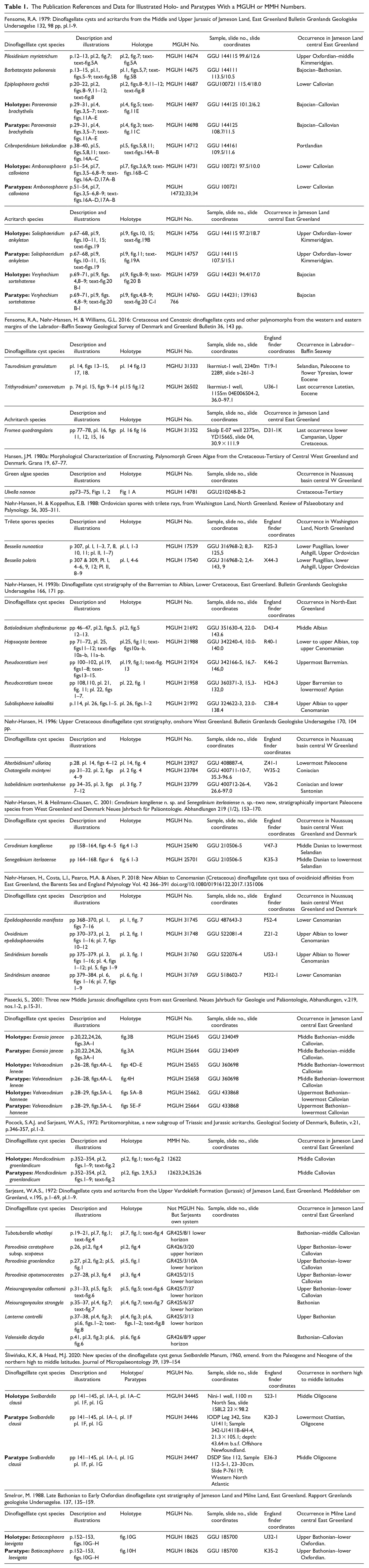
All GEUS’s Arctic slides with MGUH numbers (Museum Geologica Universitas Hafniensis) or MMH (Museum Mineralogica Hafniensis) numbered specimens, including holo- and paratypes, are housed in the type collection of the Geological Museum of the University of Copenhagen, now part of the Natural History Museum of Denmark. The Arctic palynological holo- and paratype collection represents thirty-six dinoflagellate cyst (dinocyst) holotypes and eleven paratypes, four acritarch holotypes and eight paratypes and two spore holotypes. The reference and data for each holo- and paratype is presented in Table 1 and some of these are illustrated on Figures 2 and 3.
The Publication References and Data for Illustrated Holo- and Paratypes With a MGUH or MMH Numbers.
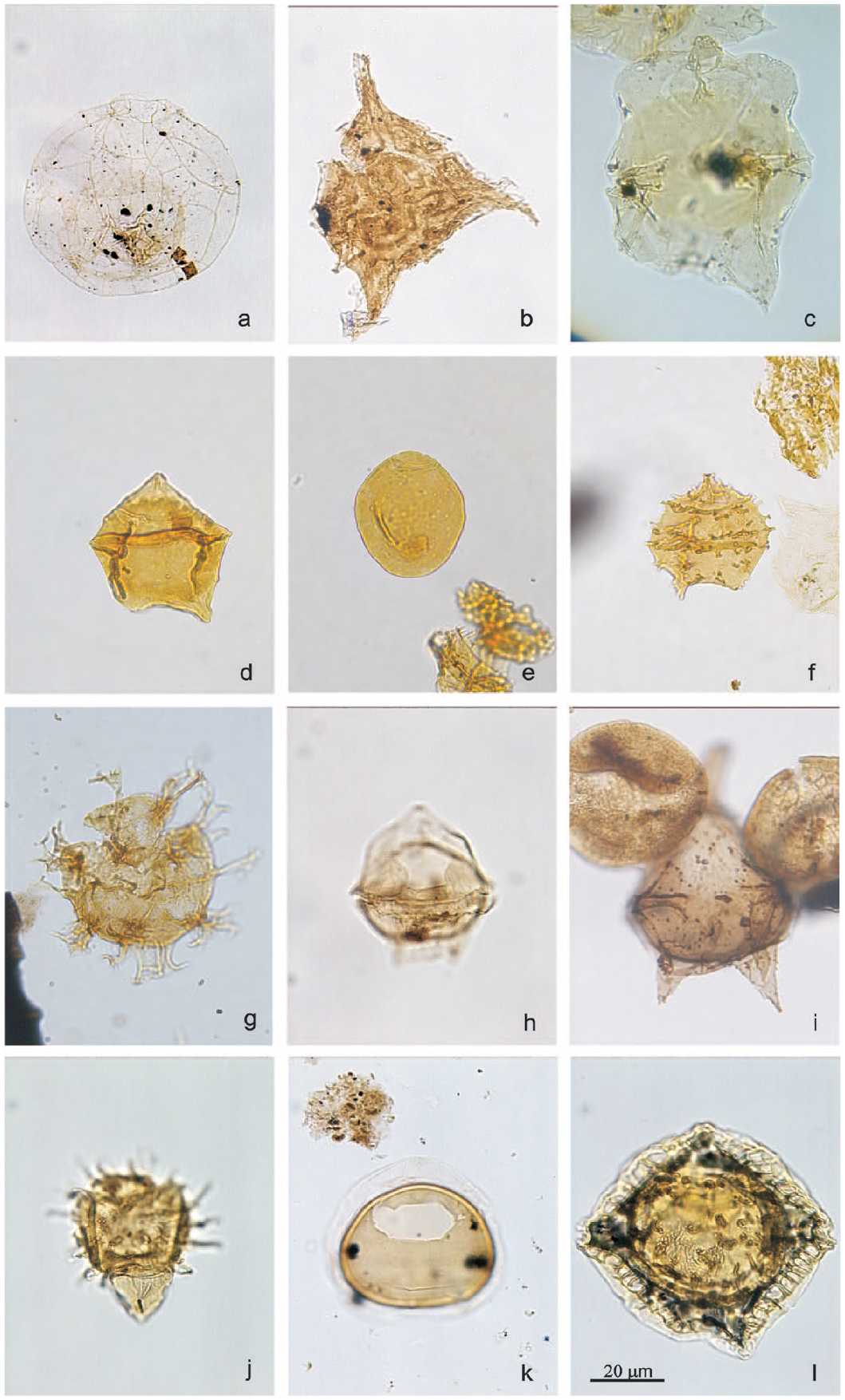
Cretaceous and Paleogene dinoflagellate cysts with a MGUH number: (a) Hapsocysta benteae Holotype, MGUH 21988, GGU sample no. 342240-4, EF R40-1 Nøhr-Hansen (1993b), pp 71–72, pl. 25, fig. 11. (b) Pseudoceratium iveri Holotype, MGUH 21924, GGU sample no. 342166-5, EF K46-2 Nøhr-Hansen (1993b), pp 100–102, pl. 19, fig. 1. (c) Chatangiella mcintyrei Holotype, MGUH 23784, GGU sample no. 400711-10-7, EF W35-2 Nøhr-Hansen (1996), pp 31–32, pl. 2, fig. 4. (d) Ovoidinium epelidosphaeroides Holotype, MGUH 31748, GGU sample no. 522081-4, EF Z21-2, Nøhr-Hansen, Piasecki, and Alsen (2020), pp 370–373, pl. 2, fig. 1. (e) Sindridinium borealis Holotype, MGUH 31760, GGU sample no. 522076-4, EF U53-1, Nøhr-Hansen, Piasecki, and Alsen (2020), pp 375–379. pl. 3, fig. 1. (f) Epelidosphaeridia manifesta Holotype, MGUH 31745, GGU sample no. 487643-3, EF F52-4, Nøhr-Hansen, Piasecki, and Alsen (2020), pp 368–370, pl. 1, fig. 7. (g) Heterosphaeridium difficile, MGUH 32038, GGU sample no. 522848-4, Pedersen et al. (2018). fig. 4 D. (h) Senegalinium iterlaaense Holotype, MGUH 25701, GGU sample no. 210506-5, EF K35-3, Nøhr-Hansen and Heilmann-Clausen (2001), pp 164–168. fig. 6 1–3. (i) Cerodinium kangiliense Holotype, MGUH 25690, GGU sample no. 210506-5, EF V47-3, Nøhr-Hansen and Heilmann-Clausen (2001), pp 164–168, figs 4 1–3. (j) Diphyes ficusoides, MGUH 26507, sample no. Kangâmiut-1, 01C1016-6, Nøhr-Hansen (2003), p 998, pl. 3 fig. 12. (k) Trithyrodinium? conservatum Holotype, MGUH 26502, sample no. Ikermiut-1, 04E006504-2, EF U36-1, Fensome, Nøhr-Hansen and Williams (2016), p 74, pl. 15, fig. 12. (l) Piladinium columna, (former Charlesdowniea columna) MGUH 26518, sample no. Kangâmiut-1, 01C2559-3, Nøhr-Hansen (2003), p 1001, pl. 5, fig. 2.
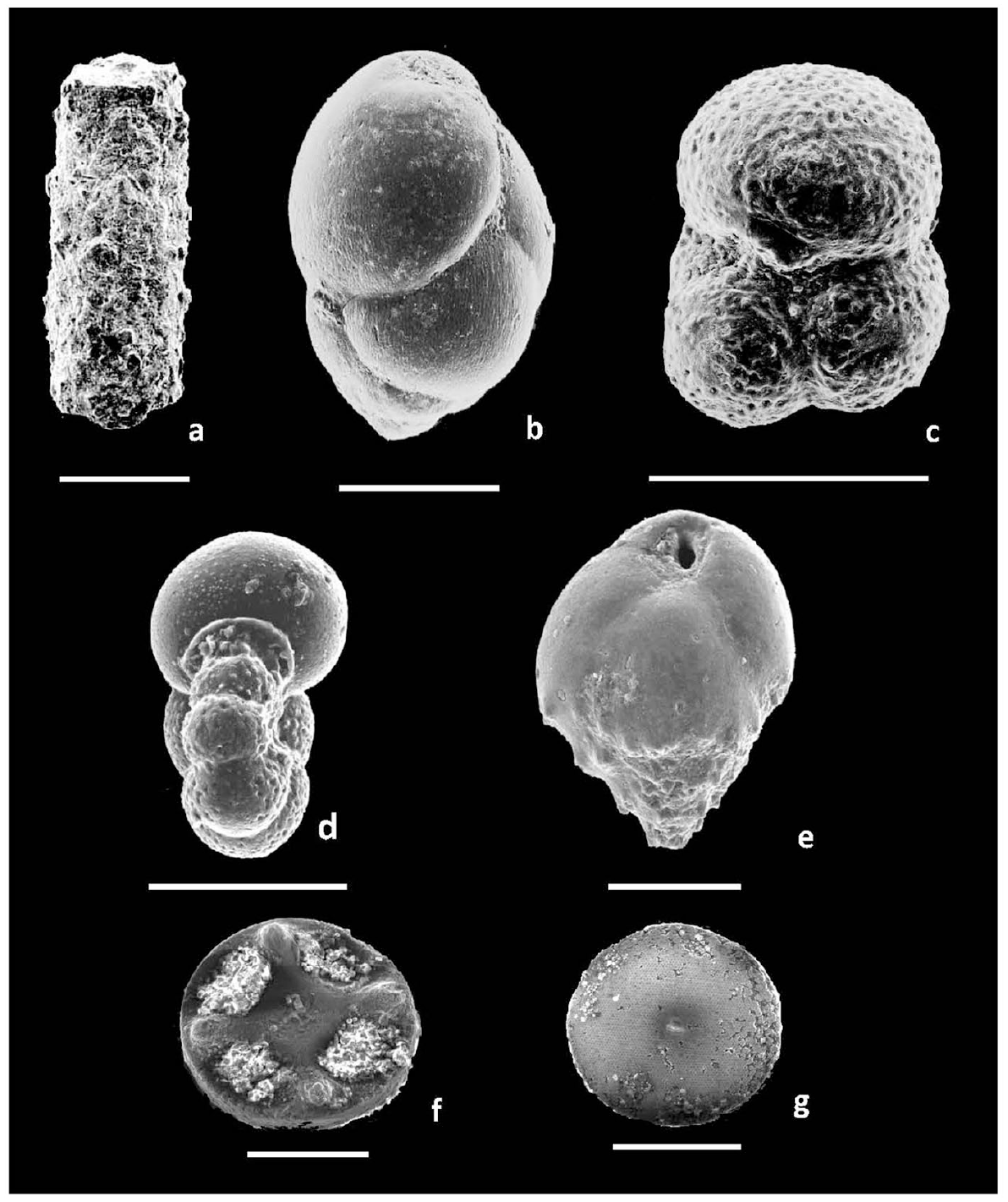
Paleogene microfossils with a MGUH number: (a) Rhabdammina discreta Brady. Agglutinated foraminifera. Bar = 40 mm, sample no. Ikermiut-1, 2474 m, MGUH 26699, Rasmussen and Sheldon (2003), p 2021, pl. 1, fig. 1. (b) Praeglobobulimina ovata (d’Orbigny). Calcareous benthic foraminifera. Bar = 200 mm, sample no. Ikermiut-1, 2549 m. MGUH 26700, Rasmussen and Sheldon (2003), p 2021, pl. 1, fig. 2. (c) Subbotina ex gr. patagonica (Todd and Kniker). Planktonic foraminifera. Bar = 200 mm, sample no. Ikermiut-1, 1800 m, MGUH 26702, Rasmussen and Sheldon (2003), p 2021, pl. 1, fig. 4. (d) Pseudohastigerina wilcoxensis (Cushman and Ponton). Planktonic foraminifera. Bar = 100 mm, sample no. Kangâmiut-1, 2844 m, MGUH 26707m, Rasmussen and Sheldon (2003), p 2023, pl. 2, fig. 1. (e) Bulimina midwayensis (Cushman and Parker). Calcareous benthic foraminifera. Bar = 100 mm, sample no. Ikermiut-1, 2549 m, MGUH 26708, Rasmussen and Sheldon (2003), p 2023, pl. 2, fig. 2. (f) Aulacodiscus hirtus (Barker and Meakin). Diatom. Bar = 100 mm, sample no. Hellefisk-1, 2414 m, MGUH 26704, Rasmussen and Sheldon (2003), p 2021, pl. 1, fig. 6. (g) Thalassiosiropsis wittiana (Pantocsek). Diatom. Bar = 100 mm, sample no. Hellefisk-1, 2420 m, MGUH 26706, Rasmussen and Sheldon (2003), p 2021, pl. 1, fig. 8.
Sample Databases
The GEUS Palynology, Nannofossil, and Microfossil Arctic Slide Collection, without type species and other figured specimens without MGUH numbers are housed at GEUS (The Geological survey of Denmark and Greenland, Øster Voldgade 10, DK-1350 Copenhagen K, Denmark). In addition to the more than 15,000 samples included in the 102 papers listed below the GEUS Artic Slide Collection holds more than 10,000 samples representing unpublished material.
All the samples are registered in an in-house GEUS database, with information on the geological survey registration sample number, lab processing number, slide text, slide numbers, box location number, collector, and processing date. This dataset is complemented by another docket database with all information of the docket labels written in the field. Each sample has a unique six-digit docket number. The docket database contains information on the sample registration number, lithology, lithostratigraphy, section identification, height/depth in section (if available), sampling area, geographical position/coordinates of samples, sampling date, and collector.
Digital Image Database
This is another large in-house database of over 40,000 images of palynomorphs, nannofossils, and microfossils compiled since its creation in 1993. Most of the images represent fossils from the Arctic region.
Distribution Charts
In many of the GEUS Arctic publications, biostratigraphic results are illustrated using distribution and/or event charts produced using the Stratigraphic Information System (SIS) software created by Tor Bjærke (Norwegian independent consulting geologist) in the 1990s and followed by the StrataBugs biostratigraphic data management software, which GEUS still uses (see an example on Figure 4).
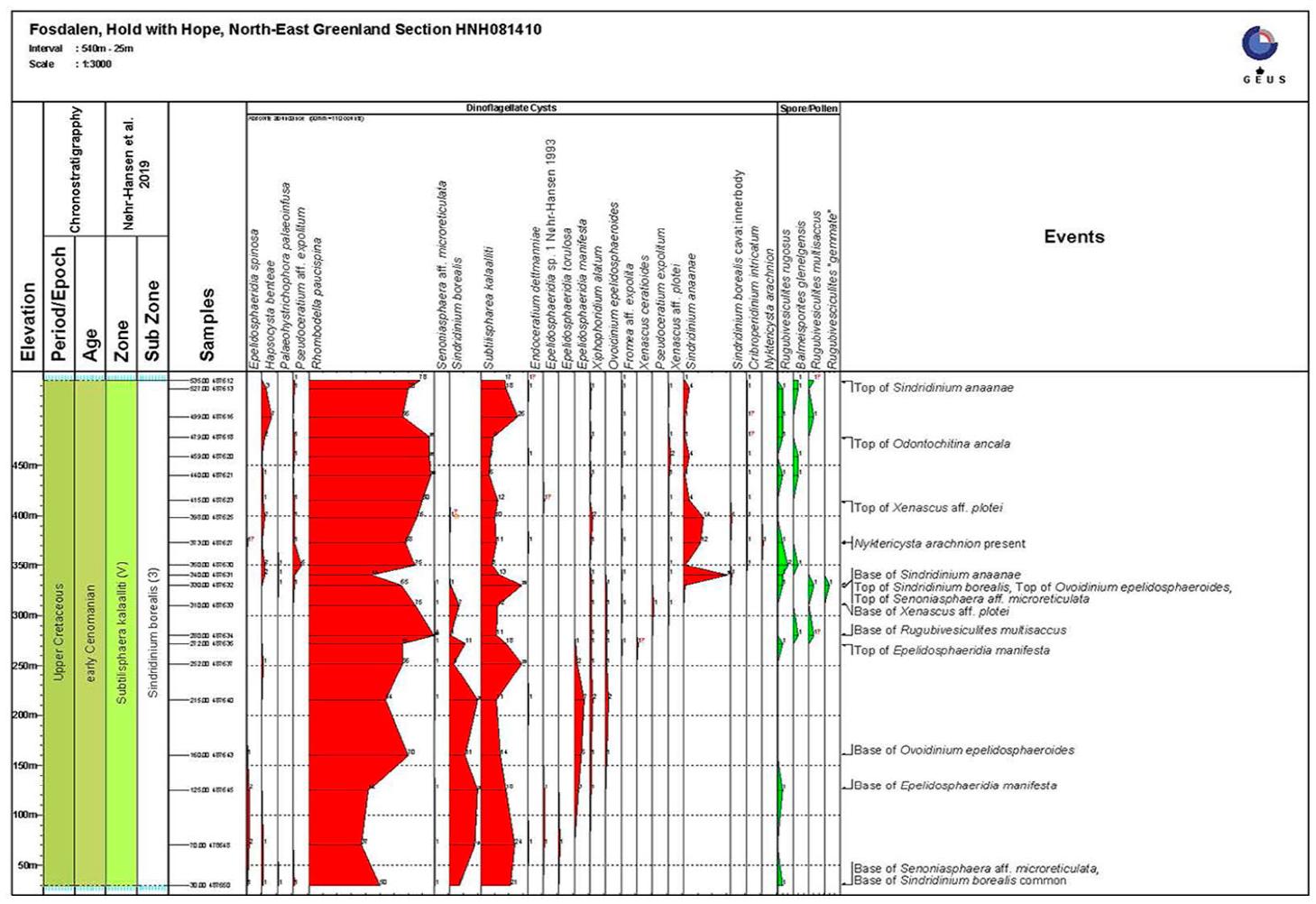
Range chart of selected dinoflagellate cysts from the more than 500-m-thick dark gray mudstone succession east of Fosdalen, Hold with Hope, North-East Greenland (GEUS section, HNH081410-01; 73o52ʹN; 20o43ʹW) modified from Nøhr-Hansen, Piasecki, and Alsen (2020).
Geographic Coverage
The Palynology, Nannofossil, and Microfossil Arctic Slide Collection of GEUS and the Natural History Museum of Denmark represents material described and published in the 102 papers and selected reports listed below, and illustrated on Figures 5 and 6: (* indicates that specimens with MGUH or MMH numbers are illustrated; # indicate when type species with MGUH or MMH numbers are illustrated and described).
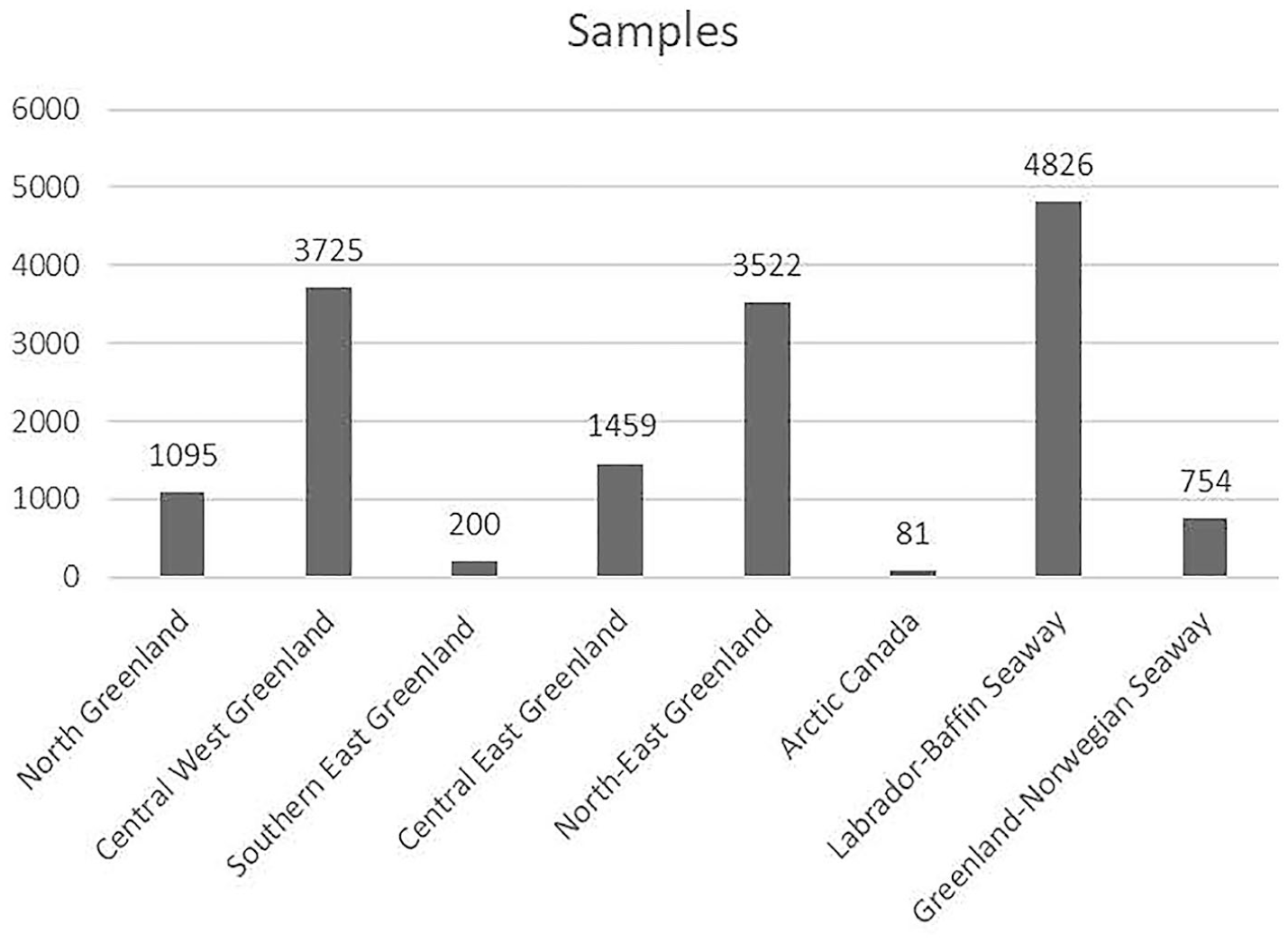
Geographical Distribution of the Numbers of Samples That Form the Background for 102 Listed Articles.
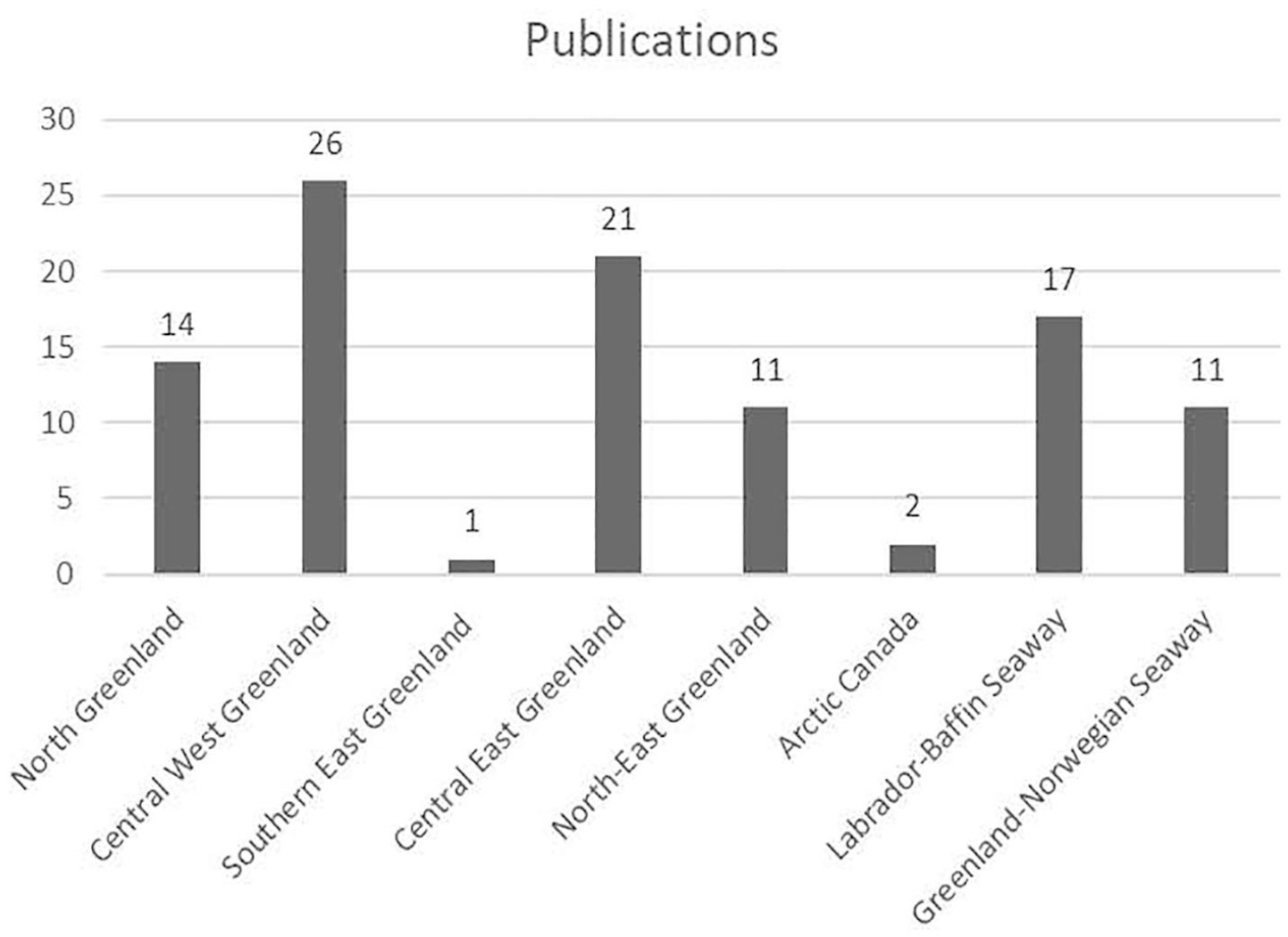
Geographical Distribution of the 102 Listed Articles.
• North Greenland 14 publications 1,095 samples
Nøhr-Hansen (1989) 455 samples. Cambrian (86 samples), Ordovician (92 samples), Silurian (277 samples).
Nøhr-Hansen and Koppelhus (1988)*# lower Pusgillian Stage, early Ashgill, late Ordovician (3 samples).
Grahn and Nøhr-Hansen* (1989) 90 samples. Ordovician (26 samples), Silurian (64 samples).
Dalhoff, Vigran and Stemmerik (2000)* early Carboniferous (11 samples).
Lindström et al. (2020) Smithian–Spathian boundary, late Early Triassic (45 samples).
Bjerager et al. (2019) Triassic (>150) samples).
Håkansson et al. (1981)* Oxfordian –Valanginian (21 samples)
Piasecki, Nøhr-Hansen and Dalhoff (2018) Hauterivian (?) – late Barremian, Early Cretaceous, early – middle Eocene (27 samples).
Ineson et al. (2021) late Barremian – late Aptian (15 samples).
Hovikoski et al. (2018) late Aptian – late Coniacian, Early – Late Cretaceous (250 samples).
Svennevig et al. (2018) late Aptian – late Coniacian, Early – Late Cretaceous.
Pedersen et al. (2018)* early Albian – Coniacian, Early – Late Cretaceous.
Batten (1982)* Campanian or Maastrichtian, Late Cretaceous (4 samples).
Lyck and Stemmerik (2000)* Paleocene (24 samples).
• Central West Greenland 26 publications 3,725 samples
Nøhr-Hansen (2005) Albian (55 samples).
Nøhr-Hansen (2008a) Albian (20 samples).
Koppelhus and Pedersen (1993)* Albian, Early Cretaceous, Cenomanian–Turonian (?), Late Cretaceous (21 samples).
Lanstorp (1999) Albian, Early Cretaceous, Cenomanian, Santonian–Campanian, Late Cretaceous and early Paleocene (39 samples).
Bojesen-Koefoed et al. (2007) Albian, Early Cretaceous, Cenomanian – Late Cretaceous (30 samples).
Pedersen and Nøhr-Hansen (2014) Cretaceous – early Paleocene (>1,000 samples).
Dam et al. (2009) Cretaceous–Paleocene.
Dam et al. (1998)* Cenomanian–Turonian, Late Cretaceous (36 samples).
Nøhr-Hansen (1997) Turonian–Coniacian.
Pedersen, Schovsbo and Nøhr-Hansen (2013) early Coniacian – early Santonian (21 samples).
Nøhr-Hansen (1996)*# Coniacian – late Maastrichtian, Late Cretaceous and Paleocene (250 samples).
Dam et al. (2000) early Campanian (61 samples).
Croxton (1980)* Campanian–Maastrichtian, Late Cretaceous – Paleocene (?) (>1,000 samples).
Kennedy, Nøhr-Hansen, and Dam (1999) late Maastrichtian, Late Cretaceous (5 samples).
Hansen (1980a)*# Cretaceous–Tertiary (300 samples).
Nøhr-Hansen and Dam (1997) Cretaceous/Tertiary boundary (178 samples).
Nøhr-Hansen and Dam (1999)* Cretaceous/Tertiary boundary.
Nøhr-Hansen (1993a)* Late Maastrichtian (?), Late Cretaceous – early Paleocene (27 samples).
Dam and Nøhr-Hansen (2001) late Maastrichtian, Late Cretaceous – early Paleocene.
Hansen (1980b) Paleocene (>300 samples)
Jûrgensen and Mikkelsen (1974)* Danian, early Paleocene (3 samples).
Piasecki et al. (1992)* Paleocene (71 samples).
Nøhr-Hansen and Sheldon (2000) Paleocene.
Sheldon (2000) Paleocene (>50 samples).
Nøhr-Hansen and Heilmann-Clausen (2001)*# Paleocene.
Nøhr-Hansen Sheldon and Dam (2002)* Paleocene (258 samples).
• Southern East Greenland 1 publication 200 samples
Nøhr-Hansen (2012) Cretaceous–Paleocene – earliest Eocene (?) (>200 samples).
• Central East Greenland 21 publications 1,459 samples
Vigran, Stemmerik and Piasecki (1999)* Tournaisian–Westphalian, Devonian–Carboniferous (152 samples).
Piasecki (1984) Permian – early Triassic (>400 samples).
Pedersen and Lund (1980)* Rhaetian, late Triassic – Hettangian, early Jurassic (50 samples).
Clemmensen et al. (2022) middle – late Hettangian, early Jurassic (3 samples).
Koppelhus and Dam (2003) Sinemurian–Aalenian, early – middle Jurassic (230 samples).
Lund and Pedersen (1985)* late Pliensbachian – early Kimmeridgian, early – late Jurassic (38 samples).
Krencker, Lindström and Bodin (2019) Toarcian, early Jurassic (31 samples).
Koppelhus and Hansen (2003) Toarcian–Bajocian, early – middle Jurassic (300 samples).
Larsen, Piasecki and Surlyk (2003) Bajocian–Oxfordian, middle – late Jurassic (25 samples).
Fensome (1979)*#, Bajocian–Portlandian, middle – late Jurassic (26 samples).
Piasecki (2001)*# middle Bathonian – middle Callovian, middle Jurassic (6 samples).
Sarjeant (1972)*# late Bathonian – early Callovian, middle Jurassic (2 samples).
Smelror (1988)*# late Bathonian – early Oxfordian, middle – late Jurassic (40 samples).
Piasecki, Callomon and Stemmerik (2004) Bathonian–Kimmeridgian, middle – late Jurassic (18 samples).
Pocock and Sarjeant (1972)*# middle Callovian, middle Jurassic (1 sample).
Piasecki et al. (2004) Callovian–Oxfordian, middle – late Jurassic (36 samples).
Piasecki and Stemmerik (2004) Callovian–Kimmeridgian, middle – late Jurassic (11 samples).
Alsen and Piasecki (2018) Oxfordian–Volgian, late Jurrassic (58 samples).
Piasecki (1979) Hauterivian, Early Cretaceous (11 samples).
Nøhr-Hansen and Piasecki (2002)* Paleocene (13 samples).
Heilmann-Clausen et al. (2008) Ypresian–Lutetian, early – middle Eocene (8 samples).
• North-East Greenland 11 publications 3,522 samples
Stemmerik et al. (1993) Carboniferous–Cretaceous (>1,000 samples).
Andrews et al. (2021) Permian– Cretaceous (50 samples)
Nøhr-Hansen, Piasecki and Alsen (2019) late Tithonian – early Maastrichtian, Early – Late Cretaceous (>1,000 samples).
Bjerager et al. (2020) late Tithonian – early Maastrichtian, Early – Late Cretaceous (>1,000 samples).
Piasecki, Bojesen-Koefoed and Alsen (2020)* early Valanginian – Hauterivian, Early Cretaceous (63 samples).
Nøhr-Hansen (1993b)*# Barremian–Albian, Early Cretaceous (192 samples).
Nøhr-Hansen (1994)* Barremian–Albian, Early Cretaceous.
Nøhr-Hansen et al. (2018)*# Albian–Cenomanian, Early – Late Cretaceous (50 samples).
Hovikoski et al. (2020) late Cenomanian – early Campanian, Early – Late Cretaceous (48 samples).
Nøhr-Hansen et al. (2011) Danian–Thanetian/Ypresian(?), Palaeogene (69 samples).
Hovikoski et al. (2021) Paleocene–Eocene (50 samples).
In addition to the material from Greenland, Cretaceous material has been described from:
• Arctic Canada 2 publications 81 samples
Nøhr-Hansen and McIntyre (1998) Barremian–Albian, Early Cretaceous (33 samples).
Lenniger et al. (2014) Cenomanian–Coniacian, Late Cretaceous (48 samples).
• Offshore exploration wells and scientific boreholes from the Labrador–Baffin Seaway, northeast Baffin Bay and the Arctic Ocean 17 publications 4,826 samples
Nøhr-Hansen (2004b) Aptian, Cretaceous – Priabonian, late Eocene (104 samples).
Sønderholm et al. (2003) Albian, Early Cretaceous – Priabonian, late Eocene.
Nøhr-Hansen et al. (2021) Neoproterozoic (19 samples); Albian–Turonian, Early – Late Cretaceous (143 samples).
Dalhoff et al. (2006) middle – late Jurassic; Early Cretaceous; Danian–Selandian, early Paleocene (242 samples).
Fensome Nøhr-Hansen and Williams (2016)*# Aptian, Early Cretaceous – Pleistocene, Quaternary.
Nøhr-Hansen, Williams, and Fensome (2016) Aptian, Early Cretaceous – Pleistocene, Quaternary (>800 samples).
Gregersen et al. (2017) Cenomanian–Paleocene (178 samples)
Toxwenius (1986) Late Cretaceous – Tertiary (2,114 samples).
Sheldon (2003b) Danian–Selandian (?), Paleocene.
Nøhr-Hansen (2003)* Danian, early Paleocene – Priabonian, late Eocene (355 samples).
Rasmussen and Sheldon, (2003)* Danian, early Paleocene – Priabonian, late Eocene (714 samples).
Rasmussen, Nøhr-Hansen and Sheldon (2003) Danian, early Paleocene – Priabonian, late Eocene.
Sheldon (2003a) Early – middle Eocene (69 samples).
Dalhoff et al. (2003) Danian, early Paleocene – Priabonian, late Eocene.
Nørgaard-Pedersen et al. (2007) Pleistocene, Quaternary.
Nøhr-Hansen (2004a) Selandian, Paleocene – Priabonian, late Eocene (81 samples).
Piasecki (2003) Neogene (26 samples).
• Greenland Sea, Norwegian Sea, Barents Sea and Spitsbergen 11 publications 754 samples
Marín et al. (2021) Middle Jurassic – Early Cretaceous (10 samples).
Marin et al. (2017) latest Ryazanian (?)/ Valanginian – Cenomanian, Early – Late Cretaceous (27 samples).
Śliwińska et al. (2020) Valanginian–Aptian, Early Cretaceous (123 samples).
Grundvåg et al. (2017) late Valanginian – middle Albian, Early Cretaceous (101 samples).
Grundvåg et al. (2019) late Valanginian – early Aptian, Early Cretaceous (38 samples).
Kairanova et al. (2018) Hauterivian–Cenomanian (?), Early – Late Cretaceous (5 samples).
Marín et al. (2018) early Barremian – late Albian (?), Early Cretaceous (31 samples).
Nøhr-Hansen et al. (2018)*# Albian–Cenomanian, Early – Late Cretaceous (50 samples). The paper also contains 50 samples from North-East Greenland as listed above.
Fyhn et al. (2021) Albian, Early Cretaceous – Eocene (68 samples)
Nøhr-Hansen (2008b) Maastrichtian–Eocene (299 samples)
Śliwińska and Head (2020)*# middle Oligocene (2 samples).
Footnotes
Acknowledgements
The present work is based on fieldwork and sample collections by the authors and several of our GGU/GEUS colleagues during field seasons in southern East, central East, North-East, North and central West Greenland (Morten Bjerager, Jørgen Bojesen-Koefoed, Flemming Getreuer Christiansen, Gregers Dam, Michael B.W. Fyhn, Jussi Hovikoski, Jon Ineson, Lotte Melchior Larsen, Lars Henrik Nielsen, Gunver Krarup Pedersen, Jan A. Rasmussen, Lars Stemmerik, Martin Sønderholm, Henrik Vosgerau) also Michael Larsen (INEOS Oil & Gas Denmark) Asger Ken Pedersen (Natural History Museum of Denmark) and colleagues from the Geological Survey of Canada (GSC) who are thanked. We also want to thank specially Yvonne Desezar, Lasse Gudmundsson, Birthe Amdrup, Johnny Hansen, Dorthe Samuelsen and Kim Villadsen, for processing and preparing high quality palynological, nannofossil and microfossil slides of numerous samples and to Jette Halskov and Stefan Sølberg who produced fine artwork. We also want to thank Dr. Juilee Decker Editor, of the peer-reviewed journal Collections and the guest editor team Dr. Consuelo Sendino and Dr. Svetlana Nikolaeva, for their very valuable comments and suggestions.
Declaration of Conflicting Interests
The author(s) declared no potential conflicts of interest with respect to the research, authorship, and/or publication of this article.
Funding
The author(s) received no financial support for the research, authorship, and/or publication of this article.
