







Abstract
This conference review offers an overview of the two-day event titled “Hazardous Heritage: Working With and Around Dangerous Materials in Cultural Heritage,” which took place in Antwerp in October 2023. The report outlines the format and objectives of the conference, providing insight into the various sessions, presentations, and discussions that occurred. It highlights the keynote speeches delivered by experts in the field and covers the two field trips that took place.
The Hazardous Heritage Conference took place at the University of Antwerp (Figure 1) in Belgium on October 23rd and 24th, 2023. It was a hybrid conference, welcoming eighty-six participants in Antwerp and another forty-nine online. The conference brought together heritage professionals who are active in academia and/or heritage institutions and museums. It was enabled by the University of Antwerp, the Faculty of Design Sciences of UAntwerp, Antwerp Cultural Heritage Sciences (ARCHES), the University of Helsinki—Faculty of Arts: Department of Cultures, the Finnish Institute of Occupational Health (FIOH), the University of Ghent—Inter-university Institute for Public History (IPG), the Flemish Center for Industrial Heritage (ETWIE), and the government of Flanders. The organization of the conference was also co-funded by a grant from the Research Foundation—Flanders (FWO).
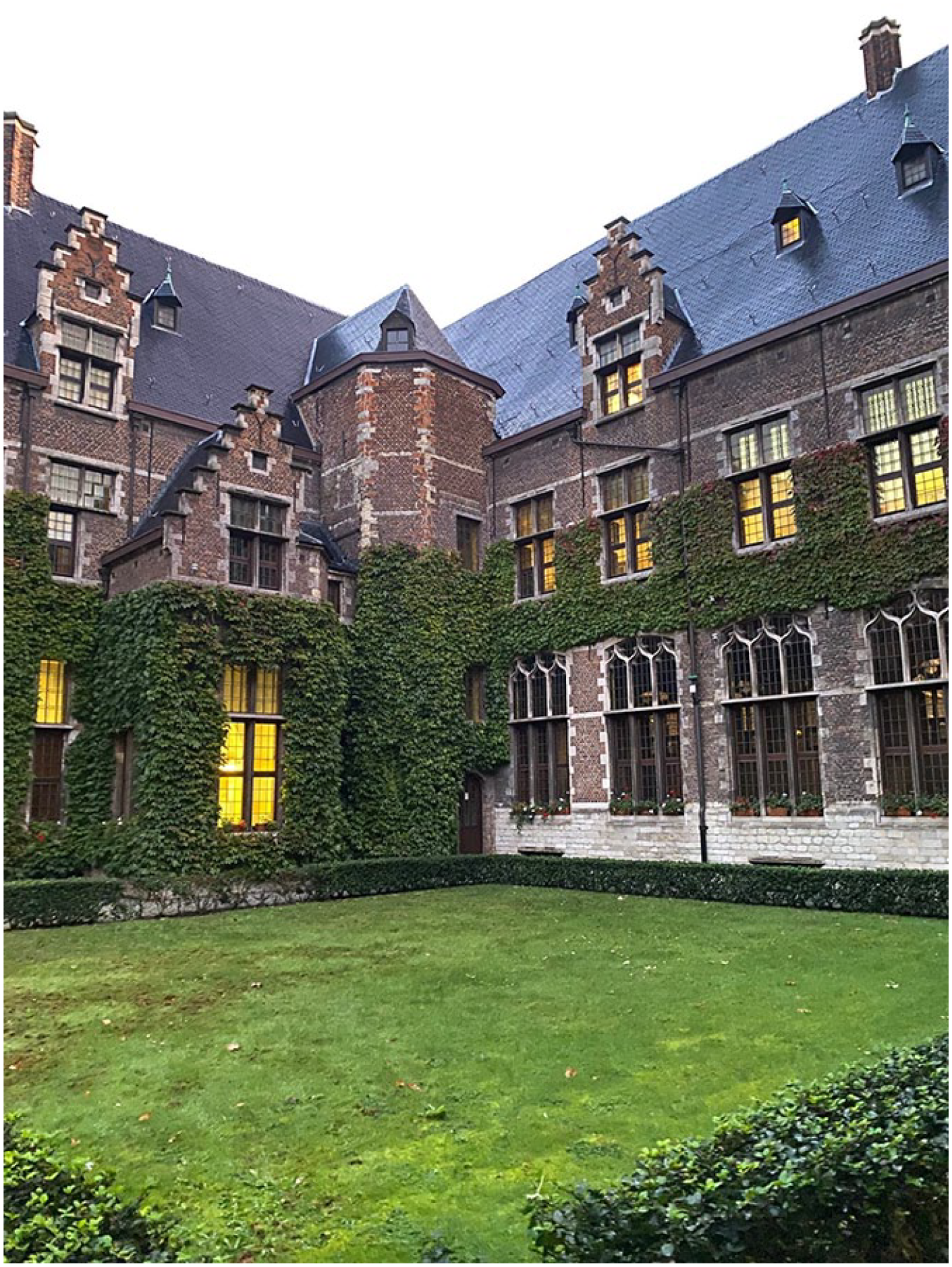
University of Antwerp building. Image by Liisa Katariina Ruuska-Jauhijärvi.
A Scientific Committee, responsible for reviewing submitted abstracts and posters, was comprised of an interdisciplinary team with notable representation from different academic sectors: Suzie Thomas, Hélène Verreyke, Doris Blancquaert, and Koen Janssens from the University of Antwerp, Koen Aerts from the University of Ghent, Jevgeni Parshintsev and Henna Sinisalo from the Finnish Institute of Occupational Health and the University of Helsinki, Rick Bonnie from the University of Helsinki, Helene Tello an independent conservator with a past affiliation at the Ethnological Museum Berlin, and Catharine Hawks from the Smithsonian Institution.
The aim of the conference was to identify and share the state of the art in current theory and practice around hazardous materials, such as mercury, asbestos, arsenic, lead, pesticides, and radioactive materials. These materials were frequently used in heritage (objects, sites, and buildings) in the past, both as applications inherent to the heritage (e.g., fireproof asbestos textile) or during restoration and conservation treatments (e.g., pesticides to treat wood against insects). Awareness of the presence of these substances in heritage objects and collections is increasing, which challenges today’s museum and heritage professionals. On the one hand, there is a need to develop measures to be taken to ensure safe storage, handling, and display of the objects. In this way, not only museum staff are protected, but also the wider public. On the other hand, there is a lack of research on the heritage values of heritage objects that are contaminated with hazardous substances. There is a need for a theoretical framework to answer the question of whether it is appropriate to remove harmful materials, as they are also part of the heritage itself, its history, and its significance. By combining these two areas of research—focusing on technical aspects, ethical issues, management, and heritage values—thoughtful conservation and (future) preservation are ensured.
Presentations and posters on the subjects were given at the conference: (1) the identification of harmful substances in cultural heritage; (2) prevention of exposure and safety regulations in the heritage sector; (3) conservation ethics related to hazardous heritage; (4) theoretical questions related to the heritage value and significance of hazardous heritage; (5) community histories behind the past use of hazardous materials, multi-voiced heritage practices, and participatory heritage evaluation; and (6) interdisciplinary approaches to working with hazardous materials in cultural heritage. The presentation program was organized around three primary themes: “Heritage and Health Hazards,” “Hazardous Heritage as Difficult Heritage,” and “Techniques for the Detection, Elimination, and Remediation of Material Hazards.” Distinguished keynotes were delivered by Helene Tello and Arthur McIvor. The conference program was further complemented by a poster session and two field trips. All presentations were given in English.
The conference featured a multidisciplinary mix of professionals—from researchers and curators to material scientists and conservators—representing cultural heritage institutions, academia, and the private sector. The atmosphere was characterized by openness and positivity, and there was a stimulating environment for open discussion and the exchange of diverse perspectives and opinions. Participants shared information regarding their research and experiences of working with cultural heritage collections that are (potentially) harmful due to the presence of toxic substances. The presentations provided valuable information and ideas for further development in research and protocols dealing with hazards. It was widely acknowledged that these hazards challenge heritage institutions and that there is a need for more research, extensive dialogue, and information-sharing among cultural heritage professionals to handle toxic substances more appropriately. The Hazardous Heritage Conference provided the opportunity, and confirmed the need, for international cooperation on these issues.
Day 1
Session 1: Heritage and Health Hazards
The first day of the conference started with the session “Heritage and Health Hazards,” chaired by Rick Bonnie. This session featured presentations addressing the presence of hazardous substances, with a focus on risk management strategies, and the health and safety of staff and visitors.
During the presentation, Dangerous fashion. On health risks as collection caretakers handling the fashion collection of MoMu Kim Verkens and Pieter Pauwels (MoMu Antwerp, Belgium) discussed the history of toxic colorants used in textiles, identifying hazardous substances discovered in the collections at MoMu (Fashion Museum Antwerp), and outlining the risk management strategies employed. Verkens elaborated on how arsenic testing kits are utilized to detect arsenic-laden pigments and explained that plastics represent a more contemporary material that presents distinct health hazards.
Marleena Vihakara (The National Library of Finland) delivered a case study during her presentation Hazardous Bookbindings - Chemical Health Hazards in the National Library of Finland, detailing how toxic heavy metals such as arsenic, mercury, and lead were detected in colored bookbinding covers, end decorations, and marbled end leaves from the Library’s Special Collections, dating from the sixteenth to the nineteenth century.
In Museum Professionals’ Perceptions of Chemical and Biological Hazards and Risks in Museum Work Environments in Finland, Henna Sinisalo (Finnish Institute of Occupational Health and University of Helsinki, Finland) shared the results of qualitative analyses from two surveys conducted as part of the “Perceived and Measured Hazards in Finnish Museum Work Environments” (MUHA) project, which ran in Finland from 2021 to 2023. The findings illuminated the perceived challenges to occupational safety and highlighted resource deficiencies. Moreover, they emphasized the pivotal role of management support in enhancing occupational safety measures.
In his presentation, Everyone an Asbestos Expert!, Joeri Januarius (Flemish Center for Industrial Heritage, Belgium) discussed the various aspects of asbestos as understood from the perspective of heritage conservation—its hazards, methods of identification, and the appropriate remediation actions. He also addressed the issue of the asbestos legacy in Belgium and the objective set by the Flemish government for Flanders to be an asbestos-safe region by the year 2040. Additionally, he advocated for international collaboration to compile information on asbestos found at heritage sites into a shared and accessible database.
The presentation by Lora Angelova, Marc Vermeulen, Juergen Vervoorst (The National Archives, UK), Sadat Nawaz (FERA Science Ltd, UK), Barbara Kafadaroğlu (ALAB GmbH, Germany), Boaz Paz (Paz Laboratorien GmbH, Germany), Francisco Moreta, and Helen Woollaston (Synergy Environmental Solutions Limited, UK), The Use of ‘Poisonous Insecticidal Solutions’ in Bookbindings: Coping with Historic Pesticide Treatments in the Archive, focused on research uncovering the employment of mercury chloride (HgCl2) and DDT as pesticides in the collections of the National Archives, UK, from the 1880s to the 1960s. The study also detailed a variety of safety protocols implemented to reduce the health risks posed to employees and users of the archive.
Emily Akkermans (Royal Museums Greenwich, UK), representing the Royal Observatory of Greenwich, gave a presentation on the museum’s hazardous artifacts, focusing particularly on clocks containing mercury, and discussed the risks they pose to both staff and visitors in her talk titled Heavy metal – mercury pendulums ‘rocking’ in heritage displays. Akkermans focused especially on practices for handling and displaying mercury in a public space and the issues surrounding the operation of these objects.
Keynote Session: Helene Tello
Helene Tello’s keynote session, Journey into a toxic past: Pest control in museums at the end of the 19th and the beginning of the 20th century, was chaired by Henna Sinisalo. The presentation focused on the historical research that Helene Tello conducted regarding the use of pesticides in European museums. Her study discussed several chemical compounds used for pest control of collections across Europe at the turn of the nineteenth and twentieth centuries, and how networking among museum professionals in different countries spread new fumigation technologies. Tello emphasized the importance of having the knowledge of past preservation and conservation treatments to comprehend the potential chemical hazards present within current cultural heritage collections. This research has recently been published as a book titled The Toxic Museum, Berlin and Beyond (New York: Routledge, 2023).
Posters
During the poster session, a diverse array of research topics was explored through seven presentations. The posters addressed various hazardous substances, the different historical artefacts and museum collections in which they occur, and treatment and detection methodologies. The following subjects were covered:
Kristina Valiulis and Roos Boons (DIVA, Belgium) presented three case studies on the identification and testing of hazardous materials in the collection of DIVA, museum for diamonds, jewelry, and silver (Antwerp). The first case study focused on testing the mercury emissions from a mercury mirror, the second examined asbestos inventory within the collections, and the third explored identification and decision-making regarding fluid collections.
S. Breiding, P. Eckhoff, J. Mehlhorn, C. Quaisser, and S. Frahnert (Leibniz Institute for Evolution and Biodiversity Science, Germany) and E. Spiegel (Care For Art, Germany) submitted a poster on the effectiveness of cleaning scientific bird mounts at the Museum für Naturkunde Berlin regarding the biocides contained. This case study elaborated on how dust-covered, pest control agent-treated birds were cleaned using an air pressure blower, followed by wiping with ethanol in a fume hood.
Rosie Grayburn (Winterthur Museum and University of Delaware, USA) and Melissa Tedone (University of Delaware, USA) presented the Poison Book Project, which is an ongoing investigation of arsenic and other heavy metals in nineteenth-century Euro-American book bindings. They also gave more information on the Bibliotoxicology Working Group and welcomed anyone interested to join (this can be done by contacting
Stefanie Bauvois, Romy Ruigrok, and Sanne Wynants (We Conserve, Belgium) submitted a poster on safeguarding asbestos in heritage by means of consolidation and preventive care. The poster elaborated on strategies for asbestos fiber containment and stabilization: procedures for isolation, handling, packaging, and testing methods to secure loose asbestos fibers in museum objects containing asbestos during a collection relocation.
Elise Spiegel (Care For Art, Germany), Katharina Deering and Stefan Rakete (Institute and Clinic for Occupational, Social, and Environmental Medicine, Germany), Carolin Wübbe (Ascora GmbH, Germany), and Christan Grunwaldt (Kommunale Unfallversicherung Bayern, Germany) presented the MUSA project: an innovative and practical database tool, that has been developed to monitor collection items as well as buildings containing hazardous substances. The database is accessible at https://musa-projekt.de/?page_id=1620&lang=en#project.
Jacqueline Riddle and Skye Marshall from Ingenium (Canada) elaborated on the identification of asbestos in the museum collection using the Collections Risk Management Program. Further information was given on legislation, identification, and treatment of asbestos-containing objects.
Saskia Van de Voorde and Zoë-Joy Vangansewinkel presented a poster on the collection of the War Heritage Institute (Belgium). Through various objects such as a fire-resistant suit, bandage kits, and taxidermized animals, they illustrated the different sorts of hazardous substances that can occur in museum objects.
Excursions
At the end of the first day, participants had the opportunity to join an excursion. Two options were available: a guided tour of the floating crane at Droogdokken site, or a visit to the conservation studios of MoMu (Fashion Museum Antwerp).
The Droogdokken site (Figure 2), which is part of the MAS (Museum aan de Stroom), houses Belgium’s most extensive historic vessel collection and the largest museum collection of harbor cranes in the world. During a guided tour, the participants were given access to one of the historic cranes. The museum staff gave a guided tour and provided more information on maintenance challenges and hazardous materials in the site’s historic buildings and industrial heritage. The walk through the charming neighborhood “het Eilandje,” which is the old harbor quarter of Antwerp, and the nice weather provided the perfect setting for this excursion.
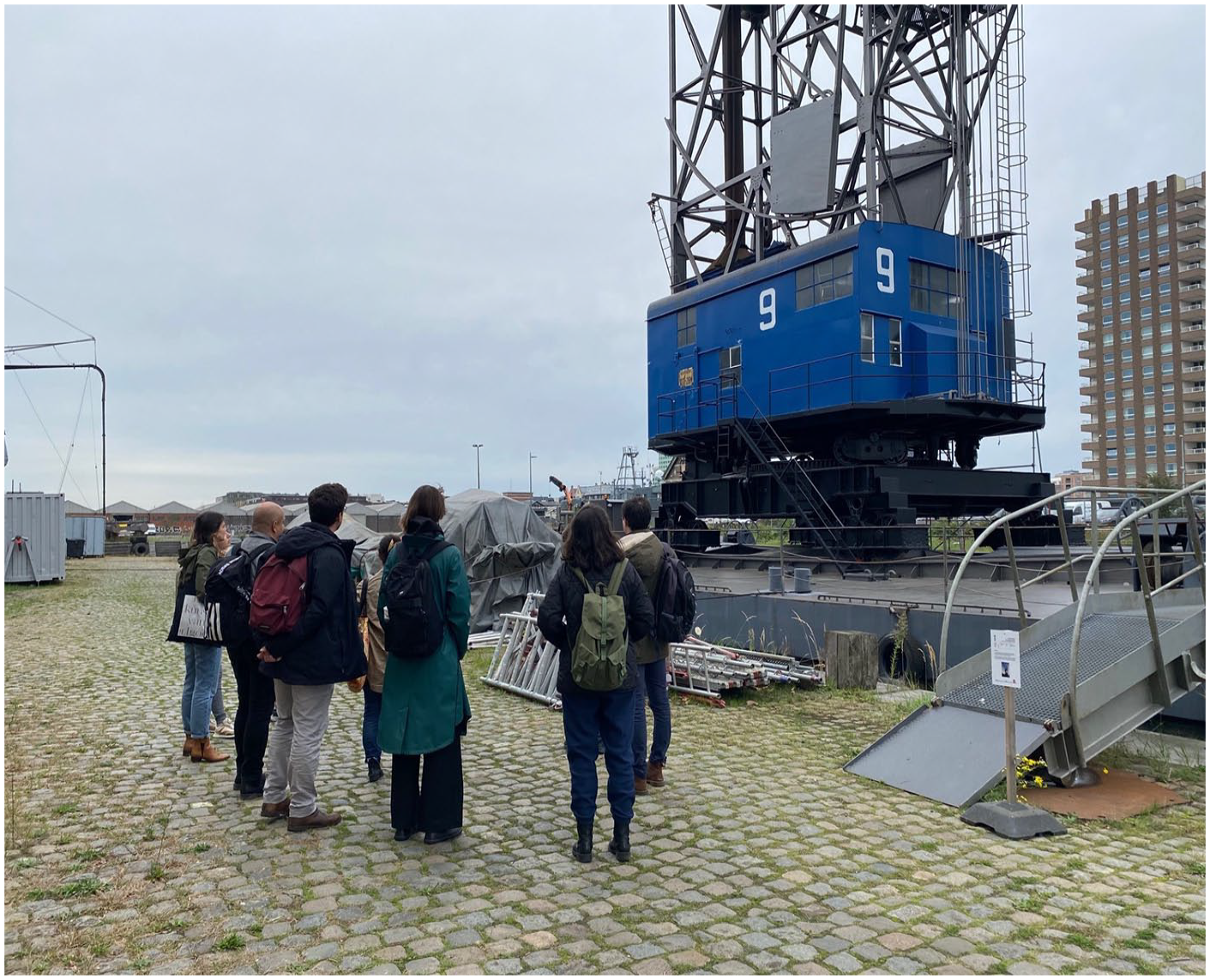
Conference excursion to the Droogdokken site in Antwerp. Image by Liisa Katariina Ruuska-Jauhijärvi.
Katariina and Marleena thank the Hazardous Heritage and Antwerp for a great conference! Image by Liisa Katariina Ruuska-Jauhijärvi.
The MoMu tour, led by textile conservator Kim Verkens, encompassed the museum’s conservation laboratories, storage areas, photo studio, and research library. Verkens explained the museum’s protocols for conserving, handling, and storing hazardous materials and demonstrated the arsenic detection kit used on objects. The visitors were also shown the deterioration damage of plastic fabrics that cannot be repaired, and they discussed the problems associated with preserving objects made of or consisting of plastics. Besides this tour, participants also had the opportunity to visit the permanent exhibition of the museum.
Day 2
Session 2: Hazardous Heritage as Difficult Heritage
The first session of this day, “Hazardous Heritage as Difficult Heritage” was chaired by Hélène Verreyke and included four expert presentations that approached the topic from various perspectives, ranging from collections and objects to buildings and the built environment in a broader context.
Doris Blancquaert’s (University of Antwerp, Belgium) presentation titled Asbestos as Difficult Heritage: The Need for a Multi-Voiced Heritage Policy focused on the relationship between the heritage values of an object and asbestos. She theorizes asbestos as difficult heritage because it is associated with a troubling or unwanted past, evoking deep emotions, particularly for people who are affected by asbestos-related diseases. By presenting a case study, she elaborated on how, and why, this heritage should be evaluated in a multi-voiced way.
The presentation Toxic Agents and Their Agency: An Exploration of Open-Air Museums and Their Contaminated Vernacular Buildings by Anne-Sofie Hjemdahl (Telemarksforsking, Norway) and Terje Planke (Norsk Folkemuseum, Norway) was about the chemical conservation practices that took place in Norwegian open-air museums between 1890 and 1990. Inspired by actor-network theory (ANT), they talked about the agency that toxins have, illustrating how they affect, challenge, and change the network of relations between, amongst others, open-air museums and their staff, the heritage bureaucracy, the materiality of the buildings, heritage values, and craftsmanship.
Liisa Katariina Ruuska-Jauhijärvi (Helsinki City Museum, Finland) gave a presentation titled Disappearing facades – The challenges behind asbestos-containing façade materials heritage value and significance. She gave an overview on the history of asbestos-containing façade materials and illustrated the challenges of this heritage, since they cannot be repaired or restored. A thematic inventory was presented to assess the cultural-historical significance of asbestos-containing façade materials. Ruuska-Jauhijärvi also argued during her presentation that the long history of asbestos-containing façade materials is part of the built environment and should be recognized as a part of the Finnish built heritage.
The presentation Danger and Poison as Two-Sided Coins: Indigenous Stakeholders from Amazonia Confronting Dangerous Materials in Museum Collection by Andrea Scholz (Ethnological Museum Berlin, Germany) focused on indigenous collections. Ethnological museums are increasingly developing into open places of exchange where descendants of creator communities interact with “their” cultural belongings. These visits are not about “seeing objects” but about interacting with beings that are assigned a life of their own. Scholz focused her presentation on the relationship between hazardous substances and indigenous cultural belongings, advocating for a more holistic view of life in the collections and thinking beyond disciplinary and cultural borders.
Keynote Session: Arthur McIvor
The keynote session of the second day was chaired by Doris Blancquaert and featured Arthur McIvor, a professor of Social History at the University of Strathclyde in Glasgow, Scotland, and the director of the Scottish Oral History Centre. Professor McIvor’s presentation, Oral History as Heritage: Asbestos and Community Activism, tackled the challenges of recording and preserving the oral histories of communities impacted by asbestos. His talk drew upon his interview-based research on asbestos in Scotland and the asbestos archive at the University of Strathclyde in Glasgow. McIvor argued that by preserving the voices and memories of people who have been exposed to toxic and cancer-causing materials at their workplace, at home, or in the wider environment, it is possible to critically reflect on the roles of key players in the so-called “toxic legacy” disaster. According to McIvor, the research helps us better understand the experiences and sentiments of those directly affected by asbestos. Sharing this research and making interviews and archival materials publicly accessible also aids environmental justice campaigning. The presentation was very engaging, and the fragments from the interviews read by McIvor deeply moved the audience.
Session 3: Methods for Detection, Removal, and Treatment of Material Hazards
The third session of the day, on the topic “Methods for detection, removal, and treatment of material hazards,” was chaired by Suzie Thomas and included six expert presentations on various hazardous substances and methods to detect, remove, and treat them.
The session started with the presentation Advanced (multi-)methods for safe handling of biocide contaminated objects: Development of the analytical methods and MUSA System by K. Deering and S. Rakete (Institute and Clinic for Occupational, Social, and Environmental Medicine, Germany), E. Spiegel (Care for Art, Germany), C. Wübbe (Ascora GmbH, Germany), and C. Grunwaldt (Bavarian Municipal Accident Insurance, Germany). In this presentation, the MUSA project was presented as a tool for occupational safety and designed to analyze hazardous substances in heritage collections and built heritage. The toolkit was designed because there is currently no simple and cost-effective method for analyzing toxic substances. A special feature of the tool is that it can be used independently, as no laboratory knowledge is required.
Larry Carr (Larry Carr H&S for Museums, UK) and Alison Noble (National Museums Northern Ireland, UK) gave a presentation titled The assessment of objects for hazards via a collections management system workflow – an integrated approach. They demonstrated how National Museums Northern Ireland transferred collections information to a workflow-driven collections management system in order to develop an integrated approach to utilizing data about hazardous objects in its collection. This workflow helps the institution broaden proactive assessment of objects for hazards, manage the risks associated with hazardous objects, and enhance the quality and accessibility of data.
In Addressing the Presence of Arsenical Bindings in the British Library’s Collection Amy Baldwin and Nicole Monjeau (British Library, UK) addressed the presence of copper acetoarsenite in nineteenth century book materials. The presenters illustrated the challenges of identifying materials that contain heavy metals within a collection of over one hundred million items stored in multiple locations. This included an explanation of methods for identifying arsenic-containing book materials and health and safety procedures specific to these materials developed for librarians and for the public.
The presentation The Decontamination of Art and Cultural Assets using the Temperature and Humidity Controlled ICM Method by Boaz Paz and Sonja Behrendt (Paz Laboratorien GmbH, Germany) introduced the Integrated Contamination Management Method (ICM). This method is used to reduce biocide contamination (insecticidal and fungicidal preservatives) in museum collections items by applying a humidity- and temperature-controlled treatment.
Kerith Koss Schrager (National September 11 Memorial & Museum, US), Nancie Ravenel, and Anna Fowler (Shelburn Museum, US) gave a presentation titled All Bottled Up: Hazard Assessment of a Historic Pharmaceutical Collection. Historical pharmaceutical products may contain a variety of chemicals that have adverse effects on human health. The results of a comprehensive collection survey were presented, including an elaboration of the diversity of the objects and a hazard assessment. This study also aimed to define worker exposure during inventory, identify collection maintenance priorities, and create resources to help other museums manage similar collections.
The last presentation, titled The Collection Risk Management Program at Ingenium – Canada’s Museums of Science and Innovation was given by Erin Secord (Ingenium, Canada). Secord described the museum’s collection move, which took place from 2019 to 2023. During this relocation, the entire collection was screened using the Collection Risk Management Program (CRMP) and more than 9,000 hazardous artifacts were found. The use of the CRMP was illustrated, and more practical approaches to, amongst others, conservation ethics, hazard remediation, and documentation were shared.
Closing Discussion Session
The conference ended with a closing discussion, inviting all participants to give feedback on the organization of the conference itself and the past two days. The necessity and urgency of engaging more in research on toxic substances and sharing the acquired knowledge with other interested parties were endorsed by the presenters and visitors of the conference. The conference’s aim to bring together researchers with a specific interest in hazardous heritage was therefore successful, as participants could network, share knowledge, and inspire each other. Subsequently, the participants engaged in a discussion about the future of hazardous heritage and explored possibilities for continued collaboration.
Footnotes
Declaration of Conflicting Interests
The author(s) declared no potential conflicts of interest with respect to the research, authorship, and/or publication of this article.
Funding
The author(s) disclosed receipt of the following financial support for the research, authorship, and/or publication of this article: Doris Blancquaert gratefully acknowledges the University of Antwerp (BOF scholarship) for funding this project.
