






Abstract
Insulinomas constitute about 25% of endocrine pancreatic tumors. Laparoscopic surgery is the treatment of choice. However, pancreas-related complications rate is very high, even in experienced hands, ranging up to 37%. Alternative procedures such as embolization with trisacryl have not been accepted by the surgical community. Image-guided robotic radiosurgery or stereotactic radiosurgery (CyberKnife) is a minimally invasive procedure delivering large doses of ionizing radiation to a well-defined target. CyberKnife radiosurgery is successfully used in brain cancer, lung cancer, prostate cancer, liver metastases, kidney cancer, and pancreatic cancer. The authors present the first case to their knowledge of a benign functioning insulinoma successfully treated by a CyberKnife technique with a 3-year follow-up.
Background
Insulinomas constitute about 25% of endocrine pancreatic tumors and are the most common of functioning tumors, often occurring at ages between 40 and 60 years.
Open or laparoscopic surgery is the treatment of choice. However, the rate of postoperative pancreas-related complications is often high even in very experienced hands, ranging up to 37%.1,2
Alternative procedures such as embolization with trisacryl have not been accepted by the surgical community 3 because of the possibility of malignancy of a diagnosed insulinoma.
Image-guided robotic radiosurgery or stereotactic radiosurgery (CyberKnife) is a minimally invasive procedure delivering large doses of ionizing radiation to a well-defined target. 4
Several hundreds of narrow beams intersect over the target volume selected for ablation delivering doses to induce tissue necroses. Surrounding healthy tissues are protected by the steep falloff, typical of this technique.
CyberKnife radiosurgery is successfully used in brain cancer and brain metastases, lung cancer, prostate cancer, liver metastases, kidney cancer, and pancreatic cancer. 5
We present the first case, to our knowledge, of an insulinoma successfully treated by image-guided robotic surgery.
Method
A 44-year-old woman was referred to the University of Molise Surgical Department for a laparoscopic removal of a 2-cm lesion on the superior aspect of the pancreatic body, close to the splenic artery.
Diagnosis of insulinoma was made on the basis of Whipple triad, ultrasound, and computed tomography imaging (Figure 1). A laparoscopic biopsy was performed and confirmed a benign insulinoma.
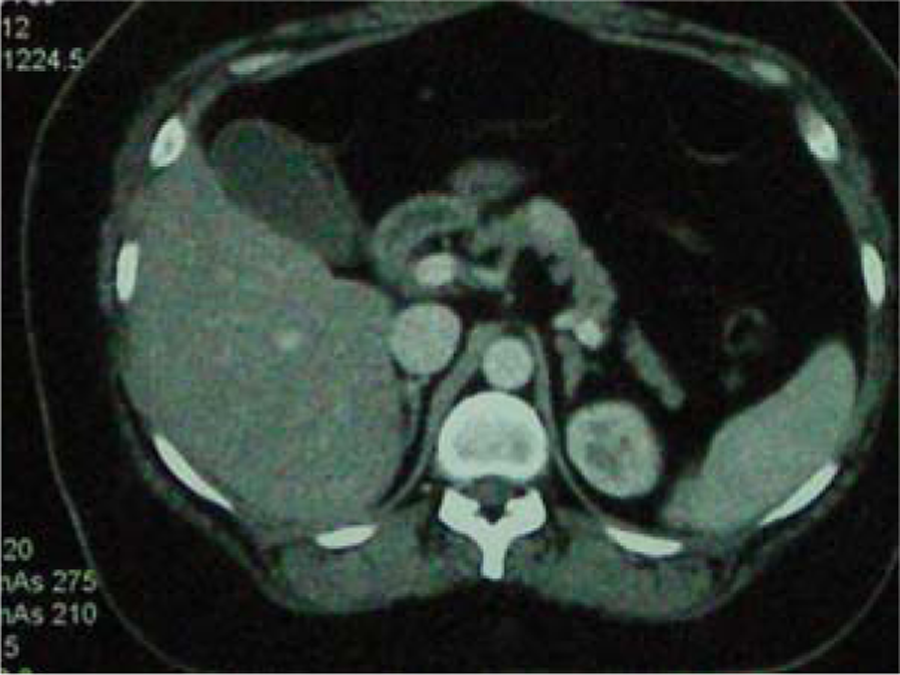
CT scan: Tumor in the body/tail of the pancreas
Hypoglycemia, hunger, obesity, and hyperinsulinemia were monitored for several weeks. During that time, several episodes of lipotimia were recorded.
To avoid any surgical complication in this morbid obesity patient (140 kg; body mass index 48.5), we discussed with the patient the possibility of a new procedure, such as CyberKnife radiosurgery, not performed before for such a benign disease.
A laparoscopy was performed to explore the abdominal cavity, to exclude peritoneal seeding, and to take a biopsy. During laparoscopy, 2 fiducials were put in place in the tumor.
The patient was treated on October 4, 2008, by 25 Gy (target volume 4616, 7 cc, Dmax 1 dose), 124 beams for 70 minutes (Figure 2). Computed tomography scans 3, 6, 12, 24, and 36 months later demonstrated necrosis of the lesion (Figure 3). The weight loss 6 months later was 14 kg, and 36 months later it was 40 kg.

Targeting of the tumor before treatment with Cyber Knife

CT scan 36 months after Cyber Knife radiosurgery
Thirty-six months after treatment, fast serum glucose and insulin levels at 8

Fast serum glucose and insulin levels up to 36 months after radiosurgery
Conclusion
The CyberKnife is a frameless robotic radiosurgery system. The 2 main elements of CyberKnife are the radiation produced from a small linear particle accelerator and a robotic arm that allows the energy to be directed to any part of the body from any direction. The CyberKnife system is a method of delivering radiotherapy, with the intention of targeting treatment more accurately than standard radiotherapy. There are 2 essential features of the CyberKnife system that set it apart from the other stereotactic therapy methods: The first is that the radiation source is mounted on a general purpose industrial robot; mounting the radiation source on the robot allows for near-complete freedom to position the source within a space about the patient. The robotic mounting enables the system to deliver radiation from many different directions without the need to move both the patient and source as required by current gantry configurations. Second, the image guidance system is the other essential item in the CyberKnife system: X-ray imaging cameras are located on supports around the patient allowing for instantaneous X-ray images to be obtained. A new robotic 6° degree of freedom patient treatment couch called robocouch has been added to CyberKnife, which provides the capability for significantly improving patient positioning options for treatment. The frameless nature of CyberKnife also increases the clinical efficiency. The CyberKnife system is the only radiosurgery device that does not require a rigid frame for precise targeting; and more so, the delivery of a radiation treatment over several days or even weeks (referred to as fractionation) can also be beneficial from a therapeutic point of view. Tumor cells typically have poor repair mechanisms compared with healthy tissue; so by dividing the radiation dose into fractions, the healthy tissue has time to repair itself between treatments. This can allow for a larger dose to be delivered to the tumor compared with a single treatment.
For all these reasons, we suggest that CyberKnife radiosurgery in pancreatic insulinoma, as in other endocrine tumors, could be a very interesting minimally invasive treatment in selected cases.
Small lesions, usually benign, in morbid obesity patients can have very high complication rates when surgically treated. CyberKnife using a combination of computers, robotics, and image guidance systems delivers a concentrated, cumulative dose of radiation high enough to control or destroy tumor cells while limiting radiation exposure to surrounding healthy tissue.
The most interesting issue is the absence of pancreatic-related complications, such as pancreatitis and fistula, 5 1-dose treatment, and very short hospital stay. With laserlike accuracy, CyberKnife crossfire technique delivers as many as 1400 highly pinpointed beams of radiation to control or destroy the tumor. Image-guided cameras locate the tumor’s position and remain located on the target throughout the procedure. The robotic arm, outfitted with a high-energy X-ray source, provides unparalleled flexibility to reach difficult locations with pinpoint accuracy. This is another reason to use this technique in endocrine tumor of the pancreas located in the pancreatic tail, close to major vessels such as splenic or hepatic artery, portal vein, aorta, and so on.
Quality of life is much better, even compared with laparoscopic procedure, because of the absence of pain and other drawbacks. 6
CyberKnife offers significantly fewer complications and lower risk than open and laparoscopic surgery. The sophisticated system offers patient ease and comfort and several advantages. There is no pain because the procedure is nonsurgical. There is no anesthesia, incision, blood loss, or recovery time. There is no body frame: Unlike other stereotactic radiosurgical techniques, the CyberKnife system uses the body’s bony structures or implanted markers to find its target. There is no overnight hospitalization. There is no breath holding: The system remains locked on its target regardless of tumor movement, so even patients undergoing treatment for endocrine tumor close to the diaphragm can relax and breathe normally during the procedure. It is at the same time faster and accurate: Approaching its target from more than 1400 angles, the system can deliver high doses of radiation to tumors while avoiding surrounding healthy tissue.
Safety is very well studied using this technique in brain tumors and metastases, lung tumors, prostate tumors, and recently in nonresectable pancreatic cancers.
Robotic radiosurgery with image-guided real-time tumor tracking of endocrine tumor of the pancreas is a new and promising approach for selected high-risk patients, not eligible for surgical resection, and might enhance the possibility of multidisciplinary, oncological treatment concepts.
Footnotes
The authors declared no potential conflicts of interest with respect to the research, authorship, and/or publication of this article.
The authors received no financial support for the research, authorship, and/or publication of this article.