







Abstract

To the Editor:
Considering the surgical excisional treatment of symptomatic prolapsing hemorrhoids, a recent network meta-analysis performed by Simillis et al 1 showed benefits using the bipolar vessel–sealing instrument LigaSure (Valleylab, Boulder, CO) or the ultrasound Harmonic Scalpel (Ethicon Endo-Surgery, Cincinnati, OH) in terms of reduction in complications and improved efficiency in comparison with the classical hemorrhoidectomy. However, no improved efficacy was noted.
Thunderbeat (Olympus, Tokyo, Japan) is a novel instrument that combines bipolar energy, assuring reliable vessel sealing, and ultrasound energy, providing fast and precise cutting and dissection of tissue, thereby making sealing and cutting tissue possible in a single step. In a small pilot trial of 36 patients (mean age = 51.4 years), we investigated the feasibility, safety, and efficacy of this instrument for excisional hemorrhoidectomy. Outcomes were evaluated during 2 follow-up visits, respectively, at a mean of 34 days and 81 days after surgery, and by means of a questionnaire, of which the mean follow-up time was 20 months.
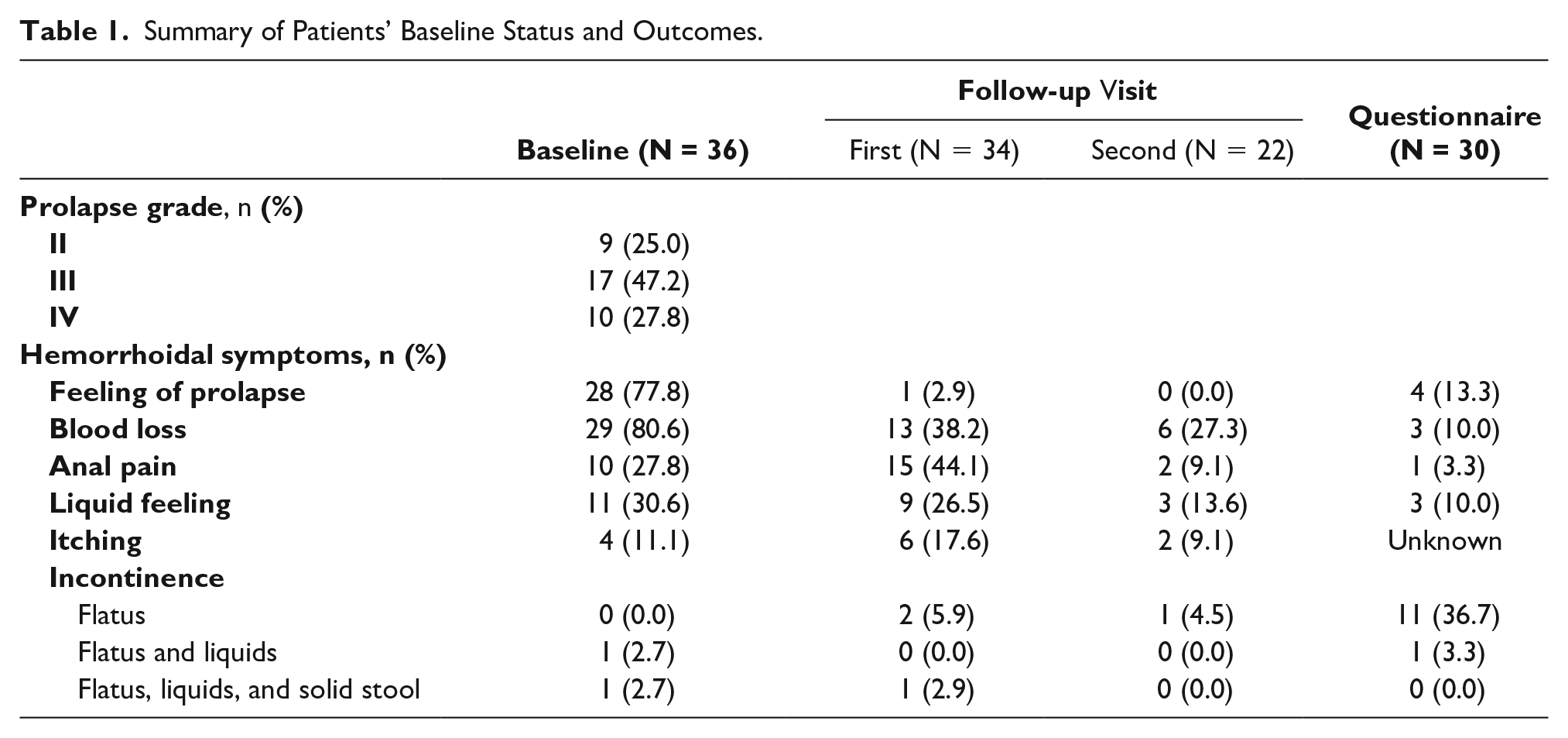
Patients’ baseline status and follow-up outcomes are summarized in Table 1. Twenty-five (69%) patients had undergone prior day-case treatments and 5 (14%) an operation, of which 2 patients received a hemorrhoid artery ligation procedure, 2 a hemorrhoidectomy, and one a hemorrhoidopexy. Ten (27.8%) patients had anemia preoperatively. Median operating time of complete pedunculated, excisional hemorrhoidectomy was 20 minutes, and during 12 (33.3%) interventions, additional hemostasis was needed. No immediate postoperative urinary retention developed in any patient, nor did any single patient present with severe 14 days postoperative hemorrhage. At the first follow-up visit, 12 (35.3%) patients still had minimal blood loss and 1 patient (2.9%) had a similar degree of blood loss as prior to the treatment. Six (27.3%) patients still experienced minimal blood loss at the second follow-up visit. Anemia persisted in only 1 patient. There was 1 patient (4.5%) who developed anal stenosis for which dilations were started.
Summary of Patients’ Baseline Status and Outcomes.
Half of the included patients (n = 19) filled out questionnaires evaluating pain and painkiller use in the early postoperative period. At day 7, 10.5% of these patients had a Visual Analogue Scale score of 2 or less. At postoperative day 14, this percentage rose to 58.7%. The pain profile of the procedure seemed to be in line with what could be expected for hemorrhoidectomy, namely, moderate to severe pain peaking up to the fifth postoperative day and steadily declining from the second postoperative week onward.
It thus seems that Thunderbeat was able to effectively alleviate symptoms of prolapsing hemorrhoids and, as such, it could provide a new feasible, safe, and effective technique for excisional hemorrhoidectomy. Studies with a randomized controlled trial design should compare Thunderbeat with other established treatments to elucidate the true value of this new instrument. Attention should also be paid for the long-term effects, since flatus incontinence was a commonly reported complication.
Footnotes
Author Contributions
Study concept and design: Lander Heyerick, Dirk Van de Putte, Marieke De Visschere, Piet Pattyn, David J. Tate, Hans Van Vlierberghe, Danny De Looze
Acquisition of data: Lander Heyerick, Danny De Looze
Analysis and interpretation: Lander Heyerick, Dirk Van de Putte, Marieke De Visschere, Piet Pattyn, David J. Tate, Hans Van Vlierberghe, Danny De Looze
Study supervision: Piet Pattyn, Hans Van Vlierberghe, Danny De Looze
Declaration of Conflicting Interests
The author(s) declared no potential conflicts of interest with respect to the research, authorship, and/or publication of this article.
Funding
The author(s) received no financial support for the research, authorship, and/or publication of this article.
