







Abstract
Intraoperative digital videos have become vital to surgical education, performance enhancement, and medical conference presentations. 1 However, surgical recording is often complicated by operating room lighting, high costs of recording equipment, and the need for competent personnel to operate cameras. Rhinoplasty is an especially challenging operation to record as the fine nasal anatomy is restricted to a narrow surgical field with limited sightlines. 2
Numerous techniques for acquiring intraoperative rhinoplasty footage have been described including the use of camcorders, action cameras, exoscopes, and smartphones which can be handheld, suspended to overhead lighting, affixed to headlamps, or enclosed within sterile plastic bags.3-5 However, these options are often costly, uncomfortable for the surgeon, or unable to capture high quality footage from the desirable frontal vantage point.
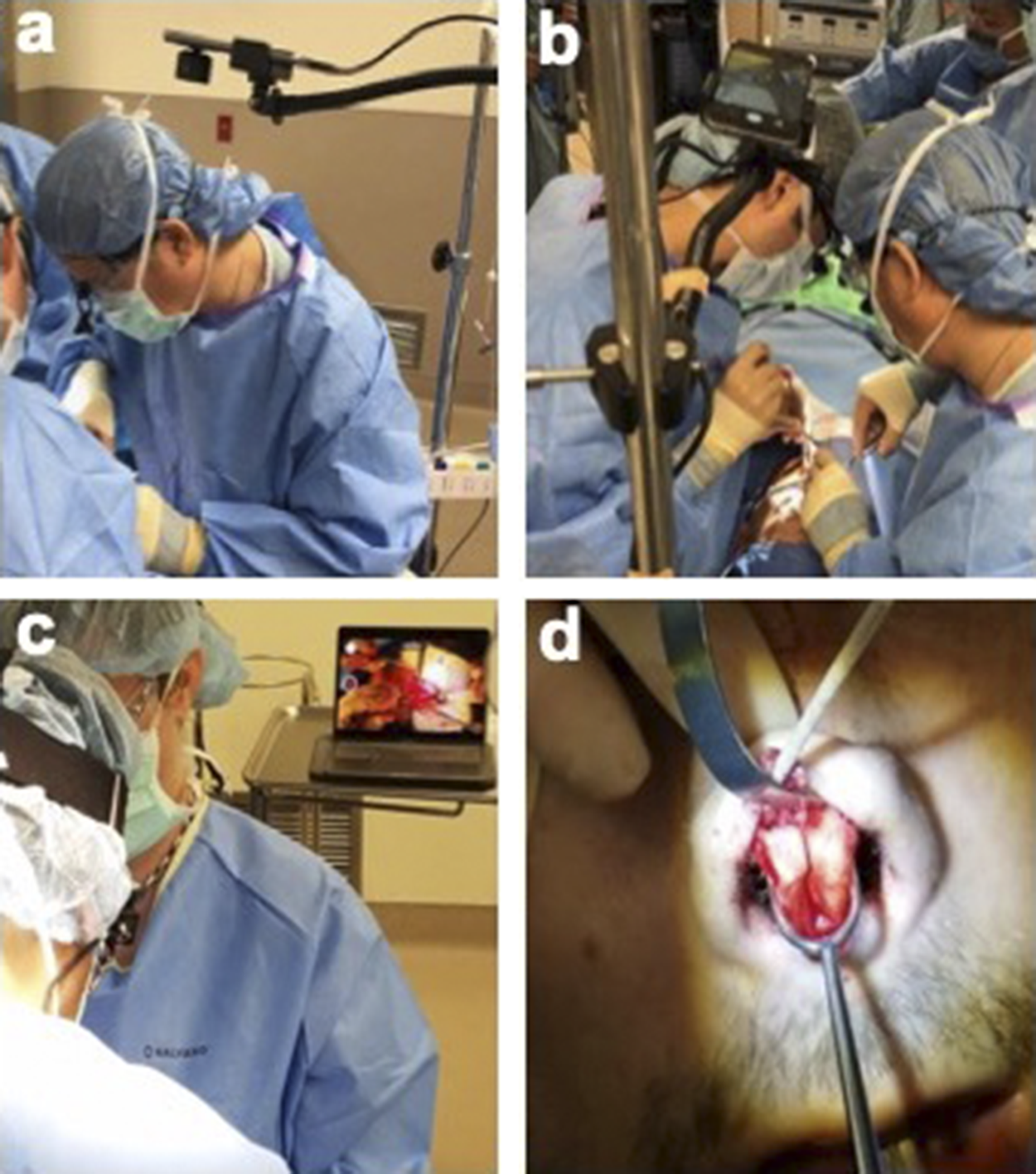
At our institution, we have found a simple and inexpensive method for obtaining intraoperative rhinoplasty video using a smartphone and consumer-grade equipment. A camera mount is assembled using a gooseneck clamp (Flex Metal Hose Gooseneck Clamp; Amazon.com Inc., Seattle, Washington), universal conversion adapter set for smartphone (Action Mount 4 pc Screw Adapter Set; Action Mount Inc., Boise, Idaho), and a cell phone tripod adapter (Cell Phone Tripod Adapter – iPhone Tripod Mount; WarehouseDeals LLC, Seattle, Washington). Additionally, a Samsung Galaxy S7 is outfitted with a MOMENT 2× magnification telephoto lens (Moment Inc., Moment, Seattle, Washington) to permit high quality optical zoom. Assembly of these pieces is rapid and straightforward, totaling $150 (Figure 1). This arrangement is then fastened to an intravenous pole positioned at the head of the operating table and at a height marginally above the surgeon’s head. The free screen-sharing application SideSync provides wireless monitoring of the smartphone’s imaging frame in real time (Figure 2). Consumer-grade parts for smartphone intraoperative recording arrangement. (a,b) The smartphone was mounted to an intravenous pole (IV) at the head of the operating table. Once secured, the IV pole can be moved to obtain footage at different surgical vantage points. (c) Screen-sharing applications like SideSync (for Android) or Airplay (for iPhone) provide live video feedback. (d) Still frame of recorded video.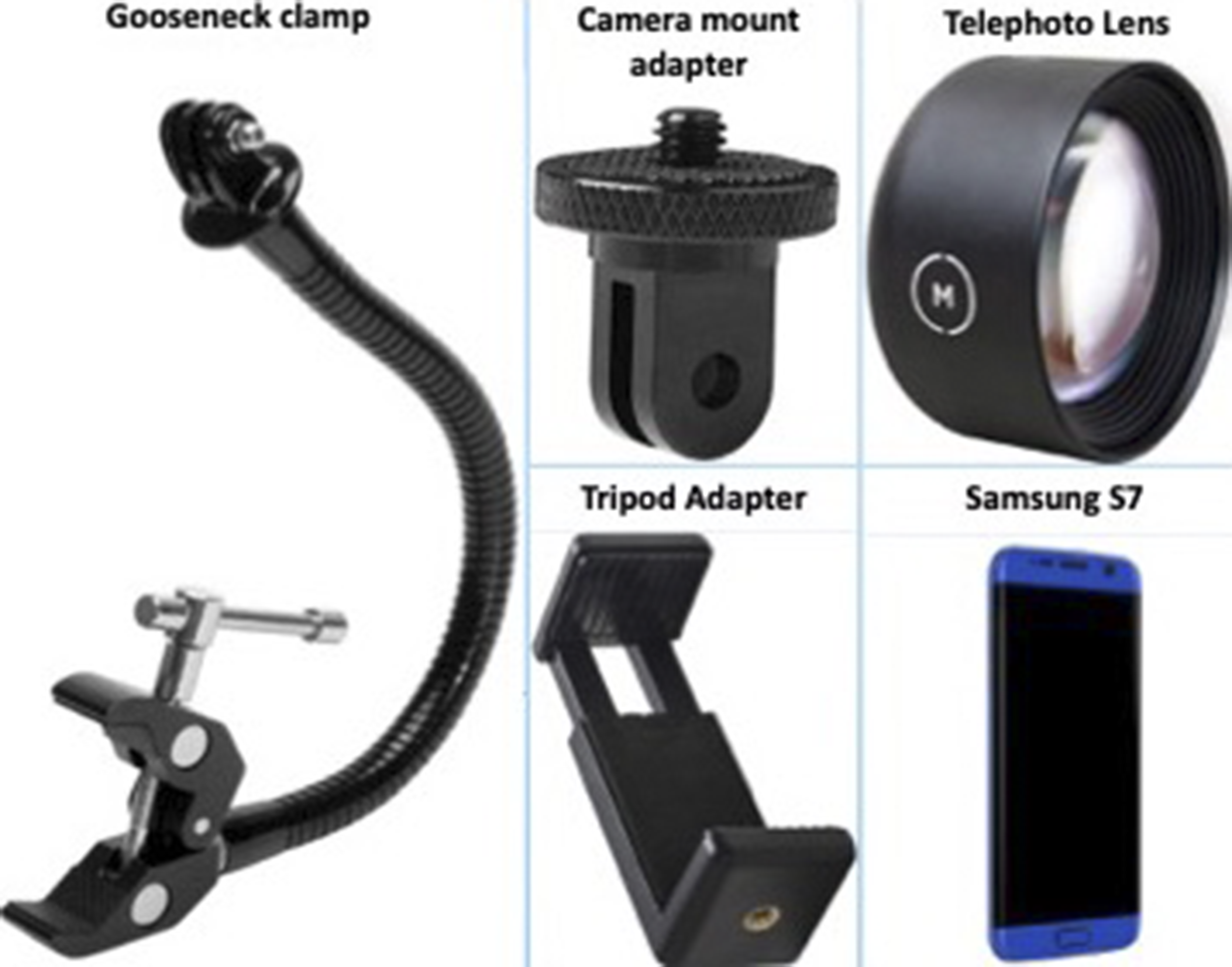
The rapid evolution of smartphone cameras has rendered the ubiquitous smartphone a viable option for high definition intraoperative video recording. Its autofocus capability overcomes surgical light overexposure observed with many action cameras. The addition of a telephoto lens permits 4K quality video capture at higher magnifications, a limitation of the digital zoom provided by other recording devices. As our proposed system is fastened to a portable intravenous pole, it can be conveniently moved to avoid workflow interferences and to acquire the desired surgical viewing angle. Finally the ubiquity of smartphones makes them a convenient and inexpensive alternative to commercial video recording equipment.
Herein, we demonstrated that a smartphone coupled with approximately $150 worth of consumer-grade parts makes capturing detailed rhinoplasty video simple, effective, and economical. As contemporary smartphones are increasingly integrating optical zoom lenses, we anticipate costs of this arrangement can be further lessened to the custom mount ($48 total). The specifications of our described setup are not limited to a Samsung S7. An iPhone can be easily used by purchasing an iPhone compatible telephoto lens and by using an iOS-compatible screen-sharing application like AirPlay.
Footnotes
Declaration of Conflicting Interests
The author(s) declared no potential conflicts of interest with respect to the research, authorship, and/or publication of this article.
Funding
The author(s) received no financial support for the research, authorship, and/or publication of this article.
