







Abstract
Background
The current simulators for teaching oncoplastic surgery marking are available in a fixed size for each model. This is not an accurate reflection of the variety of patient’s breast volumes in reality and may limit the teaching to certain techniques associated with the particular breast ptosis/size.
Device description
This is the first reported simulator with varying breast volumes/ptosis in a single model for teaching oncoplastic surgery marking, known as Adjustable Breast Oncoplastic Surgery Simulator (ABOSS). Adjustable Breast Oncoplastic Surgery Simulator was created using 3D printing.
Preliminary results
Adjustable Breast Oncoplastic Surgery Simulator could simulate the breast in appearance and texture. It is inexpensive and allows the practice of various markings based on the different breast volumes/ptosis in a single model. It also allows for the practice of the marking needed in asymmetric breasts to correct the asymmetry.
Current status
Plans for commercialisation were made.
Oncoplastic breast surgery (OBS) has a steep learning curve. 1 However, the current simulators for teaching OBS marking, such as Mastotrainer 2 and Marking Breast Oncoplastic Surgery Simulator (MBOSS) 3 have limitations and are available in a fixed size for each model. This is not an accurate reflection of the variety of patient’s breast volumes in real-life and limit the teaching to certain techniques associated with the particular breast ptosis/size.
Since various OBS techniques exist and the choice of OBS is dependent on factors, such as the patients’ breast size/ptosis etc,
4
we developed a simulator with varying breast volumes/ptosis in a single model for teaching OBS marking, known as Adjustable Breast Oncoplastic Surgery Simulator (ABOSS) (Figure 1). This is the first such reported model, to the best of our knowledge. Simulator demonstrating (A) no (B) moderate and (C) marked ptosis.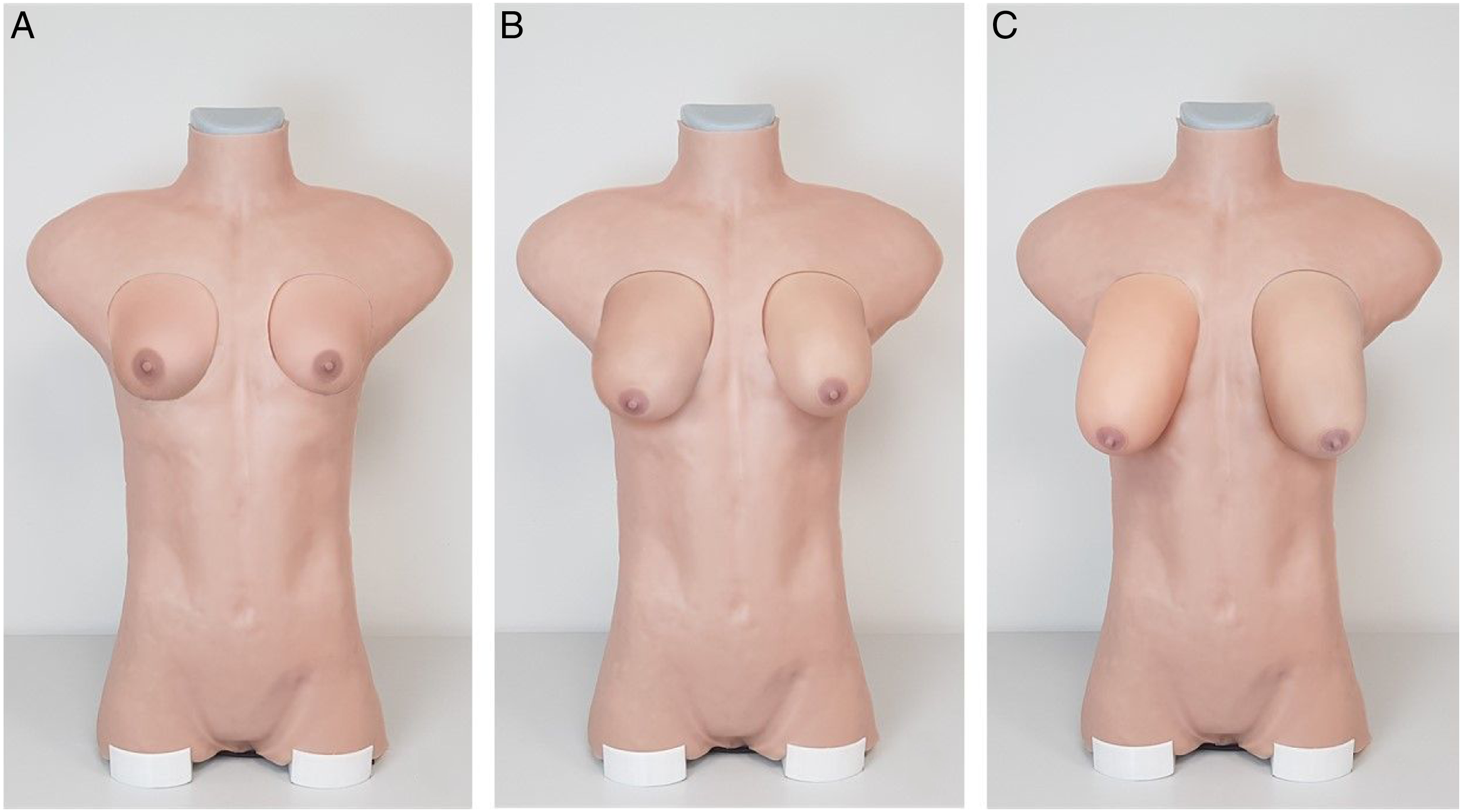
The breast molds of ABOSS were 3D printed, casted using silicon to create the various ptosis and filled with polyester wool to simulate the breast texture. This allowed the maneuver of ABOSS for the marking of OBS. The breast models of various volumes/ptosis could be fitted interchangeably to a single torso, for repeated markings.
The advantages of ABOSS are that it is inexpensive and allows the repeated practice of OBS markings for different breast volumes in a model. This is done at the trainee’s own timing and learning pace, without causing patient’s fatigue or harm. It also allows practice of the marking needed for correcting breast asymmetry (Figure 2), which could occur after surgery or is inherent. Simulator demonstrating breast asymmetry, allowing practice of oncoplastic surgery marking for the correction of asymmetry.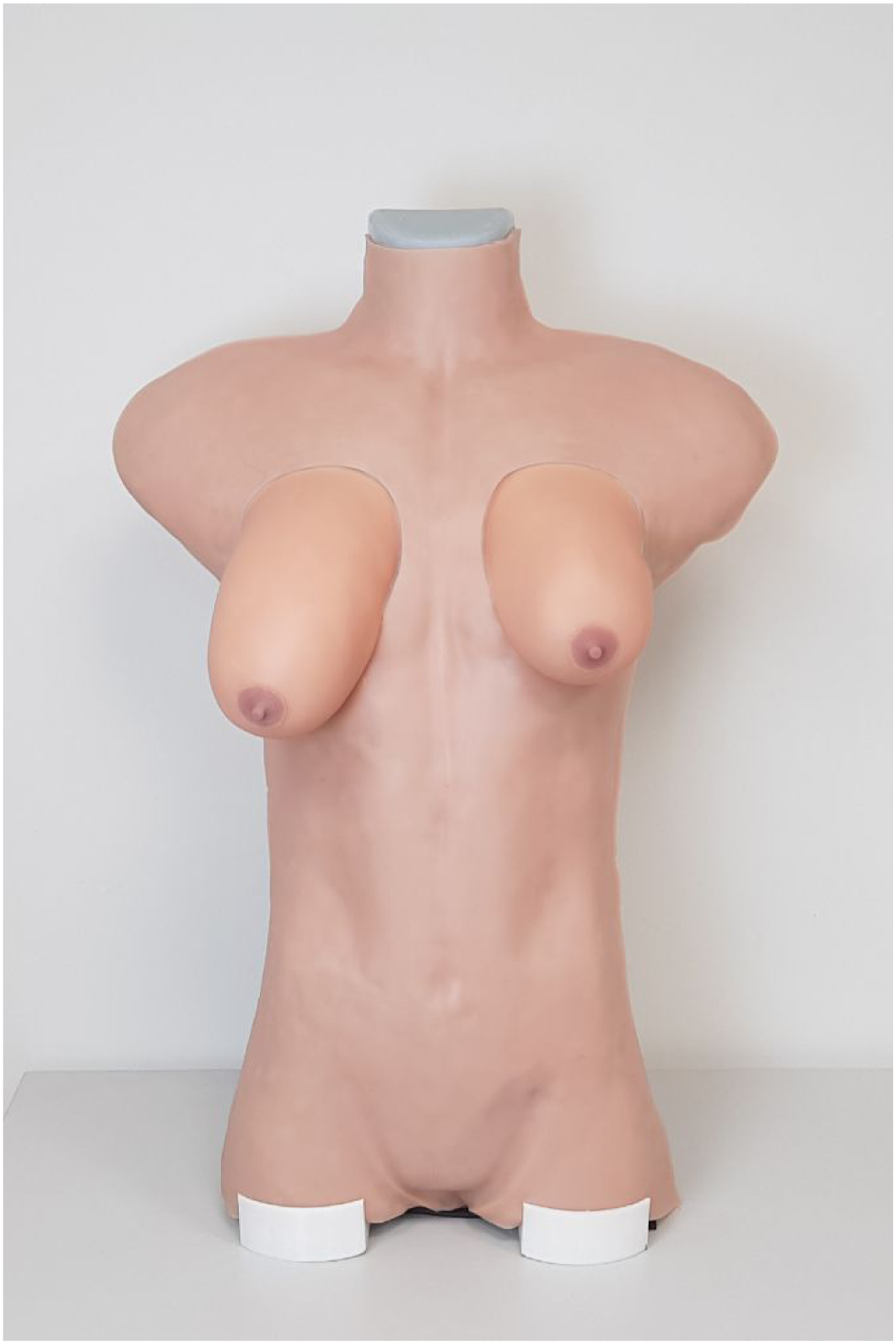
Limitations of ABOSS include it does not allow dissection for the teaching of the surgical steps. These steps could be taught using the Virtual Breast Oncoplastic Surgery Simulator (VBOSS),5,6 an online tool. In the COVID19 pandemic, when face to face teaching was restricted, teaching using simulators would be useful.
In conclusion, ABOSS is the first reported teaching simulator, which allows the practice of OBS marking with different breast sizes and asymmetry, simulating real-life scenarios.
Footnotes
Acknowledgments
We thank Eason Chow Wai Tung and Lucas Zhen Zaiyang for their contributions in the fabrication of ABOSS.
Author contribution
Conceptualization: GH
Lim. Data curation: Not applicable
Formal analysis: Not applicable
Funding acquisition: CC Yen
Methodology: All authors
Project administration: All authors
Visualization: All authors
Writing-original draft: GH Lim
Writing-review and editing: All authors.
Declaration of Conflicting Interests
The author(s) declared no potential conflicts of interest with respect to the research, authorship, and/or publication of this article.
Funding
The author(s) disclosed receipt of the following financial support for the research, authorship, and/or publication of this article: This project was funded by the National Additive Manufacturing Innovation Cluster (NAMIC) grant (project ID: 2018243)
