






Abstract
Background/Need
Laparoscopic surgeons waste time with instrument exchange. This is due to the poor design of existing instrument holders or quivers.
Device Description
We developed an instrument holder for laparoscopic instruments, energy devices and suction irrigators which correct the design deficiencies of existing quivers.
Preliminary Results
Following the use of 3D printed prototyping a design was finalised and patented. Initial samples met all design objectives on mock patient testing.
Current Status
Medsafe registration was achieved in New Zealand in September 2023. In December 2024 a Conformity Assessment Certificate was issued by the Therapeutic Goods Administration (TGA) along with an application for inclusion in the Australian Register of Therapeutic Goods (ARTG). The Surgirack™ can now be supplied in Australia and New Zealand.
Background/Need
Disruptions in surgical flow lead to a significant increase in surgical error. 1 The main disruptor in the flow of laparoscopic surgery is instrument exchange.2-5 Inefficient instrument exchange is due to the method of storage which betrays the 3 principles of motion economy and arrangement of the workplace: a definite place for all tools, located close to the point of use and aligned to permit the best sequence of motion. 6 The principle of “a place for everything and everything in its place” has never applied to laparoscopic surgery.
The method of instrument storage has remained unchanged since the advent of laparoscopic surgery: tube-shaped container (quiver) or instrument pouch. Existing quivers are opaque rather than transparent meaning the tip of the instruments cannot be visualised by the surgeon. The handles of laparoscopic instruments are often identical necessitating multiple attempts before selecting the appropriate instrument. Current quivers are straight tubes that do not conform to the sterile drape. This, along with overloading of the quiver leads to dislodgement with instruments falling to the floor. This is costly when energy devices are lost during the procedure.
Quivers fail to separate the instruments which results in entanglement and poor handle orientation. Existing quivers are not made to the correct length which means instruments forcefully hit the base leading to breakage where the shaft disconnects from the handle. It also results in damage to the tip of expensive energy devices. Instrument pouches, in addition to deficiencies seen in quivers, are routinely perforated by the instrument resulting in loss of sterility.
Quivers and pouches are designed in a way that surgeons would rather place their instruments on a Mayo tray or on the patient’s legs, abdomen or chest depending on the surgery. This results in further difficulty identifying the desired instrument and is then not aligned with repeated movements away from the direction of surgery.
Potential solutions have focused on the development of multifunctional instruments but there has been limited instrument holder design innovation.7,8 Improvement in the design of the instrument holder could reduce instrument exchange time, improve workflow, shorten operations and reduce surgical costs through better protection of our expensive instruments.
Device Description
The Surgirack™ (see Images 1-3) is an instrument management system delivered in 2 halves which are connected by a clip mechanism. The top half is made from Polyphenylsulphone which is autoclavable and therefore reusable. The smaller bottom half is made from disposable recyclable medical grade Polycarbonate. There are 2 versions of the bottom half, general surgical and bariatric length so the instrument tips are protected no matter how forcefully the surgeon stores his instruments. The Surgirack™ has a curved upper section that allows a conformed attachment to the drape overlying the patient in any possible position that is close to the point of use. It has two-point towel clip fixation which prevents rotation or dislodgement of the instrument holder. Surgirack™ used during a laparoscopic cholecystectomy, an operation where instrument storage has never been optimised. Comparing the use of traditional quiver with the Surgirack™. Note the use of 2 Surgiracks™ for complex laparoscopic procedures such as gastric bypass. Sleeve gastrectomy: note the energy device at 90° to the instruments which facilitates cable management with less handle entanglement.

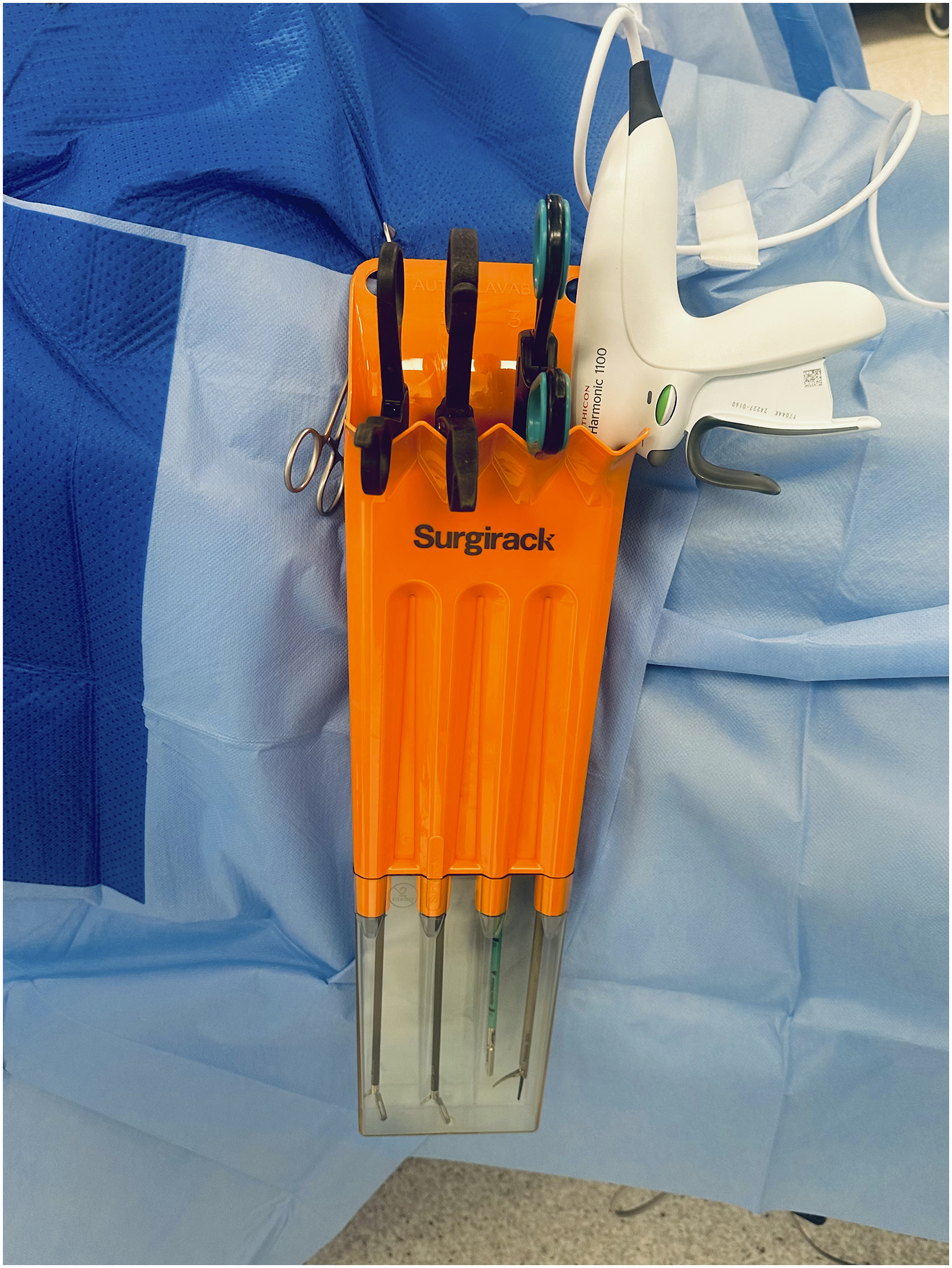
The bottom half of the Surgirack™ is transparent which allows identification of the instrument tips. The curved upper section enables the Surgirack™ to be secured in a more elevated position. This enables identification of the tips of the instruments without any significant change to the surgeon’s position to improve his view. The Surgirack™ is divided into 4 ports which forces instrument separation and prevents entanglement. The ports are numbered to additionally assist with identification of the required instrument. The V-shaped deck ensures ergonomic instrument retrieval.
The lateral ports of Surgirack™ have a side notch that supports any variations of energy devices. With the energy device at 90° to the instruments it facilitates retrieval but also cable management. The cables of energy devices or suction/irrigators are directed away from the instrument handles.
Preliminary Results
There were 28 different versions of 3D prototypes tested before reaching the final design. Further modifications were made to conform to the limitations of injection moulding. An international patent under the Patent Cooperation Treaty (PCT) was awarded in June 2021. In December 2024 applications were made for national patents in individual countries. Injection moulding tools were machined, and initial samples were trialled successfully in a mock patient scenario. The flow of laparoscopic surgery was clearly improved.
Current Status
The Surgirack™ underwent sterility validation, packaging validation, distribution testing and accelerated ageing testing. This formed the basis of a Manufacturers Evidence form submission (Quality Management Systems certificate) which was accepted by the Therapeutics Goods Administration (TGA) in Australia as a class 1s device. In December 2024 a Conformity Assessment Certificate was issued by the TGA along with inclusion in the Australian Register of Therapeutic Goods (ARTG). The Surgirack™ can now be supplied in Australia. Medsafe registration in New Zealand was achieved in September 2023. The instrument holder design changes suggested here will have application to instrument management in other areas of surgery such as orthopaedics and open surgery.
Footnotes
Author Contributions
Chisholm J.: Conceptualization, writing original draft, writing-review and editing Littlejohns B.: Conceptualization, writing-review and editing.
Declaration of Conflicting Interests
The authors declared the following potential conflicts of interest with respect to the research, authorship, and/or publication of this article: The authors are directors and shareholders of JB Surgical Pty Ltd which holds the intellectual property for Surgirack and related devices.
Funding
The authors received no financial support for the research, authorship, and/or publication of this article.
